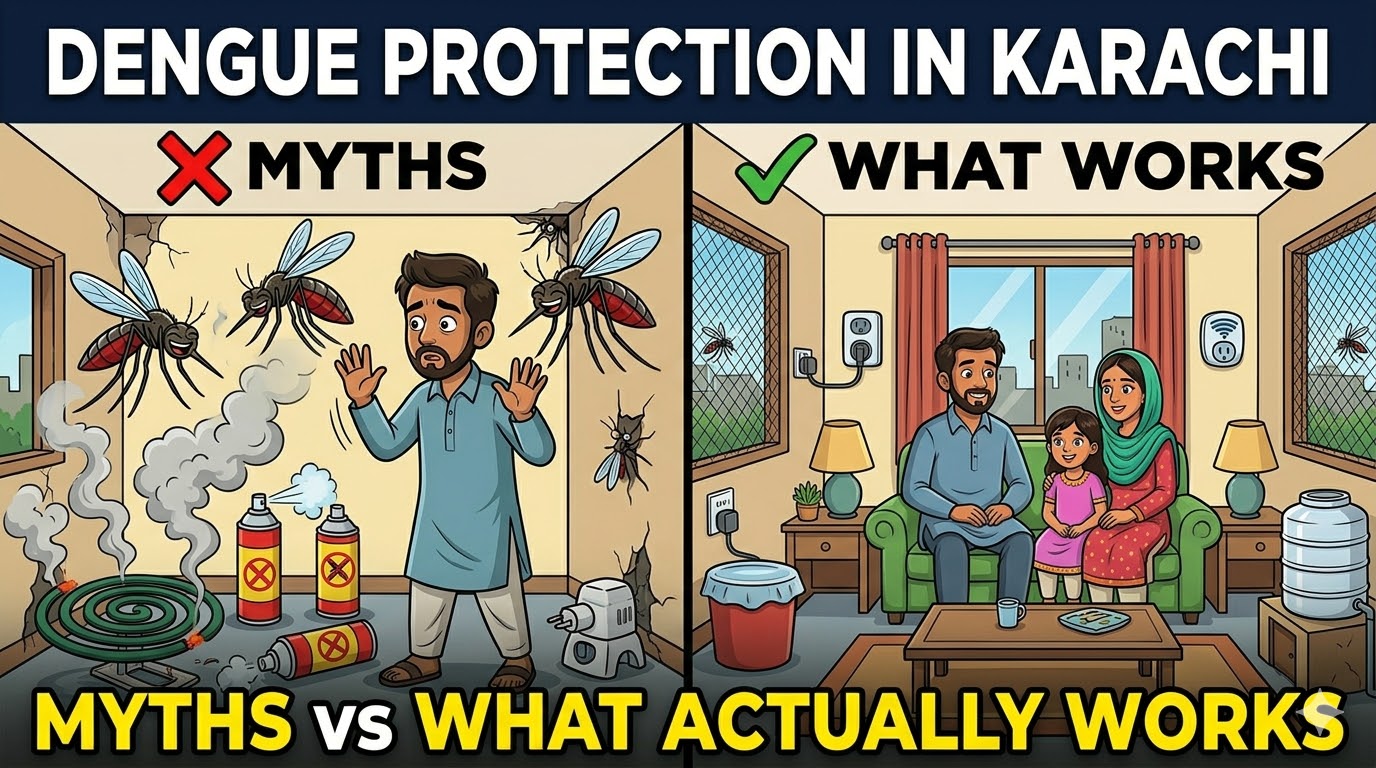
Every monsoon season in Karachi, the same cycle plays out. Dengue cases rise, health warnings appear on news channels, and families scramble to act. Well-meaning advice floods social media, family WhatsApp groups, and neighborhood conversations. Some of this advice is genuinely helpful. A significant portion is ineffective, outdated, or actively harmful.
For a Karachi homeowner trying to protect their family, separating evidence-based dengue prevention from popular myths is not a minor inconvenience — it determines whether your actions actually reduce risk or simply consume money and effort while leaving your family exposed.
This guide provides a clear, honest assessment of what works, what does not, and why.
What Actually Works: Evidence-Based Dengue Prevention
1. Weekly Source Reduction (Eliminating Standing Water)
This is the single most effective dengue prevention measure available to any Karachi household — and it costs nothing. The Aedes aegypti mosquito completes its breeding cycle in standing water in five to ten days. Weekly disruption of all standing water breaks the cycle before adult mosquitoes emerge.
What this requires:
- Emptying and scrubbing (not just refilling) all water containers every 5–7 days
- Checking and clearing roof gutters, particularly after rain
- Removing or inverting all unused containers from rooftops, balconies, and compounds
- Changing water in flower vases every three to four days
- Ensuring AC drip trays and refrigerator trays do not accumulate water
The scrubbing step is critical and often missed. Aedes mosquitoes lay eggs on container walls just above the waterline. Simply emptying and refilling does not remove these eggs. The container wall must be physically scrubbed to dislodge the strongly adhesive eggs.
2. Water Tank Sealing and Treatment
Overhead and underground water tanks with properly fitted covers are far less likely to become breeding sites. Mesh-screened overflow and inlet pipes prevent mosquito entry even when tanks must remain open during filling. BTI (Bacillus thuringiensis israelensis) larvicide, which is safe for drinking water, eliminates larvae in tanks that cannot be emptied.
3. Window and Door Screening
Properly fitted, intact window and door screens are one of the most cost-effective long-term dengue prevention investments a Karachi homeowner can make. They form a physical barrier against all flying insects — not just mosquitoes. For maximum effectiveness, screens must be:
- Fine mesh — 1.2mm openings or smaller
- Without tears or gaps along frame edges
- Fitted to all windows and doors used for ventilation, including kitchen exhausts
In older Karachi housing — common in Nazimabad, North Karachi, Liaquatabad, and similar areas — window screens are often absent or damaged. Retrofitting these is a one-time investment that provides years of protection.
4. DEET-Based Personal Repellents
For individuals — particularly children — who spend time outdoors during Aedes peak biting hours (early morning to mid-afternoon), DEET-based skin repellents provide reliable personal protection. Repellents containing 20 to 30 percent DEET provide six or more hours of protection. For children, formulations specifically tested for pediatric use are available at pharmacies across Karachi.
5. Professional Mosquito Control Treatments
For homes in high-risk areas of Karachi — or during active dengue outbreaks in your neighborhood — professional mosquito control provides a level of protection that household measures cannot match. Professional treatments include residual surface application, larvicide treatment of water bodies, and ULV fogging that reaches mosquito resting sites inaccessible to consumer products.
Scheduling professional mosquito control in Karachi before the monsoon begins — and reinforcing treatment mid-season — is the most proactive approach for families who want genuine protection rather than a false sense of security.
Common Dengue Myths in Karachi: What Does Not Work
Myth 1: ‘Burning Neem Leaves or Camphor Repels Dengue Mosquitoes’
The belief that burning neem leaves, camphor, or specific incense wards off dengue mosquitoes is widespread across Karachi. There is no peer-reviewed evidence that these methods provide meaningful protection against Aedes aegypti. While some plant-derived compounds have mild repellent properties, they are not concentrated or sustained enough to protect a room, let alone a home. Relying on neem or camphor instead of proven methods is genuinely dangerous.
Myth 2: ‘Mosquito Coils Protect the Whole Room’
A single mosquito coil creates a small, localized zone of deterrence — roughly 1 to 2 meters in radius. In a ceiling-fan-ventilated Karachi bedroom, the smoke disperses almost immediately. Coils do not protect the corners of the room, under the bed, or behind furniture — precisely where Aedes mosquitoes rest. They provide minimal comfort, not comprehensive protection.
Myth 3: ‘Mosquitoes Only Bite at Night — Closing Windows After Dark Is Enough’
This is perhaps the most dangerous myth in the context of dengue. The Aedes aegypti mosquito is primarily a daytime biter. Its two peak activity windows are shortly after sunrise (roughly 6 to 8 AM) and in the late afternoon (4 to 6 PM). Closing windows at night protects you from other mosquito species but does almost nothing against the primary dengue vector.
Myth 4: ‘Municipal Fogging Has Protected Our Area’
Municipal fogging operations, when they occur, use thermal foggers to suppress adult mosquito populations in public spaces. They are a valuable supplementary measure. However, they do not penetrate inside homes, treat water bodies, or eliminate larvae. They provide short-term, outdoor adult mosquito reduction. The assumption that municipal fogging protects your home’s interior is incorrect.
Myth 5: ‘Once You’ve Had Dengue, You’re Immune’
This is a particularly dangerous half-truth. There are four serotypes of dengue virus. Having dengue once gives you lasting immunity to that specific serotype — but not to the other three. More critically, subsequent dengue infections with a different serotype carry a significantly higher risk of severe dengue (dengue haemorrhagic fever). People in Karachi who have had dengue before are not safer — in some ways, they face greater risk of serious complications on re-infection.
Myth 6: ‘Papaya Leaf Extract Treats or Prevents Dengue’
Papaya leaf extract has been widely circulated as a dengue treatment in Pakistan, particularly its purported ability to raise platelet counts. While some studies suggest modest effects on platelet production, there is insufficient clinical evidence to recommend it as a treatment, and it should never replace medical care. Most importantly, it has no preventive value — it does not repel mosquitoes or prevent infection. It addresses a symptom after infection, not the disease itself.
Protective Clothing: Underused but Effective
Long-sleeved clothing during peak Aedes biting hours (morning and late afternoon) significantly reduces bite exposure. This is especially practical for children, whose active outdoor play often coincides with these hours. Light-colored clothing is also preferable — Aedes mosquitoes are attracted to dark colors.
For households with gardens in Karachi — common in areas like Gulshan, PECHS, and DHA — gardening during these hours without protective clothing significantly increases bite exposure.
The Combined Strategy: Why Individual Measures Are Not Enough
Every measure listed above — source reduction, tank sealing, screening, repellents, professional treatment — addresses a different part of the dengue transmission chain. No single measure eliminates all risk. The families who consistently avoid dengue in high-risk Karachi neighborhoods are those who combine multiple approaches simultaneously:
- Weekly source reduction removes breeding sites
- Screens prevent indoor entry
- Repellents protect individuals outdoors
- Professional treatment handles what household measures miss
This layered approach is more work than relying on a single product or method. But dengue is a disease that kills when not caught early, and causes weeks of severe illness even in uncomplicated cases. The combined strategy is worth the effort.
Conclusion
Protecting your family from dengue in Karachi is entirely achievable — but it requires the right information and consistent action. The myths that circulate every monsoon season consume real effort and money while leaving real vulnerabilities unaddressed. The evidence-based measures — though sometimes less intuitive — actually work.
Know the difference. Act on what is proven. And when household measures are not enough for your area, bring in professional reinforcement before, not after, someone in your family gets sick.
📞 Book a Free Inspection Today: Ready to build a real dengue defense for your home? Our fumigation and pest control experts will conduct a free inspection, identify your specific vulnerabilities, and design a protection plan based on what actually works. Contact us today and protect your family this monsoon season.

Ahmad Karimi is a PPMA-registered pest management specialist and the lead technical consultant at Karachi Fumigation Services, where he has overseen field operations and treatment protocols since 2005. With over 20 years of hands-on experience treating residential, commercial, and industrial properties across Karachi — from DHA bungalows with structural termite infestations to Korangi factories requiring large-scale rodent exclusion — he brings direct field knowledge to every article published on this blog.
Ahmad has managed pest control programs for clients including Descon Engineering, Pakistan Tobacco Company, Saylani Welfare, and J. (Junaid Jamshed), and has issued hundreds of fumigation certificates for health authority compliance, import/export, and commercial licensing purposes. He holds active PPMA membership and works exclusively with WHO-approved chemicals in all field operations.
The content on this blog draws directly from two decades of Karachi-specific infestation data — seasonal pest patterns, neighbourhood-level risk factors, building-age vulnerabilities, and the regulatory requirements that Karachi businesses actually face. No recycled content from foreign pest control sites. Every article reflects conditions specific to Karachi’s climate, infrastructure, and compliance environment.
For treatment enquiries or technical questions, Ahmad’s team can be reached at 03463303875 or via the office at Trade Tower, Civil Lines, Karachi.
Leave a Reply