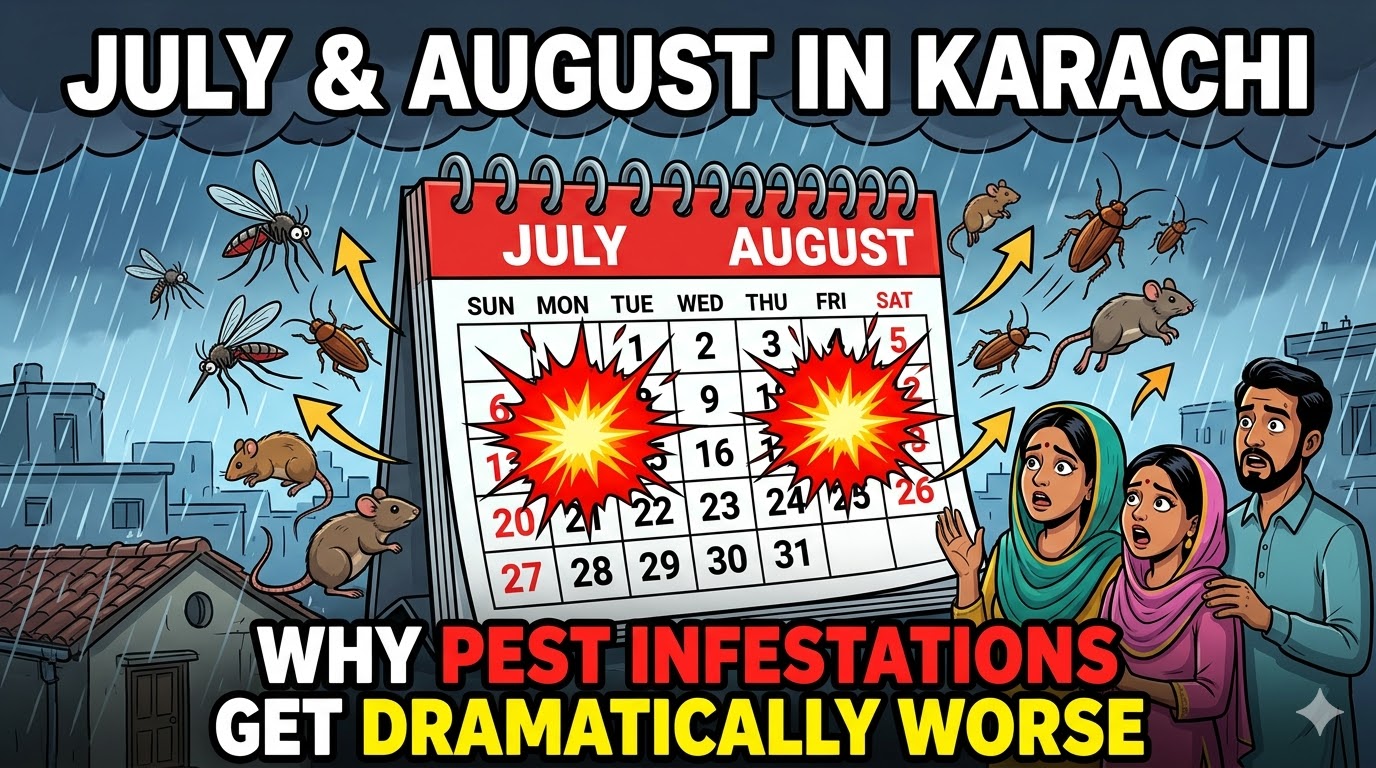
Every year, Karachi homeowners notice the same thing. The cockroaches they occasionally saw in May become a daily occurrence by July. The mosquitoes go from a nuisance to a genuine health threat by August. Rats that were outside are suddenly inside. What feels like an overnight explosion in pest activity is actually the result of weeks of accelerating conditions — and understanding why it happens is the first step toward stopping it.
This article explains, in clear terms, the biological, environmental, and structural reasons why pest infestations in Karachi intensify so dramatically during July and August. It also tells you what that means for your home — and what you can still do about it.
The Perfect Storm: What Makes July and August Different
Karachi’s monsoon season typically begins in late June and reaches its peak in July and August. During these two months, the city experiences a convergence of conditions that pest biologists would describe as near-perfect for population explosions across multiple species simultaneously.
These conditions include:
- Ambient temperatures between 32 and 38 degrees Celsius — warm enough to accelerate insect breeding cycles
- Relative humidity levels frequently above 80% — ideal for cockroach survival and mosquito larvae development
- Standing water accumulation everywhere, from blocked drains to open containers to waterlogged gardens
- Organic matter saturation — wet food waste, damp wood, and flooded compost all provide abundant nutrition for pest populations
- Structural entry: monsoon rain forces pests that prefer outdoor environments to seek shelter inside homes
No single one of these factors is decisive on its own. Together, they create a compounding effect where pest populations can double in size every week under favourable conditions.
The Biology Behind the Surge: How Temperature and Humidity Accelerate Breeding
Cockroaches: Temperature-Driven Reproduction
The German cockroach — the most common species found in Karachi kitchens — has a development cycle from egg to adult that varies dramatically with temperature. At 25 degrees Celsius, the cycle takes approximately 60 days. At 35 degrees Celsius, that drops to around 35 days. In practical terms, this means the Karachi summer is producing cockroach generations at nearly twice the speed of cooler months.
What makes July and August particularly bad is not just the heat — it is the combination of heat and humidity. Cockroaches are susceptible to desiccation (drying out) in hot and dry conditions. High monsoon humidity removes this limiting factor entirely. Cockroaches that survive in cracks and drains during dry months now have ideal survival conditions everywhere in your home.
The result: a population that has been building since May reaches an inflection point in July where the numbers become impossible to ignore.
Mosquitoes: Standing Water Is All They Need
Aedes aegypti, the primary dengue vector in Karachi, requires only about a tablespoon of standing water to complete its larval development. In a city where monsoon rainfall regularly floods gardens, rooftops, and roads, and where water storage practices leave multiple containers open, the availability of breeding sites multiplies by an order of magnitude in July.
The development cycle from egg to adult mosquito — at monsoon temperatures — takes as few as seven days. This means a single breeding event can produce biting adults within one week. Multiple overlapping breeding cycles, all triggered simultaneously by the same rainfall events, explain why mosquito populations seem to appear all at once.
Culex quinquefasciatus, the common night-biting mosquito associated with nuisance bites and some disease transmission, breeds preferentially in polluted water — Karachi’s waterlogged drains and sewage-contaminated floodwater are ideal. This species peaks slightly later in the monsoon season, meaning August can actually be worse than July for this particular pest.
Rodents: Displacement and Shelter-Seeking
Rats and mice in Karachi occupy outdoor environments for most of the year: drains, garbage areas, construction sites, and open land. When monsoon rains flood these habitats, rodents are displaced en masse and seek dry, elevated shelter. For urban rodents, that means the insides of nearby buildings.
The black rat — the dominant species in Karachi — is an excellent climber and can enter homes through gaps as small as 1.5 centimetres. During July and August, as outdoor environments become saturated, the pressure of rodents attempting to enter homes increases significantly. Homes that had no rodent problem in May may suddenly experience activity in the kitchen, loft, or walls as displaced populations seek new territory.
Termites: Monsoon Triggers Swarming
One of the most alarming sights for Karachi homeowners in the early monsoon weeks is a swarm of winged termites — known as alates — emerging from walls, floors, or gardens. This is a natural event in the termite colony lifecycle, triggered by the first heavy rains of the season, and it signals that a mature colony is nearby.
The swarm itself is not directly destructive — the alates are reproductive individuals seeking to establish new colonies. But their presence tells you something critical: there is an established, active colony in or near your home, and it has been feeding on your structure throughout the dry season. The monsoon swarming event is nature’s announcement that the colony has been there all along.
Karachi-Specific Factors That Make It Even Worse
Karachi’s pest surge in July and August is worse than comparable coastal cities for several reasons unique to the city’s geography, infrastructure, and urban density.
The Drainage Infrastructure Problem
Karachi’s stormwater drainage network was designed for a smaller city and has not kept pace with urban expansion. During peak monsoon, large areas of the city flood regularly — from Sea View and Clifton in the south to Surjani Town and Orangi in the north-west. This flooding does two things for pest populations: it creates massive new breeding sites and it disrupts the natural separation between outdoor pest habitats and indoor living spaces.
Neighbourhoods with particularly poor drainage — including parts of Landhi, Korangi, Baldia Town, and Liaquatabad — tend to experience the worst pest surges because floodwater persists for days or weeks rather than draining away.
The Open Water Storage Problem
Karachi’s intermittent water supply has created a city-wide culture of water hoarding that unintentionally creates ideal mosquito breeding conditions at scale. The millions of water tanks, barrels, buckets, and containers distributed across the city’s rooftops and yards represent, in aggregate, an enormous network of standing water bodies. During July and August, even containers that are regularly used and refilled can develop mosquito larvae if covers are absent or damaged.
High Urban Density
In densely populated areas of Karachi — from the old city areas of Saddar and Lyari to newer high-density zones like Gulshan-e-Maymar — pest populations spread rapidly between adjacent properties. A treated apartment surrounded by untreated neighbours will see reinfestation more quickly than a standalone home. This is particularly relevant for cockroach control: populations from adjacent units move freely through shared wall cavities, drain pipes, and cable routes.
Construction Activity
Karachi is in a near-constant state of construction. Open excavations, exposed foundations, construction waste, and improperly stored building materials create ideal rodent and termite habitats throughout the year. During monsoon, when excavation sites flood, displaced rodent populations accelerate the pressure on nearby residential areas.
Health Consequences: Why the Surge Matters Beyond Inconvenience
The July-August pest surge in Karachi is not merely an inconvenience — it is a direct and measurable public health threat.
Dengue Fever
Karachi has experienced recurring dengue outbreaks, with hospitalisation numbers spiking every year during the monsoon months. The Aedes aegypti mosquito that transmits dengue is a daytime biter, meaning indoor protection during sleeping hours does not prevent transmission. High-density residential areas in Karachi have recorded dengue cases across all socioeconomic levels, from low-income katchi abadis to upscale DHA and Clifton housing.
Gastroenteritis and Food Contamination
Cockroaches and rodents contaminate food preparation surfaces, utensils, and stored food with bacteria including Salmonella, E. coli, and Listeria. The July-August cockroach surge coincides directly with an increase in food-borne illness presentations in Karachi hospitals. The connection is well-established in public health literature.
Rodent-Borne Disease
Leptospirosis — spread through rodent urine in floodwater — becomes a genuine risk during severe monsoon flooding. Karachi’s 2020 and 2022 monsoon flooding events were associated with documented leptospirosis cases. Rodents sheltering inside homes dramatically increase the contamination risk to residents.
What Homeowners Typically Do Wrong
Having treated thousands of homes across Karachi, professional pest controllers consistently identify the same mistakes homeowners make during the monsoon season:
- Waiting until the infestation is visible before acting — at which point populations have already compounded significantly
- Relying on a single intervention (one spray) rather than a systematic programme
- Ignoring roof and drain areas while only treating interior living spaces
- Using over-the-counter products at incorrect concentrations, which kill a fraction of the population and drive the rest deeper into walls
- Assuming that a pre-monsoon treatment will last indefinitely — heavy rain and humidity actively degrade residual treatments, and reapplication may be needed by late July
- Treating their own property while not coordinating with neighbours in high-density housing situations
What You Should Do Right Now
If you are reading this in July or August, the surge is either already happening or about to. Here is what to prioritise immediately:
- Eliminate all standing water on your property today — check containers, plant pot saucers, blocked gutters, and unused tyres
- Ensure all water tank covers are intact and fitted
- Inspect your kitchen tonight and identify where cockroach activity is occurring — under the fridge, behind the stove, inside cabinet hinges
- Check your roof and ceiling for signs of rodent activity, particularly scratching sounds at night
- Look for mud tubes along walls near floor level — a sure sign of active termites
Then, contact professional fumigation services in Karachi without delay. During peak monsoon season, pest populations double quickly — the difference between acting this week and next week is measurable.
What Professional Pest Control Does That You Cannot Do Yourself
During July and August, professional pest control is qualitatively different from what is achievable with retail products. Here is why it matters:
- Professional-grade products have higher active ingredient concentrations and residual durations than retail alternatives
- Experienced technicians know the harbourage sites specific to Karachi housing types — they treat where pests actually live, not just where they are visible
- Integrated pest management approaches combine chemical treatment with source reduction advice, producing longer-lasting results
- Licensed companies use products approved by Pakistan’s relevant regulatory bodies — ensuring safety alongside efficacy
- Follow-up inspections identify whether reinfestation is occurring before it becomes a full-blown crisis again
The Connection Between July-August and the Rest of the Year
It is worth understanding that the pest population surge of July and August does not fully recede when monsoon ends. Populations that established large colonies during the wet months carry those numbers into October and beyond. Cockroach colonies that colonised your kitchen in August will still be there in November — reduced but present.
The most effective pest management strategy in Karachi is therefore cyclical: pre-monsoon treatment to limit breeding season starting populations, mid-monsoon intervention when needed, and post-monsoon consolidation to prevent carry-over populations entering the dry season at elevated levels.
Conclusion: The Window Is Narrow
July and August are not the time to learn about why Karachi’s pest problem is so severe. They are the time to act. The conditions that drive the surge — temperature, humidity, standing water, displaced outdoor populations — are at their peak for a defined window. Effective action taken now creates demonstrably better outcomes than action taken in September.
The biology is not negotiable. But your response to it is.
Book Your Free Inspection Today
Do not let this monsoon season become a repeat of last year. Our experienced pest control team serves Karachi homeowners across all major neighbourhoods — from DHA and Clifton to Gulshan, PECHS, North Nazimabad, Orangi, and Korangi.
We offer a free, no-obligation home inspection to assess your current infestation level and identify the highest-risk areas in your specific property. We will explain exactly what we find and what we recommend — with no pressure and no obligation.
Book your free inspection with us today. Because in Karachi in July and August, every week you wait makes the problem harder and more expensive to solve.

Ahmad Karimi is a PPMA-registered pest management specialist and the lead technical consultant at Karachi Fumigation Services, where he has overseen field operations and treatment protocols since 2005. With over 20 years of hands-on experience treating residential, commercial, and industrial properties across Karachi — from DHA bungalows with structural termite infestations to Korangi factories requiring large-scale rodent exclusion — he brings direct field knowledge to every article published on this blog.
Ahmad has managed pest control programs for clients including Descon Engineering, Pakistan Tobacco Company, Saylani Welfare, and J. (Junaid Jamshed), and has issued hundreds of fumigation certificates for health authority compliance, import/export, and commercial licensing purposes. He holds active PPMA membership and works exclusively with WHO-approved chemicals in all field operations.
The content on this blog draws directly from two decades of Karachi-specific infestation data — seasonal pest patterns, neighbourhood-level risk factors, building-age vulnerabilities, and the regulatory requirements that Karachi businesses actually face. No recycled content from foreign pest control sites. Every article reflects conditions specific to Karachi’s climate, infrastructure, and compliance environment.
For treatment enquiries or technical questions, Ahmad’s team can be reached at 03463303875 or via the office at Trade Tower, Civil Lines, Karachi.
Leave a Reply