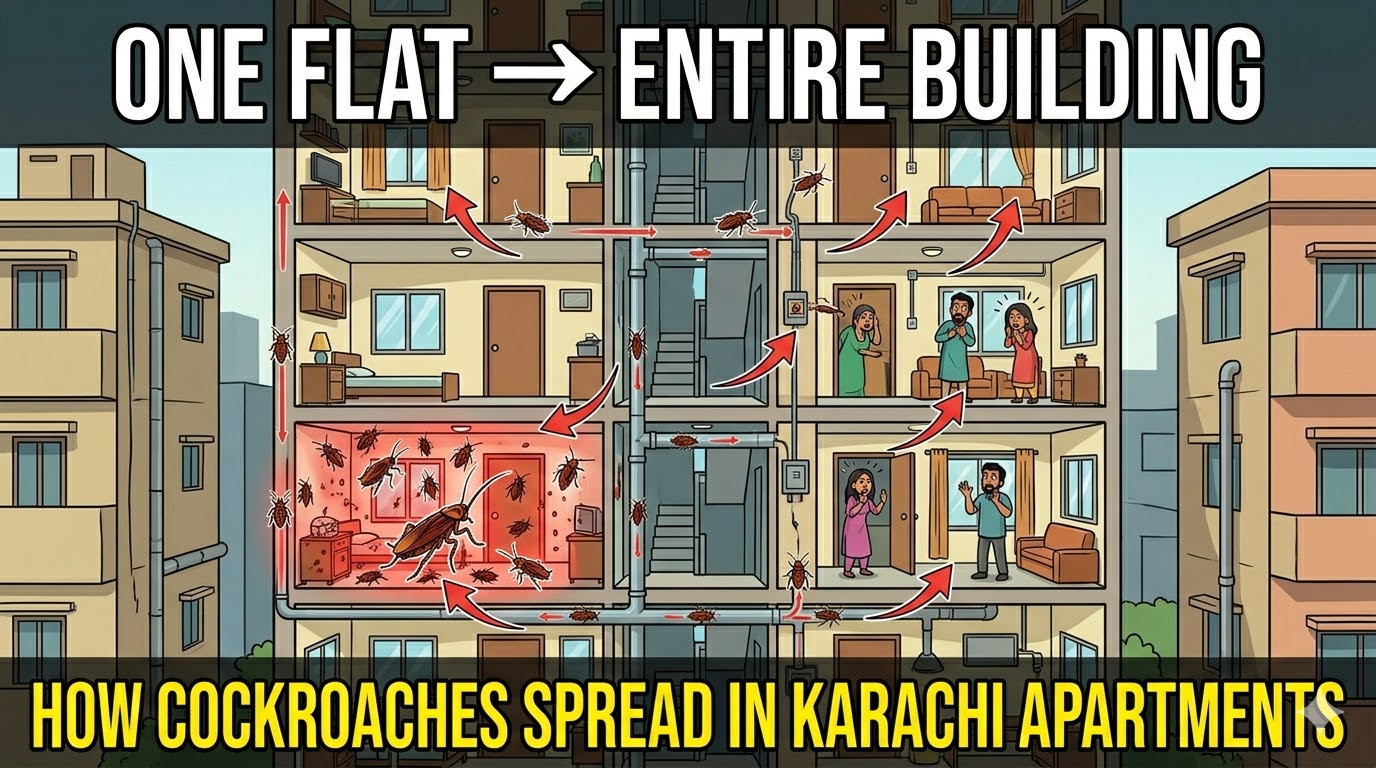
You may have had this experience: a neighbour in your building mentions they have been dealing with a cockroach problem. You feel a vague concern, but reassure yourself that your flat is clean and well-maintained. A few weeks later, you start seeing cockroaches in your kitchen. Then a resident two floors up notices the same. Then the family on the ground floor.
This is not a coincidence. It is a predictable pattern — one that plays out in apartment buildings across Karachi every day. Cockroach infestations do not respect flat boundaries. Given the right infrastructure, a single heavily infested unit can seed an entire building within a few weeks.
Why Apartment Buildings Create Ideal Conditions for Spread
Multi-storey residential buildings in Karachi — whether older walk-up apartments in areas like Federal B Area and Gulshan-e-Iqbal, or newer tower blocks in Bahria Town and DHA — share several structural characteristics that make cockroach spread between units not just possible but almost inevitable once an infestation reaches a certain size.
These characteristics include:
- Shared plumbing infrastructure — drain pipes, supply lines, and waste stacks connect every unit vertically
- Common electrical conduits running between floors and through walls
- Shared utility shafts housing pipes, cables, and ventilation ducts
- Gaps around gas pipes entering individual units from common supply lines
- Weak points in inter-unit walls, particularly around switch boxes and pipe penetrations
- Common areas — stairwells, corridors, refuse collection points — that cockroaches traverse freely
In an older Karachi building where masonry is cracked and original sealing has degraded, the connectivity between units can be surprisingly comprehensive. A cockroach established on the ground floor has multiple viable routes to every floor above.
The Population Pressure Mechanism
Cockroach spread between flats is not random wandering. It is driven by population pressure. When a colony in a single unit grows large enough that harborage space and food sources become competitive, cockroaches begin actively expanding their range — and the path of least resistance is through the shared infrastructure that connects them to neighbouring units.
German cockroaches — the species most commonly found in Karachi kitchen infestations — can produce an ootheca (egg case) containing up to 40 eggs every three to four weeks. A single female can produce six or more oothecae in her lifetime. Under Karachi’s warm conditions, development from egg to reproductive adult takes as little as six weeks. The mathematics of this reproduction rate means that an untreated infestation doubles and redoubles rapidly, creating exactly the population pressure that drives expansion.
Primary Spread Routes Through a Karachi Building
Drain and waste pipes are the most significant spread pathway. Karachi’s apartment buildings use shared vertical waste stacks into which individual unit drains connect. Cockroaches move freely up and down these stacks, exiting into any unit via drain openings that are insufficiently sealed or covered with damaged drain guards.
Water supply pipes running in shared wall cavities provide another route. Where pipe lagging or wall plaster has deteriorated, cockroaches use the cavity space to move between floors and enter units through gaps at pipe penetration points.
Electrical conduits present a surprisingly significant pathway. In Karachi’s typical residential construction, electrical wiring runs through plastic conduit pipes embedded in walls. Where conduits pass from one unit to another — through shared walls or at distribution board panels — they create unobstructed tubes that cockroaches navigate with ease.
Gas pipe entries are a commonly ignored pathway. Where the building’s gas supply line enters individual kitchens, the surrounding gap is often sealed with degraded plaster or left partially open. This provides direct entry from the common pipe space into each kitchen — which is, conveniently, exactly where cockroaches want to be.
Common corridors and stairwells allow movement of larger cockroach species, particularly American cockroaches, between floors and units via gaps under doors, around door frames, and through ventilation grilles.
How Quickly Can an Infestation Spread Building-Wide?
In an average Karachi apartment building with four to eight floors and two to four units per floor, a ground-floor infestation left untreated for two to three months can realistically seed multiple additional units. Once secondary infestations are established in neighbouring units, the spread accelerates — each new colony adding its own population pressure and expanding in further directions.
Buildings where one or more units sit vacant — a common situation in Karachi’s rental market — are particularly at risk. Vacant units receive no cleaning, no disruption of cockroach activity, and no treatment. They become staging grounds for infestation that then spreads to occupied units, often repeatedly.
The Challenge of Single-Unit Treatments
This is the fundamental problem with unit-by-unit cockroach treatment in Karachi apartment buildings: treating one flat while adjacent units remain infested is, at best, a temporary solution. Even a perfectly executed treatment in your unit will be followed by reinfestation within weeks if cockroaches from a neighbouring unit continue to access it through shared infrastructure.
Effective cockroach control for Karachi apartment buildings requires a coordinated, building-level approach — treating the common pathways, addressing the source units, and ensuring that all active colonies are suppressed simultaneously rather than one at a time.
What Building Management Should Be Doing — and Usually Is Not
In most Karachi apartment buildings, pest control is treated as an individual tenant’s responsibility. Building management rarely takes a coordinated approach to infestation control, common area maintenance from a pest perspective, or structural sealing of inter-unit pathways. This creates a situation where individual tenants spend money repeatedly treating symptoms while the underlying building-level problem remains unaddressed.
Responsible building management should maintain:
- Sealed drain covers on all communal drain points
- Sealed pipe penetrations in common utility shafts
- Regular pest inspections of common areas, basements, and rooftop spaces
- Prompt treatment of any vacant units showing signs of infestation
- A building-wide treatment schedule at least twice per year
Where management has not implemented these practices, individual tenants and flat owners can advocate for them — and in the interim, ensure their own unit is treated in a way that accounts for reinfestation pressure from outside.
Signs That Your Building Has a Multi-Unit Problem
If you live in a Karachi apartment building and notice any of the following, the infestation has likely spread beyond a single unit:
- Multiple residents independently mention seeing cockroaches in the same period
- Cockroaches appearing in corridors or stairwells, not just individual units
- Treated units show reinfestation within two to four weeks of treatment
- Cockroaches are seen at the refuse collection point or building entrance at night
- Ground-floor units consistently have heavier infestations than upper floors
The Conversation You Need to Have With Your Building
If you suspect your building has a multi-unit infestation problem, addressing it requires action beyond your own flat. We recommend:
- Raising the issue with building management in writing, noting the health implications
- Connecting with other affected tenants to present a coordinated request for building-level treatment
- Requesting a professional inspection of common areas, pipe shafts, and vacant units
- Seeking a treatment plan that covers the building’s shared infrastructure — not just individual units
Book a Building-Level Inspection Today
A single flat treatment will not solve a building-wide problem. Our team understands the specific structural dynamics of Karachi’s apartment buildings and provides coordinated treatment plans that address infestations at the source — including shared infrastructure, common areas, and the entry pathways between units.
Contact Karachi Fumigation Services today to book a free inspection. We will assess your building’s specific situation and recommend a treatment approach that produces lasting results — not just temporary relief.

Ahmad Karimi is a PPMA-registered pest management specialist and the lead technical consultant at Karachi Fumigation Services, where he has overseen field operations and treatment protocols since 2005. With over 20 years of hands-on experience treating residential, commercial, and industrial properties across Karachi — from DHA bungalows with structural termite infestations to Korangi factories requiring large-scale rodent exclusion — he brings direct field knowledge to every article published on this blog.
Ahmad has managed pest control programs for clients including Descon Engineering, Pakistan Tobacco Company, Saylani Welfare, and J. (Junaid Jamshed), and has issued hundreds of fumigation certificates for health authority compliance, import/export, and commercial licensing purposes. He holds active PPMA membership and works exclusively with WHO-approved chemicals in all field operations.
The content on this blog draws directly from two decades of Karachi-specific infestation data — seasonal pest patterns, neighbourhood-level risk factors, building-age vulnerabilities, and the regulatory requirements that Karachi businesses actually face. No recycled content from foreign pest control sites. Every article reflects conditions specific to Karachi’s climate, infrastructure, and compliance environment.
For treatment enquiries or technical questions, Ahmad’s team can be reached at 03463303875 or via the office at Trade Tower, Civil Lines, Karachi.
Leave a Reply