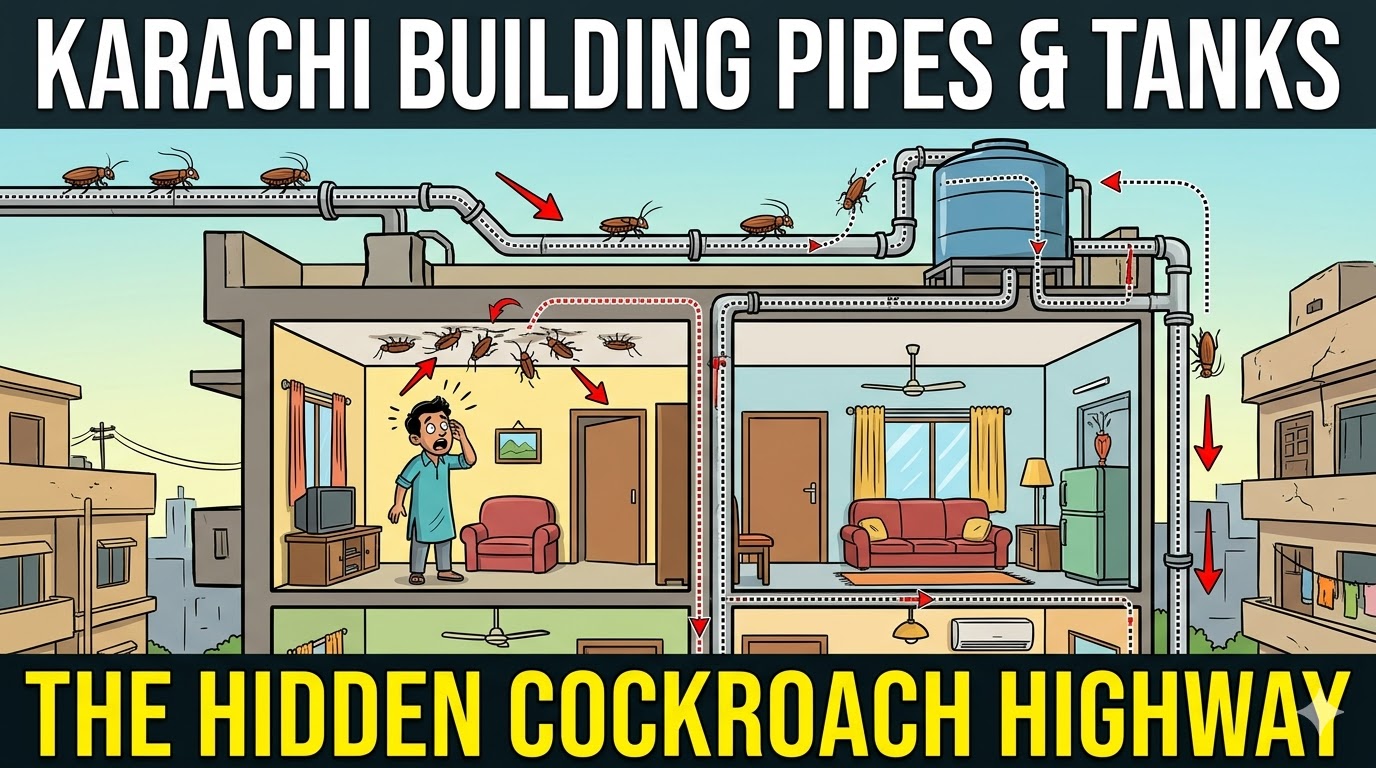
When most Karachi homeowners think about cockroach entry points, they picture open drains, kitchen gaps, or bathroom cracks. Very few look up. Yet one of the most significant — and most consistently overlooked — pathways for cockroach movement in Karachi’s residential and commercial buildings runs directly overhead: through the network of water storage tanks, overhead supply pipes, and rooftop plumbing infrastructure that almost every building in the city relies on.
Understanding how cockroaches exploit this vertical infrastructure is essential for any homeowner serious about controlling infestations — because as long as these pathways remain open, even the most thorough ground-level treatment will only produce temporary results.
Karachi’s Water Storage Reality
Unlike cities with high-pressure municipal supply, the majority of Karachi’s residential buildings depend on overhead water tanks — typically installed on rooftops or elevated platforms — to store and distribute water throughout the day. Water is pumped from underground reservoirs or tankers into these tanks, which then gravity-feed the building below through a network of pipes running inside walls, under floors, and through ceiling voids.
This infrastructure is practical. But from a pest control perspective, it creates an interconnected warm, moist, sheltered network that extends from the rooftop to every floor of the building — and cockroaches are extremely well-adapted to exploit exactly these kinds of environments.
Why Cockroaches Are Attracted to Water Infrastructure
Cockroaches have three core survival requirements: warmth, moisture, and food. Water pipes and storage tanks consistently provide the first two — and in most Karachi buildings, the third is never far away.
Specifically, cockroaches are drawn to water infrastructure because:
- Condensation on pipes provides a reliable water source in otherwise dry areas
- Pipe lagging (insulating foam wrap) offers warm, undisturbed hiding and nesting space
- Gaps where pipes enter walls or floors create direct access to concealed internal spaces
- Water tanks collect organic debris — algae, sediment, dead insects — that serves as a food source
- The dark, enclosed environment around overhead tanks is rarely inspected or disturbed
In older Karachi buildings — particularly in areas like Saddar, Liaquatabad, New Karachi, and parts of Gulshan-e-Iqbal — where pipe fittings have degraded and tank seals have deteriorated over decades, these access points are even more pronounced.
How Cockroaches Travel Vertically Through a Building
Most people think of cockroaches as floor-level creatures. They are not. German cockroaches and American cockroaches — both extremely common in Karachi — are capable climbers and will readily move vertically through a building using:
- Pipe chases (the vertical shafts in which plumbing runs between floors)
- The exterior surface of supply pipes that pass through ceiling and floor penetrations
- Gaps around where pipe brackets are fastened to walls
- Ventilation gaps in water tank housing structures
- Open access hatches on rooftop tank enclosures
A cockroach that enters a ground-floor drain can, within a single night, travel through the building’s internal pipe infrastructure and emerge on the third or fourth floor — directly behind a kitchen cabinet or underneath a bathroom sink. This is why infestations in Karachi apartments so frequently appear to materialise from nowhere, even in units where the occupants maintain clean habits.
The Rooftop Tank: A Nesting Site Above Your Head
Rooftop water tanks in Karachi are among the most problematic cockroach hotspots in the city, yet they receive almost no pest control attention. Consider the typical conditions:
- The tank enclosure is dark and undisturbed for months or years at a time
- Moisture from condensation and minor overflows creates ideal humidity
- Organic material accumulates in corners and on surfaces
- Pipe entry points are rarely sealed
- The structural warmth of a rooftop absorbs and retains heat throughout the night
An established cockroach colony in a rooftop tank enclosure can number in the hundreds. From this central hub, individuals disperse down through the building’s pipe infrastructure each night, reaching multiple floors and multiple units. No amount of ground-floor treatment will resolve an infestation that is being replenished from above.
Overhead Pipes Inside Walls: The Invisible Highway
Beyond the rooftop tank, the internal pipe runs within the walls themselves represent a continuous hidden tunnel system. In most Karachi residential construction, pipes are chased directly into masonry walls with gaps that are plastered over rather than properly sealed. Over time, as plaster cracks and fittings loosen, these gaps reopen and provide access.
The interior of a wall cavity adjacent to a water pipe is often 5 to 10 degrees warmer than the surrounding wall, slightly humid from pipe condensation, and completely dark. This is essentially a customised cockroach habitat running the full height of your building. A population established in these cavities is inaccessible to surface sprays, aerosol treatments, and standard bait placement — making professional intervention with appropriate formulations a necessity, not an option.
What This Means for Multi-Storey Buildings in Karachi
If you live in a multi-storey apartment building — as a large proportion of Karachi residents do — the pipe and tank infrastructure problem is compounded significantly. Shared plumbing means that cockroach movement is not just vertical within your unit; it is lateral across the building, connecting your apartment to every other unit that shares the same pipe infrastructure.
This is why professional cockroach control in Karachi for apartment buildings must address common areas, pipe shafts, rooftop infrastructure, and individual units as a coordinated system — not as isolated treatments applied unit by unit.
Signs That Your Pipes and Tank Are Part of the Problem
Look for these indicators that overhead and pipe infrastructure is contributing to your cockroach infestation:
- Cockroaches appearing on upper floors even after ground-level treatment
- Cockroaches found near ceiling-height areas, behind high cabinets, or inside overhead storage
- Sightings near pipe exits behind sinks, toilets, or appliances
- Cockroach activity reappearing 2 to 4 weeks after a spray treatment — suggesting reinfestation from above
- Faecal spotting near pipe penetration points in walls or floors
Any of these patterns points to a vertical infestation pathway that standard surface treatments will not resolve.
Practical Steps Homeowners Can Take
While professional treatment is necessary to fully address this problem, homeowners can take some immediate steps to reduce access:
- Seal visible gaps around pipe entry and exit points using appropriate filler or expanding foam
- Ensure rooftop tank enclosures are kept closed and properly latched
- Request that building management inspect and seal pipe chases in common areas
- Avoid storing food directly beneath overhead pipes where drip contamination could occur
- Have water tanks cleaned and inspected annually for pest activity
These measures reduce but do not eliminate the problem. An existing colony in the pipe infrastructure requires targeted professional treatment to eradicate.
Book a Free Inspection — Including Overhead Infrastructure
Our team specialises in identifying and treating the complete cockroach pathway in Karachi buildings — not just the surfaces you can see. We assess rooftop tanks, pipe shafts, internal wall cavities, and every other access point that cockroaches exploit.
As one of the leading pest control services in Karachi, we bring the expertise and equipment to treat your building’s full vertical infrastructure. Contact us today to book your free inspection and find out exactly where your cockroach problem is coming from.

Ahmad Karimi is a PPMA-registered pest management specialist and the lead technical consultant at Karachi Fumigation Services, where he has overseen field operations and treatment protocols since 2005. With over 20 years of hands-on experience treating residential, commercial, and industrial properties across Karachi — from DHA bungalows with structural termite infestations to Korangi factories requiring large-scale rodent exclusion — he brings direct field knowledge to every article published on this blog.
Ahmad has managed pest control programs for clients including Descon Engineering, Pakistan Tobacco Company, Saylani Welfare, and J. (Junaid Jamshed), and has issued hundreds of fumigation certificates for health authority compliance, import/export, and commercial licensing purposes. He holds active PPMA membership and works exclusively with WHO-approved chemicals in all field operations.
The content on this blog draws directly from two decades of Karachi-specific infestation data — seasonal pest patterns, neighbourhood-level risk factors, building-age vulnerabilities, and the regulatory requirements that Karachi businesses actually face. No recycled content from foreign pest control sites. Every article reflects conditions specific to Karachi’s climate, infrastructure, and compliance environment.
For treatment enquiries or technical questions, Ahmad’s team can be reached at 03463303875 or via the office at Trade Tower, Civil Lines, Karachi.
Leave a Reply