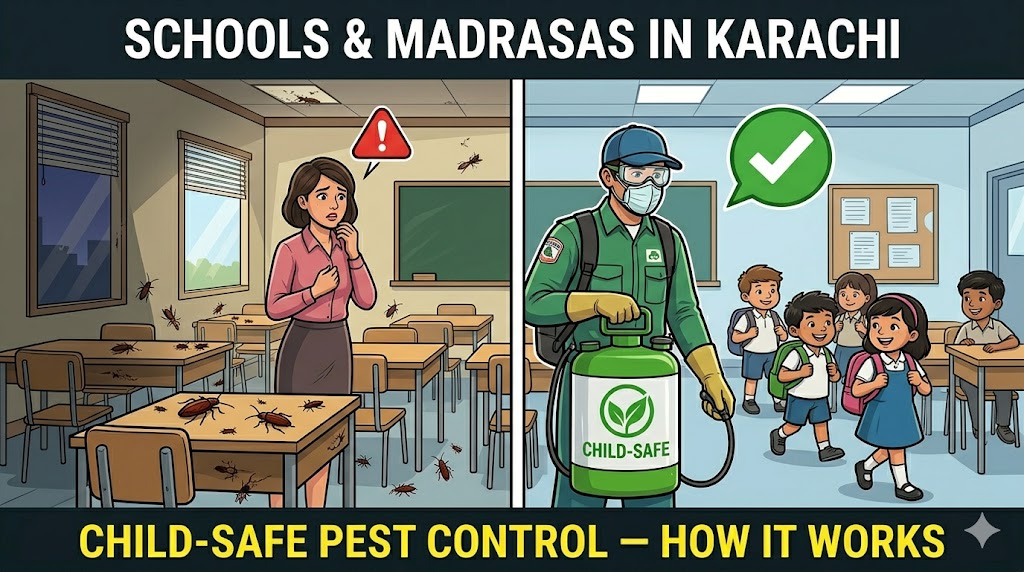
Schools and madrasas across Karachi are places of learning, growth, and community. They bring together hundreds — sometimes thousands — of children in shared classrooms, canteens, prayer halls, and dormitories every single day. But there is a reality that many administrators quietly deal with: pests.
Cockroaches in canteen kitchens. Rodents gnawing through storage rooms. Mosquitoes breeding in open water tanks on rooftops. Bedbugs in madrasa dormitories. Termites silently eating through wooden furniture and bookshelves. These are not rare occurrences in Karachi’s educational institutions — they are alarmingly common, and they pose a direct threat to the health and wellbeing of the children in your care.
The challenge, however, is not just getting rid of pests. It is doing so safely — with methods that do not expose children to harmful chemicals — and doing so at the right time so that daily educational activities are not disrupted. This guide is designed specifically for school principals, madrasa administrators, facility managers, and PTAs in Karachi who want to protect their students without creating new health hazards in the process.
Why Educational Institutions in Karachi Are High-Risk Pest Environments
Karachi’s climate is a major contributing factor. The city’s hot, humid summers and mild winters create near-perfect conditions for pest breeding. Karachi’s annual monsoon season, which brings flooding and waterlogging to neighbourhoods from Orangi Town to Gulshan-e-Iqbal, dramatically increases mosquito populations and drives rodents to seek shelter in elevated buildings — including schools.
But the physical structure of educational institutions also plays a role. Consider how a typical Karachi school operates:
- Canteens and tuck shops prepare and serve food daily, generating food waste that attracts cockroaches, ants, and rodents.
- Water storage tanks on rooftops — essential in a city where water supply is unpredictable — become ideal mosquito breeding grounds if not regularly cleaned and covered.
- Classrooms with wooden furniture, almirahs, and bookshelves provide shelter for termites and silverfish.
- Open drains near the school boundary walls are a persistent entry point for cockroaches and rodents.
- Madrasa dormitories, where students sleep on shared charpoys or mattresses, can harbour bedbugs and fleas.
- Prayer halls with carpeted floors trap moisture and create conditions favourable to insects.
The combination of food, water, warmth, and structural crevices makes schools and madrasas some of the most pest-prone buildings in any city — and Karachi is no exception.
The Non-Negotiable Priority: Child Safety
Before discussing any pest control method, it is essential to establish one absolute principle: in educational settings, child safety always comes first. This means that the pest control chemicals, techniques, and scheduling used in a school must be fundamentally different from those used in a warehouse or an industrial facility.
Children are physiologically more vulnerable to pesticides than adults. Their bodies are still developing, their immune systems are less resilient, and they spend a significant amount of time in close contact with floors, furniture, and surfaces that may have been treated. Even low-level pesticide residue can cause respiratory irritation, skin reactions, neurological effects, or longer-term health complications in young children.
This is why professional pest control for Karachi schools is not simply about choosing the least toxic chemical — it requires a comprehensive approach that includes:
- Using WHO-approved, child-safe formulations that break down rapidly and leave no harmful residues.
- Ensuring zero pesticide application while children are present on premises.
- Following mandatory ventilation and re-entry intervals after treatment.
- Applying Integrated Pest Management (IPM) principles that minimise chemical use altogether.
- Documenting every treatment for the school’s health and safety records.
Child-Safe Pest Control Methods Used in Schools
1. Gel Baiting for Cockroaches
Gel baiting is one of the most effective and child-safe methods for cockroach control in school canteens, kitchens, and bathrooms. A small quantity of specialised gel is applied inside cracks, crevices, and under sinks — areas where cockroaches harbour but children cannot reach or touch. The gel is ingested by cockroaches and works through their colony. It is odourless, targeted, and does not contaminate surfaces or food preparation areas.
2. Rodent Bait Stations
In schools where rodent activity has been detected, tamper-resistant bait stations are placed along walls, behind equipment, and in areas inaccessible to students. These enclosed stations prevent children from coming into contact with rodenticide while effectively controlling rat and mouse populations. Unlike open rodenticide placement — which is dangerous and illegal in child environments — bait stations are a critical safety measure.
3. Low-Toxicity Residual Spraying
For general insect control — including ants, flies, and cockroaches — pest control professionals can apply low-toxicity, water-based residual sprays to exterior walls, drains, and non-contact surfaces. These formulations are specifically selected for indoor environments and comply with safe pesticide use guidelines. They must be applied during scheduled off-hours only.
4. Thermal Fogging for Mosquito Control
Given Karachi’s dengue and malaria risk — particularly in areas like Korangi, Landhi, and parts of North Nazimabad — schools may need mosquito control treatments during dengue outbreak seasons. Thermal fogging using pyrethroid-based, WHO-approved insecticides is effective but must be conducted exclusively on school premises when students and staff are not present, and should be followed by a minimum 4-hour ventilation period before re-entry.
5. Anti-Termite Treatments
For schools with wooden infrastructure — particularly older government schools in areas like Lyari, Saddar, and Liaquatabad — termite infestations can cause serious structural damage and destroy educational materials. Anti-termite soil treatment and targeted wood treatment using approved termiticides can address this. These treatments are typically applied to foundations and soil perimeters where students do not have access.
6. Bedbug Heat Treatment for Madrasa Dormitories
Madrasa dormitories present a unique challenge. Heat treatment — where the room temperature is raised to levels lethal to bedbugs — is chemical-free and highly effective. While it requires students to vacate the space for several hours, it leaves no chemical residue and is among the safest treatments available for sleeping areas.
Scheduling: Timing Is Everything in School Pest Control
Effective pest control in schools is not just about what you do — it is about when you do it. Poor scheduling can result in children being exposed to chemicals, disruption to examinations, or incomplete treatments because access is restricted. A professional pest management provider working in Karachi’s educational sector should offer scheduling that aligns with the school calendar.
Recommended Treatment Windows
- Summer holidays (May–July): The longest treatment window in the Karachi school calendar. This is the ideal time for comprehensive annual treatments including anti-termite work, full-building fumigation of empty dormitories, and structural pest-proofing.
- Winter break (December–January): A shorter but valuable window for follow-up treatments, bedbug management in dormitories, and rodent proofing before the new semester begins.
- Public holidays and weekends: Suitable for gel baiting, bait station inspections, and canteen/kitchen treatments that require fewer hours.
- Eid breaks: A valuable mid-year window for mosquito control and general spraying.
During the Active School Year
Even during the academic year, maintenance treatments can be conducted — but only after school hours, typically between 5:00 PM and 8:00 AM, ensuring at least 8–10 hours before the first students arrive. Canteen kitchens require 12-hour pre-opening intervals after any treatment. All treated areas must be thoroughly ventilated before re-entry.
Integrated Pest Management (IPM): A Long-Term Approach for Schools
The most responsible approach to school pest control is not one-time fumigation — it is a sustained, year-round Integrated Pest Management (IPM) programme. IPM combines multiple strategies to reduce pest populations while minimising chemical use and human exposure.
For Karachi schools, an IPM programme typically includes:
- Regular inspections (monthly or quarterly) to detect pest activity before it becomes an infestation.
- Identification and sealing of pest entry points such as gaps in walls, broken drains, and unsealed cable conduits.
- Hygiene audits of canteens, kitchens, and waste disposal areas.
- Water tank inspections to prevent mosquito breeding.
- Staff and janitorial training on pest prevention practices.
- Targeted chemical treatments only when and where necessary, using child-safe formulations.
- Detailed service records and reports for school management and regulatory compliance.
An annual contract with a professional pest control company is the most cost-effective way to maintain an IPM programme. Many Karachi schools that have adopted this approach report significantly reduced pest activity within the first year, along with greater peace of mind for parents and staff.
What Parents and School Administrators Should Ask Their Pest Control Provider
Not all pest control companies in Karachi are equipped to work safely in educational settings. Before engaging a service provider, administrators should ask the following questions:
- Are the chemicals you use WHO-approved and certified for use in child-occupied environments?
- Do you have experience working in schools and madrasas specifically?
- Can you provide a written service record after each treatment?
- What is the re-entry interval after treatment, and how do you communicate this to school staff?
- Do you offer a scheduled annual maintenance programme aligned with the school calendar?
- Are your technicians trained in child-safe application protocols?
A reputable provider will answer all of these questions clearly and confidently. If a company cannot provide satisfactory answers, look elsewhere.
Specific Karachi Considerations for School Pest Management
Karachi’s geography and infrastructure present specific challenges that affect pest management in schools:
- Water scarcity and storage: Karachi’s irregular water supply means schools maintain large rooftop tanks — prime mosquito breeding sites. Regular tank maintenance and larvicide application are essential, particularly before and during the monsoon season.
- Neighbourhood proximity: Schools in high-density areas like PECHS, Gulberg, or New Karachi are surrounded by restaurants, markets, and residential buildings that serve as pest reservoirs. This means re-infestation from neighbouring properties is a constant risk, and regular perimeter treatments are necessary.
- Older buildings: Many government schools and madrasas in areas like Lyari, Ranchore Line, and Saddar occupy older buildings with significant structural gaps, ageing drainage, and wooden construction — all of which increase pest vulnerability.
- Monsoon risk: From July to September, Karachi schools should be on high alert for mosquito and cockroach surges. Pre-monsoon treatments are strongly recommended.
A Note on Madrasas: Unique Challenges and Sensitivities
Madrasas in Karachi operate under different conditions from mainstream schools. Many are residential, housing students from outside the city in dormitories. Shared living spaces, communal bathrooms, and communal kitchens create distinct pest management needs.
Bedbug infestations in madrasa dormitories are particularly common and require immediate, thorough treatment to prevent rapid spread among students. Cockroach and rodent control in communal kitchens is another priority. Given the 24-hour occupancy of many madrasas, scheduling treatments during prayer times, off-days, or semester breaks requires close coordination with madrasa administration.
Discretion is also important. Madrasa management may have sensitivities around pesticide use or external contractors entering premises. A professional pest control company with experience in religious educational institutions will handle this with appropriate respect and transparency.
Book a Free School Inspection Today
Your students spend six to eight hours a day in your school or madrasa. They deserve a clean, safe, pest-free environment — and you deserve a pest control partner who understands how to deliver that without compromising their health.
Whether you are dealing with an active infestation or planning ahead for the new academic year, our team at Karachi Fumigation Services specialises in child-safe, school-appropriate pest management across all areas of Karachi — from DHA and Clifton to Korangi, North Karachi, and beyond.
Contact us today for a free on-site inspection. Our specialists will assess your premises, identify active and potential pest risks, and recommend a tailored, scheduled treatment plan that works with your school calendar — not against it.
Protect your students. Protect your institution. Act now — before the next semester begins.

Ahmad Karimi is a PPMA-registered pest management specialist and the lead technical consultant at Karachi Fumigation Services, where he has overseen field operations and treatment protocols since 2005. With over 20 years of hands-on experience treating residential, commercial, and industrial properties across Karachi — from DHA bungalows with structural termite infestations to Korangi factories requiring large-scale rodent exclusion — he brings direct field knowledge to every article published on this blog.
Ahmad has managed pest control programs for clients including Descon Engineering, Pakistan Tobacco Company, Saylani Welfare, and J. (Junaid Jamshed), and has issued hundreds of fumigation certificates for health authority compliance, import/export, and commercial licensing purposes. He holds active PPMA membership and works exclusively with WHO-approved chemicals in all field operations.
The content on this blog draws directly from two decades of Karachi-specific infestation data — seasonal pest patterns, neighbourhood-level risk factors, building-age vulnerabilities, and the regulatory requirements that Karachi businesses actually face. No recycled content from foreign pest control sites. Every article reflects conditions specific to Karachi’s climate, infrastructure, and compliance environment.
For treatment enquiries or technical questions, Ahmad’s team can be reached at 03463303875 or via the office at Trade Tower, Civil Lines, Karachi.