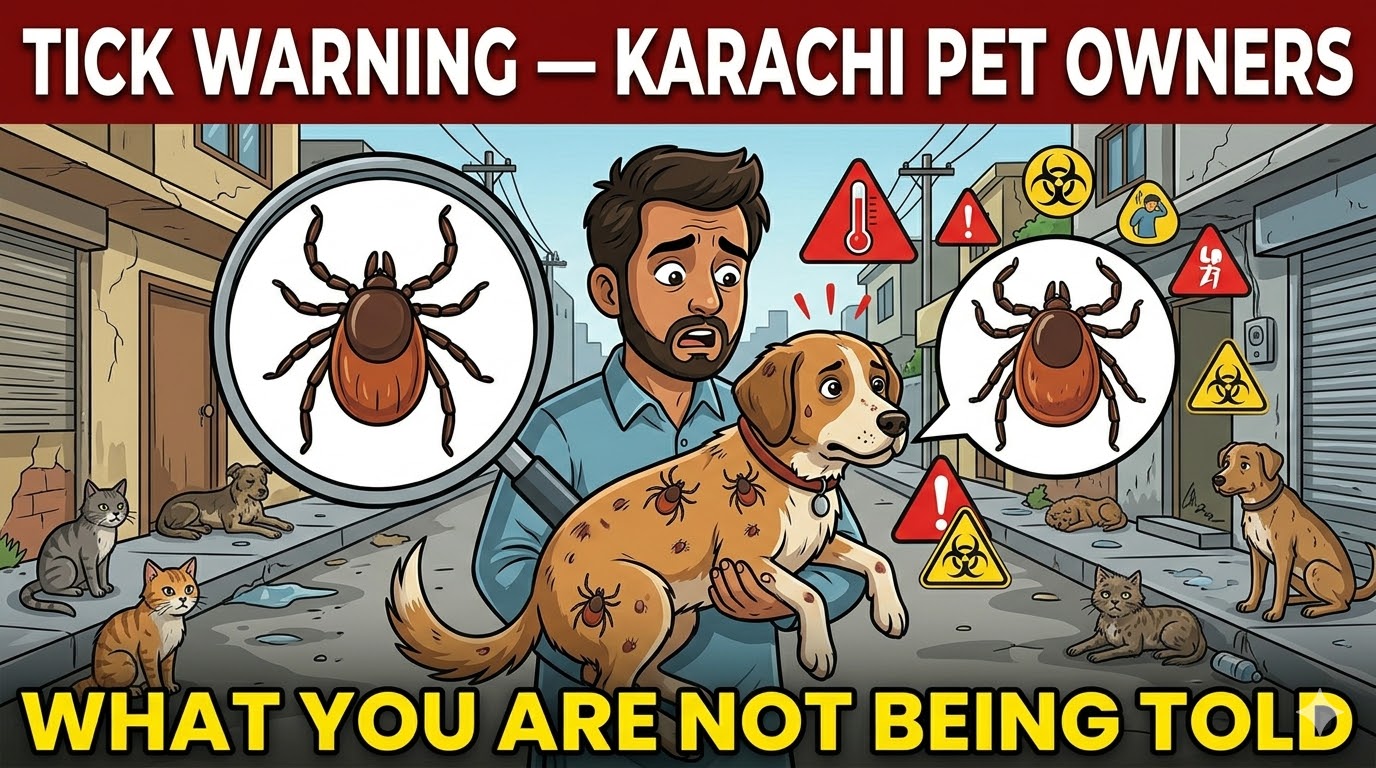
Most Karachi pet owners know ticks exist. Far fewer understand the diseases they carry, how quickly transmission can occur, and why the city’s specific environment makes their pets — and families — more vulnerable than commonly believed.
The Tick Problem Nobody Is Talking About
Tick infestations in Karachi are consistently underreported and under-discussed compared to fleas, mosquitoes, and cockroaches. Part of the reason is visibility — ticks are often found burrowed into a pet’s fur or skin, hidden around the ears, between the toes, or along the neck, and are easily missed during a quick grooming check. Another reason is awareness: most pet owners in Pakistan have not been clearly informed about the diseases ticks carry and how rapidly they can progress.
This is a gap that matters. Karachi’s climate, its large stray animal population, and the increasing number of households with pets creates an environment where tick-borne diseases are a genuine, year-round risk — not a seasonal concern.
Common Ticks Found in Karachi
Brown Dog Tick (Rhipicephalus sanguineus)
This is by far the most common tick found on pets in Karachi. It thrives in warm, dry indoor and outdoor environments, completes its entire life cycle inside homes and kennels, and can infest homes in very large numbers if left unchecked. Unlike many other tick species, the brown dog tick rarely bites humans but is a highly efficient vector of canine diseases and can occasionally transmit Rocky Mountain Spotted Fever to humans in close contact with infested dogs.
Hyalomma Ticks
These larger ticks are found in the semi-arid environments surrounding Karachi and on livestock, particularly in areas like Gadap Town, Malir, and agricultural peripheries of the city. They are a known vector of Crimean-Congo Haemorrhagic Fever (CCHF), a viral disease with a fatality rate of up to 40% in severe cases. While human cases in urban Karachi are less common, they do occur — and contact with infested livestock or animals is the primary route of transmission.
Tick-Borne Diseases: What Your Vet May Not Have Mentioned
Canine Babesiosis
Caused by the Babesia parasite transmitted by the brown dog tick, babesiosis destroys red blood cells in dogs, leading to anaemia, fever, lethargy, jaundice, and in severe cases, organ failure and death. In Karachi, babesiosis cases in dogs are seen regularly by veterinary clinics, yet many pet owners only discover the disease when their dog is already seriously ill. The disease progresses rapidly once symptoms appear — sometimes within 24 to 48 hours — and delays in treatment significantly worsen outcomes.
Diagnosis requires a blood smear test, and treatment involves antiparasitic medications that must be administered promptly. Dogs that survive a babesiosis episode may become long-term carriers.
Ehrlichiosis
Ehrlichia canis, another tick-transmitted bacterial infection common in tropical and subtropical climates, causes fever, weight loss, bleeding disorders, and immune suppression in dogs. The disease has three phases: acute (first three weeks, flu-like symptoms), subclinical (no visible symptoms but disease is progressing internally), and chronic (severe organ damage). Many dogs in Karachi are diagnosed in the subclinical or chronic phase because the early symptoms were missed or attributed to other causes.
Hepatozoonosis
This is a less commonly discussed but increasingly observed tick-borne disease in Pakistan’s dogs. Unlike babesiosis and ehrlichiosis which are transmitted by a tick bite, hepatozoonosis is transmitted when a dog ingests an infected tick — something that happens easily during grooming. The disease causes muscle pain, fever, and progressive weakness and can become chronic and debilitating.
Rocky Mountain Spotted Fever (RMSF) — Human Risk
Though classically associated with the Americas, Rickettsia species capable of causing RMSF-like illness have been identified in brown dog ticks in Asia and the Middle East. Symptoms in humans include fever, severe headache, rash, and in untreated cases, multi-organ failure. Children are disproportionately affected. Misdiagnosis as malaria or typhoid is common in Pakistan given overlapping symptoms.
Crimean-Congo Haemorrhagic Fever (CCHF)
This is the tick-borne disease that receives the most public health attention in Pakistan, and rightly so. Pakistan reports more human CCHF cases than any other country in the region. While the majority of cases are linked to livestock-handling and rural exposure, urban Karachi residents are not entirely insulated — particularly those in peri-urban areas, those handling livestock around Eid ul Adha, or those whose pets roam near livestock-keeping areas.
CCHF cannot be transmitted between humans through casual contact, but direct exposure to an infected tick or blood from an infected animal carries real risk. Early symptoms — fever, muscle aches, nausea — are indistinguishable from common viral illness, and the window for effective antiviral treatment is narrow.
How Quickly Can Transmission Happen?
This is one of the most important — and least communicated — facts about tick-borne disease. For bacterial pathogens like Ehrlichia and Rickettsia, transmission from an attached tick can begin within a few hours. For Babesia, the window is somewhat longer. But the key message is this: every hour a tick remains attached increases the risk of transmission.
This makes early detection and prompt removal critical. Yet tick checks are not routine in most Karachi households, and pet owners are rarely taught the correct technique for tick removal — which requires fine-tipped tweezers and steady upward pressure without twisting or crushing the tick’s body.
Why Karachi’s Environment Amplifies the Risk
Several factors specific to Karachi increase tick-borne disease risk beyond what the city’s residents typically assume:
- Year-round warmth means ticks are active all twelve months, with no winter dieback
- A large population of stray dogs and cats — estimated in the hundreds of thousands citywide — serves as a constant tick reservoir across all neighbourhoods
- Dense residential areas mean pets encounter other animals (and their ticks) regularly, even in upscale localities
- Limited public awareness means pet owners do not maintain year-round tick prevention, leaving their animals vulnerable
- Inadequate disposal of animal carcasses in some areas creates tick reservoirs that persist in the environment
What Pet Owners Should Be Doing — But Mostly Are Not
Given the above, the gap between risk and action among Karachi pet owners is significant. The following measures are not optional for urban pet owners in this climate:
- Year-round tick prevention via veterinarian-prescribed spot-on treatments, tick collars, or oral preventatives
- Weekly full-body tick checks on all pets, paying close attention to ears, neck, between toes, and around the tail
- Prompt and correct tick removal using proper technique — never petroleum jelly, nail polish, or heat
- Veterinary blood tests at least twice yearly for dogs to screen for tick-borne diseases
- Environmental tick control in and around the home, particularly in gardens, courtyards, and entry points used by pets
For the home environment specifically, a scheduled tick treatment in Karachi targeting harbourage zones — gardens, kennel areas, entry points — is an important layer of protection that pet treatment alone cannot provide.
The Human Risk: How to Protect Your Family
In homes where pets carry ticks, the risk of a tick finding a human host is real. Children are particularly at risk given their tendency to cuddle pets and sit on floors where ticks may have dropped.
Steps to protect your household include:
- Check yourself and children after time outdoors or extended contact with pets
- Wear long clothing when in gardens or areas with known tick presence
- Keep grass trimmed short — ticks wait on grass and low vegetation for passing hosts
- If you find a tick on a family member, remove it promptly and consult a doctor if fever or rash develops within two weeks
The Bottom Line
Tick-borne diseases are a real, present, and growing concern for pet-owning households in Karachi. The combination of the city’s climate, stray animal density, and limited public awareness creates a situation where risk consistently outpaces preparedness. Proactive pet treatment, regular tick checks, and professional environmental control are the three pillars of an effective defence. If you want to know whether ticks are already present in your home or garden, pest control services in Karachi can provide a thorough inspection and targeted treatment plan.
Protect Your Family — Book a Free Tick Inspection Don’t wait for a sick pet or a bite on your child to take action. Our trained team will inspect your home, identify tick activity zones, and recommend a safe, effective treatment plan. Contact Karachi Fumigation Services today. Free inspections, no obligation.

Ahmad Karimi is a PPMA-registered pest management specialist and the lead technical consultant at Karachi Fumigation Services, where he has overseen field operations and treatment protocols since 2005. With over 20 years of hands-on experience treating residential, commercial, and industrial properties across Karachi — from DHA bungalows with structural termite infestations to Korangi factories requiring large-scale rodent exclusion — he brings direct field knowledge to every article published on this blog.
Ahmad has managed pest control programs for clients including Descon Engineering, Pakistan Tobacco Company, Saylani Welfare, and J. (Junaid Jamshed), and has issued hundreds of fumigation certificates for health authority compliance, import/export, and commercial licensing purposes. He holds active PPMA membership and works exclusively with WHO-approved chemicals in all field operations.
The content on this blog draws directly from two decades of Karachi-specific infestation data — seasonal pest patterns, neighbourhood-level risk factors, building-age vulnerabilities, and the regulatory requirements that Karachi businesses actually face. No recycled content from foreign pest control sites. Every article reflects conditions specific to Karachi’s climate, infrastructure, and compliance environment.
For treatment enquiries or technical questions, Ahmad’s team can be reached at 03463303875 or via the office at Trade Tower, Civil Lines, Karachi.
Leave a Reply