Category: Ticks & Fleas

  • Why Flea Treatments in Karachi Often Need Two Rounds — The Egg Cycle Explained

    Why Flea Treatments in Karachi Often Need Two Rounds — The Egg Cycle Explained

    You have had your home treated for fleas. A week later, you are still seeing them. This is not a sign that the treatment failed — it is a sign that you need to understand the flea life cycle, and why a single treatment is almost never enough.

    The Most Common Frustration After Flea Treatment

    It is one of the most common complaints pest control teams in Karachi hear from homeowners: ‘We got the house treated two weeks ago and the fleas are back.’ The instinct is to blame the product or the technician. But in the vast majority of cases, what homeowners are seeing is not a treatment failure — it is biology doing exactly what biology does.

    The flea life cycle is the single most important thing to understand if you want to successfully eliminate an infestation. Without this knowledge, you will keep repeating treatments and keep experiencing reappearances — and you will keep spending money without permanent results.

    The Four Stages of the Flea Life Cycle

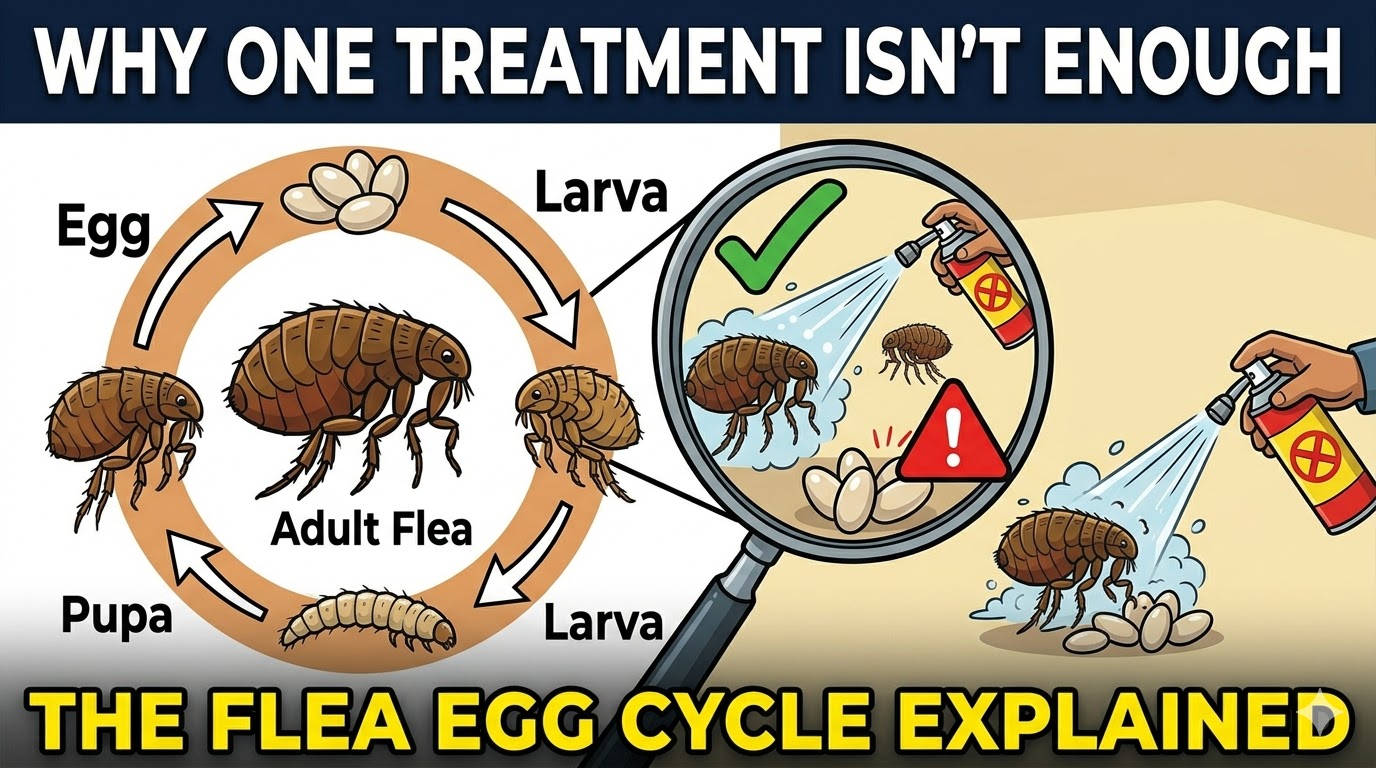
    Stage 1: The Egg

    Adult female fleas begin laying eggs within 24 to 48 hours of taking a blood meal. A single female can produce up to 50 eggs per day. These eggs are smooth, white, and about 0.5mm in size — virtually invisible to the naked eye. They are not sticky and roll off your pet’s fur onto carpets, bedding, cracks in flooring, and furniture.

    This is important: flea eggs are not on your pet. They are in your home. Every time your pet walks from room to room, it is distributing eggs across every surface it touches.

    Flea eggs are resistant to most surface-level insecticide sprays. They are protected by their shell and lie dormant through treatment.

    Stage 2: The Larva

    Eggs hatch into larvae within one to ten days depending on temperature and humidity. Karachi’s warm, humid coastal climate — particularly from May through October — accelerates this significantly. Larvae avoid light and burrow deep into carpet fibres, floor joints, and soil under furniture. They feed on organic debris and, critically, on the dried blood faeces left by adult fleas.

    Larvae are more vulnerable to treatment than eggs but are still not easy to eliminate when tucked deep into fibres and cracks. This is why proper vacuuming before treatment is essential — it agitates larvae and brings them closer to the surface.

    Stage 3: The Pupa

    This is the stage that defeats most DIY and single-session treatments. Larvae spin a sticky, silken cocoon — the pupa — in which they develop into adult fleas. These cocoons are extraordinarily resilient. They are sticky (debris clings to them, providing camouflage), resistant to chemical penetration, and the developing flea inside can remain dormant for up to five months while waiting for the right environmental signals to emerge.

    What triggers emergence? Vibration. Heat. Carbon dioxide — the kind exhaled by a nearby host. When you or your pet walks across a treated area, pupae may detect your presence and hatch within seconds. This is why homeowners who leave a treated home vacant for weeks return to find newly hatched fleas waiting for them.

    Stage 4: The Adult

    Newly hatched adult fleas are hungry and immediately seek a host. They jump up to 30 centimetres vertically — remarkable for an insect their size. Adults begin feeding within minutes of finding a host and begin laying eggs within 24 to 48 hours, restarting the entire cycle.

    Adult fleas are the only stage you can see easily and the only stage that bites. They represent only about 5% of the total flea population in an infested home. The remaining 95% — eggs, larvae, and pupae — are invisible to you, distributed throughout your home, and largely unaffected by surface-level treatments.

    Why One Treatment Cannot Break the Cycle

    Even the best professional treatment will kill adult fleas on contact and leave residual insecticide that remains active on surfaces for two to four weeks. But it cannot penetrate flea eggs, and it cannot kill pupae sealed in their cocoons.

    What happens after the first treatment:

    • Adult fleas are killed on contact or within hours of the residual exposure
    • Eggs on the floor are not affected — they continue developing
    • Pupae already in cocoons are not penetrated — they continue developing
    • Within 7 to 14 days, a new wave of adults begins hatching from those pupae
    • These new adults are now exposed to the residual insecticide — if it is still active — and are killed
    • But if the residual has faded or was inconsistently applied, the new adults survive, feed, and begin a new breeding cycle

    This is precisely why you see ‘new’ fleas after a treatment. They are not survivors of the original population — they are the next generation, freshly hatched.

    Why the Second Round Is Non-Negotiable

    The second treatment, typically scheduled two to three weeks after the first, is timed specifically to catch the newly hatched adult fleas before they have had the chance to feed and reproduce. The goal is to break the cycle at this vulnerable transition point.

    Any reputable provider offering flea and tick treatment in Karachi will schedule a follow-up session as part of the standard protocol — not as an upsell, but because a single treatment is genuinely insufficient to resolve a full infestation.

    The timing of the second round matters. Too early, and not enough pupae have hatched yet. Too late, and newly hatched adults have already fed and started a new egg cycle. A window of 14 to 21 days is generally optimal.

    Karachi-Specific Factors That Accelerate the Cycle

    In cities with temperate or cold winters, flea populations naturally decline during certain months. Karachi does not have this seasonal advantage. The city’s climate — warm and humid for most of the year — keeps flea eggs, larvae, and pupae in perpetual development mode. There is no winter die-off.

    Additionally, Karachi homes frequently have:

    • Wall-to-wall marble or tile flooring with gaps and grouting where larvae hide
    • Thick rugs and daris that provide deep refuge for all flea life stages
    • Multiple pets or shared building spaces where re-infestation is ongoing
    • Proximity to stray animal populations that serve as constant flea reservoirs

    All of these factors mean the egg-to-adult cycle completes faster, flea populations rebound quicker, and the window for effective second-round treatment is narrower than in cooler climates.

    What You Must Do Between Rounds

    The period between the first and second treatment is not passive waiting time. What you do during these two to three weeks significantly affects whether the second round succeeds:

    • Vacuum daily — the vibration stimulates pupae to hatch, exposing them to the residual insecticide
    • Keep children and pets out of heavily infested areas as much as possible
    • Continue pet flea treatment as directed by your vet — your pet must not serve as a reinfection source
    • Avoid steam cleaning or wet mopping treated surfaces, as this degrades the residual insecticide
    • Do not wash treated soft furnishings until after the second round

    How Many Rounds Are Really Needed?

    For most standard residential infestations in Karachi, two rounds are sufficient if both are properly timed and correctly executed, the pet is treated concurrently, and the homeowner follows the between-round guidelines.

    However, in severe infestations — particularly in homes where the infestation has been present undetected for weeks or months — a third round may be advisable, especially if the home has multiple animals, heavy carpeting, or ground-floor access from a courtyard or garden where stray animals enter.

    The Takeaway

    Understanding the flea egg cycle is not academic knowledge — it is practical information that directly affects whether your home stays flea-free. A second round of treatment is not a sign that the first one failed. It is an expected, necessary part of breaking the reproductive cycle. If you are unsure whether your current pest control provider is following this protocol, or if you are seeing fleas after a single treatment, it may be time to speak with professionals who understand how the biology actually works. For expert advice on scheduling and carrying out effective multi-round treatments, fumigation services in Karachi that specialise in flea infestations can guide you through the full process.

    Book Your Free Inspection Still seeing fleas after a single treatment? Let our team assess your home, identify the infestation stage, and design a properly timed two-round treatment plan that actually works. Contact Karachi Fumigation Services today — inspections are free and carry no obligation.

  • How to Treat a Flea Infestation in a Karachi Home When You Have Young Children

    How to Treat a Flea Infestation in a Karachi Home When You Have Young Children

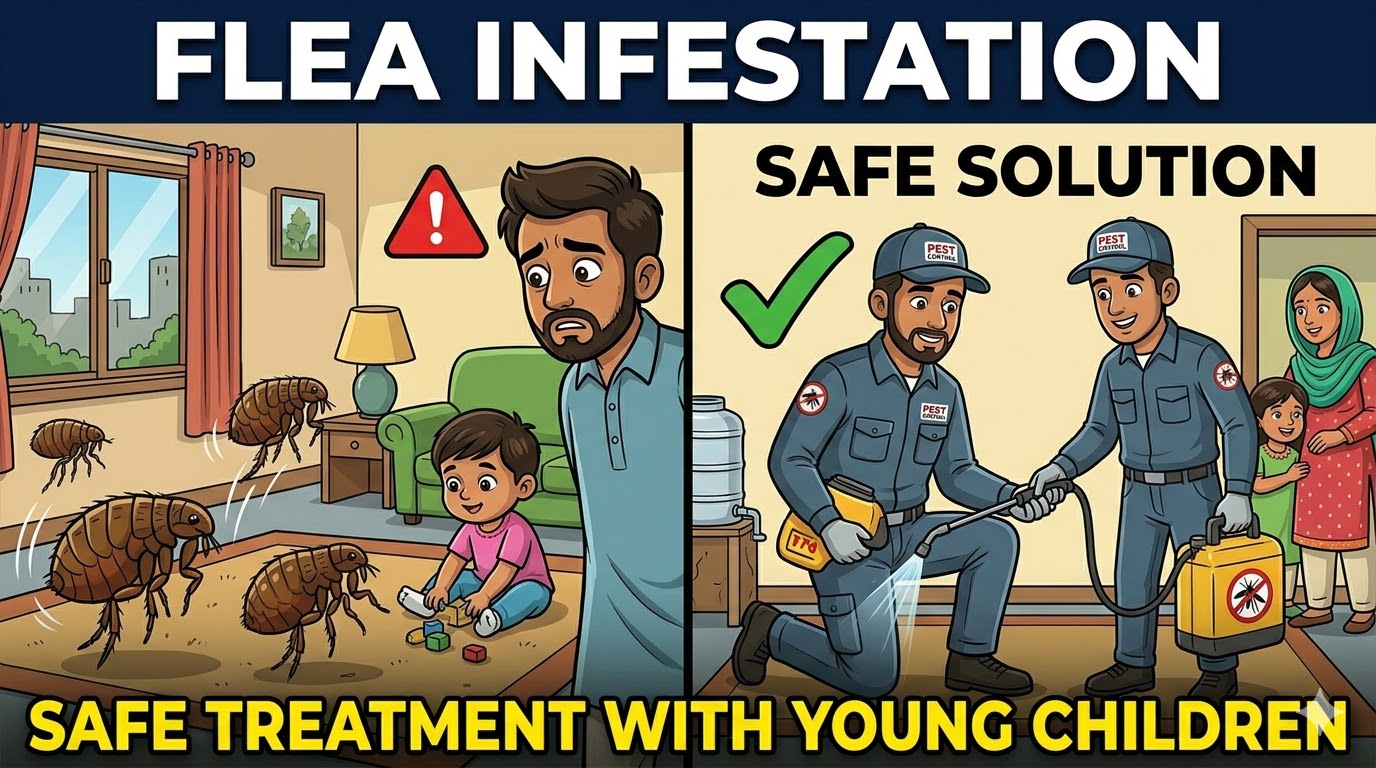
    Flea infestations in Karachi homes are more common than most families realise — especially those with pets or ground-floor units near open spaces. When you have young children in the house, the stakes are higher and the approach must be smarter.

    Why Flea Infestations Are a Serious Health Concern for Children

    Children spend a significant part of their day on the floor — crawling, playing, sitting cross-legged. This puts them in direct, constant contact with the very surfaces where fleas live, feed, and breed. Unlike adults who might notice a bite and think little of it, children are far more vulnerable to the consequences.

    In Karachi specifically, flea infestations carry risks that go beyond simple itching. The city’s warm, humid climate — particularly in neighbourhoods like Clifton, Gulshan-e-Iqbal, North Karachi, and Defence — creates near-perfect conditions for fleas to survive year-round. Flea bites in children can trigger intense allergic reactions, secondary skin infections from scratching, and in some cases transmission of Bartonella (cat scratch disease) or even tapeworms if a child accidentally ingests an infected flea.

    Understanding what you are dealing with — and what not to do — is the first step toward protecting your family.

    Recognising a Flea Infestation in Your Home

    Before you treat, you need to confirm what you are dealing with. Flea infestations are sometimes misidentified as mosquito bites or bedbugs, leading to ineffective treatment.

    Signs of a flea infestation in your home include:

    • Red, clustered bites on your child’s ankles, legs, and lower body
    • Your child scratching constantly, especially after sitting on carpets or rugs
    • Tiny dark specks (flea dirt) on pet bedding, rugs, or furniture
    • Seeing fast-moving, tiny insects jumping on light-coloured surfaces
    • Your pet scratching, biting at its fur, or showing signs of skin irritation

    A simple test: place a white paper towel on your carpet and walk over it. If you see tiny dark dots that turn reddish-brown when wet, that is flea faeces — confirmation of an active infestation.

    What NOT to Do When Children Are Present

    Many Karachi households reach for easily available over-the-counter sprays the moment they suspect fleas. This is understandable but can cause more harm than good when young children are in the home.

    Avoid Generic Over-the-Counter Sprays

    Products sold at general stores often contain pyrethrins or organophosphates in concentrations not calibrated for indoor residential use around children. Exposure can cause skin irritation, respiratory issues, and neurological effects in toddlers and infants. These products also fail to address flea eggs and larvae — meaning the infestation simply returns.

    Do Not Over-Treat Pet Animals

    Some families douse their pets in flea powders repeatedly without knowing that children who cuddle those pets are then exposed to the chemicals. Always consult a veterinarian for pet-safe flea control, and ensure the product has dried or settled completely before children come in contact with the animal.

    Avoid Treating Only One Area

    Fleas do not stay in one spot. Treating only the area where you saw fleas — a rug, a sofa — while ignoring cracks in flooring, under furniture, and skirting boards means the infestation persists. It is a common mistake that delays resolution for weeks.

    The Right Approach: Safe, Effective Treatment When You Have Kids

    Step 1 — Deep Clean Before Treatment

    Vacuum every surface thoroughly — carpets, rugs, sofas, mattresses, under beds, and along skirting boards. Use a vacuum with a sealed bag or HEPA filter. Immediately dispose of the bag outside your home after vacuuming. This removes adult fleas, some eggs, and triggers dormant pupae to hatch, making them vulnerable to treatment.

    Wash all bedding, soft toys, and cushion covers in water above 60°C. This temperature kills fleas at all life stages.

    Step 2 — Treat Your Pet

    Contact a vet for a prescription-grade flea treatment suitable for your pet’s weight and species. In Karachi, many pet owners use spot-on treatments, oral tablets, or flea collars. The key is to treat the pet and the home simultaneously — treating only one without the other guarantees failure.

    Step 3 — Professional Indoor Treatment

    For homes with young children, professional flea treatment is not a luxury — it is the responsible choice. A certified pest control company will use child-safer formulations applied at appropriate concentrations, target all life stages of the flea (eggs, larvae, pupae, adults), and treat all zones including areas that are impossible to reach through DIY methods.

    If you are looking for a team that understands both effectiveness and child safety in a Karachi context, consider booking a professional flea and tick treatment in Karachi with technicians trained in residential infestations.

    Step 4 — Temporary Relocation During Treatment

    Children (and pets) should be kept out of treated areas for at least 3 to 4 hours after professional treatment, or longer depending on the products used. Ask the pest control team specifically about re-entry times and whether additional ventilation is needed.

    Step 5 — Follow-Up Treatment

    This is where most families go wrong. A single treatment will not eliminate a flea infestation because flea pupae can remain dormant for up to five months and are resistant to chemical treatments. A second treatment, typically two to three weeks after the first, is essential to catch newly hatched adults before they reproduce. This is why reputable pest control providers in Karachi schedule follow-up visits as standard.

    Child-Safe Precautions to Maintain After Treatment

    Once the immediate infestation is addressed, maintaining a flea-free environment requires ongoing vigilance — especially in Karachi where stray animals, humid conditions, and dense neighbourhoods mean re-infestation risk is perpetually present.

    • Vacuum carpets and rugs at least twice a week
    • Wash pet bedding weekly
    • Keep your pet on a year-round flea prevention programme recommended by a vet
    • Seal gaps under doors and along flooring where fleas may enter from shared building areas
    • Avoid letting children sit directly on heavily trafficked outdoor areas if stray animals are nearby

    When to Call a Professional

    If you have tried home remedies or over-the-counter products without success, if bites are continuing despite treatment, or if your child is showing signs of an allergic reaction or skin infection — do not delay professional intervention. In Karachi’s climate, flea populations can grow exponentially within weeks if the cycle is not broken with a targeted, professional approach.

    Final Thoughts

    Flea infestations in homes with young children demand a measured, careful response — not panic, and not shortcuts. With the right preparation, a professionally conducted treatment using child-safer products, and consistent follow-through, your home can be flea-free without compromising your family’s health. If you are based in Karachi and need expert guidance, Karachi Fumigation Services offers reliable, trained pest control teams who understand the city’s unique infestation patterns.

    Book a Free Inspection Today Concerned about fleas in your home? Contact us for a no-obligation inspection. Our team will assess the severity, identify risk zones, and recommend the safest, most effective treatment plan for your family. Call or WhatsApp us now — or visit karachifumigationservices.com to schedule your appointment.

  • Tick-Borne Disease Risk in Karachi: What Pet Owners Are Not Being Told

    Tick-Borne Disease Risk in Karachi: What Pet Owners Are Not Being Told

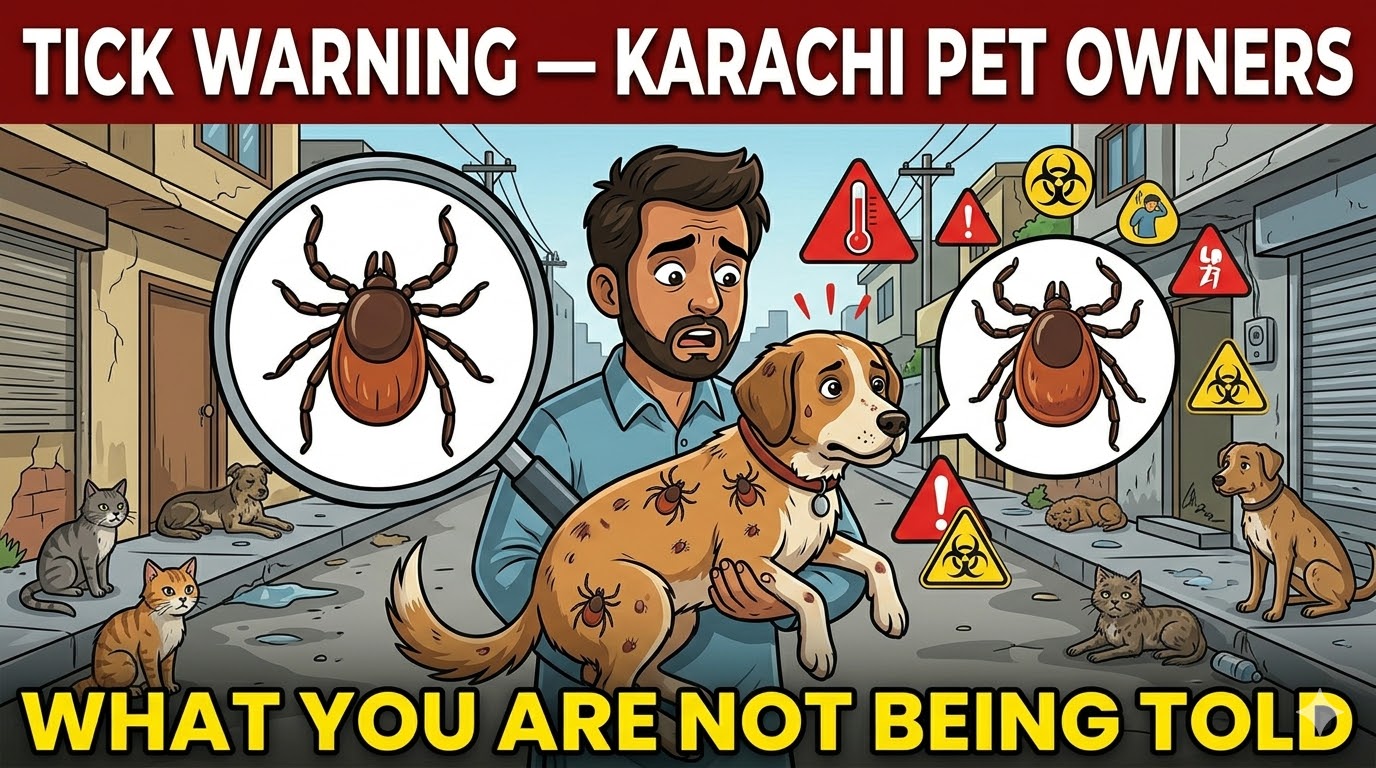
    Most Karachi pet owners know ticks exist. Far fewer understand the diseases they carry, how quickly transmission can occur, and why the city’s specific environment makes their pets — and families — more vulnerable than commonly believed.

    The Tick Problem Nobody Is Talking About

    Tick infestations in Karachi are consistently underreported and under-discussed compared to fleas, mosquitoes, and cockroaches. Part of the reason is visibility — ticks are often found burrowed into a pet’s fur or skin, hidden around the ears, between the toes, or along the neck, and are easily missed during a quick grooming check. Another reason is awareness: most pet owners in Pakistan have not been clearly informed about the diseases ticks carry and how rapidly they can progress.

    This is a gap that matters. Karachi’s climate, its large stray animal population, and the increasing number of households with pets creates an environment where tick-borne diseases are a genuine, year-round risk — not a seasonal concern.

    Common Ticks Found in Karachi

    Brown Dog Tick (Rhipicephalus sanguineus)

    This is by far the most common tick found on pets in Karachi. It thrives in warm, dry indoor and outdoor environments, completes its entire life cycle inside homes and kennels, and can infest homes in very large numbers if left unchecked. Unlike many other tick species, the brown dog tick rarely bites humans but is a highly efficient vector of canine diseases and can occasionally transmit Rocky Mountain Spotted Fever to humans in close contact with infested dogs.

    Hyalomma Ticks

    These larger ticks are found in the semi-arid environments surrounding Karachi and on livestock, particularly in areas like Gadap Town, Malir, and agricultural peripheries of the city. They are a known vector of Crimean-Congo Haemorrhagic Fever (CCHF), a viral disease with a fatality rate of up to 40% in severe cases. While human cases in urban Karachi are less common, they do occur — and contact with infested livestock or animals is the primary route of transmission.

    Tick-Borne Diseases: What Your Vet May Not Have Mentioned

    Canine Babesiosis

    Caused by the Babesia parasite transmitted by the brown dog tick, babesiosis destroys red blood cells in dogs, leading to anaemia, fever, lethargy, jaundice, and in severe cases, organ failure and death. In Karachi, babesiosis cases in dogs are seen regularly by veterinary clinics, yet many pet owners only discover the disease when their dog is already seriously ill. The disease progresses rapidly once symptoms appear — sometimes within 24 to 48 hours — and delays in treatment significantly worsen outcomes.

    Diagnosis requires a blood smear test, and treatment involves antiparasitic medications that must be administered promptly. Dogs that survive a babesiosis episode may become long-term carriers.

    Ehrlichiosis

    Ehrlichia canis, another tick-transmitted bacterial infection common in tropical and subtropical climates, causes fever, weight loss, bleeding disorders, and immune suppression in dogs. The disease has three phases: acute (first three weeks, flu-like symptoms), subclinical (no visible symptoms but disease is progressing internally), and chronic (severe organ damage). Many dogs in Karachi are diagnosed in the subclinical or chronic phase because the early symptoms were missed or attributed to other causes.

    Hepatozoonosis

    This is a less commonly discussed but increasingly observed tick-borne disease in Pakistan’s dogs. Unlike babesiosis and ehrlichiosis which are transmitted by a tick bite, hepatozoonosis is transmitted when a dog ingests an infected tick — something that happens easily during grooming. The disease causes muscle pain, fever, and progressive weakness and can become chronic and debilitating.

    Rocky Mountain Spotted Fever (RMSF) — Human Risk

    Though classically associated with the Americas, Rickettsia species capable of causing RMSF-like illness have been identified in brown dog ticks in Asia and the Middle East. Symptoms in humans include fever, severe headache, rash, and in untreated cases, multi-organ failure. Children are disproportionately affected. Misdiagnosis as malaria or typhoid is common in Pakistan given overlapping symptoms.

    Crimean-Congo Haemorrhagic Fever (CCHF)

    This is the tick-borne disease that receives the most public health attention in Pakistan, and rightly so. Pakistan reports more human CCHF cases than any other country in the region. While the majority of cases are linked to livestock-handling and rural exposure, urban Karachi residents are not entirely insulated — particularly those in peri-urban areas, those handling livestock around Eid ul Adha, or those whose pets roam near livestock-keeping areas.

    CCHF cannot be transmitted between humans through casual contact, but direct exposure to an infected tick or blood from an infected animal carries real risk. Early symptoms — fever, muscle aches, nausea — are indistinguishable from common viral illness, and the window for effective antiviral treatment is narrow.

    How Quickly Can Transmission Happen?

    This is one of the most important — and least communicated — facts about tick-borne disease. For bacterial pathogens like Ehrlichia and Rickettsia, transmission from an attached tick can begin within a few hours. For Babesia, the window is somewhat longer. But the key message is this: every hour a tick remains attached increases the risk of transmission.

    This makes early detection and prompt removal critical. Yet tick checks are not routine in most Karachi households, and pet owners are rarely taught the correct technique for tick removal — which requires fine-tipped tweezers and steady upward pressure without twisting or crushing the tick’s body.

    Why Karachi’s Environment Amplifies the Risk

    Several factors specific to Karachi increase tick-borne disease risk beyond what the city’s residents typically assume:

    • Year-round warmth means ticks are active all twelve months, with no winter dieback
    • A large population of stray dogs and cats — estimated in the hundreds of thousands citywide — serves as a constant tick reservoir across all neighbourhoods
    • Dense residential areas mean pets encounter other animals (and their ticks) regularly, even in upscale localities
    • Limited public awareness means pet owners do not maintain year-round tick prevention, leaving their animals vulnerable
    • Inadequate disposal of animal carcasses in some areas creates tick reservoirs that persist in the environment

    What Pet Owners Should Be Doing — But Mostly Are Not

    Given the above, the gap between risk and action among Karachi pet owners is significant. The following measures are not optional for urban pet owners in this climate:

    • Year-round tick prevention via veterinarian-prescribed spot-on treatments, tick collars, or oral preventatives
    • Weekly full-body tick checks on all pets, paying close attention to ears, neck, between toes, and around the tail
    • Prompt and correct tick removal using proper technique — never petroleum jelly, nail polish, or heat
    • Veterinary blood tests at least twice yearly for dogs to screen for tick-borne diseases
    • Environmental tick control in and around the home, particularly in gardens, courtyards, and entry points used by pets

    For the home environment specifically, a scheduled tick treatment in Karachi targeting harbourage zones — gardens, kennel areas, entry points — is an important layer of protection that pet treatment alone cannot provide.

    The Human Risk: How to Protect Your Family

    In homes where pets carry ticks, the risk of a tick finding a human host is real. Children are particularly at risk given their tendency to cuddle pets and sit on floors where ticks may have dropped.

    Steps to protect your household include:

    • Check yourself and children after time outdoors or extended contact with pets
    • Wear long clothing when in gardens or areas with known tick presence
    • Keep grass trimmed short — ticks wait on grass and low vegetation for passing hosts
    • If you find a tick on a family member, remove it promptly and consult a doctor if fever or rash develops within two weeks

    The Bottom Line

    Tick-borne diseases are a real, present, and growing concern for pet-owning households in Karachi. The combination of the city’s climate, stray animal density, and limited public awareness creates a situation where risk consistently outpaces preparedness. Proactive pet treatment, regular tick checks, and professional environmental control are the three pillars of an effective defence. If you want to know whether ticks are already present in your home or garden, pest control services in Karachi can provide a thorough inspection and targeted treatment plan.

    Protect Your Family — Book a Free Tick Inspection Don’t wait for a sick pet or a bite on your child to take action. Our trained team will inspect your home, identify tick activity zones, and recommend a safe, effective treatment plan. Contact Karachi Fumigation Services today. Free inspections, no obligation.

  • How Stray Cats and Dogs Near Karachi Homes Bring Fleas and Ticks Inside

    How Stray Cats and Dogs Near Karachi Homes Bring Fleas and Ticks Inside

    You may not own a pet. You may not let strays into your home. But if you live in Karachi, the city’s vast population of stray animals may already be affecting the pest load inside your house — in ways most homeowners have not considered.

    Karachi’s Stray Animal Problem Is Everyone’s Problem

    Karachi has one of the largest urban stray dog populations in South Asia, and the number of feral and community cats is similarly high. Estimates vary, but stray dogs alone in the city likely number in the hundreds of thousands. They live in virtually every neighbourhood — from Defence and Clifton to Orangi, Korangi, Landhi, and beyond. Stray cats occupy apartment building courtyards, rooftops, alleys, and car parks across the city.

    This is relevant to every homeowner — not just those with pets — because stray animals are among the most significant vectors for introducing fleas and ticks into residential environments. Unlike owned pets that receive occasional flea treatment, strays carry persistent, high-density flea and tick infestations year-round with no intervention. They are, in epidemiological terms, a constantly replenishing reservoir.

    The Transmission Pathways You May Not Have Considered

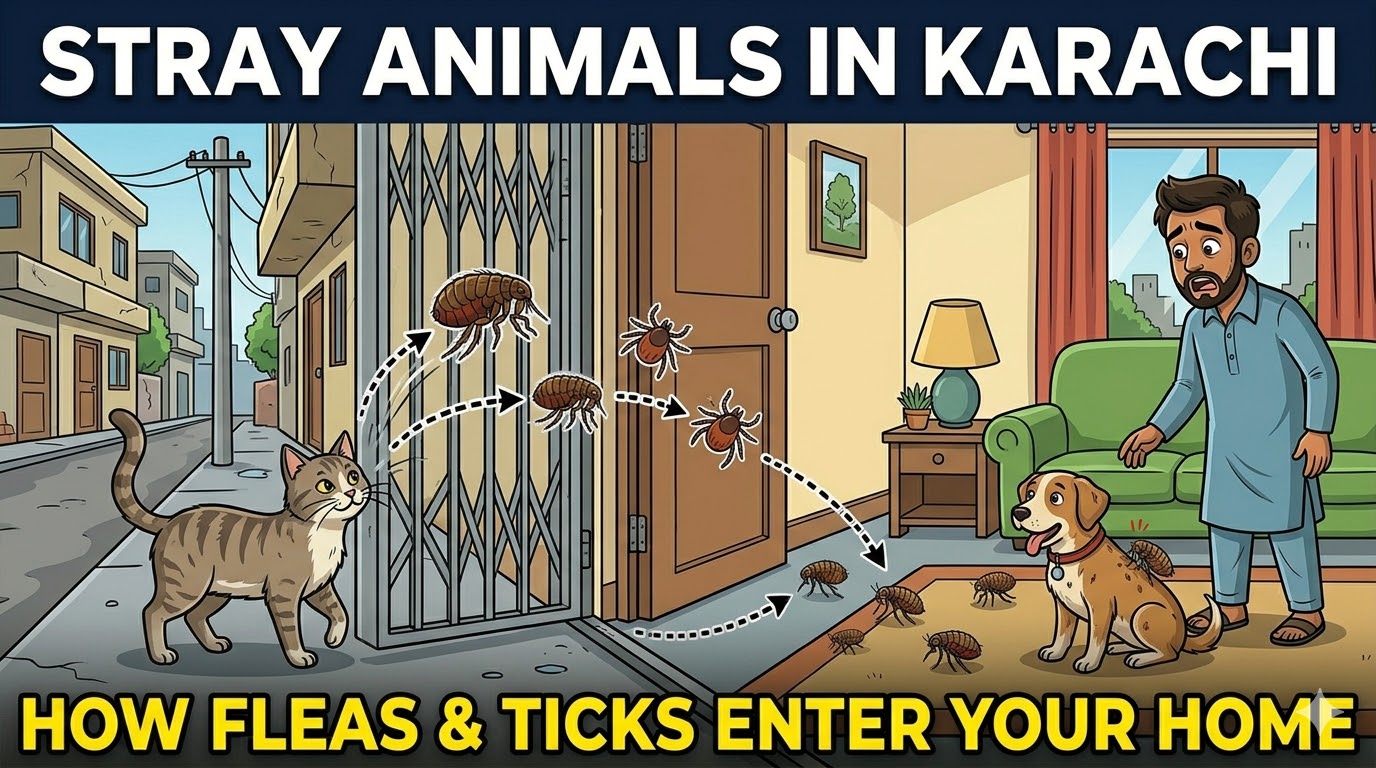
    Pathway 1: Shared Outdoor Spaces

    Strays rest, sleep, and spend extended time in outdoor areas directly adjacent to or connected with your home: car parks, building lobbies, shared gardens, rooftops, stairwells, and back lanes. During this time, flea eggs, larvae, and adult fleas drop from their bodies onto the ground, grass, soil, and crevices in paving. Ticks drop from their hosts after feeding and wait in vegetation or gaps for a new host.

    When you, your children, or your domestic staff walk through these same areas, fleas jump onto clothing and shoes, and ticks attach to exposed skin or fabric. They are then carried into your home.

    Pathway 2: Shared Walls, Drains, and Gaps

    In Karachi’s older housing stock — bungalows, older apartments, houses in areas like Saddar, Lyari, PECHS, or North Nazimabad — gaps under doors, open drains, and cracks in exterior walls are common. Fleas can enter through these gaps. More critically, flea larvae and eggs introduced into these entry zones by passing strays can develop indoors once inside.

    Ground-floor apartments and homes with courtyards are particularly vulnerable. If stray cats regularly sleep in your courtyard or porch area, they are effectively conducting ongoing flea seeding of your immediate environment.

    Pathway 3: Your Children

    Children interact with stray animals. Despite parental warnings, this is a consistent reality in urban Pakistan. A brief petting of a neighbourhood stray — something that occurs daily in most Karachi residential areas — can transfer dozens of flea eggs and potentially ticks onto a child’s clothing. Those pests are then brought inside, deposited onto carpets and furniture, and begin their life cycle in your home.

    Pathway 4: Shared Building Areas in Apartments

    In Karachi’s many multi-unit residential buildings, if one ground-floor unit or a building’s shared basement or car park has an established flea infestation — potentially seeded and maintained by strays entering those spaces — the infestation can spread via shared corridors, elevators, and ventilation pathways to upper floors. This is a pattern that pest control professionals in the city encounter regularly.

    Pathway 5: Domestic Workers

    Domestic staff who travel on public transport, pass through stray-animal-dense areas on their commute, or live in neighbourhoods with significant stray populations may unknowingly carry flea larvae or adults into your home on their clothing or bags. This pathway is almost never considered but represents a real vector, particularly for households that employ daily domestic help.

    Why Strays Carry More Fleas Than Owned Pets

    The disparity between the flea and tick burden carried by strays versus owned pets is substantial. A typical untreated stray dog in Karachi may host hundreds to thousands of fleas in various life stages across its body. An owned pet on a regular flea prevention programme may carry very few to none.

    The reasons are straightforward: strays receive no veterinary care, no flea treatment, no grooming, and no dietary support that would strengthen their immune system. They also interact constantly with other strays, making reinfestation a daily occurrence. This means that any stray regularly accessing the area around your home is a continuous, near-inexhaustible source of flea and tick introduction.

    Signs That Stray Animals Are the Source of Your Infestation

    If you do not own a pet but have an active flea or tick infestation, a nearby stray is the most probable source. Specific indicators include:

    • Bites concentrated on lower legs and ankles, consistent with ground-level flea exposure near entry points
    • Flea activity noticed near exterior doors, hallways, or ground-floor rooms more than other areas
    • Visible stray activity in your building’s immediate surroundings — strays resting near your gate, in the parking area, or in a shared garden
    • A flea infestation that returns repeatedly despite treatment, suggesting ongoing external introduction

    What You Can Do to Block These Pathways

    Secure Entry Points

    Seal gaps under exterior doors with door sweeps or weather stripping. Fill cracks in exterior walls, around pipes entering the home, and in floor junctions near exterior boundaries. Pay particular attention to gaps in grilles, ventilation openings, and gaps around utility pipes.

    Discourage Strays from Accessing Your Immediate Property

    While compassionate care for stray animals is admirable, allowing strays to sleep regularly in your courtyard, porch, or driveway creates a persistent flea-seeding zone directly adjacent to your home’s entry points. If you are concerned about the welfare of local strays, coordinate with a local animal welfare organisation for humane management — but address the immediate pest risk to your home simultaneously.

    Treat the Perimeter, Not Just the Interior

    Standard indoor flea and tick treatments address the interior of your home but do not break the external introduction cycle. If strays are regularly accessing areas adjacent to your home, the exterior perimeter — driveway edges, garden borders, courtyards, car park areas — should be included in any professional treatment.

    A comprehensive flea and tick treatment for your Karachi home should include assessment of exterior harbourage zones where stray animal activity has been observed, not just interior rooms.

    Personal Hygiene After Outdoor Exposure

    After passing through areas with known stray activity, change clothing at the door before entering main living areas. Have children change clothes and wash hands after any outdoor play or animal contact. This sounds excessive but is a genuinely effective practice in high-exposure environments.

    A Note on Karachi’s Specific Neighbourhoods

    Flea and tick transmission risk from strays is not uniform across the city. Areas with higher stray densities — particularly older residential areas, areas near open waste grounds, and neighbourhoods adjacent to industrial zones or markets — carry higher risk. However, even in well-maintained localities like DHA, Bahria Town Karachi, and Gulshan-e-Iqbal, stray animal presence is consistent enough to create real transmission pathways. No area of the city is entirely insulated.

    The Broader Picture

    Stray animals are a permanent feature of Karachi’s urban landscape and are unlikely to be eliminated in the near future. This means that managing flea and tick risk in your home requires an ongoing, layered approach rather than a one-time fix. Environmental sealing, regular professional treatment, and awareness of transmission pathways are all necessary components. If you are dealing with a flea or tick problem and suspect strays are involved, speak with a specialist in fumigation and pest control in Karachi who can assess both your interior and your exterior environment.

    Suspect Strays Are Behind Your Infestation? Book a Free Inspection Our team can assess both your home interior and the surrounding access points to identify exactly how pests are entering and recommend a treatment plan that addresses the full picture. Contact Karachi Fumigation Services today — free inspection, honest advice.

  • Flea and Tick Treatment for Karachi Homes: What the Process Involves and How Long It Takes

    Flea and Tick Treatment for Karachi Homes: What the Process Involves and How Long It Takes

    If you have never had your home professionally treated for fleas or ticks, you likely have questions about what the process involves, how long you need to stay out, and what to expect afterwards. This guide walks you through the entire process — from initial inspection to completion.

    Why Professional Treatment Is Different from DIY

    Many homeowners attempt flea or tick control with store-bought sprays, powders, or fumigation cans. These products are designed for surface application and lack the residual activity, targeted formulations, and penetration depth required to address a full infestation. They also typically target only one or two life stages of fleas or only kill ticks on contact without residual protection.

    A professional treatment is structured differently. It uses commercial-grade products applied at calibrated concentrations, covers all infestation zones including those inaccessible to homeowners, and follows a protocol that accounts for the biology of the pest — not just its visible adult population.

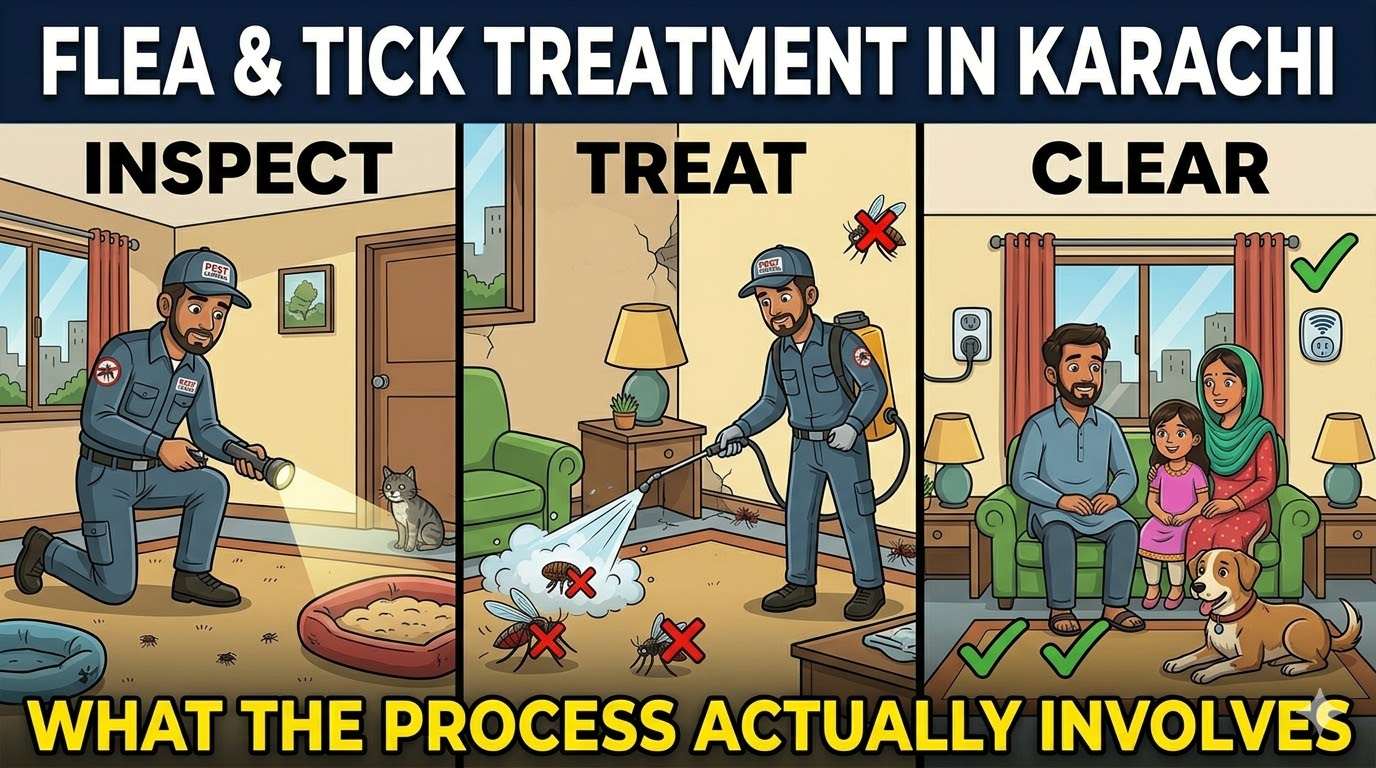
    Phase 1: The Inspection

    A properly conducted professional treatment begins with an inspection — not a quick walkthrough, but a methodical assessment of your home. During this phase, the technician will:

    • Identify evidence of flea or tick activity across different rooms and surfaces
    • Assess the severity and probable duration of the infestation
    • Locate primary harbourage zones — areas where the pests are breeding and sheltering
    • Check pet resting areas, sleeping spots, and movement routes
    • Evaluate entry points such as gaps under doors, cracks in flooring, and any outdoor areas connected to the interior
    • Ask about pet treatment status, recent travel, and stray animal contact

    This inspection usually takes 20 to 40 minutes depending on the size of the property. The information gathered directly determines which products are selected and how they are applied.

    Phase 2: Pre-Treatment Preparation by the Homeowner

    Homeowner preparation is essential and not just a formality. The quality of your preparation directly affects treatment success. Your pest control team will provide specific instructions, but the standard requirements are:

    Clearing and Vacuuming

    Vacuum all carpets, rugs, upholstered furniture, along skirting boards, and under furniture. This serves two purposes: it removes flea debris and some adults, and — critically — the vibration from vacuuming stimulates dormant pupae to hatch, making them vulnerable to the treatment products that will soon be applied.

    After vacuuming, immediately seal the vacuum bag in a plastic bag and dispose of it outside your home.

    Washing and Removing Fabrics

    Wash all removable fabric items — pet bedding, cushion covers, children’s soft toys, throw rugs — in hot water above 60°C. Items that cannot be washed should be bagged and set aside. Remove all items from floors, particularly bedroom floors, to allow full access to baseboards and carpet edges.

    Securing Food and Water

    Cover or remove all food, water, and food preparation surfaces. Cover fish tanks and disconnect their air pumps. Remove pets from the premises for the duration of the treatment.

    Occupant Evacuation

    All people and pets must vacate the property before treatment begins. You will be given a specific re-entry time by the technician — typically 3 to 5 hours post-treatment, though this may extend depending on the size of the property and the products used.

    Phase 3: The Treatment Itself

    Once the property is prepared and vacated, the professional team will begin treatment. A comprehensive flea and tick treatment in a standard Karachi home typically involves the following:

    Interior Residual Spray

    The primary treatment method involves applying a residual insecticide — typically a pyrethroid or a newer-generation compound such as a neonicotinoid or insect growth regulator (IGR) blend — to all floor surfaces, carpets, furniture bases, skirting boards, and wall junctions. The residual compound remains active on surfaces for two to four weeks, killing fleas and ticks that emerge after the initial treatment.

    Insect growth regulators (IGRs) are a critical component of any properly formulated product for flea control. They do not kill adult fleas directly but disrupt the development of eggs and larvae, preventing them from maturing into reproducing adults. This effectively prevents the next generation from establishing.

    Targeted Harbourage Treatment

    Beyond surface application, specific attention is given to harbourage zones: under furniture, along skirting boards, in gaps in flooring, around pet bedding areas, in storage rooms, and — in Karachi homes with courtyards or gardens — in outdoor spaces adjacent to entry points. Ticks particularly favour dry, sheltered areas: kennel surrounds, garden borders, stone or tile gaps in outdoor areas.

    Aerosol or Fog Application (Where Appropriate)

    In some cases, particularly for very large properties or severe infestations, a supplementary aerosol fog may be used to treat hard-to-reach areas. This is not the same as a general space fog — it is a directed application targeting specific zones that a liquid spray cannot adequately reach.

    For a detailed understanding of what a professional flea and tick treatment in Karachi covers in terms of product selection, treatment zones, and warranty, consulting the service provider directly before booking ensures your expectations are aligned.

    How Long Does the Treatment Take?

    Treatment duration depends on property size, severity of infestation, and the number of areas requiring targeted attention. As a general guide:

    • A 2-bedroom apartment in Karachi: 45 to 75 minutes of active treatment
    • A 3 to 4 bedroom house with a garden or courtyard: 90 to 150 minutes
    • A large villa or bungalow with multiple outbuildings or a swimming pool area: 2.5 to 4 hours

    These times cover the treatment itself. The full visit — including inspection, preparation confirmation, treatment, and post-treatment briefing — typically takes 30 to 60 minutes longer than the treatment time alone.

    Phase 4: Post-Treatment Period and Re-Entry

    After the technician completes the treatment, the home should remain closed — windows and doors shut — for the specified period. This allows the product to settle and achieve maximum surface contact before ventilation.

    Re-entry times vary by product and environmental conditions, but a standard guideline for most professional-grade insecticide applications is:

    • 3 to 4 hours minimum before adults and children re-enter
    • 4 to 6 hours recommended if young children or pregnant women live in the home
    • Pets should not re-enter until surfaces are completely dry — usually after ventilation with open windows for at least 30 to 60 minutes post the minimum re-entry period

    Your technician will provide exact re-entry instructions specific to the products used. Always follow these instructions — re-entering too early or without adequate ventilation is the most common cause of post-treatment irritation.

    Phase 5: The Second Round

    As discussed in detail in our article on the flea egg cycle, a single treatment does not eliminate an infestation. The second round, scheduled two to three weeks after the first, is standard and essential.

    The second visit is typically shorter than the first — it focuses on the same treatment zones but does not require as extensive a preparation phase. The key preparation requirement between rounds is continued daily vacuuming to encourage pupa hatching.

    What You Should Do After Treatment

    To support the treatment and maximise its effectiveness, follow these guidelines during the weeks after treatment:

    • Vacuum daily — do not skip this, it is integral to hatching dormant pupae into the residual zone
    • Do not mop or steam clean treated floor surfaces for at least 14 days
    • Do not wash treated furniture or rugs until after the second round
    • Continue your pet’s flea and tick prevention treatment as directed by your vet
    • Keep windows and doors sealed during hot, still days when ticks or fleas from outside may re-enter

    Is There a Guarantee?

    Reputable pest control companies in Karachi will offer a service warranty for flea and tick treatment — typically a re-treatment guarantee if the infestation persists beyond a defined period following the second round, provided the homeowner has followed all preparation and aftercare instructions. Ask specifically about warranty terms before booking.

    Final Thoughts

    Understanding the process takes away the uncertainty and helps you prepare properly — which is half the battle. A professional treatment conducted correctly, followed by the homeowner’s cooperation between rounds, resolves the vast majority of flea and tick infestations within four to six weeks. If you are in Karachi and ready to move forward, pest control in Karachi with a structured, two-round protocol and clear post-treatment guidance is the fastest path to a pest-free home.

    Ready to Book? Start with a Free Inspection Our team will assess your home, walk you through exactly what the treatment involves, and give you a clear timeline from start to finish. Contact Karachi Fumigation Services — no obligation, no surprises.

  • After Flea Treatment in Karachi: What to Expect in the First Two Weeks

    After Flea Treatment in Karachi: What to Expect in the First Two Weeks

    The treatment is done. Your home has been professionally treated for fleas. Now what? The two weeks following a professional flea treatment are a critical period — and knowing exactly what is normal versus what is a problem will determine whether you handle this period with confidence or unnecessary anxiety.

    The Most Important Thing to Understand First

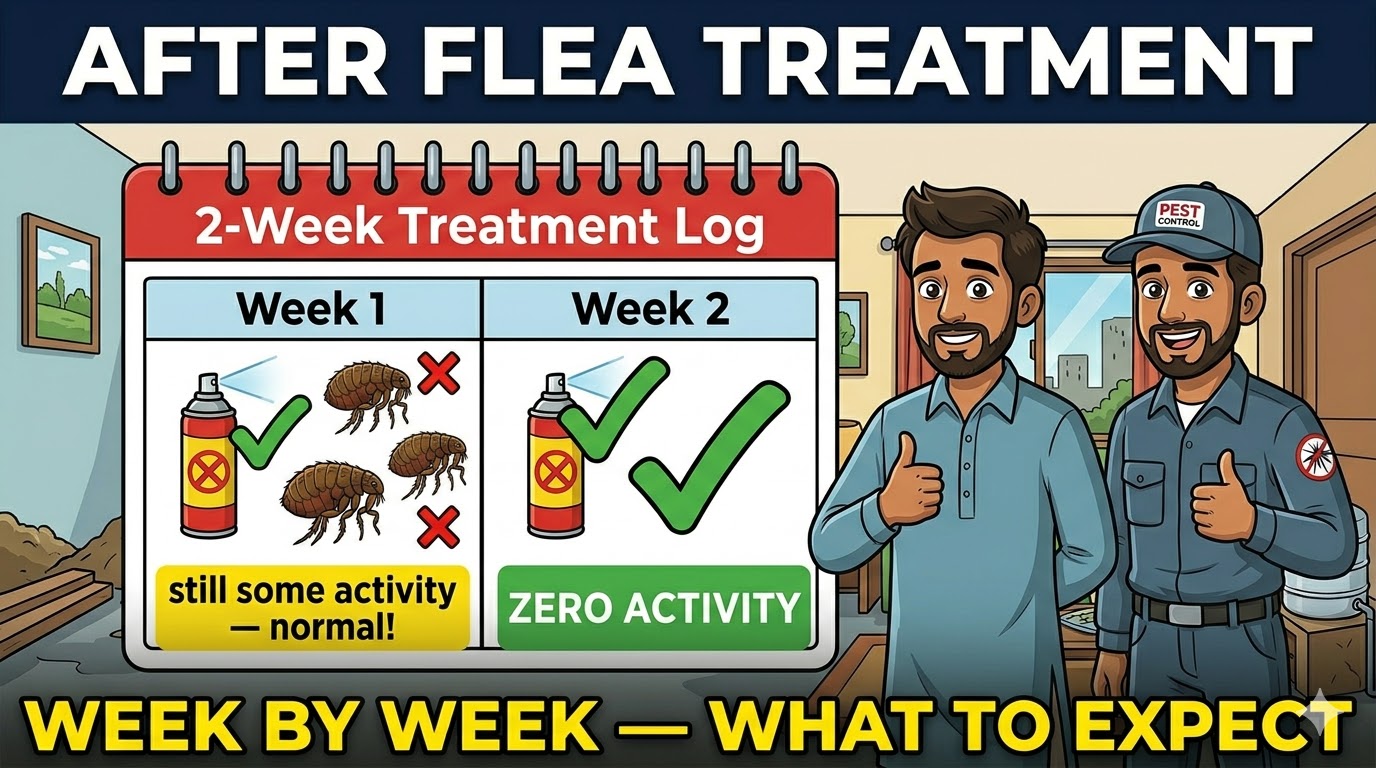
    Seeing fleas after professional treatment is expected. Read that again. If you see fleas in the days following treatment — particularly in the first week — this is not a sign that the treatment failed. It is a sign that the treatment is working as designed.

    Here is why: flea pupae sealed in their cocoons are immune to chemical treatment. They will continue to hatch after treatment. The newly hatched adults will be exposed to the residual insecticide on your floors and surfaces, and they will die — but not instantly. This process takes time, and during that time you may see live fleas. This is normal, expected, and is part of the treatment’s mechanism.

    Understanding this distinction is essential. Homeowners who do not know this often call their pest control provider in alarm after day three or four, convinced the treatment was ineffective. In most cases, everything is proceeding exactly as it should.

    Day-by-Day: What to Expect in Week One

    Days 1 to 3

    The immediate post-treatment period will show a significant drop in visible flea activity. Adult fleas that were present at the time of treatment are killed on contact or within hours of exposure to the residual product. Your pet, if treated concurrently, should also show reduced scratching.

    You may notice a faint chemical smell in treated rooms — this is normal and will dissipate with ventilation. The smell is strongest in carpeted areas and along skirting boards where product concentration is highest. Continue to ventilate the home after the minimum re-entry period, but avoid wet mopping treated floor surfaces.

    Days 4 to 7

    This is typically when homeowners begin to see new flea activity and become concerned. Pupae that survived the initial treatment are beginning to hatch, triggered by the vibration and heat of household activity. Newly hatched adults are exposed to the residual insecticide on treated surfaces and will die within hours — but they exist in your home for that window.

    Continue vacuuming daily. This is not optional maintenance advice — it is an active part of the treatment protocol. Every vacuuming session agitates additional pupae into hatching, bringing more of them into contact with the residual zone. The faster you trigger pupa hatching, the faster the infestation cycle is closed.

    Do not vacuum up the treated areas and then wash the floors. This removes the residual product that is doing the work.

    Days 7 to 10

    Flea activity may seem to peak during this period — counterintuitively, this is often the point at which the treatment is most actively working. Large numbers of pupae are hatching simultaneously, newly hatched adults are encountering the residual, and die-off is occurring rapidly. Many homeowners who push through this phase report a sharp decline in flea activity by day 10 to 12.

    Continue the protocol: daily vacuuming, no wet mopping of treated surfaces, pet flea prevention ongoing.

    Week Two: What Should Be Happening

    Days 10 to 14

    By the second week, the frequency of new flea sightings should be noticeably declining. The residual insecticide is still active on surfaces, and the majority of the pupae that were present at the time of treatment should have hatched and been eliminated by this point.

    If you are seeing a continued high level of activity — comparable to what you saw before treatment — this warrants a call to your pest control provider. It may indicate that the initial treatment missed key harbourage zones, that your pet’s flea treatment is not working, or that there is an ongoing external source of reinfestation (such as stray animal access to your property).

    This is also the period to begin preparing for your second round of treatment. Your flea and tick treatment provider in Karachi should have already scheduled the follow-up — if not, contact them now. The optimal window for the second round is 14 to 21 days after the first.

    What You Must NOT Do in the First Two Weeks

    Do Not Mop or Steam Clean Treated Surfaces

    Wet mopping and steam cleaning are the single most effective ways to destroy the residual insecticide that is doing the ongoing work after treatment. Many homeowners who call their pest control provider reporting treatment failure have, on investigation, steam cleaned or wet mopped their floors within the first week. The residual was removed, the hatching pupae found no insecticide, survived, and began reproducing.

    Dry vacuuming is acceptable and encouraged. Wet cleaning is not.

    Do Not Wash Treated Rugs and Upholstery

    For the same reason, do not wash, beat, or wet-clean any soft furnishing that was included in the treatment zone during the first two weeks. If specific items need cleaning urgently for hygiene reasons, discuss this with your technician first.

    Do Not Stop Your Pet’s Flea Treatment

    A treated home with an untreated pet is the most reliably ineffective combination in flea control. Your pet continues to serve as a host for any fleas that hatch and a transport mechanism for reintroduction. Maintain your pet’s flea prevention continuously — this is particularly important in Karachi where stray animal contact is nearly unavoidable.

    Do Not Assume One Treatment Is Enough

    This point cannot be overstated. The single most common reason flea infestations persist in Karachi homes after professional treatment is not product failure — it is the absence of a properly timed second round. If your pest control provider has not proactively scheduled a follow-up, raise this before the two-week mark.

    What Signs Indicate a Problem Worth Calling About

    While some post-treatment flea activity is expected and normal, there are specific signs that warrant a call to your pest control provider before the scheduled second round:

    • Flea activity is as intense on day 14 as it was before treatment
    • Bites are continuing on multiple family members daily
    • Your pet shows no improvement in scratching or skin irritation despite ongoing veterinary flea treatment
    • You are finding ticks on family members or pets, suggesting tick treatment may have been incomplete
    • The infestation appears to be spreading to rooms that were not previously affected

    Managing Your Family’s Comfort During This Period

    The first two weeks after treatment can be uncomfortable, particularly if young children are present. Some practical measures to reduce exposure and manage bites:

    • Have children wear socks and light trousers indoors to reduce direct skin exposure to ground-level flea activity
    • Use a mild antihistamine cream (paediatric formula) for bite relief — consult your pharmacist or doctor
    • Focus children’s indoor activities on elevated surfaces (beds, sofas) rather than floor-level play during the peak hatching period
    • Change and wash children’s clothing daily during this period
    • Continue using your vacuum daily and ensuring the home is well-ventilated

    After the Second Round: The Road to a Flea-Free Home

    Following a well-executed second treatment, most households in Karachi achieve complete flea elimination within one to two weeks post the second round — assuming the pet is treated, the home preparation was thorough, and no significant external reintroduction source is present.

    The weeks after the second treatment follow a similar but typically shorter and less intense version of the first post-treatment period. Again, some pupa hatching and new adult activity may occur in the first week after the second round. The residual from the second treatment handles this final wave.

    At the four to six-week mark from the first treatment, a successfully treated Karachi home should be entirely flea-free — assuming ongoing pet treatment continues and external introduction pathways have been addressed.

    Long-Term Prevention After Treatment

    Once your home is free of fleas, maintaining that status requires modest but consistent effort:

    • Keep your pet on year-round prescription flea prevention — not seasonal
    • Vacuum carpets and rugs twice weekly as routine maintenance
    • Wash pet bedding weekly in hot water
    • Seal gaps around exterior doors and access points that strays may pass through
    • Schedule a professional inspection annually if your home has ongoing stray animal exposure nearby

    Final Thoughts

    The two weeks following professional flea treatment are a period that requires patience, consistency, and the right information. Homeowners who know what to expect, follow the protocol, and maintain communication with their pest control provider navigate this period with confidence and achieve lasting results. If you are currently post-treatment and have questions about what you are seeing, or if you need to schedule your second round, reach out to Karachi Fumigation Services for straightforward, expert guidance.

    Questions About Your Post-Treatment Period? We Are Here to Help Whether you are mid-treatment and seeing fleas, approaching your second-round window, or concerned about reinfestation risk — our team can assess the situation and advise you clearly. Book a free follow-up inspection with Karachi Fumigation Services. Call or WhatsApp us today.