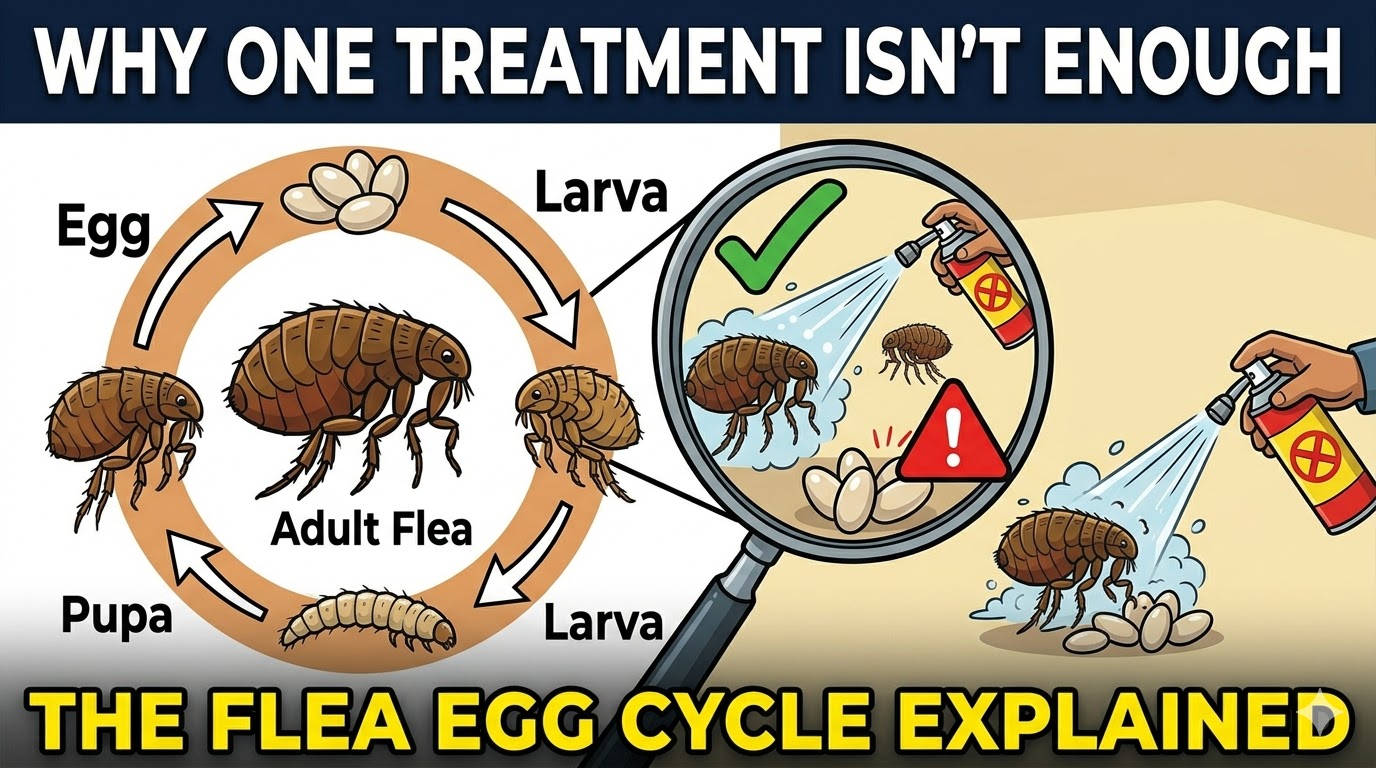
You have had your home treated for fleas. A week later, you are still seeing them. This is not a sign that the treatment failed — it is a sign that you need to understand the flea life cycle, and why a single treatment is almost never enough.
The Most Common Frustration After Flea Treatment
It is one of the most common complaints pest control teams in Karachi hear from homeowners: ‘We got the house treated two weeks ago and the fleas are back.’ The instinct is to blame the product or the technician. But in the vast majority of cases, what homeowners are seeing is not a treatment failure — it is biology doing exactly what biology does.
The flea life cycle is the single most important thing to understand if you want to successfully eliminate an infestation. Without this knowledge, you will keep repeating treatments and keep experiencing reappearances — and you will keep spending money without permanent results.
The Four Stages of the Flea Life Cycle
Stage 1: The Egg
Adult female fleas begin laying eggs within 24 to 48 hours of taking a blood meal. A single female can produce up to 50 eggs per day. These eggs are smooth, white, and about 0.5mm in size — virtually invisible to the naked eye. They are not sticky and roll off your pet’s fur onto carpets, bedding, cracks in flooring, and furniture.
This is important: flea eggs are not on your pet. They are in your home. Every time your pet walks from room to room, it is distributing eggs across every surface it touches.
Flea eggs are resistant to most surface-level insecticide sprays. They are protected by their shell and lie dormant through treatment.
Stage 2: The Larva
Eggs hatch into larvae within one to ten days depending on temperature and humidity. Karachi’s warm, humid coastal climate — particularly from May through October — accelerates this significantly. Larvae avoid light and burrow deep into carpet fibres, floor joints, and soil under furniture. They feed on organic debris and, critically, on the dried blood faeces left by adult fleas.
Larvae are more vulnerable to treatment than eggs but are still not easy to eliminate when tucked deep into fibres and cracks. This is why proper vacuuming before treatment is essential — it agitates larvae and brings them closer to the surface.
Stage 3: The Pupa
This is the stage that defeats most DIY and single-session treatments. Larvae spin a sticky, silken cocoon — the pupa — in which they develop into adult fleas. These cocoons are extraordinarily resilient. They are sticky (debris clings to them, providing camouflage), resistant to chemical penetration, and the developing flea inside can remain dormant for up to five months while waiting for the right environmental signals to emerge.
What triggers emergence? Vibration. Heat. Carbon dioxide — the kind exhaled by a nearby host. When you or your pet walks across a treated area, pupae may detect your presence and hatch within seconds. This is why homeowners who leave a treated home vacant for weeks return to find newly hatched fleas waiting for them.
Stage 4: The Adult
Newly hatched adult fleas are hungry and immediately seek a host. They jump up to 30 centimetres vertically — remarkable for an insect their size. Adults begin feeding within minutes of finding a host and begin laying eggs within 24 to 48 hours, restarting the entire cycle.
Adult fleas are the only stage you can see easily and the only stage that bites. They represent only about 5% of the total flea population in an infested home. The remaining 95% — eggs, larvae, and pupae — are invisible to you, distributed throughout your home, and largely unaffected by surface-level treatments.
Why One Treatment Cannot Break the Cycle
Even the best professional treatment will kill adult fleas on contact and leave residual insecticide that remains active on surfaces for two to four weeks. But it cannot penetrate flea eggs, and it cannot kill pupae sealed in their cocoons.
What happens after the first treatment:
- Adult fleas are killed on contact or within hours of the residual exposure
- Eggs on the floor are not affected — they continue developing
- Pupae already in cocoons are not penetrated — they continue developing
- Within 7 to 14 days, a new wave of adults begins hatching from those pupae
- These new adults are now exposed to the residual insecticide — if it is still active — and are killed
- But if the residual has faded or was inconsistently applied, the new adults survive, feed, and begin a new breeding cycle
This is precisely why you see ‘new’ fleas after a treatment. They are not survivors of the original population — they are the next generation, freshly hatched.
Why the Second Round Is Non-Negotiable
The second treatment, typically scheduled two to three weeks after the first, is timed specifically to catch the newly hatched adult fleas before they have had the chance to feed and reproduce. The goal is to break the cycle at this vulnerable transition point.
Any reputable provider offering flea and tick treatment in Karachi will schedule a follow-up session as part of the standard protocol — not as an upsell, but because a single treatment is genuinely insufficient to resolve a full infestation.
The timing of the second round matters. Too early, and not enough pupae have hatched yet. Too late, and newly hatched adults have already fed and started a new egg cycle. A window of 14 to 21 days is generally optimal.
Karachi-Specific Factors That Accelerate the Cycle
In cities with temperate or cold winters, flea populations naturally decline during certain months. Karachi does not have this seasonal advantage. The city’s climate — warm and humid for most of the year — keeps flea eggs, larvae, and pupae in perpetual development mode. There is no winter die-off.
Additionally, Karachi homes frequently have:
- Wall-to-wall marble or tile flooring with gaps and grouting where larvae hide
- Thick rugs and daris that provide deep refuge for all flea life stages
- Multiple pets or shared building spaces where re-infestation is ongoing
- Proximity to stray animal populations that serve as constant flea reservoirs
All of these factors mean the egg-to-adult cycle completes faster, flea populations rebound quicker, and the window for effective second-round treatment is narrower than in cooler climates.
What You Must Do Between Rounds
The period between the first and second treatment is not passive waiting time. What you do during these two to three weeks significantly affects whether the second round succeeds:
- Vacuum daily — the vibration stimulates pupae to hatch, exposing them to the residual insecticide
- Keep children and pets out of heavily infested areas as much as possible
- Continue pet flea treatment as directed by your vet — your pet must not serve as a reinfection source
- Avoid steam cleaning or wet mopping treated surfaces, as this degrades the residual insecticide
- Do not wash treated soft furnishings until after the second round
How Many Rounds Are Really Needed?
For most standard residential infestations in Karachi, two rounds are sufficient if both are properly timed and correctly executed, the pet is treated concurrently, and the homeowner follows the between-round guidelines.
However, in severe infestations — particularly in homes where the infestation has been present undetected for weeks or months — a third round may be advisable, especially if the home has multiple animals, heavy carpeting, or ground-floor access from a courtyard or garden where stray animals enter.
The Takeaway
Understanding the flea egg cycle is not academic knowledge — it is practical information that directly affects whether your home stays flea-free. A second round of treatment is not a sign that the first one failed. It is an expected, necessary part of breaking the reproductive cycle. If you are unsure whether your current pest control provider is following this protocol, or if you are seeing fleas after a single treatment, it may be time to speak with professionals who understand how the biology actually works. For expert advice on scheduling and carrying out effective multi-round treatments, fumigation services in Karachi that specialise in flea infestations can guide you through the full process.
Book Your Free Inspection Still seeing fleas after a single treatment? Let our team assess your home, identify the infestation stage, and design a properly timed two-round treatment plan that actually works. Contact Karachi Fumigation Services today — inspections are free and carry no obligation.

Ahmad Karimi is a PPMA-registered pest management specialist and the lead technical consultant at Karachi Fumigation Services, where he has overseen field operations and treatment protocols since 2005. With over 20 years of hands-on experience treating residential, commercial, and industrial properties across Karachi — from DHA bungalows with structural termite infestations to Korangi factories requiring large-scale rodent exclusion — he brings direct field knowledge to every article published on this blog.
Ahmad has managed pest control programs for clients including Descon Engineering, Pakistan Tobacco Company, Saylani Welfare, and J. (Junaid Jamshed), and has issued hundreds of fumigation certificates for health authority compliance, import/export, and commercial licensing purposes. He holds active PPMA membership and works exclusively with WHO-approved chemicals in all field operations.
The content on this blog draws directly from two decades of Karachi-specific infestation data — seasonal pest patterns, neighbourhood-level risk factors, building-age vulnerabilities, and the regulatory requirements that Karachi businesses actually face. No recycled content from foreign pest control sites. Every article reflects conditions specific to Karachi’s climate, infrastructure, and compliance environment.
For treatment enquiries or technical questions, Ahmad’s team can be reached at 03463303875 or via the office at Trade Tower, Civil Lines, Karachi.
Leave a Reply