
You have sprayed your kitchen thoroughly. The cockroaches have disappeared, for now. Then, three weeks later, you start seeing small nymphs. Young ones, barely a centimetre long, appearing in the same corners and cracks as before. You spray again. The cycle repeats.
What you are witnessing is the egg cycle at work. And until you understand how cockroach eggs are produced, where they are hidden, and why standard spray treatments cannot reach them, you will keep experiencing this same frustrating pattern.
What Is a Cockroach Egg Case?
Female cockroaches do not lay individual eggs. They produce an ootheca: a hardened egg case that contains multiple developing embryos in a protective protein capsule. The ootheca is remarkably durable: it is resistant to desiccation, and critically, to many contact insecticides that would kill an adult cockroach on direct exposure.
German vs American cockroach egg cases
German cockroach
Small kitchen cockroach
- 30–40 eggs per case
- Female carries the case until about a day before it hatches
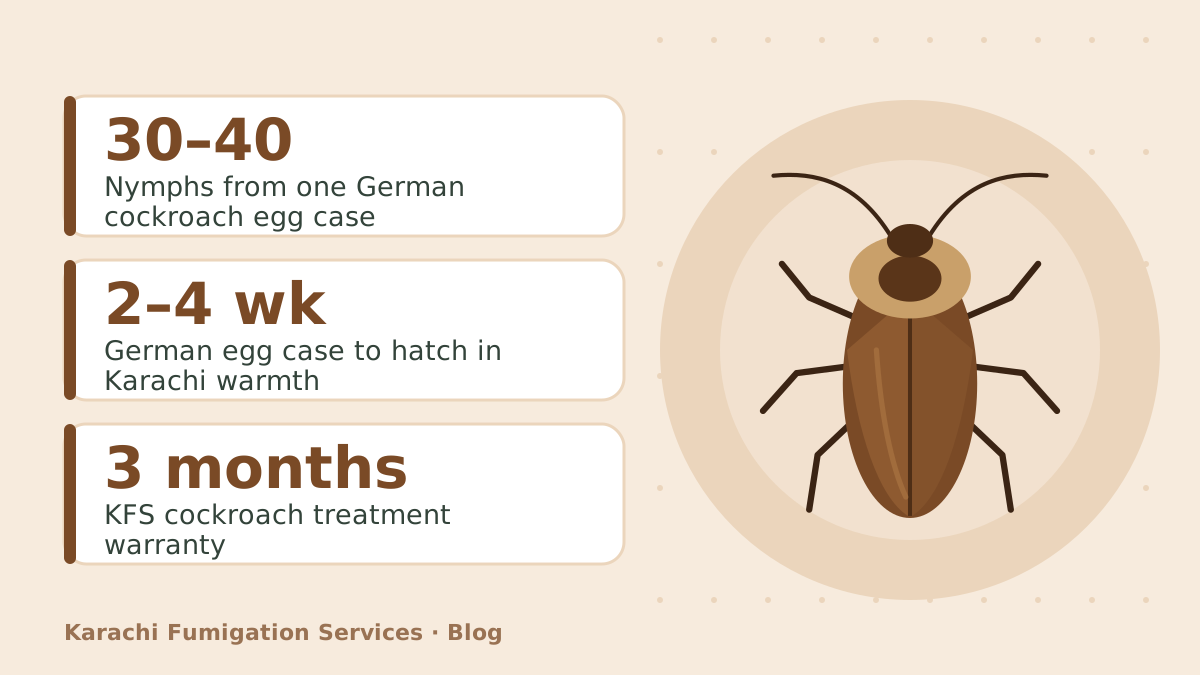
- Hatches in roughly 2–4 weeks in Karachi warmth
- Case about 6–9 mm, light brown
American cockroach
Large drain cockroach (lal baig)
- 12–15 eggs per case
- Case is glued in a hidden spot long before hatching
- Takes longer, often six weeks or more
- Case about 8 mm, dark reddish-brown
Either way, the case shields the eggs from contact spray. The treatment has to outlast the hatch.
The German cockroach, the most common species found in Karachi kitchens, produces oothecae containing 30 to 40 eggs each, and a female produces several over her life. Unlike most species, she carries the case on her body for almost the whole incubation and drops it in a sheltered spot about a day before it hatches. Under Karachi's warm conditions, eggs hatch in roughly 14 to 28 days. Spray her while she is carrying it and the case can still hatch.
The American cockroach, the large sewage-associated species also extremely common in Karachi, produces oothecae of around 12 to 15 eggs each, glues them in hidden places, and keeps producing them for most of her long adult life. These cases take longer to hatch, often six weeks or more.
Consider the arithmetic: a single German cockroach female in your kitchen can produce well over a hundred offspring before she dies. In a colony of dozens of reproductive females, the production rate is enormous, and almost all of it is happening in locations your spray never touches.
Why the Ootheca Is Spray-Resistant
The hard outer shell of the ootheca acts as a physical barrier. Contact insecticide sprays work by penetrating the cuticle of an exposed cockroach or being ingested during grooming. An egg case has no cuticle to penetrate and no grooming behaviour. The insecticide simply sits on the surface and evaporates without reaching the developing embryos inside.
This is the fundamental reason why a spray treatment that appears to eliminate an active infestation will be followed by reinfestation within three to four weeks: the adults and nymphs are killed, but the oothecae survive and hatch on schedule, producing a new generation. If no treatment is in place to address the hatchlings, they mature and begin producing their own oothecae within about two months in warm conditions.
Where Cockroach Egg Cases Are Hidden in Karachi Homes
Female cockroaches deposit oothecae (German females at the last moment, American females well before hatching) in protected, warm, humid locations as close to food sources as possible. In Karachi homes, the most common hiding sites include:
Where egg cases hide in a Karachi kitchen
- Fridge motor compartment Warm, dark and never cleaned
- Cabinet hinges and voids Gaps inside hinges and hollow cabinet bases
- Under the sink Humid space around the drain-pipe collar
- Wall cracks and tile gaps Broken grout and wall-floor joints
- Behind switch and socket plates Warm, dark void behind the cover
- Back of base cabinets The gap between the back panel and the wall
Behind and underneath kitchen appliances: The motor compartment of a refrigerator is one of the most productive egg-laying sites in any Karachi kitchen. It is warm, dark, vibration-dampened, and rarely disturbed. Oothecae are also commonly found behind washing machines, underneath microwave stands, and inside the recesses of dishwashers.
Inside kitchen cabinet hinges and base cavities: The gaps inside cabinet hinge mechanisms, the hollow bases of mounted cabinets, and the narrow void between the back panel of a base cabinet and the wall are all favoured sites. These areas are typically never cleaned and never sprayed.
Under the kitchen sink: The warm, humid environment beneath a sink, particularly around the drain pipe collar, is heavily used for egg laying in Karachi kitchens. The combination of moisture and warmth makes it ideal.
In wall cracks and tile gaps: Any crack in kitchen tiling, gap at the junction between wall and floor, or deteriorated grout line provides a sheltered deposit site. These are impossible to spray effectively without very targeted equipment.
Behind electrical switch boxes and socket plates: The void behind a switch plate or socket cover on a kitchen wall is warm (from electrical activity), dark, and completely undisturbed. Oothecae are commonly found in these locations during professional inspections.
Inside hollow curtain rods and door frame gaps: Less commonly known, but cockroaches will carry oothecae to any sufficiently undisturbed cavity, including the hollow interior of aluminium window frame sections, hollow skirting boards, and door frame voids.
In book spines and stacked paper: In rooms where paper goods are stored (office areas, storage rooms) the spaces between stacked books and documents are used. The paste and sizing in bookbinding also provides a food source.
The common thread across all these sites is that they are protected, warm, undisturbed, and inaccessible to the basic cleaning and spraying routine of any household.
Signs That Egg Cases Are Present
Homeowners who know what to look for can identify oothecae during careful inspection:
- German cockroach oothecae are small (roughly 6 to 9 mm), light brown, and ridged: resembling a tiny purse, and often seen still attached to the female's abdomen
- American cockroach oothecae are about 8 mm, dark reddish-brown to black, and more rounded
- They are typically glued to surfaces near food sources or in harbourage sites
- Shed ootheca casings (empty cases after hatching) are paler and papery
Finding oothecae, including empty ones, confirms that the infestation is actively breeding in your home, not just passing through from outside.
What Spray Treatment Does and Does Not Do
Residual spray treatments, when correctly applied, are effective at killing adult cockroaches and nymphs that contact treated surfaces. They can produce a significant and rapid visible reduction in cockroach activity. This is why homeowners who spray see results initially: the visible population is suppressed.
What spray does not do:
- Penetrate or affect oothecae
- Reach harbourage sites hidden in wall cavities and appliance interiors
- Prevent surviving egg cases from hatching 2 to 4 weeks after treatment
- Control the next generation emerging from those eggs
This is why the word 'alone' in this article's title matters. Spray treatment is not useless; it is just incomplete when used without addressing the egg cycle.
Treatment Approaches That Address the Egg Cycle
Comprehensive cockroach control requires an integrated approach that accounts for egg cases:
Why one spray is not enough
Days after the first treatment
Gel bait with cascade effect: Professional gel baits work partly because their slow-acting toxicant passes through the food chain: a poisoned cockroach is consumed by nest-mates, and hatching nymphs exposed to contaminated adults and their frass also ingest the toxicant. This creates pressure on successive generations, including those emerging from egg cases.
Follow-up treatment: A second treatment timed to coincide with egg case hatching, typically 14 to 21 days after initial treatment, addresses the new generation before it reaches reproductive maturity. Without this step, the infestation often rebounds.
Physical removal of accessible oothecae: During a professional inspection, accessible oothecae can be physically removed and destroyed. This is not possible in all locations but can reduce the reproductive load significantly.
Insect growth regulators (IGRs): These compounds interrupt cockroach development, preventing nymphs from maturing to reproductive adults. When incorporated into a treatment plan, they effectively break the breeding cycle over successive generations.
A properly structured cockroach extermination service in Karachi incorporates all of these elements, not just a single spray application, because only an integrated approach can address both the active population and the egg cycle simultaneously.
On our visits these steps happen together: gel bait goes into hinges, cabinet bases and appliance voids, a residual spray and an electric fogger cover the cracks and cavities, and the drain lines are treated. You will still see cockroaches for 5 to 7 days afterwards; that is the bait working, not the treatment failing. The work carries a 3-month written warranty, and the active ingredients we use for cockroaches are listed on our chemicals we use page.
Karachi-Specific Considerations
In Karachi's climate, egg development is accelerated by ambient heat. Hatching can occur at the faster end of the 14 to 28 day window during the summer months, meaning the reinfestation cycle following an inadequate treatment can be as short as two weeks. Treatment plans must account for this accelerated timeline with appropriately timed follow-up visits.
Additionally, Karachi's housing stock (particularly the older residential buildings across areas like Saddar, PECHS, Liaquatabad, and Gulshan-e-Iqbal) contains the kinds of deteriorated wall surfaces, cracked tiles, and inaccessible cabinet configurations that create maximum egg-laying opportunity. Newer construction is not immune, but these older structural characteristics significantly increase the number of protected harbourage sites available.