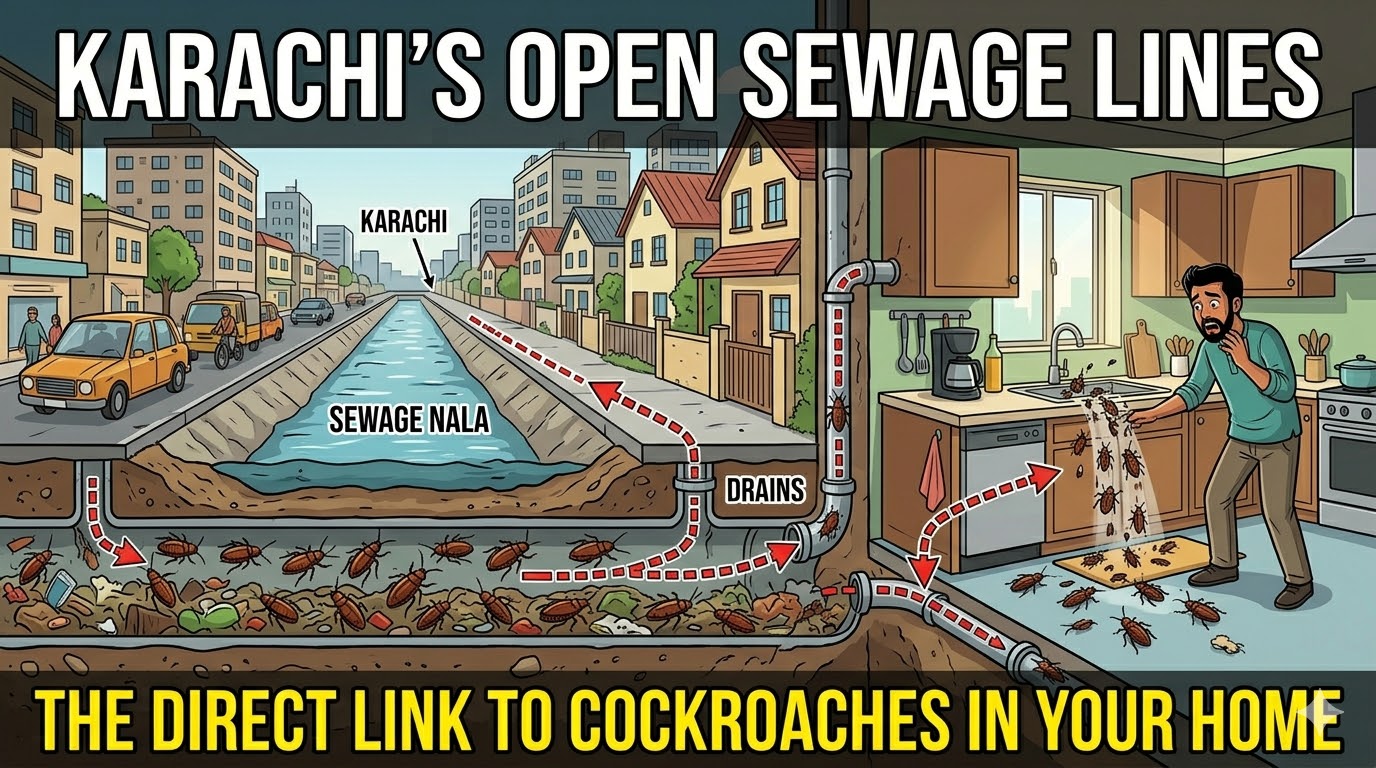
Karachi’s drainage infrastructure is, by any honest assessment, one of the city’s most persistent and far-reaching public health challenges. Open sewage channels run through residential neighbourhoods from Orangi Town and Korangi to parts of Lyari, Landhi, and beyond. Even in areas with underground drainage, ageing pipes leak, manholes overflow during rain, and infrastructure gaps leave large stretches of sewage exposed.
For cockroaches — specifically the American cockroach (Periplaneta americana), which Karachi residents often refer to as the large or sewage cockroach — this infrastructure is not a hazard. It is a habitat. And the connection between outdoor sewage systems and indoor cockroach infestations is far more direct, continuous, and difficult to interrupt than most homeowners realise.
Understanding the American Cockroach’s Relationship with Sewage
The American cockroach is a sewage specialist. It thrives in the warm, moist, organically rich environment of drainage systems — feeding on the organic matter that accumulates in pipes and channels, breeding in the stable temperature conditions that underground systems provide, and using the drainage network as a city-wide highway that connects outdoor environments to the interior of buildings.
Unlike the German cockroach, which typically establishes its primary colony inside a building, the American cockroach maintains large populations in sewage infrastructure and makes regular incursions into buildings to forage. This fundamental difference has critical implications for treatment: you can eliminate every American cockroach inside your home, but if the sewage connection remains open, you will have new cockroaches within days.
The Scale of the Problem in Karachi
Karachi has an estimated population of over 20 million people served by drainage infrastructure designed for a fraction of that number. Open nallahs — drainage channels — run for hundreds of kilometres through residential areas. Underground sewers are present in some parts of the city but are frequently cracked, overloaded, and poorly maintained.
In areas with open sewage channels — Orangi Town (home to one of the largest informal sewage networks in the world), Korangi Industrial Area, parts of Gulshan-e-Hadeed, Baldia Town, and numerous katchi abadis across the city — the cockroach population sustained by this infrastructure is enormous. Surveys and ecological studies of urban sewage systems consistently find American cockroach population densities measured in thousands per kilometre of drainage channel.
These populations do not stay in the drain. They forage into the surrounding urban environment every night, and the homes, shops, and buildings closest to open sewage lines bear the heaviest infestation pressure.
How Cockroaches Move from Sewage Lines into Your Home
The pathway from an open sewage channel to the interior of a residential building typically works as follows:
Step 1 — Exit from the drain system. American cockroaches exit sewage infrastructure through manholes, open channel edges, pipe joints, and any unsealed connection between the underground drainage network and the surrounding environment. In Karachi’s older residential areas, these exit points are numerous.
Step 2 — Entry into the building’s drainage connection. Once outside, cockroaches quickly locate the drain connections of nearby buildings. These include the external floor drain openings, the pipe connections at the building perimeter, and any point where the building’s internal drainage system connects to the municipal system.
Step 3 — Movement through internal drainage. Once inside the building’s drain system, American cockroaches move freely through the internal pipe network. They emerge through bathroom floor drains, toilet bases, kitchen sink drain points, and any other opening in the drainage system inside the building.
Step 4 — Indoor foraging. Cockroaches that enter through drains forage for food in kitchens and food storage areas, contaminating surfaces, food, and utensils before returning to the drain system before dawn.
This cycle repeats nightly. Without intervention at the entry point, it will continue indefinitely — regardless of how many times the interior of the home is treated.
Karachi’s Monsoon Season: When the Problem Intensifies
Karachi’s monsoon season — typically July through September — dramatically worsens the sewage-to-home cockroach problem. When heavy rain floods open drains and causes underground systems to overflow, cockroaches are displaced from their sewage harborage in very large numbers and actively seek alternative shelter. This is when Karachi homeowners report the most alarming cockroach incursions: large cockroaches appearing suddenly in kitchens and bathrooms in numbers that seem to emerge from nowhere.
They are not coming from nowhere. They are coming from the flooded drain system — forced out by water and seeking any available dry, warm space. Buildings with unsealed drain connections are particularly vulnerable during these episodes. In areas like Malir, Landhi, and low-lying parts of Korangi where flooding is most severe, monsoon season cockroach incursions can be extreme.
The Specific Entry Points in a Typical Karachi Home
Understanding the specific ways sewage cockroaches enter homes allows homeowners to prioritise protective measures. The most significant entry points are:
- Bathroom floor drain grilles — particularly those with missing, damaged, or ill-fitting covers
- The gap around toilet base connections where the toilet outlet pipe meets the floor drain
- The drain connection beneath the kitchen sink, particularly if the drain pipe seal has degraded
- External drain openings in the building’s courtyard or stairwell areas
- The point where the building’s main drainage stack exits through the ground floor or basement
- Any crack or gap in ground-floor flooring near drain infrastructure
In Karachi’s older housing stock — and even in many newer buildings where construction quality control has been poor — multiple of these entry points are typically unsealed or inadequately protected.
Why Interior Treatment Without Drain Management Fails
This is the core practical problem for Karachi homeowners living near open sewage infrastructure: no interior treatment, however thorough, will produce lasting results if the sewage entry pathway remains open.
Professional cockroach pest control in Karachi that does not include an assessment and treatment of drain entry points is an incomplete solution. A high-quality gel bait treatment or residual spray can suppress the indoor population effectively, but within one to two weeks, the population will be replenished from the sewage reservoir outside. The treatment must address both the interior infestation and the entry pathway simultaneously.
What Homeowners Can Do to Reduce Sewage Cockroach Ingress
While wholesale resolution of Karachi’s sewage infrastructure is beyond any individual homeowner’s ability, targeted protective measures can significantly reduce ingress:
- Fit weighted or sealed drain covers on all bathroom floor drain points — weighted designs resist cockroaches pushing up from below
- Seal the gap around toilet base connections with appropriate sanitary sealant, inspecting regularly for deterioration
- Ensure the P-trap under every sink drain is functioning and maintains its water seal — a dry P-trap provides direct access from the drain system
- Seal visible gaps in ground-floor slab around drain pipe exits using cement or expanding foam
- Keep external drain openings in courtyards covered or fitted with pest-proof grilles
- During monsoon season, pay particular attention to drain covers and inspect them after heavy rain events
These measures reduce but do not eliminate the risk, particularly in properties adjacent to open sewage channels. Professional treatment of the interior is still necessary where an active infestation exists.
The Wider Context: Urban Cockroach Pressure in Karachi
The sewage-cockroach connection is a city-level public health issue. In neighbourhoods with open nullah infrastructure, every building faces continuous cockroach pressure from the surrounding environment. Individual homeowners are not simply managing a domestic pest problem — they are managing the interface between their home and a vast urban cockroach population sustained by inadequate public infrastructure.
This context matters for setting realistic expectations. Complete and permanent elimination of American cockroach activity in a home adjacent to open sewage lines is not achievable through treatment alone. The goal is effective ongoing management: keeping the interior population suppressed, maintaining entry point protection, and addressing ingress promptly when it occurs.
Book a Free Inspection — Including Drain Entry Assessment
If you live in or near an area with open sewage infrastructure, your cockroach problem has an external source that interior treatment alone cannot resolve. Our team assesses both the interior infestation and the external entry pathways — identifying the drain connections that cockroaches are using to access your home and recommending the appropriate combination of treatment and structural protection.
Contact Karachi Fumigation Services today to book your free inspection. Understanding the full picture — including the sewage connection — is the only way to develop a treatment plan that actually works in Karachi’s environment.

Ahmad Karimi is a PPMA-registered pest management specialist and the lead technical consultant at Karachi Fumigation Services, where he has overseen field operations and treatment protocols since 2005. With over 20 years of hands-on experience treating residential, commercial, and industrial properties across Karachi — from DHA bungalows with structural termite infestations to Korangi factories requiring large-scale rodent exclusion — he brings direct field knowledge to every article published on this blog.
Ahmad has managed pest control programs for clients including Descon Engineering, Pakistan Tobacco Company, Saylani Welfare, and J. (Junaid Jamshed), and has issued hundreds of fumigation certificates for health authority compliance, import/export, and commercial licensing purposes. He holds active PPMA membership and works exclusively with WHO-approved chemicals in all field operations.
The content on this blog draws directly from two decades of Karachi-specific infestation data — seasonal pest patterns, neighbourhood-level risk factors, building-age vulnerabilities, and the regulatory requirements that Karachi businesses actually face. No recycled content from foreign pest control sites. Every article reflects conditions specific to Karachi’s climate, infrastructure, and compliance environment.
For treatment enquiries or technical questions, Ahmad’s team can be reached at 03463303875 or via the office at Trade Tower, Civil Lines, Karachi.
Leave a Reply