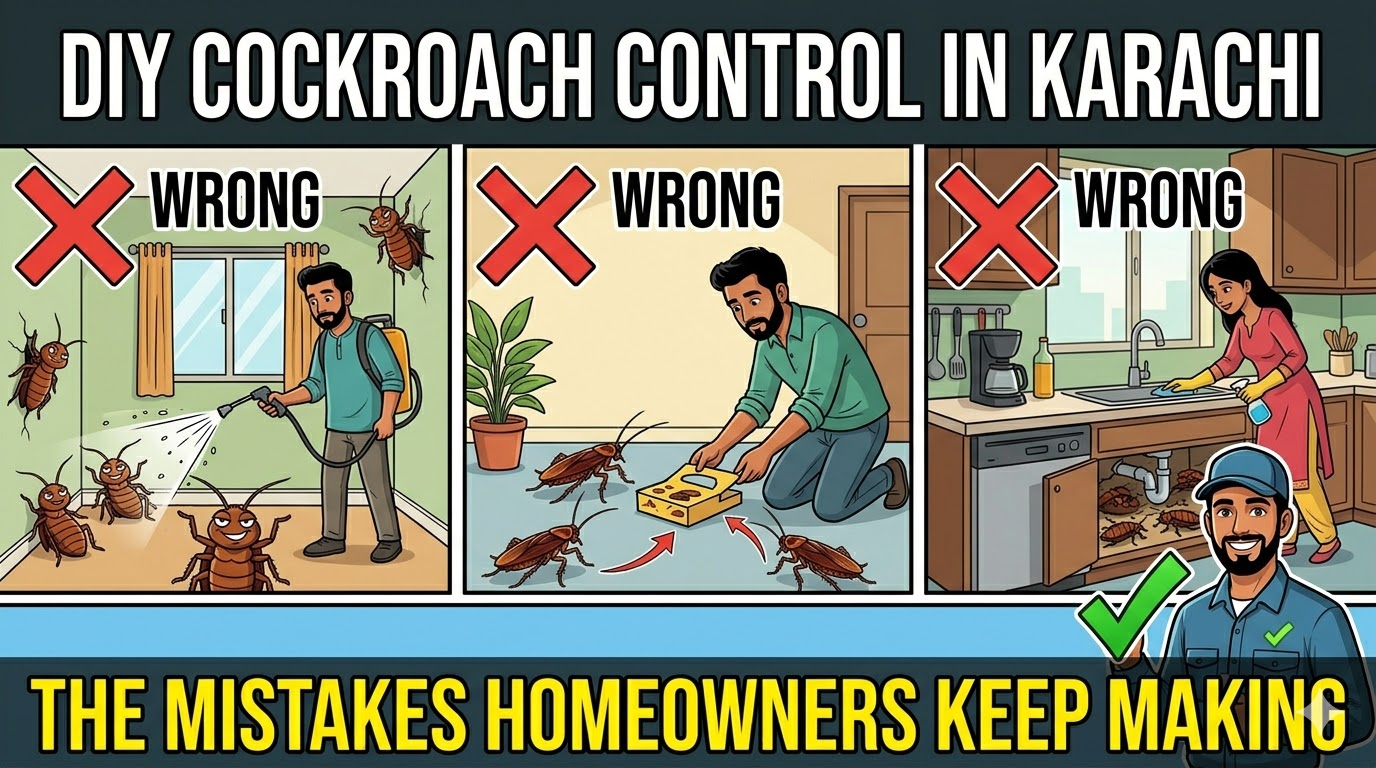
Every year, Karachi homeowners spend significant money on sprays, chalk lines, ultrasonic devices, and homemade remedies — and most of them continue to have cockroaches. This is not because those homeowners are not trying hard enough. It is because the most common DIY cockroach control approaches are built on fundamental misunderstandings of how cockroaches behave, breed, and survive.
This article is not written to make you feel bad about what you have tried. It is written because the mistakes are consistent, understandable, and entirely fixable — and recognising them is the first step toward actually solving the problem.
Mistake 1: Treating What You Can See Instead of Where They Live
The instinct when you see a cockroach is to spray it. The cockroach dies. The problem feels addressed. But the cockroach you saw was a forager — a single individual that had emerged from the colony to find food. Killing it does not affect the dozens or hundreds of cockroaches still hidden in their harborage: behind wall tiles, inside the motor compartment of your fridge, underneath the base of your kitchen cabinets, in the gap behind your water heater.
Effective cockroach control requires treating the harborage — the nesting site — not just the visible individuals. This is why a can of spray used across a kitchen surface, however thoroughly, will not produce lasting results. The colony is untouched, and it will continue to send foragers out every night.
Mistake 2: Using Spray and Bait at the Same Time
Many Karachi homeowners, frustrated by results from spray alone, decide to add gel bait to their approach — using both simultaneously in the hope of covering all bases. This actually undermines both treatments.
Most residual insecticide sprays contain repellent compounds. When applied to surfaces near bait placement points, they make cockroaches avoid those areas entirely — including the bait. The result is that the bait goes untouched, the spray kills the few cockroaches that contact treated surfaces, and the bulk of the colony remains undisturbed. If you are using gel bait, surfaces in and around the bait application area should not be treated with repellent spray.
Mistake 3: Applying Bait Incorrectly
Consumer-grade gel baits are available in Karachi, and some homeowners do try them. The most common errors in application are:
- Applying too much — cockroaches avoid oversized bait deposits; placements should be pea-sized
- Placing bait in open visible areas rather than along edges, in corners, and inside crack openings where cockroaches actually travel
- Not replacing dried-out bait — Karachi’s heat evaporates bait moisture quickly, making it unpalatable
- Placing bait too far from actual harborage sites — cockroaches are unlikely to travel far from their nest to feed
- Using bait alongside sprays, as described above
Correct bait placement requires knowledge of cockroach behaviour and an understanding of where harborage sites are likely to be in your specific kitchen layout — knowledge that comes from experience and proper inspection, not guesswork.
Mistake 4: Focusing Only on the Kitchen
Karachi homeowners almost always focus cockroach control efforts on the kitchen because that is where cockroaches are most visible. However, German cockroaches — the dominant kitchen species — do not limit themselves to one room. They establish secondary harborage in bathrooms, in gaps around toilet bases and cisterns, behind bathroom cabinets, and inside the motor compartments of washing machines.
American cockroaches — the larger sewage species common in Karachi — use bathroom drains and floor grates as entry points and will forage well beyond the bathroom into any room of the home. Treating only the kitchen while leaving bathroom entry points unaddressed means the infestation has an ongoing unchallenged access route into the home.
Mistake 5: Not Sealing Entry Points
Even a perfectly executed treatment will be followed by reinfestation if the pathways through which cockroaches enter the home are not addressed. The most common unsealed entry points in Karachi homes include:
- Gaps around drain pipes under kitchen sinks and in bathroom floors
- Gaps where gas pipes enter the kitchen wall
- Deteriorated seals around toilet bases
- Gaps at the junction between kitchen cabinet bases and walls
- Unsealed conduit entries near electrical switch boxes
- Gaps under exterior-facing doors, particularly kitchen or utility doors
Without sealing these entry points, cockroaches from external sources — the building’s drain infrastructure, neighbouring units, or the open sewage environment that surrounds much of Karachi — will continue to enter regardless of what is done to the population already inside.
Mistake 6: Treating Once and Considering It Done
Cockroach control is a process, not a single event. This is true even for professional treatments — which is why reputable pest control companies schedule follow-up visits rather than treating once and walking away.
The reason is eggs. Cockroach egg cases (oothecae) are highly resistant to most insecticides. An initial treatment can dramatically reduce the active adult and nymph population, but surviving egg cases will hatch one to three weeks later, beginning a new generation. Without a follow-up treatment to address newly hatched nymphs before they reach reproductive maturity, the infestation rebounds.
Many Karachi homeowners treat once, see a significant reduction in cockroach activity, conclude the problem is solved, and then find themselves back to the same level of infestation four to six weeks later. This is the egg cycle at work.
Mistake 7: Relying on Chalk, Essential Oils, or Ultrasonic Devices
Cockroach chalk (often called Chinese chalk or Miraculous Insecticide Chalk) is widely sold in Karachi markets and frequently used by homeowners. While it contains insecticide and can kill cockroaches that contact it, it presents significant health concerns — particularly for homes with children and pets — and is not approved for indoor use by reputable regulatory bodies. More importantly, it does not address the infestation systematically and provides no lasting colony control.
Essential oil repellents (peppermint, eucalyptus, bay leaves) may cause cockroaches to temporarily avoid treated areas but do not kill them or control the population. Cockroaches simply route around the repellent.
Ultrasonic devices have been evaluated repeatedly in studies and consistently shown to have no meaningful effect on cockroach behaviour or population. They are a waste of money.
Mistake 8: Assuming a Clean Home Cannot Have a Serious Infestation
Cleanliness reduces available food sources for cockroaches, which matters — but it does not prevent infestation. Cockroaches need very little to sustain themselves. A small amount of food residue in a drain, condensation on a pipe, or the paste in book bindings can sustain a cockroach. In Karachi’s environment, where cockroaches have access to building infrastructure, sewage systems, and external organic matter, they can survive independently of the cleanliness of your kitchen.
Many of Karachi’s cleanest, most well-maintained homes have serious cockroach infestations — because the infestation is entering through structural pathways, not because of hygiene failures. Conflating hygiene with pest control leads homeowners to clean more intensively while the actual problem — structural access — remains unaddressed.
Mistake 9: Not Inspecting the Problem Properly Before Treating
Effective cockroach control begins with a proper inspection: identifying the species involved, locating harborage sites, mapping travel routes, and assessing entry pathways. Most DIY treatments skip this step entirely — they treat the visible surfaces and hope for the best.
A professional cockroach inspection and treatment in Karachi begins with a systematic assessment of these factors before any treatment is applied. The inspection determines which treatment approach is appropriate, where it should be targeted, and what structural measures are needed to prevent reinfestation.
The Bottom Line
DIY cockroach control in Karachi is not ineffective because the products do not work. It is ineffective because the approach is usually reactive and incomplete — treating symptoms rather than causes, addressing visible insects rather than the colony, and skipping the structural work that prevents reinfestation.
Understanding these mistakes is valuable even if you plan to continue managing pest control yourself. But for established infestations in Karachi’s complex residential environment, professional intervention is consistently more effective and more cost-efficient over time than repeated DIY treatments that never fully resolve the problem.
Book Your Free Inspection Today
Stop wasting money on treatments that do not work. Our certified team will inspect your home, identify exactly where your infestation is coming from, and design a targeted treatment plan that addresses the problem at its source.
Book a free inspection with Karachi Fumigation Services today. The first step toward actually solving your cockroach problem is finding out the full picture — and that starts with a proper professional assessment.

Ahmad Karimi is a PPMA-registered pest management specialist and the lead technical consultant at Karachi Fumigation Services, where he has overseen field operations and treatment protocols since 2005. With over 20 years of hands-on experience treating residential, commercial, and industrial properties across Karachi — from DHA bungalows with structural termite infestations to Korangi factories requiring large-scale rodent exclusion — he brings direct field knowledge to every article published on this blog.
Ahmad has managed pest control programs for clients including Descon Engineering, Pakistan Tobacco Company, Saylani Welfare, and J. (Junaid Jamshed), and has issued hundreds of fumigation certificates for health authority compliance, import/export, and commercial licensing purposes. He holds active PPMA membership and works exclusively with WHO-approved chemicals in all field operations.
The content on this blog draws directly from two decades of Karachi-specific infestation data — seasonal pest patterns, neighbourhood-level risk factors, building-age vulnerabilities, and the regulatory requirements that Karachi businesses actually face. No recycled content from foreign pest control sites. Every article reflects conditions specific to Karachi’s climate, infrastructure, and compliance environment.
For treatment enquiries or technical questions, Ahmad’s team can be reached at 03463303875 or via the office at Trade Tower, Civil Lines, Karachi.
Leave a Reply