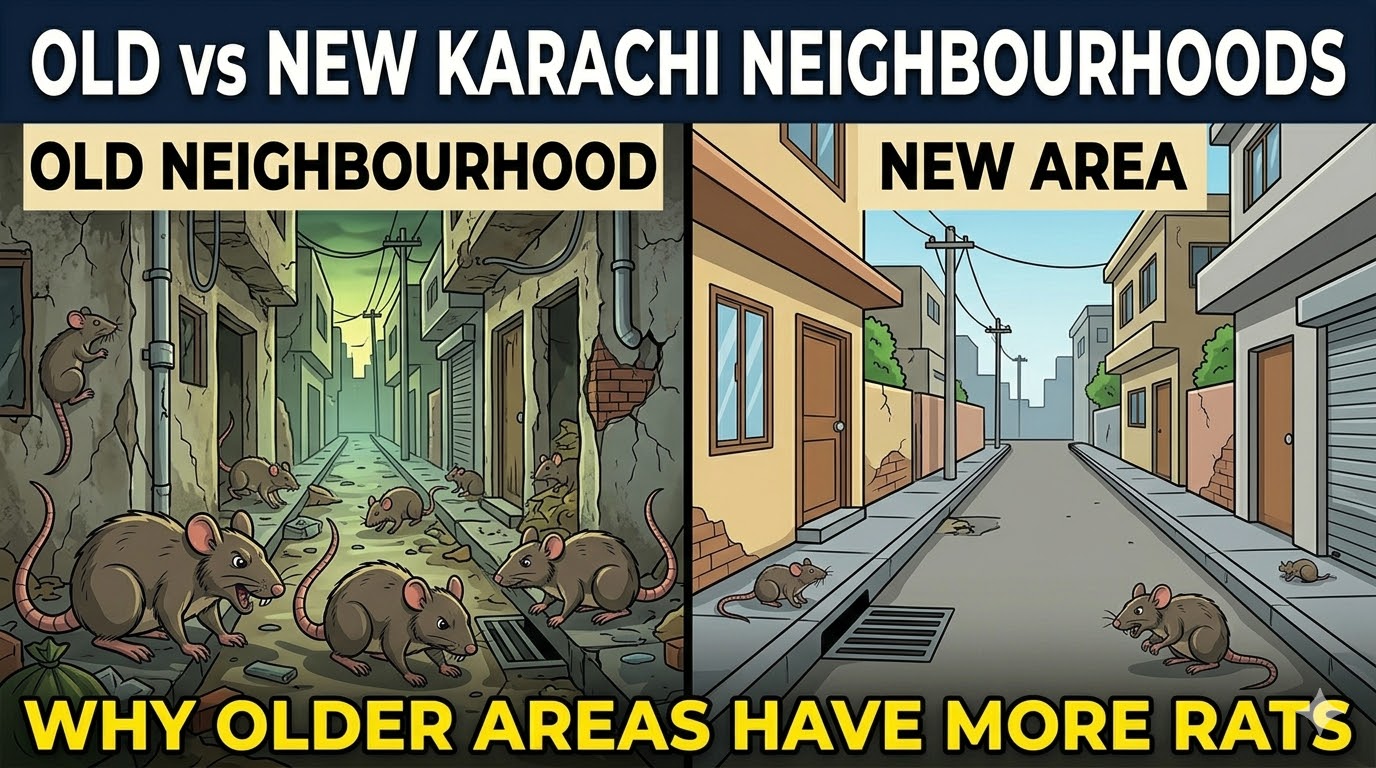
If you live in Nazimabad, PECHS, Liaquatabad, Saddar, Kharadar, or any of Karachi’s established older residential areas, you may have noticed that rodent problems here seem more persistent, more severe, and harder to resolve than in newer parts of the city. Neighbours compare notes. Professional pest control helps but the rats keep coming back. The building a few streets over seems to have the same problem. This is not coincidence, and it is not a reflection of any individual household’s maintenance standards.
Karachi’s older neighbourhoods have structurally worse rodent problems for reasons that are embedded in the physical and urban fabric of the areas themselves. Understanding why is the first step toward changing it — both at the level of your own property and at the neighbourhood level. This article explains the specific factors that create persistently high rodent pressure in older Karachi localities and outlines what property owners and residents can actually do about it.
Factor 1: Ageing Underground Infrastructure
The most significant contributor to severe rodent problems in older Karachi neighbourhoods is the condition of the underground sewage and drainage infrastructure. Sewer systems in areas like Saddar, Lyari, PECHS, and Nazimabad were built during the mid-twentieth century for population densities far lower than exist today. Decades of use, inadequate maintenance, and the physical stress of Karachi’s ground conditions have left these systems with cracked pipes, collapsed sections, and open joints.
For rats, a cracked or compromised sewer system is not an obstacle — it is a highway. Norway rats move freely through sewer networks and emerge through broken pipes and open joints into the soil beneath buildings, through floor drains, and directly into basements and ground-floor spaces. In newer areas with more recently laid sewer infrastructure — DHA Phase 8, Bahria Town, some parts of Gulshan-e-Hadeed — the sewer system is more intact and provides less direct access. The difference in above-ground rodent pressure is directly related to below-ground infrastructure condition.
Factor 2: Building Age and Construction Standards
Buildings constructed in the 1950s through 1980s in Karachi were not built with rodent exclusion in mind — neither the materials nor the construction standards of the era included systematic pest-proofing. Foundations are often rubble or brick, with irregular joints. Wall ties, pipe penetrations, and service entries were typically left with gaps sealed only with soft mortar, which has since deteriorated. Expansion cracks have developed across decades of ground movement and monsoon loading.
A house in PECHS or Nazimabad that was well-maintained through the 1980s but has had limited structural attention since then will have accumulated dozens of small entry points that simply do not exist in buildings that were constructed more recently. This is not a criticism of the original construction or of subsequent maintenance — it is simply the physical consequence of building age in a demanding climate.
Compound this with the common practice of informal additions — rooms added above the original structure, walls built against existing buildings, service pipes routed externally — and the number of unplanned gaps and penetrations in older properties grows further.
Factor 3: Land Use Density and Mixed Development
Older Karachi neighbourhoods are characterised by mixed land use in ways that newer planned areas are not. A residential street in Nazimabad or Liaquatabad will typically have ground-floor commercial units, food vendors, small workshops, garment operations, and residential apartments coexisting in a single block. This density of different uses creates a complex food waste environment at street level that supports very high rodent populations directly adjacent to residential spaces.
The organic waste output from even a small number of food-related businesses — a single paratha stall, a fruit vendor, a small restaurant — is sufficient to sustain a significant rat population in the immediate vicinity. In a mixed-use block of the kind common across older Karachi, there are multiple such sources within a few metres of every residential unit. Controlling the rodent population in your home while those food sources persist outside is a perpetual rather than solvable problem unless it is addressed structurally.
Factor 4: Shared Boundary Walls and Compound Infrastructure
Many older Karachi properties share boundary walls, drains, and in some cases underground infrastructure with adjacent properties. This creates a situation where a rodent problem in one property cannot be fully resolved without addressing the adjacent ones. Rats burrowing under a shared boundary wall move freely between properties. A property that has been treated and sealed will be repopulated from the adjacent one within weeks if that property remains infested.
In newer planned communities and apartment developments, the physical separation between properties is cleaner, and the shared infrastructure (lifts, common areas, service shafts) is managed collectively by building management. In older, organically developed residential areas, this collective management is largely absent, which means individual efforts to control rodents are partially undermined by the broader neighbourhood condition.
Factor 5: Open Nala Proximity
Many of Karachi’s older established areas were developed adjacent to or around the natural drainage channels that became the city’s nala network. Areas like Golimar, Liaquatabad, Orangi, and large parts of Korangi are in close proximity to open drainage channels. As noted in the broader article on Karachi’s rodent ecology, these nalas function as population reservoirs — supporting large numbers of rats in the channel environment and continuously generating dispersal pressure into the surrounding residential areas.
Properties within 300 to 500 metres of an open nala face a fundamentally different baseline rodent pressure than properties further from the channel. No amount of individual property management eliminates this pressure — it can only be managed through a combination of exclusion, ongoing professional control, and, ideally, coordinated neighbourhood-level action.
Factor 6: Historical Accumulation in Older Structures
Rats that have been nesting in a building for generations leave behind material evidence — grease marks on frequently used runs, accumulated droppings in wall voids, and nesting material in cavities — that guides subsequent rat populations to the same locations. Older buildings with long histories of rodent activity have, in a sense, been ‘mapped’ for use by the local rat population. This is why infestations in older properties tend to recur in the same locations and why complete elimination requires not just population control but clearing the physical signs of previous activity.
What Actually Changes the Situation in Older Neighbourhoods
The factors above are structural, but they are not insurmountable. What changes the situation is a combination of property-level investment and, ideally, coordinated neighbourhood-level effort.
At the Individual Property Level
- Comprehensive structural exclusion — identifying and sealing every entry point using materials rats cannot gnaw through — is the most impactful single investment a homeowner can make
- Upgrading drain covers and fitting rat blocker valves on main drain outlets eliminates the sewer access route
- Addressing the building’s immediate perimeter — clearing clutter, eliminating ground-level harborage, maintaining a clear zone around the foundation
- Engaging professional pest control on a maintenance basis rather than reactively — this is essential in older neighbourhoods where external pressure is continuous
At the Neighbourhood Level
The most effective improvements in older Karachi neighbourhoods come from coordinated action among a cluster of properties. This is more achievable than it sounds. A group of homeowners in a block who commission a collective exclusion and treatment programme get better results than any of them would individually, at a cost per household that is typically lower than individual contracts.
Pressure on local bodies for improved drainage maintenance, covered nala sections, and reliable waste collection removes the environmental conditions that sustain the rat population. In areas where these improvements have been implemented — certain sections of DHA’s older phases, some managed housing societies in Gulshan and North Karachi — rodent pressure visibly decreases.
The Role of Professional Assessment in Older Properties
In older Karachi homes, a professional assessment is especially valuable because the history of the building shapes the specific rodent control strategy required. A trained technician can identify the established travel routes, the historical nesting sites, and the entry points that are being actively used — information that guides a targeted treatment and exclusion plan rather than a generic one.
Our rodent control service in Karachi is specifically experienced with the challenges of older residential properties across the city’s established neighbourhoods. We understand that in PECHS or Nazimabad, the approach to rodent control cannot be the same as in a recently built apartment block — and we tailor our programmes accordingly.
Whether you are looking for a one-time comprehensive treatment or an ongoing maintenance programme suited to the conditions of an older Karachi property, our team has the knowledge and local experience to make it work. We are proud to be among the trusted fumigation services in Karachi that understand the city’s unique urban environment and the specific pest pressures it creates.
Book a Free Inspection Today
If you are living in one of Karachi’s older neighbourhoods and dealing with a rodent problem that keeps coming back no matter what you try, the answer starts with a proper professional assessment of your specific property. Our free inspection service is designed exactly for this situation — we will examine the structural vulnerabilities of your home, assess the level of external pressure, and give you a clear, practical plan. Contact us today to book your free inspection and get a genuinely lasting solution.

Ahmad Karimi is a PPMA-registered pest management specialist and the lead technical consultant at Karachi Fumigation Services, where he has overseen field operations and treatment protocols since 2005. With over 20 years of hands-on experience treating residential, commercial, and industrial properties across Karachi — from DHA bungalows with structural termite infestations to Korangi factories requiring large-scale rodent exclusion — he brings direct field knowledge to every article published on this blog.
Ahmad has managed pest control programs for clients including Descon Engineering, Pakistan Tobacco Company, Saylani Welfare, and J. (Junaid Jamshed), and has issued hundreds of fumigation certificates for health authority compliance, import/export, and commercial licensing purposes. He holds active PPMA membership and works exclusively with WHO-approved chemicals in all field operations.
The content on this blog draws directly from two decades of Karachi-specific infestation data — seasonal pest patterns, neighbourhood-level risk factors, building-age vulnerabilities, and the regulatory requirements that Karachi businesses actually face. No recycled content from foreign pest control sites. Every article reflects conditions specific to Karachi’s climate, infrastructure, and compliance environment.
For treatment enquiries or technical questions, Ahmad’s team can be reached at 03463303875 or via the office at Trade Tower, Civil Lines, Karachi.
Leave a Reply