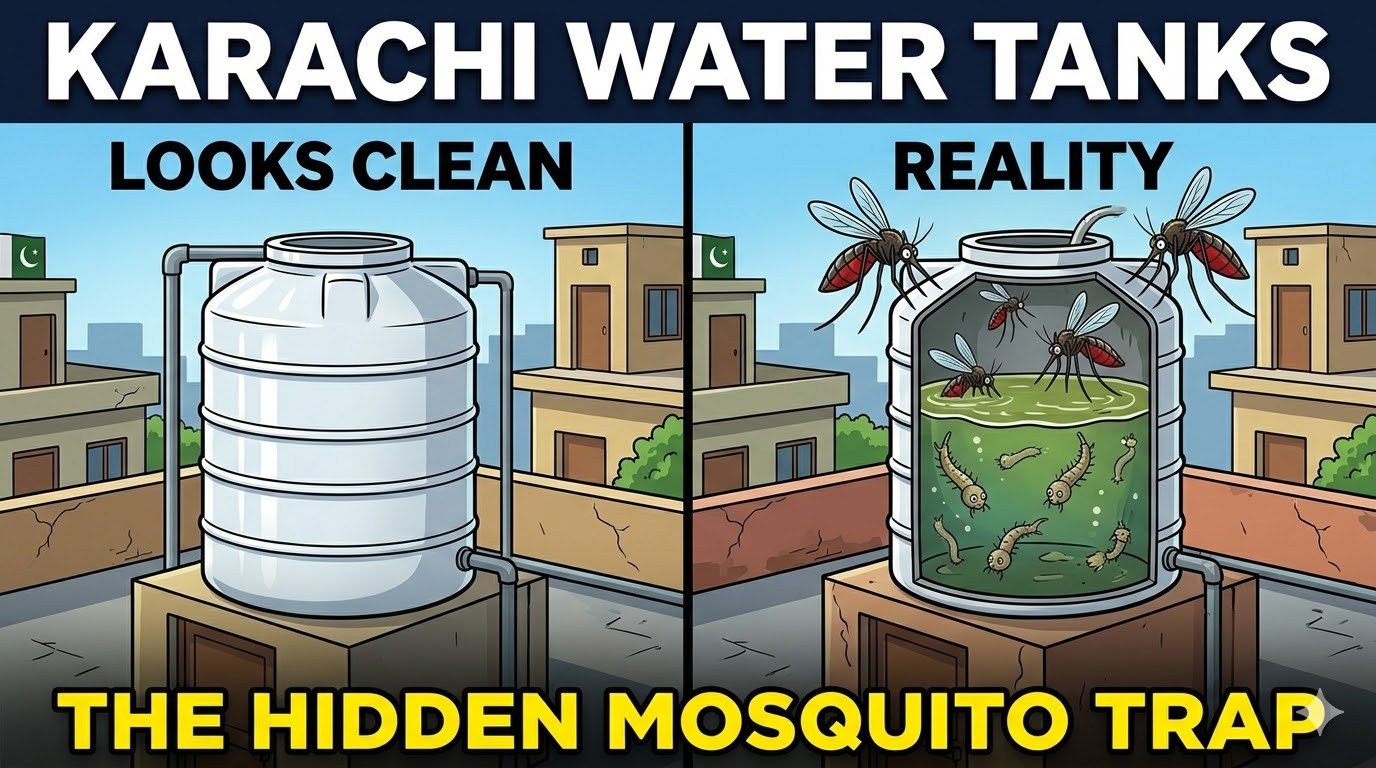
Ask any Karachi homeowner about their water tank, and most will tell you it looks fine. The water appears clear, there is no visible growth, no smell — surely it is safe? Unfortunately, when it comes to dengue mosquito breeding, appearance is deeply misleading. A perfectly clear, odorless tank can harbour hundreds of mosquito larvae completely invisible to the untrained eye.
This misconception is one of the primary reasons dengue continues to spread in Karachi despite widespread public awareness campaigns. Families believe they are safe because their tanks look clean. They are not checking for what they cannot see.
Understanding the Aedes Mosquito and Water Preference
The Aedes aegypti mosquito — responsible for transmitting dengue, chikungunya, and Zika — has a distinct preference: clean, stagnant water. Unlike many other insect pests, it does not seek out dirty, polluted, or biologically rich water. It actively prefers clear, still water with minimal organic content.
This is precisely the water stored in Karachi’s overhead and underground tanks. The water that comes through municipal supply or tankers and sits in storage tanks is ideal for Aedes breeding. There is no turbulence to disturb eggs, the temperature is warm due to Karachi’s climate, and the water is clear — exactly what the mosquito needs.
Aedes mosquitoes lay their eggs not floating on the water surface but along the waterline on container walls — just above the water level. These eggs are tiny, dark, and firmly attached. They are invisible without close inspection, and they survive for months in a dried state, hatching immediately when water returns.
How Karachi’s Water Storage Habits Create Risk
Karachi faces chronic water supply challenges. Most households — regardless of income level — maintain some form of water storage to cope with irregular supply. This is entirely rational given the infrastructure realities of the city. However, it creates a city-wide network of potential mosquito breeding sites.
Overhead Rooftop Tanks
Plastic and concrete overhead tanks are ubiquitous across Karachi’s rooftops. The issues that make them high-risk include:
- Lids that do not seal properly, leaving gaps through which mosquitoes enter
- Cracked or absent lids in older tanks common in areas like Orangi Town, Korangi, and parts of Gulshan
- Overflow pipes that lack mesh screening — a direct entry point for mosquitoes
- Inlet pipes from tanker water that are left open after filling
- Interior walls with microscopic surface irregularities where eggs adhere between cleanings
- Low fill levels during dry periods that expose large interior wall areas above the waterline — the exact spot mosquitoes prefer
Underground Water Tanks and Sumps
Underground tanks and sumps present a separate challenge. Because they are below ground and often accessed only through small manholes, they are rarely inspected. Gaps or damaged covers allow mosquito entry, and the dark, enclosed space with its still, clean water is a perfect environment.
Many Karachi homes discovered during outbreak investigations that their underground sump — fitted years ago and never serviced — was one of their largest breeding sites.
The Tank Cleaning Paradox
Many homeowners do have their tanks cleaned — annually or semi-annually. This is good practice. However, incomplete cleaning creates a false sense of security and sometimes makes the problem worse. Here is why:
- Standard cleaning removes algae and sediment but does not address Aedes eggs attached to walls
- Eggs laid above the waterline are often above the water level during cleaning and survive the process
- If the tank is refilled immediately after cleaning, eggs that survived hatch within days
- Cleaning without treating — using a larvicide or appropriate solution — leaves the tank vulnerable immediately after refilling
Proper dengue-prevention tank maintenance requires physical scrubbing of all interior walls at and above the waterline, allowing the tank to dry completely if possible, and then refilling. In cases where tanks cannot be emptied, dengue prevention measures such as BTI (Bacillus thuringiensis israelensis) larvicide tablets — which are safe for drinking water and highly effective against mosquito larvae — can be used under professional guidance.
Warning Signs Your Tank Has a Mosquito Problem
Even without directly inspecting the tank interior, certain signs suggest a breeding problem:
- Increased mosquito activity in rooms closest to the tank (often top floors or areas near the tank room)
- Adult mosquitoes seen emerging from the tank area during daytime hours
- Tiny wriggling larvae visible if you can shine a flashlight into the tank — larvae hang just below the surface
- Small, raft-shaped egg masses floating on the water surface (more common in less turbulent water)
In Karachi’s high-rise buildings — common in Clifton, Defence, and newer developments in Bahria Town Karachi — a single contaminated rooftop tank can spread mosquitoes across multiple floors. Building management in such properties has a collective responsibility to ensure all shared water storage is maintained and treated.
The Role of Tanker Water in Dengue Risk
A significant proportion of Karachi’s population relies on private water tankers for their supply. These tankers are an underappreciated vector for dengue risk. The water transported by tankers:
- May already carry mosquito eggs or larvae from contaminated water sources
- Is typically delivered and pumped into tanks that are not inspected before refilling
- Creates turbulence during filling that dislodges wall-attached eggs, causing them to hatch faster
This does not mean tanker water is inherently unsafe to drink — most Karachi residents use it without incident. But it does mean that the tank receiving that water requires regular monitoring and cleaning, not just a one-time setup.
What Effective Tank Protection Looks Like
A properly protected water tank in Karachi combines physical, chemical, and structural solutions:
Physical Controls
- Install tightly fitting, purpose-made tank covers with no gaps
- Screen all inlet, outlet, and overflow pipes with fine mesh (at least 1mm openings)
- Ensure the tank base and surrounding area does not accumulate spilled or dripped water
Cleaning Protocol
- Clean tanks at minimum every six months, ideally before and after monsoon season
- Physically scrub all interior walls — do not just flush with water
- Allow to dry completely before refilling where possible
Chemical Controls (Professional Application)
- BTI larvicide treatment safe for potable water storage
- Professional inspection of overflow and inlet pipes for hidden breeding
- Treatment of surrounding areas for adult mosquitoes
Homeowners who are uncertain about the condition of their tanks or who have experienced increased mosquito activity should consider a professional mosquito control inspection in Karachi. Trained technicians can assess and treat water storage systems safely, without compromising your water supply.
What About Building and Apartment Complex Tanks?
If you live in an apartment building in Karachi, the responsibility for shared water tanks typically falls on the building management or apartment owners’ association. However, your individual risk is directly linked to shared tank conditions.
It is worth raising the issue with your building management if:
- Shared tank lids are damaged or missing
- Tanks have not been cleaned in over six months
- Mosquito activity has increased in the building
- There has been a dengue case in the building within the past month
Building-level mosquito control in Karachi requires coordinated intervention — treating common areas, tanks, rooftops, and drainage simultaneously. Individual apartment treatment without addressing shared tanks will provide only partial protection.
Conclusion
Clean-looking water tanks are not safe tanks — not in Karachi, not during or after monsoon season. The dengue mosquito has evolved to exploit precisely the kind of water storage that Karachi’s water infrastructure necessitates. Understanding this, and taking proactive steps to seal, clean, and treat your tanks, is one of the most powerful things you can do to reduce your family’s dengue risk.
Do not let the clarity of the water mislead you. What you cannot see is exactly what you need to address.
📞 Book a Free Inspection Today: Is your water tank properly sealed and treated? Our team at Fumigation Services in Karachi offers free home inspections that include water tank assessment. We identify vulnerabilities and provide safe, effective treatments that protect your family without affecting your water supply. Book your free inspection now.

Ahmad Karimi is a PPMA-registered pest management specialist and the lead technical consultant at Karachi Fumigation Services, where he has overseen field operations and treatment protocols since 2005. With over 20 years of hands-on experience treating residential, commercial, and industrial properties across Karachi — from DHA bungalows with structural termite infestations to Korangi factories requiring large-scale rodent exclusion — he brings direct field knowledge to every article published on this blog.
Ahmad has managed pest control programs for clients including Descon Engineering, Pakistan Tobacco Company, Saylani Welfare, and J. (Junaid Jamshed), and has issued hundreds of fumigation certificates for health authority compliance, import/export, and commercial licensing purposes. He holds active PPMA membership and works exclusively with WHO-approved chemicals in all field operations.
The content on this blog draws directly from two decades of Karachi-specific infestation data — seasonal pest patterns, neighbourhood-level risk factors, building-age vulnerabilities, and the regulatory requirements that Karachi businesses actually face. No recycled content from foreign pest control sites. Every article reflects conditions specific to Karachi’s climate, infrastructure, and compliance environment.
For treatment enquiries or technical questions, Ahmad’s team can be reached at 03463303875 or via the office at Trade Tower, Civil Lines, Karachi.
Leave a Reply