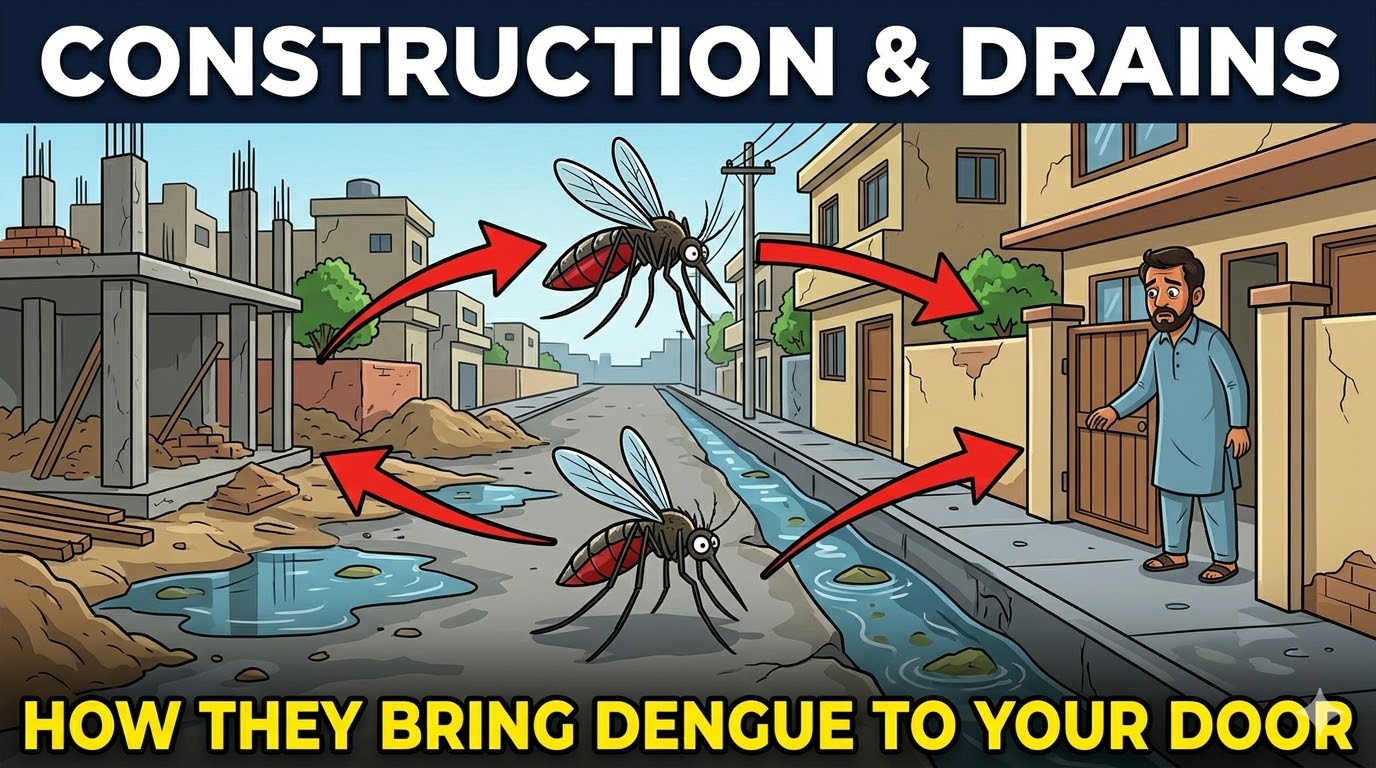
When we talk about dengue prevention, the conversation usually focuses on what is inside the home — water tanks, flower pots, gutters. This is important. But for many Karachi families, the greater threat comes from directly outside: the construction site two blocks away, the open nullah running along the street, the half-excavated plot next door that fills with water every time it rains.
Your personal hygiene and home maintenance practices can be exemplary, and you can still be at high dengue risk if your immediate neighborhood contains large, unmanaged breeding environments. Understanding these external sources — and knowing what you can do about them — is essential for any comprehensive dengue protection strategy in Karachi.
Why Karachi’s Construction Boom Is a Dengue Accelerator
Karachi is one of the fastest-growing cities in Asia, with construction activity visible in virtually every neighborhood — from Bahria Town and DHA City in the periphery to constant vertical development in established areas like Gulshan-e-Iqbal, PECHS, and Clifton.
Construction sites, by their nature, create conditions that are almost ideally suited for Aedes mosquito breeding:
Excavations and Foundation Pits
Foundation excavations and basement pits accumulate water rapidly during rain and are slow to drain due to compacted soil. A single construction pit of modest size can hold thousands of liters of standing water for days after a rainfall. With no cover, no treatment, and full sun exposure warming the water to ideal breeding temperatures, these become mosquito nurseries of industrial scale.
Stored Construction Materials
Construction sites accumulate materials that create small-scale water traps:
- Hollow iron pipes and scaffolding tubes hold water in their openings
- Plastic tarps and protective sheets fold and collect water
- Overturned wheelbarrows, buckets, and mixing trays retain water after rain
- Bricks and concrete blocks with textured surfaces create micro-pools
Incomplete Drainage Infrastructure
During construction, original drainage from the site is disrupted. Water that previously flowed away now pools unpredictably. New drainage systems for the building under construction are not installed until late-stage construction. This gap period — which can last months or years in Karachi’s construction timeline reality — creates chronic waterlogging in and around the site.
Concrete Mixer Troughs and Water Storage
Construction requires significant water for mixing. Sites typically store water in large plastic drums, tanks, or open troughs. These are rarely covered adequately and rarely treated for mosquito control. They represent large-volume, accessible, clean-water breeding sites.
The Open Drain Problem: Karachi’s Chronic Challenge
Karachi’s open drain — or nullah — network is one of the city’s most persistent infrastructure challenges. The main nullahs (like Gujjar Nullah, Orangi Nullah, and the network flowing through Landhi and Korangi) are large enough to be visible on satellite imagery. But the problem extends to thousands of smaller open drains in residential streets throughout the city.
Open drains create dengue risk in several distinct ways:
Stagnant Water During Dry Periods
Between rains, drain flow slows dramatically or stops entirely in many residential areas of Karachi. Solid waste accumulation blocks flow. The result is a chain of stagnant water pockets throughout the drain — warm, accessible, and unmanaged.
Post-Rain Overflow
During and after heavy rain, Karachi’s drains often overflow, flooding adjacent streets and properties with contaminated water. When this water recedes, it leaves behind pools in depressions, roadside vegetation, and low-lying plots. These residual pools become immediate breeding sites.
Vegetation and Shade
Drain banks in older Karachi neighborhoods are often lined with vegetation that provides shade and moisture retention. This creates conditions that support mosquito resting populations as well as breeding — the covered, shaded drain bank is a refuge for adult mosquitoes during heat peaks.
Quantifying the Radius: How Far Does the Risk Extend?
Aedes aegypti is considered a relatively limited-range mosquito compared to other species — its typical flight range is estimated at 100 to 400 meters under normal conditions. However, this is a statistical average. Wind, human movement, and availability of hosts can extend effective range.
Practically, if you live within 200 meters of:
- An active construction site with unmanaged water accumulation
- An open drain or nullah
- A vacant plot with debris and irregular surface
- A large garden or nursery area with multiple water containers
…your dengue risk is materially elevated above a household in a fully developed, well-drained neighborhood, even if your own home is immaculately maintained.
What Karachi Homeowners Can Realistically Do
The frustrating reality is that you cannot control what happens on a construction site next door or how often the municipal drain is cleaned. You can, however, take a combination of personal and community-level actions that meaningfully reduce risk.
Personal Protective Measures
- Ensure your own home’s defensive perimeter is solid: sealed tanks, cleared gutters, no standing water in the compound
- Install properly fitted window and door screens — Aedes mosquitoes that breed nearby will enter your home to feed
- Use DEET-based repellent on children playing outdoors in the morning or late afternoon — peak Aedes feeding hours
- Schedule professional mosquito treatment for your home more frequently during active nearby construction
Community and Regulatory Action
- Report chronic open drain blockages to your local Union Committee or district municipality
- Contact KWSB (Karachi Water and Sewerage Board) for drain cleaning requests in your area
- Engage with your Residents Welfare Association to advocate for construction site inspections
- Formally notify nearby construction site management about water accumulation — under Pakistan’s environmental regulations, construction sites are required to maintain drainage
- Document breeding sites with photos and report to Karachi Metropolitan Corporation (KMC) health department — particularly during dengue outbreak periods when enforcement is more active
Given the external threats that construction sites and open drains represent, having professional mosquito control done for your Karachi home becomes even more critical. Treatment of your home addresses the mosquitoes that enter from external breeding sources, reducing your family’s bite exposure regardless of what is happening in your neighborhood.
The New Development Paradox in Karachi
There is an irony that residents in Karachi’s newer, more affluent developments have noted: neighborhoods undergoing rapid development often have higher dengue incidence than established, denser areas. The reason is the construction activity itself. DHA City, Bahria Town Karachi, and areas around the new Ring Road development all experienced dengue clusters coinciding with peak construction periods.
Families who purchase homes in new developments expecting a clean, well-managed environment sometimes find that the construction activity surrounding their homes creates the exact environmental conditions that drive dengue outbreaks. This is not an argument against purchasing in new developments — it is an argument for being especially proactive about mosquito control in those areas.
Specific High-Risk Areas in Karachi Currently
Without naming specific properties, certain general zones in Karachi present elevated ambient risk due to construction activity and drainage challenges:
- Areas adjacent to major road expansion projects — where excavation creates extensive waterlogging
- Neighborhoods bordering major nullahs — particularly during pre-drain-cleaning periods
- Newly developing residential zones at Karachi’s periphery where infrastructure is incomplete
- Industrial areas near residential clusters where industrial water storage and drainage is poorly managed
Conclusion
Dengue risk in Karachi is not contained within your walls. Construction sites and open drains within 200 to 400 meters of your home are active contributors to the mosquito population that puts your family at risk. Acknowledging this reality — and responding with both personal household protection and community-level advocacy — is the only comprehensive approach.
Your home can be a fortress against mosquitoes even when the neighborhood presents challenges. But that fortress requires professional-grade protection, not just retail sprays.
📞 Book a Free Inspection Today: Living near construction or open drains in Karachi? You need stronger protection. Our Pest Control Services in Karachi team will assess your specific neighborhood risk factors and provide targeted treatment designed for high-exposure environments. Contact us for your free inspection and take back control of your family’s safety.

Ahmad Karimi is a PPMA-registered pest management specialist and the lead technical consultant at Karachi Fumigation Services, where he has overseen field operations and treatment protocols since 2005. With over 20 years of hands-on experience treating residential, commercial, and industrial properties across Karachi — from DHA bungalows with structural termite infestations to Korangi factories requiring large-scale rodent exclusion — he brings direct field knowledge to every article published on this blog.
Ahmad has managed pest control programs for clients including Descon Engineering, Pakistan Tobacco Company, Saylani Welfare, and J. (Junaid Jamshed), and has issued hundreds of fumigation certificates for health authority compliance, import/export, and commercial licensing purposes. He holds active PPMA membership and works exclusively with WHO-approved chemicals in all field operations.
The content on this blog draws directly from two decades of Karachi-specific infestation data — seasonal pest patterns, neighbourhood-level risk factors, building-age vulnerabilities, and the regulatory requirements that Karachi businesses actually face. No recycled content from foreign pest control sites. Every article reflects conditions specific to Karachi’s climate, infrastructure, and compliance environment.
For treatment enquiries or technical questions, Ahmad’s team can be reached at 03463303875 or via the office at Trade Tower, Civil Lines, Karachi.
Leave a Reply