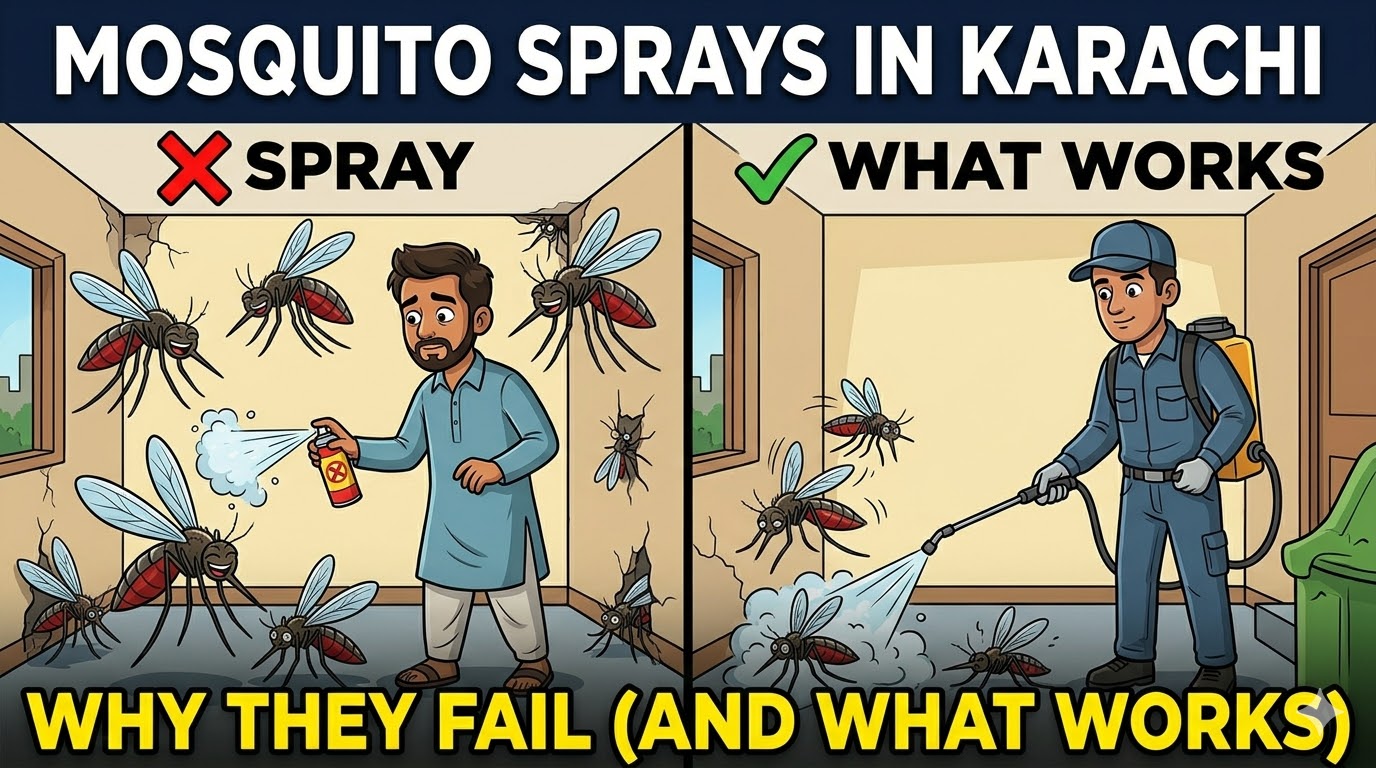
The Spray-and-Forget Problem – Walk into any supermarket in Karachi — from Imtiaz to Naheed — and you will find a full shelf of mosquito repellent sprays, coils, electric vaporizers, and aerosol cans. They are affordable, widely available, and easy to use. Most Karachi families have at least two or three of these products at home.
And yet dengue cases continue to rise every monsoon. Hospital wards fill up. Platelet count updates circulate in family WhatsApp groups. Children and adults get infected despite homes stocked with sprays.
The problem is not user error. The problem is that consumer mosquito sprays are fundamentally the wrong tool for dengue prevention. Understanding why requires understanding what these products actually do — and what they do not.
What Consumer Mosquito Sprays Actually Do
Most retail mosquito sprays sold in Pakistan contain pyrethroid insecticides — typically permethrin, cypermethrin, or d-allethrin. These are the same active ingredients used in professional pest control, but in much lower concentrations and with a critical limitation: they are contact killers and short-range repellents.
What this means practically:
- They kill or repel mosquitoes that are directly hit by the spray mist
- They provide a short residual effect — typically 30 minutes to a few hours at maximum
- They do not address mosquito larvae or eggs
- They do not penetrate into the crevices, cavities, or dark corners where Aedes mosquitoes rest during the day
- They dissipate quickly in Karachi’s warm, ventilated homes
You spray your room at night, it smells strongly of insecticide, and you feel protected. But the Aedes aegypti mosquito is primarily a daytime biter — it is most active from early morning until mid-afternoon. By the time it is actively seeking a blood meal, your previous evening’s spray has long since evaporated.
The Resistance Problem in Karachi
There is another issue that local pest control professionals have observed for years: Aedes mosquitoes in Karachi show increasing resistance to the pyrethroid class of insecticides used in most retail sprays.
This is not unique to Karachi — it is a global phenomenon documented in dengue-endemic regions. Repeated exposure to sub-lethal concentrations of pyrethroids (exactly what happens when families use consumer sprays daily for years) creates selection pressure, and populations develop resistance. Mosquitoes that survive repeated pyrethroid exposure pass on their resistance to offspring.
The practical result: sprays that provided reasonable protection five or ten years ago have significantly reduced effectiveness against today’s mosquito populations in urban Karachi.
Mosquito Coils and Electric Vaporizers: Are They Any Better?
Mosquito coils work by releasing pyrethroid smoke that creates a zone of deterrence. They are moderately effective in small, enclosed, still-air spaces. Their limitations in Karachi homes:
- Ineffective in rooms with ceiling fans or air conditioning, which disperse the active compound before it reaches mosquito resting zones
- Only protect the immediate area — a coil on the floor protects approximately a 2-meter radius
- Require continuous burning — protection ends when the coil is done
- The smoke poses its own respiratory concerns with prolonged daily use
Electric vaporizers use a heating element to release insecticide from a liquid or mat. They are slightly more consistent than coils but share the same fundamental limitation: they treat only the air in the immediate vicinity. They do not reach breeding sites, wall cavities, or the areas under furniture and behind appliances where Aedes mosquitoes rest.
Repellent Sprays Applied to Skin: A Personal Tool, Not a Household Solution
DEET-based and picaridin-based repellents applied to skin are genuinely effective at preventing mosquito bites on the individual wearing them. They are an excellent personal protection measure, particularly for children, outdoor workers, and people in high-risk areas of Karachi.
But they do nothing for the mosquitoes breeding in your water tank, the larvae developing in your flower pot tray, or the adult mosquitoes resting behind your wardrobe. They protect you while you wear them. They do not address the mosquito population in your home.
What Actually Works: A Layered, Professional Approach
Effective long-term dengue control in a Karachi home requires addressing three separate but connected problems: adult mosquito populations, mosquito larvae, and breeding source elimination. No single product addresses all three.
1. Source Reduction — Non-Negotiable
No treatment will provide lasting protection if breeding sites are not eliminated. Weekly inspection and removal of standing water — from tanks, trays, containers, and drains — reduces the mosquito population at its source. This is the most powerful and cost-free intervention available.
2. Larvicide Treatment
Larvicides target mosquito larvae in water before they become adult mosquitoes. The most widely used and safest is BTI (Bacillus thuringiensis israelensis), a naturally occurring bacterium toxic to mosquito larvae but harmless to humans, pets, fish, and other wildlife. BTI tablets can be used in water tanks — including drinking water tanks under professional guidance — and any water body that cannot be emptied.
3. Residual Insecticide Treatment (Professional Grade)
Professional pest control companies use residual insecticide formulations — not aerosols — that are applied to wall surfaces, under furniture, inside drainage lines, and other resting sites. These formulations adhere to surfaces and remain active for weeks. When a mosquito lands on a treated surface, it absorbs a lethal dose even without direct spray contact.
This is fundamentally different from an aerosol can that you spray into the air. Residual treatments work while you are not there, treating the entire home including areas inaccessible to household sprays.
4. Space Spraying (Fogging)
Thermal fogging or ULV (ultra-low-volume) cold fogging, when done professionally, produces extremely fine droplets that penetrate into crevices and resting sites far more effectively than consumer aerosols. This is what health departments use during outbreak responses and what professional pest control companies deploy during active dengue seasons.
Consumer foggers sold at hardware stores in Karachi do not produce the particle size necessary for effective penetration. Professional-grade ULV equipment generates droplets in the 5 to 20 micron range — small enough to stay airborne longer and reach hidden resting zones.
For a comprehensive, evidence-based approach to mosquito elimination in your Karachi home, a professional mosquito control treatment combines larvicide, residual surface treatment, and targeted fogging in a coordinated programme that retail products simply cannot replicate.
How Often Should Professional Treatment Be Done?
In Karachi, timing matters. The dengue risk window runs from approximately July through October, with peak risk in August and September. A practical professional treatment schedule for a Karachi household:
- Pre-monsoon treatment: June to early July — disrupt breeding before mosquito populations explode
- Mid-season treatment: August — reinforce protection at peak dengue season
- Post-monsoon follow-up: October — address residual breeding from the tail end of the rainy season
For homes in high-risk areas — near open drains, construction sites, or neighborhoods with documented dengue cases — monthly treatment during peak season is recommended.
Protecting Your Children Specifically
Children are particularly vulnerable to dengue in Karachi for several reasons: they spend more time at home during school holidays (which coincide with monsoon), they play outdoors during Aedes peak biting hours in the morning, and their immune systems produce more severe inflammatory responses to primary dengue infection in some cases.
For households with young children, the combination of professional home treatment, daily application of DEET-based repellent on exposed skin, and window/door screening creates a multi-layered defense that consumer sprays alone cannot provide.
Conclusion
Consumer mosquito sprays in Karachi are not protecting your family from dengue as effectively as you think. They address the adult mosquito briefly and partially. They do nothing for larvae, nothing for breeding sites, and increasingly little against pyrethroid-resistant mosquito populations. The false sense of security they provide may actually delay more effective interventions.
Long-term protection requires source reduction, larvicide application, professional residual treatments, and properly timed fogging — a coordinated strategy that only professional pest control can reliably deliver.
📞 Book a Free Inspection Today: Stop relying on sprays that fall short. Our pest control experts will assess your home’s specific risk profile and design a treatment plan that actually works — through monsoon season and beyond. Book your free inspection today.

Ahmad Karimi is a PPMA-registered pest management specialist and the lead technical consultant at Karachi Fumigation Services, where he has overseen field operations and treatment protocols since 2005. With over 20 years of hands-on experience treating residential, commercial, and industrial properties across Karachi — from DHA bungalows with structural termite infestations to Korangi factories requiring large-scale rodent exclusion — he brings direct field knowledge to every article published on this blog.
Ahmad has managed pest control programs for clients including Descon Engineering, Pakistan Tobacco Company, Saylani Welfare, and J. (Junaid Jamshed), and has issued hundreds of fumigation certificates for health authority compliance, import/export, and commercial licensing purposes. He holds active PPMA membership and works exclusively with WHO-approved chemicals in all field operations.
The content on this blog draws directly from two decades of Karachi-specific infestation data — seasonal pest patterns, neighbourhood-level risk factors, building-age vulnerabilities, and the regulatory requirements that Karachi businesses actually face. No recycled content from foreign pest control sites. Every article reflects conditions specific to Karachi’s climate, infrastructure, and compliance environment.
For treatment enquiries or technical questions, Ahmad’s team can be reached at 03463303875 or via the office at Trade Tower, Civil Lines, Karachi.
Leave a Reply