
Ask any Karachi homeowner about their water tank, and most will tell you it looks fine. The water appears clear, there is no visible growth, no smell: surely it is safe? Unfortunately, when it comes to dengue mosquito breeding, appearance is deeply misleading. A perfectly clear, odourless tank can hold eggs and larvae that most people never think to look for.
This misconception is one of the primary reasons dengue continues to spread in Karachi despite widespread public awareness campaigns. Families believe they are safe because their tanks look clean. They are not checking for what they cannot see.
Understanding the Aedes Mosquito and Water Preference
The Aedes aegypti mosquito (responsible for transmitting dengue, chikungunya, and Zika) has a distinct preference: clean, stagnant water. Unlike many other insect pests, it does not seek out dirty, polluted, or biologically rich water. It actively prefers clear, still water with minimal organic content.
How Aedes breeds in a clean water tank
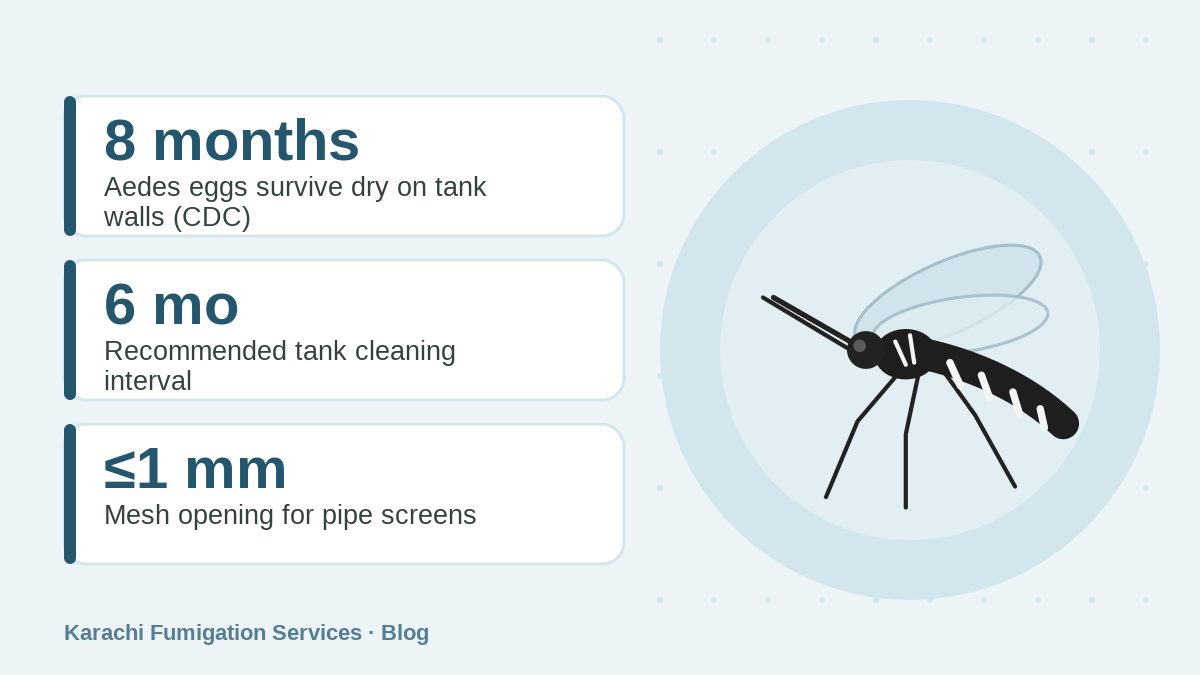
- Eggs stuck to the wall Laid just above the waterline; survive drying for up to 8 months
- Water rises, eggs hatch A refill or tanker delivery floods them
- Larvae Hang just below the surface
- Pupae Do not feed; emerge in a couple of days
- Adult mosquito About 7–10 days after hatching
This is precisely the water stored in Karachi's overhead and underground tanks. The water that comes through municipal supply or tankers and sits in storage tanks is ideal for Aedes breeding. There is no turbulence to disturb eggs, the temperature is warm due to Karachi's climate, and the water is clear: exactly what the mosquito needs.
Aedes mosquitoes lay their eggs not floating on the water surface but along the waterline on container walls, just above the water level. These eggs are tiny, dark, and firmly attached. They are invisible without close inspection, and they survive for months in a dried state, hatching immediately when water returns.
How Karachi's Water Storage Habits Create Risk
Karachi faces chronic water supply challenges. Most households, regardless of income level, maintain some form of water storage to cope with irregular supply. This is entirely rational given the infrastructure realities of the city. However, it creates a city-wide network of potential mosquito breeding sites.
Overhead Rooftop Tanks
Plastic and concrete overhead tanks are ubiquitous across Karachi's rooftops. The issues that make them high-risk include:
- Lids that do not seal properly, leaving gaps through which mosquitoes enter
- Cracked or absent lids in older tanks common in areas like Orangi Town, Korangi, and parts of Gulshan
- Overflow pipes that lack mesh screening: a direct entry point for mosquitoes
- Inlet pipes from tanker water that are left open after filling
- Interior walls with microscopic surface irregularities where eggs adhere between cleanings
- Low fill levels during dry periods that expose large interior wall areas above the waterline: the exact spot mosquitoes prefer
Underground Water Tanks and Sumps
Underground tanks and sumps present a separate challenge. Because they are below ground and often accessed only through small manholes, they are rarely inspected. Gaps or damaged covers allow mosquito entry, and the dark, enclosed space with its still, clean water is a perfect environment.
An underground sump fitted years ago and never opened since can easily be the biggest breeding site on the property.
The Tank Cleaning Paradox
Many homeowners do have their tanks cleaned: annually or semi-annually. This is good practice. However, incomplete cleaning creates a false sense of security and sometimes makes the problem worse. Here is why:
Why a quick tank clean isn't enough
Quick flush
- Removes algae and sediment only
- Eggs above the waterline survive
- Refilled straight away, so eggs hatch within days
- Lid and pipe gaps left as they were
Proper clean
- Drained, then walls treated and scrubbed by hand
- Band above the waterline cleaned, where eggs sit
- Rinsed and left to dry where possible
- Lid fitted and pipes screened afterwards
- Standard cleaning removes algae and sediment but does not address Aedes eggs attached to walls
- Eggs laid above the waterline are often above the water level during cleaning and survive the process
- If the tank is refilled immediately after cleaning, eggs that survived hatch within days
- Cleaning without treating, using a larvicide or appropriate solution, leaves the tank vulnerable immediately after refilling
Proper dengue-prevention tank maintenance requires physical scrubbing of all interior walls at and above the waterline, allowing the tank to dry completely if possible, and then refilling. In cases where tanks cannot be emptied, dengue prevention measures such as BTI (Bacillus thuringiensis israelensis) larvicide tablets, which are safe for drinking water and highly effective against mosquito larvae, can be used under professional guidance.
Warning Signs Your Tank Has a Mosquito Problem
Even without directly inspecting the tank interior, certain signs suggest a breeding problem:
- Increased mosquito activity in rooms closest to the tank (often top floors or areas near the tank room)
- Adult mosquitoes seen emerging from the tank area during daytime hours
- Tiny wriggling larvae visible if you can shine a flashlight into the tank: larvae hang just below the surface
- Small raft-shaped egg masses floating on the surface: these belong to Culex mosquitoes, a sign the water is also getting dirty; Aedes eggs are single dark specks stuck to the wall
In Karachi's high-rise buildings (common in Clifton, Defence, and newer developments in Bahria Town Karachi) a single contaminated rooftop tank can spread mosquitoes across multiple floors. Building management in such properties has a collective responsibility to ensure all shared water storage is maintained and treated.
The Role of Tanker Water in Dengue Risk
A significant proportion of Karachi's population relies on private water tankers for their supply. These tankers are an underappreciated vector for dengue risk. The water transported by tankers:
- May already carry mosquito eggs or larvae from contaminated water sources
- Is typically delivered and pumped into tanks that are not inspected before refilling
- Raises the water level over eggs already stuck to the tank walls, which is exactly what makes them hatch
This does not mean tanker water is inherently unsafe to drink: most Karachi residents use it without incident. But it does mean that the tank receiving that water requires regular monitoring and cleaning, not just a one-time setup.
What Effective Tank Protection Looks Like
A properly protected water tank in Karachi combines physical, chemical, and structural solutions:
A properly protected tank
- Tight, purpose-made lidNo gaps at the edges or hatch
- Fine mesh on every pipeInlet, outlet, vent and overflow: openings no larger than 1 mm
- Dry surroundingsNo dripping or pooled water at the tank base
- Scrubbed every six monthsIdeally before and after the monsoon
- BTI larvicide where neededSafe for stored drinking water
Physical Controls
- Install tightly fitting, purpose-made tank covers with no gaps
- Screen all inlet, outlet, vent and overflow pipes with fine mesh (openings no larger than 1 mm)
- Ensure the tank base and surrounding area does not accumulate spilled or dripped water
Cleaning Protocol
- Clean tanks at minimum every six months, ideally before and after monsoon season
- Physically scrub all interior walls; do not just flush with water
- Allow to dry completely before refilling where possible
Chemical Controls (Professional Application)
- BTI larvicide treatment safe for potable water storage
- Professional inspection of overflow and inlet pipes for hidden breeding
- Treatment of surrounding areas for adult mosquitoes
Homeowners who are uncertain about the condition of their tanks or who have experienced increased mosquito activity should consider a professional mosquito control inspection in Karachi. Trained technicians can assess and treat water storage systems safely, without compromising your water supply.
A professional tank clean follows a fixed sequence: the tank is drained, the walls and floor are treated with a chlorine and potassium permanganate solution, pressure-washed and scrubbed by hand, including the band above the waterline where Aedes eggs sit, then rinsed until the water runs clear. Our water tank cleaning service page describes the process; a standard household tank takes two to four hours.
What About Building and Apartment Complex Tanks?
If you live in an apartment building in Karachi, the responsibility for shared water tanks typically falls on the building management or apartment owners' association. However, your individual risk is directly linked to shared tank conditions.
It is worth raising the issue with your building management if:
- Shared tank lids are damaged or missing
- Tanks have not been cleaned in over six months
- Mosquito activity has increased in the building
- There has been a dengue case in the building within the past month
Building-level mosquito control in Karachi requires coordinated intervention: treating common areas, tanks, rooftops, and drainage simultaneously. Individual apartment treatment without addressing shared tanks will provide only partial protection.
The same roof spaces and pipe shafts also carry cockroaches between floors, which we cover in why Karachi's building water tanks and overhead pipes are a hidden cockroach highway. If someone in the building has a fever during dengue season, read how to tell dengue from ordinary viral fever.
Conclusion
Clean-looking water tanks are not safe tanks, not in Karachi, not during or after monsoon season. The dengue mosquito has evolved to exploit precisely the kind of water storage that Karachi's water infrastructure necessitates. Understanding this, and taking proactive steps to seal, clean, and treat your tanks, is one of the most powerful things you can do to reduce your family's dengue risk.
Do not let the clarity of the water mislead you. What you cannot see is exactly what you need to address.