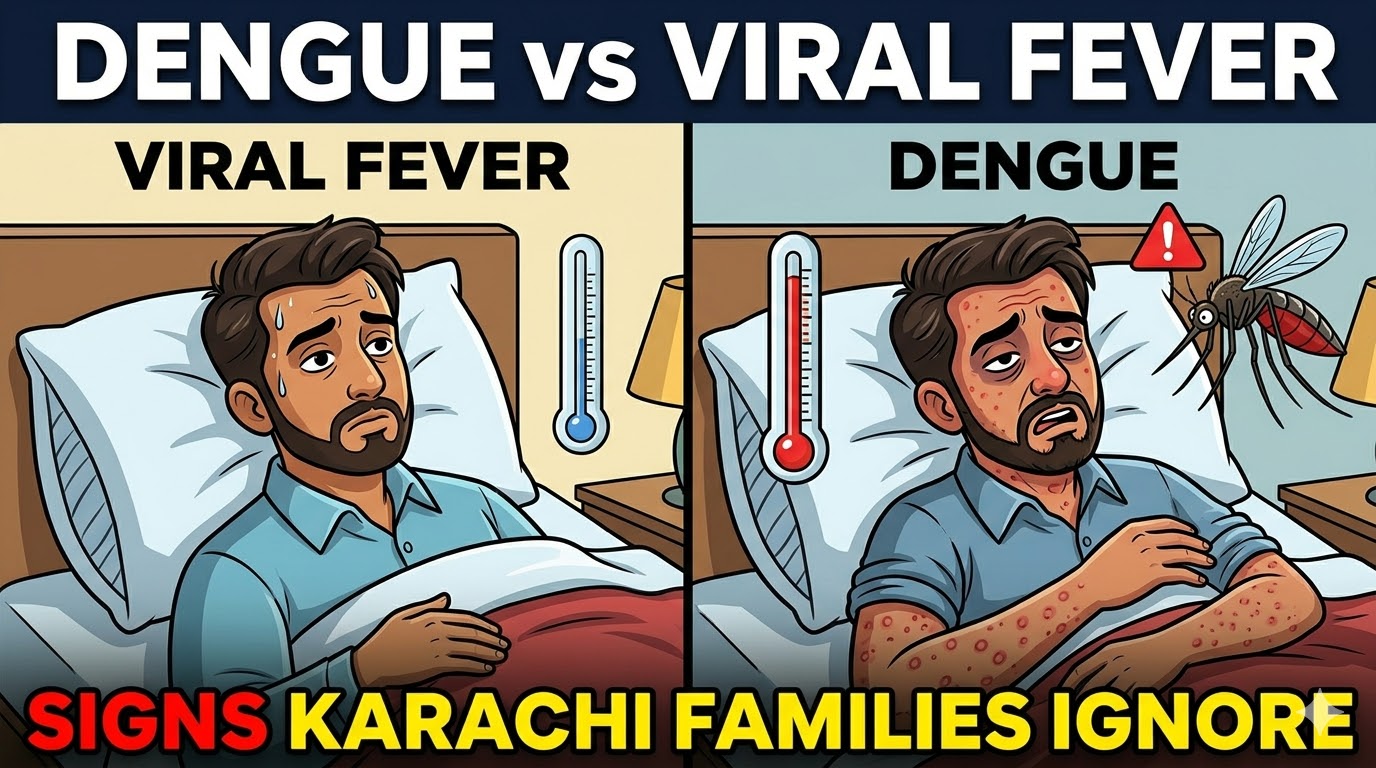
The Confusion That Costs Lives – Every year during Karachi’s monsoon and post-monsoon months — roughly July through November — hospitals across the city see a surge in fever cases. Most patients and their families assume it is a common viral fever, widely referred to locally as ‘viral.’ They rest at home, take paracetamol, and wait for it to pass.
In many cases, it does pass. But in others — when the fever is actually dengue — the delay in diagnosis leads to dangerous complications. Dengue fever follows a predictable pattern, and recognizing the early signs versus a standard viral infection is a potentially life-saving skill.
This guide is written specifically for Karachi residents who need to navigate this distinction quickly and confidently.
Why Dengue Is Commonly Missed in Karachi
Dengue is not always immediately distinguishable from other viral infections, which is what makes it so dangerous. Several factors specific to Karachi compound the problem:
- High background rate of general viral fever during monsoon means families are conditioned to expect and dismiss fever
- Dengue’s early stage closely mimics other common illnesses including flu, chikungunya, and even typhoid
- Self-medication culture — visiting a pharmacy before a doctor — often leads to treatment with ibuprofen or aspirin, which are dangerous in dengue and can trigger bleeding
- Overcrowded public hospitals create a hesitation to seek care early for what seems like ‘just a fever’
- Limited awareness of the specific patterns that distinguish dengue from other fevers
The Classic Dengue Fever Pattern
Dengue fever, caused by four distinct serotypes of the dengue virus and transmitted by the Aedes aegypti mosquito, follows a characteristic three-phase pattern. Knowing these phases helps you identify it early.
Phase 1: Febrile Phase (Days 1–3)
The febrile phase is where most people dismiss dengue as ordinary viral fever. Symptoms include:
- Sudden, high fever — typically 39 to 40.5 degrees Celsius, appearing abruptly
- Severe headache, particularly behind the eyes (retro-orbital pain) — pressing the eyeballs causes significant pain
- Intense body aches, particularly in the joints, muscles, and bones — historically called ‘breakbone fever’
- Flushed, red appearance of the face
- Mild rash in some cases — appears as widespread redness, especially on the chest
- Loss of appetite and nausea
The distinguishing characteristic at this stage is the severity and combination of symptoms. Ordinary viral fever rarely produces the degree of bone and joint pain seen in dengue. The retro-orbital headache (pain behind the eyes) is particularly specific to dengue and worth noting.
Phase 2: Critical Phase (Days 4–6)
This is the most dangerous period. The fever may actually drop — a fact that leads many families to believe the patient is recovering. This is a critical mistake. The apparent improvement can mask serious internal developments:
- Plasma leakage from blood vessels, which can lead to dengue shock syndrome
- Rapid drop in platelet count (thrombocytopenia) — normal is 150,000 to 400,000; in severe dengue, it can fall below 20,000
- Warning signs of severe dengue: bleeding from gums or nose, blood in vomit or urine, severe abdominal pain, persistent vomiting, rapid breathing, fatigue or restlessness
If fever drops but the patient develops any of the warning signs above, it is a medical emergency. This is the stage at which many dengue-related fatalities in Karachi occur — not from the fever itself, but from the cardiovascular complications of the critical phase.
Phase 3: Recovery Phase (Days 7–10)
Most patients who pass through the critical phase without complications begin recovering. However, the recovery phase has its own characteristics:
- Return of appetite
- Stabilization of platelet count and fluid levels
- Possible appearance of a secondary rash — described as ‘islands of white in a sea of red’
- Bradycardia (slow heart rate) is common during recovery and is not cause for alarm
Comparing Dengue to Common Viral Fever: Key Differences
Here is a direct comparison to help Karachi families make a faster, better-informed judgment:
Fever Pattern
- Viral fever: Gradual onset, moderate (37.5–38.5°C), often fluctuates
- Dengue fever: Sudden onset, high (39–40.5°C), saddle-back pattern (drops then returns)
Pain Profile
- Viral fever: Mild to moderate body aches, occasional headache
- Dengue: Severe joint, muscle, and bone pain; pronounced retro-orbital (behind-eye) headache
Skin Changes
- Viral fever: Rarely produces a rash in adults
- Dengue: Flushing in early stage; classic petechial rash (small red dots that do not blanch under pressure) in later stages
Bleeding
- Viral fever: No bleeding
- Dengue: Possible nosebleeds, gum bleeding, easy bruising, blood in urine or stool
Platelet Count
- Viral fever: Normal or minimally reduced
- Dengue: Significant reduction, often below 100,000 and potentially below 20,000 in severe cases
Abdominal Symptoms
- Viral fever: Mild nausea possible
- Dengue: Severe abdominal pain and persistent vomiting are warning signs of severe dengue
When to Get Tested in Karachi
Given the frequency of dengue cases in Karachi, any fever during or after monsoon season that:
- Exceeds 38.5°C and came on suddenly
- Is accompanied by severe muscle/bone pain and retro-orbital headache
- Lasts more than two days without obvious cause (such as a cold or throat infection)
…warrants a dengue test. The NS1 antigen test is most useful in the first five days of fever. After day five, IgM and IgG antibody tests are more appropriate. Complete blood count (CBC) showing low platelets and low white blood cells strongly supports a dengue diagnosis even before confirmatory tests return.
Most diagnostic labs in Karachi — including Agha Khan Hospital, Liaquat National, and the network of private pathology labs — offer dengue testing. Do not wait for a full five days to pass if warning signs are present.
What Not to Do When You Suspect Dengue
This is equally important. Many well-intentioned interventions make dengue significantly worse:
- Never take ibuprofen (Brufen) or aspirin for fever — these thin the blood and dramatically increase bleeding risk in dengue
- Do not delay testing because symptoms seem mild in the first two days
- Do not stop monitoring platelet counts because fever has decreased — this is the critical phase
- Do not administer any injectable medications without medical supervision
- Avoid herbal or alternative remedies without consulting a doctor — some delay necessary treatment
The Environmental Connection: Protecting Your Household
Understanding the symptoms helps you respond faster. Understanding the source helps you prevent the next case. If one member of your household has been diagnosed with dengue, the likelihood that the breeding source is inside or immediately adjacent to your home is very high. An emergency inspection and treatment of your living space should be conducted immediately — not after the patient recovers.
Professional mosquito control services in Karachi can identify and eliminate the breeding source, reducing the immediate risk for all other household members who may already have been bitten.
Conclusion
The early signs of dengue are recognizable if you know what to look for. The sudden high fever, the bone-deep aches, the retro-orbital headache, and the potential for a dangerous critical phase when fever drops — these patterns distinguish dengue from ordinary viral fever. In Karachi, where dengue cases escalate every monsoon season, knowing these signs is not optional preparation. It is essential knowledge for every household.
Act fast, test early, use only paracetamol for fever, and monitor platelet counts closely. Those three actions, taken promptly, save lives.
📞 Book a Free Inspection Today: Has there been a dengue case in your home or neighborhood? Don’t wait for the next one. Contact Pest Control Services in Karachi for a free home inspection. We identify breeding grounds, eliminate active mosquito populations, and help protect your family through the entire dengue season.

Ahmad Karimi is a PPMA-registered pest management specialist and the lead technical consultant at Karachi Fumigation Services, where he has overseen field operations and treatment protocols since 2005. With over 20 years of hands-on experience treating residential, commercial, and industrial properties across Karachi — from DHA bungalows with structural termite infestations to Korangi factories requiring large-scale rodent exclusion — he brings direct field knowledge to every article published on this blog.
Ahmad has managed pest control programs for clients including Descon Engineering, Pakistan Tobacco Company, Saylani Welfare, and J. (Junaid Jamshed), and has issued hundreds of fumigation certificates for health authority compliance, import/export, and commercial licensing purposes. He holds active PPMA membership and works exclusively with WHO-approved chemicals in all field operations.
The content on this blog draws directly from two decades of Karachi-specific infestation data — seasonal pest patterns, neighbourhood-level risk factors, building-age vulnerabilities, and the regulatory requirements that Karachi businesses actually face. No recycled content from foreign pest control sites. Every article reflects conditions specific to Karachi’s climate, infrastructure, and compliance environment.
For treatment enquiries or technical questions, Ahmad’s team can be reached at 03463303875 or via the office at Trade Tower, Civil Lines, Karachi.
Leave a Reply