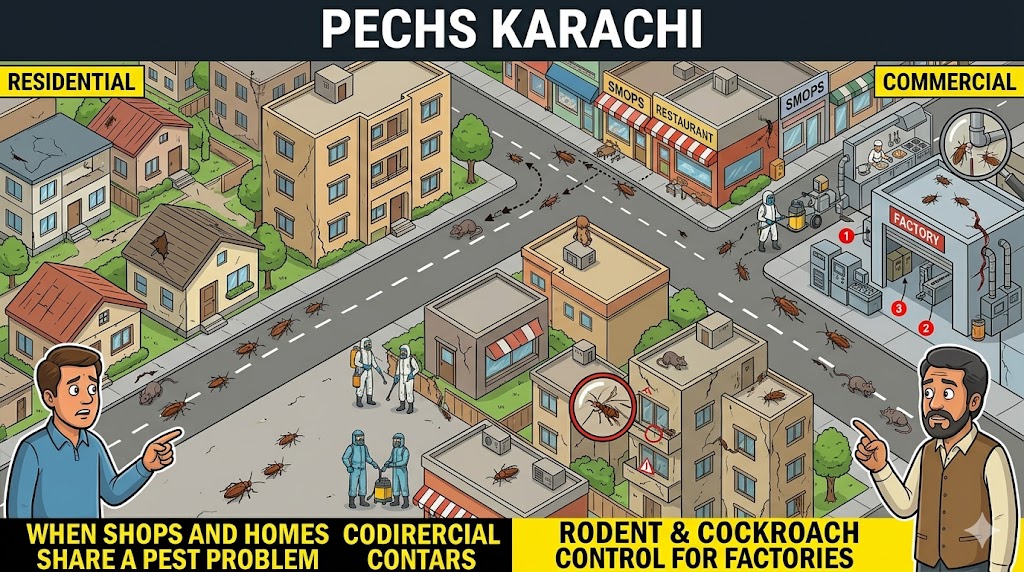
Pakistan Employees Cooperative Housing Society — PECHS — is one of Karachi’s most storied neighbourhoods, a place where the city’s commercial and residential fabric has been woven together so tightly for so long that the two are now inseparable. A residential bungalow shares a boundary wall with a restaurant. A family apartment sits directly above a pharmacy. A clothing boutique operates in the converted ground floor of what was once a family home.
This mixed-use reality is what makes PECHS one of the most vibrant — and pest-challenged — neighbourhoods in Karachi. The combination of commercial food establishments, aging residential infrastructure, heavy pedestrian traffic, and decades of urban density creates a pest pressure environment unlike anything found in purely residential areas like DHA or purely commercial ones like Saddar.
If you live or operate a business in PECHS, this guide is for you. Understanding how commercial and residential pest problems interact on the same block is the key to protecting your property, your family, and your business.
The PECHS Pest Problem: Why It Is Different From Other Areas
PECHS was originally developed as a residential neighbourhood in the 1950s and 1960s. Over the following decades, commercial activity gradually encroached — first into the main boulevard (Shahrah-e-Faisal and its connecting roads), then into the interior streets of Blocks A, B, C, D, E, and F. Today, virtually every block in PECHS has at least some commercial activity, whether it is a corner shop, a restaurant, a clinic, or a converted building housing offices.
This mixed-use evolution has created specific pest dynamics:
- Commercial food establishments generate continuous food waste — cooking oil, organic refuse, food scraps — that act as permanent attractors for cockroaches, rats, and flies within a radius of several hundred metres
- The daytime footfall and movement of goods through commercial establishments constantly introduces new pest vectors — deliveries, packaging, and human traffic all carry pest hitchhikers
- Residential buildings adjacent to commercial ones share drainage connections, meaning cockroach and rodent populations that breed in commercial spaces have direct access to residential units
- Commercial air conditioning systems and their drainage lines run through or past residential walls, creating moisture trails that pests follow
- The concentration of food-adjacent businesses in PECHS — restaurants, bakeries, dhaba-style eateries, fruit and vegetable vendors — is higher per street than almost anywhere else in Karachi south of the city centre
The Most Common Pests in PECHS
Cockroaches: The Defining PECHS Pest
Cockroaches are the dominant pest challenge in PECHS, for both residential and commercial properties. The neighbourhood’s combination of old drainage infrastructure, food establishments, and shared walls creates ideal conditions for sustained cockroach populations that are exceptionally difficult to eliminate without coordinated block-level treatment.
Two species are most commonly found:
- German cockroaches (Blattella germanica): Smaller, faster-breeding, and the primary commercial pest. These are found in restaurant kitchens, bakery storage rooms, and food preparation areas. They spread into adjacent residential units through shared piping and wall junctions. A single infested restaurant kitchen can contribute to cockroach problems in up to 15 to 20 neighbouring apartments.
- American cockroaches (Periplaneta americana): Larger, drain-dwelling, and present throughout the PECHS drainage network. These are the cockroaches residents encounter in bathrooms and kitchens at night — they are migrating upward from the city’s drainage system. Buildings on or near the main drainage arteries of PECHS face the most persistent American cockroach pressure.
Rats and Mice
PECHS has one of Karachi’s most significant urban rodent problems, driven directly by the density of food establishments. Restaurant waste skips, open food storage in commercial kitchens, and the gaps between commercial and residential buildings provide everything rodents need to establish large, well-fed colonies.
Roof rats (Rattus rattus) are the primary species in PECHS residential buildings — they are agile climbers that use the exterior of buildings, utility poles, and boundary walls to access upper floors and rooftop areas. Norway rats are more common in the ground-level and basement spaces adjacent to commercial kitchens and waste disposal areas.
For PECHS residents, the most common entry points are:
- Gaps around utility pipes entering through walls
- Deteriorated drain covers and pipe entry seals in bathrooms and kitchens
- Gaps in boundary walls shared with commercial properties
- Rooftop access through water tank rooms and AC unit spaces
Flies
Houseflies and fruit flies are an intensified problem in PECHS due to the proximity of food preparation and waste from commercial establishments. Fly populations in PECHS spike dramatically from April through October and are directly correlated with the density of food businesses on any given block.
For residential units adjacent to restaurants or food stalls, fly intrusion through unscreened windows is a daily reality during warm months. Beyond being a nuisance, flies are active disease vectors in a neighbourhood where food preparation and human habitation are so densely intertwined.
Termites
PECHS contains some of Karachi’s oldest intact bungalow stock — properties from the 1950s and 1960s that have never received a modern anti-termite re-treatment. These properties, found particularly in the interior streets of Blocks A, B, C, and D, are among the most termite-vulnerable properties in the city.
Renovation activity in PECHS is continuous as bungalows are converted into offices, clinics, and commercial spaces. Each renovation disturbs walls and floors and can scatter existing termite colonies, spreading infestations into adjacent residential properties.
Mosquitoes
PECHS’s proximity to Karachi’s central drainage system and the density of small commercial operations — many of which have poorly maintained air conditioner drain lines, water tanks, and basement areas — creates significant mosquito breeding sites. The Dengue-vector Aedes aegypti mosquito is active across PECHS from June through October.
The Residential-Commercial Interface: How Your Home Gets Affected
Many PECHS residents are aware that they have a pest problem, but are frustrated that treatment does not seem to hold. The reason is almost always the same: the source of the pest pressure is not inside your home — it is coming from the commercial activity around it.
Here is how commercial pest activity spills into residential spaces in PECHS:
- Shared drainage: PECHS drainage lines serve both commercial and residential properties. Cockroaches and rats that breed in commercial kitchen drainage migrate into residential buildings through the same shared pipe network.
- Waste proximity: If your building’s waste collection area or boundary wall is adjacent to a commercial waste area, you are in a high-risk zone for rodent and cockroach entry regardless of how well-maintained your own property is.
- Construction and renovation: Ongoing commercial-to-residential conversions and vice versa throughout PECHS disturb pest colonies and cause them to scatter into adjacent buildings.
- Air conditioning and water: Commercial buildings’ drainage lines and water features are often poorly maintained and serve as mosquito breeding sites that affect the entire surrounding block.
A Block-by-Block Risk Overview
PECHS Block A, B, and C
These blocks are the original residential core of PECHS and now have the highest density of commercial conversion. Original bungalows have been transformed into restaurants, offices, schools, and clinics. The residential properties that remain are surrounded by commercial activity, creating maximum commercial-to-residential pest spillover. Cockroach, rat, and termite risk is highest in these blocks.
PECHS Block D and E
Blocks D and E retain more residential character but are heavily influenced by the commercial activity along their main connecting roads. These blocks have significant rodent pressure due to proximity to food markets and disposal areas. Cockroach problems in residential buildings are commonly traced to restaurants on the adjacent connecting roads.
PECHS Block F and the Shahrah-e-Faisal Periphery
Properties adjacent to Shahrah-e-Faisal face pest pressure from Karachi’s busiest commercial artery. The concentration of fast food outlets, restaurants, and food vendors along this corridor is a permanent, year-round source of cockroach, rat, and fly pressure for all adjacent residential buildings. Properties within two blocks of Shahrah-e-Faisal should treat pest control as a continuous maintenance requirement, not a one-time event.
What PECHS Residents Should Know About DIY Treatment Limitations
Over-the-counter pest sprays, cockroach chalk, rat glue traps, and mosquito coils are widely used in PECHS homes. They provide temporary relief — sometimes — but they cannot address the underlying problem, which is continuous pest re-entry from surrounding commercial environments.
Professional treatment differs in several important ways:
- Professional-grade cockroach gel bait is placed inside harbourage areas — inside wall cavities, behind appliances, under sinks — where cockroaches actually live, not just where you see them. Spray treatments kill visible cockroaches but miss the colony entirely.
- Rodent exclusion work — sealing pipe entry points, repairing drain seals, and installing rodent-proof barriers — addresses the entry routes that make rat and mouse treatment sustainable long-term.
- Quarterly professional treatments maintain a chemical barrier that prevents the continuous cockroach and rodent migrations from commercial areas from establishing inside your home.
- Professional inspection identifies the specific entry routes and harbourage sites in your specific property, making treatment far more targeted and effective than generalised DIY approaches.
Recommendations for Commercial Properties in PECHS
If you operate a commercial property in PECHS — particularly a food-related business — your pest control is not just a compliance issue. It is a direct concern for every residential neighbour on your block. Poorly controlled pest populations in a single commercial kitchen can be the source of cockroach infestations across an entire adjacent residential building.
Commercial properties in PECHS should have:
- Monthly professional pest treatments at minimum, with weekly internal monitoring
- Functional, regularly emptied grease traps to eliminate one of the primary cockroach attractants
- Sealed waste storage areas with rodent-proof bins and clear disposal schedules
- Ongoing maintenance of drainage covers, pipe seals, and entry points around utilities
- A written pest control log as required by Karachi Metropolitan Corporation food establishment regulations
The Right Approach: Coordinated Block-Level Treatment
The most effective pest control strategy for PECHS — and the approach that delivers the most durable results — is coordinated treatment across multiple properties on the same block. When a single building is treated professionally while adjacent buildings go untreated, re-infestation begins within weeks through shared drainage and wall connections.
We have worked with building management committees, housing society representatives, and commercial building owners in PECHS to coordinate block-level treatments that produce dramatically better results than individual property treatments alone. If you are on a residential committee or manage a building in PECHS, coordinated treatment is worth exploring with your neighbours.
Book a Free PECHS Inspection Today
PECHS’s unique mixed-use environment requires pest control expertise that understands both residential and commercial building dynamics. Our team provides specialist pest control services in Karachi with deep experience across all PECHS blocks and building types — from original 1950s bungalows to modern commercial conversions.
We will inspect your property, identify the specific entry points and pest sources affecting you — including those coming from neighbouring commercial properties — and provide a treatment plan that addresses the actual root cause, not just the visible symptoms.
Do not keep applying temporary fixes to a structural problem. Contact us today to book your free inspection. Whether you are a resident dealing with cockroaches, a landlord concerned about your building’s pest status, or a business owner looking to stay compliant, we have a solution for your specific PECHS situation.
Call us, WhatsApp us, or reach us online. Let us take care of PECHS — one block at a time.

Ahmad Karimi is a PPMA-registered pest management specialist and the lead technical consultant at Karachi Fumigation Services, where he has overseen field operations and treatment protocols since 2005. With over 20 years of hands-on experience treating residential, commercial, and industrial properties across Karachi — from DHA bungalows with structural termite infestations to Korangi factories requiring large-scale rodent exclusion — he brings direct field knowledge to every article published on this blog.
Ahmad has managed pest control programs for clients including Descon Engineering, Pakistan Tobacco Company, Saylani Welfare, and J. (Junaid Jamshed), and has issued hundreds of fumigation certificates for health authority compliance, import/export, and commercial licensing purposes. He holds active PPMA membership and works exclusively with WHO-approved chemicals in all field operations.
The content on this blog draws directly from two decades of Karachi-specific infestation data — seasonal pest patterns, neighbourhood-level risk factors, building-age vulnerabilities, and the regulatory requirements that Karachi businesses actually face. No recycled content from foreign pest control sites. Every article reflects conditions specific to Karachi’s climate, infrastructure, and compliance environment.
For treatment enquiries or technical questions, Ahmad’s team can be reached at 03463303875 or via the office at Trade Tower, Civil Lines, Karachi.