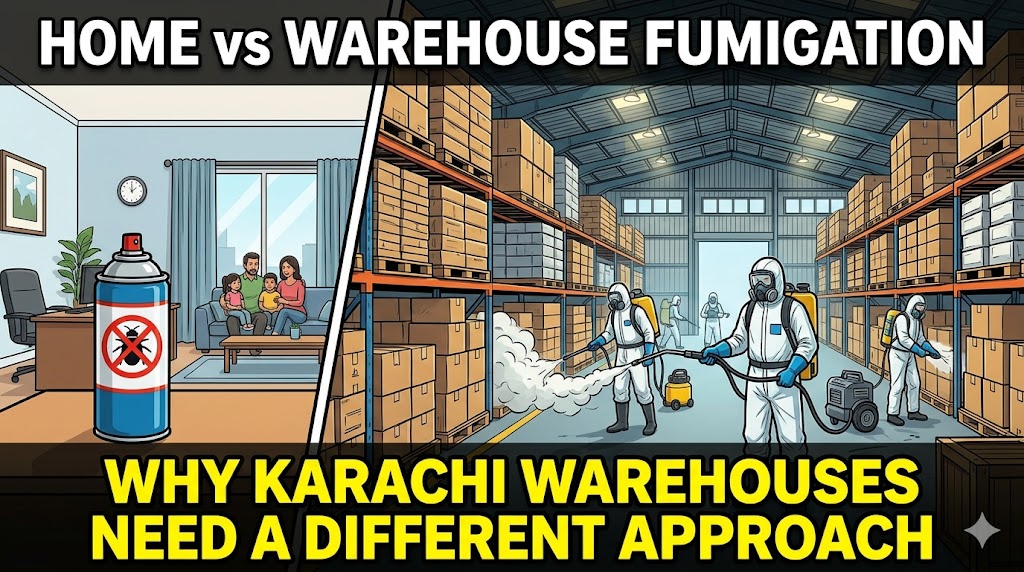
If you manage a warehouse in Karachi — whether it stores textiles in SITE Industrial Area, food commodities near Kemari port, electronics in Korangi, or pharmaceuticals in one of the city’s growing industrial zones — you already know that pest control is not optional. Pests in a warehouse are not just a nuisance. They are a direct financial liability. They destroy goods, contaminate food supplies, damage packaging, compromise regulatory compliance, and in some cases, cost businesses their supplier contracts or export certifications.
But here is where many warehouse operators in Karachi make a critical mistake: they apply the same pest control thinking to their 50,000-square-foot warehouse that they would to their home. They call a general fumigation company, ask for a routine spray, and assume the job is done.
It is not. And the difference is not minor — it is fundamental. Warehouses in Karachi face a completely different category of pest challenge, requiring specialised methods, equipment, chemicals, and expertise that residential pest control simply cannot provide.
This article explains exactly why — and what a proper warehouse fumigation approach actually looks like in Karachi’s industrial context.
The Scale Problem: Volume and Complexity
The most immediate and obvious difference between a home and a warehouse is scale. A typical Karachi household might be 1,500 to 3,000 square feet. A warehouse in SITE, Port Qasim, or Korangi Industrial Area can be 20,000 to 200,000 square feet or more — multi-story, with high ceilings, mezzanine floors, loading docks, cold storage annexes, and densely stacked inventory.
This scale means:
- Standard residential spray equipment does not deliver adequate coverage in high-ceiling, large-volume spaces.
- Dosage calculations for fumigants must be precisely based on cubic footage — not square footage — and a miscalculation in a large warehouse can result in either ineffective treatment or dangerous over-application.
- Access to fumigant cannot be obstructed by stacked goods, meaning fumigation scheduling must account for inventory arrangement or partial clearance.
- Multiple entry and exit points must all be properly sealed and monitored during fumigation — a task that requires a trained crew, not a single technician.
Residential pest control teams are not equipped — either in manpower or in machinery — to handle these requirements. Commercial fumigation demands industrial-grade blowers, dosimetry equipment, gas monitoring devices, and professionally trained teams working in coordinated roles.
The Goods Problem: What Is Being Protected Matters
In a home, pest control is about protecting your family and your property. In a warehouse, you are protecting commercial goods — and the nature of those goods fundamentally changes the fumigation approach required.
Food Commodities and Grain Storage
Karachi is Pakistan’s largest port city and a hub for food commodity storage and distribution — rice, wheat, sugar, spices, pulses, and packaged foods all pass through or are stored in Karachi’s warehouses. Food storage facilities face a specific and serious threat from stored product insects: weevils, grain borers, flour beetles, and moth larvae that infest commodities from within.
The standard residential spray is useless against stored product insects hidden deep inside grain sacks or commodity bales. These pests require phosphine fumigation (using aluminium phosphide tablets) — a highly specialised process that involves sealing the entire storage area, introducing the fumigant at calculated doses, maintaining a minimum exposure period (typically 5–7 days), and then aerating the space under controlled conditions before re-entry. This process must comply with Pakistan’s pesticide regulations and, for export commodities, with international phytosanitary standards.
No residential pest control company is licensed or equipped to conduct phosphine fumigation.
Textile and Garment Warehouses
Karachi’s textile sector — concentrated in SITE, Landhi, and North Karachi industrial areas — stores vast quantities of fabric, yarn, and finished garments. These materials are vulnerable to moth larvae, silverfish, and carpet beetles, which can destroy goods silently and at significant scale. Textile warehouses require fumigation methods that penetrate deep into stacked bales and rolls without leaving residues that could affect fabric quality, colouring, or certification for export.
Pharmaceutical and Medical Warehouses
Pharmaceutical warehouses are subject to stringent regulatory requirements — including WHO Good Storage Practices and DRAP (Drug Regulatory Authority of Pakistan) guidelines. Pest control in these facilities must be conducted by companies that can provide documented, validated treatment records. Cockroach and rodent activity in a pharmaceutical warehouse is not just a financial problem — it is a regulatory and public health crisis. Fumigation must be conducted with chemicals that do not contaminate drug packaging or compromise temperature-sensitive products.
Electronics and Hardware Warehouses
Rodent damage to electronics warehouses can cause catastrophic losses. Rats and mice gnaw through wiring, packaging, and components. The fumigation approach here must prioritise rodent extermination and prevention — using tamper-resistant bait stations, rodent-proofing structural entry points, and applying residual treatments to perimeter areas and loading docks.
The Compliance Problem: Regulations Apply to Warehouses, Not Homes
If your warehouse stores goods for export, handles food commodities, or operates in a sector regulated by DRAP, PSQCA, or the Federal Plant Protection Department, you are subject to pest management compliance requirements that have no residential equivalent.
For example:
- Export container fumigation must be conducted by companies registered with the Federal Plant Protection Department, using approved protocols and issuing official fumigation certificates.
- Food warehouses seeking HACCP certification or ISO 22000 compliance must maintain documented pest control records as part of their quality management system.
- Pharmaceutical warehouses under DRAP oversight must demonstrate pest management as part of their Good Storage Practice compliance.
A residential pest control company spraying your warehouse with a hand pump and an unregistered insecticide will not only fail to solve your pest problem — it will actively jeopardise your compliance status and potentially void your export certifications.
The Technical Problem: Warehouse-Specific Pest Control Methods
Proper warehouse fumigation in Karachi requires a range of specialised methods that simply do not exist in residential pest control:
Phosphine (Aluminium Phosphide) Fumigation
Used for stored grain and food commodities. Requires full enclosure, gas concentration monitoring, safety exclusion zones, and certified handling by trained fumigators. Lethal at high concentrations to humans — this is not a DIY or residential-grade treatment.
Methyl Bromide Fumigation (for Export Containers)
Required under ISPM 15 for wood packaging materials in export containers. Must be conducted by licensed operators using calibrated dosing equipment and gas monitoring. An internationally recognised fumigation certificate is issued on completion.
ULV (Ultra-Low Volume) Misting
Used for flying insect control in large warehouse spaces. ULV machines generate extremely fine droplets that remain airborne and penetrate into difficult-to-reach spaces — effective for controlling flies, mosquitoes, and moth populations in large open warehouses.
Residual Surface Treatments
Industrial-strength residual insecticides are applied to floors, walls, loading docks, and structural surfaces. These provide extended protection periods between treatments — important for high-traffic warehouse environments where reinfestation from loading and delivery activities is constant.
Integrated Rodent Management
A comprehensive rodent programme for warehouses includes physical proofing (sealing gaps around doors, pipes, and cable entries), placement of tamper-resistant bait stations at strategic intervals along the perimeter, and regular monitoring inspections. This is a continuous programme, not a one-time treatment.
Karachi’s Warehouse Districts: Location-Specific Pest Risks
Karachi’s major industrial and warehousing zones each present distinct pest management challenges:
- SITE Industrial Area: One of the largest industrial estates in Pakistan, SITE warehouses deal with heavy rodent pressure due to the proximity of open nullahs, food processing units, and ageing infrastructure. Cockroach populations are persistent, particularly in older single-story warehouses.
- Port Qasim and Kemari: Warehouses near the port are on the frontline of invasive pest species arriving via shipping containers. Stored product insects, rodents, and even occasional exotic pests are introduced through imported goods. Port-adjacent warehouses require especially rigorous incoming goods inspection and treatment protocols.
- Korangi Industrial Area: A hub for pharmaceutical, food processing, and manufacturing storage, Korangi warehouses typically have compliance-driven pest management requirements. Rodent and cockroach control are primary concerns.
- Landhi and North Karachi Industrial Zones: Primarily textile and light manufacturing, these areas face moth, silverfish, and rodent pressure. Proximity to Karachi’s outskirts means wildlife (including snakes) can occasionally be a factor.
- Bin Qasim: Container storage and logistics hubs require regular phosphine and methyl bromide fumigation for outgoing export consignments.
The Cost of Getting Warehouse Fumigation Wrong
The financial consequences of inadequate warehouse pest control in Karachi can be severe:
- Commodity losses: A single weevil infestation in a rice or grain warehouse can render an entire stock lot unsaleable, causing losses of hundreds of thousands to millions of rupees.
- Rejected export shipments: A failed phytosanitary inspection at port can result in a container being turned back, with associated demurrage, restuffing, and re-fumigation costs.
- Regulatory action: A DRAP inspection finding cockroach or rodent evidence in a pharmaceutical warehouse can trigger license suspension.
- Client contract termination: Many corporate clients and international buyers now conduct supplier audits that include pest management checks. A warehouse with poor pest control records risks losing major contracts.
The cost of proper warehouse fumigation — contracted annually with a qualified provider — is a fraction of any one of these potential losses.
Book a Free Warehouse Inspection
If your warehouse is currently relying on a residential-grade pest control service, or if you have not had a professional assessment of your facility’s pest risk in the past 12 months, now is the time to act. At pest control services in Karachi, we specialise in industrial and commercial pest management with the technical capability, registered chemicals, compliance documentation, and experienced crews that Karachi’s warehouses demand.
We serve warehouses across SITE, Korangi, Port Qasim, Landhi, North Karachi, Bin Qasim, and all major industrial zones. Our team will conduct a thorough free on-site inspection, assess your specific pest risks based on your stored goods and facility layout, and provide a customised treatment plan that protects your inventory, your compliance status, and your business.
Do not let a preventable pest problem become a business crisis. Contact us today to schedule your free inspection.

Ahmad Karimi is a PPMA-registered pest management specialist and the lead technical consultant at Karachi Fumigation Services, where he has overseen field operations and treatment protocols since 2005. With over 20 years of hands-on experience treating residential, commercial, and industrial properties across Karachi — from DHA bungalows with structural termite infestations to Korangi factories requiring large-scale rodent exclusion — he brings direct field knowledge to every article published on this blog.
Ahmad has managed pest control programs for clients including Descon Engineering, Pakistan Tobacco Company, Saylani Welfare, and J. (Junaid Jamshed), and has issued hundreds of fumigation certificates for health authority compliance, import/export, and commercial licensing purposes. He holds active PPMA membership and works exclusively with WHO-approved chemicals in all field operations.
The content on this blog draws directly from two decades of Karachi-specific infestation data — seasonal pest patterns, neighbourhood-level risk factors, building-age vulnerabilities, and the regulatory requirements that Karachi businesses actually face. No recycled content from foreign pest control sites. Every article reflects conditions specific to Karachi’s climate, infrastructure, and compliance environment.
For treatment enquiries or technical questions, Ahmad’s team can be reached at 03463303875 or via the office at Trade Tower, Civil Lines, Karachi.