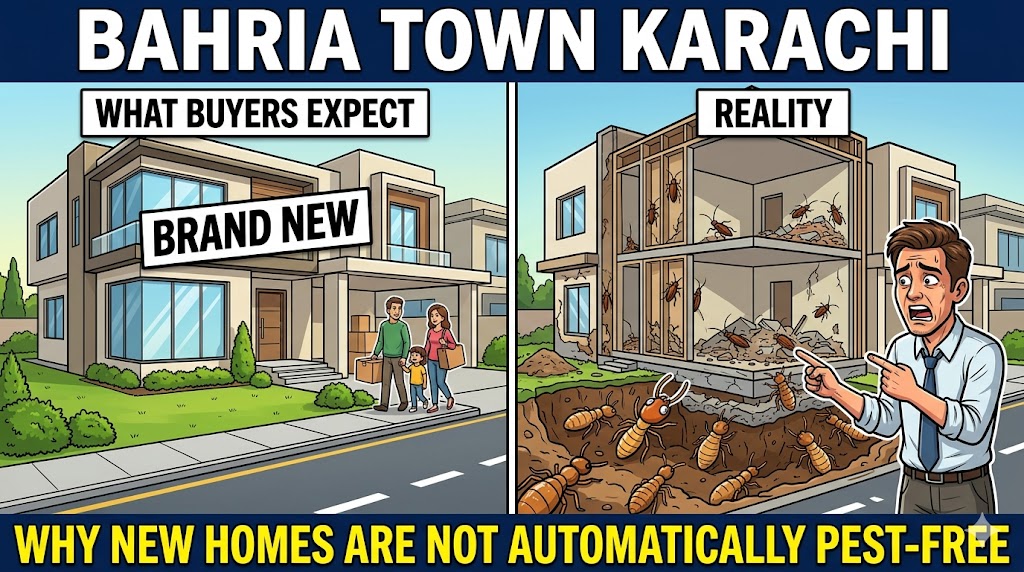
Bahria Town Karachi is one of Pakistan’s most ambitious real estate projects — a self-contained city on the outskirts of Karachi that has been marketed, and largely perceived, as a premium, well-managed alternative to the chaos of the city proper. Gated communities, maintained green spaces, planned road networks, and modern apartment complexes have made it an aspirational address for thousands of Karachi families.
But there is a persistent misconception among residents and prospective buyers: that Bahria Town’s planned development, modern construction, and professional management infrastructure somehow make pest problems less likely. That the fees, the gates, and the gleaming new facades translate into a pest-free living environment.
They don’t. And this misconception — left unaddressed — leaves Bahria Town Karachi residents underprepared for pest problems that are both predictable and serious.
This article explains the specific pest challenges facing Bahria Town Karachi’s residents, why new and planned developments carry their own vulnerabilities, and what homeowners need to do to actually protect their properties.
The Planned Development Fallacy
The appeal of a planned development like Bahria Town Karachi is real and justified in many ways. Roads are laid out in advance, utilities are designed systematically, and building standards are theoretically higher than in Karachi’s unplanned growth areas.
But pest pressure doesn’t respect planning. Here’s the fundamental reality:
Bahria Town Karachi is built on land that previously supported large populations of field rats, burrowing rodents, and the insect species that come with agricultural and semi-arid terrain. The act of construction — excavation, ground disturbance, vegetation removal — doesn’t eliminate these populations. It displaces and concentrates them.
The development’s current construction boundary is enormous, and it is perpetually active. While one sector is fully completed and occupied, the adjacent sector is mid-construction and the one after that is being excavated. This means that at any given time, a significant portion of Bahria Town Karachi is a construction site — which is also prime rodent habitat — immediately adjacent to completed residential areas.
And unlike in central Karachi, where pest populations have millennia of urban adaptation behind them, Bahria Town’s pests include field rodent species — notably the common bandicoot rat (Bandicota bengalensis) — that are larger, more aggressive, and more difficult to control than the house rat species common in older urban areas.
Construction Phase Pest Legacy in Bahria Town
Every completed sector in Bahria Town Karachi went through a construction phase that lasted months to years. During that phase:
- Construction debris, timber, and stored materials provided nesting habitat for rodents
- Temporary worker camps and canteen areas introduced cockroach species into the site
- Ground disturbance concentrated displaced field rodent populations around the construction perimeter
- Poor waste management during construction left food sources that sustained pest populations
When construction ends and residents move in, these established pest populations don’t disappear. They adapt. The rats that were nesting in construction debris find their way into the completed buildings’ walls and ceiling voids. The cockroaches from the site facilities migrate into the newly occupied kitchens. Bahria Town Karachi’s gleaming new properties inherit a pest legacy before their first residents unpack their bags.
This isn’t unique to Bahria Town — it is a universal characteristic of new development. But the scale of Bahria Town’s construction, and the type of terrain being developed, make this legacy particularly significant.
The Bandicoot Rat Problem
Bahria Town Karachi sits on land that, until relatively recently, supported extensive agricultural and semi-arid terrain. This terrain is home to the bandicoot rat — a species significantly larger and more behaviourally complex than the house rats common in established Karachi neighbourhoods.
Bandicoots are burrowing rats. They create extensive underground tunnel systems, which means that physical exclusion — the standard technique for rodent control — is more difficult. They burrow under foundations, into garden areas, and beneath road surfaces. Their tunnels can destabilise garden walls and drainage channels over time.
They are larger and more aggressive. Bandicoots regularly reach weights of 500 grams or more. They can cause structural damage that house rats typically cannot, and they are less deterred by standard rodent control measures.
They enter buildings from below. While house rats typically enter through openings in walls and foundations, bandicoots often enter through floor drains, damaged floor slabs, and utility penetrations at ground level. Standard rodent-proofing at door and window level doesn’t address this entry route.
Many Bahria Town Karachi homeowners who have dealt with what they thought was a standard rodent problem have been surprised to find evidence of bandicoot activity in their garden areas and ground floors. This is not a random occurrence — it is a predictable consequence of building on previously agricultural land.
Karachi’s Climate Creates Year-Round Pest Pressure Even in Planned Areas
Bahria Town Karachi’s location at the edge of the city does not remove it from Karachi’s climate. And Karachi’s climate is, as discussed in other contexts, among the most pest-hospitable in the world.
The development’s location also introduces some specific climate-related challenges:
Wind-blown dust and debris: Bahria Town’s exposed location means properties are subject to significant dust accumulation. Dust accumulation in HVAC systems, air gaps around windows and doors, and roof areas creates additional pest entry points and harbourage opportunities that well-sealed city-centre properties don’t face to the same degree.
Green belt and landscape maintenance: Bahria Town’s landscaping — while attractive — provides significant pest habitat. Maintained lawns that are watered regularly create moist soil conditions ideal for subterranean insect activity. Dense planted borders harbour cockroaches and ants. Ornamental water features in some sectors attract mosquito breeding. The landscaping that adds to the development’s appeal is simultaneously adding to its pest pressure.
Monsoon flooding and drainage: Parts of Bahria Town Karachi are in low-lying areas that experience significant water accumulation during the monsoon. Flooding events displace rodent populations from outdoor burrows into buildings, creating sharp seasonal spikes in rodent activity inside homes.
Apartment Blocks vs. Villas: Different Challenges in the Same Development
Bahria Town Karachi includes both high-rise apartment complexes and villa communities, and these housing types face different pest challenges that require different approaches.
Apartment blocks: Share all the challenges of high-rise buildings discussed in other contexts — pests travelling between units through shared utilities, re-infestation from untreated neighbouring flats, moisture from shared water tanks. The same coordination problem that affects North Nazimabad’s high-rises applies in Bahria Town’s apartment towers. Professional, building-wide treatment is far more effective than individual unit treatment.
Villa communities: Face different but equally serious challenges. Garden areas harbour bandicoots and provide rodent access routes to the home. Boundary walls with adjacent undeveloped plots are effectively bridges for rodent movement. Villas often have accessible roof areas that provide entry to ceiling voids — a route that apartment buildings typically don’t offer.
Commercial areas within the development: Bahria Town’s internal commercial zones — the food courts, retail plazas, and market areas — are significant pest sources that affect surrounding residential properties. Commercial food waste, the constant movement of goods deliveries, and the density of food preparation create pest populations that spill into adjacent residential sectors.
Why Bahria Town’s Management Cannot Solve Your Pest Problem
Bahria Town Karachi does maintain common areas and infrastructure to a standard significantly above what most Karachi neighbourhoods receive. But residents sometimes assume that pest problems in their home are the responsibility of this management, or that the development’s general maintenance addresses individual property pest issues.
It doesn’t, and it can’t. Bahria Town’s management can maintain common areas, but it has neither the mandate nor the ability to treat the interior of private properties. The pest management of your home — your kitchen, your bedrooms, your garden — is your responsibility.
Furthermore, the management of common areas, while helpful, does not eliminate the pest pressure on individual homes. Well-maintained common areas reduce pest population density in shared spaces, but the constant arrival of new residents with their belongings, the ongoing construction at the development’s edges, and the pressure from surrounding terrain mean that pest pressure on individual properties is continuous and requires individual attention.
The Construction Dust Problem and HVAC
One pest entry route that is especially relevant in Bahria Town Karachi is the HVAC system. Many newer villas and apartments in the development have split air conditioning systems, ducted air handling units, or both. These systems have external components and ducting that, if not properly sealed, provide pest access routes that completely bypass the building’s external envelope.
A rat or a cockroach that enters an HVAC conduit at the external unit can access ceiling voids, wall cavities, and in some configurations individual rooms via the supply air grilles. This is a surprisingly common but under-recognised entry route in Bahria Town’s newer builds.
HVAC pest-proofing — fitting appropriate mesh screens at external unit penetrations, sealing conduit entries, and ensuring that supply and return air grilles have no gap between them and the wall — should be standard in any comprehensive pest control assessment for Bahria Town properties.
What Effective Fumigation and Pest Control Looks Like in Bahria Town Karachi
Given the specific challenges of Bahria Town Karachi — the bandicoot pressure from surrounding terrain, the construction legacy in recent phases, the HVAC vulnerability, and the ongoing development at the margins — effective pest control for the development’s residents needs to be comprehensive.
External boundary assessment: Every property in Bahria Town needs an assessment of its external perimeter — looking for rodent burrows in garden areas, entry points through boundary walls, and evidence of bandicoot activity in areas adjacent to undeveloped land.
Subterranean treatment where bandicoot activity is confirmed: Standard rodenticide bait stations are often insufficient for bandicoot control. Burrow treatment and physical exclusion of specific entry points are required.
HVAC and utility penetration inspection: All external HVAC penetrations, conduit entries, and duct runs should be inspected and appropriately sealed or screened.
Interior treatment matched to confirmed species: German cockroach gel baiting for kitchen and bathroom areas, targeted void treatments where rodent activity is confirmed in ceiling or wall cavities.
Ongoing monitoring appropriate to the phase: Properties near Bahria Town’s active construction boundary need more frequent monitoring than those in established, fully developed sectors.
A Word for Buyers and New Residents
If you are considering purchasing a property in Bahria Town Karachi, or you have recently moved in, the single most important pest management step you can take is a professional inspection before or immediately after moving in.
A pre-occupancy inspection identifies the specific vulnerabilities of your property — the unsealed penetrations, the bandicoot evidence in the garden, the HVAC gaps — before you have furniture in place and before any infestation has had time to establish. Treating a property before occupancy is faster, cheaper, and more effective than treating an established infestation.
For existing residents experiencing recurring pest problems despite previous treatments, the answer is almost always that one or more significant entry points or harbourage zones have not been identified and addressed. A comprehensive reassessment rather than another round of the same treatment is the right approach.
Professional fumigation services in Karachi for Bahria Town properties should understand the development’s specific challenges — the terrain, the construction timeline, the bandicoot pressure, and the HVAC vulnerabilities that generic pest control approaches miss.
Book Your Free Inspection Today
Bahria Town Karachi represents a significant investment for anyone who owns property there. Protecting that investment means protecting it from pest damage, contamination, and the structural problems that uncontrolled rodent activity can cause over time.
Our team serves Bahria Town Karachi’s residential and commercial properties, and we understand the development’s specific pest challenges better than general pest control operators who apply the same approach regardless of location. Contact us today to book a free inspection. We will assess your property’s external perimeter, internal harbourage, entry points, and any specific vulnerabilities related to your sector’s position in the development. Don’t let the premium address give you a false sense of security — book your inspection today and protect your Bahria Town investment.

Ahmad Karimi is a PPMA-registered pest management specialist and the lead technical consultant at Karachi Fumigation Services, where he has overseen field operations and treatment protocols since 2005. With over 20 years of hands-on experience treating residential, commercial, and industrial properties across Karachi — from DHA bungalows with structural termite infestations to Korangi factories requiring large-scale rodent exclusion — he brings direct field knowledge to every article published on this blog.
Ahmad has managed pest control programs for clients including Descon Engineering, Pakistan Tobacco Company, Saylani Welfare, and J. (Junaid Jamshed), and has issued hundreds of fumigation certificates for health authority compliance, import/export, and commercial licensing purposes. He holds active PPMA membership and works exclusively with WHO-approved chemicals in all field operations.
The content on this blog draws directly from two decades of Karachi-specific infestation data — seasonal pest patterns, neighbourhood-level risk factors, building-age vulnerabilities, and the regulatory requirements that Karachi businesses actually face. No recycled content from foreign pest control sites. Every article reflects conditions specific to Karachi’s climate, infrastructure, and compliance environment.
For treatment enquiries or technical questions, Ahmad’s team can be reached at 03463303875 or via the office at Trade Tower, Civil Lines, Karachi.