
If you own or live in a bungalow in Defence Housing Authority (DHA) Karachi, you may already know the sinking feeling of tapping on a wooden door frame and hearing a hollow echo where solid wood used to be. That hollow sound is termites, and in DHA, they are not a rare problem. They are practically a neighbourhood fixture.
DHA bungalows, despite being among the most desirable and well-maintained properties in Karachi, are disproportionately vulnerable to termite infestations compared to apartments and newer constructions in other parts of the city. Understanding why this happens, and what you can do about it, is the first step toward protecting one of your most valuable assets.
This guide is written specifically for DHA homeowners who want to understand the unique termite risks in their properties, what the warning signs look like, and when to act.
The DHA Factor: Why Bungalows Are at Higher Risk
Not all properties are equally attractive to termites. Bungalows in DHA have a combination of structural, environmental, and historical features that make them almost ideal termite habitats. Let us break down each risk factor in detail.
Why a DHA bungalow is a termite target
- Old timber Frames
- Expired treatment Original soil barrier long broken down
- Mature trees and gardens Roots and mulch against the walls
- False ceilings Warm
- Renovations Old timber and new wood bring them in
1. Age of Construction and Expired Chemical Treatments
Much of DHA Karachi's older housing was built decades ago, and construction then used substantial quantities of natural wood (door frames, window shutters, ceiling beams, roof trusses, built-in wardrobes, and staircases) treated with anti-termite chemicals available at the time.
Older treatments used long-lasting organochlorines such as chlordane, which are now banned, and even they break down over the decades. Many bungalows have never had a full re-treatment since construction, which leaves old timber inside the walls unprotected.
The older the bungalow, the greater the likelihood that its original termite-proofing has completely broken down. This is one of the single biggest drivers of DHA's termite problem.
2. Soil Conditions and Underground Termite Networks
DHA's coastal location keeps garden soil humid for much of the year, which suits subterranean termites. Among the most destructive species in Pakistan is Heterotermes indicola, a native subterranean termite whose colonies live entirely underground, forage widely through the soil, and enter buildings wherever timber is in contact with it.
Bungalows, unlike apartments, have direct soil contact at their foundations. Mud tubes, the pencil-thin earthen tunnels termites build to travel from underground, are commonly found along the exterior base walls of DHA bungalows, rising from the soil up toward wooden components. In DHA's wide plots with gardens and mature trees, there are abundant moisture sources and root systems that termite colonies exploit as bridges toward your home.
3. Mature Trees, Gardens, and Landscaping
DHA is one of the greener residential areas of Karachi. Streets lined with neem, gul mohr, and bougainvillea are part of the neighbourhood's charm, but decaying root systems from mature trees, mulched flower beds, and timber pergolas or gazebos create some of the most common entry points for termite colonies onto private property.
Once termites colonise a garden tree stump, a wooden boundary wall frame, or a landscaped raised bed, the distance to your bungalow's foundation is often just a few metres. Subterranean termites cover this distance underground, completely undetected, until they emerge inside your walls. By that point, they have likely been feeding for months.
4. The False Ceiling Problem
A defining feature of older DHA bungalows is the false ceiling, typically a wooden or ply-based frame supporting decorative panels or thermal insulation. The space between the original concrete ceiling and the false ceiling creates a warm, dark, humid, and completely undisturbed environment that termites find ideal for nesting and foraging.
It is common to find termite galleries that have run through false ceiling joists for years without the homeowner being aware. By the time visible damage appears (sagging panels, powder trails, or surface cracks in the plaster) the colony has often been active for years.
5. Renovation Cycles That Spread Infestations
DHA bungalows change hands and undergo renovations frequently. Every renovation cycle (kitchen remodel, bathroom upgrade, room addition, or external extension) involves breaking open walls and floors. This disturbs existing termite colonies, causing them to scatter and spread the infestation to previously unaffected areas of the home.
Timber and old furniture brought in during renovations can also carry active termites. Untreated or recycled wood from the market is an underappreciated source of new infestations; you may not even realise your renovation introduced the problem.
Which DHA Phases Are Most Affected?
Termites are active across all of DHA, but risk follows the age of the house and the size of the garden more than the phase number:
- Older bungalows in the earlier-developed phases: original woodwork, long-expired treatment and mature trees. Highest risk.
- Large plots with extensive gardens: more soil contact, more moisture and more roots leading to the walls. High risk.
- Newer bungalows in the later phases: better initial treatment where it was done properly, but risk grows each year after construction.
- New developments such as DHA City: protection depends on whether pre-construction soil treatment was actually carried out.
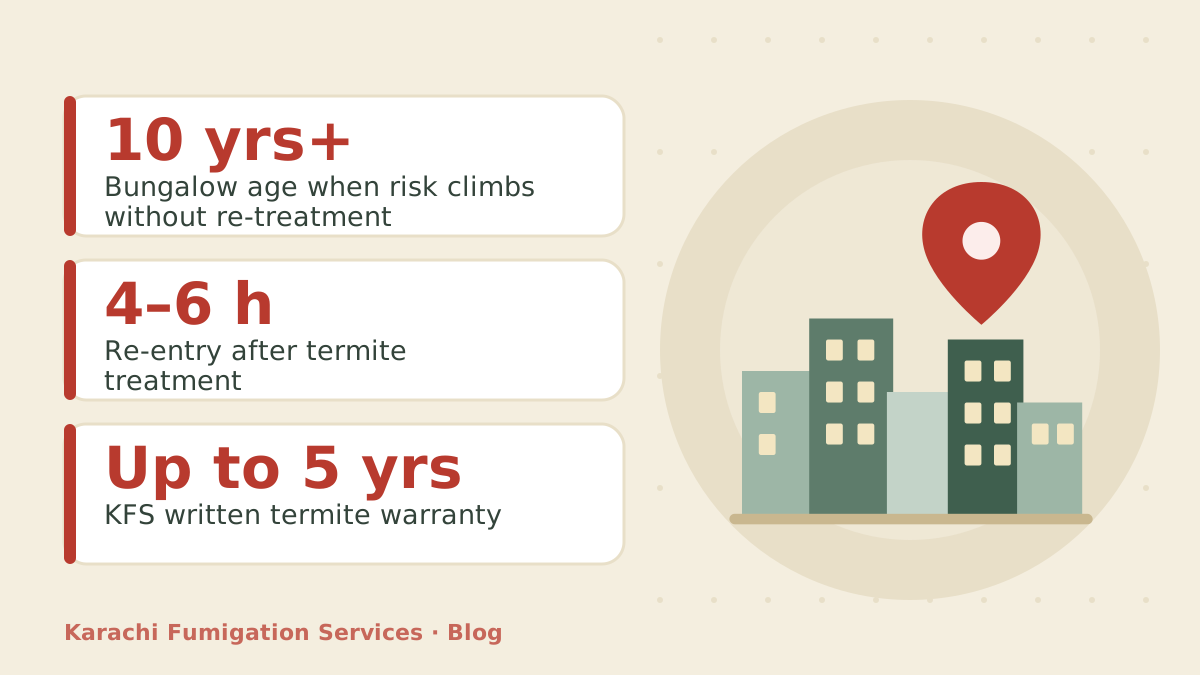
As a general rule: any bungalow over 10 years old without documented chemical re-treatment is at significant and growing termite risk.
Common Signs of Termite Damage in DHA Bungalows
Recognising early warning signs can mean the difference between a manageable treatment and a costly structural repair:
Common signs in DHA bungalows
- Hollow skirting and framesWhen you tap them
- Mud tubesOn outside walls, along pipes and floor joints
- Blistered paintDamp patches with no leak
- Swollen, sticking doorsMoist, damaged timber
- Swarmers and wingsNear lights on humid evenings
- Hollow sound when tapping wooden door frames, window frames, or skirting boards
- Thin mud tubes running along the exterior base of walls, along pipes, or between floor and walls
- Cracked or bubbling paint on wooden surfaces where termites have created galleries just underneath
- Fine powdery frass (termite droppings) appearing near wooden fixtures, furniture, or along walls
- Doors and windows that have subtly warped and become difficult to open or close
- Visible damage to roof wooden beams when accessing the attic or roof space
- Swarms of winged termites (alates) near light sources, often on warm, humid evenings or after rain
Even one of these signs warrants immediate professional assessment. Termite colonies do not stop growing on their own, and the damage compounds with every passing week.
Why DHA Bungalows Fare Worse Than Apartments
It is worth understanding why apartment dwellers, even in DHA, tend to have far fewer termite problems. Apartments above the ground floor have limited soil contact, reduced exposed timber, and building management structures that often handle periodic pest treatments for common areas.
Bungalow owners carry individual responsibility for full-structure treatment. The combination of direct soil contact, mature garden vegetation, extensive structural woodwork, and aging chemical treatments creates conditions no apartment can replicate. This is why termite damage in DHA bungalows frequently runs deeper, lasts longer, and costs far more to repair than infestations elsewhere in the city.
The True Cost of Inaction
Termite damage is not just a maintenance issue; it is a serious financial risk. Replacing damaged roof timber, door frames, window shutters, built-in furniture and beams in a bungalow can run to a very large bill, and the work usually means living with carpenters and masons for weeks.
Properties with undisclosed termite damage are also known to see significant reductions in resale value. When buyers conduct pre-purchase inspections, as is increasingly common in DHA's active property market, termite damage is one of the most common reasons for price renegotiation or deal collapse.
The cost of professional prevention and treatment is a fraction of these repair figures.
What Effective Termite Control for DHA Bungalows Looks Like
A proper termite treatment for a DHA bungalow should include all of the following:
A proper termite treatment for a bungalow
- 1Full inspectionSub-floor, roof space, false ceilings, walls and garden
- 2Soil treatmentTermiticide injected along foundations and drain lines
- 3Wood treatmentExposed timber treated; frames injected
- 4Written warrantyUp to 5 years, with yearly checks
- Full property inspection including sub-floor, roof space, false ceilings, external walls, and garden perimeter
- Soil treatment via termiticide injection around the foundation, drainage lines, and all known entry points
- Wood treatment of all exposed timber using boron-based or other approved chemicals
- Termite monitoring station installation around the garden perimeter if recommended
- A written post-treatment warranty and a scheduled follow-up inspection
DIY solutions (sprays, powders, and store-bought products) are not adequate for established subterranean termite colonies. Professional-grade chemicals and application equipment are required to penetrate the soil, reach the colony, and ensure the treatment holds over time.
Our termite treatment in Karachi follows that sequence. Holes are drilled along interior and exterior walls at about five-foot intervals, a measured termiticide emulsion is poured into the soil beneath, every door frame is injected at the base, fixed woodwork is sprayed and the holes are plugged. The family can return 4 to 6 hours later, and the work carries a written warranty of up to 5 years. Because the price depends on covered area and the extent of the infestation, termite work is quoted after a free survey; see the pricing page.
Preventive Steps Every DHA Homeowner Should Take
If your bungalow has not had a termite inspection or treatment in the last five years, these preventive steps can reduce your risk:
- Eliminate wood-to-soil contact wherever possible: raised planters, wooden boundary frames, and timber trellises touching the ground are key risk points
- Fix leaking pipes, AC drain overflow, and water seepage immediately: termites are powerfully attracted to consistent moisture sources
- Store firewood, timber off-cuts, and construction materials away from the main structure
- Do not allow mulch or garden waste to accumulate against exterior walls
- Schedule a professional inspection annually: early detection saves enormous cost and structural damage