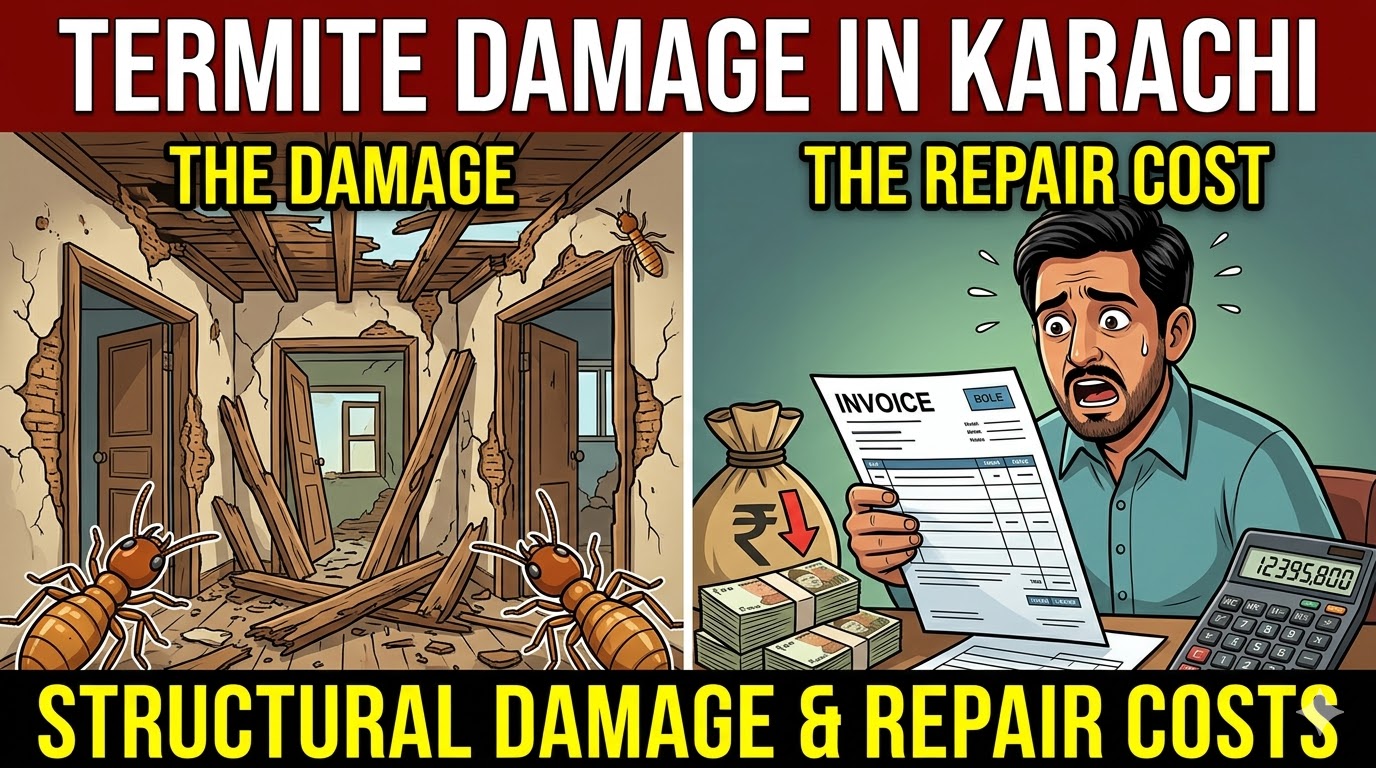
Most homeowners in Karachi think about termites in terms of damaged door frames or eaten skirting boards — cosmetic problems that are annoying but manageable. The reality is considerably more serious. Left undetected or untreated, termites can cause damage that compromises the structural integrity of a building, creates safety hazards for occupants, and results in repair bills that dwarf the cost of prevention and treatment many times over.
This article gives Karachi homeowners a realistic picture of what termites are actually capable of, which parts of a property are at highest risk, how damage progresses over time, and what the financial consequences look like in the current Karachi construction and labour market.
Understanding How Termites Destroy a Building
To appreciate the scale of potential damage, it helps to understand how termites actually cause it. Subterranean termites — the primary structural threat in Karachi — feed on cellulose, the organic compound found in wood, paper, cardboard, and plant material. In a building, their target is timber: door frames, window frames, roof joists, floor boards, furniture carcasses, and any other wood-based material they can access.
Termites eat wood from the inside outward. They consume the soft inner grain while leaving the hardest outer surface intact — which is why termite-damaged wood can look completely normal on the outside while being hollow and structurally useless inside. A door frame attacked by termites may look solid until you press on it and your thumb goes straight through.
A mature subterranean termite colony can contain 200,000 to 500,000 workers. Each worker is small, but collectively a colony of this size can consume approximately 400 grams of wood per day under favourable conditions. In Karachi’s warm climate, colonies are active for most of the year. This means a colony established beneath a building for 12 to 24 months can cause damage that would take a human days to replicate with power tools.
Drywood termites, which infest timber directly without needing soil contact, are slower but more difficult to detect — they can be active inside structural timber for years before visible signs appear.
The Five Stages of Termite Damage Progression
Stage 1 — Entry and establishment (months 1–6): Termites enter the building through soil contact, cracks in the foundation, or gaps around plumbing. They begin foraging through wall cavities, under floors, and within any accessible timber. At this stage, there are rarely visible signs. A professional inspection with the right tools can detect activity; an untrained eye will miss it entirely.
Stage 2 — Initial structural feeding (months 6–18): Termites begin consuming the interior of wooden elements: the lower sections of door frames, wooden skirting, sub-floor timber, and any untreated wood near entry points. Early signs may emerge: occasional mud tubes, slight discolouration on walls near the floor. Most homeowners in Karachi at this stage either do not notice or attribute symptoms to dampness or normal wear.
Stage 3 — Expanding damage (months 18–36): The colony grows and foraging expands through the building. Multiple wooden elements are now affected. Structural timber — roof joists, load-bearing wooden beams, floor supports — may begin to show damage. Visible signs become more obvious: hollow sounds when tapping wood, doors or windows that no longer open smoothly, paint bubbling or peeling near the floor. This is the stage at which most Karachi homeowners first call a pest control company.
Stage 4 — Severe structural damage (years 3–7): Without treatment, damage now extends to multiple structural elements. Roof timber may be significantly weakened. Load-bearing elements may show visible sagging or warping. The cost of repair at this stage is substantial and may require partial demolition and reconstruction of affected areas.
Stage 5 — Critical structural failure (7+ years): In extreme cases of prolonged, untreated infestation, termite damage can render sections of a building structurally unsafe. This is most common in older properties in central Karachi, where infestation has proceeded unchecked for many years. At this stage, repair costs approach or exceed the rebuilding value of the affected sections.
Which Parts of a Karachi Home Are at Highest Risk?
Not all building elements carry equal risk. The following are the most commonly and severely affected components in Karachi homes and the reason for their vulnerability:
Door frames and window frames: These are almost always the first elements attacked because they are close to the floor, in direct or near-direct contact with the foundation, and rarely inspected. In Karachi properties, door frames are frequently made from untreated wood, and the bottom sections are attacked almost immediately upon termite entry. Replacement cost for a standard door frame with labour in Karachi currently ranges from Rs. 8,000 to Rs. 25,000 per frame depending on material and finish.
Wooden roof structures: Properties in Karachi with timber roof joists, rafters, or purlins — common in older bungalows in DHA, Clifton, and PECHS — are at significant risk once termites establish in the building. Roof timber is often not inspected for years, meaning damage is discovered late. Partial replacement of a timber roof structure can cost Rs. 200,000 to Rs. 800,000 or more depending on the size and extent of damage.
Built-in cabinetry and fitted furniture: Kitchen units, wardrobes, and storage cupboards made from standard commercial MDF or untreated plywood are extremely vulnerable. These can be completely hollowed out within 12 to 18 months. Replacement of a full kitchen fit-out in Karachi ranges from Rs. 150,000 to Rs. 600,000 depending on specification.
Wooden flooring and sub-floor structures: Parquet flooring, wooden deck flooring, and any timber sub-floor structure is at risk, particularly on ground floors. Damaged wooden flooring requires full removal, treatment, and replacement — typically Rs. 80 to Rs. 200 per square foot for materials and labour, adding up quickly in larger rooms.
Structural concrete and plaster (secondary damage): Termites do not eat concrete, but their tunnelling activities create channels in plaster and create conditions for moisture ingress that weakens plaster work and can lead to efflorescence and surface failure. Replastering of affected walls typically costs Rs. 50 to Rs. 120 per square foot.
Estimated Repair Costs for Termite Damage in Karachi
The following table provides indicative repair cost ranges in the current Karachi market (2024–2025). These are estimates based on standard residential properties and typical damage patterns — actual costs will vary based on property size, accessibility, material specifications, and the extent of structural involvement.
| Damage Type | Moderate Damage | Severe Damage |
| Single door frame replacement | Rs. 8,000–15,000 | Rs. 15,000–30,000 |
| All door frames (typical 3-bed house) | Rs. 60,000–120,000 | Rs. 120,000–250,000 |
| Built-in wardrobe replacement | Rs. 40,000–80,000 | Rs. 80,000–180,000 |
| Kitchen cabinet replacement | Rs. 150,000–300,000 | Rs. 300,000–600,000 |
| Wooden flooring (per 100 sq ft) | Rs. 12,000–25,000 | Rs. 25,000–50,000 |
| Partial roof timber replacement | Rs. 150,000–350,000 | Rs. 350,000–800,000 |
| Plaster repair and redecoration (per room) | Rs. 20,000–45,000 | Rs. 45,000–100,000 |
| Full home structural remediation | Rs. 500,000–1,200,000 | Rs. 1,200,000–3,500,000+ |
These figures illustrate an important point: even moderate termite damage in a typical three-bedroom home in Karachi can result in Rs. 300,000 to Rs. 600,000 in repairs once the full scope of affected elements is addressed. Severe, long-term damage can exceed Rs. 2 million in a property that is structurally compromised.
By contrast, comprehensive professional termite treatment for a property of the same size — including soil treatment, wood treatment, and a multi-year warranty — typically costs a fraction of even the lower repair estimate.
The Hidden Costs Beyond Timber Replacement
The visible cost of replacing damaged timber and replastering walls is only part of the financial picture. Homeowners dealing with serious termite damage in Karachi frequently encounter additional costs that are not immediately obvious:
- Temporary accommodation: If structural repairs require sections of the house to be uninhabitable during remediation, alternative housing costs are incurred. In Karachi, even basic short-term rental adds Rs. 30,000 to Rs. 80,000 per month depending on area.
- Professional structural assessment: For any significant damage to load-bearing elements, an independent structural engineer’s assessment is essential before repair work begins. This typically costs Rs. 20,000 to Rs. 60,000 in Karachi.
- Property value reduction: Termite damage — even when repaired — can reduce a property’s market value if buyers are aware of the history. In Karachi’s property market, disclosed termite damage typically results in a negotiated discount of 5% to 15% on the asking price.
- Disruption costs: Repairing termite damage involves significant disruption — contractors in and out of the home, dust, noise, displaced furniture, and the time required to manage the process. The indirect cost to working families is real, even if it is harder to quantify.
- Recurring risk without treatment: Repairing damaged timber without treating the underlying termite infestation guarantees that the same damage will recur. New timber installed into a building without active termite barrier treatment will simply become the next target.
Case Study: A Typical Karachi Scenario
Consider a typical scenario that our team encounters regularly: a family in Gulshan-e-Iqbal purchases a 200-square-yard house approximately eight years old. The property was inspected visually before purchase but not professionally. Within 18 months of moving in, they notice that two bedroom door frames feel soft when pressed and one wardrobe has small piles of what looks like sawdust at its base.
A professional inspection reveals active termite infestation throughout the ground floor, with damage to all four ground-floor door frames, two sets of built-in wardrobes, skirting boards throughout two rooms, and — more seriously — early-stage damage to the timber window frames on the ground floor. There is also evidence of old termite activity in the roof space, though this appears dormant.
The repair scope: all four door frames replaced, both wardrobe units replaced, skirting replaced throughout, window frames treated and partially replaced, roof space inspected and treated. Total repair cost: approximately Rs. 620,000. Additionally, comprehensive termite treatment of the building including soil injection and wood treatment: approximately Rs. 45,000.
The total cost of dealing with an infestation that had been developing for years — much of it before the family purchased the property — exceeded Rs. 650,000. Had a professional inspection been carried out before purchase, the damage would have been discovered, the cost reflected in the purchase price negotiation, and treatment carried out before it progressed further.
What a Professional Inspection Can Save You
Early detection and treatment is always significantly cheaper than late-stage repair. This is not unique to Karachi — it is a principle that applies universally. What is unique to Karachi is the elevated baseline risk created by the city’s climate, soil conditions, construction practices, and the scale of its housing stock. In this environment, waiting for visible signs before acting is a costly strategy.
When to Act: Signs That Damage Is Progressing
If you notice any of the following in your Karachi property, do not delay — these indicate that termite damage may already be at an intermediate or advanced stage:
- Any wooden element that feels soft, spongy, or hollow when pressed
- Doors or windows that suddenly become difficult to open or close (swelling effect from moisture in damaged timber)
- Visible sagging in wooden floors, particularly on ground floor
- Paint that bubbles, peels, or appears damp near skirting level without a plumbing cause
- Small piles of fine pellets or sawdust-like material near wooden fittings
- Mud tubes on any wall, internal or external
- Ceiling sections that appear slightly sunken, warped, or discoloured
Any single one of these signs warrants an immediate professional inspection. Two or more together indicate active infestation that has likely been underway for some time.
The Cost of Doing Nothing
The most expensive decision a Karachi homeowner can make when it comes to termites is to postpone action. Each month that an active infestation continues, more timber is consumed, more structural elements are weakened, and the scope — and cost — of eventual repair grows.
A termite colony does not resolve itself. It does not die off in summer or go dormant in winter in Karachi’s climate. Without treatment, a colony will continue foraging and expanding for years. The only thing that stops the damage is professional intervention.
Book Your Free Inspection — Protect Your Investment Before Damage Escalates
If you have any concern about termite activity in your Karachi property — whether you have seen signs or simply want to confirm that your home is protected — our team will conduct a thorough professional inspection at no charge.
We will assess your full property, identify any current or potential risk areas, and provide you with a clear, honest written report. Treatment, if needed, is competitively priced with a multi-year warranty. Doing nothing is always the most expensive option in the long run — let us help you act before the damage makes that choice for you. Contact us today to book your free inspection.

Ahmad Karimi is a PPMA-registered pest management specialist and the lead technical consultant at Karachi Fumigation Services, where he has overseen field operations and treatment protocols since 2005. With over 20 years of hands-on experience treating residential, commercial, and industrial properties across Karachi — from DHA bungalows with structural termite infestations to Korangi factories requiring large-scale rodent exclusion — he brings direct field knowledge to every article published on this blog.
Ahmad has managed pest control programs for clients including Descon Engineering, Pakistan Tobacco Company, Saylani Welfare, and J. (Junaid Jamshed), and has issued hundreds of fumigation certificates for health authority compliance, import/export, and commercial licensing purposes. He holds active PPMA membership and works exclusively with WHO-approved chemicals in all field operations.
The content on this blog draws directly from two decades of Karachi-specific infestation data — seasonal pest patterns, neighbourhood-level risk factors, building-age vulnerabilities, and the regulatory requirements that Karachi businesses actually face. No recycled content from foreign pest control sites. Every article reflects conditions specific to Karachi’s climate, infrastructure, and compliance environment.
For treatment enquiries or technical questions, Ahmad’s team can be reached at 03463303875 or via the office at Trade Tower, Civil Lines, Karachi.
Leave a Reply