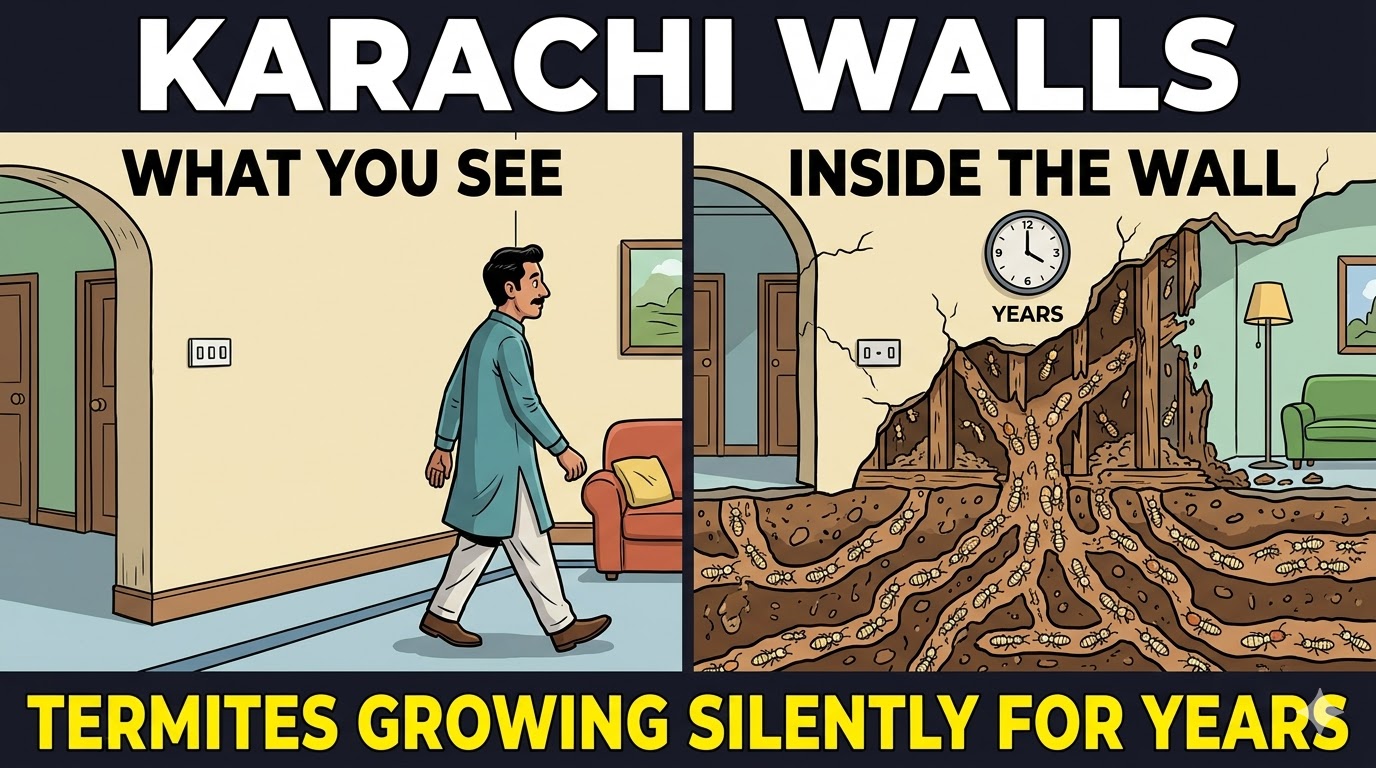
Category: Termite

  • How to Check If a New Property in Karachi Has Termite Damage Before You Buy or Rent

    How to Check If a New Property in Karachi Has Termite Damage Before You Buy or Rent

    Buying or renting a property in Karachi is one of the biggest financial decisions most families make. Whether you are looking at a flat in Gulshan-e-Iqbal, a house in DHA, or a commercial space in SITE Industrial Area, there is one hidden threat that could quietly destroy the value of your investment: termites.

    Karachi’s hot, humid coastal climate creates near-perfect conditions for subterranean and drywood termites to thrive year-round. Termites are often called the ‘silent destroyers’ for good reason — they can hollow out wooden beams, door frames, flooring, and even plaster walls over months or years without any obvious external sign. By the time visible damage appears, the structural integrity of the property may already be seriously compromised.

    This guide walks you through exactly how to inspect a property for termite damage before signing any agreement — so you can negotiate from a position of knowledge or walk away before it is too late.

    Why Karachi Properties Are Especially Vulnerable

    Before getting into inspection techniques, it helps to understand why termite damage is so prevalent in Karachi specifically.

    The city sits near sea level with a semi-arid coastal climate. Monsoon season brings heavy moisture into soil and building foundations, while the rest of the year remains warm enough for termites to stay active. Older neighbourhoods such as Saddar, Lyari, Nazimabad, and parts of Korangi have properties that are decades old with untreated wood and original foundations — prime termite territory.

    Even newer constructions are not immune. Many builders in Karachi use inadequately treated timber for door frames, window shutters, and furniture fixtures. Pre-cast soil that has not received anti-termite chemical treatment during the slab stage can harbour termite colonies from day one.

    Knowing this context, a careful inspection before purchase or rental is not just advisable — it is essential.

    Step 1: Inspect the Exterior Foundation and Soil Line

    Start outside. Walk around the full perimeter of the property before entering. You are looking for:

    • Mud tubes: These pencil-thin tunnels of dried soil and debris are the most reliable indicator of subterranean termite activity. They typically run from the soil upward along foundation walls, plumbing pipes, or exterior walls. Even an old, dried mud tube indicates that termites were active at some point.
    • Soil disturbance near the foundation: Soft, crumbly, or unusually dark soil close to the base of the building can indicate termite nesting activity below the surface.
    • Wood in direct contact with soil: Wooden door frames, boundary walls with timber inserts, or garden structures touching the ground are high-risk entry points. Check them closely.
    • Weep holes and drainage pipes: Termites exploit any crack or gap in the foundation. Check around where pipes enter the structure.

    In areas like North Karachi or Orangi Town where properties are closely packed and older utility infrastructure is in place, this exterior walk is even more important because underground moisture channels are common.

    Step 2: Tap and Press All Wooden Surfaces Inside

    Once inside the property, methodically inspect every wooden element. The technique is simple but effective: tap firmly on wooden surfaces with your knuckle or a small tool. Solid wood produces a sharp, clear knock. Termite-damaged wood produces a hollow, dull thud — because the inside has been eaten away, leaving only a thin shell.

    Focus your tapping inspection on:

    • Door frames (especially the lower 60 cm closest to the floor)
    • Window sills and shutters
    • Skirting boards and wooden architraves
    • Ceiling beams and wooden roof structures
    • Built-in wardrobes, kitchen cabinets, and shelving
    • Wooden flooring or parquet panels
    • Staircases with wooden risers or banisters

    In properties built before 2000 — common in areas like P.E.C.H.S., Gulberg, and Clifton’s older housing — wooden elements may not have received any chemical pre-treatment. Press gently on surfaces with your thumb. Wood that feels soft, spongy, or gives way under light pressure almost certainly has internal termite damage.

    Step 3: Look for Frass — Termite Droppings

    Drywood termites, which infest the wood itself rather than coming up from the soil, push their excrement (called frass) out of the wood through tiny kick-out holes. Frass looks like small, elongated pellets — similar in shape to coffee grounds or coarse sawdust — and is usually found in small piles below infested wood.

    Check below window sills, at the base of door frames, in corners of rooms, and beneath built-in furniture. A small pile of frass is a definitive sign of active drywood termite infestation in that exact location.

    Frass is often confused with regular dust or sawdust during property viewings. Look carefully. If in doubt, collect a small sample and show it to a professional — a qualified pest control technician can confirm whether it is termite frass in seconds.

    Step 4: Examine Walls, Paint, and Plaster

    Termites do not only damage wood — they travel through wall cavities, and their presence often creates secondary damage to plaster and paint. Signs to look for include:

    • Bubbling or peeling paint: Termites produce moisture as they digest cellulose. This moisture causes paint to bubble, peel, or appear damp even on interior walls away from water sources.
    • Thin, papery surface on walls: Run your hand along plastered walls. If certain areas feel hollow or produce a papery sound when tapped, termites may have built channels behind the plaster.
    • Small pinholes in plaster or drywall: These are exit holes where termites have broken through from internal channels. They may be freshly sealed with mud — a clear sign of recent activity.
    • Discolouration or staining: Dark patches on walls at floor level, particularly in corners, can indicate termite-related moisture damage.

    Be especially alert in properties that have been freshly painted or recently replastered. In Karachi’s property market, it is unfortunately common for sellers or landlords to paint over termite damage to hide it from prospective buyers. A fresh coat of paint on just the lower sections of walls should raise immediate questions.

    Step 5: Check Bathrooms, Kitchens, and Utility Areas

    Termites are drawn to moisture. Any area of the property where water is regularly present is a higher-risk zone. In Karachi homes, bathrooms and kitchens often have wooden sub-frames behind tiles, wooden cabinet bases, and under-sink storage areas that are rarely inspected.

    Pull open all under-sink cabinets and storage areas. Look for mud tubes, frass, soft or damaged wood, and discolouration. Check the area around the water meter and main supply pipes where they enter the building — these are common termite entry points, particularly in older properties where pipe seals have degraded.

    In properties with a basement or lower ground floor — less common in Karachi but found in some DHA and Clifton bungalows — inspect thoroughly along all walls at floor level and around any utility access points.

    Step 6: Inspect the Roof Space and Upper Floors

    Drywood termites, in particular, can infest roof timber from the top down. If the property has an accessible roof space or attic, inspect the timber joists and rafters. Termite-damaged roof timber is a serious structural concern and can be very expensive to repair.

    Even without roof access, check the ceilings of upper floors. Sagging, cracked, or discoloured ceiling sections can indicate termite activity in roof beams above. In older properties in Karachi with wooden beam roofs — still common in parts of Saddar, Ranchore Lines, and some heritage-style properties in Garden East — this step is especially important.

    Step 7: Ask the Right Questions

    Beyond physical inspection, the conversation you have with the seller or landlord matters. Ask directly:

    • Has the property ever had a termite problem?
    • Has anti-termite treatment ever been carried out, and if so, when and by whom?
    • Are there any warranties or certificates from a licensed pest control company?
    • Has there been any significant structural repair or renovation in the last five years?

    A seller who becomes evasive or vague when these questions are raised is giving you important information. A property with a documented history of professional termite treatment and a current pest control certificate is actually a positive — it means the issue was addressed properly.

    Step 8: Commission a Professional Pre-Purchase Inspection

    The steps above will help you identify obvious signs of termite damage during a viewing. However, for a property of significant value, a professional inspection is strongly recommended before you commit financially.

    Red Flags That Should Make You Walk Away

    Some situations indicate termite damage so severe that the safest option may be to decline the property entirely unless the price reflects major remediation work:

    • Multiple structural wooden elements that are hollow or collapsed under pressure
    • Evidence of very recent replastering or repainting specifically around wall bases and door frames with no explanation
    • Strong musty odour inside — can indicate extensive termite damage combined with moisture
    • Visible sagging of floors or ceilings not explained by building age alone
    • Seller or agent refuses to allow an independent professional inspection

    What to Do If You Find Evidence of Termites

    If your inspection reveals signs of termite activity, do not panic — but do not ignore it either. The extent of the damage and the cost of treatment need to be factored into your decision.

    For light infestation in a small number of wooden elements, localised treatment may be relatively straightforward. For widespread infestation affecting structural elements, foundation areas, or multiple rooms, a comprehensive treatment plan involving soil treatment, borate wood treatment, and possibly structural repairs will be needed.

    Get a professional assessment and a written treatment quote before making any financial commitment on the property. This gives you the full picture of what you are taking on.

    Final Checklist for Your Property Inspection

    Use this checklist during your next property viewing in Karachi:

    • Walk the exterior perimeter — check for mud tubes, soil disturbance, wood-to-soil contact
    • Tap all wooden surfaces — listen for hollow sounds
    • Check for frass beneath windows, door frames, and furniture
    • Examine walls for bubbling paint, hollow plaster, pinholes
    • Inspect bathrooms, kitchens, and utility areas for moisture + wood damage
    • Check roof space or ceiling condition on upper floors
    • Ask the seller direct questions about treatment history
    • Commission a professional inspection for high-value properties

    Book Your Pre-Purchase Termite Inspection Today

    Contact us today for a free inspection consultation. Do not let termites turn your dream property into a costly nightmare — let our experts give you the clarity you need to make a confident decision.

  • How Much Structural Damage Can Termites Cause in a Karachi Home — and What Repairs Cost

    How Much Structural Damage Can Termites Cause in a Karachi Home — and What Repairs Cost

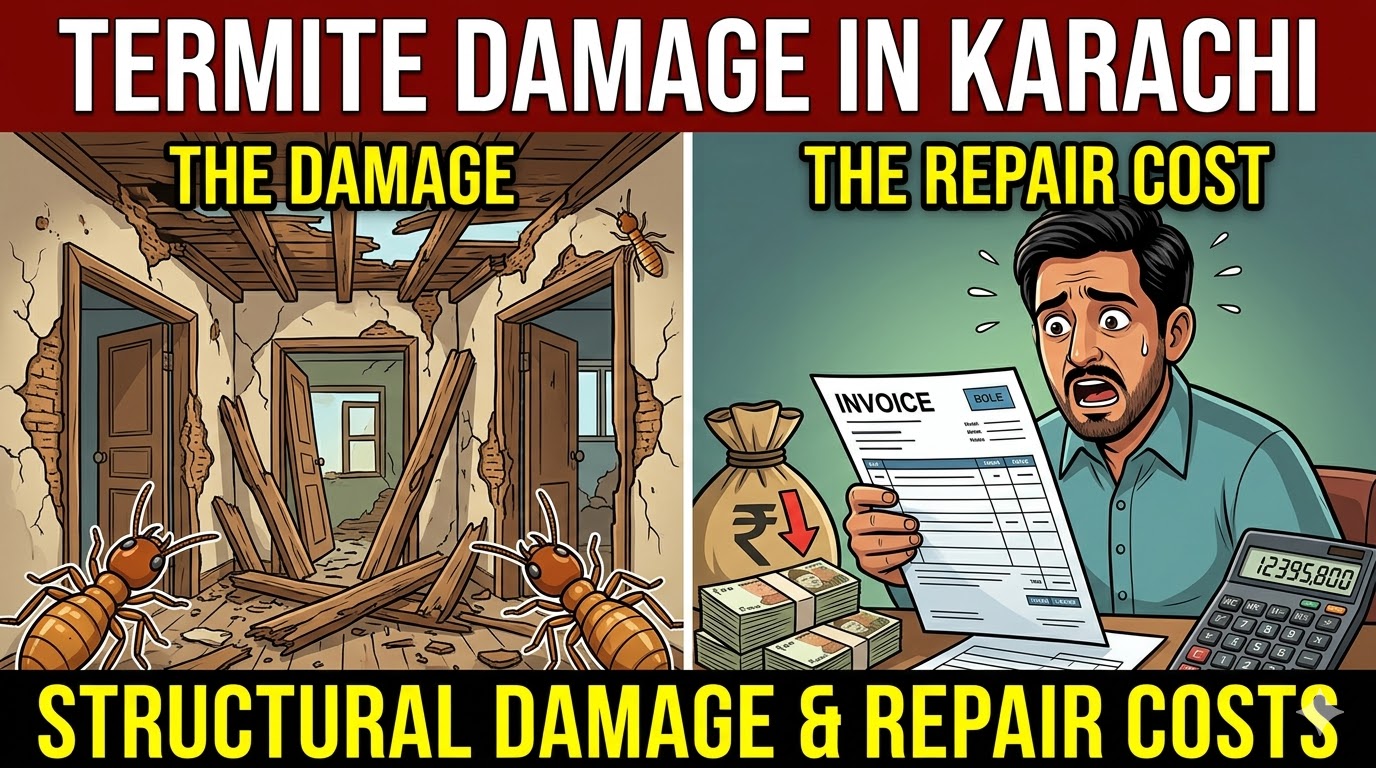
    Most homeowners in Karachi think about termites in terms of damaged door frames or eaten skirting boards — cosmetic problems that are annoying but manageable. The reality is considerably more serious. Left undetected or untreated, termites can cause damage that compromises the structural integrity of a building, creates safety hazards for occupants, and results in repair bills that dwarf the cost of prevention and treatment many times over.

    This article gives Karachi homeowners a realistic picture of what termites are actually capable of, which parts of a property are at highest risk, how damage progresses over time, and what the financial consequences look like in the current Karachi construction and labour market.

    Understanding How Termites Destroy a Building

    To appreciate the scale of potential damage, it helps to understand how termites actually cause it. Subterranean termites — the primary structural threat in Karachi — feed on cellulose, the organic compound found in wood, paper, cardboard, and plant material. In a building, their target is timber: door frames, window frames, roof joists, floor boards, furniture carcasses, and any other wood-based material they can access.

    Termites eat wood from the inside outward. They consume the soft inner grain while leaving the hardest outer surface intact — which is why termite-damaged wood can look completely normal on the outside while being hollow and structurally useless inside. A door frame attacked by termites may look solid until you press on it and your thumb goes straight through.

    A mature subterranean termite colony can contain 200,000 to 500,000 workers. Each worker is small, but collectively a colony of this size can consume approximately 400 grams of wood per day under favourable conditions. In Karachi’s warm climate, colonies are active for most of the year. This means a colony established beneath a building for 12 to 24 months can cause damage that would take a human days to replicate with power tools.

    Drywood termites, which infest timber directly without needing soil contact, are slower but more difficult to detect — they can be active inside structural timber for years before visible signs appear.

    The Five Stages of Termite Damage Progression

    Stage 1 — Entry and establishment (months 1–6): Termites enter the building through soil contact, cracks in the foundation, or gaps around plumbing. They begin foraging through wall cavities, under floors, and within any accessible timber. At this stage, there are rarely visible signs. A professional inspection with the right tools can detect activity; an untrained eye will miss it entirely.

    Stage 2 — Initial structural feeding (months 6–18): Termites begin consuming the interior of wooden elements: the lower sections of door frames, wooden skirting, sub-floor timber, and any untreated wood near entry points. Early signs may emerge: occasional mud tubes, slight discolouration on walls near the floor. Most homeowners in Karachi at this stage either do not notice or attribute symptoms to dampness or normal wear.

    Stage 3 — Expanding damage (months 18–36): The colony grows and foraging expands through the building. Multiple wooden elements are now affected. Structural timber — roof joists, load-bearing wooden beams, floor supports — may begin to show damage. Visible signs become more obvious: hollow sounds when tapping wood, doors or windows that no longer open smoothly, paint bubbling or peeling near the floor. This is the stage at which most Karachi homeowners first call a pest control company.

    Stage 4 — Severe structural damage (years 3–7): Without treatment, damage now extends to multiple structural elements. Roof timber may be significantly weakened. Load-bearing elements may show visible sagging or warping. The cost of repair at this stage is substantial and may require partial demolition and reconstruction of affected areas.

    Stage 5 — Critical structural failure (7+ years): In extreme cases of prolonged, untreated infestation, termite damage can render sections of a building structurally unsafe. This is most common in older properties in central Karachi, where infestation has proceeded unchecked for many years. At this stage, repair costs approach or exceed the rebuilding value of the affected sections.

    Which Parts of a Karachi Home Are at Highest Risk?

    Not all building elements carry equal risk. The following are the most commonly and severely affected components in Karachi homes and the reason for their vulnerability:

    Door frames and window frames: These are almost always the first elements attacked because they are close to the floor, in direct or near-direct contact with the foundation, and rarely inspected. In Karachi properties, door frames are frequently made from untreated wood, and the bottom sections are attacked almost immediately upon termite entry. Replacement cost for a standard door frame with labour in Karachi currently ranges from Rs. 8,000 to Rs. 25,000 per frame depending on material and finish.

    Wooden roof structures: Properties in Karachi with timber roof joists, rafters, or purlins — common in older bungalows in DHA, Clifton, and PECHS — are at significant risk once termites establish in the building. Roof timber is often not inspected for years, meaning damage is discovered late. Partial replacement of a timber roof structure can cost Rs. 200,000 to Rs. 800,000 or more depending on the size and extent of damage.

    Built-in cabinetry and fitted furniture: Kitchen units, wardrobes, and storage cupboards made from standard commercial MDF or untreated plywood are extremely vulnerable. These can be completely hollowed out within 12 to 18 months. Replacement of a full kitchen fit-out in Karachi ranges from Rs. 150,000 to Rs. 600,000 depending on specification.

    Wooden flooring and sub-floor structures: Parquet flooring, wooden deck flooring, and any timber sub-floor structure is at risk, particularly on ground floors. Damaged wooden flooring requires full removal, treatment, and replacement — typically Rs. 80 to Rs. 200 per square foot for materials and labour, adding up quickly in larger rooms.

    Structural concrete and plaster (secondary damage): Termites do not eat concrete, but their tunnelling activities create channels in plaster and create conditions for moisture ingress that weakens plaster work and can lead to efflorescence and surface failure. Replastering of affected walls typically costs Rs. 50 to Rs. 120 per square foot.

    Estimated Repair Costs for Termite Damage in Karachi

    The following table provides indicative repair cost ranges in the current Karachi market (2024–2025). These are estimates based on standard residential properties and typical damage patterns — actual costs will vary based on property size, accessibility, material specifications, and the extent of structural involvement.

    Damage TypeModerate DamageSevere Damage
    Single door frame replacementRs. 8,000–15,000Rs. 15,000–30,000
    All door frames (typical 3-bed house)Rs. 60,000–120,000Rs. 120,000–250,000
    Built-in wardrobe replacementRs. 40,000–80,000Rs. 80,000–180,000
    Kitchen cabinet replacementRs. 150,000–300,000Rs. 300,000–600,000
    Wooden flooring (per 100 sq ft)Rs. 12,000–25,000Rs. 25,000–50,000
    Partial roof timber replacementRs. 150,000–350,000Rs. 350,000–800,000
    Plaster repair and redecoration (per room)Rs. 20,000–45,000Rs. 45,000–100,000
    Full home structural remediationRs. 500,000–1,200,000Rs. 1,200,000–3,500,000+

    These figures illustrate an important point: even moderate termite damage in a typical three-bedroom home in Karachi can result in Rs. 300,000 to Rs. 600,000 in repairs once the full scope of affected elements is addressed. Severe, long-term damage can exceed Rs. 2 million in a property that is structurally compromised.

    By contrast, comprehensive professional termite treatment for a property of the same size — including soil treatment, wood treatment, and a multi-year warranty — typically costs a fraction of even the lower repair estimate.

    The Hidden Costs Beyond Timber Replacement

    The visible cost of replacing damaged timber and replastering walls is only part of the financial picture. Homeowners dealing with serious termite damage in Karachi frequently encounter additional costs that are not immediately obvious:

    • Temporary accommodation: If structural repairs require sections of the house to be uninhabitable during remediation, alternative housing costs are incurred. In Karachi, even basic short-term rental adds Rs. 30,000 to Rs. 80,000 per month depending on area.
    • Professional structural assessment: For any significant damage to load-bearing elements, an independent structural engineer’s assessment is essential before repair work begins. This typically costs Rs. 20,000 to Rs. 60,000 in Karachi.
    • Property value reduction: Termite damage — even when repaired — can reduce a property’s market value if buyers are aware of the history. In Karachi’s property market, disclosed termite damage typically results in a negotiated discount of 5% to 15% on the asking price.
    • Disruption costs: Repairing termite damage involves significant disruption — contractors in and out of the home, dust, noise, displaced furniture, and the time required to manage the process. The indirect cost to working families is real, even if it is harder to quantify.
    • Recurring risk without treatment: Repairing damaged timber without treating the underlying termite infestation guarantees that the same damage will recur. New timber installed into a building without active termite barrier treatment will simply become the next target.

    Case Study: A Typical Karachi Scenario

    Consider a typical scenario that our team encounters regularly: a family in Gulshan-e-Iqbal purchases a 200-square-yard house approximately eight years old. The property was inspected visually before purchase but not professionally. Within 18 months of moving in, they notice that two bedroom door frames feel soft when pressed and one wardrobe has small piles of what looks like sawdust at its base.

    A professional inspection reveals active termite infestation throughout the ground floor, with damage to all four ground-floor door frames, two sets of built-in wardrobes, skirting boards throughout two rooms, and — more seriously — early-stage damage to the timber window frames on the ground floor. There is also evidence of old termite activity in the roof space, though this appears dormant.

    The repair scope: all four door frames replaced, both wardrobe units replaced, skirting replaced throughout, window frames treated and partially replaced, roof space inspected and treated. Total repair cost: approximately Rs. 620,000. Additionally, comprehensive termite treatment of the building including soil injection and wood treatment: approximately Rs. 45,000.

    The total cost of dealing with an infestation that had been developing for years — much of it before the family purchased the property — exceeded Rs. 650,000. Had a professional inspection been carried out before purchase, the damage would have been discovered, the cost reflected in the purchase price negotiation, and treatment carried out before it progressed further.

    What a Professional Inspection Can Save You

    Early detection and treatment is always significantly cheaper than late-stage repair. This is not unique to Karachi — it is a principle that applies universally. What is unique to Karachi is the elevated baseline risk created by the city’s climate, soil conditions, construction practices, and the scale of its housing stock. In this environment, waiting for visible signs before acting is a costly strategy.

    When to Act: Signs That Damage Is Progressing

    If you notice any of the following in your Karachi property, do not delay — these indicate that termite damage may already be at an intermediate or advanced stage:

    • Any wooden element that feels soft, spongy, or hollow when pressed
    • Doors or windows that suddenly become difficult to open or close (swelling effect from moisture in damaged timber)
    • Visible sagging in wooden floors, particularly on ground floor
    • Paint that bubbles, peels, or appears damp near skirting level without a plumbing cause
    • Small piles of fine pellets or sawdust-like material near wooden fittings
    • Mud tubes on any wall, internal or external
    • Ceiling sections that appear slightly sunken, warped, or discoloured

    Any single one of these signs warrants an immediate professional inspection. Two or more together indicate active infestation that has likely been underway for some time.

    The Cost of Doing Nothing

    The most expensive decision a Karachi homeowner can make when it comes to termites is to postpone action. Each month that an active infestation continues, more timber is consumed, more structural elements are weakened, and the scope — and cost — of eventual repair grows.

    A termite colony does not resolve itself. It does not die off in summer or go dormant in winter in Karachi’s climate. Without treatment, a colony will continue foraging and expanding for years. The only thing that stops the damage is professional intervention.

    Book Your Free Inspection — Protect Your Investment Before Damage Escalates

    If you have any concern about termite activity in your Karachi property — whether you have seen signs or simply want to confirm that your home is protected — our team will conduct a thorough professional inspection at no charge.

    We will assess your full property, identify any current or potential risk areas, and provide you with a clear, honest written report. Treatment, if needed, is competitively priced with a multi-year warranty. Doing nothing is always the most expensive option in the long run — let us help you act before the damage makes that choice for you. Contact us today to book your free inspection.

  • Why Karachi’s New Construction Projects Are Still at High Risk of Termite Damage

    Why Karachi’s New Construction Projects Are Still at High Risk of Termite Damage

    A common assumption among new property buyers in Karachi is that a newly built home or apartment is automatically safe from termites. After all, the structure is fresh — new concrete, new timber, new fittings. What could termites possibly have found their way into?

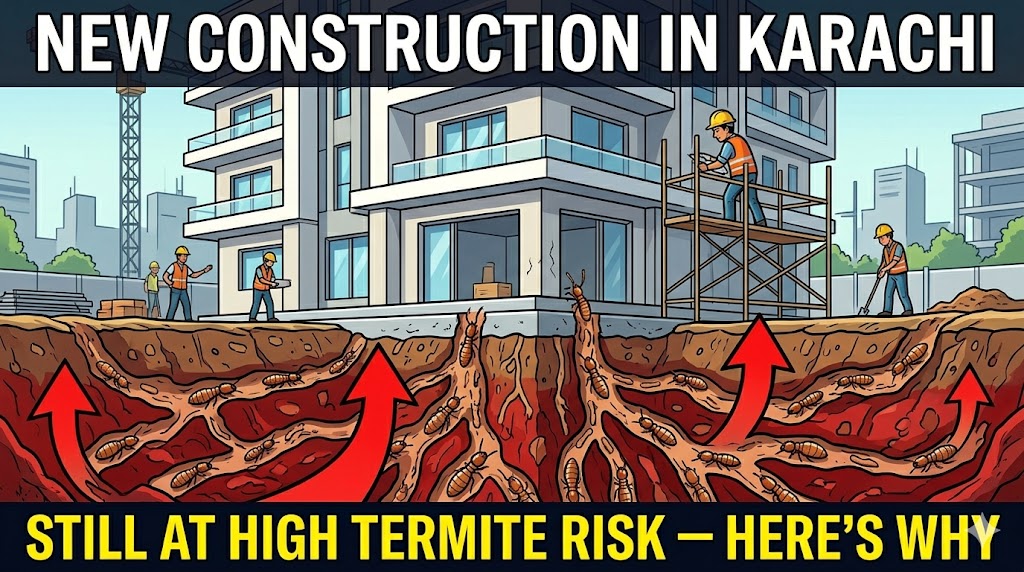
    This assumption is dangerously wrong, and it is costing homeowners across the city significant money in structural repairs within just a few years of moving in. New construction in Karachi is not inherently protected from termites. In fact, several factors specific to Karachi’s building industry, geography, and regulatory environment make new builds particularly vulnerable — and the damage often begins long before the first occupant moves in.

    If you have recently purchased a new property in Karachi, are in the process of building, or are considering buying off-plan, this article explains the risks you need to understand and what you can do about them.

    Reason 1: Pre-Construction Termite Treatment Is Often Skipped or Done Poorly

    In a properly managed construction project, anti-termite soil treatment is applied before the concrete foundation slab is poured. This creates a chemical barrier in the soil immediately beneath and around the building, preventing subterranean termites from entering through the floor.

    The problem is that in Karachi, this step is frequently skipped, performed incorrectly, or done with substandard materials to cut costs. The construction industry in Pakistan operates in an environment where oversight is inconsistent, and small contractors — who build the majority of residential properties in Karachi — face commercial pressure to finish quickly and cheaply.

    Common failures in pre-construction treatment include:

    • Using diluted or low-quality termiticide that does not meet required concentration levels
    • Treating only part of the foundation area rather than the full floor plan
    • Applying treatment in dry conditions without adequate soil moisture, reducing chemical absorption
    • Failing to treat around plumbing penetrations, utility entries, and expansion joints — the very gaps termites exploit
    • Using uncertified or counterfeit pesticide products that have no verified efficacy

    When pre-construction treatment is inadequate, the building is essentially constructed on top of an untreated termite habitat. The soil may harbour active colonies — and those colonies will find their way into the structure within months to a few years of completion.

    Reason 2: Karachi’s Soil Harbours Termite Colonies Year-Round

    Subterranean termites — the species most responsible for structural damage in Karachi — live in the soil. They build extensive underground colonies that can number in the hundreds of thousands of workers, and they forage widely through the soil searching for cellulose food sources.

    Karachi’s soil conditions are highly favourable for termite colony survival. The city’s underlying geology includes sandy, porous soil layers in many areas — particularly across Malir, Korangi, Bin Qasim Town, and the newer development zones toward Super Highway and Karachi-Hyderabad Motorway. These soil types retain enough moisture during and after monsoon season to support large underground termite populations, while draining well enough that colonies do not flood.

    Crucially, construction activity itself creates ideal conditions for termites. Excavation exposes deep soil layers. Construction waste — offcuts of timber, cardboard, wooden pallets, scaffolding timber left in contact with the ground — provides a rich food source that attracts and establishes termite populations right at the building site. By the time construction is complete, a thriving termite colony may already be established in the soil immediately adjacent to the new foundation.

    This is why new development areas on the outskirts of Karachi — including parts of Bahria Town Karachi, DHA City, and schemes along the Northern Bypass — report significant termite problems in properties that are only one to three years old.

    Reason 3: Untreated or Poorly Treated Timber

    Modern construction in Karachi uses timber in a number of applications: door frames, window frames and shutters, ceiling joists in some construction styles, built-in furniture, and roof structures. The quality and treatment of this timber varies enormously.

    Pressure-treated or borate-treated timber is termite-resistant. Untreated timber — even newly cut, fresh wood — is not. Termites will find and attack untreated wood regardless of how new it is.

    In Karachi’s construction supply chain, much of the timber used in residential projects comes from local markets where treatment standards are not verified or enforced. Timber merchants sell both treated and untreated wood, often without clear labelling. Contractors purchase based on price, and untreated timber is cheaper.

    The result is that many new buildings in Karachi contain door frames, window surrounds, and fitted furniture made from wood that offers zero termite resistance. These elements are the first to be attacked once termites establish access to the building, and in warm, humid conditions — particularly in ground-floor units and basements — attack can begin within the first year of construction.

    Reason 4: Coastal Humidity Accelerates Termite Activity

    Karachi’s position on the Arabian Sea coast has a direct impact on termite activity. Termites thrive in warm, humid conditions, and coastal Karachi provides both in abundance for much of the year.

    The monsoon season, typically running from July to September, saturates soil and creates ideal nesting conditions for subterranean termites. But even in the drier months, sea breezes carry ambient humidity that keeps building materials and soil at moisture levels favourable for termite activity. Unlike cities in Pakistan’s drier interior, Karachi rarely provides the extended dry periods that naturally suppress termite populations.

    For new construction, this means that any gap in termite protection — inadequate soil treatment, untreated timber, unsealed entry points — will be exploited relatively quickly. There is no seasonal dormancy to provide a grace period. Termites can be active and foraging throughout most of Karachi’s calendar year.

    Areas closest to the coast — DHA Phases 1 through 8, Clifton, Defence Housing, Kemari, and parts of Lyari — experience the highest ambient humidity and consequently some of the highest rates of termite activity in the city.

    Reason 5: Post-Construction Entry Points

    Even when pre-construction soil treatment is done correctly, new buildings develop vulnerabilities over time. Every new building in Karachi goes through a period of settlement — minor shifting and cracking of the foundation slab, walls, and floor joins — that creates new entry points for termites.

    These include:

    • Cracks in the expansion joints between the floor slab and walls
    • Gaps around plumbing pipes where they pass through the floor or foundation
    • Settling cracks in external walls at or near ground level
    • Gaps between concrete foundation blocks where mortar has shrunk slightly
    • Drainage channels and utility conduits that run from outside to inside the building

    Subterranean termites can exploit a gap as narrow as 1.5 mm. In a building that is two to three years old — settling naturally and experiencing its first few monsoon cycles — such gaps are virtually guaranteed to exist, regardless of how well the construction was executed.

    This is why post-construction treatment and a professional inspection in the first few years of a new building’s life is not just for older properties — it is essential maintenance for any new build.

    Reason 6: Inadequate Regulation and Quality Control

    Pakistan does not currently have a robust national standard or enforcement mechanism for anti-termite treatment in residential construction. Building plans may require anti-termite treatment certification as a condition of approval, but on-site verification of whether treatment was actually carried out — and carried out correctly — is inconsistent.

    Karachi’s building control environment adds further complexity. With millions of units across both formally approved and informally developed areas, systematic inspection of anti-termite measures is not realistic with available resources. Developers and contractors know this, and it reduces the incentive to invest properly in termite protection.

    For new property buyers, this regulatory gap means you cannot rely on the existence of a building approval certificate as evidence that proper anti-termite treatment was completed. You need to ask for specific documentation from the developer — the name of the pest control company, the product used, the area treated, and any warranty provided.

    Reason 7: Landscaping and External Features Introduce New Risk

    Once a new property is occupied, homeowners typically invest in landscaping — gardens, flower beds, boundary trees, and decorative timber elements. Each of these can introduce termite risk if not managed carefully.

    Soil brought in for garden beds may contain termite eggs or juvenile colonies. Mulch used in planting areas is an attractive food source for termites. Wooden garden furniture, timber pergolas, boundary trellises, and decorative driftwood placed near the building create bridges between soil-level termite activity and the structure itself.

    New construction in gated communities such as those in DHA City, Bahria Town Karachi, and Saadi Town often includes communal green spaces and landscaping managed by the development authority. If this landscaping is not properly treated and monitored for termite activity, it creates a shared risk for all adjacent properties.

    What New Property Owners in Karachi Should Do Right Now

    If you have recently moved into a new property in Karachi — or are about to — here are the practical steps to take:

    1. Request documentation from your developer. Ask specifically for the anti-termite treatment certificate, including the company name, product used, and treatment date. If the developer cannot provide this, assume the treatment was either not done or not done correctly.

    2. Get a professional inspection in the first year. Even if documentation exists, a professional inspection by a qualified technician gives you an independent assessment of the current condition. This is especially important if you notice any of the early warning signs — mud tubes, hollow-sounding woodwork, frass deposits, or paint bubbling near the floor.

    3. Arrange post-construction treatment if documentation is absent.

    4. Use treated timber in all future additions. If you are adding a pergola, fitted wardrobe, kitchen extension, or any new wooden element, ensure the timber has been pressure-treated or borate-treated before installation.

    5. Manage external landscape risk. Keep soil, mulch, and garden beds at least 30 cm away from the building’s foundation walls. Inspect wooden outdoor furniture and fixtures annually. Remove dead wood, tree stumps, and construction waste from the garden.

    6. Seal foundation cracks promptly. As your building settles and small cracks develop, have them sealed with appropriate materials. Do not leave them open — even a small gap is sufficient for termite entry.

    The Hidden Cost of Waiting

    Termite damage in new Karachi properties rarely announces itself dramatically. It develops quietly over months and years. By the time homeowners notice bubbling paint, a door that no longer closes properly, or a skirting board that crumbles when touched, the damage behind the visible surface is often far more extensive than it appears.

    The cost of treating a new property proactively is a fraction of the cost of repairing structural termite damage even a few years into ownership. And with Karachi’s property market representing major financial commitments for most families, protection of that investment is not optional — it is essential.

    Book Your Free Inspection — Before Termites Make the Decision for You

    If your property is newly built or under construction and you are not 100% certain that professional-grade anti-termite treatment has been applied, now is the time to act. Our team provides free inspections across Karachi, a detailed written assessment, and honest advice on the right protection for your specific property.

    Do not wait for visible damage to appear. By the time you can see it, termites have already been at work for much longer than you realise. Contact us today to book your free inspection and protect your new home from day one.

  • Termite Warranty in Karachi: What 1-Year, 3-Year, and 5-Year Coverage Actually Means

    Termite Warranty in Karachi: What 1-Year, 3-Year, and 5-Year Coverage Actually Means

    If you have ever received a quote for termite treatment in Karachi, you have almost certainly seen warranty periods offered — one year, three years, or five years. But most homeowners have no idea what these numbers actually mean, what they cover, what they exclude, or whether the company offering them will honour them in practice.

    Warranty periods are one of the most misunderstood aspects of professional pest control — and in a city like Karachi, where termite infestation risk is high and treatment quality varies enormously, understanding what a warranty actually covers could be the difference between a protected home and a very expensive disappointment.

    This guide explains every aspect of termite warranties in plain language: what each coverage period means, what is typically included and excluded, what questions to ask before signing, and how to evaluate whether a warranty is genuinely valuable.

    What Is a Termite Treatment Warranty?

    A termite warranty is a written agreement from a pest control company that guarantees the effectiveness of their treatment for a defined period. In broad terms, it means that if termites return — or if termite activity is discovered during the warranty period — the company will re-treat the property at no additional charge.

    However, the details of what “re-treat” means, what conditions must be met for the warranty to apply, and what the company’s obligations actually are vary significantly between providers. A warranty is only as good as the company standing behind it — and in Karachi’s pest control market, where providers range from licensed, professional operations to informal one-person operations, due diligence is essential.

    Why Termite Warranties Exist — and Why They Matter in Karachi

    Professional termite treatment in Karachi involves the application of chemical barriers in soil, targeted injection into wall cavities, and the installation of monitoring systems. These treatments are highly effective — but they are not permanent. Over time, soil movement, new construction, heavy rains, and the natural persistence of underground colonies can compromise chemical barriers.

    In Karachi specifically, several factors make post-treatment monitoring especially important:

    • Monsoon flooding can dilute or displace soil-applied termiticide, potentially compromising external perimeter barriers
    • New construction on adjacent plots — common in rapidly developing areas like Bahria Town, DHA Phase 8, and Scheme 33 — disturbs underground termite colonies and can redirect foraging activity toward treated properties
    • Plumbing repairs, renovations, and floor work inside a treated property can breach chemical barriers applied at construction joints
    • The underground termite colonies in Karachi’s older residential neighbourhoods are exceptionally large and persistent, requiring sustained control rather than a one-time application

    A warranty provides the ongoing attention and accountability needed to address these post-treatment risks. For Karachi homeowners, it transforms a one-time treatment into a sustained protection programme.

    1-Year Termite Warranty: What It Covers and Who It Suits

    A one-year warranty is the standard coverage offered with most basic or reactive termite treatments. It is the entry-level guarantee and, while better than no warranty, it should be understood in context.

    What a 1-Year Warranty Typically Includes:

    Re-treatment of the affected area if termite activity returns within 12 months of the original treatment date. Usually one follow-up inspection visit, either scheduled or on-request. Coverage for the specific areas treated in the original scope of work.

    Limitations of 1-Year Coverage

    The fundamental limitation of a one-year warranty is that it provides only short-term assurance. The most commonly used termiticide products applied in professional treatment remain active for two to five years under ideal conditions, but soil conditions, rainfall, and construction activity can significantly shorten their effective lifespan.

    A one-year warranty typically does not include annual inspection visits as a standard service — these may be offered separately. It also rarely covers any structural repair or damage that occurs if termites return within the warranty period.

    Who Should Consider a 1-Year Warranty

    A one-year warranty is appropriate for reactive treatments of minor, localised infestations — for example, a single room or a specific piece of built-in furniture — where the infestation is small, well-contained, and the property has no known history of recurring termite problems. It is not recommended as the primary protection plan for a full-property treatment or for a home with a history of termite activity.

    3-Year Termite Warranty: The Practical Middle Ground

    A three-year warranty represents a meaningful step up in protection and is the most commonly recommended option for established homes in Karachi. It aligns more closely with the realistic active lifespan of professionally applied termiticide and provides the ongoing monitoring that Karachi’s risk environment demands.

    What a 3-Year Warranty Typically Includes:

    Full re-treatment of any affected areas if termite activity is detected within the warranty period. Annual inspection visits (one per year) to check for new activity, assess barrier integrity, and address any vulnerabilities. Coverage for the full treated area, including soil barriers, internal injection points, and monitoring stations. Priority response for warranty claims, typically within 48 to 72 hours in Karachi.

    Why Annual Inspections Are the Key Feature

    The most valuable component of a three-year warranty is not the re-treatment guarantee — it is the annual inspection schedule. These inspections allow a professional to identify new termite activity at the earliest possible stage, before it becomes structural damage. In Karachi, where a single monsoon season can displace treated soil and create new entry points, having a licensed technician inspect the property each year is a significant safeguard.

    Who Should Consider a 3-Year Warranty

    A three-year warranty is recommended for any established home receiving a full-property termite treatment, particularly in older neighbourhoods like Gulshan-e-Iqbal, North Nazimabad, PECHS, and similar areas with high background termite pressure. It is also strongly recommended for homes where previous termite activity has been recorded, even if fully treated.

    5-Year Termite Warranty: Comprehensive Long-Term Protection

    A five-year warranty is the highest standard of termite protection available for residential properties and is the recommended choice for high-value homes, properties with a significant history of infestation, or homeowners who want the most comprehensive peace of mind available.

    What a 5-Year Warranty Typically Includes:

    Full re-treatment guarantee across the entire warranty period with no call-out charge. Annual inspection visits (five total), conducted by a licensed and experienced technician. Immediate response to any warranty claim — typically same-day or next-day service in Karachi. Coverage for both internal and external treatment zones, including sub-floor and perimeter barriers. Detailed inspection reports after each annual visit, documenting property condition and any preventive actions taken. Priority scheduling for all warranty service calls.

    Pre-Construction Anti-Termite Treatment and 5-Year Coverage

    For properties undergoing new construction or major renovation, a five-year warranty is typically associated with a pre-construction anti-termite soil treatment — the application of termiticide to the building’s foundation soil before the slab is poured. This creates a long-lasting chemical barrier that provides protection from the ground up. Developers and individual homeowners building in Karachi’s new residential zones (DHA Phase 8, Bahria Town, Scheme 33, Lake City) should strongly consider this treatment with five-year warranty coverage.

    Who Should Consider a 5-Year Warranty

    Five-year coverage is recommended for high-value properties in DHA, Clifton, and similar premium residential areas; for properties that have experienced significant past infestations; for landlords and property investors managing multiple units; and for any property where the cost of termite-related structural repair would be particularly high due to premium finishes, imported joinery, or custom cabinetry.

    Warranty Comparison at a Glance

    Feature1-Year3-Year5-Year
    Re-treatment if termites returnYesYesYes
    Annual inspection visitsNoYes (1/year)Yes (1/year)
    Inspection reports providedNoYesYes
    Response time for claimsStandard48–72 hoursSame/next day
    Covers full property areaPartialYesYes
    Pre-construction treatment eligibleNoOccasionallyYes
    Recommended for high-value homesNoYesYes (preferred)
    Suitable for post-infestation homesNoYesYes (preferred)

    What Termite Warranties Typically Do NOT Cover

    Understanding exclusions is just as important as understanding coverage. A reputable company will always disclose these clearly. Typical exclusions include:

    • Structural repair costs: Warranties cover re-treatment, not the cost of repairing damaged wood, plaster, cabinetry, or ceilings. Structural repairs are always the property owner’s responsibility and are quoted separately.
    • Damage caused by homeowner modifications: If the chemical barrier is broken by plumbing repairs, floor tiling, excavation, or construction work carried out after treatment without notifying the pest control company, the warranty may be voided for the affected area.
    • Infestations in areas not covered in the original treatment scope: If only the ground floor was treated and termites appear on an upper floor, this may not be covered unless the full property was within scope.
    • Damage resulting from failure to allow scheduled inspection visits: Annual inspections are typically a condition of the warranty. Refusing or repeatedly postponing scheduled inspections can void coverage.
    • Active infestations discovered at time of warranty claim that pre-dated treatment: A reputable company will assess whether new activity is a treatment failure or a pre-existing condition in an untreated area.

    Ten Questions to Ask Before Accepting a Termite Warranty in Karachi

    Not all warranties are equal. Before committing to any termite treatment contract, ask these questions:

    • Is the warranty in writing, and does it clearly specify coverage, exclusions, and the conditions under which it applies?
    • Is the company licensed with the Karachi or Sindh Environmental Protection authority for professional pest control?
    • What specific chemical products will be used, and what is the manufacturer’s stated effectiveness duration?
    • How many inspection visits are included, and are they scheduled proactively by the company or on-request only?
    • What is the response time guarantee if we notice termite activity during the warranty period?
    • Is the warranty transferable if we sell the property?
    • What modifications to the property would void the warranty, and do you provide guidance to help us avoid this?
    • Does the warranty cover both internal treatments and external perimeter barriers?
    • What is the process for making a warranty claim — who do we contact, and what documentation is required?
    • Can you provide references from Karachi homeowners who have used your warranty service and had to make a claim?

    Red Flags: When a Warranty Offer Is Not What It Seems

    Karachi’s pest control market includes many operators who offer warranties as a marketing tool without the intention or capability to honour them reliably. Watch for these warning signs:

    • The warranty is verbal, not written: Any warranty that is not documented in a signed contract is worth nothing in practice.
    • No contact information or registered business address: Informal operators who cannot provide a verifiable business address and phone number frequently disappear when warranty claims arise.
    • Prices that are significantly below market rate: Treatment that costs a fraction of professional-grade service almost certainly uses lower-quality products, inexperienced labour, or incomplete application — all of which make warranty claims more likely and less likely to be honoured.
    • No mention of specific chemicals or application methods: A professional company can tell you exactly what product they are applying, at what concentration, and in what locations. Vague answers are a red flag.
    • A very long warranty period offered at a very low price: A five-year warranty is a genuine commitment that requires ongoing labour and resources. A company offering it at an implausibly low price is likely pricing it as a sales tool rather than a real service commitment.

    Our Warranty: What Karachi Fumigation Services Offers

    We believe homeowners deserve complete transparency about what their treatment warranty covers. Our approach to warranty-backed termite treatment is built on three principles:

    • Written contracts with plain language: Every warranty we issue is in writing, with clear coverage terms, exclusion clauses, and a defined response-time commitment.
    • Scheduled annual inspections as a standard service: We do not wait for homeowners to call with a problem. Our warranty includes proactive inspections that allow us to identify and address new activity before it becomes structural damage.
    • Licensed, trained technicians on every job: All of our treatment teams are trained in current termite control standards and use WHO-certified, professionally applied termiticide products.

    Our termite treatment services in Karachi are available with 1-year, 3-year, and 5-year warranty packages, each tailored to the property type, infestation history, and coverage requirements. Every package begins with a free inspection and a written assessment — no pressure, no surprise costs.

    Frequently Asked Questions

    Is a termite warranty the same as termite insurance?

    No. A termite warranty guarantees re-treatment by the pest control company if termites return. Termite insurance — which is distinct and not commonly offered in Pakistan — would cover the cost of structural repairs caused by termite damage. Always clarify whether the warranty covers treatment only, or whether any structural repair component is included.

    Can I transfer a termite warranty to a new owner if I sell my property?

    Some warranties are transferable — this is a feature to specifically ask about when signing. A transferable warranty adds real value to a Karachi property sale, as it demonstrates professional treatment history and ongoing protection. Ask whether the transfer requires a re-inspection fee or a simple notification to the company.

    Does renovation work inside my home void the warranty?

    Not automatically — but it can. Renovation work that involves breaking floors, re-tiling, excavating near foundations, or running new plumbing through treated areas can breach chemical barriers. If you are planning significant work, notify your pest control company in advance. A reputable company will advise you on how to protect the warranty and, if necessary, schedule a post-renovation re-treatment at minimal or no cost.

    What happens when a warranty period expires?

    When your warranty period ends, you have two options: renew coverage with an annual maintenance contract, or leave the property unmonitored. Most professional companies in Karachi offer annual maintenance plans that include one inspection visit and emergency call-out coverage at a significantly lower cost than a full new treatment. Renewing coverage is strongly recommended in Karachi’s high-risk termite environment.

    Conclusion: A Warranty Is Only as Good as the Company Behind It

    For Karachi homeowners, a termite warranty is not just a nice-to-have — it is an essential part of any serious termite treatment plan. Given the city’s termite pressure, climate, and construction landscape, one-time treatments without ongoing monitoring are genuinely insufficient.

    A three or five-year warranty from a reputable, licensed company transforms termite treatment from a reactive expense into a proactive protection programme. It ensures that any new activity is caught early, addressed quickly, and does not become the structural and financial crisis that termite damage eventually becomes without professional oversight.

    Choose your pest control provider carefully. Verify their credentials. Read the warranty document before you sign. And do not accept a warranty that is not in writing, no matter how confident the salesperson sounds.

    Get a Free Inspection and Warranty Quote Today
    Our team will inspect your property at no charge, identify any existing or potential termite activity, and provide you with a detailed written quote covering all three warranty options — so you can make an informed decision with no sales pressure.
    Karachi Fumigation Services covers DHA, Clifton, Gulshan-e-Iqbal, PECHS, North Nazimabad, Bahria Town, Scheme 33, Korangi, and all surrounding areas. Contact us today to book your free inspection and receive a clear, transparent warranty proposal.

  • Soil Treatment vs. Bait Stations for Termite Control in Karachi: A Practical Comparison

    Soil Treatment vs. Bait Stations for Termite Control in Karachi: A Practical Comparison

    When a termite infestation is confirmed — or when you are preparing a new construction or existing property against termite risk — one of the first decisions you will face is which treatment method to use. In Karachi’s pest control market, the two most widely discussed and professionally applied options are soil chemical treatment (also called a soil barrier treatment) and termite bait stations.

    Both methods work. Both are used by professional pest control companies in Karachi. But they work very differently, suit different scenarios, and come with different cost profiles, timelines, and maintenance requirements. Choosing the wrong approach for your specific property can mean spending money on a solution that does not fully address your termite problem.

    This guide gives you a clear, honest comparison of both methods — what they are, how they work, where each excels, and which is likely the better choice for your situation in Karachi.

    What Is Soil Chemical Treatment?

    Soil treatment — sometimes referred to as a soil barrier or liquid termiticide treatment — is currently the most widely used method for termite control in Karachi, particularly for residential and commercial construction.

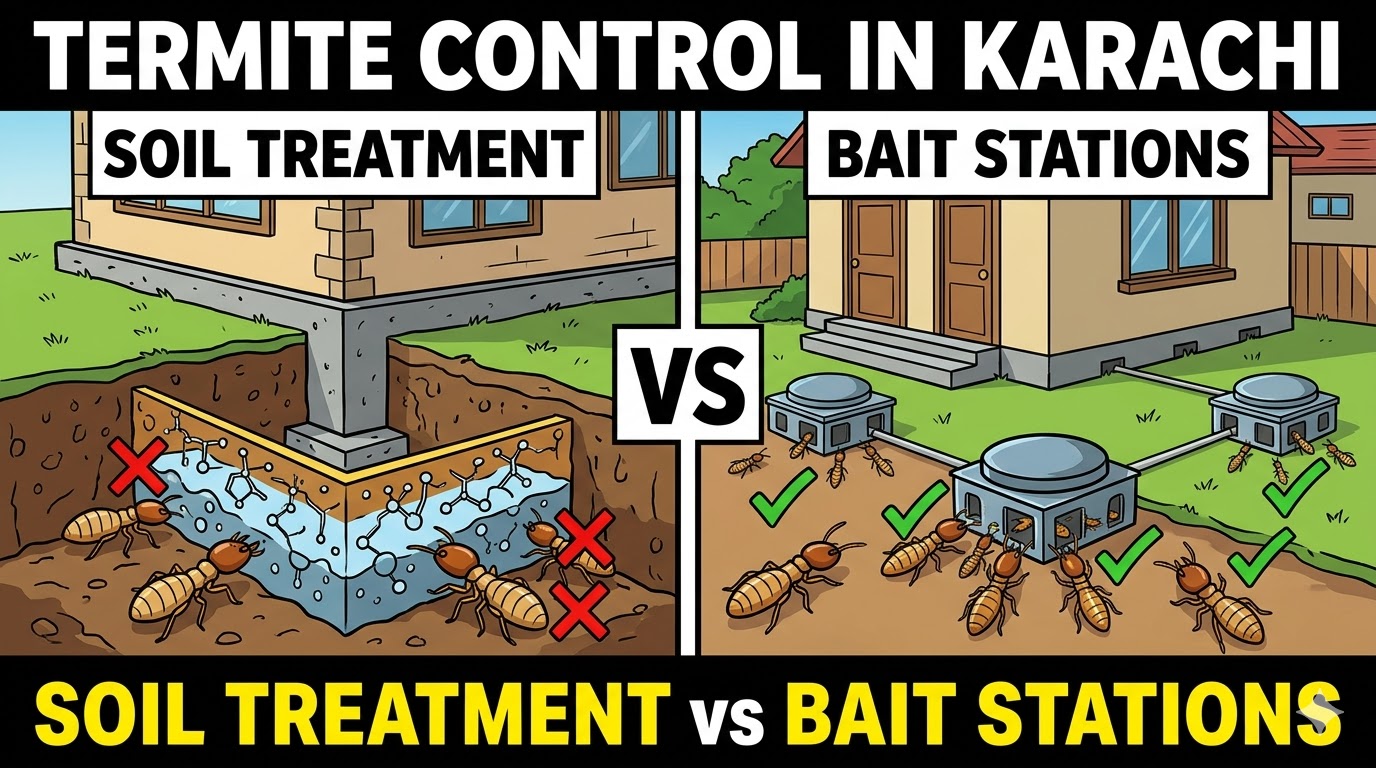
    The process involves injecting or drenching a liquid chemical termiticide into the soil around and beneath a structure. The goal is to create a continuous chemical barrier in the soil that either kills termites on contact or repels them from entering the building. Modern termiticides may be repellent (termites avoid treated soil entirely) or non-repellent (termites enter treated soil, absorb the chemical, and die, often transferring it to other colony members before doing so).

    In Karachi, soil treatment is typically applied:

    • During construction, before the concrete slab is poured — this is called pre-construction anti-termite treatment
    • Around the external perimeter and foundation of existing buildings — called post-construction treatment
    • Through drilling into existing concrete floors and walls to inject termiticide into the soil beneath

    The chemicals most commonly used in Karachi include imidacloprid, bifenthrin, chlorpyrifos (though increasingly being phased out), and fipronil-based compounds. Non-repellent termiticides based on fipronil or imidacloprid are generally preferred by professional technicians because they achieve better colony elimination through the transfer effect.

    What Are Termite Bait Stations?

    Termite bait station systems take a fundamentally different approach. Instead of creating a chemical barrier, they use termite feeding behaviour to introduce a slow-acting toxic agent into the colony.

    The system works like this: plastic monitoring stations containing cellulose material (a food source termites are drawn to) are installed at regular intervals around the property perimeter, either in the soil or attached to walls. Technicians check these stations regularly. When termite activity is detected in a monitoring station, the cellulose is replaced with bait containing a slow-acting insect growth regulator or toxic substance. Termites feed on this bait, carry it back to the colony, and gradually the colony is eliminated.

    The key advantage of bait systems is that they target the colony itself rather than just blocking access to the building. The key disadvantage is that they require ongoing monitoring and maintenance over an extended period.

    Bait systems are marketed under various international brand names and are becoming more available in Karachi’s pest control market, though they remain less common than soil treatment for most residential applications.

    Side-by-Side Comparison

    The table below summarises the key differences between soil chemical treatment and bait station systems in the Karachi context:

    FactorSoil Chemical TreatmentBait Station System
    How it worksChemical barrier in soil kills/repels termites at entry pointsToxic bait fed back to colony, eliminates colony over time
    Speed of resultsFast — barrier is in place immediately after applicationSlow — colony elimination may take 3–12 months
    Best forNew construction, severe infestation, broad coverageOngoing monitoring, environmentally sensitive areas, mild to moderate infestation
    MaintenanceLow — re-treatment typically every 5–10 yearsHigh — regular technician visits required (monthly or quarterly)
    Cost (upfront)Moderate to high depending on property sizeModerate to high depending on number of stations
    Cost (ongoing)Low after initial treatmentOngoing service contract required
    DisruptionMay require drilling into floors/walls for existing buildingsMinimal — stations installed at perimeter only
    EffectivenessExcellent for subterranean termites when applied correctlyExcellent for colony elimination but slower to act
    Environmental impactChemicals enter soil — lower impact with modern termiticidesTargeted — minimal chemical dispersal in environment

    When Soil Treatment Is the Right Choice for Karachi Properties

    For the majority of Karachi homeowners and property developers, soil chemical treatment remains the first-line recommendation. Here is why:

    1. Speed matters in active infestations. If termites are already causing visible damage to a building, waiting months for a bait system to eliminate the colony is not a realistic option. Soil treatment creates an immediate barrier and, with non-repellent termiticides, also begins killing termites in contact within days.

    2. It suits Karachi’s construction landscape. Karachi has hundreds of new residential and commercial developments under construction at any given time, from high-rises in Bahria Town Karachi to townhouses in Scheme 33. Pre-construction soil treatment is mandated in professional building practice and provides long-lasting protection from day one of occupancy.

    3. Cost efficiency at scale. For larger properties — independent houses in DHA or North Karachi, commercial buildings in Korangi Industrial Area — soil treatment covers the entire footprint in a single application at a lower total cost than installing and maintaining a full perimeter bait station network.

    4. Low maintenance burden. Karachi homeowners are busy. A well-applied soil treatment from a qualified company typically comes with a multi-year warranty and requires no further action on the homeowner’s part until re-treatment is due. This suits many families far better than a service contract requiring recurring technician visits.

    The main caveat: soil treatment is only as good as its application. Gaps in the chemical barrier — caused by rushed drilling, inadequate dilution, or untreated areas — will be exploited by termites. This is why choosing a qualified, experienced provider of

    When Bait Stations Make Sense

    Bait station systems are not the right tool for every job, but they are genuinely the better option in certain circumstances:

    1. Properties where drilling is not feasible. Some buildings in Karachi have ornate tiled flooring, heritage-style construction, or owner restrictions on drilling. Bait stations installed around the perimeter can provide effective monitoring and colony control without any structural intrusion.

    2. Ongoing post-treatment monitoring. Once a severe infestation has been treated with soil chemicals, installing a bait station monitoring system around the property provides an early warning system for any new termite activity — effectively acting as a sentinel network.

    3. Environmentally conscious property owners. Modern bait systems use very small quantities of active ingredient targeted precisely at termite colonies. For property owners with gardens, water features, or concerns about chemical exposure to children and pets, bait stations offer a credible lower-chemical alternative.

    4. Commercial and institutional properties. Offices, schools, and hotels in Karachi where large-scale soil drilling is disruptive to operations may find the perimeter bait station approach more practical, combined with targeted spot treatments for specific active areas.

    The Combination Approach: Best of Both Worlds

    Increasingly, professional pest control companies in Karachi recommend a combined approach for high-value properties: soil treatment to create an immediate protective barrier, followed by bait station installation for ongoing monitoring and colony elimination.

    This combination is particularly sensible for:

    • Large independent houses in areas like DHA, Clifton, or Gulshan-e-Hadeed
    • Commercial properties where termite activity would cause significant business disruption
    • Properties that have experienced repeat infestations, suggesting persistent colony activity in the surrounding soil
    • New construction projects in areas known for high termite pressure, such as parts of Malir, Bin Qasim, and coastal areas near Karachi’s outskirts

    The combined approach costs more upfront but provides layered protection — immediate barrier coverage plus ongoing colony elimination — that neither method achieves alone.

    How to Choose a Qualified Provider in Karachi

    Regardless of which method you choose, the quality of application is the determining factor in whether treatment succeeds. When selecting a pest control company in Karachi for termite treatment, look for:

    • Licensed technicians with documented training in termite biology and treatment methods
    • Use of registered, approved termiticide products from reputable suppliers
    • A written treatment plan and warranty with clear terms
    • References or verifiable experience with properties of your type and size
    • Transparent pricing with no hidden charges for drilling, materials, or follow-up visits

    Do not simply go with the cheapest quote. Termite treatment shortcuts — diluted chemicals, incomplete drilling, skipped zones — create the illusion of protection while leaving your property vulnerable.

    Questions to Ask Your Pest Control Company

    Whether you are getting a quote for soil treatment, bait stations, or both, ask the following before signing any agreement:

    • What specific termiticide product will you use, and what is its active ingredient?
    • Is it a repellent or non-repellent formulation?
    • What warranty do you provide, and what does it cover?
    • How many drilling points will be required, and where?
    • Will you provide a post-treatment certificate?
    • For bait systems: how often will you inspect the stations, and what does the service contract cover?

    Making the Right Decision for Your Property

    The right choice between soil treatment and bait stations depends on your specific situation: the age and type of property, the severity of any current infestation, your budget, your tolerance for disruption, and how much ongoing maintenance you want to manage.

    For most Karachi homeowners dealing with an active or suspected termite problem, soil chemical treatment — applied professionally with a quality termiticide — provides the fastest, most cost-effective resolution. For those looking at long-term monitoring and prevention, or who have specific constraints around drilling, bait stations deserve serious consideration.

    Book Your Free Termite Inspection Today

    Not sure which treatment option is right for your property? Our expert technicians will assess your specific situation and give you an honest, professional recommendation — with no pressure and no obligation. Contact us today to book a free inspection and get the clarity you need to protect your home or business from termite damage.

  • What Happens If You Ignore a Termite Infestation in Your Karachi Home for 6 Months?

    What Happens If You Ignore a Termite Infestation in Your Karachi Home for 6 Months?

    You noticed a few discarded wings near the window last month. There might be a small mud tube behind the cupboard — or it could just be dirt. The walls look fine. Nothing is broken. Surely it can wait.

    This is the reasoning that costs Karachi homeowners hundreds of thousands of rupees every year.

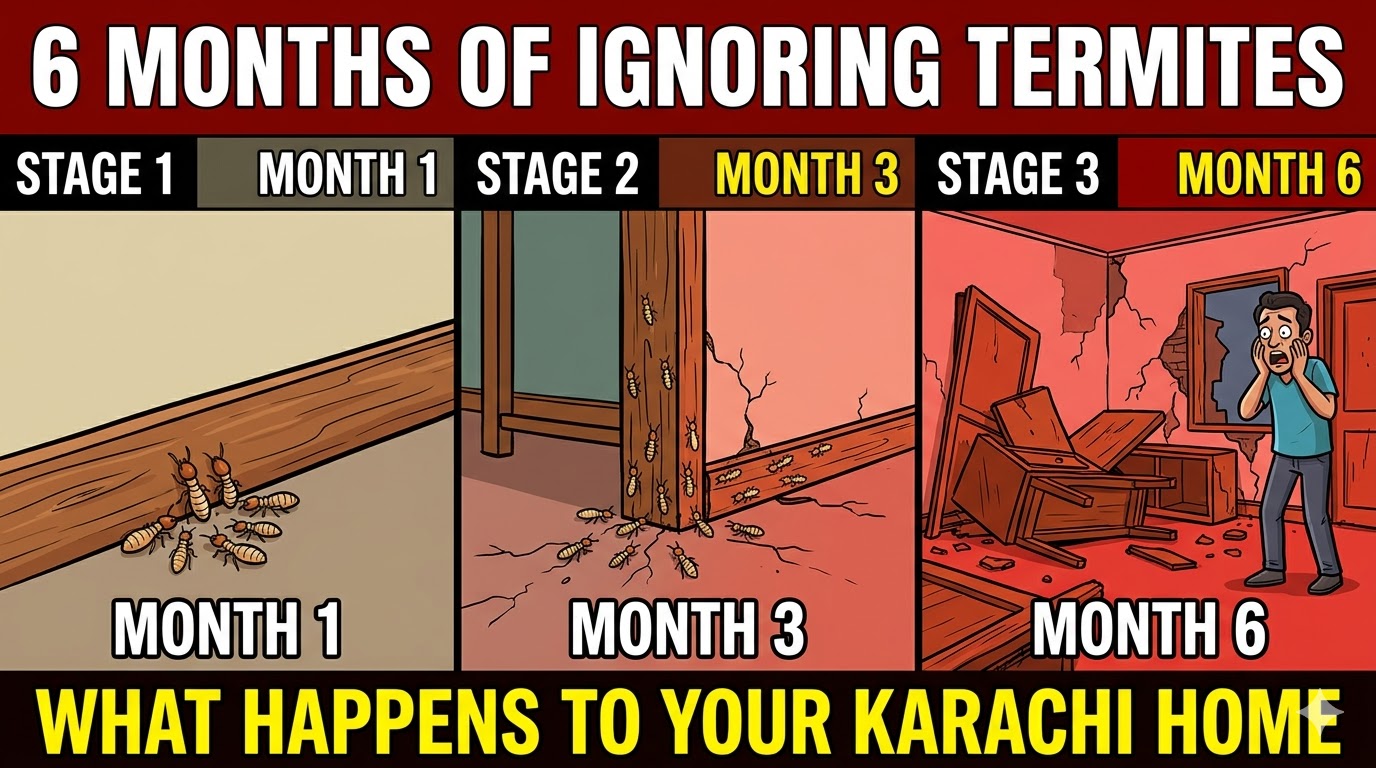
    A six-month delay in treating an active termite infestation is not a minor risk — it is a major one. In Karachi’s warm, humid climate, termite colonies grow aggressively. What looks manageable today can become structurally catastrophic within half a year. This article walks you through exactly what happens — month by month — when a termite infestation is left untreated, and what the real-world consequences look like for homeowners in this city.

    First, Understand What You Are Dealing With

    When a Karachi homeowner first notices signs of termite activity — mud tubes, wing litter, hollow-sounding walls — the infestation is almost never new. As explained in detail in our guide on how termite colonies grow silently inside Karachi walls, by the time any visible sign appears, the colony has typically been established for two to four years and contains hundreds of thousands of individuals.

    What you are seeing is not the beginning of the problem — it is the problem announcing itself after years of quiet growth. And once it announces itself, the pace of visible damage accelerates significantly.

    Month-by-Month: What a 6-Month Delay Actually Looks Like

    Month 1 — Signs Are Present, Damage Is Contained

    You notice the first signs — perhaps mud tubes or a slightly soft spot on a door frame. The structural damage at this point is localised. Treatment would be relatively straightforward: injection of termiticide into affected areas, barrier treatment around the foundation, and monitoring stations. Repair cost estimate: minor — perhaps Rs. 5,000 to Rs. 20,000 for carpentry.

    Month 2 — The Colony Doubles Its Foraging Activity

    With no treatment interrupting their foraging, workers continue to expand their tunnel network. In Karachi’s warm temperatures, termite metabolic activity stays high year-round. By month two, what began as a single door frame infestation has typically spread to the adjacent wall cavity and, in many cases, to the skirting boards of the connected room.

    Month 3 — False Ceiling and Vertical Spread

    By the third month, a well-established colony will have extended its tunnels upward through wall cavities. In homes with POP false ceilings — extremely common in DHA, Clifton, and Gulshan — termites reach the wooden battens and metal framework that support the ceiling. The hollowing of ceiling elements begins. You may start to notice small cracks in plaster or slightly discoloured patches on the ceiling surface.

    Month 4 — Kitchen Cabinets, Built-In Wardrobes, and Furniture

    Fitted furniture that backs against affected walls is now under direct attack. In Karachi homes, this typically means kitchen cabinets, built-in wardrobes in bedrooms, and shelving units. The internal chipboard and MDF used in most fitted furniture is especially vulnerable — termites consume it far faster than solid timber. By month four, entire cabinet sections may be structurally compromised even while the outer surface appears intact.

    Month 5 — Structural Door and Window Frames Fail

    Door frames and window frames that were partially affected in month one are now severely compromised. In older Karachi homes where frames were set directly into the wall without a protective cavity, the wood behind the plaster may be almost entirely consumed. Doors begin to sag. Windows become difficult to open or close. In some cases, frames crack or collapse under normal use.

    Month 6 — Electrical Hazards, Ceiling Risk, and Structural Damage

    At the six-month mark, the infestation has typically spread to multiple rooms and multiple structural elements. However, the greatest risks at this stage are less visible:

    • Electrical conduits inside walls are often built with plastic casing. Termites, in their tunnelling, can breach PVC conduit and chew through cable insulation. This creates a genuine fire and electrocution risk.
    • False ceilings supported by compromised wooden battens can partially collapse under their own weight or during minor movement.
    • Load-bearing wooden elements in older properties — lintels, roof joists, and stair stringers — may have lost significant structural integrity.

    The Cost of Delay: A Real-World Comparison

    The following comparison illustrates the typical cost difference between treating an infestation promptly versus delaying by six months, based on professional assessments in Karachi residential properties:

    Damage CategoryTreated Promptly (Month 1)Treated After 6 Months
    Termite treatment costRs. 8,000 – 25,000Rs. 25,000 – 60,000+
    Door/window frame replacement1–2 frames4–8+ frames
    Cabinet/furniture repairMinor or noneFull replacement likely
    False ceiling repairNonePartial or full replacement
    Electrical inspection needed?NoOften yes
    Structural engineer assessment?NoPossibly yes
    Estimated total repair costRs. 20,000 – 50,000Rs. 150,000 – 500,000+

    The Hidden Costs Beyond Repair Bills

    Property Value Reduction

    In Karachi’s property market, a disclosed termite infestation or visible termite damage can reduce the resale or rental value of a property by 10% to 30%. In high-demand areas like DHA and Clifton, where buyers conduct pre-purchase inspections, untreated or poorly treated termite damage is a significant red flag. Many property transactions in Karachi have collapsed at the final stage because of termite issues discovered during inspection.

    Disruption and Displacement

    Extensive termite damage often requires significant renovation work — replastering walls, replacing ceilings, reinstalling cabinets, and repainting entire rooms. In severe cases, families are displaced for days or weeks during repair work. The inconvenience, stress, and associated costs of temporary accommodation add significantly to the total impact.

    Health and Safety Risks

    Beyond structural concerns, severely infested homes carry secondary health and safety risks. Damaged electrical wiring increases fire risk. Collapsing false ceiling elements can cause injury. Moisture damage associated with extensive termite activity creates conditions favourable to mould growth, which carries its own respiratory health implications — particularly relevant for children and the elderly.

    Why Karachi Homeowners Delay — and Why Those Reasons Are Costly

    Having worked with hundreds of Karachi homeowners, we consistently hear the same reasons for delayed action:

    “It does not look that bad.”Termites are designed to look invisible. By the time it looks bad, it is already serious.

    “I will get it treated after Eid / after the summer / after the rains.”Termites are not waiting for a convenient time. In Karachi’s warm climate, colony growth is year-round.

    “I will try a spray from the hardware store first.”Over-the-counter sprays kill surface termites but do not penetrate walls or reach the colony. They often cause the colony to split and spread more widely — a phenomenon called “budding”.

    “The cost seems high.”Professional treatment costs a fraction of the repair bills that follow six months of inaction. The table above illustrates this clearly.

    What Effective Treatment Actually Involves

    Many homeowners imagine termite treatment as a simple spray-down. Professional treatment is considerably more comprehensive — and that comprehensiveness is what makes it effective.

    A qualified termite control service in Karachi typically includes:

    • Full site inspection to map infestation extent and identify all active tunnels, entry points, and affected structural elements
    • Soil treatment around the external perimeter using professional-grade termiticide to create a chemical barrier that kills foraging termites and disrupts the colony
    • Targeted injection of termiticide into internal wall cavities and affected structural timbers
    • Bait station installation to monitor for new activity and deliver slow-acting termiticide back to the colony
    • Post-treatment report and a scheduled follow-up inspection

    Treatment duration and complexity increase significantly with infestation size. A treatment that takes one day for a contained early-stage infestation may require two to three days for a property with six months of unchecked damage.

    A Note on Karachi’s Monsoon Season

    The period between June and September — Karachi’s monsoon season — is when termite swarming activity peaks. Alates emerge from established colonies and attempt to found new ones. Homeowners across Karachi report seeing winged insects around light sources in large numbers during and after monsoon rains.

    If you see this happening in your home this monsoon and choose to delay action until “after the rains settle down”, you are giving an already large colony several additional months of optimal growth conditions. Post-monsoon is also the season when we receive the largest volume of calls from homeowners who wish they had called six months earlier.

    Frequently Asked Questions

    Can I treat a severe infestation myself?

    No. DIY products available in Karachi’s hardware markets are not formulated for structural termite treatment. They do not penetrate wall cavities, do not carry the active ingredient back to the colony, and do not provide any lasting barrier. In some cases, improper DIY treatment causes colony splitting, which spreads the infestation to new areas.

    How long does professional treatment take for a severe infestation?

    Depending on property size and infestation extent, treatment for a severe infestation typically takes one to three days. Structural repairs — replacing frames, cabinets, and ceiling elements — take considerably longer and are separate from the treatment process.

    Can a severely infested home be fully treated?

    Yes. Professional termite treatment eliminates active colonies and prevents reinfestation through ongoing barrier and monitoring systems. The termites can always be treated — the question is how much structural damage needs to be repaired afterwards.

    Conclusion: Six Months Is a Very Long Time

    In Karachi’s climate, a six-month delay in treating an active termite infestation transforms a manageable problem into a major crisis. Contained damage becomes widespread structural compromise. Affordable treatment becomes expensive multi-room renovation. A simple inspection becomes an urgent structural assessment.

    The termites in your walls are not going to stop. They are not going to move on. They are going to eat — quietly, relentlessly, and invisibly — until they are stopped.

    The good news is that treatment is effective, available, and significantly cheaper than the alternative. But it requires action today — not next month.

    Do Not Give Termites Another Six Months
    If you have noticed any signs of termite activity — or if you simply have not had an inspection in over a year — now is the time to act. Our licensed team covers all of Karachi, including DHA, Clifton, Gulshan-e-Iqbal, PECHS, North Nazimabad, Bahria Town, and beyond.
    Book your free termite inspection with Karachi Fumigation Services today. We will assess your property, identify any active infestation, and give you a clear, honest report — with no obligation. The earlier we treat it, the less it costs you.

  • How Termite Colonies Silently Grow Inside Karachi Walls for Years Before You Notice

    How Termite Colonies Silently Grow Inside Karachi Walls for Years Before You Notice

    Most Karachi homeowners discover termites the hard way — a hand pressed against a wall suddenly sinks in, a wooden door frame crumbles at the touch, or a lick of paint peels back to reveal a hollow, honeycomb-like ruin beneath. By that point, termites have already been living in your home for years.

    This is the terrifying truth about termite infestations: the damage happens long before any visible sign appears. In Karachi’s climate — humid coastal air, clay-heavy soil, and temperatures that rarely dip below 20°C — subterranean termites find an almost perfect environment to build massive underground colonies and quietly consume everything in their path.

    In this article, we explain exactly how termite colonies establish, grow, and spread inside Karachi homes without triggering any alarm — and what you can do about it before the damage becomes irreversible.

    Understanding Termite Biology: Why They Are So Hard to Detect

    To understand why termites go unnoticed for so long, you need to understand how they live. The most destructive species in Karachi is the subterranean termite (Coptotermes gestroi and related species), and their entire biology is designed around staying hidden.

    A Colony Is a Living, Growing Organism

    A single termite colony can contain anywhere from 100,000 to over one million individual termites. However, a colony does not start that way. It begins with a single pair — one reproductive queen and one king — that settle into the soil, usually beneath or near a building’s foundation.

    In the first year, the queen lays only a handful of eggs per day. The colony at this stage is microscopic — a few dozen workers foraging cautiously within inches of the nest. No structural damage occurs. No signs appear. This is why even a professional cannot always detect a brand-new infestation.

    By Year 3 to 5, the queen’s egg production can reach thousands per day. The colony now has a fully organized caste system: workers (who eat your walls), soldiers (who defend the colony), and reproductives (who will eventually spread to new locations). The foraging range expands dramatically — up to 100 metres in every direction.

    They Never Surface — Unless Forced To

    Subterranean termites are photophobic — they actively avoid light and open air. Every tunnel they build is sealed with a mixture of soil, saliva, and faecal matter (called “carton”). When they penetrate walls, they hollow out the inside of wood and drywall while leaving the outer surface completely intact. This is why you can tap a wall for years and hear nothing wrong until the structure has been almost entirely consumed.

    Karachi’s Unique Conditions: A Termite’s Ideal Home

    Not every city in Pakistan faces the same level of termite risk. Karachi has several specific environmental and construction factors that make it one of the highest-risk cities in the country for termite infestation.

    Coastal Humidity and Clay Soil

    Karachi’s coastal location keeps humidity levels elevated for most of the year, particularly in areas like Clifton, DHA, Lyari, and Korangi. Termites need moisture to survive, and damp soil near foundations provides the perfect environment for underground colonies to thrive. Clay-heavy soil, common across much of Karachi’s older residential zones, retains moisture exceptionally well — acting almost like a natural termite nursery.

    Older Construction and RCC Slab Buildings

    Much of Karachi’s residential housing stock — particularly in areas like PECHS, North Nazimabad, Gulshan-e-Iqbal, and Nazimabad — was built between the 1960s and 1990s using construction methods that offer little termite resistance. Exposed wooden joinery, inadequate chemical pre-treatment of foundations, and the use of low-density timber in doors, windows, and ceiling frames have left an entire generation of homes vulnerable.

    Even newer constructions in DHA Phases 7 and 8, Bahria Town, and Scheme 33 are at risk if pre-construction anti-termite soil treatment was skipped or applied inadequately — which, according to professionals, happens more often than homeowners realise.

    Plumbing Leaks and Ground-Floor Vulnerability

    Dripping pipes, slow drainage, and bathroom seepage create moisture hotspots inside walls. Termites detect these wet zones and use them as entry points. Ground-floor apartments and bungalows are especially at risk, but termites in Karachi are regularly found on upper floors as well — travelling through pipe ducts, electrical conduit paths, and party walls shared between units.

    The Silent Timeline: How a Colony Grows Inside Your Walls Year by Year

    Here is a realistic breakdown of what happens inside a Karachi home during a typical termite infestation:

    Year 1: Establishment Below Ground

    A queen and king termite — called “alates” — land near your home after a monsoon swarm, shed their wings, and burrow into soil near the foundation. The nest is established 30 to 60 cm below ground. No signs are visible. The colony has fewer than 1,000 members.

    Year 2: Probing the Foundation

    Workers begin extending foraging tunnels, reaching foundation walls. If there are any cracks, gaps around plumbing pipes, or poorly sealed expansion joints, workers enter the structure. They begin feeding on concealed timber elements — skirting boards, door frames, and sub-floor timbers if present. Still no external evidence. Colony size: 5,000 to 30,000.

    Year 3 to 4: Active Wall Infestation

    Termites build mud tubes along the inner surface of walls and begin hollowing out wooden elements systematically. In homes with false ceilings, they travel upward to wooden battens and POP framing. In older homes, they consume door architraves, window frames, and kitchen cabinetry. The outer paint or plaster remains intact. Colony size: 100,000 to 500,000.

    Year 5 and Beyond: Reproductive Expansion

    The colony produces winged reproductives (swarmers) that emerge — usually after the first monsoon rains — to establish new colonies nearby. Homeowners often see small, winged insects near light sources and mistake them for flying ants. This is the first visible sign most people notice, and by this point, the primary colony is enormous and the structural damage is already severe.

    The Warning Signs You Should Know — and Why Most Homeowners Miss Them

    Termites do leave signs, but these signs are subtle and easy to misinterpret without training. Here is what to look for:

    • Mud tubes on walls or near the base of walls: These pencil-thin brown tubes are how termites travel above ground. Check exterior and interior walls at ground level, especially in storage rooms, utility areas, and behind furniture.
    • Hollow sound when tapping wood: Use your knuckle to tap along door frames, skirting boards, and kitchen cabinets. A hollow, papery sound suggests the interior has been eaten away.
    • Bubbling or uneven paint: Paint that bubbles, blisters, or appears to have moisture beneath it on an interior wall can indicate termites building carton material just under the surface.
    • Discarded wings near window sills or light fixtures: Swarmers shed their wings immediately after landing. Small piles of translucent wings — often mistaken for insect litter — are a major warning sign.
    • Tight-fitting doors and windows: Termite activity generates heat and moisture that warps timber. If doors or windows that previously opened smoothly have become stiff or warped, this may be an early structural indicator.
    • Frass (termite droppings): Dry-wood termites push their droppings out of small holes. These look like tiny, hexagonal pellets or sawdust and appear near infested wood.

    The challenge is that in a busy Karachi household, these signs are often overlooked, attributed to moisture, or simply cleaned up without investigation. By the time homeowners grow concerned enough to call a professional, the infestation has typically been active for three to five years.

    What Areas of Your Home Are at Greatest Risk?

    Termites do not attack randomly — they follow moisture, wood, and structural gaps. The highest-risk areas in a typical Karachi home include:

    • Ground-floor walls adjacent to soil: Any wall that sits directly on or near the ground, especially in older homes without a damp-proof course (DPC), is highly vulnerable.
    • Bathroom and kitchen walls: Pipe leaks and condensation create sustained moisture that attracts termites into wall cavities.
    • Wooden door and window frames: These are often the first structural elements attacked, particularly in homes with solid wood frames.
    • False ceilings and POP work: Widely installed across DHA and Gulshan properties, false ceilings with wooden battens provide an ideal concealed environment for termites to spread horizontally across an entire floor.
    • Under stairs and inside storage cupboards: Dark, rarely disturbed spaces with contact to walls are prime infestation zones.
    • Behind fitted kitchen cabinets: Particularly in older kitchens where cabinets sit against external or ground-adjacent walls.

    Why Professional Detection Matters More Than DIY Inspection

    Many homeowners attempt self-inspection, but termite detection requires more than looking for obvious damage. A professional inspection involves:

    • Thermal imaging to detect heat anomalies behind walls that indicate termite activity
    • Moisture mapping to identify entry points and feeding zones
    • Probing and tapping across all suspect surfaces systematically
    • Inspection of subterranean entry points including expansion joints, plumbing ducts, and foundation cracks
    • Colony activity assessment to determine whether an infestation is new, established, or in an advanced stage

    If you suspect termite activity — or simply want peace of mind — professional termite treatment in Karachi begins with a thorough site inspection that identifies not just active infestations but structural vulnerabilities that could be exploited in the future.

    Prevention: Reducing the Risk Before Termites Establish

    While professional treatment is the only reliable solution for an active infestation, there are practical steps Karachi homeowners can take to reduce the risk of initial colony establishment:

    • Fix all plumbing leaks promptly — dripping pipes inside walls are among the most common termite attractants in urban Karachi homes.
    • Seal all cracks and gaps at the wall-floor junction, particularly on ground floors.
    • Avoid storing firewood, construction timber, or cardboard against exterior walls or inside enclosed spaces adjacent to walls.
    • Ensure proper drainage away from your home’s foundation — pooling water near walls creates the moisture conditions termites need.
    • If renovating or building new, insist on certified anti-termite pre-construction soil treatment before the slab is poured.

    For existing homes, annual inspections by a licensed pest control company are the single most effective preventive measure. A qualified team offering pest control services in Karachi will identify early-stage activity before it becomes a structural crisis.

    Frequently Asked Questions

    Can termites damage a concrete structure?

    Termites do not eat concrete, but they exploit any crack, gap, or joint in concrete to reach wooden elements inside walls and floors. Concrete structures in Karachi are not immune — the wood embedded within them (door frames, window frames, ceiling battens) is still fully at risk.

    How quickly can termites spread from one floor to another?

    In a multi-storey building, termites can travel from ground floor to upper floors within 12 to 18 months of establishing a large colony. They travel through pipe ducts, shared walls, and structural joints. In Karachi’s apartment buildings, termite infestations regularly spread across multiple units.

    Is it possible to have termites without seeing mud tubes?

    Yes. Termites living entirely within wall cavities, false ceilings, or subfloor structures may not construct visible mud tubes on accessible surfaces. This is why an inspection is the only reliable detection method.

    Do termites only affect old homes?

    No. New homes in Karachi are equally at risk if pre-construction treatment was not applied correctly. We have inspected homes less than three years old with active infestations. Soil conditions and construction quality are more important risk factors than age alone.

    Conclusion: The Damage Is Happening Right Now

    The most dangerous thing about termites in Karachi is not that they are destructive — it is that they are patient. By the time you see the damage, years of silent destruction have already occurred. Walls that look solid are hollow. Frames that appear intact are structurally compromised. Repairs that could have cost a few thousand rupees have grown into projects costing lakhs.

    The only protection is early detection. A professional inspection costs a fraction of what termite repair work costs — and it gives you something no wall inspection can: certainty.

    Book Your Free Termite Inspection Today
    Do not wait for the damage to become visible. Our licensed inspectors serve all major Karachi neighbourhoods — DHA, Clifton, Gulshan-e-Iqbal, PECHS, North Nazimabad, Bahria Town, Scheme 33, and more. We identify termite activity at every stage, provide a detailed inspection report, and recommend a customised treatment plan for your specific home.
    Contact Karachi Fumigation Services now to schedule your free inspection. The earlier we find them, the less they cost you.