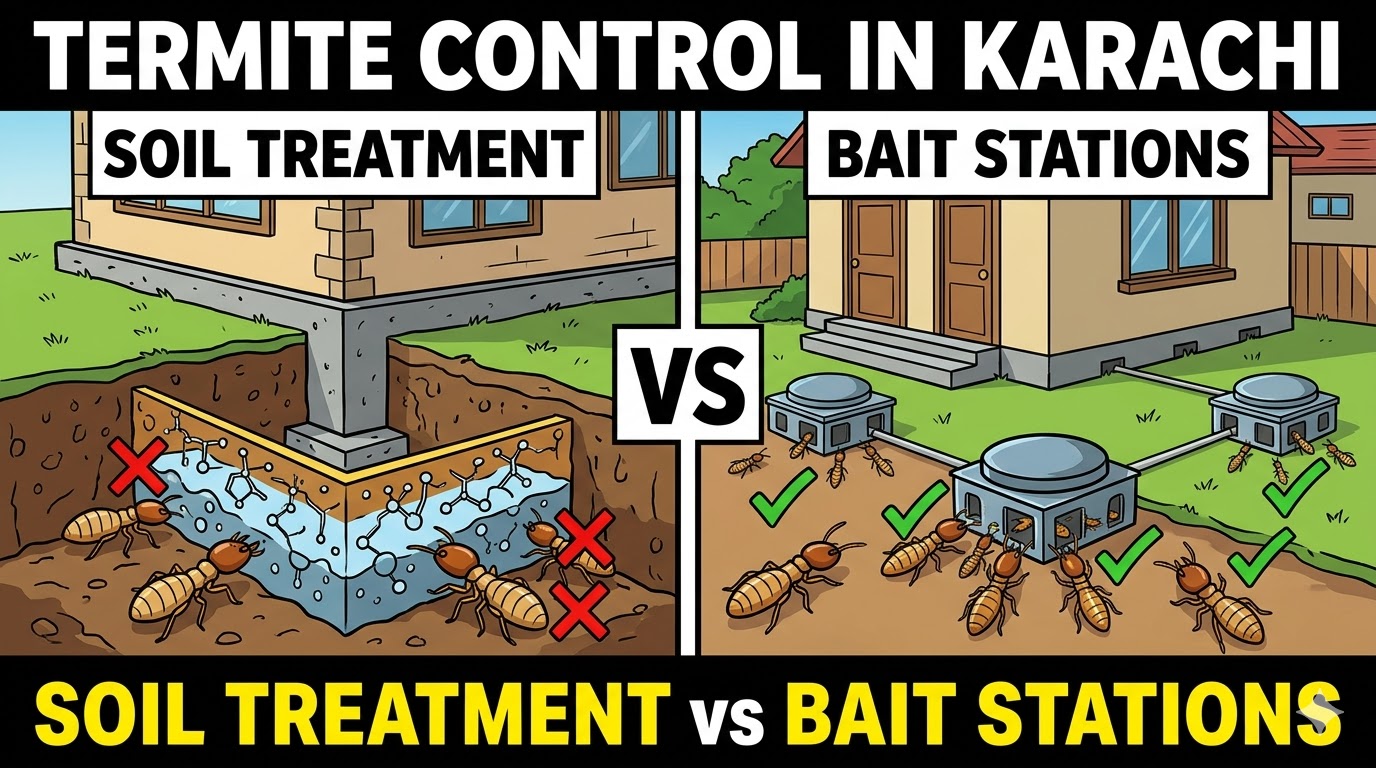
When a termite infestation is confirmed — or when you are preparing a new construction or existing property against termite risk — one of the first decisions you will face is which treatment method to use. In Karachi’s pest control market, the two most widely discussed and professionally applied options are soil chemical treatment (also called a soil barrier treatment) and termite bait stations.
Both methods work. Both are used by professional pest control companies in Karachi. But they work very differently, suit different scenarios, and come with different cost profiles, timelines, and maintenance requirements. Choosing the wrong approach for your specific property can mean spending money on a solution that does not fully address your termite problem.
This guide gives you a clear, honest comparison of both methods — what they are, how they work, where each excels, and which is likely the better choice for your situation in Karachi.
What Is Soil Chemical Treatment?
Soil treatment — sometimes referred to as a soil barrier or liquid termiticide treatment — is currently the most widely used method for termite control in Karachi, particularly for residential and commercial construction.
The process involves injecting or drenching a liquid chemical termiticide into the soil around and beneath a structure. The goal is to create a continuous chemical barrier in the soil that either kills termites on contact or repels them from entering the building. Modern termiticides may be repellent (termites avoid treated soil entirely) or non-repellent (termites enter treated soil, absorb the chemical, and die, often transferring it to other colony members before doing so).
In Karachi, soil treatment is typically applied:
- During construction, before the concrete slab is poured — this is called pre-construction anti-termite treatment
- Around the external perimeter and foundation of existing buildings — called post-construction treatment
- Through drilling into existing concrete floors and walls to inject termiticide into the soil beneath
The chemicals most commonly used in Karachi include imidacloprid, bifenthrin, chlorpyrifos (though increasingly being phased out), and fipronil-based compounds. Non-repellent termiticides based on fipronil or imidacloprid are generally preferred by professional technicians because they achieve better colony elimination through the transfer effect.
What Are Termite Bait Stations?
Termite bait station systems take a fundamentally different approach. Instead of creating a chemical barrier, they use termite feeding behaviour to introduce a slow-acting toxic agent into the colony.
The system works like this: plastic monitoring stations containing cellulose material (a food source termites are drawn to) are installed at regular intervals around the property perimeter, either in the soil or attached to walls. Technicians check these stations regularly. When termite activity is detected in a monitoring station, the cellulose is replaced with bait containing a slow-acting insect growth regulator or toxic substance. Termites feed on this bait, carry it back to the colony, and gradually the colony is eliminated.
The key advantage of bait systems is that they target the colony itself rather than just blocking access to the building. The key disadvantage is that they require ongoing monitoring and maintenance over an extended period.
Bait systems are marketed under various international brand names and are becoming more available in Karachi’s pest control market, though they remain less common than soil treatment for most residential applications.
Side-by-Side Comparison
The table below summarises the key differences between soil chemical treatment and bait station systems in the Karachi context:
| Factor | Soil Chemical Treatment | Bait Station System |
| How it works | Chemical barrier in soil kills/repels termites at entry points | Toxic bait fed back to colony, eliminates colony over time |
| Speed of results | Fast — barrier is in place immediately after application | Slow — colony elimination may take 3–12 months |
| Best for | New construction, severe infestation, broad coverage | Ongoing monitoring, environmentally sensitive areas, mild to moderate infestation |
| Maintenance | Low — re-treatment typically every 5–10 years | High — regular technician visits required (monthly or quarterly) |
| Cost (upfront) | Moderate to high depending on property size | Moderate to high depending on number of stations |
| Cost (ongoing) | Low after initial treatment | Ongoing service contract required |
| Disruption | May require drilling into floors/walls for existing buildings | Minimal — stations installed at perimeter only |
| Effectiveness | Excellent for subterranean termites when applied correctly | Excellent for colony elimination but slower to act |
| Environmental impact | Chemicals enter soil — lower impact with modern termiticides | Targeted — minimal chemical dispersal in environment |
When Soil Treatment Is the Right Choice for Karachi Properties
For the majority of Karachi homeowners and property developers, soil chemical treatment remains the first-line recommendation. Here is why:
1. Speed matters in active infestations. If termites are already causing visible damage to a building, waiting months for a bait system to eliminate the colony is not a realistic option. Soil treatment creates an immediate barrier and, with non-repellent termiticides, also begins killing termites in contact within days.
2. It suits Karachi’s construction landscape. Karachi has hundreds of new residential and commercial developments under construction at any given time, from high-rises in Bahria Town Karachi to townhouses in Scheme 33. Pre-construction soil treatment is mandated in professional building practice and provides long-lasting protection from day one of occupancy.
3. Cost efficiency at scale. For larger properties — independent houses in DHA or North Karachi, commercial buildings in Korangi Industrial Area — soil treatment covers the entire footprint in a single application at a lower total cost than installing and maintaining a full perimeter bait station network.
4. Low maintenance burden. Karachi homeowners are busy. A well-applied soil treatment from a qualified company typically comes with a multi-year warranty and requires no further action on the homeowner’s part until re-treatment is due. This suits many families far better than a service contract requiring recurring technician visits.
The main caveat: soil treatment is only as good as its application. Gaps in the chemical barrier — caused by rushed drilling, inadequate dilution, or untreated areas — will be exploited by termites. This is why choosing a qualified, experienced provider of
When Bait Stations Make Sense
Bait station systems are not the right tool for every job, but they are genuinely the better option in certain circumstances:
1. Properties where drilling is not feasible. Some buildings in Karachi have ornate tiled flooring, heritage-style construction, or owner restrictions on drilling. Bait stations installed around the perimeter can provide effective monitoring and colony control without any structural intrusion.
2. Ongoing post-treatment monitoring. Once a severe infestation has been treated with soil chemicals, installing a bait station monitoring system around the property provides an early warning system for any new termite activity — effectively acting as a sentinel network.
3. Environmentally conscious property owners. Modern bait systems use very small quantities of active ingredient targeted precisely at termite colonies. For property owners with gardens, water features, or concerns about chemical exposure to children and pets, bait stations offer a credible lower-chemical alternative.
4. Commercial and institutional properties. Offices, schools, and hotels in Karachi where large-scale soil drilling is disruptive to operations may find the perimeter bait station approach more practical, combined with targeted spot treatments for specific active areas.
The Combination Approach: Best of Both Worlds
Increasingly, professional pest control companies in Karachi recommend a combined approach for high-value properties: soil treatment to create an immediate protective barrier, followed by bait station installation for ongoing monitoring and colony elimination.
This combination is particularly sensible for:
- Large independent houses in areas like DHA, Clifton, or Gulshan-e-Hadeed
- Commercial properties where termite activity would cause significant business disruption
- Properties that have experienced repeat infestations, suggesting persistent colony activity in the surrounding soil
- New construction projects in areas known for high termite pressure, such as parts of Malir, Bin Qasim, and coastal areas near Karachi’s outskirts
The combined approach costs more upfront but provides layered protection — immediate barrier coverage plus ongoing colony elimination — that neither method achieves alone.
How to Choose a Qualified Provider in Karachi
Regardless of which method you choose, the quality of application is the determining factor in whether treatment succeeds. When selecting a pest control company in Karachi for termite treatment, look for:
- Licensed technicians with documented training in termite biology and treatment methods
- Use of registered, approved termiticide products from reputable suppliers
- A written treatment plan and warranty with clear terms
- References or verifiable experience with properties of your type and size
- Transparent pricing with no hidden charges for drilling, materials, or follow-up visits
Do not simply go with the cheapest quote. Termite treatment shortcuts — diluted chemicals, incomplete drilling, skipped zones — create the illusion of protection while leaving your property vulnerable.
Questions to Ask Your Pest Control Company
Whether you are getting a quote for soil treatment, bait stations, or both, ask the following before signing any agreement:
- What specific termiticide product will you use, and what is its active ingredient?
- Is it a repellent or non-repellent formulation?
- What warranty do you provide, and what does it cover?
- How many drilling points will be required, and where?
- Will you provide a post-treatment certificate?
- For bait systems: how often will you inspect the stations, and what does the service contract cover?
Making the Right Decision for Your Property
The right choice between soil treatment and bait stations depends on your specific situation: the age and type of property, the severity of any current infestation, your budget, your tolerance for disruption, and how much ongoing maintenance you want to manage.
For most Karachi homeowners dealing with an active or suspected termite problem, soil chemical treatment — applied professionally with a quality termiticide — provides the fastest, most cost-effective resolution. For those looking at long-term monitoring and prevention, or who have specific constraints around drilling, bait stations deserve serious consideration.
Book Your Free Termite Inspection Today
Not sure which treatment option is right for your property? Our expert technicians will assess your specific situation and give you an honest, professional recommendation — with no pressure and no obligation. Contact us today to book a free inspection and get the clarity you need to protect your home or business from termite damage.

Ahmad Karimi is a PPMA-registered pest management specialist and the lead technical consultant at Karachi Fumigation Services, where he has overseen field operations and treatment protocols since 2005. With over 20 years of hands-on experience treating residential, commercial, and industrial properties across Karachi — from DHA bungalows with structural termite infestations to Korangi factories requiring large-scale rodent exclusion — he brings direct field knowledge to every article published on this blog.
Ahmad has managed pest control programs for clients including Descon Engineering, Pakistan Tobacco Company, Saylani Welfare, and J. (Junaid Jamshed), and has issued hundreds of fumigation certificates for health authority compliance, import/export, and commercial licensing purposes. He holds active PPMA membership and works exclusively with WHO-approved chemicals in all field operations.
The content on this blog draws directly from two decades of Karachi-specific infestation data — seasonal pest patterns, neighbourhood-level risk factors, building-age vulnerabilities, and the regulatory requirements that Karachi businesses actually face. No recycled content from foreign pest control sites. Every article reflects conditions specific to Karachi’s climate, infrastructure, and compliance environment.
For treatment enquiries or technical questions, Ahmad’s team can be reached at 03463303875 or via the office at Trade Tower, Civil Lines, Karachi.
Leave a Reply