You noticed a few discarded wings near the window last month. There might be a small mud tube behind the cupboard — or it could just be dirt. The walls look fine. Nothing is broken. Surely it can wait.
This is the reasoning that costs Karachi homeowners hundreds of thousands of rupees every year.
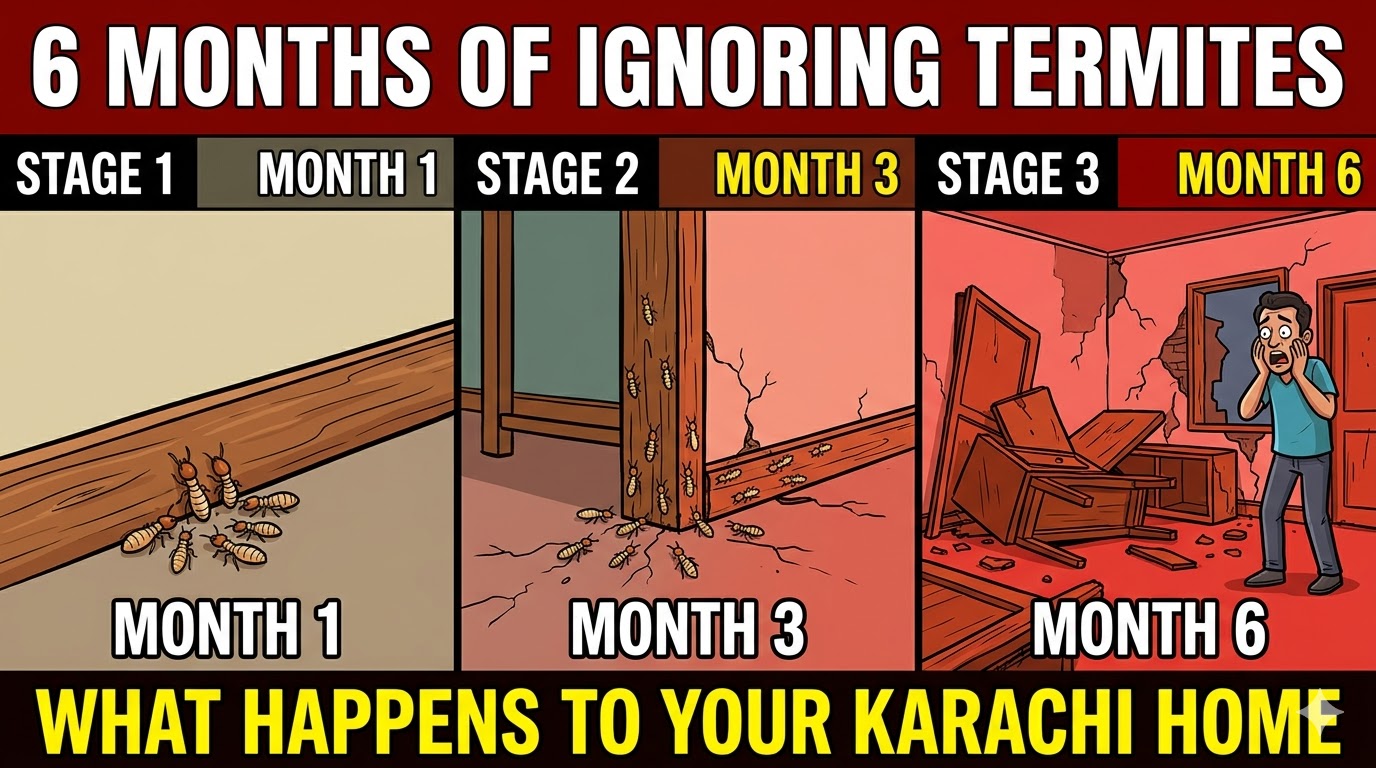
A six-month delay in treating an active termite infestation is not a minor risk — it is a major one. In Karachi’s warm, humid climate, termite colonies grow aggressively. What looks manageable today can become structurally catastrophic within half a year. This article walks you through exactly what happens — month by month — when a termite infestation is left untreated, and what the real-world consequences look like for homeowners in this city.
First, Understand What You Are Dealing With
When a Karachi homeowner first notices signs of termite activity — mud tubes, wing litter, hollow-sounding walls — the infestation is almost never new. As explained in detail in our guide on how termite colonies grow silently inside Karachi walls, by the time any visible sign appears, the colony has typically been established for two to four years and contains hundreds of thousands of individuals.
What you are seeing is not the beginning of the problem — it is the problem announcing itself after years of quiet growth. And once it announces itself, the pace of visible damage accelerates significantly.
Month-by-Month: What a 6-Month Delay Actually Looks Like
Month 1 — Signs Are Present, Damage Is Contained
You notice the first signs — perhaps mud tubes or a slightly soft spot on a door frame. The structural damage at this point is localised. Treatment would be relatively straightforward: injection of termiticide into affected areas, barrier treatment around the foundation, and monitoring stations. Repair cost estimate: minor — perhaps Rs. 5,000 to Rs. 20,000 for carpentry.
Month 2 — The Colony Doubles Its Foraging Activity
With no treatment interrupting their foraging, workers continue to expand their tunnel network. In Karachi’s warm temperatures, termite metabolic activity stays high year-round. By month two, what began as a single door frame infestation has typically spread to the adjacent wall cavity and, in many cases, to the skirting boards of the connected room.
Month 3 — False Ceiling and Vertical Spread
By the third month, a well-established colony will have extended its tunnels upward through wall cavities. In homes with POP false ceilings — extremely common in DHA, Clifton, and Gulshan — termites reach the wooden battens and metal framework that support the ceiling. The hollowing of ceiling elements begins. You may start to notice small cracks in plaster or slightly discoloured patches on the ceiling surface.
Month 4 — Kitchen Cabinets, Built-In Wardrobes, and Furniture
Fitted furniture that backs against affected walls is now under direct attack. In Karachi homes, this typically means kitchen cabinets, built-in wardrobes in bedrooms, and shelving units. The internal chipboard and MDF used in most fitted furniture is especially vulnerable — termites consume it far faster than solid timber. By month four, entire cabinet sections may be structurally compromised even while the outer surface appears intact.
Month 5 — Structural Door and Window Frames Fail
Door frames and window frames that were partially affected in month one are now severely compromised. In older Karachi homes where frames were set directly into the wall without a protective cavity, the wood behind the plaster may be almost entirely consumed. Doors begin to sag. Windows become difficult to open or close. In some cases, frames crack or collapse under normal use.
Month 6 — Electrical Hazards, Ceiling Risk, and Structural Damage
At the six-month mark, the infestation has typically spread to multiple rooms and multiple structural elements. However, the greatest risks at this stage are less visible:
- Electrical conduits inside walls are often built with plastic casing. Termites, in their tunnelling, can breach PVC conduit and chew through cable insulation. This creates a genuine fire and electrocution risk.
- False ceilings supported by compromised wooden battens can partially collapse under their own weight or during minor movement.
- Load-bearing wooden elements in older properties — lintels, roof joists, and stair stringers — may have lost significant structural integrity.
The Cost of Delay: A Real-World Comparison
The following comparison illustrates the typical cost difference between treating an infestation promptly versus delaying by six months, based on professional assessments in Karachi residential properties:
| Damage Category | Treated Promptly (Month 1) | Treated After 6 Months |
| Termite treatment cost | Rs. 8,000 – 25,000 | Rs. 25,000 – 60,000+ |
| Door/window frame replacement | 1–2 frames | 4–8+ frames |
| Cabinet/furniture repair | Minor or none | Full replacement likely |
| False ceiling repair | None | Partial or full replacement |
| Electrical inspection needed? | No | Often yes |
| Structural engineer assessment? | No | Possibly yes |
| Estimated total repair cost | Rs. 20,000 – 50,000 | Rs. 150,000 – 500,000+ |
The Hidden Costs Beyond Repair Bills
Property Value Reduction
In Karachi’s property market, a disclosed termite infestation or visible termite damage can reduce the resale or rental value of a property by 10% to 30%. In high-demand areas like DHA and Clifton, where buyers conduct pre-purchase inspections, untreated or poorly treated termite damage is a significant red flag. Many property transactions in Karachi have collapsed at the final stage because of termite issues discovered during inspection.
Disruption and Displacement
Extensive termite damage often requires significant renovation work — replastering walls, replacing ceilings, reinstalling cabinets, and repainting entire rooms. In severe cases, families are displaced for days or weeks during repair work. The inconvenience, stress, and associated costs of temporary accommodation add significantly to the total impact.
Health and Safety Risks
Beyond structural concerns, severely infested homes carry secondary health and safety risks. Damaged electrical wiring increases fire risk. Collapsing false ceiling elements can cause injury. Moisture damage associated with extensive termite activity creates conditions favourable to mould growth, which carries its own respiratory health implications — particularly relevant for children and the elderly.
Why Karachi Homeowners Delay — and Why Those Reasons Are Costly
Having worked with hundreds of Karachi homeowners, we consistently hear the same reasons for delayed action:
“It does not look that bad.”Termites are designed to look invisible. By the time it looks bad, it is already serious.
“I will get it treated after Eid / after the summer / after the rains.”Termites are not waiting for a convenient time. In Karachi’s warm climate, colony growth is year-round.
“I will try a spray from the hardware store first.”Over-the-counter sprays kill surface termites but do not penetrate walls or reach the colony. They often cause the colony to split and spread more widely — a phenomenon called “budding”.
“The cost seems high.”Professional treatment costs a fraction of the repair bills that follow six months of inaction. The table above illustrates this clearly.
What Effective Treatment Actually Involves
Many homeowners imagine termite treatment as a simple spray-down. Professional treatment is considerably more comprehensive — and that comprehensiveness is what makes it effective.
A qualified termite control service in Karachi typically includes:
- Full site inspection to map infestation extent and identify all active tunnels, entry points, and affected structural elements
- Soil treatment around the external perimeter using professional-grade termiticide to create a chemical barrier that kills foraging termites and disrupts the colony
- Targeted injection of termiticide into internal wall cavities and affected structural timbers
- Bait station installation to monitor for new activity and deliver slow-acting termiticide back to the colony
- Post-treatment report and a scheduled follow-up inspection
Treatment duration and complexity increase significantly with infestation size. A treatment that takes one day for a contained early-stage infestation may require two to three days for a property with six months of unchecked damage.
A Note on Karachi’s Monsoon Season
The period between June and September — Karachi’s monsoon season — is when termite swarming activity peaks. Alates emerge from established colonies and attempt to found new ones. Homeowners across Karachi report seeing winged insects around light sources in large numbers during and after monsoon rains.
If you see this happening in your home this monsoon and choose to delay action until “after the rains settle down”, you are giving an already large colony several additional months of optimal growth conditions. Post-monsoon is also the season when we receive the largest volume of calls from homeowners who wish they had called six months earlier.
Frequently Asked Questions
Can I treat a severe infestation myself?
No. DIY products available in Karachi’s hardware markets are not formulated for structural termite treatment. They do not penetrate wall cavities, do not carry the active ingredient back to the colony, and do not provide any lasting barrier. In some cases, improper DIY treatment causes colony splitting, which spreads the infestation to new areas.
How long does professional treatment take for a severe infestation?
Depending on property size and infestation extent, treatment for a severe infestation typically takes one to three days. Structural repairs — replacing frames, cabinets, and ceiling elements — take considerably longer and are separate from the treatment process.
Can a severely infested home be fully treated?
Yes. Professional termite treatment eliminates active colonies and prevents reinfestation through ongoing barrier and monitoring systems. The termites can always be treated — the question is how much structural damage needs to be repaired afterwards.
Conclusion: Six Months Is a Very Long Time
In Karachi’s climate, a six-month delay in treating an active termite infestation transforms a manageable problem into a major crisis. Contained damage becomes widespread structural compromise. Affordable treatment becomes expensive multi-room renovation. A simple inspection becomes an urgent structural assessment.
The termites in your walls are not going to stop. They are not going to move on. They are going to eat — quietly, relentlessly, and invisibly — until they are stopped.
The good news is that treatment is effective, available, and significantly cheaper than the alternative. But it requires action today — not next month.
Do Not Give Termites Another Six Months
If you have noticed any signs of termite activity — or if you simply have not had an inspection in over a year — now is the time to act. Our licensed team covers all of Karachi, including DHA, Clifton, Gulshan-e-Iqbal, PECHS, North Nazimabad, Bahria Town, and beyond.
Book your free termite inspection with Karachi Fumigation Services today. We will assess your property, identify any active infestation, and give you a clear, honest report — with no obligation. The earlier we treat it, the less it costs you.

Ahmad Karimi is a PPMA-registered pest management specialist and the lead technical consultant at Karachi Fumigation Services, where he has overseen field operations and treatment protocols since 2005. With over 20 years of hands-on experience treating residential, commercial, and industrial properties across Karachi — from DHA bungalows with structural termite infestations to Korangi factories requiring large-scale rodent exclusion — he brings direct field knowledge to every article published on this blog.
Ahmad has managed pest control programs for clients including Descon Engineering, Pakistan Tobacco Company, Saylani Welfare, and J. (Junaid Jamshed), and has issued hundreds of fumigation certificates for health authority compliance, import/export, and commercial licensing purposes. He holds active PPMA membership and works exclusively with WHO-approved chemicals in all field operations.
The content on this blog draws directly from two decades of Karachi-specific infestation data — seasonal pest patterns, neighbourhood-level risk factors, building-age vulnerabilities, and the regulatory requirements that Karachi businesses actually face. No recycled content from foreign pest control sites. Every article reflects conditions specific to Karachi’s climate, infrastructure, and compliance environment.
For treatment enquiries or technical questions, Ahmad’s team can be reached at 03463303875 or via the office at Trade Tower, Civil Lines, Karachi.
Leave a Reply