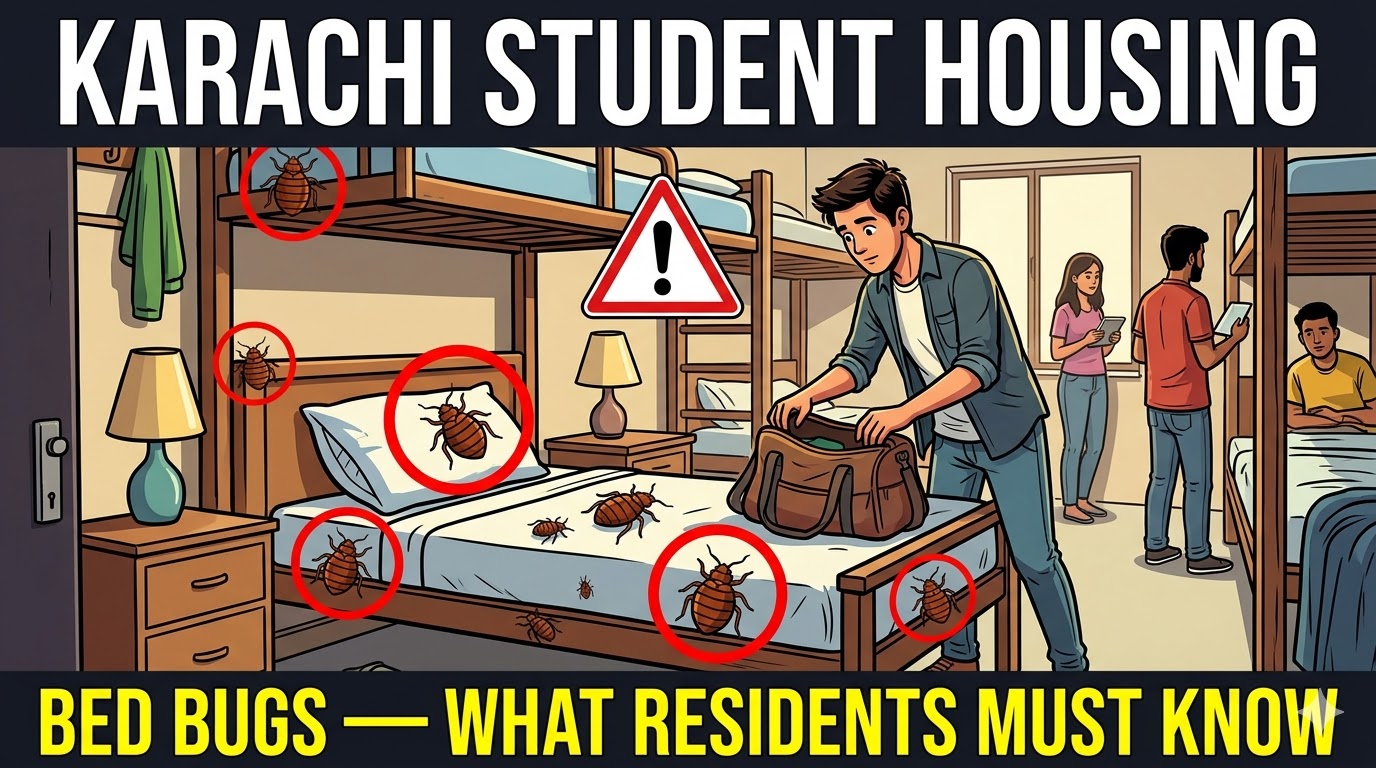
If you’re living in a hostel or student accommodation in Karachi — near Karachi University, NED, IBA, SZABIST, LUMHS, or any of the city’s dozens of campuses — bed bugs are a risk you need to take seriously. Not because student housing is dirty or poorly managed, but because of the specific conditions that make shared accommodation the single highest-risk environment for bed bug infestations.
Students move in and out constantly. Luggage travels from home to hostel and back. Secondhand furniture gets shared. Bunk beds are close together. Room inspections are infrequent. These factors combine to create near-perfect conditions for bed bugs to establish and spread rapidly.
This guide is for students, hostel wardens, parents of students, and anyone managing shared accommodation in Karachi. Understanding the risk is the first step to protecting yourself.
Why Hostels and Student Housing Are High-Risk
Constant Turnover of Residents
Bed bugs spread by travelling on luggage, clothing, and personal items. When students return from semester breaks, weekends at home, or trips to other cities, they can unknowingly bring bed bugs back with them. In a hostel where 10, 20, or 50 people are moving in and out of the same space throughout the academic year, the chances of introduction are extremely high.
Shared and Secondhand Furniture
Many hostels in Karachi use mattresses and furniture that have been in service for years, shared across many students. Even a single prior infested mattress that wasn’t treated correctly can harbour eggs in the seams that will hatch months later. Students buying or borrowing secondhand furniture from markets in Saddar, Empress Market, or from departing seniors are at particular risk.
Close Sleeping Quarters
Bed bugs find hosts by following warmth and carbon dioxide. In a room with multiple bunk beds, all sleeping areas are within easy reach of a bug population. A single infested bed can seed the entire room within weeks.
Delayed Reporting
Students often delay reporting bites or visible bugs out of embarrassment, uncertainty about what they’re dealing with, or not wanting to cause disruption. By the time a hostel management team is informed, the infestation has typically had weeks or months to spread through multiple rooms.
How to Identify Bed Bugs in Your Hostel Room
You don’t need to see a live bug to confirm an infestation — though you might. Here’s what to look for:
- Rust-coloured stains on bedding: These are dried blood spots left when a fed bug is crushed or when it defecates. Check the mattress, sheets, and pillow cases.
- Dark spots on mattress seams: Bed bug droppings look like small dark ink dots, usually along mattress folds, seams, and in the bed frame joints.
- Shed skins: Nymphs shed their outer skin (exoskeleton) five times as they grow. These translucent, yellowish husks collect in hiding spots.
- Eggs: Tiny (1mm), white, and oval-shaped, usually stuck to surfaces in batches along seams.
- Live bugs: About the size and shape of an apple seed when unfed — flat, oval, reddish-brown. After feeding they become darker and more rounded.
- Bites: Typically appear in lines or clusters on exposed skin — arms, legs, neck, face. They itch intensely but are not always felt at the time of the bite.
Check especially: mattress seams and tufts, the underside of the box spring or platform, behind the headboard, along the bed frame, behind electrical sockets near the bed, and in the folds of any stuffed furniture.
What to Do Immediately If You Find Bed Bugs
Finding bed bugs in your room does not mean you have failed at hygiene. It means a pest that is extremely good at hitchhiking found its way to your space. Act quickly and systematically:
- Report to hostel management immediately — don’t delay out of embarrassment. The sooner management knows, the sooner the entire affected area can be treated.
- Do not move your belongings to another room — this will spread the infestation. Stay put until treatment is arranged.
- Bag all bedding, clothing, and soft items in sealed plastic bags — wash them on the highest heat setting your fabrics can tolerate, then dry on high heat.
- Vacuum the mattress, bed frame, and floor carefully — dispose of the vacuum bag in a sealed plastic bag outside the building.
- Do not self-treat with sprays from a general store — these are almost never effective against a true infestation and may cause bugs to scatter further.
For Hostel Management: What a Proper Response Looks Like
If you manage student accommodation in Karachi, a confirmed bed bug sighting should trigger the following response:
1. Inspect the Entire Floor, Not Just the Reported Room
Bed bugs spread through wall voids, under door gaps, and via shared items. Assume the infestation extends beyond the room where it was first found. Inspect all adjacent rooms immediately.
2. Engage a Professional Service Immediately
Do not attempt to resolve a hostel-level infestation with generic sprays purchased from a shop. The scope, the life cycle management, and the need for follow-up treatments require a professional approach. Delays allow the population to grow.
3. Communicate Clearly with Residents
Students who know there is a treatment happening are more likely to prepare their belongings properly, which directly improves treatment efficacy. Secrecy is counterproductive.
4. Schedule Mattress Inspection and Replacement Where Necessary
Some mattresses in long-term use are too heavily infested to treat economically. Professional advice on which mattresses to replace versus treat is valuable.
5. Establish a Re-inspection Schedule
After treatment, a follow-up inspection 2 weeks later, and again at 4–6 weeks, is essential. One treatment is rarely sufficient.
Prevention: How Students Can Protect Themselves
You can’t fully control what happens in a shared building, but you can reduce your personal risk significantly:
- When moving into a new room, inspect the mattress and bed frame before sleeping in it
- Store luggage off the floor — use luggage racks or hang bags when possible
- When returning from travel or a visit home, inspect your bag before bringing it into your room
- Avoid secondhand mattresses, upholstered furniture, and bedding
- If buying used furniture from Saddar or other markets, inspect thoroughly and consider steam-cleaning before use
- Use a mattress encasement cover — this traps any bugs inside the mattress and makes it easier to detect activity
What Parents Should Know
If your child is living in student accommodation in Karachi, bed bugs are a real and common risk. If they report bites or mention bugs, take it seriously and support them in escalating to hostel management. Delayed action results in a larger infestation that is harder to treat.
Professional bed bug removal services in Karachi can be arranged for both hostels and individual rooms. If hostel management is unresponsive, parents can arrange an inspection directly.
Book a Free Inspection for Your Hostel or Student Room
Whether you’re a student dealing with an active infestation, a parent concerned about your child’s accommodation, or a hostel manager who needs a reliable professional response — we’re here to help. Pest control services in Karachi from our team cover all types of shared accommodation, with discreet, thorough treatment that protects every resident. Book your free inspection today and let us handle the problem the right way.

Ahmad Karimi is a PPMA-registered pest management specialist and the lead technical consultant at Karachi Fumigation Services, where he has overseen field operations and treatment protocols since 2005. With over 20 years of hands-on experience treating residential, commercial, and industrial properties across Karachi — from DHA bungalows with structural termite infestations to Korangi factories requiring large-scale rodent exclusion — he brings direct field knowledge to every article published on this blog.
Ahmad has managed pest control programs for clients including Descon Engineering, Pakistan Tobacco Company, Saylani Welfare, and J. (Junaid Jamshed), and has issued hundreds of fumigation certificates for health authority compliance, import/export, and commercial licensing purposes. He holds active PPMA membership and works exclusively with WHO-approved chemicals in all field operations.
The content on this blog draws directly from two decades of Karachi-specific infestation data — seasonal pest patterns, neighbourhood-level risk factors, building-age vulnerabilities, and the regulatory requirements that Karachi businesses actually face. No recycled content from foreign pest control sites. Every article reflects conditions specific to Karachi’s climate, infrastructure, and compliance environment.
For treatment enquiries or technical questions, Ahmad’s team can be reached at 03463303875 or via the office at Trade Tower, Civil Lines, Karachi.
Leave a Reply