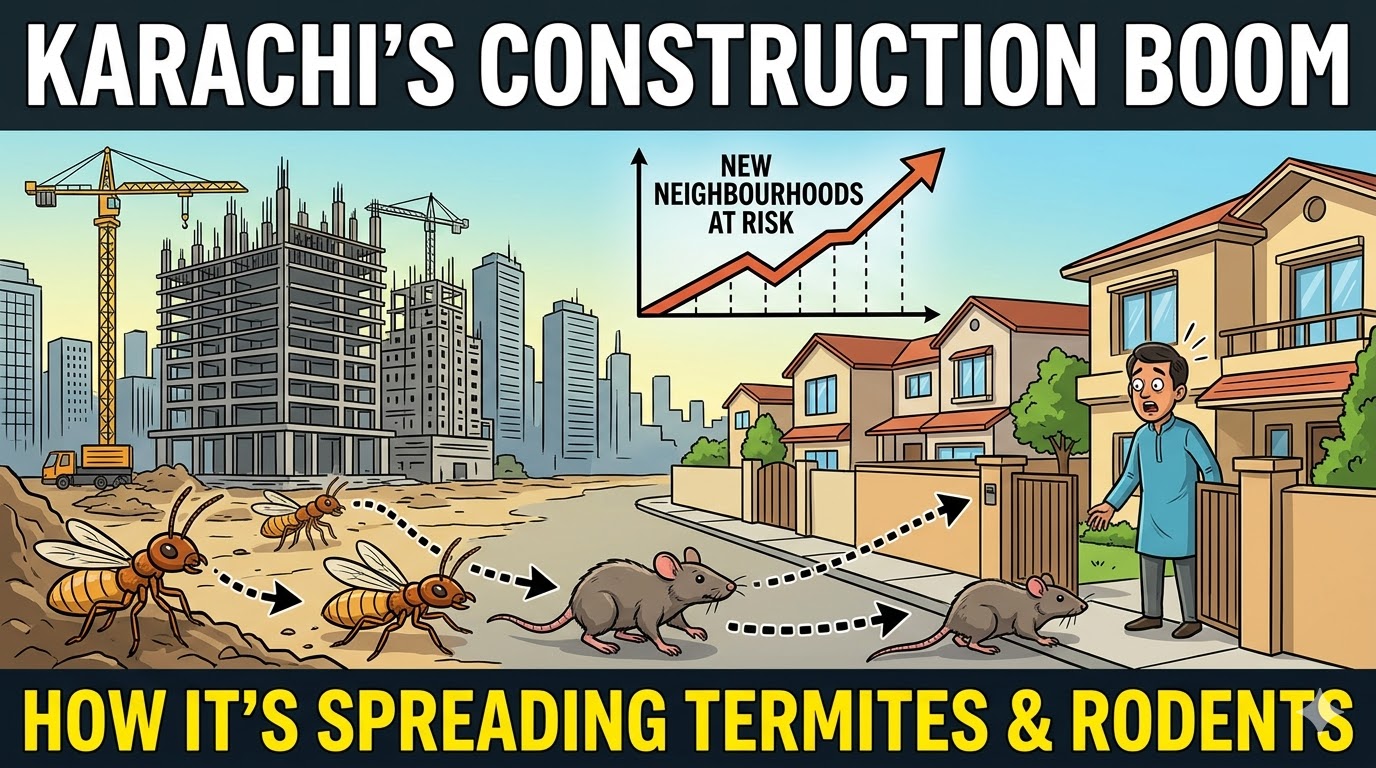
If you’ve moved into a new apartment in Bahria Town Karachi, a freshly built house in DHA City, or a recently completed building in Scheme 33 or Gulshan-e-Maymar, you might have expected to be starting fresh — a clean, new home free from the pest problems that plague older properties. What many residents of Karachi’s newest developments are discovering, to their shock and frustration, is the opposite: they are experiencing termite damage, rodent activity, and cockroach infestations within months of moving in.
This is not a coincidence, and it is not bad luck. It is a direct consequence of Karachi’s ongoing and largely unregulated construction boom — one of the most intense phases of urban expansion the city has ever seen. Understanding exactly how construction spreads pests is the first step toward protecting your new home before the damage becomes irreversible.
Karachi’s Construction Boom: The Scale of the Problem
Karachi is one of the fastest-growing cities in the world. Over the past decade, massive residential projects have transformed what were once open fields, agricultural land, and mangrove fringes on the city’s outskirts. Bahria Town Karachi alone spans over 44,000 acres. DHA City Karachi, Gadap Town, and the various housing schemes in Surjani Town, Orangi, and Malir have collectively displaced tens of thousands of acres of undeveloped land in a remarkably short period.
That undeveloped land was not empty. It was teeming with life — including a vast and complex ecosystem of underground termite colonies, burrowing rodents, and other pests that had lived undisturbed for decades. When construction begins, this ecosystem is violently disrupted. The question is never whether those pests will move — it’s where they will go. And the answer, almost invariably, is into the nearest available structure: your new home.
How Termites Spread Through Construction Sites
Termites are arguably the most serious pest threat created by Karachi’s construction boom. They are ancient, highly organised, and extraordinarily effective at finding and exploiting wood and cellulose-containing materials in structures. Here is how construction activities specifically facilitate their spread:
Soil Disruption and Colony Displacement
Subterranean termites — the dominant species in Karachi’s soil — build colonies that can extend several metres underground and span areas larger than a tennis court. When excavation work begins for foundations, roads, or underground utilities, these colonies are physically disrupted. Worker termites immediately begin searching for new territory, following moisture gradients and chemical trails. The freshly poured concrete and wood formwork of a construction site offers both moisture and cellulose — an irresistible combination.
Infected Timber in Construction
A major but under-discussed pathway for termite spread in Karachi is the use of infested timber in construction. Much of the formwork timber used in Karachi’s construction sites is reused multiple times and sourced from timber yards where storage conditions are poor. Termites in this timber are transported directly to new construction sites, often at considerable distances from their original colony. By the time the building is complete and residents move in, termites may already be active in wooden elements of the structure.
Landscaping and Garden Mulch
New housing societies in Karachi invest heavily in landscaping. The imported soil, mulch, and plants used in these projects frequently carry termite colonies. Bahria Town Karachi’s extensive green areas, for instance, have been created using soil brought from various locations — a practice that facilitates the widespread dispersal of termite populations across the development. Residents whose homes border these green zones are at particularly elevated risk.
Construction Debris Left on Site
In many Karachi construction projects, wood debris, cardboard, and cellulose waste is left on site for extended periods. This provides an ideal feeding and harbouring site for termites, allowing colonies to establish themselves close to the finished structures. Even after cleaning, the chemical trails (pheromones) left behind by termites in soil persist for months and continue to attract new termite activity.
Poor Soil Treatment Compliance
Pakistani building codes require anti-termite soil treatment (chemical barrier application) before foundation laying. In practice, this requirement is frequently skipped, inadequately applied, or performed with diluted chemicals by contractors seeking to cut costs. In a city undergoing the construction pace of Karachi, enforcement is virtually impossible. The result is that a significant proportion of new buildings in Karachi’s boom developments lack any chemical protection against subterranean termites.
How Construction Spreads Rodents into New Areas
Rodents — primarily Norway rats, roof rats, and house mice — are equally displaced by construction, though their mechanisms of spread differ from termites:
Field Rat Displacement
Karachi’s outer areas — including the Malir Valley, Hub River Road corridor, and the fringes of Gadap — have historically been home to large populations of field rats. These rodents live in burrows in agricultural and undeveloped land, feeding on seeds, grain, and vegetation. When that land is cleared for construction, the field rats are forced out almost immediately. Their natural behaviour is to move to the nearest available food and shelter — which is the construction site and, progressively, the residential areas taking shape within it.
Construction Site Conditions That Attract and Breed Rodents
Construction sites are almost ideal rodent environments. Labourers’ food waste, temporary shelter structures, stored materials, and poor sanitation all attract rats and mice. These rodents breed rapidly — a pair of Norway rats can produce 20-50 offspring in a year — and populations established on construction sites do not disappear when the site is completed. They move into the finished buildings.
Infrastructure as Rodent Highways
The laying of new sewage, drainage, and utility infrastructure across Karachi’s expanding areas creates underground tunnels and conduits that serve as protected rodent highways. Karachi’s rats are well-adapted to using drain systems for travel, and new infrastructure provides fresh routes into previously inaccessible residential areas. This is a particular problem in new housing developments where drainage infrastructure is completed before full occupancy, leaving rodents with unobstructed access to hundreds of homes.
Demolition of Old Structures
Karachi’s construction boom is not only about building in new areas — it also involves extensive demolition of older buildings in established neighbourhoods. In areas like PECHS, Gulshan-e-Iqbal, and Nazimabad, old bungalows and low-rise buildings are regularly demolished to make way for multi-storey apartment complexes. These demolitions displace established rodent colonies that have lived in the old structures for years, driving them into neighbouring buildings. Residents living next to demolition sites in Karachi frequently report sudden and severe rodent infestations with no prior history of the problem.
The Specific Neighbourhoods Most Affected
While the entire city is affected by construction-related pest spread, certain areas are experiencing particularly intense problems based on current development activity:
- Bahria Town Karachi: The sheer scale of development across former agricultural land has created one of the most significant termite risk zones in the city. Residents in Phase 1 through Phase 7 have reported active termite infestations in brand-new properties. The extensive green landscaping, imported soil, and proximity to undeveloped buffer zones compounds the risk significantly.
- DHA City Karachi and DHA Phase 8 Extension: Development adjacent to Hub River Road and the Lyari River corridor has displaced large rodent populations from previously undisturbed scrubland. New residents are encountering Norway rats and roof rats that are far more aggressive than the typical urban variety.
- Scheme 33 and Gulshan-e-Maymar: Rapid, high-density construction in these areas has created conditions ideal for cockroach and rodent spread between units. Poor construction standards in some developments have left numerous entry points.
- Orangi Town Expansion Areas: Construction at the edges of Orangi displaces pests from both the old neighbourhood infrastructure and the surrounding undeveloped land, creating a compounded pest pressure on new buildings.
- PECHS and Bahadurabad Redevelopment Zones: Old bungalow demolitions throughout these established areas are consistently displacing rodent colonies into adjacent apartment buildings. Residents in these areas who have never had rodent problems are suddenly finding them after neighbouring demolitions.
The Signs That Construction-Related Pests Have Entered Your Home
Many residents of new properties do not immediately connect pest activity to the construction around them. Here are the specific signs to watch for:
Signs of Termite Activity:
- Mud tubes (thin, pencil-width tunnels of dried soil) on walls, foundations, or inside cupboards
- Wood that sounds hollow when tapped
- Paint that bubbles or peels without moisture explanation
- Discarded termite wings on windowsills or floor — especially after evening hours when swarmers are active
- Fine, sawdust-like frass (termite droppings) near wooden furniture or structural elements
Signs of Rodent Activity:
- Droppings — dark, capsule-shaped, most common near food sources or along walls
- Gnaw marks on food packaging, wiring, or wooden surfaces
- Grease trails — dark smear marks along walls at floor level, where rats travel repeatedly
- Scratching sounds at night from ceilings, walls, or under floors
- Nesting material — shredded paper, fabric, or insulation in hidden corners or roof spaces
What New Karachi Homeowners Must Do Right Now
If you have recently moved into a new property, or if construction is ongoing nearby, these actions are essential:
For Termite Prevention:
- Ask your developer or builder for documentation of anti-termite soil treatment. If they cannot provide it, assume it was not done adequately and schedule a professional soil treatment
- Do not allow wood debris, cardboard boxes, or garden mulch to accumulate against your home’s exterior
- Inspect new wooden furniture thoroughly before bringing it indoors — termite-infested furniture from timber markets is a common introduction route
- Maintain adequate ventilation in all rooms — termites prefer damp, stale conditions
- Have your property professionally inspected for termites before the end of the first monsoon season — this is when subterranean termite activity is most detectable
For Rodent Prevention:
- Seal all gaps around pipe penetrations through walls — these are the primary rodent entry points in new buildings
- Install steel mesh over ventilation openings at foundation level
- Check that all drain connections are properly sealed and covered
- Do not allow construction waste, food packaging, or organic material to accumulate in or around your property
- If you can hear rodent activity before the building is fully occupied, contact pest control before moving in — it is far easier to treat an unoccupied building
The Responsibility Gap: Who Should Be Protecting New Residents?
There is a genuine protection gap in Karachi’s construction industry. Developers are legally required to provide anti-termite treatment but frequently do not. Housing societies are obligated to maintain sanitary conditions but often lack enforcement mechanisms. Newly arrived residents assume their new homes have been properly treated — an assumption that is, in too many cases, incorrect.
Until regulatory enforcement improves, the responsibility falls on homeowners and residents to be proactive. This means not assuming that a new building is pest-protected, understanding the risks of the construction environment you have moved into, and investing in professional pest management from the moment you take possession of a new property.
Professional Pest Control: Essential, Not Optional, for New Developments
For residents of Karachi’s new housing developments, professional pest control is not a reactive measure — it is a foundational step in making your new home liveable and protecting your investment. A professional inspection will identify whether anti-termite treatment was applied correctly, detect any existing rodent or insect activity, and recommend the appropriate preventive treatments to neutralise the risks inherent in your specific location.
With experienced teams serving both new developments and established neighbourhoods across the city, the professionals offering fumigation services in Karachi understand the specific pest risks created by the city’s construction activity. They can provide new-construction termite treatment, rodent exclusion services, and ongoing preventive programmes tailored to the unique challenges of Karachi’s expanding urban landscape.
Conclusion
Karachi’s construction boom is transforming the city’s skyline, but it is also transforming its pest landscape. Every new development that displaces undeveloped land displaces the pests living in that land — and those pests go somewhere. Without proper preventive measures, that somewhere is your new home.
If you live in or near a new development, if there has been recent demolition in your neighbourhood, or if you’ve moved into a new building in the last two years, the threat of construction-spread termites and rodents is real and present. Don’t wait for damage to appear before you act. In the case of termites especially, by the time the damage is visible, it has been ongoing for months — sometimes years.
📞 Book Your Free Pest Inspection Today
Whether you’ve just moved into a new development or you’ve been noticing warning signs for months, our team is ready to help. Book a free inspection with us today. We’ll assess your property for termite and rodent risk, check whether anti-termite soil treatment was properly applied, and recommend a clear, affordable protection plan. Your new home deserves a fresh start — let us make sure it gets one.

Ahmad Karimi is a PPMA-registered pest management specialist and the lead technical consultant at Karachi Fumigation Services, where he has overseen field operations and treatment protocols since 2005. With over 20 years of hands-on experience treating residential, commercial, and industrial properties across Karachi — from DHA bungalows with structural termite infestations to Korangi factories requiring large-scale rodent exclusion — he brings direct field knowledge to every article published on this blog.
Ahmad has managed pest control programs for clients including Descon Engineering, Pakistan Tobacco Company, Saylani Welfare, and J. (Junaid Jamshed), and has issued hundreds of fumigation certificates for health authority compliance, import/export, and commercial licensing purposes. He holds active PPMA membership and works exclusively with WHO-approved chemicals in all field operations.
The content on this blog draws directly from two decades of Karachi-specific infestation data — seasonal pest patterns, neighbourhood-level risk factors, building-age vulnerabilities, and the regulatory requirements that Karachi businesses actually face. No recycled content from foreign pest control sites. Every article reflects conditions specific to Karachi’s climate, infrastructure, and compliance environment.
For treatment enquiries or technical questions, Ahmad’s team can be reached at 03463303875 or via the office at Trade Tower, Civil Lines, Karachi.
Leave a Reply