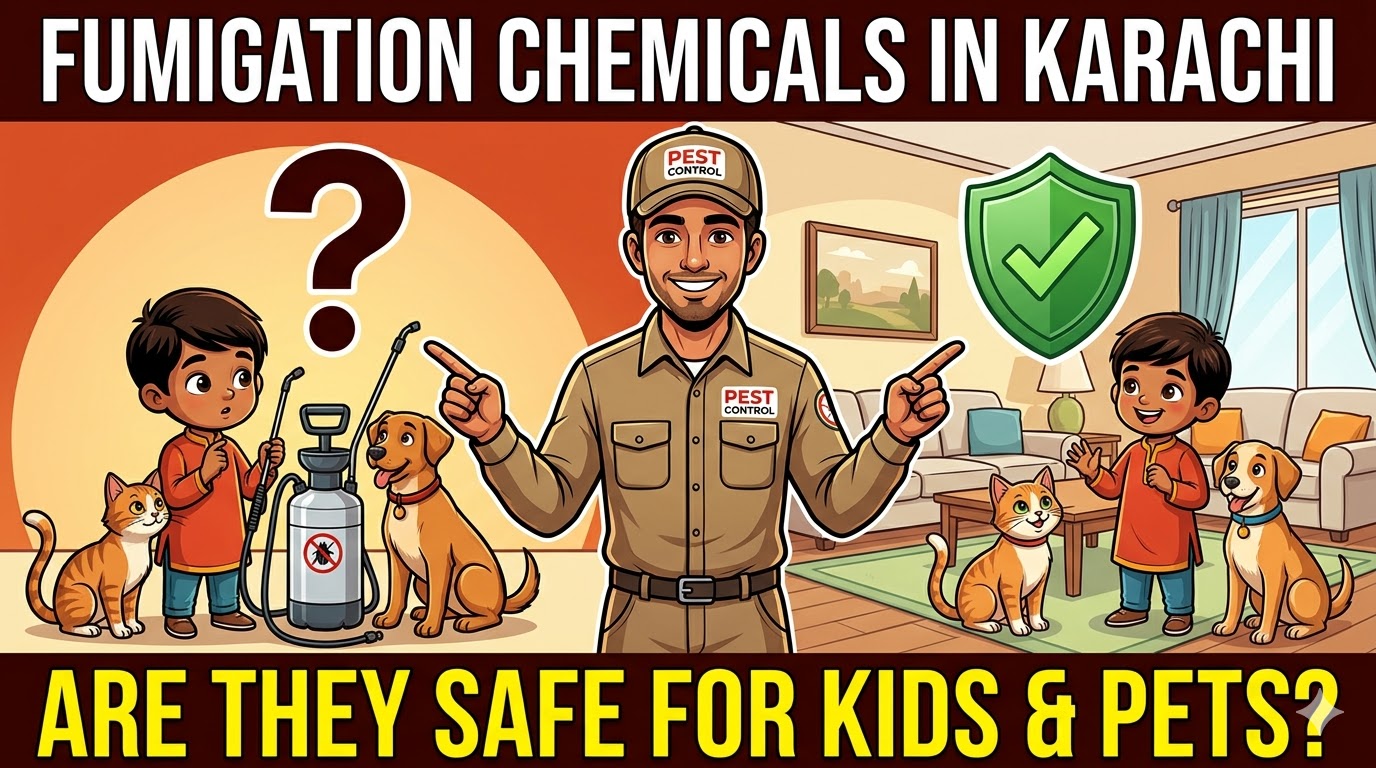
If you have children running barefoot across the floors or a cat lounging on the sofa, the thought of filling your home with pest control chemicals is unsettling. You want the cockroaches and mosquitoes gone — but not at the cost of your child’s health or your pet’s safety. So what is the honest answer: are fumigation chemicals safe for kids and pets in Karachi?
The answer requires nuance. Some chemicals are genuinely risky. Others are safe if used correctly. And the outcome depends heavily on which company you hire, what precautions are taken, and how you manage the post-treatment period. This article gives you the complete picture — no sugarcoating, no unnecessary alarm.
Why Children and Pets Are More Vulnerable Than Adults
Children and pets are not just smaller versions of adults. Their physiology makes them genuinely more susceptible to chemical exposure, and the reasons are specific:
Children
- Children breathe faster than adults, meaning they inhale more air — and more airborne chemicals — per unit of body weight
- They spend more time on the floor, where chemical residues settle and concentrate
- Their hands frequently go in their mouths, creating a direct ingestion pathway for surface residues
- Their developing organ systems — particularly the liver, kidneys, and nervous system — are less capable of metabolising and eliminating toxins
- Neurological development continues well into adolescence, making young children particularly vulnerable to chemicals that affect the brain and nervous system
Pets
- Dogs and cats groom themselves by licking their fur and paws, which brings any surface residue directly into their digestive systems
- Birds and small animals (hamsters, rabbits, guinea pigs) are extremely sensitive to airborne chemicals and can suffer respiratory distress or death even from low concentrations
- Reptiles and fish absorb chemicals through skin and water respectively — aquarium water can become contaminated from spray drift
- Pets cannot communicate symptoms of chemical poisoning early, meaning reactions can escalate before you notice
The Most Common Fumigation Chemicals Used in Karachi Homes — and Their Risk Profiles
Pyrethroids (Cypermethrin, Permethrin, Deltamethrin)
These are the most widely used chemicals in Karachi residential pest control. They are synthetic versions of natural pyrethrin and are effective against cockroaches, ants, mosquitoes, and bed bugs.
For children: Pyrethroids are considered relatively low toxicity when used correctly and when the home is properly ventilated before re-entry. However, they can cause skin irritation, eye irritation, and respiratory sensitivity in young children if re-entry occurs too early.
For pets: Permethrin is highly toxic to cats. This is critical — many pet owners do not know this. A cat that walks across a freshly treated floor and then grooms itself can experience tremors, seizures, and in severe cases, death. Dogs are less sensitive but should still be kept away for the recommended period.
Organophosphates (Chlorpyrifos, Malathion, Dichlorvos)
These are older-generation chemicals that are still in use by some pest control companies in Karachi. They work by disrupting the nervous system of insects — and they can do the same to children and pets in high enough doses.
For children: Chronic exposure to organophosphates has been linked to impaired cognitive development, reduced IQ scores, and increased risk of ADHD in children. The WHO has classified chlorpyrifos as a developmental neurotoxin. Ask your pest control provider directly whether they use any organophosphate-based products.
For pets: Organophosphates are toxic to dogs and cats. Symptoms of poisoning include excessive salivation, vomiting, tremors, and difficulty breathing. Immediate veterinary attention is required if exposure is suspected.
Boric Acid
Boric acid is one of the safer options used in gel baits for cockroaches. It works as a stomach poison for insects.
For children: Boric acid has low inhalation risk since it is not sprayed. However, it is still a toxin if ingested in quantity, so gel bait placements should be out of children’s reach — inside cabinets, behind appliances.
For pets: Similarly low risk when placed in inaccessible areas. A pet chewing on a gel bait station is unlikely to consume enough to cause serious harm, but placement matters.
Rodenticides (Bromadiolone, Brodifacoum)
These are anticoagulant poisons used in rat control. They are among the highest-risk chemicals for both children and pets.
For children: Rodenticide ingestion is a medical emergency. These should only be placed in locked bait stations that children cannot access.
For pets: Secondary poisoning is a serious risk. A dog or cat that eats a poisoned rodent can itself be poisoned. This is a well-documented veterinary emergency. If you have pets and need rodent control, inform your pest control provider — there are safer, enclosed bait station options.
Specific Risks in Karachi Homes
Floor Contamination
Karachi homes with marble, tile, or cemented floors are common, and many children spend significant time sitting and playing on these surfaces. When sprays are applied to floors and lower surfaces, residues can persist — particularly in the grout lines of tiles and porous concrete. Even after visual drying, residue can remain active for days. Mopping with water after the recommended re-entry period is essential before allowing young children onto treated floors.
Rooftop Water Tanks
Many Karachi households store drinking water in overhead tanks or ground-level reservoirs. During fumigation, if tanks are not sealed, spray aerosols and fumes can contaminate the water supply. This is not hypothetical — it is a documented risk in densely housed neighbourhoods. Every responsible fumigation company should verify water storage is sealed before treatment.
Kitchen and Food Storage Areas
Cockroach infestations in Karachi kitchens are extremely common, and kitchen fumigation is one of the most frequent requests. However, the kitchen is also where chemical exposure through food is most likely. All open food, spices, and utensils must be removed or sealed before treatment. Babies’ milk storage, formula, and weaning foods must receive special attention.
Bird Cages and Aquariums
If you have birds, even covering a cage in the same room may not be enough — the respiratory system of birds is extremely sensitive. Birds must be moved to a completely separate, unaffected area during and for at least 24 hours after treatment. Fish tanks must be covered with plastic and the air pump disconnected before fogging or spraying.
A Practical Safety Checklist for Karachi Families with Children and Pets
Before fumigation:
- Move all children and pets out of the home before treatment begins
- Remove or tightly seal all food, water, and baby items
- Cover fish tanks and disconnect air pumps; relocate birds and small animals
- Inform the pest control team you have children and pets — ask for low-toxicity alternatives
- Request the names and MSDS sheets for all chemicals to be used
After fumigation:
- Do not bring children or pets back before the recommended re-entry time
- Mop all hard floors with water before children return
- Wipe all reachable surfaces, furniture, and children’s play areas
- Wash pet bedding and remove any items the pet might lick or chew
- Keep windows open for continued ventilation for several hours
- Do not let cats back in until all treated surfaces are fully dry and the home is aired
How to Choose a Fumigation Company That Takes Child and Pet Safety Seriously
Not all pest control operators in Karachi follow the same standards. Here is how to identify one that will genuinely protect your family:
- They ask about children and pets before recommending a treatment plan
- They provide clear, written re-entry timelines specific to your household composition
- They offer low-toxicity or child/pet-safe treatment options when relevant
- They do not use organophosphate compounds without clear justification and disclosure
- They provide product documentation upon request
When selecting a provider, look for established home fumigation services in Karachi that employ trained technicians, use registered chemicals, and demonstrate transparency in their process. A company that brushes off questions about child and pet safety is not one you want in your home.
What Are the Symptoms of Chemical Exposure in Children?
If you suspect a child has been exposed to pest control chemicals, watch for:
- Skin redness, itching, or rash
- Red or watery eyes
- Persistent coughing or sneezing
- Nausea or vomiting
- Dizziness or unusual fatigue
- Headache
- In severe cases: tremors, difficulty breathing, or loss of consciousness
If any of these symptoms appear after returning to a recently fumigated home, seek medical attention immediately and inform the doctor about the chemicals used. Save any product documentation from your pest control provider.
What Are the Symptoms of Chemical Exposure in Pets?
Watch for these signs in your animals after fumigation:
- Excessive pawing at the face or mouth
- Drooling or foaming at the mouth
- Vomiting or diarrhoea
- Trembling or muscle weakness
- Dilated pupils
- Difficulty walking or loss of coordination
- Breathing difficulty
If you observe any of these signs, contact a veterinarian immediately and provide information about the chemicals used. Time matters in chemical poisoning cases.
Safer Alternatives That Work in Karachi’s Context
For families with young children, infants, or sensitive pets, these lower-risk approaches can reduce or eliminate the need for high-toxicity treatments:
- Gel baits for cockroaches: Applied in enclosed spaces away from children and pets, gel baits are highly effective and carry minimal inhalation or dermal risk
- Diatomaceous earth: A physical rather than chemical pest control agent, effective against crawling insects without systemic toxicity
- Integrated Pest Management (IPM): A professional IPM approach combines monitoring, exclusion techniques, targeted low-toxicity treatments, and prevention to minimise chemical use over time
- Boric acid powder: When placed correctly (deep inside wall cavities, under appliances), it offers effective cockroach control without direct exposure risk
A good pest control company will discuss these options with you rather than defaulting immediately to heavy chemical spraying.
The Bottom Line: Safe, Yes — But Only When Done Right
Fumigation in a Karachi home with children and pets is not inherently dangerous. It becomes dangerous when done by unqualified operators, when the wrong chemicals are used, when safety protocols are not followed, or when families return too early.
Properly conducted, professionally supervised pest control — using appropriate chemicals, with full evacuation of children and pets, and with correct post-treatment ventilation and cleaning — can be carried out safely. The responsibility lies jointly with you as the homeowner to ask the right questions, and with the pest control company to answer them honestly.
Book Your Free Home Inspection — Child and Pet Safety Is Our Priority
Dealing with cockroaches, termites, mosquitoes, or rodents and worried about the impact on your children or pets? Our team will come to your home, assess the infestation, and design a treatment plan that is both effective and as safe as possible for every member of your household.
We are transparent about every chemical we use, we explain the re-entry timeline clearly, and we offer lower-toxicity options where they are appropriate. We know your family’s safety is not negotiable.
Book your free inspection today — and get a pest control solution designed around your family, not just the pests.

Ahmad Karimi is a PPMA-registered pest management specialist and the lead technical consultant at Karachi Fumigation Services, where he has overseen field operations and treatment protocols since 2005. With over 20 years of hands-on experience treating residential, commercial, and industrial properties across Karachi — from DHA bungalows with structural termite infestations to Korangi factories requiring large-scale rodent exclusion — he brings direct field knowledge to every article published on this blog.
Ahmad has managed pest control programs for clients including Descon Engineering, Pakistan Tobacco Company, Saylani Welfare, and J. (Junaid Jamshed), and has issued hundreds of fumigation certificates for health authority compliance, import/export, and commercial licensing purposes. He holds active PPMA membership and works exclusively with WHO-approved chemicals in all field operations.
The content on this blog draws directly from two decades of Karachi-specific infestation data — seasonal pest patterns, neighbourhood-level risk factors, building-age vulnerabilities, and the regulatory requirements that Karachi businesses actually face. No recycled content from foreign pest control sites. Every article reflects conditions specific to Karachi’s climate, infrastructure, and compliance environment.
For treatment enquiries or technical questions, Ahmad’s team can be reached at 03463303875 or via the office at Trade Tower, Civil Lines, Karachi.
Leave a Reply