You’ve hired a fumigation company, paid the bill, and they’ve handed you a warranty certificate. You feel protected. But do you know what that warranty actually covers — and more importantly, what it doesn’t?
For many Karachi homeowners, a fumigation warranty is a vague document that provides a false sense of security until the moment it’s needed. Then, when the cockroaches return or the termites resurface, the company’s response reveals just how limited the warranty actually was.
This guide cuts through the ambiguity. We’ll explain what a legitimate fumigation warranty should cover, what the typical exclusions look like, and what questions every Karachi homeowner should ask before accepting any warranty document.
Why Fumigation Warranties Matter in Karachi Specifically
Karachi’s environment makes pest re-infestation a persistent reality. Seasonal monsoons drive cockroaches, rodents, and ants indoors. The city’s older housing stock — particularly in Saddar, Lyari, Garden, P.E.C.H.S, and North Nazimabad — has more entry points and hiding places than newer construction. Dense apartment living in areas like Gulshan-e-Iqbal, Clifton, and DHA means that even after your unit is treated, neighbouring units can reintroduce pests.
This is why a warranty isn’t just a formality — it’s a practical necessity. A good warranty acknowledges the reality of Karachi’s pest environment and commits the company to stand behind its work when re-infestation occurs. A weak warranty quietly excuses the company from almost every realistic scenario.
Understanding the difference before you sign is the entire point.
What a Legitimate Fumigation Warranty Should Cover
A proper fumigation warranty in Karachi should include the following elements. If any of these are absent, you should ask why — and consider whether that company’s warranty is worth the paper it’s printed on.
1. Specified Pest Coverage
The warranty should explicitly name the pests it covers. Not “all pests” — but specific types: cockroaches, termites, bedbugs, rodents, ants, mosquitoes, or whatever was identified during the inspection and treated.
Vague warranties that say “pest control” without specification are a red flag. If a new type of pest appears after treatment, you need to know whether it falls within your warranty or requires a separate service agreement.
2. Defined Warranty Period
Every warranty should have a clear start date (typically the date of treatment) and end date. Standard warranty periods in Karachi’s professional pest control market vary by pest type:
| Pest Type | Typical Warranty Period | Notes |
| Termites (subterranean) | 1–5 years | Chemical soil barrier treatments carry longer warranties |
| Cockroaches | 3–6 months | Gel baiting programs often have rolling warranties |
| Bedbugs | 3–6 months | Requires multiple treatment sessions |
| Rodents | 1–3 months | Often tied to ongoing monitoring contracts |
| General pests (ants, mosquitoes) | 1–3 months | Seasonal treatments may have shorter coverage |
Any warranty period significantly shorter than the ranges above — particularly for termites — is worth questioning.
3. Free Re-Treatment Commitment
The core value of any fumigation warranty is this: if the infestation returns within the warranty period, the company will re-treat your property at no additional cost.
This should be stated explicitly. Vague language like “we will address the issue” or “additional support may be available” are not the same as a clear, written commitment to free re-treatment. Push for the specific words: no additional charge, re-treatment included, covered under warranty.
4. Coverage Area
The warranty should specify which areas of the property it covers. Does it apply to the entire premises — all rooms, storage areas, balconies, and utility spaces? Or only the areas that were treated on the day of service?
In older Karachi properties with multiple entry points — particularly ground-floor apartments or bungalows near storm drains — a coverage area limitation can render a warranty almost useless. Make sure you know exactly what’s included.
5. Contact and Claim Process
The warranty document should include clear contact information and a straightforward process for making a claim. How do you report a re-infestation? Is there a response time commitment? Who authorises the re-treatment?
A professional company will make this process simple. A company that makes warranty claims difficult — requiring multiple escalations, imposing excessive documentation requirements, or simply not answering — is one you should have avoided in the first place.
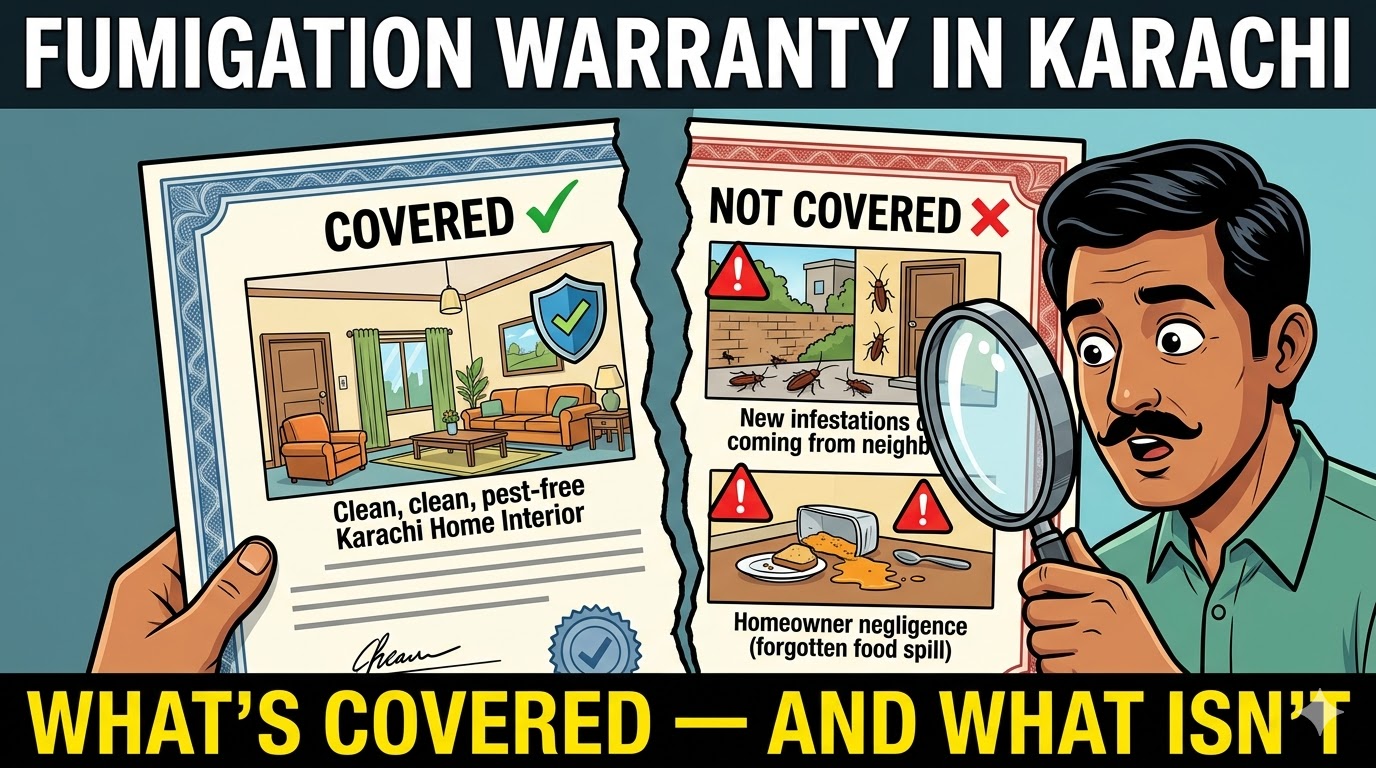
What a Fumigation Warranty Typically Does NOT Cover
This is where most homeowners are surprised. Even legitimate, professionally written warranties contain exclusions. Knowing these exclusions upfront prevents unpleasant disputes later.
1. New Pest Species Not Covered by the Original Treatment
If your warranty covered cockroaches and bedbugs, and three months later you discover a rodent infestation, that is almost certainly not covered. Warranties apply to the specific pests treated — not to all future pest issues.
This is reasonable from the company’s perspective, but homeowners should understand it clearly. A new infestation of a different pest species will require a new service agreement and fee.
2. Infestations Caused by External or Structural Factors
Most warranties exclude re-infestation that can be attributed to conditions that were not present — or not disclosed — at the time of treatment. Common exclusions include:
- Water seepage or damp walls that create new harborage conditions
- Structural changes or renovation work that opens new entry points
- New furniture, goods, or materials introduced from infested sources
- Infestations entering from adjacent units in a shared building
This last point is particularly relevant in Karachi’s apartment culture. If you live in a high-rise in Clifton or a multi-unit building in Gulshan, pests from untreated neighbouring flats can re-enter your unit — and your warranty will typically not cover that scenario unless the company offers a building-wide treatment program.
3. Denial of Inspection or Access
Companies include a standard clause: the warranty is void if you deny them access for re-inspection or follow-up visits. This is reasonable — they cannot assess or remediate a problem they cannot inspect.
However, this clause can sometimes be used against homeowners if the company makes access requests unreasonably difficult or expensive. Ensure that the warranty specifies how and when re-inspection visits will be scheduled, and that no additional charges are imposed for warranty inspections.
4. Post-Treatment Failure to Follow Instructions
Professional fumigation companies provide specific post-treatment instructions — re-entry times, cleaning protocols, food safety guidelines, and follow-up precautions. If a homeowner does not follow these instructions, the company may argue that treatment efficacy was compromised and the warranty is void.
This is another reason why pre-treatment communication matters. Ask for written post-treatment instructions, follow them, and keep a record that you did.
5. Property Damage or Consequential Losses
A fumigation warranty covers re-treatment — not property damage. If termites have already damaged your wooden flooring, furniture, or structural elements, or if a cockroach infestation has resulted in contaminated food supplies, the warranty does not compensate you for those losses.
For significant termite damage specifically, homeowners in Karachi should understand that treatment warranties cover future pest activity — not the repair of damage already done. Remediation of structural damage is a separate — and often costly — process that falls entirely outside the scope of pest control warranties.
Red Flags in Fumigation Warranty Documents
Watch for these warning signs in any warranty offered by a Karachi fumigation company:
- No written warranty at all: Verbal guarantees are worthless. If they won’t put it in writing, the guarantee means nothing.
- Blanket exclusions: “Warranty void in case of re-infestation from any external source” — in Karachi’s dense urban environment, this exclusion covers virtually every realistic scenario.
- Excessively short warranty periods: A 2-week warranty on cockroach treatment is not meaningful. Any company offering such a short window has no confidence in their own work.
- Uncapped re-inspection fees: If the warranty requires you to pay for inspection visits before re-treatment is authorised, the warranty value is significantly diminished.
- No specific pest coverage: “General pest control warranty” without named pests can be interpreted to cover almost nothing when challenged.
- No claims process: If the document doesn’t explain how to make a claim, that’s deliberate. It makes claims harder to pursue.
Questions to Ask Before Accepting Any Fumigation Warranty
Use this list when evaluating any fumigation company in Karachi:
- Which specific pests are covered under this warranty?
- What is the exact start and end date of coverage?
- If re-infestation occurs, will re-treatment be provided at no additional cost?
- Are there any conditions or actions that could void the warranty?
- Does the warranty cover the entire property or only treated areas?
- What is the process for making a warranty claim? How quickly will you respond?
- Are follow-up inspection visits included, and will they incur any charges?
- Is this warranty transferable if I rent or sell the property?
Any professional provider of fumigation services in Karachi should be able to answer every one of these questions clearly and without hesitation. Evasive or vague answers to any of them should give you pause.
How to Make the Most of Your Fumigation Warranty
Even with a good warranty in place, a few steps on your end will ensure you’re fully protected:
- Read the document before signing. Don’t assume the warranty covers everything. Read every clause and ask for clarification on anything unclear.
- Keep your copy safely. Store the warranty document, original invoice, and treatment report together — you’ll need them if you ever make a claim.
- Follow all post-treatment instructions. Documented compliance with the company’s guidelines protects you if they ever try to void the warranty.
- Report re-infestation promptly. Don’t wait months before contacting the company. Early reporting prevents the problem from escalating and demonstrates good faith.
- Document everything. Photograph evidence of re-infestation, note dates, and keep records of all communications with the company.
Final Thoughts: A Warranty Is Only as Good as the Company Behind It
A written warranty is a meaningful protection — but only when it comes from a company that actually intends to honour it. A piece of paper from an unregistered, fly-by-night operator carries no real weight.
The best protection a Karachi homeowner can have is choosing a reputable, professional fumigation company from the start: one that uses approved chemicals, employs trained technicians, provides a thorough treatment, and issues a clear, enforceable written warranty.
When you understand exactly what your warranty covers — and what it doesn’t — you can also make informed decisions about additional precautions: whether to negotiate better warranty terms, consider a building-wide treatment, or schedule periodic follow-up visits proactively.
Pest control done right is an investment in the safety, comfort, and value of your home. A warranty done right is the assurance that investment is protected.
Get a Free Inspection and a Warranty You Can Trust
Not sure what your home needs — or whether your current fumigation warranty actually protects you? Our team offers a free, no-obligation on-site inspection for Karachi homeowners. We’ll assess your infestation, recommend the right treatment, and walk you through exactly what our warranty covers before you commit to anything.
Book your free inspection today. Protect your home with a fumigation service that stands behind its work — in writing, and in practice.

Ahmad Karimi is a PPMA-registered pest management specialist and the lead technical consultant at Karachi Fumigation Services, where he has overseen field operations and treatment protocols since 2005. With over 20 years of hands-on experience treating residential, commercial, and industrial properties across Karachi — from DHA bungalows with structural termite infestations to Korangi factories requiring large-scale rodent exclusion — he brings direct field knowledge to every article published on this blog.
Ahmad has managed pest control programs for clients including Descon Engineering, Pakistan Tobacco Company, Saylani Welfare, and J. (Junaid Jamshed), and has issued hundreds of fumigation certificates for health authority compliance, import/export, and commercial licensing purposes. He holds active PPMA membership and works exclusively with WHO-approved chemicals in all field operations.
The content on this blog draws directly from two decades of Karachi-specific infestation data — seasonal pest patterns, neighbourhood-level risk factors, building-age vulnerabilities, and the regulatory requirements that Karachi businesses actually face. No recycled content from foreign pest control sites. Every article reflects conditions specific to Karachi’s climate, infrastructure, and compliance environment.
For treatment enquiries or technical questions, Ahmad’s team can be reached at 03463303875 or via the office at Trade Tower, Civil Lines, Karachi.