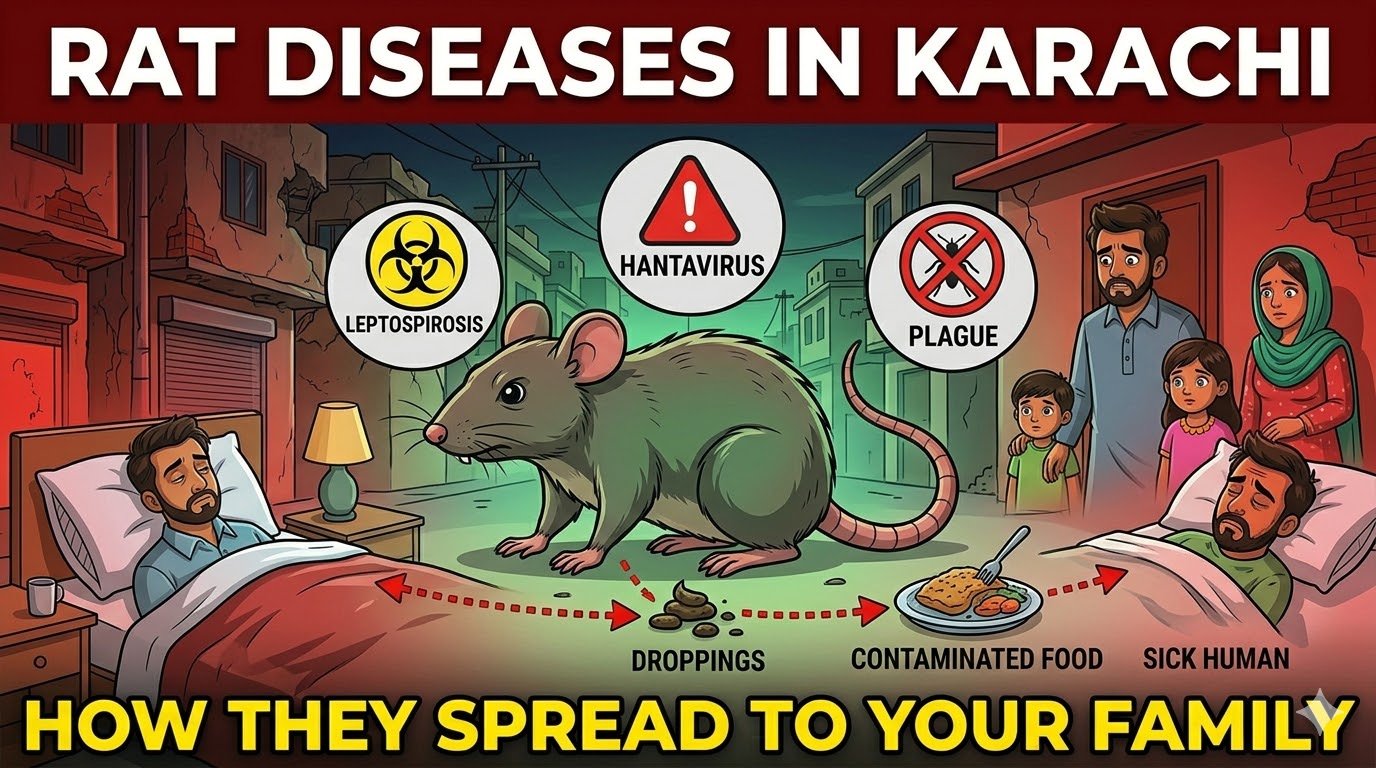
Rats have coexisted with human settlements for thousands of years, and in that time they have served as vectors — carriers — for some of history’s most devastating diseases. In a contemporary city like Karachi, the health risks associated with rat infestations are not historical curiosities. They are active, documented, and relevant to any household, food storage facility, or business that has rats on the premises.
The disease burden associated with urban rodent populations in Pakistan is not comprehensively tracked in the way it might be in countries with more robust public health surveillance infrastructure. But the pathogens rats carry are well-documented globally, and Karachi’s environmental conditions — warm climate, limited healthcare access in many areas, compromised water and sanitation infrastructure — create conditions under which transmission is more likely and consequences more serious than in cities with stronger public health systems.
This article covers the key diseases rats carry, how each one reaches humans, and why Karachi households are specifically at risk.
How Rat-Borne Disease Transmission Works
Rats transmit diseases to humans through several distinct routes, which is why simply not being bitten is not sufficient protection:
- Direct contact: handling a rat, being bitten, or coming into contact with rat urine or droppings with bare skin
- Indirect contact: touching surfaces contaminated by rat urine or droppings, then touching the mouth, nose, or eyes
- Consumption: eating or drinking food or water contaminated with rat urine, droppings, or fur
- Airborne inhalation: disturbing dried rat urine or droppings, which aerosolizes particles containing pathogens
- Secondary vectors: fleas, mites, and ticks that have fed on infected rats then bite humans
In a household with an active rat infestation, all five of these transmission routes are potentially active simultaneously. This is what makes a rat infestation a genuine public health concern, not merely a nuisance.
Leptospirosis
Leptospirosis is arguably the most medically significant rat-borne disease in urban Pakistan. It is caused by Leptospira bacteria, which are shed in large quantities in rat urine. Rats carry the bacteria without showing symptoms, meaning a healthy-looking rat population is still actively infectious.
In Karachi, the transmission risk is elevated for two specific reasons. First, the monsoon season floods streets, drains, and in some areas homes with water that has been in contact with rat urine in drainage infrastructure. Wading through or even contact with flood water during and after the monsoon carries a real leptospirosis exposure risk. Second, open drains and nalas — which run through residential areas throughout the city — carry rat urine from upstream burrowing and nesting sites into areas where children play and adults walk regularly.
Leptospirosis presents initially as a flu-like illness with fever, severe headache, and muscle pain. In its severe form (Weil’s disease), it can progress to kidney and liver failure and is potentially fatal. It is significantly underdiagnosed in Karachi, as its early symptoms overlap with common viral illnesses and many patients do not seek care until the disease has progressed.
Salmonellosis
Salmonella bacteria are carried in rat intestinal tracts and shed in their droppings. In a kitchen, food storage area, or any space where rats are active, the contamination risk to food is continuous. Rats defecate while they move — not at a specific location — meaning that any surface they run across, including kitchen counters, food storage shelving, and the exterior of food packaging, can be contaminated.
Salmonellosis causes gastroenteritis — nausea, vomiting, diarrhoea, and fever — and in young children, elderly individuals, and immunocompromised people it can become severe enough to require hospitalisation. Salmonella contamination from rats is particularly insidious because it leaves no visual sign. Food that looks clean may still be contaminated if a rat has run across the surface or nearby.
In Karachi households where food is stored in kitchen cabinets or on open shelving — rather than in sealed, hard-sided containers — and where rats have access to the kitchen at night, salmonella exposure is a realistic risk that is experienced as what the family believes to be an ordinary stomach bug.
Rat-Bite Fever
Rat-bite fever is caused by Streptobacillus moniliformis bacteria and is transmitted through bites or scratches from infected rats, or through contact with rat urine and mucous secretions. Despite its name, a bite is not the only route of transmission — handling a rat or contact with its secretions is sufficient.
In Karachi’s lower-income neighbourhoods where rat populations are densest and living conditions mean closer proximity to rodents, rat bites — particularly of sleeping children — are not uncommon. Rat-bite fever presents with fever, rash, and joint pain and, if untreated, can have serious complications. Awareness of it as a distinct illness (rather than simply a consequence of being bitten) is low, and treatment is often delayed.
Hantavirus
Hantavirus is transmitted primarily through inhalation of aerosolized particles from infected rat urine, droppings, or nesting material. It does not require direct contact with the rat. This makes it particularly dangerous in enclosed spaces where dried rat droppings accumulate — a storeroom, an attic, a rarely-used spare room, or a building that has been vacant.
Hantavirus Pulmonary Syndrome (HPS) is severe, with high mortality rates if it progresses to the pulmonary phase. Awareness and diagnostic capacity for hantavirus in Pakistan is limited, meaning severe cases may be misdiagnosed or attributed to other causes. The practical implication for Karachi homeowners is that cleaning up rat droppings — particularly in an enclosed, poorly ventilated space — should never be done by sweeping or vacuuming, which aerosolizes the material. Appropriate respiratory protection and wet cleaning methods should be used.
Plague
The mention of plague may seem dramatic, but it is a documented disease in Pakistan, carried by rats and transmitted to humans through the bites of rat fleas (Xenopsylla cheopis). While Karachi does not have the epidemic levels of plague seen in some other countries, the presence of dense rat populations with their associated flea burden means that the biological chain of transmission exists. Sporadic cases of plague are documented in South Asia, and the conditions in parts of Karachi — dense rat populations, close human-rodent proximity, limited healthcare access — are the same conditions under which plague transmission occurs historically and currently in other parts of the world.
Murine Typhus
Murine typhus is caused by Rickettsia typhi bacteria, transmitted by rat fleas. It presents as a prolonged febrile illness with headache, rash, and sometimes severe systemic involvement. It is diagnosed periodically in Karachi and in other Pakistani cities, though like leptospirosis it is likely significantly underdiagnosed due to non-specific symptoms and limited clinical testing. Any household with a rat infestation also has a flea population — rats carry fleas, and those fleas can and do transfer to humans and household pets.
Contamination of Food and Water Supplies
Beyond specific named diseases, rat activity in kitchen and food storage areas causes a general contamination problem that affects household health even without a specific infection being identified. Rat urine and droppings contain a range of bacteria, viruses, and parasites that cause gastrointestinal illness. In Karachi households where rats have access to the kitchen — which in most cases with an active infestation means essentially all of them — the general hygiene standard of the food preparation environment is compromised in ways that correlate with elevated rates of the undifferentiated gastrointestinal illness that many families simply accept as normal in urban living.
Protecting Your Family: Practical Steps
- Never handle rat droppings with bare hands — use gloves and masks for any cleaning in areas with rodent activity
- Avoid consuming food that may have been in contact with rat activity, even if visually undamaged
- Store food in sealed, hard-sided containers — not in bags, open shelves, or cardboard boxes
- Ensure children do not play in areas with evidence of rat activity
- Consult a doctor promptly if you experience fever, severe headache, or muscle pain after known or suspected rat exposure
- Address rat infestations professionally — the health risk is too serious to manage with inadequate DIY methods
Why Professional Rodent Control Is a Health Investment
The health risks outlined in this article reframe what rodent control actually is. It is not primarily about protecting food or property — it is about protecting people. An active rat infestation is an active disease risk, and the longer it continues, the greater the cumulative exposure. Professional rodent control in Karachi eliminates the population, removes the disease risk, and implements exclusion measures that prevent recurrence.
As a provider of professional pest control services in Karachi we take the health dimension of rodent infestations seriously. Our approach addresses the complete problem — population control, exclusion, and sanitation guidance — rather than simply reducing the number of visible rats.
Book a Free Inspection Today
If you have evidence of rat activity in your home — droppings, gnaw marks, sounds in walls or ceilings — the health risk to your family is active right now. Do not delay. Book a free inspection with our team today. We will assess the extent of the infestation, identify the disease transmission risks specific to your property, and provide a comprehensive treatment plan to eliminate the problem and protect your household’s health.

Ahmad Karimi is a PPMA-registered pest management specialist and the lead technical consultant at Karachi Fumigation Services, where he has overseen field operations and treatment protocols since 2005. With over 20 years of hands-on experience treating residential, commercial, and industrial properties across Karachi — from DHA bungalows with structural termite infestations to Korangi factories requiring large-scale rodent exclusion — he brings direct field knowledge to every article published on this blog.
Ahmad has managed pest control programs for clients including Descon Engineering, Pakistan Tobacco Company, Saylani Welfare, and J. (Junaid Jamshed), and has issued hundreds of fumigation certificates for health authority compliance, import/export, and commercial licensing purposes. He holds active PPMA membership and works exclusively with WHO-approved chemicals in all field operations.
The content on this blog draws directly from two decades of Karachi-specific infestation data — seasonal pest patterns, neighbourhood-level risk factors, building-age vulnerabilities, and the regulatory requirements that Karachi businesses actually face. No recycled content from foreign pest control sites. Every article reflects conditions specific to Karachi’s climate, infrastructure, and compliance environment.
For treatment enquiries or technical questions, Ahmad’s team can be reached at 03463303875 or via the office at Trade Tower, Civil Lines, Karachi.
Leave a Reply