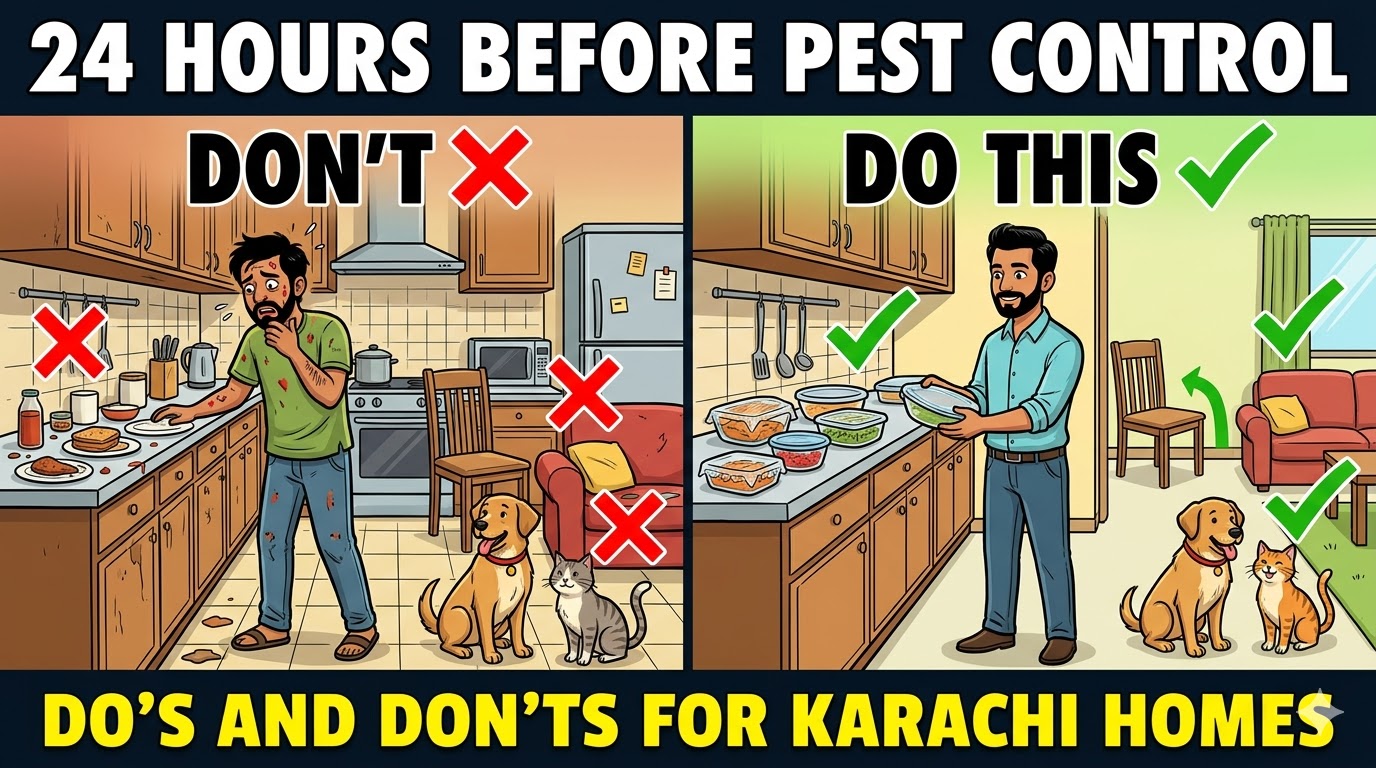
You have booked a pest control visit. The team is coming tomorrow. Now what?
Most Karachi homeowners assume their job ends at booking the appointment. But the preparation you do — or fail to do — in the 24 hours before a pest control visit directly determines how effective the treatment will be. It also determines how safe your family and your home will be during and after the process.
This guide walks you through everything you must do, everything you must avoid, and the specific Karachi-context factors that make preparation here different from what you might read in a generic online checklist.
Why Pre-Treatment Preparation Matters More Than Most People Realise
Here is the reality that many pest control companies do not emphasise enough: if your home is not properly prepared before fumigation or pest control spraying, the treatment will underperform. Clutter blocks chemical access to pest hiding spots. Uncovered food becomes a contamination hazard. Sealed entry points prevent proper aeration. And a poorly prepared home often means the infestation returns faster, costing you more money and more stress.
Preparation is your investment in making the treatment work. Think of it as doing your part so the professionals can do theirs.
The 24-Hour Do List: What You Must Do Before the Visit
1. Clear and Clean All Kitchen Surfaces
The kitchen is ground zero for most pest infestations in Karachi homes — cockroaches in particular thrive in kitchen cabinets, behind appliances, and under sinks. For the treatment to reach these areas effectively:
- Remove everything from kitchen countertops and lower cabinets
- Clear out underneath the sink completely — this is one of the most common cockroach harbourage zones
- Pull appliances away from walls where possible — refrigerators, washing machines, and stoves should have at least a few inches of clearance
- Remove everything stored on the floor of kitchen cabinets
- Wipe down cabinet interiors to remove food debris that could compete with chemical baits
2. Store All Food Safely
This step is non-negotiable for both effectiveness and safety. All food must be out of harm’s way before any chemical treatment takes place.
- Place all open food items — including flour, rice, spices, and snacks — in sealed containers or plastic bags
- Move sealed containers to an area that will not be treated, or store them in a sealed box
- Baby food, formula, and any items used by infants must be completely removed from the premises
- Do not forget pet food and animal water bowls — remove or seal these as well
- In Karachi’s heat, food left out in improperly sealed containers can also attract pests, so proper food storage is good practice year-round
3. Cover or Relocate Water Storage
This is one of the most Karachi-specific preparations on this list. Many households have rooftop tanks, ground-level storage tanks, or large containers for drinking water storage — particularly in areas with irregular KWSB supply such as parts of Orangi, North Karachi, and Korangi.
- Ensure all water storage containers have tight-fitting lids or are sealed with plastic wrap
- Cover overhead tanks if any roof access points are near treatment areas
- Empty and flip water vessels that are not in use, preventing both contamination and post-treatment mosquito breeding
- If you have water purification equipment (RO filters), cover inlet points
4. Remove or Cover Aquariums and Relocate Pets and Birds
- Fish tanks must be covered with plastic sheeting and the air pump must be switched off before any fogging or spraying occurs — chemicals can enter through the air supply
- Birds must be physically moved to a location away from the treatment area — a neighbour’s home, a car with windows up, or another part of the building that will not be treated
- Cats and dogs should be moved outside or to a separate location for the duration of the treatment plus the recommended re-entry period
- Small caged animals (rabbits, hamsters, guinea pigs) are extremely sensitive and must be relocated
5. Clear Clutter from Floors and Baseboards
Pest control technicians need clear access to baseboards, wall corners, and the spaces beneath furniture — these are the highways and harbourage zones for most urban pests in Karachi homes.
- Pick up clothes, bags, shoes, and boxes from floor level
- Move children’s toys away from walls and off the floor
- Shift furniture slightly away from walls to expose the baseboard and corner areas
- In bedrooms: clear under the bed and ensure the technician has access to all four walls
6. Empty and Clear Bathroom and Drainage Areas
Cockroaches and other pests often use drainage pipes and damp bathroom areas as entry points — especially in Karachi’s older buildings where pipe sealing is poor.
- Remove bath items, soap dishes, and toiletries from the floor
- Clear under the bathroom sink
- If requested by your pest control team, pour water down all floor drains to create a water seal (prevents chemical back-draft)
7. Arrange Alternative Accommodation for Your Family
For most standard spray treatments, you will need to vacate for 2–6 hours. For more intensive treatments (fogging or structural fumigation), you may need to stay away for up to 24 hours or longer. Plan this in advance:
- Arrange to stay with a family member, friend, or neighbour
- In a pinch, a local cafe or mall in DHA, Clifton, or Gulshan-e-Iqbal can serve as a waiting area for shorter treatments
- Have a bag packed with essentials: medications, children’s items, phone chargers
- Make arrangements for school-aged children — do not plan the treatment on a day when kids will be returning from school mid-treatment
8. Inform Household Staff
Many Karachi households have domestic staff — bais, drivers, or security guards. Ensure:
- All domestic workers are informed of the treatment and are not present in the home during the process
- If the guard or driver will remain on the property, they should stay in the outdoor compound or vehicle — not inside the home
- The building chowkidar or security should be informed if fumigation will affect common areas
9. Identify and Mark Problem Areas for the Technician
The more specific information you can give your pest control team, the better targeted the treatment will be. Walk through your home mentally and note:
- Where you have seen the most cockroach activity (inside cabinets, behind stove, etc.)
- Any confirmed or suspected termite damage (wooden window frames, skirting boards, furniture legs)
- Areas of damp or water seepage — particularly relevant in Karachi homes during and after monsoon
- Previous pest activity zones that may have been treated before
Share this information with the technician when they arrive. It helps them prioritise and ensures no area is missed.
10. Remove Plants from Treatment Areas
Many pest control chemicals are harmful to plants. Indoor plants and potted plants on balconies or near windows that will be treated should be moved out of the spray zone. If you have a rooftop garden, inform the technician in advance.
The 24-Hour Don’t List: What You Must Avoid Before the Visit
Do Not Spray Your Own Insecticides the Night Before
This is a very common mistake in Karachi homes. Homeowners use local mosquito sprays or hit-type aerosols the night before a professional visit, thinking it will give the treatment a head start. It does the opposite.
When pests are exposed to one chemical before a professional treatment, they can become temporarily sensitised or alert — causing them to avoid treated areas. Some DIY sprays also interact poorly with professional chemicals. Let the professionals do their work on a clean slate.
Do Not Mop with Strongly Scented Floor Cleaners
Bleach, pine oil, and strongly scented floor cleaners used just before treatment can mask chemical trails and disrupt the attractant properties of gel baits. If you want to clean the floors, use plain water. Avoid scented or chemical-heavy floor cleaners for at least 24 hours before the visit.
Do Not Seal or Caulk Potential Entry Points the Day Before
It sounds counterintuitive, but sealing entry points — gaps in skirting, cracks in walls, pipe penetrations — immediately before a treatment can trap pests inside, making the infestation harder to resolve. Entry point sealing is best done after treatment, as part of a longer-term prevention strategy.
Do Not Leave Standing Water
Especially during Karachi’s monsoon season (July–September), standing water in coolers, buckets, and plant trays around the home creates mosquito breeding zones that can re-infest a freshly treated property within days. Drain or cover all standing water before the visit.
Do Not Cook or Leave Food Out
Cooking smells and uncovered food attract pests actively. If pest control is scheduled for the morning, avoid cooking the night before and leaving any food residue out. A clean, food-odour-free kitchen makes the bait treatments more effective.
Do Not Forget the Store Room, Garage, or Back Passage
Karachi homes with a store room (qila), utility passage, or attached garage often treat these as afterthoughts. These spaces are frequently the primary harbourage zones — especially for rats, termites, and cockroaches. Do not clean them up minimally. Give them the same level of clearance as your main living areas.
Room-by-Room Preparation Checklist
Use this as a final walk-through checklist the evening before your scheduled visit:
Kitchen
- All food removed from countertops and lower cabinets
- Under-sink area cleared completely
- Appliances pulled away from walls
- All pet food and bowls removed
Bedrooms
- Floors cleared of clutter, clothing, and shoes
- Furniture pulled slightly away from walls
- Bed linens that will not be washed can be covered temporarily
Bathrooms
- Floor cleared of personal items
- Under-sink cleared
- Drains have water in P-trap
Living Areas
- Sofas and chairs moved slightly from walls
- Books and items removed from low shelves
- Children’s toys collected and stored in a sealed bag or box
Rooftop / Utility Areas
- Water tanks sealed or covered
- Standing water drained or covered
- Any loose items near treated areas stored away
Preparing Your Building Neighbours (If Applicable)
If you live in a multi-floor apartment building in an area like Defence, Clifton, or Gulshan-e-Iqbal, pest control in your unit alone may have limited long-term effectiveness. Cockroaches and rodents move between units through shared walls, drainage, and service passages.
Consider informing your neighbours and building management that you are having your home treated. A coordinated building-wide approach produces far better results than isolated treatments. Some of Karachi’s better-managed apartment complexes now arrange annual pest control for the entire building — worth raising with your building management committee if you are on one.
Communicating with Your Pest Control Team
Good preparation also means good communication. When you book with a professional pest control company in Karachi, confirm the following details in advance:
- Exactly which areas of your home will be treated
- The specific chemicals to be used (ask for names or active ingredients)
- The recommended re-entry time for your specific household (with children, pets, elderly, etc.)
- Whether food and water should be removed or if sealed storage is sufficient
- What post-treatment cleaning is necessary
A professional company will walk you through all of this without hesitation. If they cannot or will not, find a different provider.
Why Preparation Is the Difference Between One Treatment and Many
In Karachi’s residential pest environment — dense housing, persistent heat, seasonal moisture, and older building stock in many neighbourhoods — pest infestations are tenacious. A poorly prepared home leads to an ineffective treatment, which leads to a recurring infestation, which leads to more treatments and more expense.
Doing your preparation properly the first time is the most cost-effective and safest approach. It means the treatment reaches every hiding spot, the chemicals are not competing with food odours or cleaning products, and your family returns to a home that has been genuinely cleared rather than superficially sprayed.
Book Your Professional Pest Control Visit Today
Ready to finally deal with that cockroach problem in your kitchen, the termite damage in your wooden doors, or the mosquitoes that have taken over your drawing room? Our team will come to your home, carry out a thorough inspection, and walk you through exactly what preparation is needed for your specific situation.
We do not give vague instructions and leave you guessing. We tell you precisely what to do, exactly when to do it, and we make sure the treatment is as effective as possible — for the long term, not just for a week.
Book your free inspection today and take the first step toward a pest-free Karachi home.

Ahmad Karimi is a PPMA-registered pest management specialist and the lead technical consultant at Karachi Fumigation Services, where he has overseen field operations and treatment protocols since 2005. With over 20 years of hands-on experience treating residential, commercial, and industrial properties across Karachi — from DHA bungalows with structural termite infestations to Korangi factories requiring large-scale rodent exclusion — he brings direct field knowledge to every article published on this blog.
Ahmad has managed pest control programs for clients including Descon Engineering, Pakistan Tobacco Company, Saylani Welfare, and J. (Junaid Jamshed), and has issued hundreds of fumigation certificates for health authority compliance, import/export, and commercial licensing purposes. He holds active PPMA membership and works exclusively with WHO-approved chemicals in all field operations.
The content on this blog draws directly from two decades of Karachi-specific infestation data — seasonal pest patterns, neighbourhood-level risk factors, building-age vulnerabilities, and the regulatory requirements that Karachi businesses actually face. No recycled content from foreign pest control sites. Every article reflects conditions specific to Karachi’s climate, infrastructure, and compliance environment.
For treatment enquiries or technical questions, Ahmad’s team can be reached at 03463303875 or via the office at Trade Tower, Civil Lines, Karachi.
Leave a Reply