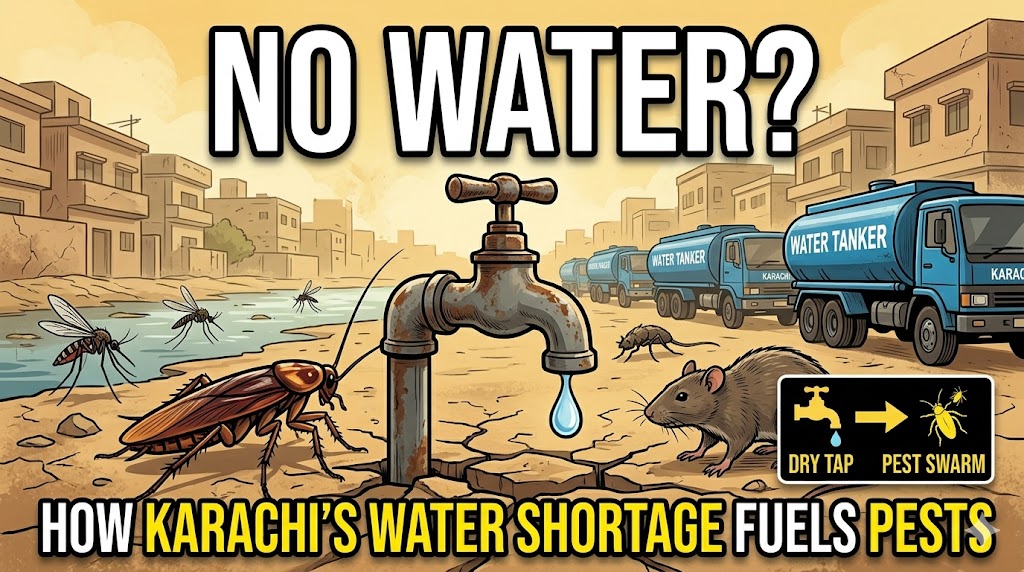
Karachi gets water on a schedule, not on demand. Depending on where you live — whether it’s a bungalow in Gulshan-e-Iqbal, a flat in North Karachi, or a house in Orangi Town — you might get KWSB supply for a few hours every other day, or you might go days without any municipal supply at all. So you do what every Karachi resident does: you store water. Underground tanks, rooftop tanks, large plastic drums in bathrooms, barrels in kitchens, overhead taps left running into buckets — water storage is not optional, it’s survival infrastructure.
But every container of stored water, every leaking pipe, every damp wall near a tank overflow, every puddle that accumulates in a bathroom corner or a rooftop drain — these are pest infrastructure too. Karachi’s water crisis and Karachi’s pest crisis are not separate problems. They are the same problem viewed from two different angles. And until you understand the connection between them, any pest control effort in this city is addressing symptoms rather than causes.
This post breaks down exactly how water storage practices in Karachi create, sustain, and amplify pest infestations — and what you can do to break that cycle without abandoning the water storage you depend on.
The Core Problem: Still Water Is Pest Infrastructure
Pests don’t need much water. But they need some — and in a city where most households maintain multiple water storage points, that water is everywhere.
The most direct impact is on mosquitoes. Aedes aegypti, the mosquito responsible for dengue — which Karachi deals with every monsoon season with grim predictability — breeds exclusively in still, clean water. Not dirty water. Not drains. Clean water that’s been sitting for more than three to four days. The rooftop tank with the cracked lid. The water drum in the bathroom that never fully empties before being refilled. The plastic bucket left under a dripping tap. These are dengue mosquito nurseries, and they’re present in almost every residential property in Karachi.
Beyond mosquitoes, standing water creates conditions that support the full spectrum of urban pests:
- Cockroaches require access to water to survive — they can go a month without food but only a week without moisture. Kitchens and bathrooms with persistent dampness from tank overflow, pipe drips, or wet storage areas keep cockroach populations alive and breeding year-round.
- Rats and mice are attracted to water sources and will establish routes to whatever water is consistently accessible. Underground tank access points, rooftop tank areas, and any part of your home where water regularly pools become rodent territory.
- Termites are drawn to moisture-damaged wood. Walls adjacent to leaking tanks, rooftop slabs with poor waterproofing, and areas with chronic seepage all create the soft, damp wood that subterranean termites exploit.
- Silverfish require ambient humidity above 75% — conditions easily created and sustained by the combination of water storage and Karachi’s natural humidity, particularly during monsoon months.
The relationship is circular: the water shortage forces storage; storage creates moisture points; moisture points sustain pests; pests cause damage that compounds housing problems; and the infrastructure that creates those moisture points — aging pipes, cracked tanks, poor rooftop drainage — rarely gets properly fixed because maintenance is deprioritised in a city managing too many crises at once.
Underground Tanks: The Pest Problem You Can’t See
Underground water tanks are standard infrastructure in the vast majority of Karachi properties. They range from properly constructed concrete tanks to improvised fibreglass or plastic containers buried in courtyards and under parking slabs. The problem is what surrounds them.
Every underground tank has entry points — the fill pipe, the motor pump connection, the vent, the access hatch. In older or poorly constructed installations, these entry points are gaps in disguise. Rats regularly access underground tanks through damaged access hatches or through the same conduits used by supply pipes. Cockroaches navigate water pipe channels between floors and walls as internal highways. And the soil around a leaking underground tank becomes permanently damp, creating ideal conditions for subterranean termite colonies to expand toward the structure above it.
There’s also the overflow pipe. When a tank fills and the float valve fails — extremely common in aging installations — water overflows, typically into a drain that may not be properly sealed or may discharge adjacent to the building’s foundation. Chronic foundation moisture from tank overflow is one of the most common and least discussed contributors to both termite activity and rodent burrowing in Karachi residential properties.
Professional water tank cleaning and maintenance addresses not just water quality but the structural integrity of the tank installation — lids, seals, pipe connections, and overflow management. If your underground tank hasn’t been properly inspected and cleaned in the past year, it is probably contributing to your pest problem in ways you can’t see.
Rooftop Tanks and the Mosquito Problem
Rooftop water tanks are even more problematic from a mosquito breeding standpoint. They sit in open air, exposed to the heat that accelerates water warming — which speeds up mosquito larvae development — and they’re typically inspected less frequently than underground tanks because access is inconvenient.
The issues that turn rooftop tanks into mosquito breeding grounds are consistent across Karachi:
- Damaged or missing lids. Even a small gap is sufficient for Aedes mosquitoes to enter and lay eggs on the water surface.
- Inadequate sealing of inlet and outlet pipes. Gaps around pipe connections are entry points for both mosquitoes and airborne debris that accumulates into organic matter on which mosquito larvae feed.
- Overflow onto the rooftop slab. When tanks overflow, water pools on rooftop surfaces — particularly in areas with poor drainage or blocked drains. Rooftop puddles that persist for more than four days are active mosquito nurseries.
- Cracked or damaged tank walls. Hairline cracks in older cement or fibreglass tanks allow seepage into the roof slab, creating chronic moisture that damages the structure and supports cockroach and silverfish populations in the ceiling space below.
During monsoon season, rooftop water management becomes critical. Standing water from rain accumulation combines with tank overflow to create the conditions that drive Karachi’s annual dengue surge. Professional mosquito control treatment before and during monsoon season is one of the highest-value interventions a Karachi household can make — but it must be combined with addressing the water sources that sustain mosquito breeding, or the treatment effect will be temporary.
Bathroom Drums and In-Home Water Storage
Walk into any bathroom in a Karachi home that has unreliable water supply — which is most of them — and you’ll find at least one large plastic drum, barrel, or multiple buckets used as water storage. This is not a problem in itself. The problem is management.
Drums and large containers that aren’t sealed between uses accumulate standing water that warms to ambient temperature, which in Karachi can reach 35°C or higher in summer. At these temperatures, mosquito eggs hatch within 24 hours and larvae reach the pupal stage in as little as five to seven days. A bathroom drum that’s refilled but never fully emptied and cleaned will cycle through several mosquito generations before anyone notices.
Additionally:
- Water that spills or drips around drum storage points creates persistently damp floor areas that cockroaches exploit for moisture access
- The space behind or under large drums — rarely cleaned — accumulates organic matter and provides cockroach harborage
- High bathroom humidity sustained by large water storage volumes keeps conditions permanently favourable for silverfish
The practical fix: Use drums with secure lids. Empty and scrub drums at least twice a week — not just refill them. Don’t let water sit in open containers for more than three days. Keep the area around water storage points clean and dry.
How Dampness Spreads Through the Building
Water doesn’t stay where you put it in Karachi’s aging building stock. Leaking tank installations, overflowing drainage, and poorly waterproofed roof slabs mean that moisture migrates — through walls, down concrete columns, across slab junctions — in ways that aren’t always visible until damage is already significant.
This moisture migration is how a rooftop tank problem becomes a third-floor ceiling problem, and how a first-floor apartment ends up with termite activity originating from a ground-level moisture source. Pest infestations in shared buildings in Karachi rarely have a single-apartment origin — they have building-wide moisture patterns that sustain them across multiple units.
This is relevant to pest control because:
- Termites follow moisture trails through concrete and masonry, not just wood. A termite treatment in an apartment that doesn’t address the moisture source driving the colony’s movement will fail to provide lasting protection.
- Cockroaches use internal pipe runs and wall voids as migration corridors — a cockroach control treatment in one unit of a building will be undermined by ongoing migration from adjacent units if building-wide conditions aren’t addressed.
- Rodents access multiple floors through pipe chases that often run adjacent to water line installations. Rodent control in a building context requires understanding these movement patterns, not just baiting individual apartments.
In multi-unit buildings, the most effective pest management is building-wide. If you’re a building manager or landlord managing a residential or commercial property in Karachi, commercial fumigation services that address the entire building are significantly more effective than individual tenant treatments that leave moisture corridors and pest highways intact.
What You Can Actually Control
You can’t fix Karachi’s water supply. You can’t waterproof a building you don’t own. But you can control the conditions within your property that turn a water shortage into a pest problem. Here’s what makes a measurable difference:
- Inspect and fix your tank installation. Get your underground and rooftop tanks professionally cleaned and inspected. Replace cracked lids, seal pipe connections, repair overflow management. This is not optional maintenance — it is directly connected to your pest situation.
- Eliminate standing water weekly. Check every surface in your property — rooftop, courtyard, balcony, bathroom floor, under sinks — for standing water and eliminate it. If drainage is the problem, fix the drainage.
- Seal pipe penetrations. Every gap around a pipe where it enters a wall is a pest entry point sustained by the moisture conditions around the pipe itself. Foam sealant is cheap and effective.
- Repair wall and ceiling dampness promptly. A damp patch on a wall is not just an aesthetic problem. It is a termite attractant, a cockroach moisture source, and a silverfish habitat. Get seepage fixed at source, not plastered over.
- Schedule pre-monsoon mosquito treatment. Before the rains arrive — ideally in May or June — treat your property for mosquitoes. Combine this with a tank inspection and cleaning so you’re addressing both the breeding grounds and the adult population simultaneously.
The Bottom Line: Fix the Water, Fix the Pests
Pest control in Karachi that doesn’t address water management is a temporary fix. The cockroaches will come back. The mosquitoes will breed again. The rodents will return to their water source. And you’ll be paying for treatments repeatedly rather than solving the underlying problem.
The most effective approach is integrated: professional pest treatment combined with water infrastructure maintenance and the physical sealing and drainage fixes that break the moisture cycle sustaining the infestation. That’s not more expensive than repeated treatments — it’s considerably less expensive over time, and it actually works.
Start with a professional water tank cleaning to eliminate the primary mosquito breeding ground and address tank installation issues. Add targeted mosquito control treatment for the property, particularly before monsoon. Have a pest assessment done through Karachi Fumigation Services to identify which pests are active and which moisture conditions are sustaining them. Then deal with both simultaneously.
Get a Pest Assessment That Accounts for Your Water Situation
Most pest control companies in Karachi treat symptoms. A proper assessment connects your specific water storage setup, your building’s moisture patterns, and your pest activity into a single picture — and treats the cause, not just the effect.
Request a free quote from Karachi Fumigation Services and tell them about your water storage setup and any moisture issues you’re aware of in the property. Check whether your neighbourhood is covered on the areas page, and book an inspection before the next monsoon season makes your current pest situation significantly worse.

Ahmad Karimi is a PPMA-registered pest management specialist and the lead technical consultant at Karachi Fumigation Services, where he has overseen field operations and treatment protocols since 2005. With over 20 years of hands-on experience treating residential, commercial, and industrial properties across Karachi — from DHA bungalows with structural termite infestations to Korangi factories requiring large-scale rodent exclusion — he brings direct field knowledge to every article published on this blog.
Ahmad has managed pest control programs for clients including Descon Engineering, Pakistan Tobacco Company, Saylani Welfare, and J. (Junaid Jamshed), and has issued hundreds of fumigation certificates for health authority compliance, import/export, and commercial licensing purposes. He holds active PPMA membership and works exclusively with WHO-approved chemicals in all field operations.
The content on this blog draws directly from two decades of Karachi-specific infestation data — seasonal pest patterns, neighbourhood-level risk factors, building-age vulnerabilities, and the regulatory requirements that Karachi businesses actually face. No recycled content from foreign pest control sites. Every article reflects conditions specific to Karachi’s climate, infrastructure, and compliance environment.
For treatment enquiries or technical questions, Ahmad’s team can be reached at 03463303875 or via the office at Trade Tower, Civil Lines, Karachi.