Author: Ahmad Karimi

  • What Happens If You Ignore a Termite Infestation in Your Karachi Home for 6 Months?

    What Happens If You Ignore a Termite Infestation in Your Karachi Home for 6 Months?

    You noticed a few discarded wings near the window last month. There might be a small mud tube behind the cupboard — or it could just be dirt. The walls look fine. Nothing is broken. Surely it can wait.

    This is the reasoning that costs Karachi homeowners hundreds of thousands of rupees every year.

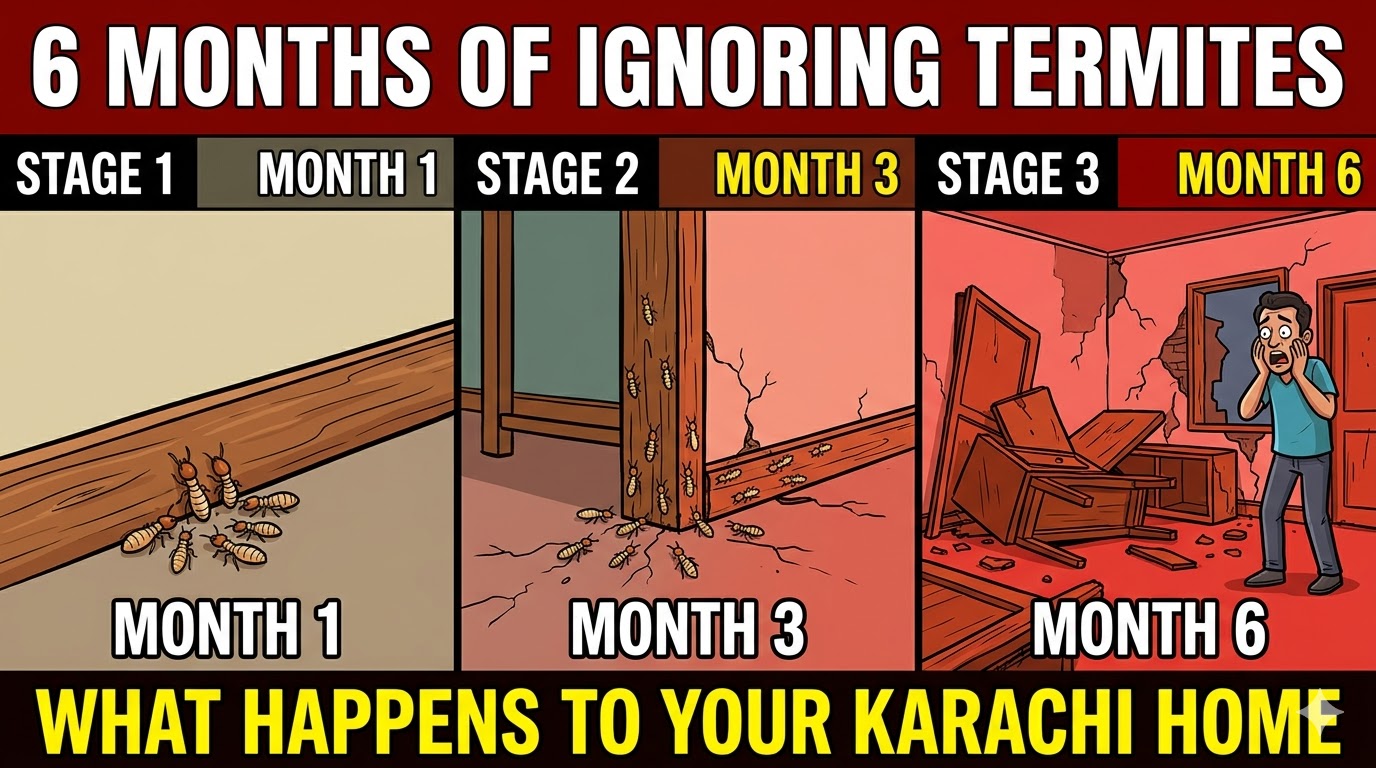
    A six-month delay in treating an active termite infestation is not a minor risk — it is a major one. In Karachi’s warm, humid climate, termite colonies grow aggressively. What looks manageable today can become structurally catastrophic within half a year. This article walks you through exactly what happens — month by month — when a termite infestation is left untreated, and what the real-world consequences look like for homeowners in this city.

    First, Understand What You Are Dealing With

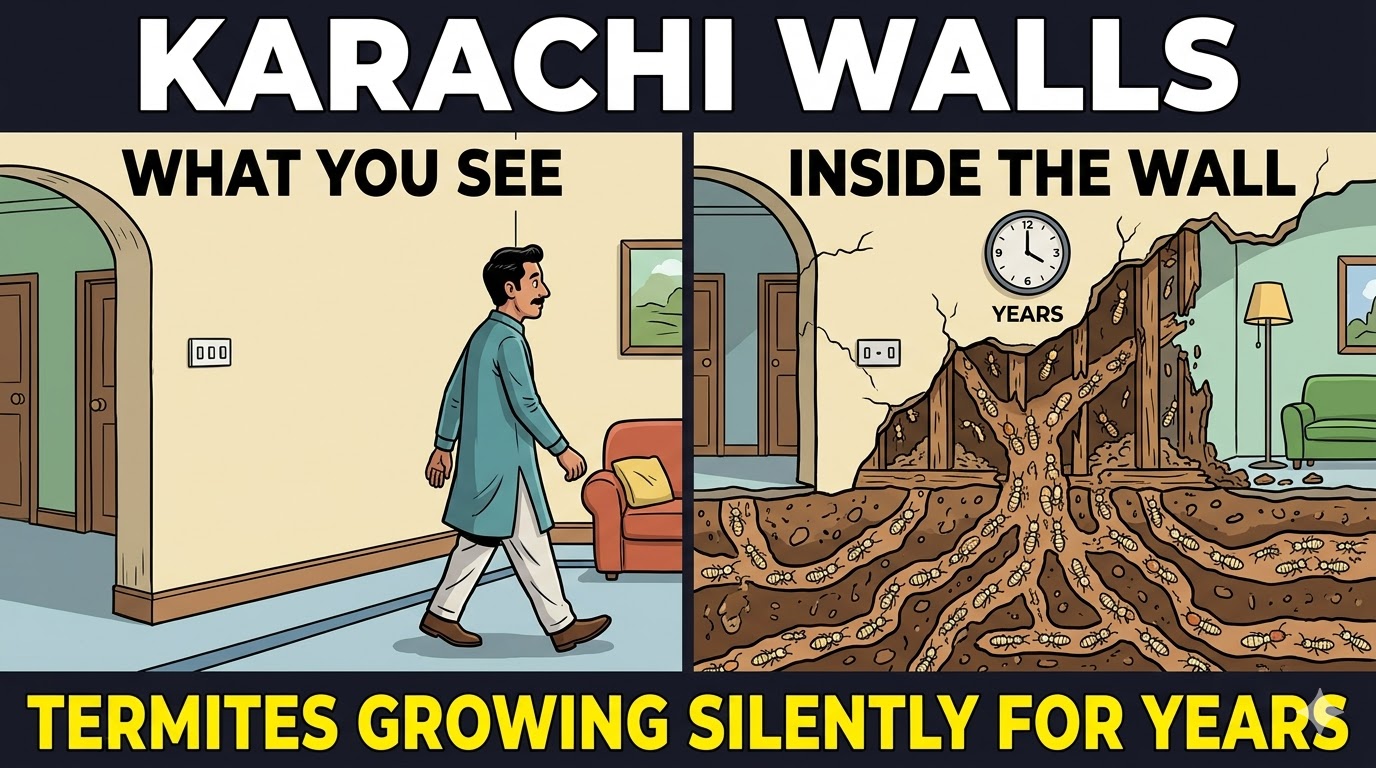
    When a Karachi homeowner first notices signs of termite activity — mud tubes, wing litter, hollow-sounding walls — the infestation is almost never new. As explained in detail in our guide on how termite colonies grow silently inside Karachi walls, by the time any visible sign appears, the colony has typically been established for two to four years and contains hundreds of thousands of individuals.

    What you are seeing is not the beginning of the problem — it is the problem announcing itself after years of quiet growth. And once it announces itself, the pace of visible damage accelerates significantly.

    Month-by-Month: What a 6-Month Delay Actually Looks Like

    Month 1 — Signs Are Present, Damage Is Contained

    You notice the first signs — perhaps mud tubes or a slightly soft spot on a door frame. The structural damage at this point is localised. Treatment would be relatively straightforward: injection of termiticide into affected areas, barrier treatment around the foundation, and monitoring stations. Repair cost estimate: minor — perhaps Rs. 5,000 to Rs. 20,000 for carpentry.

    Month 2 — The Colony Doubles Its Foraging Activity

    With no treatment interrupting their foraging, workers continue to expand their tunnel network. In Karachi’s warm temperatures, termite metabolic activity stays high year-round. By month two, what began as a single door frame infestation has typically spread to the adjacent wall cavity and, in many cases, to the skirting boards of the connected room.

    Month 3 — False Ceiling and Vertical Spread

    By the third month, a well-established colony will have extended its tunnels upward through wall cavities. In homes with POP false ceilings — extremely common in DHA, Clifton, and Gulshan — termites reach the wooden battens and metal framework that support the ceiling. The hollowing of ceiling elements begins. You may start to notice small cracks in plaster or slightly discoloured patches on the ceiling surface.

    Month 4 — Kitchen Cabinets, Built-In Wardrobes, and Furniture

    Fitted furniture that backs against affected walls is now under direct attack. In Karachi homes, this typically means kitchen cabinets, built-in wardrobes in bedrooms, and shelving units. The internal chipboard and MDF used in most fitted furniture is especially vulnerable — termites consume it far faster than solid timber. By month four, entire cabinet sections may be structurally compromised even while the outer surface appears intact.

    Month 5 — Structural Door and Window Frames Fail

    Door frames and window frames that were partially affected in month one are now severely compromised. In older Karachi homes where frames were set directly into the wall without a protective cavity, the wood behind the plaster may be almost entirely consumed. Doors begin to sag. Windows become difficult to open or close. In some cases, frames crack or collapse under normal use.

    Month 6 — Electrical Hazards, Ceiling Risk, and Structural Damage

    At the six-month mark, the infestation has typically spread to multiple rooms and multiple structural elements. However, the greatest risks at this stage are less visible:

    • Electrical conduits inside walls are often built with plastic casing. Termites, in their tunnelling, can breach PVC conduit and chew through cable insulation. This creates a genuine fire and electrocution risk.
    • False ceilings supported by compromised wooden battens can partially collapse under their own weight or during minor movement.
    • Load-bearing wooden elements in older properties — lintels, roof joists, and stair stringers — may have lost significant structural integrity.

    The Cost of Delay: A Real-World Comparison

    The following comparison illustrates the typical cost difference between treating an infestation promptly versus delaying by six months, based on professional assessments in Karachi residential properties:

    Damage CategoryTreated Promptly (Month 1)Treated After 6 Months
    Termite treatment costRs. 8,000 – 25,000Rs. 25,000 – 60,000+
    Door/window frame replacement1–2 frames4–8+ frames
    Cabinet/furniture repairMinor or noneFull replacement likely
    False ceiling repairNonePartial or full replacement
    Electrical inspection needed?NoOften yes
    Structural engineer assessment?NoPossibly yes
    Estimated total repair costRs. 20,000 – 50,000Rs. 150,000 – 500,000+

    The Hidden Costs Beyond Repair Bills

    Property Value Reduction

    In Karachi’s property market, a disclosed termite infestation or visible termite damage can reduce the resale or rental value of a property by 10% to 30%. In high-demand areas like DHA and Clifton, where buyers conduct pre-purchase inspections, untreated or poorly treated termite damage is a significant red flag. Many property transactions in Karachi have collapsed at the final stage because of termite issues discovered during inspection.

    Disruption and Displacement

    Extensive termite damage often requires significant renovation work — replastering walls, replacing ceilings, reinstalling cabinets, and repainting entire rooms. In severe cases, families are displaced for days or weeks during repair work. The inconvenience, stress, and associated costs of temporary accommodation add significantly to the total impact.

    Health and Safety Risks

    Beyond structural concerns, severely infested homes carry secondary health and safety risks. Damaged electrical wiring increases fire risk. Collapsing false ceiling elements can cause injury. Moisture damage associated with extensive termite activity creates conditions favourable to mould growth, which carries its own respiratory health implications — particularly relevant for children and the elderly.

    Why Karachi Homeowners Delay — and Why Those Reasons Are Costly

    Having worked with hundreds of Karachi homeowners, we consistently hear the same reasons for delayed action:

    “It does not look that bad.”Termites are designed to look invisible. By the time it looks bad, it is already serious.

    “I will get it treated after Eid / after the summer / after the rains.”Termites are not waiting for a convenient time. In Karachi’s warm climate, colony growth is year-round.

    “I will try a spray from the hardware store first.”Over-the-counter sprays kill surface termites but do not penetrate walls or reach the colony. They often cause the colony to split and spread more widely — a phenomenon called “budding”.

    “The cost seems high.”Professional treatment costs a fraction of the repair bills that follow six months of inaction. The table above illustrates this clearly.

    What Effective Treatment Actually Involves

    Many homeowners imagine termite treatment as a simple spray-down. Professional treatment is considerably more comprehensive — and that comprehensiveness is what makes it effective.

    A qualified termite control service in Karachi typically includes:

    • Full site inspection to map infestation extent and identify all active tunnels, entry points, and affected structural elements
    • Soil treatment around the external perimeter using professional-grade termiticide to create a chemical barrier that kills foraging termites and disrupts the colony
    • Targeted injection of termiticide into internal wall cavities and affected structural timbers
    • Bait station installation to monitor for new activity and deliver slow-acting termiticide back to the colony
    • Post-treatment report and a scheduled follow-up inspection

    Treatment duration and complexity increase significantly with infestation size. A treatment that takes one day for a contained early-stage infestation may require two to three days for a property with six months of unchecked damage.

    A Note on Karachi’s Monsoon Season

    The period between June and September — Karachi’s monsoon season — is when termite swarming activity peaks. Alates emerge from established colonies and attempt to found new ones. Homeowners across Karachi report seeing winged insects around light sources in large numbers during and after monsoon rains.

    If you see this happening in your home this monsoon and choose to delay action until “after the rains settle down”, you are giving an already large colony several additional months of optimal growth conditions. Post-monsoon is also the season when we receive the largest volume of calls from homeowners who wish they had called six months earlier.

    Frequently Asked Questions

    Can I treat a severe infestation myself?

    No. DIY products available in Karachi’s hardware markets are not formulated for structural termite treatment. They do not penetrate wall cavities, do not carry the active ingredient back to the colony, and do not provide any lasting barrier. In some cases, improper DIY treatment causes colony splitting, which spreads the infestation to new areas.

    How long does professional treatment take for a severe infestation?

    Depending on property size and infestation extent, treatment for a severe infestation typically takes one to three days. Structural repairs — replacing frames, cabinets, and ceiling elements — take considerably longer and are separate from the treatment process.

    Can a severely infested home be fully treated?

    Yes. Professional termite treatment eliminates active colonies and prevents reinfestation through ongoing barrier and monitoring systems. The termites can always be treated — the question is how much structural damage needs to be repaired afterwards.

    Conclusion: Six Months Is a Very Long Time

    In Karachi’s climate, a six-month delay in treating an active termite infestation transforms a manageable problem into a major crisis. Contained damage becomes widespread structural compromise. Affordable treatment becomes expensive multi-room renovation. A simple inspection becomes an urgent structural assessment.

    The termites in your walls are not going to stop. They are not going to move on. They are going to eat — quietly, relentlessly, and invisibly — until they are stopped.

    The good news is that treatment is effective, available, and significantly cheaper than the alternative. But it requires action today — not next month.

    Do Not Give Termites Another Six Months
    If you have noticed any signs of termite activity — or if you simply have not had an inspection in over a year — now is the time to act. Our licensed team covers all of Karachi, including DHA, Clifton, Gulshan-e-Iqbal, PECHS, North Nazimabad, Bahria Town, and beyond.
    Book your free termite inspection with Karachi Fumigation Services today. We will assess your property, identify any active infestation, and give you a clear, honest report — with no obligation. The earlier we treat it, the less it costs you.

  • How Termite Colonies Silently Grow Inside Karachi Walls for Years Before You Notice

    How Termite Colonies Silently Grow Inside Karachi Walls for Years Before You Notice

    Most Karachi homeowners discover termites the hard way — a hand pressed against a wall suddenly sinks in, a wooden door frame crumbles at the touch, or a lick of paint peels back to reveal a hollow, honeycomb-like ruin beneath. By that point, termites have already been living in your home for years.

    This is the terrifying truth about termite infestations: the damage happens long before any visible sign appears. In Karachi’s climate — humid coastal air, clay-heavy soil, and temperatures that rarely dip below 20°C — subterranean termites find an almost perfect environment to build massive underground colonies and quietly consume everything in their path.

    In this article, we explain exactly how termite colonies establish, grow, and spread inside Karachi homes without triggering any alarm — and what you can do about it before the damage becomes irreversible.

    Understanding Termite Biology: Why They Are So Hard to Detect

    To understand why termites go unnoticed for so long, you need to understand how they live. The most destructive species in Karachi is the subterranean termite (Coptotermes gestroi and related species), and their entire biology is designed around staying hidden.

    A Colony Is a Living, Growing Organism

    A single termite colony can contain anywhere from 100,000 to over one million individual termites. However, a colony does not start that way. It begins with a single pair — one reproductive queen and one king — that settle into the soil, usually beneath or near a building’s foundation.

    In the first year, the queen lays only a handful of eggs per day. The colony at this stage is microscopic — a few dozen workers foraging cautiously within inches of the nest. No structural damage occurs. No signs appear. This is why even a professional cannot always detect a brand-new infestation.

    By Year 3 to 5, the queen’s egg production can reach thousands per day. The colony now has a fully organized caste system: workers (who eat your walls), soldiers (who defend the colony), and reproductives (who will eventually spread to new locations). The foraging range expands dramatically — up to 100 metres in every direction.

    They Never Surface — Unless Forced To

    Subterranean termites are photophobic — they actively avoid light and open air. Every tunnel they build is sealed with a mixture of soil, saliva, and faecal matter (called “carton”). When they penetrate walls, they hollow out the inside of wood and drywall while leaving the outer surface completely intact. This is why you can tap a wall for years and hear nothing wrong until the structure has been almost entirely consumed.

    Karachi’s Unique Conditions: A Termite’s Ideal Home

    Not every city in Pakistan faces the same level of termite risk. Karachi has several specific environmental and construction factors that make it one of the highest-risk cities in the country for termite infestation.

    Coastal Humidity and Clay Soil

    Karachi’s coastal location keeps humidity levels elevated for most of the year, particularly in areas like Clifton, DHA, Lyari, and Korangi. Termites need moisture to survive, and damp soil near foundations provides the perfect environment for underground colonies to thrive. Clay-heavy soil, common across much of Karachi’s older residential zones, retains moisture exceptionally well — acting almost like a natural termite nursery.

    Older Construction and RCC Slab Buildings

    Much of Karachi’s residential housing stock — particularly in areas like PECHS, North Nazimabad, Gulshan-e-Iqbal, and Nazimabad — was built between the 1960s and 1990s using construction methods that offer little termite resistance. Exposed wooden joinery, inadequate chemical pre-treatment of foundations, and the use of low-density timber in doors, windows, and ceiling frames have left an entire generation of homes vulnerable.

    Even newer constructions in DHA Phases 7 and 8, Bahria Town, and Scheme 33 are at risk if pre-construction anti-termite soil treatment was skipped or applied inadequately — which, according to professionals, happens more often than homeowners realise.

    Plumbing Leaks and Ground-Floor Vulnerability

    Dripping pipes, slow drainage, and bathroom seepage create moisture hotspots inside walls. Termites detect these wet zones and use them as entry points. Ground-floor apartments and bungalows are especially at risk, but termites in Karachi are regularly found on upper floors as well — travelling through pipe ducts, electrical conduit paths, and party walls shared between units.

    The Silent Timeline: How a Colony Grows Inside Your Walls Year by Year

    Here is a realistic breakdown of what happens inside a Karachi home during a typical termite infestation:

    Year 1: Establishment Below Ground

    A queen and king termite — called “alates” — land near your home after a monsoon swarm, shed their wings, and burrow into soil near the foundation. The nest is established 30 to 60 cm below ground. No signs are visible. The colony has fewer than 1,000 members.

    Year 2: Probing the Foundation

    Workers begin extending foraging tunnels, reaching foundation walls. If there are any cracks, gaps around plumbing pipes, or poorly sealed expansion joints, workers enter the structure. They begin feeding on concealed timber elements — skirting boards, door frames, and sub-floor timbers if present. Still no external evidence. Colony size: 5,000 to 30,000.

    Year 3 to 4: Active Wall Infestation

    Termites build mud tubes along the inner surface of walls and begin hollowing out wooden elements systematically. In homes with false ceilings, they travel upward to wooden battens and POP framing. In older homes, they consume door architraves, window frames, and kitchen cabinetry. The outer paint or plaster remains intact. Colony size: 100,000 to 500,000.

    Year 5 and Beyond: Reproductive Expansion

    The colony produces winged reproductives (swarmers) that emerge — usually after the first monsoon rains — to establish new colonies nearby. Homeowners often see small, winged insects near light sources and mistake them for flying ants. This is the first visible sign most people notice, and by this point, the primary colony is enormous and the structural damage is already severe.

    The Warning Signs You Should Know — and Why Most Homeowners Miss Them

    Termites do leave signs, but these signs are subtle and easy to misinterpret without training. Here is what to look for:

    • Mud tubes on walls or near the base of walls: These pencil-thin brown tubes are how termites travel above ground. Check exterior and interior walls at ground level, especially in storage rooms, utility areas, and behind furniture.
    • Hollow sound when tapping wood: Use your knuckle to tap along door frames, skirting boards, and kitchen cabinets. A hollow, papery sound suggests the interior has been eaten away.
    • Bubbling or uneven paint: Paint that bubbles, blisters, or appears to have moisture beneath it on an interior wall can indicate termites building carton material just under the surface.
    • Discarded wings near window sills or light fixtures: Swarmers shed their wings immediately after landing. Small piles of translucent wings — often mistaken for insect litter — are a major warning sign.
    • Tight-fitting doors and windows: Termite activity generates heat and moisture that warps timber. If doors or windows that previously opened smoothly have become stiff or warped, this may be an early structural indicator.
    • Frass (termite droppings): Dry-wood termites push their droppings out of small holes. These look like tiny, hexagonal pellets or sawdust and appear near infested wood.

    The challenge is that in a busy Karachi household, these signs are often overlooked, attributed to moisture, or simply cleaned up without investigation. By the time homeowners grow concerned enough to call a professional, the infestation has typically been active for three to five years.

    What Areas of Your Home Are at Greatest Risk?

    Termites do not attack randomly — they follow moisture, wood, and structural gaps. The highest-risk areas in a typical Karachi home include:

    • Ground-floor walls adjacent to soil: Any wall that sits directly on or near the ground, especially in older homes without a damp-proof course (DPC), is highly vulnerable.
    • Bathroom and kitchen walls: Pipe leaks and condensation create sustained moisture that attracts termites into wall cavities.
    • Wooden door and window frames: These are often the first structural elements attacked, particularly in homes with solid wood frames.
    • False ceilings and POP work: Widely installed across DHA and Gulshan properties, false ceilings with wooden battens provide an ideal concealed environment for termites to spread horizontally across an entire floor.
    • Under stairs and inside storage cupboards: Dark, rarely disturbed spaces with contact to walls are prime infestation zones.
    • Behind fitted kitchen cabinets: Particularly in older kitchens where cabinets sit against external or ground-adjacent walls.

    Why Professional Detection Matters More Than DIY Inspection

    Many homeowners attempt self-inspection, but termite detection requires more than looking for obvious damage. A professional inspection involves:

    • Thermal imaging to detect heat anomalies behind walls that indicate termite activity
    • Moisture mapping to identify entry points and feeding zones
    • Probing and tapping across all suspect surfaces systematically
    • Inspection of subterranean entry points including expansion joints, plumbing ducts, and foundation cracks
    • Colony activity assessment to determine whether an infestation is new, established, or in an advanced stage

    If you suspect termite activity — or simply want peace of mind — professional termite treatment in Karachi begins with a thorough site inspection that identifies not just active infestations but structural vulnerabilities that could be exploited in the future.

    Prevention: Reducing the Risk Before Termites Establish

    While professional treatment is the only reliable solution for an active infestation, there are practical steps Karachi homeowners can take to reduce the risk of initial colony establishment:

    • Fix all plumbing leaks promptly — dripping pipes inside walls are among the most common termite attractants in urban Karachi homes.
    • Seal all cracks and gaps at the wall-floor junction, particularly on ground floors.
    • Avoid storing firewood, construction timber, or cardboard against exterior walls or inside enclosed spaces adjacent to walls.
    • Ensure proper drainage away from your home’s foundation — pooling water near walls creates the moisture conditions termites need.
    • If renovating or building new, insist on certified anti-termite pre-construction soil treatment before the slab is poured.

    For existing homes, annual inspections by a licensed pest control company are the single most effective preventive measure. A qualified team offering pest control services in Karachi will identify early-stage activity before it becomes a structural crisis.

    Frequently Asked Questions

    Can termites damage a concrete structure?

    Termites do not eat concrete, but they exploit any crack, gap, or joint in concrete to reach wooden elements inside walls and floors. Concrete structures in Karachi are not immune — the wood embedded within them (door frames, window frames, ceiling battens) is still fully at risk.

    How quickly can termites spread from one floor to another?

    In a multi-storey building, termites can travel from ground floor to upper floors within 12 to 18 months of establishing a large colony. They travel through pipe ducts, shared walls, and structural joints. In Karachi’s apartment buildings, termite infestations regularly spread across multiple units.

    Is it possible to have termites without seeing mud tubes?

    Yes. Termites living entirely within wall cavities, false ceilings, or subfloor structures may not construct visible mud tubes on accessible surfaces. This is why an inspection is the only reliable detection method.

    Do termites only affect old homes?

    No. New homes in Karachi are equally at risk if pre-construction treatment was not applied correctly. We have inspected homes less than three years old with active infestations. Soil conditions and construction quality are more important risk factors than age alone.

    Conclusion: The Damage Is Happening Right Now

    The most dangerous thing about termites in Karachi is not that they are destructive — it is that they are patient. By the time you see the damage, years of silent destruction have already occurred. Walls that look solid are hollow. Frames that appear intact are structurally compromised. Repairs that could have cost a few thousand rupees have grown into projects costing lakhs.

    The only protection is early detection. A professional inspection costs a fraction of what termite repair work costs — and it gives you something no wall inspection can: certainty.

    Book Your Free Termite Inspection Today
    Do not wait for the damage to become visible. Our licensed inspectors serve all major Karachi neighbourhoods — DHA, Clifton, Gulshan-e-Iqbal, PECHS, North Nazimabad, Bahria Town, Scheme 33, and more. We identify termite activity at every stage, provide a detailed inspection report, and recommend a customised treatment plan for your specific home.
    Contact Karachi Fumigation Services now to schedule your free inspection. The earlier we find them, the less they cost you.

  • The Importance of Fumigation & Pest Control Services in Karachi

    The Importance of Fumigation & Pest Control Services in Karachi

    Karachi — Pakistan’s largest city and economic hub — is home to over 16 million people living in dense residential communities, thriving commercial districts, and sprawling industrial zones. But the same heat, humidity, and urban density that defines this vibrant city also makes it one of the most pest-prone environments in South Asia.

    From cockroaches in restaurant kitchens to termites silently hollowing out wooden furniture, from rodents infesting warehouses to mosquitoes spreading life-threatening diseases — pests are a constant, year-round challenge in Karachi. The consequences of ignoring them extend far beyond minor inconvenience: they impact public health, structural safety, food security, and economic productivity.

    This is why professional fumigation and pest control services in Karachi have become an indispensable part of responsible home and business management.


    Why Karachi Is Especially Vulnerable to Pest Infestations

    Understanding the root causes of Karachi’s pest problem helps explain why regular, professional pest control is so critical here — far more so than in cities with drier or cooler climates.

    1. The Climate Factor

    Karachi sits on the Arabian Sea coastline and experiences a hot, semi-arid climate with high humidity levels, particularly during the monsoon season from June to September. Temperatures often exceed 35–40°C in summer, and humidity routinely climbs above 70–80%. This combination is exactly what cockroaches, mosquitoes, termites, and rodents thrive in. Unlike cold climates where winters naturally suppress pest populations, Karachi offers pests a warm, hospitable environment every single month of the year.

    2. Rapid Urbanization & Dense Housing

    Karachi’s explosive urban growth has created densely packed neighbourhoods — from the high-rise apartments of Clifton and Defence to the bustling lanes of Orangi Town and Lyari. Dense housing means shared walls, communal drainage systems, and interconnected infrastructure, all of which make it extremely easy for pests to migrate from one unit to another. A single infested apartment can spread cockroaches or bed bugs to an entire building within weeks.

    3. Drainage & Sanitation Challenges

    Many parts of Karachi still face challenges with open drainage channels, irregular garbage collection, and standing water after rainfall. These conditions are prime breeding grounds for mosquitoes, flies, and rodents. Areas near nullahs (drainage canals) are particularly high-risk zones for serious pest infestations.

    4. Year-Round Food Industry Activity

    Karachi is home to thousands of restaurants, food processing units, warehouses, and markets — all operating continuously. Food facilities are magnets for cockroaches, rodents, flies, and stored-product insects. Without rigorous, professional pest management, food contamination becomes an ever-present risk.


    Common Pests Found in Karachi Homes & Businesses

    Karachi is home to a wide variety of pest species, each with its own behaviour, hiding spots, and damage profile:

    • Cockroaches — German & American species thrive in kitchens, bathrooms, and drainage pipes. A major food contamination risk year-round.
    • Mosquitoes — Aedes & Anopheles species breed in standing water and are vectors for dengue, malaria, and chikungunya.
    • Rodents (Rats & Mice) — Gnaw through electrical wiring, contaminate food, and carry leptospirosis and other dangerous diseases.
    • Termites — Silent destroyers that cause devastating structural damage to wood and foundations, often undetected for years.
    • Bed Bugs — Hitchhike through luggage and second-hand furniture. Extremely difficult to eliminate without professional treatment.
    • Wasps & Bees — Build nests in wall cavities and rooftops, posing a serious risk to children and allergic individuals.
    • Flies — Houseflies and drain flies spread bacteria rapidly across food preparation areas.
    • Lizards — Their droppings contaminate food surfaces and their presence often signals a larger underlying insect infestation.

    The Serious Health Risks of Uncontrolled Pest Infestations

    The most urgent reason to take pest control seriously in Karachi is public health. Pests are not merely a nuisance — they are active vectors and carriers of dangerous diseases that affect thousands of families in the city every year.

    Mosquito-Borne Diseases: A Deadly Annual Threat

    Karachi faces dengue fever outbreaks virtually every monsoon season. The Aedes aegypti mosquito breeds in clean, stagnant water found in flower pots, water containers, and clogged drains. Dengue can be fatal in its severe hemorrhagic form. Malaria, transmitted by Anopheles mosquitoes, also remains a public health concern in peri-urban areas of Karachi.

    Professional mosquito fumigation programs dramatically reduce breeding populations and are critical during and after the monsoon period.

    Cockroaches and Gastrointestinal Illness

    Cockroaches carry Salmonella, E. coli, Staphylococcus, and numerous other pathogens on their bodies and legs. They contaminate food surfaces, utensils, and stored food with their droppings and shed skin. For Karachi’s food service industry, a cockroach infestation is not just a health code violation — it is a direct pathway to foodborne illness outbreaks affecting customers and staff.

    Rodents and Leptospirosis

    Rats and mice are prolific in Karachi’s urban environments, particularly near markets, restaurants, and older residential buildings. Rodent urine is the primary vehicle for leptospirosis — a bacterial infection that can cause liver and kidney failure if untreated. Rodents also gnaw through electrical wiring, creating serious fire hazards in homes and commercial premises.

    Bed Bugs and Mental Health Impact

    While bed bugs do not transmit diseases, their impact on quality of life is profound. Itching bites, sleep deprivation, anxiety, and the psychological distress of a persistent infestation take a measurable toll on the mental health of affected households. Children are particularly vulnerable in severe infestations.

    “In Karachi, pest control is not a luxury service — it is a public health necessity for every household, school, hospital, restaurant, and office in the city. The cost of inaction is always greater than the cost of prevention.”


    Protecting Your Property from Pest-Related Damage

    Beyond health risks, pests cause enormous financial damage to properties across Karachi every year.

    Termites: The Silent Structural Threat

    Termites are arguably the most financially devastating pest in Karachi. Subterranean termite colonies can silently consume wooden beams, floorboards, furniture, books, and even structural components of a building for years before any visible damage becomes apparent. By the time homeowners notice signs — bubbling paint, hollow-sounding wood, mud tubes along walls — the damage is often already extensive and expensive to repair.

    A single mature termite colony can number in the millions. Professional termite control with soil treatment and baiting systems is the only reliable solution.

    Rodent Damage to Infrastructure

    Rodents must constantly gnaw to keep their teeth from overgrowing. In buildings, this means chewing through electrical cables, water pipes, insulation, and structural materials. Chewed electrical wiring is a leading cause of unexplained fires in residential and commercial properties.

    Cockroaches and Business Reputation

    For restaurants, hotels, and food processing businesses in Karachi, a cockroach infestation can be catastrophic. A single failed health inspection or viral social media complaint can cost a business years of hard-earned goodwill. Regular professional pest control is not just a compliance requirement — it is fundamental brand protection.


    Why Professional Fumigation Is Far Superior to DIY Methods

    Many Karachi residents and businesses attempt to manage pest problems with over-the-counter sprays and traps. While these may offer temporary relief, they consistently fail to address the root cause of infestations. Here is why professional fumigation is in a different league entirely:

    1. Accurate Identification & Assessment — Trained technicians identify the exact species, assess the severity of the infestation, and locate nesting sites and entry points that untrained eyes routinely miss.
    2. Commercial-Grade Treatments — Licensed fumigation companies use approved, commercial-strength pesticides that are not available to the general public. These are significantly more effective at eliminating entire colonies, not just visible individuals.
    3. Safety & Proper Application — Many fumigation chemicals require precise dosages and application methods. Professional technicians are trained in safe handling, proper ventilation procedures, and post-treatment protocols to protect residents and pets.
    4. Integrated Pest Management (IPM) — Reputable pest control companies combine chemical treatments with physical barriers, exclusion methods, sanitation recommendations, and follow-up monitoring for long-term, sustainable protection.
    5. Guaranteed Results & Follow-Up — Professional services include warranties and follow-up treatments if a problem persists. DIY products offer no such guarantee.

    Key Fumigation & Pest Control Services Available in Karachi

    A full-service provider offers a comprehensive range of specialized treatments:

    General Fumigation

    Application of liquid insecticides to interior surfaces — walls, floors, crevices, and drains — to eliminate cockroaches, ants, silverfish, and other crawling insects. The foundational service most homes and offices require on a quarterly or bi-annual basis.

    Termite Proofing & Control

    Includes soil treatment (applying termiticide around and beneath foundations), wood treatment, and bait station systems that allow termites to carry slow-acting poison back to the colony. Requires expert assessment before treatment.

    Mosquito Control & Fogging

    Thermal or cold fogging machines disperse insecticidal mist across gardens, drains, and outdoor spaces. Particularly valuable before the monsoon season, during dengue alerts, and for housing societies and commercial campuses.

    Rodent Control

    Combines bait stations with rodenticide, glue traps, and — most critically — exclusion work: identifying and sealing entry points through which rodents are accessing the building.

    Bed Bug Treatment

    Typically requires heat treatment or a combination of liquid insecticide and dust applications to all harbourage areas including mattresses, bed frames, skirting boards, and electrical sockets. Multiple treatment sessions are usually required.

    Warehouse & Commercial Fumigation

    For large warehouses, food storage facilities, and industrial premises, whole-building fumigation is used to eliminate stored-product insects and rodents from bulk commodities and large spaces.


    Who Needs Professional Pest Control in Karachi?

    The short answer: everyone. But certain properties have particularly heightened needs:

    • Residential homes & apartments — especially ground-floor units, older buildings, and properties near drainage channels
    • Restaurants, cafes & food courts — regulatory compliance, food safety, and reputation management all depend on zero-tolerance pest control
    • Hospitals & clinics — where pest activity poses direct infection control risks to vulnerable patients
    • Schools & educational institutions — protecting children from cockroach allergens, mosquito bites, and rodent-spread illness
    • Hotels & guesthouses — where a single bed bug complaint can damage years of business reputation
    • Warehouses & storage facilities — preventing losses from pest-damaged goods and stock
    • Offices & commercial premises — employee health, hygiene standards, and professional image
    • Newly constructed buildings — pre-construction termite proofing is far more effective and economical than post-infestation treatment

    How Often Should You Schedule Pest Control in Karachi?

    The ideal frequency depends on your property type, location, and past infestation history:

    Property TypeRecommended Frequency
    Residential homesEvery 3–4 months; annual termite inspection
    Restaurants & food businessesMonthly at minimum; quarterly deep treatment
    Hotels & hospitalsMonthly for high-risk areas; quarterly comprehensive
    OfficesQuarterly; annual termite inspection
    WarehousesQuarterly; pre-shipment fumigation as required

    Karachi’s year-round warm climate means there is no “off-season” for pests. Consistent scheduled treatment is always more effective — and more economical — than reactive emergency treatments after a major infestation takes hold.


    The Economic Case for Investing in Pest Control

    Some property owners hesitate due to perceived cost. This is a false economy.

    A professional quarterly fumigation program for a standard home in Karachi costs a fraction of what a single termite remediation project costs after structural damage has occurred. Termite repairs to wooden furniture, flooring, and structural beams can run into hundreds of thousands of rupees.

    A restaurant facing closure due to a failed pest inspection loses far more in a single day than a full year of monthly professional fumigation would cost.

    Pest control is, at its core, an investment in asset protection — whether that asset is your family’s health, your property’s structural integrity, or your business’s operational continuity and reputation.


    Preventive Measures Between Professional Treatments

    Professional fumigation creates a protective window — but your habits between treatments significantly influence how long that protection lasts:

    • Seal all cracks, gaps, and crevices in walls, around pipes, and under doors
    • Store food in airtight containers — open packaging is an open invitation for cockroaches and rodents
    • Eliminate standing water immediately after rain — even a small container is sufficient for mosquito breeding
    • Clear clutter regularly, especially cardboard boxes, which are ideal nesting sites
    • Keep drainage pipes and sink drains clean and fitted with mesh covers
    • Inspect second-hand furniture carefully before bringing it into your home
    • Maintain clean garbage disposal practices and use sealed dustbins
    • Trim vegetation near building foundations to reduce termite and rodent harborage

    Conclusion: Pest Control Is Non-Negotiable in Karachi

    Karachi’s unique combination of tropical climate, dense urbanization, and year-round warmth makes it one of the most challenging cities in South Asia for pest management. Cockroaches, mosquitoes, termites, rodents, and bed bugs are not seasonal visitors here — they are permanent residents that will proliferate unchecked without active, professional intervention.

    The importance of fumigation and pest control services in Karachi cannot be overstated. It is a matter of public health — protecting families from dengue, salmonella, and leptospirosis. It is a matter of property protection — defending homes and businesses from the devastating structural damage caused by termites and rodents. And it is a matter of economic responsibility — preventing far greater costs from reactive repairs, business closures, and medical treatment.

    Whether you own a flat in Gulshan-e-Iqbal, manage a restaurant in Saddar, run a warehouse in SITE, or operate a hotel in Clifton — professional fumigation and pest control is not a luxury. It is a fundamental responsibility to the people who live, work, and eat in your space.

    To learn more or to schedule a free inspection, visit Karachi Fumigation Services — your trusted partner in creating pest-free environments across the city.