Author: Ahmad Karimi

  • Cockroach Eggs in Karachi Homes: Where They Hide and Why Sprays Alone Don’t Work

    Cockroach Eggs in Karachi Homes: Where They Hide and Why Sprays Alone Don’t Work

    You have sprayed your kitchen thoroughly. The cockroaches have disappeared — for now. Then, three weeks later, you start seeing small nymphs. Young ones, barely a centimetre long, appearing in the same corners and cracks as before. You spray again. The cycle repeats.

    What you are witnessing is the egg cycle at work. And until you understand how cockroach eggs are produced, where they are hidden, and why standard spray treatments cannot reach them, you will keep experiencing this same frustrating pattern.

    What Is a Cockroach Egg Case?

    Female cockroaches do not lay individual eggs. They produce an ootheca — a hardened egg case that contains multiple developing embryos in a protective protein capsule. The ootheca is remarkably durable: it is resistant to desiccation, and critically, to many contact insecticides that would kill an adult cockroach on direct exposure.

    The German cockroach — the most common species found in Karachi kitchens — produces oothecae containing 30 to 40 eggs each. A single female produces six to eight oothecae in her lifetime. Under Karachi’s warm conditions, eggs hatch in 14 to 28 days.

    The American cockroach — the large sewage-associated species also extremely common in Karachi — produces oothecae containing around 14 to 16 eggs each, with females producing up to 90 oothecae over a lifetime.

    Consider the arithmetic: a single German cockroach female in your kitchen can be responsible for 200 to 300 offspring before she dies. In a colony of dozens of reproductive females, the production rate is enormous — and almost all of it is happening in locations your spray never touches.

    Why the Ootheca Is Spray-Resistant

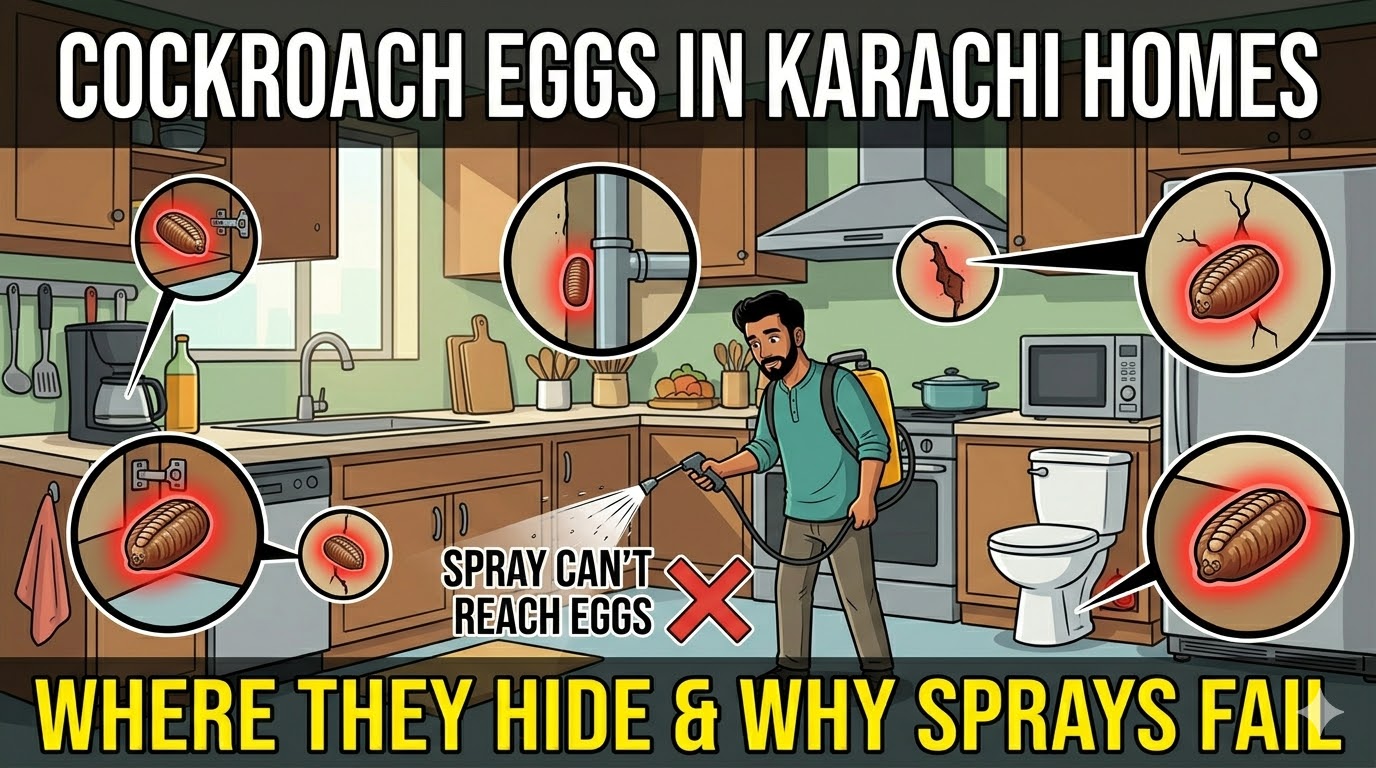
    The hard outer shell of the ootheca acts as a physical barrier. Contact insecticide sprays work by penetrating the cuticle of an exposed cockroach or being ingested during grooming. An egg case has no cuticle to penetrate and no grooming behaviour. The insecticide simply sits on the surface and evaporates without reaching the developing embryos inside.

    This is the fundamental reason why a spray treatment that appears to eliminate an active infestation will be followed by reinfestation within three to four weeks: the adults and nymphs are killed, but the oothecae survive and hatch on schedule, producing a new generation. If no treatment is in place to address the hatchlings, they mature and begin producing their own oothecae within six weeks.

    Where Cockroach Egg Cases Are Hidden in Karachi Homes

    Female cockroaches deposit oothecae in protected, warm, humid locations as close to food sources as possible. In Karachi homes, the most common hiding sites include:

    Behind and underneath kitchen appliances: The motor compartment of a refrigerator is one of the most productive egg-laying sites in any Karachi kitchen. It is warm, dark, vibration-dampened, and rarely disturbed. Oothecae are also commonly found behind washing machines, underneath microwave stands, and inside the recesses of dishwashers.

    Inside kitchen cabinet hinges and base cavities: The gaps inside cabinet hinge mechanisms, the hollow bases of mounted cabinets, and the narrow void between the back panel of a base cabinet and the wall are all favoured sites. These areas are typically never cleaned and never sprayed.

    Under the kitchen sink: The warm, humid environment beneath a sink — particularly around the drain pipe collar — is heavily used for egg laying in Karachi kitchens. The combination of moisture and warmth makes it ideal.

    In wall cracks and tile gaps: Any crack in kitchen tiling, gap at the junction between wall and floor, or deteriorated grout line provides a sheltered deposit site. These are impossible to spray effectively without very targeted equipment.

    Behind electrical switch boxes and socket plates: The void behind a switch plate or socket cover on a kitchen wall is warm (from electrical activity), dark, and completely undisturbed. Oothecae are commonly found in these locations during professional inspections.

    Inside hollow curtain rods and door frame gaps: Less commonly known, but cockroaches will carry oothecae to any sufficiently undisturbed cavity — including the hollow interior of aluminium window frame sections, hollow skirting boards, and door frame voids.

    In book spines and stacked paper: In rooms where paper goods are stored — office areas, storage rooms — the spaces between stacked books and documents are used. The paste and sizing in bookbinding also provides a food source.

    The common thread across all these sites is that they are protected, warm, undisturbed, and inaccessible to the basic cleaning and spraying routine of any household.

    Signs That Egg Cases Are Present

    Homeowners who know what to look for can identify oothecae during careful inspection:

    • German cockroach oothecae are small (4 to 6mm), brown, and ridged — resembling a tiny purse or capsule
    • American cockroach oothecae are slightly larger (8mm), darker, and more rounded
    • They are typically glued to surfaces near food sources or in harborage sites
    • Shed ootheca casings (empty cases after hatching) are paler and papery

    Finding oothecae — including empty ones — confirms that the infestation is actively breeding in your home, not just passing through from outside.

    What Spray Treatment Does and Does Not Do

    Residual spray treatments, when correctly applied, are effective at killing adult cockroaches and nymphs that contact treated surfaces. They can produce a significant and rapid visible reduction in cockroach activity. This is why homeowners who spray see results initially — the visible population is suppressed.

    What spray does not do:

    • Penetrate or affect oothecae
    • Reach harborage sites hidden in wall cavities and appliance interiors
    • Prevent surviving egg cases from hatching 2 to 4 weeks after treatment
    • Control the next generation emerging from those eggs

    This is why the word ‘alone’ in this article’s title matters. Spray treatment is not useless — it is just incomplete when used without addressing the egg cycle.

    Treatment Approaches That Address the Egg Cycle

    Comprehensive cockroach control requires an integrated approach that accounts for egg cases:

    Gel bait with cascade effect: Professional gel baits work partly because their slow-acting toxicant passes through the food chain — a poisoned cockroach is consumed by nest-mates, and hatching nymphs exposed to contaminated adults and their frass also ingest the toxicant. This creates pressure on successive generations, including those emerging from egg cases.

    Follow-up treatment: A second treatment timed to coincide with egg case hatching — typically 14 to 21 days after initial treatment — addresses the new generation before it reaches reproductive maturity. Without this step, the infestation reliably rebounds.

    Physical removal of accessible oothecae: During a professional inspection, accessible oothecae can be physically removed and destroyed. This is not possible in all locations but can reduce the reproductive load significantly.

    Insect growth regulators (IGRs): These compounds interrupt cockroach development, preventing nymphs from maturing to reproductive adults. When incorporated into a treatment plan, they effectively break the breeding cycle over successive generations.

    A properly structured cockroach extermination service in Karachi incorporates all of these elements — not just a single spray application — because only an integrated approach can address both the active population and the egg cycle simultaneously.

    Karachi-Specific Considerations

    In Karachi’s climate, egg development is accelerated by ambient heat. Hatching can occur at the faster end of the 14 to 28 day window during the summer months — meaning the reinfestation cycle following an inadequate treatment can be as short as two weeks. Treatment plans must account for this accelerated timeline with appropriately timed follow-up visits.

    Additionally, Karachi’s housing stock — particularly the older residential buildings across areas like Saddar, PECHS, Liaquatabad, and Gulshan-e-Iqbal — contains the kinds of deteriorated wall surfaces, cracked tiles, and inaccessible cabinet configurations that create maximum egg-laying opportunity. Newer construction is not immune, but these older structural characteristics significantly increase the number of protected harborage sites available.

    Book a Free Inspection — Including a Full Harborage Assessment

    If your cockroach problem keeps returning after treatment, the egg cycle is almost certainly the reason. Our team conducts thorough harborage assessments as part of every inspection — identifying where egg cases are likely to be located and designing a treatment plan that addresses the full breeding cycle, not just the visible population.

    Contact Karachi Fumigation Services today to book your free inspection. Breaking the egg cycle is the key to lasting cockroach control — and that starts with knowing exactly where to look.

  • What Karachi Homeowners Get Wrong When Trying to Eliminate Cockroaches Themselves

    What Karachi Homeowners Get Wrong When Trying to Eliminate Cockroaches Themselves

    Every year, Karachi homeowners spend significant money on sprays, chalk lines, ultrasonic devices, and homemade remedies — and most of them continue to have cockroaches. This is not because those homeowners are not trying hard enough. It is because the most common DIY cockroach control approaches are built on fundamental misunderstandings of how cockroaches behave, breed, and survive.

    This article is not written to make you feel bad about what you have tried. It is written because the mistakes are consistent, understandable, and entirely fixable — and recognising them is the first step toward actually solving the problem.

    Mistake 1: Treating What You Can See Instead of Where They Live

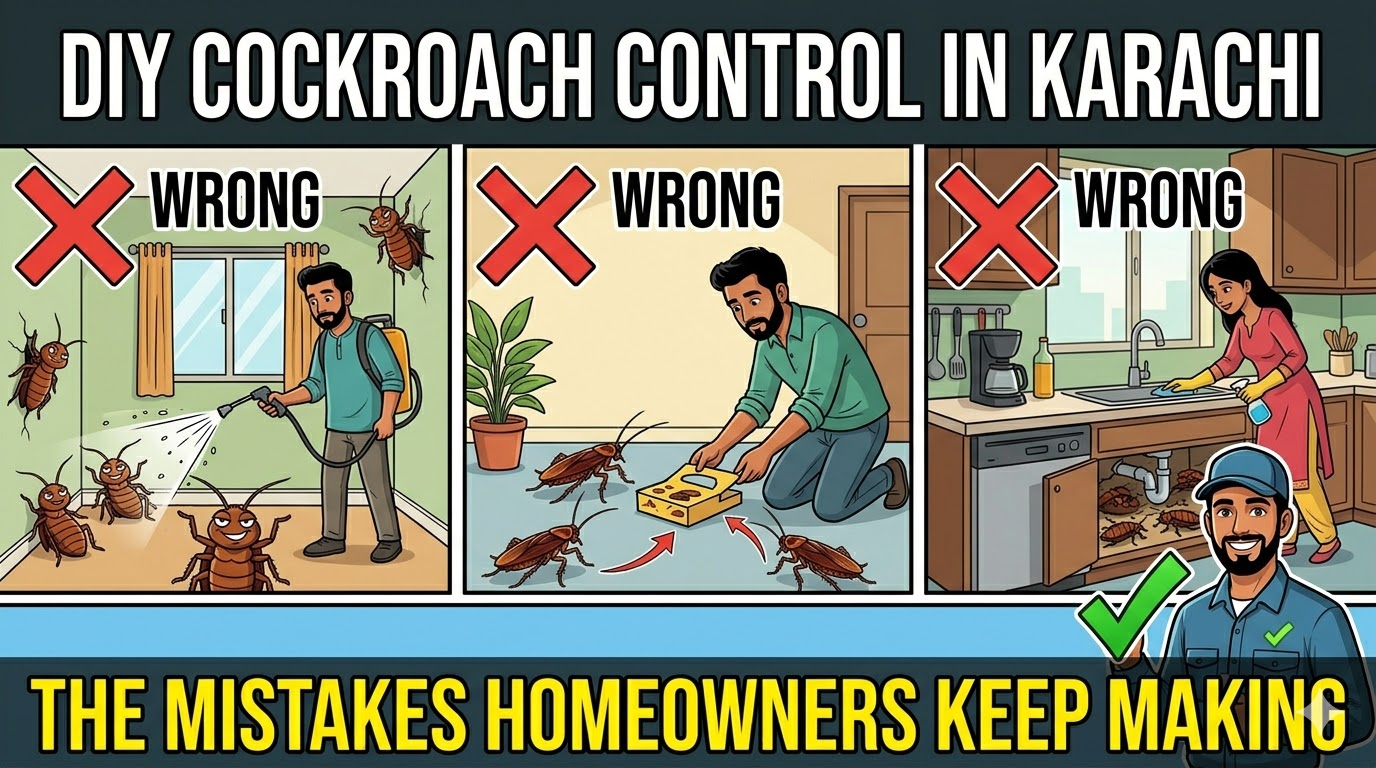
    The instinct when you see a cockroach is to spray it. The cockroach dies. The problem feels addressed. But the cockroach you saw was a forager — a single individual that had emerged from the colony to find food. Killing it does not affect the dozens or hundreds of cockroaches still hidden in their harborage: behind wall tiles, inside the motor compartment of your fridge, underneath the base of your kitchen cabinets, in the gap behind your water heater.

    Effective cockroach control requires treating the harborage — the nesting site — not just the visible individuals. This is why a can of spray used across a kitchen surface, however thoroughly, will not produce lasting results. The colony is untouched, and it will continue to send foragers out every night.

    Mistake 2: Using Spray and Bait at the Same Time

    Many Karachi homeowners, frustrated by results from spray alone, decide to add gel bait to their approach — using both simultaneously in the hope of covering all bases. This actually undermines both treatments.

    Most residual insecticide sprays contain repellent compounds. When applied to surfaces near bait placement points, they make cockroaches avoid those areas entirely — including the bait. The result is that the bait goes untouched, the spray kills the few cockroaches that contact treated surfaces, and the bulk of the colony remains undisturbed. If you are using gel bait, surfaces in and around the bait application area should not be treated with repellent spray.

    Mistake 3: Applying Bait Incorrectly

    Consumer-grade gel baits are available in Karachi, and some homeowners do try them. The most common errors in application are:

    • Applying too much — cockroaches avoid oversized bait deposits; placements should be pea-sized
    • Placing bait in open visible areas rather than along edges, in corners, and inside crack openings where cockroaches actually travel
    • Not replacing dried-out bait — Karachi’s heat evaporates bait moisture quickly, making it unpalatable
    • Placing bait too far from actual harborage sites — cockroaches are unlikely to travel far from their nest to feed
    • Using bait alongside sprays, as described above

    Correct bait placement requires knowledge of cockroach behaviour and an understanding of where harborage sites are likely to be in your specific kitchen layout — knowledge that comes from experience and proper inspection, not guesswork.

    Mistake 4: Focusing Only on the Kitchen

    Karachi homeowners almost always focus cockroach control efforts on the kitchen because that is where cockroaches are most visible. However, German cockroaches — the dominant kitchen species — do not limit themselves to one room. They establish secondary harborage in bathrooms, in gaps around toilet bases and cisterns, behind bathroom cabinets, and inside the motor compartments of washing machines.

    American cockroaches — the larger sewage species common in Karachi — use bathroom drains and floor grates as entry points and will forage well beyond the bathroom into any room of the home. Treating only the kitchen while leaving bathroom entry points unaddressed means the infestation has an ongoing unchallenged access route into the home.

    Mistake 5: Not Sealing Entry Points

    Even a perfectly executed treatment will be followed by reinfestation if the pathways through which cockroaches enter the home are not addressed. The most common unsealed entry points in Karachi homes include:

    • Gaps around drain pipes under kitchen sinks and in bathroom floors
    • Gaps where gas pipes enter the kitchen wall
    • Deteriorated seals around toilet bases
    • Gaps at the junction between kitchen cabinet bases and walls
    • Unsealed conduit entries near electrical switch boxes
    • Gaps under exterior-facing doors, particularly kitchen or utility doors

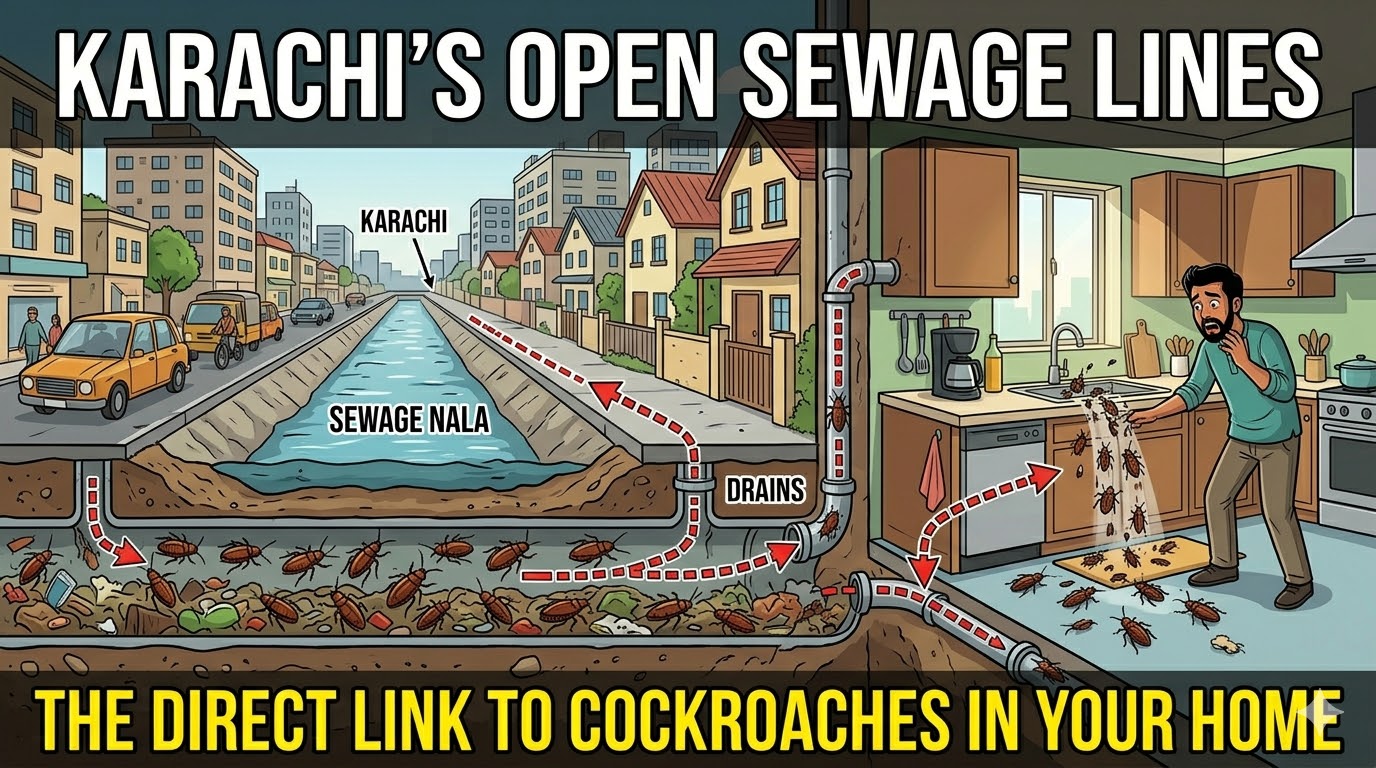
    Without sealing these entry points, cockroaches from external sources — the building’s drain infrastructure, neighbouring units, or the open sewage environment that surrounds much of Karachi — will continue to enter regardless of what is done to the population already inside.

    Mistake 6: Treating Once and Considering It Done

    Cockroach control is a process, not a single event. This is true even for professional treatments — which is why reputable pest control companies schedule follow-up visits rather than treating once and walking away.

    The reason is eggs. Cockroach egg cases (oothecae) are highly resistant to most insecticides. An initial treatment can dramatically reduce the active adult and nymph population, but surviving egg cases will hatch one to three weeks later, beginning a new generation. Without a follow-up treatment to address newly hatched nymphs before they reach reproductive maturity, the infestation rebounds.

    Many Karachi homeowners treat once, see a significant reduction in cockroach activity, conclude the problem is solved, and then find themselves back to the same level of infestation four to six weeks later. This is the egg cycle at work.

    Mistake 7: Relying on Chalk, Essential Oils, or Ultrasonic Devices

    Cockroach chalk (often called Chinese chalk or Miraculous Insecticide Chalk) is widely sold in Karachi markets and frequently used by homeowners. While it contains insecticide and can kill cockroaches that contact it, it presents significant health concerns — particularly for homes with children and pets — and is not approved for indoor use by reputable regulatory bodies. More importantly, it does not address the infestation systematically and provides no lasting colony control.

    Essential oil repellents (peppermint, eucalyptus, bay leaves) may cause cockroaches to temporarily avoid treated areas but do not kill them or control the population. Cockroaches simply route around the repellent.

    Ultrasonic devices have been evaluated repeatedly in studies and consistently shown to have no meaningful effect on cockroach behaviour or population. They are a waste of money.

    Mistake 8: Assuming a Clean Home Cannot Have a Serious Infestation

    Cleanliness reduces available food sources for cockroaches, which matters — but it does not prevent infestation. Cockroaches need very little to sustain themselves. A small amount of food residue in a drain, condensation on a pipe, or the paste in book bindings can sustain a cockroach. In Karachi’s environment, where cockroaches have access to building infrastructure, sewage systems, and external organic matter, they can survive independently of the cleanliness of your kitchen.

    Many of Karachi’s cleanest, most well-maintained homes have serious cockroach infestations — because the infestation is entering through structural pathways, not because of hygiene failures. Conflating hygiene with pest control leads homeowners to clean more intensively while the actual problem — structural access — remains unaddressed.

    Mistake 9: Not Inspecting the Problem Properly Before Treating

    Effective cockroach control begins with a proper inspection: identifying the species involved, locating harborage sites, mapping travel routes, and assessing entry pathways. Most DIY treatments skip this step entirely — they treat the visible surfaces and hope for the best.

    A professional cockroach inspection and treatment in Karachi begins with a systematic assessment of these factors before any treatment is applied. The inspection determines which treatment approach is appropriate, where it should be targeted, and what structural measures are needed to prevent reinfestation.

    The Bottom Line

    DIY cockroach control in Karachi is not ineffective because the products do not work. It is ineffective because the approach is usually reactive and incomplete — treating symptoms rather than causes, addressing visible insects rather than the colony, and skipping the structural work that prevents reinfestation.

    Understanding these mistakes is valuable even if you plan to continue managing pest control yourself. But for established infestations in Karachi’s complex residential environment, professional intervention is consistently more effective and more cost-efficient over time than repeated DIY treatments that never fully resolve the problem.

    Book Your Free Inspection Today

    Stop wasting money on treatments that do not work. Our certified team will inspect your home, identify exactly where your infestation is coming from, and design a targeted treatment plan that addresses the problem at its source.

    Book a free inspection with Karachi Fumigation Services today. The first step toward actually solving your cockroach problem is finding out the full picture — and that starts with a proper professional assessment.

  • How Cockroach Infestations in One Karachi Flat Spread to the Entire Building

    How Cockroach Infestations in One Karachi Flat Spread to the Entire Building

    You may have had this experience: a neighbour in your building mentions they have been dealing with a cockroach problem. You feel a vague concern, but reassure yourself that your flat is clean and well-maintained. A few weeks later, you start seeing cockroaches in your kitchen. Then a resident two floors up notices the same. Then the family on the ground floor.

    This is not a coincidence. It is a predictable pattern — one that plays out in apartment buildings across Karachi every day. Cockroach infestations do not respect flat boundaries. Given the right infrastructure, a single heavily infested unit can seed an entire building within a few weeks.

    Why Apartment Buildings Create Ideal Conditions for Spread

    Multi-storey residential buildings in Karachi — whether older walk-up apartments in areas like Federal B Area and Gulshan-e-Iqbal, or newer tower blocks in Bahria Town and DHA — share several structural characteristics that make cockroach spread between units not just possible but almost inevitable once an infestation reaches a certain size.

    These characteristics include:

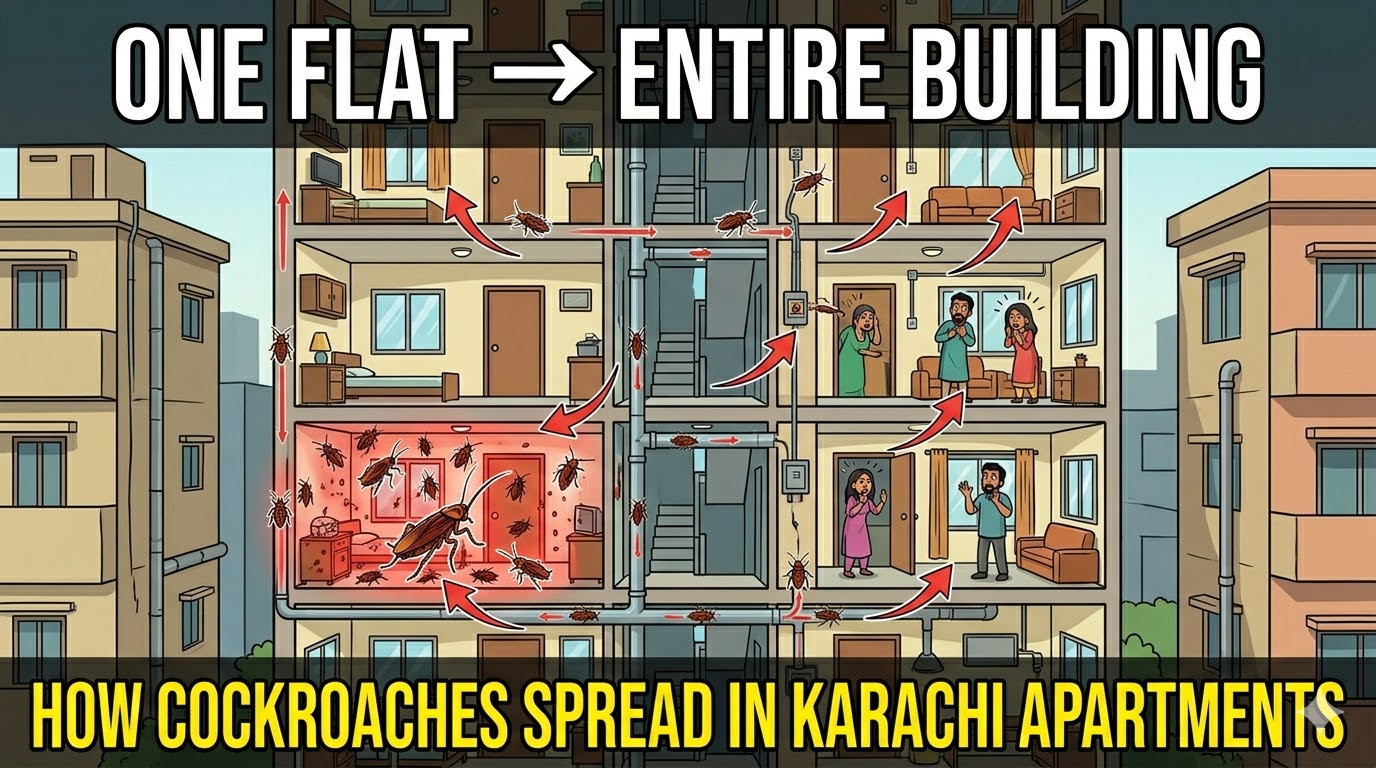
    • Shared plumbing infrastructure — drain pipes, supply lines, and waste stacks connect every unit vertically
    • Common electrical conduits running between floors and through walls
    • Shared utility shafts housing pipes, cables, and ventilation ducts
    • Gaps around gas pipes entering individual units from common supply lines
    • Weak points in inter-unit walls, particularly around switch boxes and pipe penetrations
    • Common areas — stairwells, corridors, refuse collection points — that cockroaches traverse freely

    In an older Karachi building where masonry is cracked and original sealing has degraded, the connectivity between units can be surprisingly comprehensive. A cockroach established on the ground floor has multiple viable routes to every floor above.

    The Population Pressure Mechanism

    Cockroach spread between flats is not random wandering. It is driven by population pressure. When a colony in a single unit grows large enough that harborage space and food sources become competitive, cockroaches begin actively expanding their range — and the path of least resistance is through the shared infrastructure that connects them to neighbouring units.

    German cockroaches — the species most commonly found in Karachi kitchen infestations — can produce an ootheca (egg case) containing up to 40 eggs every three to four weeks. A single female can produce six or more oothecae in her lifetime. Under Karachi’s warm conditions, development from egg to reproductive adult takes as little as six weeks. The mathematics of this reproduction rate means that an untreated infestation doubles and redoubles rapidly, creating exactly the population pressure that drives expansion.

    Primary Spread Routes Through a Karachi Building

    Drain and waste pipes are the most significant spread pathway. Karachi’s apartment buildings use shared vertical waste stacks into which individual unit drains connect. Cockroaches move freely up and down these stacks, exiting into any unit via drain openings that are insufficiently sealed or covered with damaged drain guards.

    Water supply pipes running in shared wall cavities provide another route. Where pipe lagging or wall plaster has deteriorated, cockroaches use the cavity space to move between floors and enter units through gaps at pipe penetration points.

    Electrical conduits present a surprisingly significant pathway. In Karachi’s typical residential construction, electrical wiring runs through plastic conduit pipes embedded in walls. Where conduits pass from one unit to another — through shared walls or at distribution board panels — they create unobstructed tubes that cockroaches navigate with ease.

    Gas pipe entries are a commonly ignored pathway. Where the building’s gas supply line enters individual kitchens, the surrounding gap is often sealed with degraded plaster or left partially open. This provides direct entry from the common pipe space into each kitchen — which is, conveniently, exactly where cockroaches want to be.

    Common corridors and stairwells allow movement of larger cockroach species, particularly American cockroaches, between floors and units via gaps under doors, around door frames, and through ventilation grilles.

    How Quickly Can an Infestation Spread Building-Wide?

    In an average Karachi apartment building with four to eight floors and two to four units per floor, a ground-floor infestation left untreated for two to three months can realistically seed multiple additional units. Once secondary infestations are established in neighbouring units, the spread accelerates — each new colony adding its own population pressure and expanding in further directions.

    Buildings where one or more units sit vacant — a common situation in Karachi’s rental market — are particularly at risk. Vacant units receive no cleaning, no disruption of cockroach activity, and no treatment. They become staging grounds for infestation that then spreads to occupied units, often repeatedly.

    The Challenge of Single-Unit Treatments

    This is the fundamental problem with unit-by-unit cockroach treatment in Karachi apartment buildings: treating one flat while adjacent units remain infested is, at best, a temporary solution. Even a perfectly executed treatment in your unit will be followed by reinfestation within weeks if cockroaches from a neighbouring unit continue to access it through shared infrastructure.

    Effective cockroach control for Karachi apartment buildings requires a coordinated, building-level approach — treating the common pathways, addressing the source units, and ensuring that all active colonies are suppressed simultaneously rather than one at a time.

    What Building Management Should Be Doing — and Usually Is Not

    In most Karachi apartment buildings, pest control is treated as an individual tenant’s responsibility. Building management rarely takes a coordinated approach to infestation control, common area maintenance from a pest perspective, or structural sealing of inter-unit pathways. This creates a situation where individual tenants spend money repeatedly treating symptoms while the underlying building-level problem remains unaddressed.

    Responsible building management should maintain:

    • Sealed drain covers on all communal drain points
    • Sealed pipe penetrations in common utility shafts
    • Regular pest inspections of common areas, basements, and rooftop spaces
    • Prompt treatment of any vacant units showing signs of infestation
    • A building-wide treatment schedule at least twice per year

    Where management has not implemented these practices, individual tenants and flat owners can advocate for them — and in the interim, ensure their own unit is treated in a way that accounts for reinfestation pressure from outside.

    Signs That Your Building Has a Multi-Unit Problem

    If you live in a Karachi apartment building and notice any of the following, the infestation has likely spread beyond a single unit:

    • Multiple residents independently mention seeing cockroaches in the same period
    • Cockroaches appearing in corridors or stairwells, not just individual units
    • Treated units show reinfestation within two to four weeks of treatment
    • Cockroaches are seen at the refuse collection point or building entrance at night
    • Ground-floor units consistently have heavier infestations than upper floors

    The Conversation You Need to Have With Your Building

    If you suspect your building has a multi-unit infestation problem, addressing it requires action beyond your own flat. We recommend:

    • Raising the issue with building management in writing, noting the health implications
    • Connecting with other affected tenants to present a coordinated request for building-level treatment
    • Requesting a professional inspection of common areas, pipe shafts, and vacant units
    • Seeking a treatment plan that covers the building’s shared infrastructure — not just individual units

    Book a Building-Level Inspection Today

    A single flat treatment will not solve a building-wide problem. Our team understands the specific structural dynamics of Karachi’s apartment buildings and provides coordinated treatment plans that address infestations at the source — including shared infrastructure, common areas, and the entry pathways between units.

    Contact Karachi Fumigation Services today to book a free inspection. We will assess your building’s specific situation and recommend a treatment approach that produces lasting results — not just temporary relief.

  • Gel Bait vs. Spray Treatment for Cockroaches in Karachi: Which Works Longer?

    Gel Bait vs. Spray Treatment for Cockroaches in Karachi: Which Works Longer?

    Walk into any supermarket in Karachi — from a departmental store in Gulshan to a general store in North Nazimabad — and you will find rows of cockroach sprays. They are cheap, instantly available, and satisfying to use. A cockroach runs out, you spray, it dies. Problem solved.

    Except it is not. Not by a long way.

    The spray killed one cockroach. The colony of two hundred behind your kitchen tiles is untouched. This is the central problem with how most Karachi homeowners approach cockroach treatment — and it is why gel bait, properly understood and applied, is a fundamentally different and more effective tool for long-term control.

    Understanding the Two Methods

    Before comparing effectiveness, it is worth understanding what each treatment actually does — and does not do.

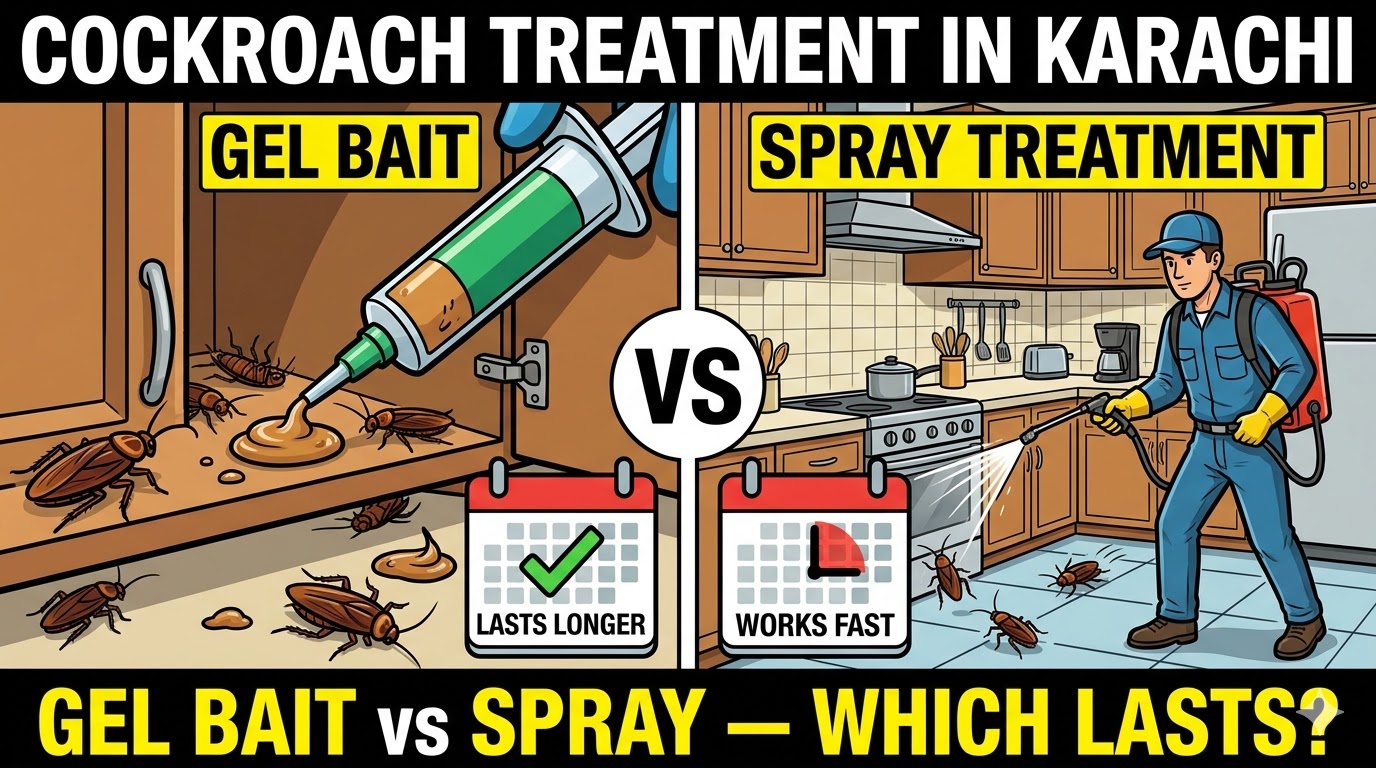
    Spray treatments (also called residual insecticide sprays or aerosol contact killers) work by depositing a chemical film on surfaces. When a cockroach walks through the treated area or is sprayed directly, the insecticide enters through its exoskeleton or respiratory system and kills it. Sprays are effective at killing individual cockroaches on contact and can provide some residual surface protection for a period after application.

    Gel bait works on a completely different principle. A small amount of slow-acting insecticide is mixed into an attractive food matrix and placed in strategic locations. Cockroaches are drawn to the bait, consume it, and return to their harborage site before dying. Other cockroaches then feed on the dead cockroach’s body and also ingest the insecticide — creating a cascade effect that reaches deep into the colony, including individuals that never directly encountered the bait.

    Why Spray Treatment Falls Short in Karachi Homes

    In the specific conditions of Karachi’s residential environment, spray treatments face several significant limitations:

    • Karachi’s heat and humidity accelerate the degradation of residual insecticide on surfaces, reducing effective contact time from weeks to days in some cases
    • Cockroaches that sense a recently sprayed surface will avoid it — a behaviour known as repellency — effectively pushing them deeper into wall cavities and inaccessible nesting areas
    • Sprays kill foraging individuals but do not penetrate to nesting sites where breeding females and egg cases are located
    • German cockroaches — the most common species in Karachi kitchens — have developed significant resistance to many pyrethroid-based sprays commonly sold and used in the city
    • After spraying, cockroach populations typically recover within two to four weeks as new hatchlings emerge from untouched egg cases

    This is the pattern most Karachi homeowners have experienced: spray, see results for a couple of weeks, then the cockroaches come back. Often in the same numbers as before.

    How Gel Bait Addresses the Root Problem

    Gel bait is effective specifically because it targets the colony rather than individual insects. The cascade mechanism — where poisoned cockroaches return to the harborage and are consumed by nest-mates — means that a single application can work its way through hundreds of insects over days and weeks.

    In Karachi’s conditions, professional-grade gel bait has several specific advantages:

    • Heat-stable formulations maintain palatability and efficacy even in temperatures exceeding 40°C — common in Karachi kitchens during summer
    • Bait does not repel cockroaches; it attracts them, meaning populations do not scatter and become harder to treat
    • Small application points in cracks, corners, and behind appliances place the bait exactly where cockroaches forage, requiring no broad surface coverage
    • When applied correctly, gel bait reaches German cockroaches that never leave their harborage except to feed — individuals that spray would never contact
    • Professional formulations rotate active ingredients to prevent resistance build-up — a critical factor given the spray resistance already established in Karachi’s cockroach populations

    The Comparison at a Glance

    FeatureGel BaitSpray Treatment
    Duration of effect3 to 6 months2 to 6 weeks
    Reaches nesting sitesYes — cockroaches carry it backSurface contact only
    Safe for food areasYes — minimal chemical exposureRequires vacating area
    Kills eggs/oothecaeIndirectly through colony collapseNo
    Effective in Karachi heatYes — heat-stable formulationsDegrades faster in humidity
    Resistance riskLower with rotationHigher — widespread resistance
    Best used forActive infestations, flats, kitchensSupplementary flushing, perimeter

    The Resistance Problem in Karachi

    This point deserves specific attention. Cockroach resistance to common pyrethroid insecticides — the chemical class used in most widely available Karachi sprays — is well-documented in dense urban environments. The pattern is simple: when a population is repeatedly exposed to the same chemical class, individuals with genetic traits that allow them to survive are the ones that reproduce, progressively breeding resistance into the population.

    In a city like Karachi, where over-the-counter sprays have been used intensively for decades, resistance in the German cockroach population is a genuine and significant problem. This is one of the reasons many homeowners report that sprays which used to work effectively no longer seem to produce the same results.

    Professional gel bait products rotate active ingredients and use formulations not widely available over the counter — bypassing much of the resistance that has built up in spray-exposed populations.

    When Spray Treatment Is Appropriate

    This is not to say that spray treatment has no place in cockroach control. It does — but as a supplementary tool rather than a primary strategy.

    Spray is useful for:

    • Flushing cockroaches out of hiding to confirm the extent of an infestation
    • Treating specific exterior entry points such as drain pipe exits and wall penetrations
    • Addressing American cockroaches (large sewage cockroaches) in open outdoor areas
    • Providing initial rapid knockdown when an infestation is newly discovered and severe

    The most effective professional treatment plans for Karachi homes combine gel bait for the active colony with targeted spray application at entry and perimeter points — addressing both the internal infestation and external reinfestation risk simultaneously.

    Why DIY Gel Bait Often Fails

    Consumer-grade gel baits are available in Karachi, and some homeowners do try them. Results are frequently disappointing — not because the method does not work, but because application matters enormously.

    Common DIY gel bait errors include:

    • Applying too large an amount — cockroaches avoid oversized bait deposits
    • Placing bait in the wrong locations — far from actual harborage sites
    • Using bait alongside sprays — the repellent effect of spray makes cockroaches avoid bait
    • Not replacing bait when it dries out in Karachi’s heat
    • Using bait alone without addressing structural entry points

    Professional cockroach treatment in Karachi ensures bait is applied in the right locations, in the correct quantities, using formulations matched to the specific infestation — and combined with a complete treatment strategy that addresses reinfestation pathways.

    The Long-Term Picture: Durability of Results

    For Karachi homeowners asking which method lasts longer, the honest answer is that professionally applied gel bait, combined with structural exclusion work, produces results that are measurably more durable than spray alone.

    A professional gel bait treatment can maintain effective colony suppression for three to six months. When combined with follow-up inspections and bait renewal, and with attention to entry points, results can be sustained long-term. Spray treatment, in contrast, typically requires re-application every three to six weeks to maintain any meaningful effect — at greater chemical exposure and cost over time.

    Book a Free Inspection and Get the Right Treatment for Your Home

    If your current approach to cockroach control is not producing lasting results, the method may be the problem — not the effort you are putting in.

    Our Pest Control Services in Karachi team uses professional-grade gel bait systems combined with targeted spray applications and structural advice to deliver results that last. Contact us today to book your free inspection and find out which treatment strategy is right for your specific situation.

  • Why Karachi’s Building Water Tanks and Overhead Pipes Are a Hidden Cockroach Highway

    Why Karachi’s Building Water Tanks and Overhead Pipes Are a Hidden Cockroach Highway

    When most Karachi homeowners think about cockroach entry points, they picture open drains, kitchen gaps, or bathroom cracks. Very few look up. Yet one of the most significant — and most consistently overlooked — pathways for cockroach movement in Karachi’s residential and commercial buildings runs directly overhead: through the network of water storage tanks, overhead supply pipes, and rooftop plumbing infrastructure that almost every building in the city relies on.

    Understanding how cockroaches exploit this vertical infrastructure is essential for any homeowner serious about controlling infestations — because as long as these pathways remain open, even the most thorough ground-level treatment will only produce temporary results.

    Karachi’s Water Storage Reality

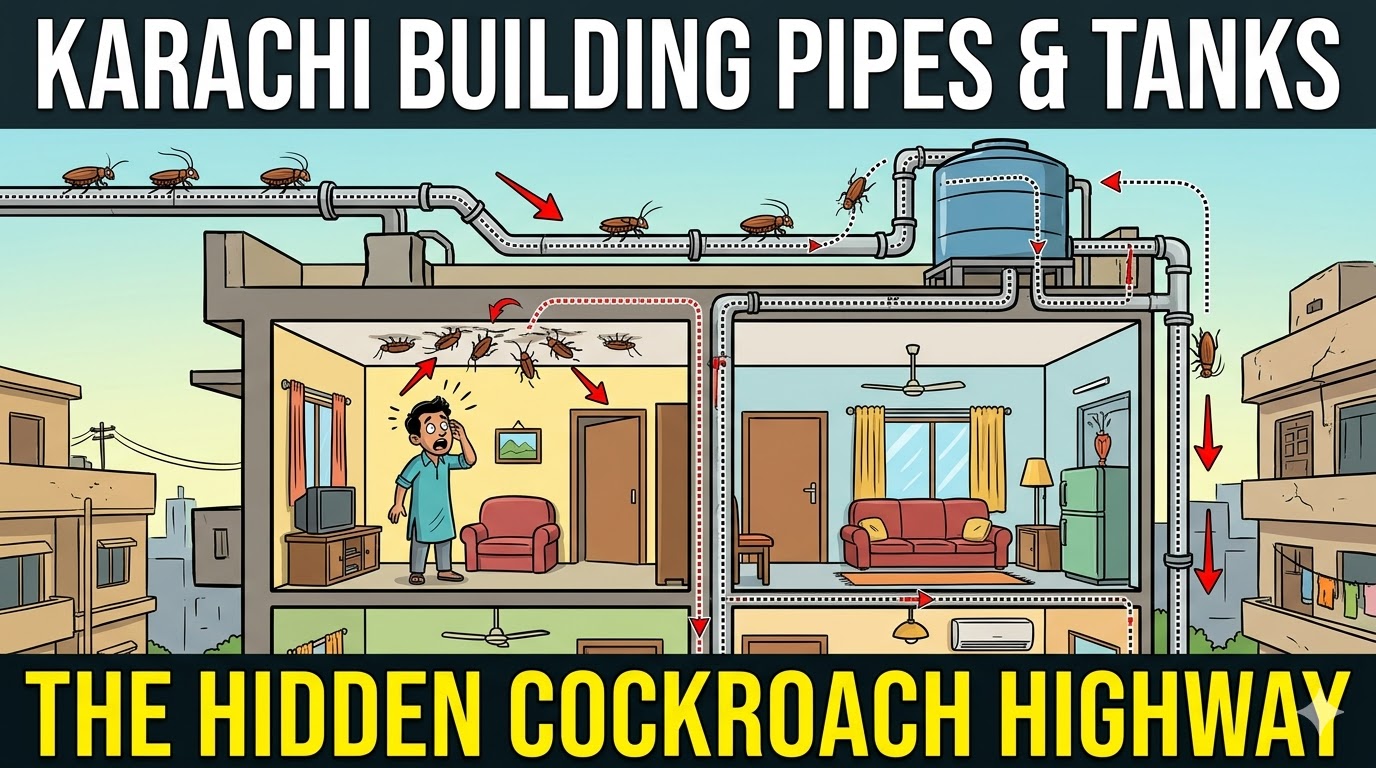
    Unlike cities with high-pressure municipal supply, the majority of Karachi’s residential buildings depend on overhead water tanks — typically installed on rooftops or elevated platforms — to store and distribute water throughout the day. Water is pumped from underground reservoirs or tankers into these tanks, which then gravity-feed the building below through a network of pipes running inside walls, under floors, and through ceiling voids.

    This infrastructure is practical. But from a pest control perspective, it creates an interconnected warm, moist, sheltered network that extends from the rooftop to every floor of the building — and cockroaches are extremely well-adapted to exploit exactly these kinds of environments.

    Why Cockroaches Are Attracted to Water Infrastructure

    Cockroaches have three core survival requirements: warmth, moisture, and food. Water pipes and storage tanks consistently provide the first two — and in most Karachi buildings, the third is never far away.

    Specifically, cockroaches are drawn to water infrastructure because:

    • Condensation on pipes provides a reliable water source in otherwise dry areas
    • Pipe lagging (insulating foam wrap) offers warm, undisturbed hiding and nesting space
    • Gaps where pipes enter walls or floors create direct access to concealed internal spaces
    • Water tanks collect organic debris — algae, sediment, dead insects — that serves as a food source
    • The dark, enclosed environment around overhead tanks is rarely inspected or disturbed

    In older Karachi buildings — particularly in areas like Saddar, Liaquatabad, New Karachi, and parts of Gulshan-e-Iqbal — where pipe fittings have degraded and tank seals have deteriorated over decades, these access points are even more pronounced.

    How Cockroaches Travel Vertically Through a Building

    Most people think of cockroaches as floor-level creatures. They are not. German cockroaches and American cockroaches — both extremely common in Karachi — are capable climbers and will readily move vertically through a building using:

    • Pipe chases (the vertical shafts in which plumbing runs between floors)
    • The exterior surface of supply pipes that pass through ceiling and floor penetrations
    • Gaps around where pipe brackets are fastened to walls
    • Ventilation gaps in water tank housing structures
    • Open access hatches on rooftop tank enclosures

    A cockroach that enters a ground-floor drain can, within a single night, travel through the building’s internal pipe infrastructure and emerge on the third or fourth floor — directly behind a kitchen cabinet or underneath a bathroom sink. This is why infestations in Karachi apartments so frequently appear to materialise from nowhere, even in units where the occupants maintain clean habits.

    The Rooftop Tank: A Nesting Site Above Your Head

    Rooftop water tanks in Karachi are among the most problematic cockroach hotspots in the city, yet they receive almost no pest control attention. Consider the typical conditions:

    • The tank enclosure is dark and undisturbed for months or years at a time
    • Moisture from condensation and minor overflows creates ideal humidity
    • Organic material accumulates in corners and on surfaces
    • Pipe entry points are rarely sealed
    • The structural warmth of a rooftop absorbs and retains heat throughout the night

    An established cockroach colony in a rooftop tank enclosure can number in the hundreds. From this central hub, individuals disperse down through the building’s pipe infrastructure each night, reaching multiple floors and multiple units. No amount of ground-floor treatment will resolve an infestation that is being replenished from above.

    Overhead Pipes Inside Walls: The Invisible Highway

    Beyond the rooftop tank, the internal pipe runs within the walls themselves represent a continuous hidden tunnel system. In most Karachi residential construction, pipes are chased directly into masonry walls with gaps that are plastered over rather than properly sealed. Over time, as plaster cracks and fittings loosen, these gaps reopen and provide access.

    The interior of a wall cavity adjacent to a water pipe is often 5 to 10 degrees warmer than the surrounding wall, slightly humid from pipe condensation, and completely dark. This is essentially a customised cockroach habitat running the full height of your building. A population established in these cavities is inaccessible to surface sprays, aerosol treatments, and standard bait placement — making professional intervention with appropriate formulations a necessity, not an option.

    What This Means for Multi-Storey Buildings in Karachi

    If you live in a multi-storey apartment building — as a large proportion of Karachi residents do — the pipe and tank infrastructure problem is compounded significantly. Shared plumbing means that cockroach movement is not just vertical within your unit; it is lateral across the building, connecting your apartment to every other unit that shares the same pipe infrastructure.

    This is why professional cockroach control in Karachi for apartment buildings must address common areas, pipe shafts, rooftop infrastructure, and individual units as a coordinated system — not as isolated treatments applied unit by unit.

    Signs That Your Pipes and Tank Are Part of the Problem

    Look for these indicators that overhead and pipe infrastructure is contributing to your cockroach infestation:

    • Cockroaches appearing on upper floors even after ground-level treatment
    • Cockroaches found near ceiling-height areas, behind high cabinets, or inside overhead storage
    • Sightings near pipe exits behind sinks, toilets, or appliances
    • Cockroach activity reappearing 2 to 4 weeks after a spray treatment — suggesting reinfestation from above
    • Faecal spotting near pipe penetration points in walls or floors

    Any of these patterns points to a vertical infestation pathway that standard surface treatments will not resolve.

    Practical Steps Homeowners Can Take

    While professional treatment is necessary to fully address this problem, homeowners can take some immediate steps to reduce access:

    • Seal visible gaps around pipe entry and exit points using appropriate filler or expanding foam
    • Ensure rooftop tank enclosures are kept closed and properly latched
    • Request that building management inspect and seal pipe chases in common areas
    • Avoid storing food directly beneath overhead pipes where drip contamination could occur
    • Have water tanks cleaned and inspected annually for pest activity

    These measures reduce but do not eliminate the problem. An existing colony in the pipe infrastructure requires targeted professional treatment to eradicate.

    Book a Free Inspection — Including Overhead Infrastructure

    Our team specialises in identifying and treating the complete cockroach pathway in Karachi buildings — not just the surfaces you can see. We assess rooftop tanks, pipe shafts, internal wall cavities, and every other access point that cockroaches exploit.

    As one of the leading pest control services in Karachi, we bring the expertise and equipment to treat your building’s full vertical infrastructure. Contact us today to book your free inspection and find out exactly where your cockroach problem is coming from.

  • How Cockroaches in Karachi Spread Bacteria to Food Without You Realising

    How Cockroaches in Karachi Spread Bacteria to Food Without You Realising

    You cleaned the kitchen last night. The counters are wiped, the dishes are done, and everything looks fine. But by the time you wake up and prepare breakfast, a cockroach may have already walked across your cutting board, dragged bacteria from the drain, and left invisible traces on the very surface where you slice your fruit.

    In Karachi, this is not a hypothetical. It is happening in thousands of homes every single day — silently, in the dark, and completely undetected.

    Why Karachi Is Particularly Vulnerable

    Karachi’s combination of warm humidity, dense housing, aged drainage infrastructure, and open waste exposure creates near-perfect conditions for cockroach activity year-round. Unlike colder climates where infestations die down in winter, Karachi’s cockroaches never get a seasonal break. They breed continuously, forage aggressively, and move between food preparation areas and contamination sources without pause.

    Areas like Nazimabad, Orangi Town, Lyari, Korangi, and older parts of Clifton and Saddar are particularly affected due to aging sewage lines and close-quarter housing. But no neighbourhood is truly immune — even newer developments in DHA and Bahria Town report significant cockroach activity in ground-floor and basement units.

    The Contamination Route You Cannot See

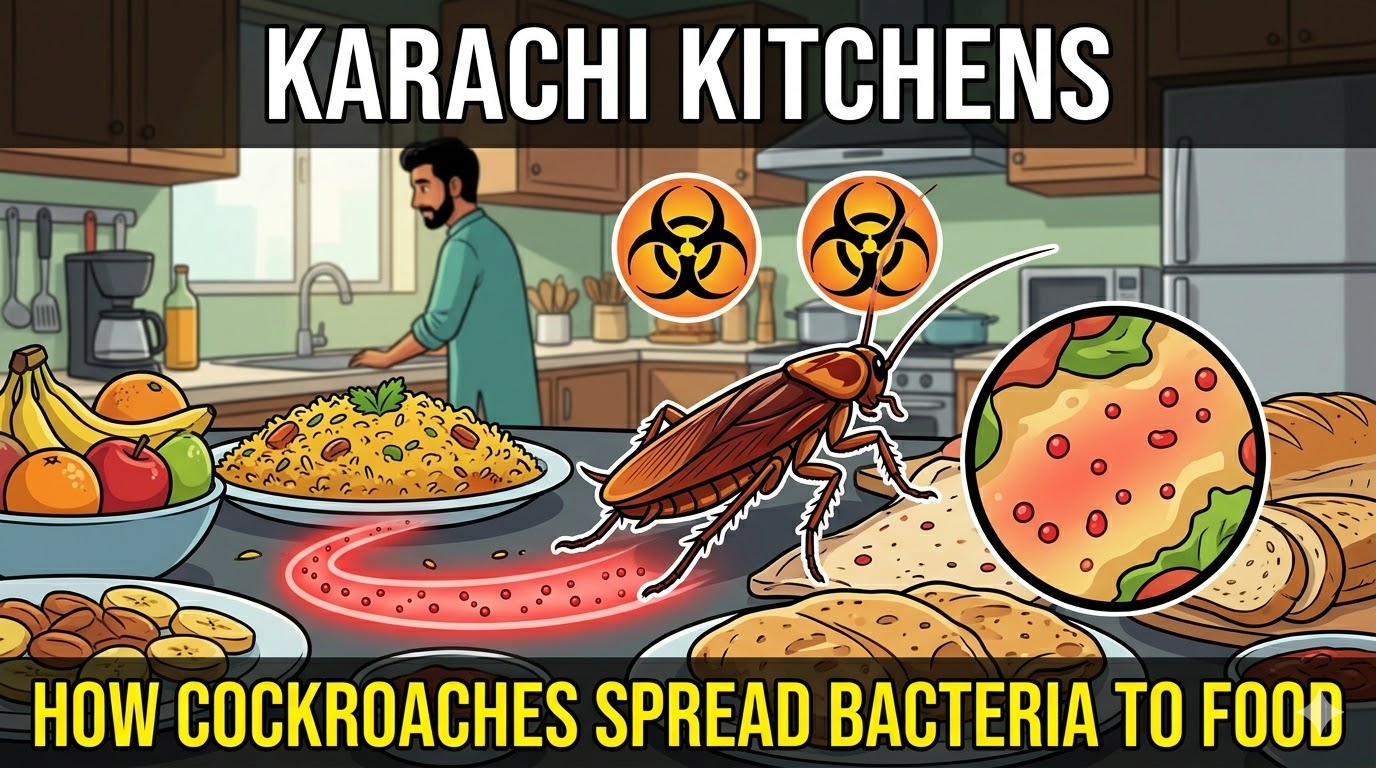
    The key to understanding how cockroaches contaminate food is understanding where they travel before they reach your kitchen. A cockroach foraging at night typically follows a route that includes:

    • Sewage drains and waste pipes beneath floors
    • Bathroom floor grates and toilet bases
    • Garbage bins and decomposing organic matter
    • Dead insects, animal droppings, and mould
    • Then — your kitchen counters, utensil drawers, and uncovered food

    Each step of this journey loads the cockroach’s legs, body hair, and mouthparts with bacteria. Cockroaches are known carriers of Salmonella, E. coli, Staphylococcus, Klebsiella, and Listeria — all of which can cause serious foodborne illness in humans.

    The transfer happens through direct contact. When a cockroach walks across a chopping board, pot lid, or open container, it deposits these pathogens in a trail that is invisible to the naked eye. You cannot smell it. You cannot see it. You have no idea it happened.

    Faecal Spotting: The Hidden Marker You Are Likely Ignoring

    One of the most overlooked signs of bacterial contamination is cockroach faecal spotting. These appear as tiny dark specks — often mistaken for spilled black pepper, dried food crumbs, or dust — and are found along the edges of shelves, inside cabinet corners, behind appliances, and near food storage areas.

    Cockroach faeces contain the same pathogens the insect picked up during its travels. When they dry, they can become airborne as particles and contaminate open food containers, pots left to cool with loose lids, or ingredients stored without sealed packaging. In a Karachi kitchen where spices, lentils, and grains are often kept in open jars or loosely covered containers, this represents a real and daily contamination risk.

    Cockroach Saliva and Shed Skins Also Contaminate

    Beyond bacteria, cockroaches leave behind saliva and shed exoskeletons (cast skins) as they moult and grow. These materials contain proteins that are known allergens and can trigger asthma attacks, particularly in children. In Karachi’s densely populated homes where multiple families share kitchens or live in close quarters, these allergens circulate through shared air and accumulate over time.

    Research consistently links cockroach allergen exposure to increased rates of asthma and respiratory illness in urban populations — a problem particularly relevant to Karachi, which already struggles with poor air quality.

    Night Activity Means You Are Rarely There to See It

    Cockroaches are nocturnal. They are most active between midnight and 4 AM — precisely when your kitchen is unattended, lights are off, and food surfaces are unguarded. By the time morning arrives, the cockroaches have returned to their hiding spots and left no obvious sign of their activity beyond the bacterial trail they deposited.

    This is why many Karachi homeowners genuinely believe they do not have a serious cockroach problem. They may see one or two occasionally, dismiss it as a minor issue, and carry on. Meanwhile, an active colony of dozens or hundreds is foraging nightly through the kitchen.

    Common Karachi Kitchen Habits That Increase Risk

    Several common practices in Karachi households unintentionally increase the bacterial transfer risk:

    • Leaving roti, bread, or cooked rice uncovered overnight
    • Storing fruit in open baskets on countertops
    • Keeping utensils in open-top containers beside the stove
    • Using damp dishcloths left on counters overnight
    • Leaving pet food bowls out through the night
    • Storing onions, garlic, or potatoes in open low cabinets accessible from floor gaps

    Each of these provides both a food source and an unprotected surface for cockroaches to contaminate.

    What Research Says About Cockroach-Linked Illness

    The World Health Organization classifies cockroaches as a significant public health concern specifically because of their role as mechanical vectors of pathogens. They do not inject bacteria like mosquitoes — instead, they transport it physically on their bodies and deposit it wherever they walk and feed.

    Studies conducted in urban Pakistan and across South Asia have identified cockroach contamination as a contributing factor in diarrhoeal diseases, particularly in children under five. In a city like Karachi where household crowding is high and kitchen hygiene can be challenging to maintain, the exposure risk is magnified.

    Why Cleaning Alone Is Not Enough

    The instinct of most homeowners when they spot a cockroach is to clean more thoroughly. While maintaining a clean kitchen is important and does reduce available food sources, it does not eliminate an established infestation. Cockroaches nest inside wall cavities, behind tiles, under sinks, and inside appliance motor compartments — places that regular cleaning does not reach.

    A thorough clean removes surface contamination but does not address the colony, the egg cases hidden in inaccessible places, or the bacteria being continuously reintroduced each time cockroaches emerge. For genuine protection, the infestation itself must be treated.

    Professional cockroach control in Karachi targets the nesting sites, breeding areas, and travel routes that household cleaning never reaches — eliminating the source of contamination rather than just the visible signs.

    The Risk Is Not Theoretical — It Is Ongoing

    If you are living in Karachi and have seen even occasional cockroach activity, the bacterial transfer described in this article is likely already occurring in your home. The question is not whether it can happen — it is whether you are taking the steps to stop it.

    Covering food, sealing containers, and keeping surfaces clean are all important habits. But they are incomplete solutions without addressing the cockroach population itself. Until the infestation is eliminated, the contamination cycle continues every night.

    Book a Free Inspection Today

    Do not wait until you see cockroaches on your food to act. By then, contamination has been happening for weeks or months. Our certified pest control specialists will assess the extent of your infestation, identify the contamination pathways in your home, and recommend a targeted treatment plan.

    Contact Fumigation Services in Karachi today to book your free inspection. Protect your family’s health — because the safety of your food should never be left to chance.

  • How Long Does a Bed Bug Infestation Take to Clear Completely in a Karachi Flat?

    How Long Does a Bed Bug Infestation Take to Clear Completely in a Karachi Flat?

    This is one of the first questions Karachi homeowners ask after they’ve identified a bed bug problem and started treatment: How long is this going to take? When will I know it’s actually over?

    There is no universal answer, because the timeline depends on several factors specific to your situation. But there are clear benchmarks and expected timeframes you can plan around, and understanding them will help you stay patient, stay vigilant, and know when to be concerned that treatment isn’t working.

    This guide gives you a realistic, honest picture of what to expect during and after bed bug treatment in Karachi’s conditions.

    The Short Answer

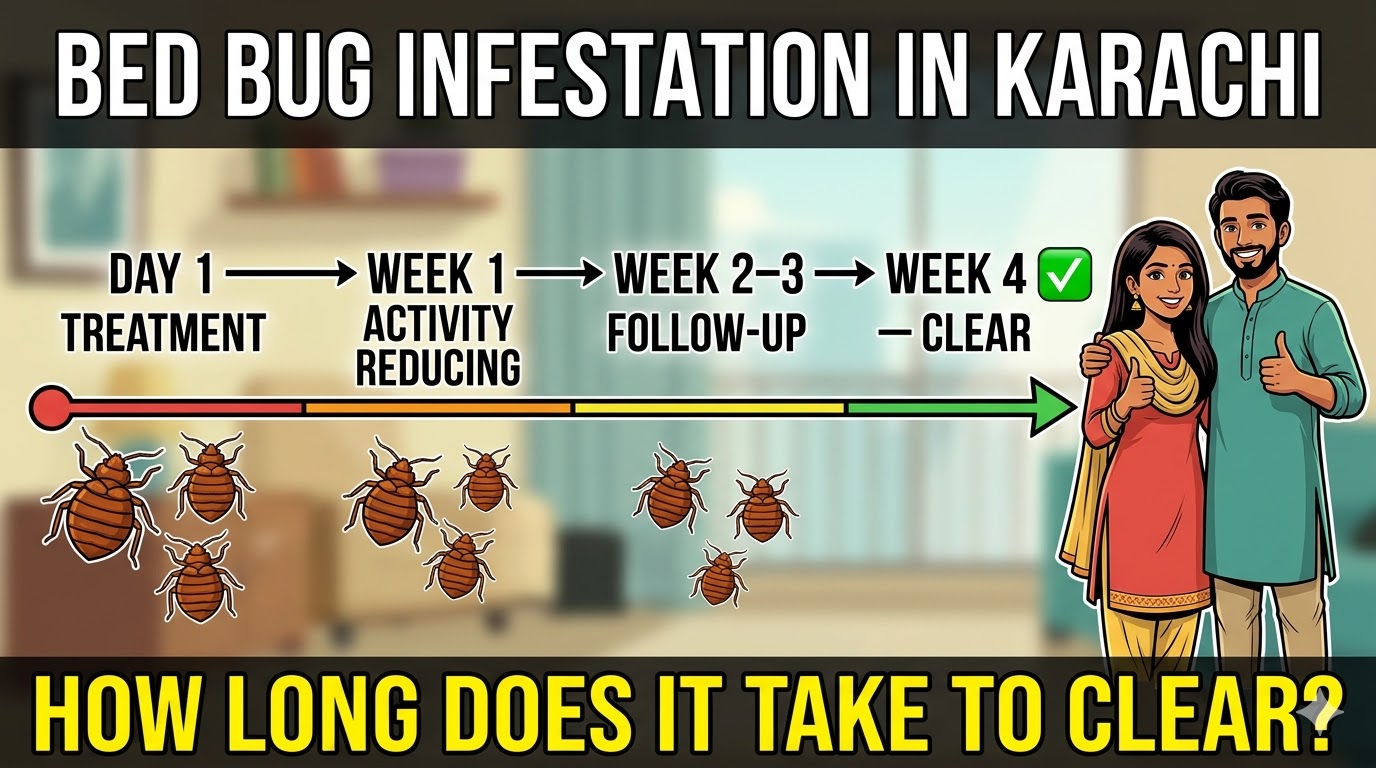
    For a moderate infestation in a standard Karachi flat — treated professionally with a multi-visit protocol — most homeowners see a significant reduction in activity within 2 weeks of the first treatment, and complete elimination within 4–8 weeks including follow-up visits. Severe infestations or those that have spread to multiple rooms or multiple units in a building can take longer.

    If you are still seeing active bugs or getting new bites after 8 weeks of proper professional treatment, something in the treatment protocol needs to be reviewed.

    Why It’s Never Instant: The Life Cycle Factor

    Understanding why bed bug elimination takes weeks rather than days requires understanding the life cycle — specifically, the egg stage.

    A female bed bug lays 1–5 eggs per day, cementing them into cracks and seams. Most professional insecticides are highly effective against adult bugs and nymphs but significantly less effective against eggs. Even a thorough first treatment will leave surviving eggs that will hatch within 6–10 days at Karachi room temperatures.

    This is not a treatment failure — it is a biological reality that professional pest controllers account for. It is why the follow-up visit, scheduled at 10–14 days after the first treatment, is essential. The follow-up targets newly hatched nymphs before they reach reproductive maturity (which takes 5–6 weeks), breaking the cycle.

    This is why single-visit treatments almost always fail: they kill the adults but leave the eggs, and the cycle restarts.

    Week-by-Week: What to Expect After Professional Treatment in Karachi

    Days 1–3: Increased Activity (Normal and Expected)

    Immediately after chemical treatment, it’s common to see more bed bugs than before — sometimes significantly more. This is not a sign that treatment failed. The disturbance and chemical residual causes bugs to emerge from their harborage sites, become more visible, and in many cases die on treated surfaces.

    Do not call the pest control company in a panic on day two. This is a normal part of the treatment process.

    Days 4–10: Declining Activity

    The number of bugs you see (and the frequency of bites) should begin declining noticeably within a week. The residual chemical continues killing bugs as they come into contact with treated surfaces. You may still see occasional bugs during this period — this is normal.

    Days 10–14: The Critical Follow-Up Window

    This is when the follow-up treatment should happen. Eggs laid before the first treatment are now hatching. If you have engaged a professional bed bug treatment service in Karachi that follows a proper protocol, your technician will return at this point for the second application, targeting newly hatched nymphs.

    Skipping this visit because things seem “much better” is a common mistake. The infestation is not over yet — it’s in a vulnerable window.

    Weeks 3–4: Major Reduction

    After the second treatment, activity should drop to near zero. You should not be experiencing regular bites. If you do see occasional bugs, they are likely stragglers from harborage areas that were partially missed — not a sign of reinfestation.

    Weeks 5–8: Confirmation Period

    Continue monitoring using active interceptor traps placed under bed legs. Check these every few days. If the traps remain empty for 4–6 consecutive weeks after the last treatment, combined with no new bites and no visible evidence, the infestation can be considered cleared.

    Week 8+: Third Treatment (If Needed)

    For severe infestations, or those that had spread to multiple rooms, a third treatment may be warranted. Your pest control provider should assess at the week 4–6 mark whether a third visit is necessary.

    Factors That Extend the Timeline in Karachi

    Several factors specific to Karachi conditions can extend the clearance timeline:

    Karachi’s Year-Round Warmth Accelerates Egg Hatching

    In cooler climates, eggs may take up to 21 days to hatch. In Karachi’s warm conditions (24–32°C year-round in most flats), hatching can occur in as little as 6 days. This compresses the window between first and second treatment — if your follow-up visit is delayed beyond 14 days, a new generation may already be developing.

    Re-infestation From Neighbouring Units

    In dense apartment buildings in areas like Nazimabad, Liaquatabad, Federal B Area, and Orangi Town, treatment of a single flat may be undermined by continuous re-entry of bugs from neighbouring units through wall voids and shared infrastructure. If you’re experiencing recurring infestations despite proper treatment, the building as a whole may need to be addressed.

    Missed Harborage Sites

    If treatment didn’t reach all harborage sites — particularly wall voids, inside electrical fittings, or deeply embedded in heavy furniture — surviving populations can restart the infestation. This is why professional inspection quality matters as much as the quality of the products used.

    Inadequate Preparation

    Homes that were not properly prepared before treatment (cluttered floors, furniture against walls, unsealed clothing) will have more surviving populations post-treatment, extending the timeline.

    How to Monitor Progress During Treatment

    Don’t rely solely on bites to monitor progress. Use these methods:

    • Bed leg interceptor traps: Place these under all four legs of the bed. Check weekly. Declining trap counts are a reliable indicator of progress.
    • Visual inspection of mattress seams: Check every 3–5 days. Declining evidence (fewer fresh dark spots) indicates the population is reducing.
    • White cloth test: Once a week, run a damp white cloth along the mattress seams and bed frame — any bugs, eggs, or dark material will transfer to the cloth.
    • Keep a log: Note dates, number of bugs seen, trap catches, and whether you experienced bites. This log helps your treatment provider make informed decisions about follow-up strategy.

    When Should You Be Concerned?

    Contact your pest control provider if:

    • You are still experiencing frequent bites more than 3 weeks after the first treatment
    • You are seeing live bugs in large numbers more than 2 weeks after treatment
    • Activity appears to be increasing rather than declining
    • New harborage sites have been discovered that weren’t treated initially

    A good pest control company will want to know this information and will respond with a plan — not dismiss your concerns.

    When Is It Truly Over?

    Bed bug elimination is confirmed when:

    • No live bugs or eggs are found during a thorough inspection
    • Interceptor traps have been empty for 4–6 consecutive weeks
    • No new bites have occurred for at least 3–4 weeks
    • A professional re-inspection (recommended) confirms no activity

    Do not remove interceptor traps or fully relax vigilance after just 2 weeks of no activity. The 4–6 week monitoring window exists specifically because the life cycle allows for slow-developing eggs to hatch late.

    A Realistic Summary

    For most Karachi homeowners with a moderate infestation caught reasonably early:

    • Significant relief after first treatment: 1–2 weeks
    • Follow-up treatment: 10–14 days after first treatment
    • Near-complete elimination: 4–6 weeks after treatment begins
    • Confirmed clearance: 6–8 weeks after treatment begins

    For severe infestations or building-wide problems, plan for 8–12 weeks of monitoring.

    Start the Clock — Book Your Treatment Today

    The sooner treatment begins, the shorter the total timeline to a bug-free home. Every week of delay is more eggs, more bugs, and a longer road to resolution. Contact our team for a free inspection and let us begin the process of clearing your Karachi flat of bed bugs with a protocol that’s built for your specific situation. Reach us through Karachi Fumigation Services — professional pest control delivered with honesty and accountability.

  • Bed Bug Treatment Preparation Checklist for Karachi Households

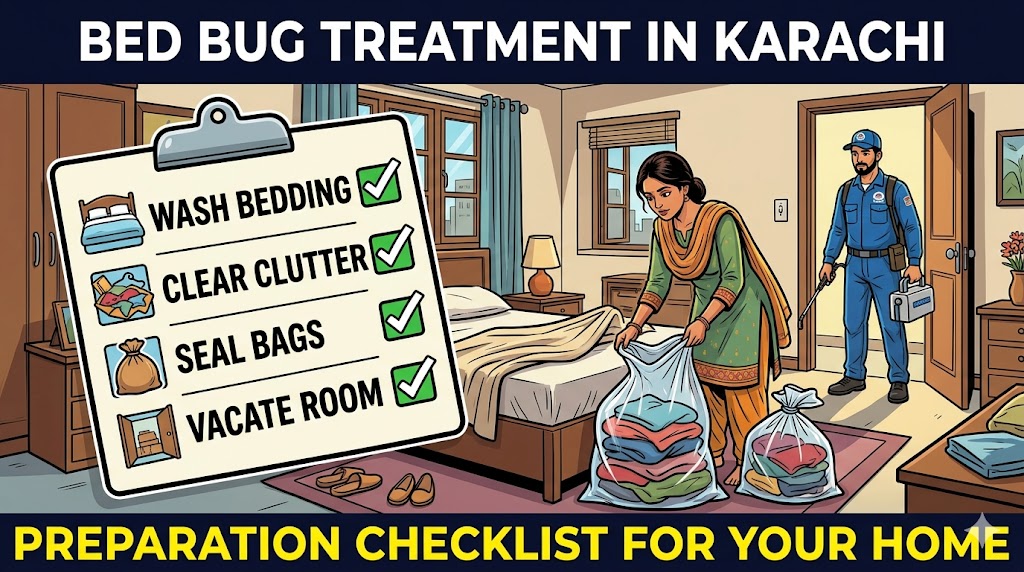
    Bed Bug Treatment Preparation Checklist for Karachi Households

    You’ve booked a professional bed bug treatment. You’ve taken the first and most important step. But how well your home is prepared on treatment day has a direct, significant impact on how effective the treatment will be.

    Many treatment failures in Karachi can be traced back to inadequate preparation — not inadequate products or untrained technicians, but a home that wasn’t ready for treatment. Clutter blocks chemical access. Undisturbed piles of clothing give bugs safe refuges. Furniture pushed against walls prevents treatment of critical areas.

    This comprehensive checklist is designed for Karachi households. Use it to prepare every room that will be treated, completing each section the day before your treatment appointment.

    Why Preparation Matters So Much

    Professional-grade bed bug insecticides need direct contact or proximity to harborage sites to be effective. If a crack is blocked by a pile of books, or a wardrobe base is covered by shoes, treatment cannot reach the bugs hiding there.

    Proper preparation:

    • Ensures treatment reaches every harborage site
    • Reduces the number of bugs that escape treatment and seed a new population
    • Makes follow-up treatments more effective
    • Protects your belongings during and after treatment

    Think of it this way: a professional treatment is only as good as the access you give the technician.

    Bedroom Preparation Checklist

    Bedding and Linens

    • Strip all sheets, pillowcases, duvet covers, and blankets from the bed
    • Place them in sealed plastic bags immediately — do not carry them loosely
    • Wash on the hottest setting tolerable (60°C+) and dry on maximum heat
    • Store clean, dried bedding in sealed bags away from the treatment area — do not return to the bed until after treatment is complete and the room has been aired
    • Remove and bag all decorative cushions and pillow covers from the room

    Mattress and Bed Frame

    • Move the mattress away from the wall — your technician will need access to all sides and the base
    • If possible, stand the mattress upright against a clear wall so all surfaces are accessible
    • Move the bed frame away from the wall — there should be at least 30cm of clear access on all sides
    • Remove any items stored under the bed and wash, inspect, or seal them in bags

    Furniture and Storage

    • Empty all wardrobe and drawer contents — clothes and soft items should be washed and sealed in bags
    • Remove all items from shelving near the bed
    • Move furniture at least 30cm away from walls so skirting boards are fully accessible
    • Disassemble any bed frames that can be taken apart — this gives technicians access to internal joints
    • Remove all items from under sofas and chairs in the room

    Electrical and Wall Areas

    • Remove and bag any items hung on walls in the treatment area
    • Remove picture frames and mirrors near the bed and lean them against a cleared wall
    • Ensure electrical socket plates near the bed are accessible — technicians will need to treat behind these

    Living Room and Common Areas Preparation

    • Remove cushion covers from all sofas and chairs — wash and bag them
    • Move sofa cushions to allow access to the frame underneath
    • Clear the floor of rugs, mats, toys, and loose items
    • Move sofas and chairs away from walls
    • Remove items from shelving units near sleeping or resting areas
    • Clear coffee tables and side tables completely

    Kitchen and Non-Sleeping Areas

    Bed bugs don’t typically inhabit kitchens (there’s no host nearby), but if the infestation is heavy or the kitchen doubles as a sleeping area, the same principles apply. For standard treatments:

    • Cover and seal any exposed food and utensils — some products require this
    • Remove pet food and water bowls from the treatment area
    • Ensure pets are out of the treatment area and kept away for the duration specified by your treatment provider

    Clothing and Soft Items

    This is one of the most important and most overlooked preparation tasks. Clothing left in the treatment area during spraying may absorb chemical residuals — wash them before putting them back on. More importantly, unwashed clothing that has been in contact with infested areas can re-introduce bugs after treatment.

    • All clothing in the infested room should be washed on 60°C+ and dried on maximum heat
    • Sealed bags of laundered clothing should be stored outside the treatment area
    • Don’t return clothing to wardrobes until after treatment is complete and the room has been confirmed clear
    • Shoes from the infested area should be inspected — bugs can hide in shoes

    Children and Pets

    Safety during and after professional treatment:

    • Children and pets must vacate the treated area for the duration specified by your treatment provider — typically 2–4 hours for spray treatments
    • Children’s toys in the treatment area should be bagged and sealed
    • Ensure children’s room is prepared with the same thoroughness as the master bedroom if it is being treated
    • Aquariums should be covered and air pumps turned off during chemical treatment

    Day-of Checklist

    On the morning of your treatment:

    1. Confirm all preparation tasks are complete
    2. Ensure all family members and pets know when they need to leave the property
    3. Have a bag ready with essentials you’ll need while the treatment is drying (phones, medications, documents)
    4. Leave keys accessible for the technician if you won’t be home
    5. Note down any areas you weren’t able to prepare and inform the technician on arrival

    After Treatment: Important Instructions

    Your bed bug treatment provider in Karachi will give you specific post-treatment instructions. General guidelines include:

    • Stay out of treated areas for the time period specified by your technician
    • Do not vacuum treated surfaces for at least 2 weeks — this removes the chemical residual that continues killing newly hatched bugs
    • Do not wipe or mop treated surfaces
    • Keep windows closed for the first few hours after treatment to allow products to work
    • Report any continued activity to your treatment provider — this is what the follow-up visit is for

    A Note on Karachi-Specific Conditions

    In Karachi’s hot and humid climate, preparation is even more important than in cooler environments. The heat accelerates the bed bug life cycle, meaning freshly hatched nymphs emerge faster. Ensuring treatment reaches every possible harborage site reduces the chance of any surviving population restarting the cycle before the follow-up visit.

    Additionally, in Karachi apartment buildings, the shared wall cavities can harbour bugs from neighbouring units. If your building has a history of infestation across multiple flats, mention this to your treatment provider — it affects the treatment strategy.

    Download and Use This Checklist

    Print or save this checklist and work through it systematically the day before your treatment. Assign tasks to different family members if needed — preparation is a household effort, but it’s worth every hour it takes.

    Book Your Treatment — We Handle the Rest

    Our team provides complete guidance to Karachi homeowners before, during, and after professional bed bug fumigation. When you book with us, we send you a full preparation guide specific to your home’s layout and infestation scope. Book your free inspection today and we’ll walk you through exactly what needs to happen before treatment day.

  • What to Do the Night You Discover Bed Bugs in Your Karachi Home: A Step-by-Step Response

    What to Do the Night You Discover Bed Bugs in Your Karachi Home: A Step-by-Step Response

    It’s late at night. You’ve pulled back your mattress and found what you were hoping you wouldn’t find: the telltale dark spots, maybe a live bug, maybe both. Your stomach drops. What do you do right now, tonight?

    The decisions you make in the first few hours after discovering a bed bug infestation can significantly affect how quickly and completely it gets resolved. The wrong moves — panic reactions that seem logical but aren’t — can spread the infestation further and make professional treatment harder. The right moves contain the problem and set you up for successful elimination.

    This is your step-by-step guide for tonight.

    Step 1: Stay Calm and Don’t Panic Spray

    The first instinct for many people is to grab a can of Mortein, Raid, or whatever insecticide is available and spray the mattress and surrounding area immediately. Resist this urge.

    Why? Because over-the-counter sprays used without a proper plan can cause bugs to scatter from their primary harborage area into the walls, other rooms, and other furniture. You might temporarily drive the infestation out of sight — but you’ll make professional treatment significantly more difficult and spread bugs that were previously concentrated in one area.

    Taking a breath and making smart decisions tonight is far more valuable than reactive spraying.

    Step 2: Do a Focused Inspection to Understand What You’re Dealing With

    Before you do anything else, take 20–30 minutes to properly inspect the area around the discovery. Use a bright torch and check:

    • All seams and folds of the mattress
    • The bed frame, headboard joints, and any screw holes
    • Behind the headboard if it’s wall-mounted
    • The nightstand drawers and joints
    • Electrical sockets on the wall near the bed

    The goal is to understand the rough extent of the infestation tonight — is it limited to one area, or have you found evidence in multiple locations? This information will be important when you call a professional tomorrow morning.

    Photograph everything you find. Dark spots on seams, shed skins, eggs, live bugs — photograph it all. This documentation helps the pest control team plan an effective treatment.

    Step 3: Contain — Do Not Spread

    This is the most important principle for tonight: do not move infested items to other rooms. This is the number one mistake Karachi homeowners make on discovery night.

    Do NOT do the following tonight:

    • Move the mattress to another room or to the balcony — bugs will travel off it and into new areas
    • Carry pillows, sheets, or clothing through the house in your arms — put them directly into sealed plastic bags first
    • Move furniture to a different room — satellite populations will spread
    • Go sleep in another room without first checking that room — you may be carrying bugs with you

    Step 4: Bag and Isolate Bedding

    What you should do with bedding tonight:

    1. Take all sheets, pillowcases, duvet covers, and pillows directly off the bed.
    2. Place them immediately into a sealed plastic bag — don’t carry them through the house loosely.
    3. If your washing machine is accessible tonight, run the bedding on the hottest setting the fabric allows (60°C or higher), followed by the highest heat dryer cycle.
    4. If washing isn’t possible tonight, keep the bags sealed until morning.
    5. Store the clean, dried bedding in a clean sealed bag until treatment is complete — don’t put it back on the mattress.

    Step 5: Vacuum the Immediate Area

    A thorough vacuum of the mattress, bed frame, and surrounding floor will remove many surface bugs, eggs, and shed skins. Important points:

    • Use a vacuum with a bag (not bagless) if possible — dispose of the bag immediately after in a sealed plastic bag placed outside your home
    • If using a bagless vacuum, empty the canister outside into a sealed bag immediately and clean the canister
    • Do not vacuum treated areas before your pest control team arrives — wait for guidance
    • Vacuum seams, folds, and cracks of the mattress thoroughly, as well as the floor around the bed, the bed frame, and the skirting boards

    Vacuuming doesn’t eliminate a bed bug infestation — but it reduces the immediate surface population and makes the environment cleaner for professional treatment.

    Step 6: Create a Barrier Around the Bed

    If you need to sleep tonight (and most people do), you can reduce exposure while you wait for professional treatment. Consider:

    • Moving the bed away from the wall on all sides so bugs can’t climb up via the wall
    • Placing each bed leg in a bed bug interceptor trap (a plastic cup with talcum powder, or commercially available interceptors) — bugs can’t climb the slippery surface
    • Ensuring no bedding is hanging to the floor — this creates a bridge for bugs to climb up

    These are temporary measures. They do not eliminate the infestation — they reduce your exposure while professional treatment is arranged.

    Step 7: Call a Professional First Thing Tomorrow Morning

    Tonight, you’ve stabilised the situation. Tomorrow morning, your first task is to contact a professional pest control service. When you call:

    • Describe where you found the evidence and how extensive it appeared
    • Mention whether you’ve seen live bugs, eggs, and dark spots
    • Share your photographs if the company has a WhatsApp or email
    • Ask about their inspection and treatment process, and specifically about follow-up visits
    • Ask how quickly they can come — for active infestations, within 24–48 hours is ideal

    Our team offers professional bed bug treatment across Karachi and can usually arrange an inspection within 24 hours of your call.

    What NOT to Do Tonight (Summary)

    To make this as clear as possible, here’s a quick list of things that will make your situation worse:

    • Spraying random insecticides — scatters bugs, may increase spread
    • Moving infested items to other rooms — spreads the infestation
    • Throwing away all furniture tonight — unnecessary (bugs can be treated) and you may carry bugs to the skip and then back inside on your clothes)
    • Sleeping in another room without precautions — you may carry bugs there
    • Waiting to see if it “gets better” — it won’t. Every day of delay is more eggs and more bugs.

    You’re Not Alone — This Happens More Than You Think

    Bed bug infestations are genuinely common in Karachi — across Defence, PECHS, Clifton, Gulshan, and every other neighbourhood. Dense housing, high humidity, and year-round warmth create ideal conditions for their spread. Finding them in your home is not a reflection of your cleanliness or how well you maintain your home.

    What matters now is the response: calm, systematic, and professional.

    Book Your Free Inspection Now

    Don’t wait through another sleepless night. Contact our fumigation services team in Karachi first thing tomorrow — or even right now if you prefer to WhatsApp us — and book your free bed bug inspection. Our team will assess your situation quickly, explain the treatment plan clearly, and get you on the road to a bug-free home as fast as possible.

  • How to Confirm You Have Bed Bugs in Your Karachi Home Before Calling a Company

    How to Confirm You Have Bed Bugs in Your Karachi Home Before Calling a Company

    Waking up with itchy red welts is alarming. Your first instinct might be to call a pest control company immediately — but before you do, it’s worth taking 30 minutes to do a proper inspection yourself. Not because professional help isn’t necessary (it almost certainly will be), but because confirming what you’re dealing with helps you communicate clearly with the treatment team, ensures the right treatment is planned, and prevents you from paying for treatment of the wrong pest.

    This guide walks you through exactly how to inspect your Karachi home for bed bugs — what tools you need, where to look, and how to interpret what you find.

    Why Confirming the Pest Matters

    Not every bite is a bed bug bite. In Karachi, mosquitoes, fleas (especially in homes with pets), mites, and even allergic reactions can produce skin reactions that look similar. Calling a pest control company for bed bugs when you actually have a flea problem leads to the wrong treatment being applied.

    Conversely, many Karachi residents who do have bed bugs don’t realise it for weeks because they attribute bites to mosquitoes. During those weeks, the infestation grows significantly.

    A proper inspection resolves the uncertainty in either direction, and the evidence you gather helps a professional team understand the scope of the problem before they arrive.

    What You’ll Need for the Inspection

    You don’t need any specialist equipment. Gather:

    • A bright LED torch or phone flashlight
    • A credit card, old loyalty card, or thin plastic card (to probe seams and cracks)
    • A white sheet of paper or a white cloth to catch fallen bugs or debris
    • Disposable gloves
    • A magnifying glass if available (helpful but not essential)
    • A phone for taking photos of any evidence you find

    Where to Look: Room by Room

    The Bed — Your Primary Search Area

    Bed bugs are named for their habitat. The bed is always the first and most thorough inspection area.

    Mattress: Strip all bedding completely. Inspect every seam of the mattress — run your card along the seam as you look, because bugs and eggs hide in the folded edge. Look at both sides and all four sides. Check any tufts or stitching details. Look for:

    • Dark spots (1–2mm) — bed bug excrement, which appears as dark ink dots
    • Rust-coloured smears — dried blood, often from a bug crushed during sleep
    • Tiny white oval eggs — usually cemented along seam folds
    • Translucent yellow shed skins (exuviae)
    • Live bugs — flat, oval, reddish-brown, roughly 5mm long when unfed

    Bed frame and headboard: This is often the heaviest concentration area. Unscrew the headboard from the wall if it’s wall-mounted, or pull the bed slightly away from the wall. Inspect every joint, groove, and crack. Run your card into the gaps. Bugs cluster in these areas in large numbers in established infestations.

    Box spring: If your bed has a box spring, inspect along every seam and edge. The fabric backing is often a major harborage area. Lift the mattress completely to inspect the top of the box spring.

    Bedside Furniture

    Nightstands, bedside tables, and any furniture within 1–2 metres of the bed are common satellite harborage areas. Open every drawer and inspect the inside edges. Check the joints where legs meet the frame. Pull furniture away from the wall and inspect the back surfaces.

    Sofas and Upholstered Furniture

    In heavier infestations, or in homes where people frequently sleep on the sofa, upholstered furniture becomes infested. Inspect all seams, under cushions, and along the bottom edge of the frame. Lift the cushions and check underneath.

    Walls and Electrical Points

    Bed bugs travel along walls and hide behind electrical socket plates, light switches, and wall frames near sleeping areas. Gently pull these plates away (after turning off the power at the breaker) and shine your torch inside. This is a spot many homeowners miss entirely.

    Check also: any picture frames or mirrors hanging close to the bed, any cracks in plaster or paint, and the junction between wall and skirting board.

    Wardrobe and Clothing Storage

    In heavier infestations, bugs migrate to wardrobes. Check along the inside edges and joints of the wardrobe, especially if it is close to the sleeping area.

    Interpreting What You Find

    Here’s a quick guide to what different signs tell you about the infestation:

    • Only dark spots, no live bugs: Early or moderate infestation. Bugs are present but may be hidden deeply. Professional treatment is needed.
    • Dark spots plus shed skins: Active infestation with ongoing reproduction. Urgency is high.
    • Live bugs visible in daylight: Significant infestation. When bugs are visible outside their normal nocturnal hiding period, the population is large enough that hiding spots are crowded.
    • Eggs found: Treatment must include follow-up visits to catch newly hatching nymphs. Flag this to your treatment provider.
    • Infestation in multiple areas of the home: The spread is already established. Multiple rooms need to be treated simultaneously.

    How Bite Patterns Help Confirm the Pest

    While bites alone can’t definitively confirm bed bugs (they look similar to other bites), the pattern can help:

    • Bed bugs: Bites typically appear in a line or small cluster (3 or more bites close together). They appear on exposed skin — arms, neck, face, legs. They itch intensely the next day.
    • Mosquitoes: Random placement, no pattern, typically larger welt with a central puncture mark.
    • Fleas: Concentrated around the ankles and lower legs, associated with pet presence.

    Bed bug bites may not appear until 24–72 hours after the bite. Some people react strongly; others show almost no visible reaction at all, which is why physical evidence from the inspection matters more than bites alone.

    Document Your Findings Before Calling

    Before you call a professional, photograph everything you’ve found. Good documentation:

    • Helps the pest control team understand the scope before they arrive
    • Enables a more accurate quote
    • Ensures the right treatment protocol is planned
    • Provides a baseline for post-treatment comparison

    Once you’ve confirmed the infestation, contact a professional for a thorough bed bug inspection and treatment in Karachi. Share your photos and inspection findings with them.

    Book Your Free Professional Inspection

    Your own inspection is a valuable first step — but a professional inspection will check areas you may not have access to, use detection tools you don’t have at home, and give you an accurate picture of the full extent of the infestation. Contact Fumigation Services in Karachi today to book your free inspection. Our team will confirm exactly what you’re dealing with and recommend the right treatment plan for your specific situation.