Author: Ahmad Karimi

  • Pest Control in Clifton Karachi: What Residents Deal With Most by Area and Floor Level

    Pest Control in Clifton Karachi: What Residents Deal With Most by Area and Floor Level

    Clifton is one of Karachi’s most prestigious and densely populated residential districts, home to everyone from long-established families in sea-facing bungalows to young professionals in high-rise apartments off Khayaban-e-Iqbal. It is a neighbourhood of contradictions: immaculate lobbies can sit alongside overflowing nullahs; luxury high-rises can share a block with aging low-rise housing societies.

    These contradictions create a uniquely complex pest environment. The types of pests Clifton residents encounter — and the severity of those encounters — vary significantly depending on which block you live in, how close you are to the sea or the nullah, and which floor of a building you occupy.

    This guide breaks down exactly what Clifton residents are dealing with, area by area and floor by floor, so you can understand your specific risk and take the right action.

    Why Clifton Has a Distinct Pest Profile

    Several factors make Clifton’s pest challenges different from those in drier inland areas like Gulberg or North Karachi:

    • Coastal proximity: The sea-facing areas of Clifton — particularly Blocks 1 through 4 — have consistently higher humidity, which promotes cockroach, mosquito, and silverfish activity year-round
    • Nullah and drainage proximity: The Clifton nullahs, particularly near Khayaban-e-Roomi and the older sections of Block 2 and 3, have historically been pest breeding grounds
    • Mixed building age: Colonial-era bungalows sit alongside 1990s apartments and modern high-rises, meaning the pest challenges are not uniform across the area
    • Proximity to the sea breeze: Salt-laden air accelerates building material deterioration, creating cracks and gaps that provide pest entry points faster than in inland areas
    • Street-level commercial activity: Ground-floor restaurants, bakeries, and grocery stores throughout Clifton create pest attractors that affect adjacent residential units

    Block-by-Block Pest Breakdown

    Clifton Block 1, 2, and 3: The Sea-Facing Zone

    Properties closest to the sea — particularly the bungalows and older apartment buildings in Blocks 1, 2, and 3 — face the most persistent cockroach and mosquito problems in all of Clifton. The combination of salty humidity, aging drainage infrastructure, and proximity to the tidal flats creates year-round pest pressure.

    American cockroaches (Periplaneta americana) are the dominant pest in these blocks. They thrive in the large drainage systems running beneath these older properties and enter homes through drains, gaps in flooring, and deteriorated pipe seals. Residents in ground-floor and first-floor units in Block 1 and 2 report cockroach sightings as a near-nightly occurrence without regular treatment.

    Mosquito breeding in stagnant water along the coastal scrubland and in poorly maintained rooftop water tanks is also a major issue. Dengue-carrying Aedes aegypti mosquitoes are active across these blocks, with peak risk from July through October during and after monsoon.

    Clifton Block 4 and 5: The Core Residential Zone

    Blocks 4 and 5 contain some of Clifton’s most densely populated residential streets, including the housing societies along Khayaban-e-Saadi, Khayaban-e-Iqbal, and Khayaban-e-Tariq. The pest mix here is broader:

    • Rodents: Block 4 has a persistent rat problem driven by the density of food establishments along main commercial strips and the presence of older residential buildings with structural gaps. Roof rats (Rattus rattus) are common in upper floors and attics.
    • Cockroaches: Both German and American cockroaches are present. German cockroaches are particularly prevalent in apartment kitchens and are notoriously difficult to eliminate without professional gel baiting.
    • Bed bugs: Hospitality and short-term rental properties in this zone have contributed to bed bug spread into adjacent residential buildings. If you have recently moved in or had guests, a bed bug inspection is worthwhile.
    • Ants: Pharaoh ants and black garden ants are active in most buildings in Block 4 and 5, particularly during summer months.

    Clifton Block 6, 7, and 8: The Newer Residential Zones

    Blocks 6, 7, and 8 represent some of Clifton’s newer development areas and tend to have lower overall pest pressure than the older coastal blocks — but they are not problem-free:

    • Termites: Several housing societies in Block 8 built on or near former agricultural land have reported subterranean termite activity. Newer construction does not mean termite-proof construction.
    • Mosquitoes: Block 7 properties near the nullahs and underdeveloped green spaces face seasonal mosquito spikes.
    • Pigeons and bird mites: High-rise buildings in Block 6 and near Khayaban-e-Mujahid frequently deal with pigeon nesting in AC units, water tanks, and rooftop areas — which subsequently introduces bird mites into upper-floor apartments.

    The Floor Level Factor: How Your Floor Determines Your Pest Risk

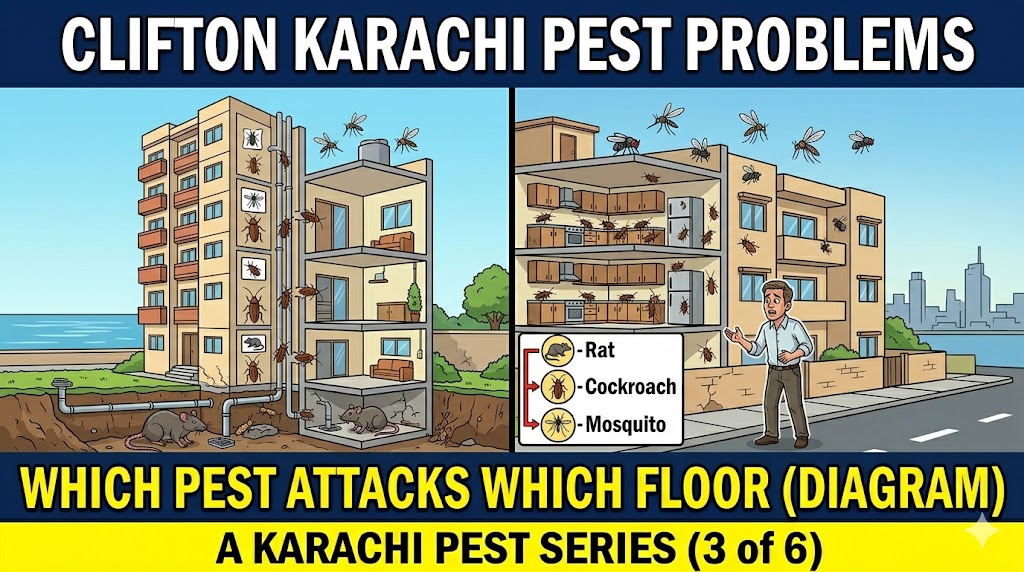
    In Clifton’s apartment buildings, your floor level has a direct and significant impact on the types and intensity of pest problems you experience. This is one of the most important — and least discussed — aspects of urban pest control in Karachi.

    Ground Floor and Basement Units

    Ground-floor units in Clifton face the highest and most diverse pest pressure of any floor level. Direct contact with soil and drainage infrastructure means:

    • Subterranean termites can enter directly through foundation cracks and plumbing channels
    • Cockroaches enter via drains, gaps at wall-floor junctions, and utility pipe entries
    • Rats have easy entry through low-level gaps, grilles, and building perimeter weaknesses
    • Ants establish nesting sites in ground-floor walls and floor cavities
    • In basement units, dampness creates ideal conditions for silverfish, centipedes, and mold-associated pests

    Ground-floor residents in Clifton should have professional pest treatments every 3 to 4 months at minimum. Waiting for a visible problem to appear is too late — by then, infestations are established.

    First to Fourth Floor Units

    Lower-to-mid floor apartments are primarily affected by cockroaches migrating upward through drains and electrical conduits, and by pests entering through windows and balcony doors. Key risks include:

    • German cockroaches spreading from ground-floor infestations or neighbouring kitchens via shared walls and piping
    • Mosquitoes, particularly in units facing gardens, nullahs, or uncovered water features
    • Ants, particularly if food storage is not properly sealed
    • Rodents in buildings where the ground floor has an active infestation — rats and mice will travel upward through false ceilings and pipe chases

    Residents on these floors often assume they are safe because they are “not on the ground floor.” This is a dangerous assumption in Clifton’s older buildings where drainage and plumbing infrastructure is shared and aging.

    Fifth Floor and Above

    Upper-floor residents are not pest-free — they face a different set of challenges:

    • Roof rats: These rodents are expert climbers and regularly inhabit attics, rooftop water tank rooms, and false ceilings on upper floors of Clifton’s high-rises
    • Bird mites and pigeon-associated pests: Rooftop nesting pigeons introduce mites that enter through roof spaces and AC systems into upper-floor apartments
    • Flying insects: Mosquitoes and flying ants at upper floors tend to enter through unscreened windows and balconies, often drawn to indoor lighting
    • Cockroaches from rooftop water tank rooms: Poorly maintained rooftop tanks and associated plumbing are a common infestation source for top-floor apartments

    Upper-floor residents who assume pests are a “ground floor problem” often discover an active infestation well after it has become established.

    Seasonal Pest Patterns in Clifton

    Clifton’s coastal climate produces distinct seasonal pest spikes that residents should prepare for:

    • March to May (Pre-Monsoon Heat): Termite swarms (alates), ant activity, and initial cockroach population rises as temperatures climb
    • July to September (Monsoon): Peak mosquito activity, rodent displacement from flooded street drains into buildings, cockroach infestations intensified by humidity
    • October to November (Post-Monsoon): Residual mosquito activity, silverfish increase as humidity remains high indoors
    • December to February (Winter): Reduced activity overall but rats and mice seek indoor warmth, and bed bug activity is not seasonal — winter offers no protection

    What Clifton Residents Often Get Wrong About Pest Control

    Several common misconceptions lead Clifton residents to underestimate their pest problems or use ineffective solutions:

    • Misconception 1 – “Spraying once is enough”: Over-the-counter sprays kill visible pests but do not reach nesting sites or colonies. Professional treatments target the source.
    • Misconception 2 – “I live on a high floor, I am safe”: As described above, upper floors face distinct pest risks that are often more difficult to detect.
    • Misconception 3 – “New construction means no pests”: Pests colonise new buildings within months through drainage connections to older adjacent structures.
    • Misconception 4 – “I have not seen any pests”: Cockroaches, termites, and rodents are nocturnal and largely hidden. Absence of sightings does not mean absence of infestation.

    Professional Pest Control: What to Expect in Clifton

    A professional pest control service for a Clifton residential property should include a full inspection before any treatment is applied. For apartments, this means checking kitchen drains, bathroom seals, balcony junctions, and utility cupboards. For bungalows, it extends to the soil perimeter, garden vegetation, roof space, and false ceilings.

    Treatment protocols should be specific to the pests identified — a cockroach gel baiting treatment is very different from a mosquito fogging programme or a termite soil injection. Be wary of services that apply one-size-fits-all chemical sprays without conducting an inspection first.

    If you are a Clifton resident looking for professional assessment, our team offers dedicated pest control services in Karachi with specific expertise across all Clifton blocks and building types.

    Book Your Free Clifton Pest Inspection

    Whether you are in a ground-floor unit dealing with cockroaches and rats, a mid-floor apartment experiencing unexplained bites, or a top-floor resident who has noticed something moving in the ceiling, the right step is a professional inspection.

    Do not wait until the problem is visible and established. Contact us today to book a free pest inspection for your Clifton property. Our inspectors know the specific building types, drainage infrastructure, and pest patterns in each Clifton block — and we will give you a clear, honest report along with a treatment plan tailored to your specific situation.

    Call us, WhatsApp us, or submit an inquiry online. Clifton residents deserve pest-free homes — let us help you get there.

  • Why DHA Karachi Bungalows Have Some of the Worst Termite Damage in the City

    Why DHA Karachi Bungalows Have Some of the Worst Termite Damage in the City

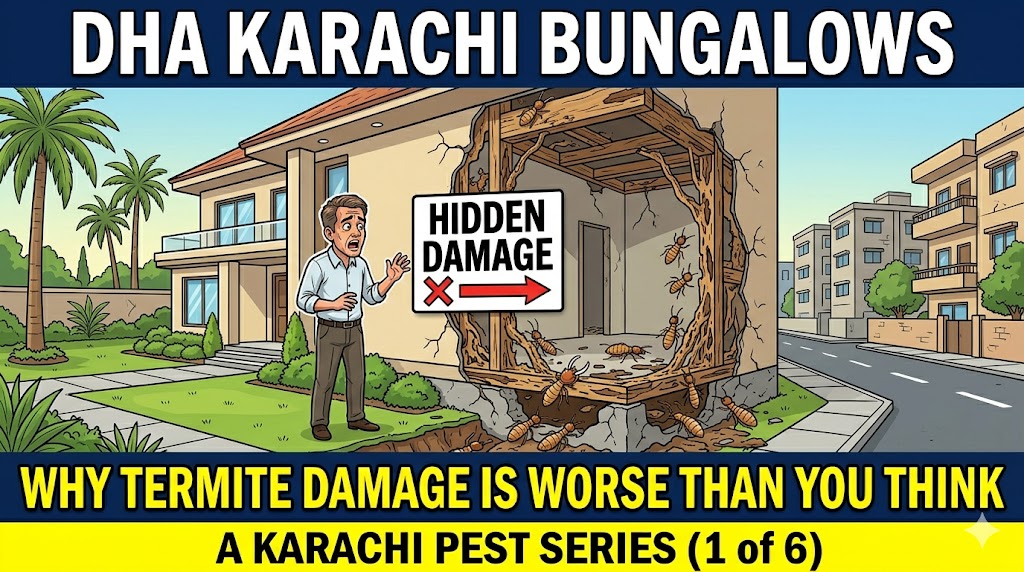
    If you own or live in a bungalow in Defence Housing Authority (DHA) Karachi, you may already know the sinking feeling of tapping on a wooden door frame and hearing a hollow echo where solid wood used to be. That hollow sound is termites — and in DHA, they are not a rare problem. They are practically a neighbourhood fixture.

    DHA bungalows, despite being among the most desirable and well-maintained properties in Karachi, are disproportionately vulnerable to termite infestations compared to apartments and newer constructions in other parts of the city. Understanding why this happens — and what you can do about it — is the first step toward protecting one of your most valuable assets.

    This guide is written specifically for DHA homeowners who want to understand the unique termite risks in their properties, what the warning signs look like, and when to act.

    The DHA Factor: Why Bungalows Are at Higher Risk

    Not all properties are equally attractive to termites. Bungalows in DHA have a combination of structural, environmental, and historical features that make them almost ideal termite habitats. Let us break down each risk factor in detail.

    1. Age of Construction and Expired Chemical Treatments

    Much of DHA Karachi was developed across Phases I through VI between the 1970s and early 2000s. Construction during this era used substantial quantities of natural wood — door frames, window shutters, ceiling beams, roof trusses, built-in wardrobes, and staircases — treated with anti-termite chemicals available at the time.

    Those chemical treatments, including organochlorines such as chlordane and heptachlor, were effective for approximately 15 to 25 years under ideal conditions. However, few DHA bungalows have ever received a full chemical re-treatment since original construction. That means decades of exposed, untreated timber are sitting inside the walls of homes across Phase II, III, IV, and V right now — unprotected and vulnerable.

    The older the bungalow, the greater the likelihood that its original termite-proofing has completely broken down. This is one of the single biggest drivers of DHA’s termite problem.

    2. Soil Conditions and Underground Termite Networks

    DHA Karachi sits on coastal alluvial soil — compacted, moisture-retaining earth that is almost perfect for subterranean termite colonies. The species most active across DHA is Heterotermes indicola, a subterranean termite native to South Asia that builds enormous underground colonies and can travel dozens of metres through the soil to reach a food source.

    Bungalows, unlike apartments, have direct soil contact at their foundations. Mud tubes — the pencil-thin earthen tunnels termites build to travel from underground — are commonly found along the exterior base walls of DHA bungalows, rising from the soil up toward wooden components. In DHA’s wide plots with gardens and mature trees, there are abundant moisture sources and root systems that termite colonies exploit as bridges toward your home.

    3. Mature Trees, Gardens, and Landscaping

    DHA is one of the greener residential areas of Karachi. Streets lined with neem, gul mohr, and bougainvillea are part of the neighbourhood’s charm — but decaying root systems from mature trees, mulched flower beds, and timber pergolas or gazebos create some of the most common entry points for termite colonies onto private property.

    Once termites colonise a garden tree stump, a wooden boundary wall frame, or a landscaped raised bed, the distance to your bungalow’s foundation is often just a few metres. Subterranean termites cover this distance underground, completely undetected, until they emerge inside your walls. By that point, they have likely been feeding for months.

    4. The False Ceiling Problem

    A defining feature of older DHA bungalows is the false ceiling — typically a wooden or ply-based frame supporting decorative panels or thermal insulation. The space between the original concrete ceiling and the false ceiling creates a warm, dark, humid, and completely undisturbed environment that termites find ideal for nesting and foraging.

    Inspections across DHA regularly uncover termite galleries running through false ceiling joists for years without the homeowner being aware. By the time visible damage appears — sagging panels, powder trails, or surface cracks in the plaster — the colony has often been active for two to five years.

    5. Renovation Cycles That Spread Infestations

    DHA bungalows change hands and undergo renovations frequently. Every renovation cycle — kitchen remodel, bathroom upgrade, room addition, or external extension — involves breaking open walls and floors. This disturbs existing termite colonies, causing them to scatter and spread the infestation to previously unaffected areas of the home.

    Timber brought in during renovations from markets in Lyari, Shershah, or Jodia Bazaar has also been found to carry termite eggs and larvae. Infested imported timber is one of the most underappreciated vectors of new infestations in DHA bungalows — you may not even realise your renovation introduced the problem.

    Which DHA Phases Are Most Affected?

    While termites are active across all of DHA, certain phases carry significantly higher infestation risk:

    • Phase I and Phase II: The oldest properties, many with original untreated woodwork still in place. Extremely high risk.
    • Phase IV and Phase V: Larger bungalows with extensive garden areas and deeply embedded timber. Very high risk.
    • Phase VI and Phase VIII: More modern construction with better initial treatments, but risk grows with each passing year.
    • DHA Creek Vista and DHA City: Newer developments with modern pre-treatment, but proximity to coastal moisture remains a long-term risk factor.

    As a general rule: any bungalow over 10 years old without documented chemical re-treatment is at significant and growing termite risk.

    Common Signs of Termite Damage in DHA Bungalows

    Recognising early warning signs can mean the difference between a manageable treatment and a costly structural repair:

    • Hollow sound when tapping wooden door frames, window frames, or skirting boards
    • Thin mud tubes running along the exterior base of walls, along pipes, or between floor and walls
    • Cracked or bubbling paint on wooden surfaces where termites have created galleries just underneath
    • Fine powdery frass (termite droppings) appearing near wooden fixtures, furniture, or along walls
    • Doors and windows that have subtly warped and become difficult to open or close
    • Visible damage to roof wooden beams when accessing the attic or roof space
    • Swarms of winged termites (alates) near light sources in the evenings, especially March through May

    Even one of these signs warrants immediate professional assessment. Termite colonies do not stop growing on their own, and the damage compounds with every passing week.

    Why DHA Bungalows Fare Worse Than Apartments

    It is worth understanding why apartment dwellers — even in DHA — tend to have far fewer termite problems. Apartments above the ground floor have limited soil contact, reduced exposed timber, and building management structures that often handle periodic pest treatments for common areas.

    Bungalow owners carry individual responsibility for full-structure treatment. The combination of direct soil contact, mature garden vegetation, extensive structural woodwork, and aging chemical treatments creates conditions no apartment can replicate. This is why termite damage in DHA bungalows frequently runs deeper, lasts longer, and costs far more to repair than infestations elsewhere in the city.

    The True Cost of Inaction

    Termite damage is not just a maintenance issue — it is a serious financial risk. Replacing damaged roof trusses, door frames, window shutters, built-in furniture, and structural beams in a typical DHA bungalow can cost anywhere from PKR 2 lakh to well over PKR 10 lakh, depending on the extent of damage.

    Properties with undisclosed termite damage are also known to see significant reductions in resale value. When buyers conduct pre-purchase inspections — as is increasingly common in DHA’s active property market — termite damage is one of the most common reasons for price renegotiation or deal collapse.

    The cost of professional prevention and treatment is a fraction of these repair figures.

    What Effective Termite Control for DHA Bungalows Looks Like

    A proper termite treatment for a DHA bungalow should include all of the following:

    • Full property inspection including sub-floor, roof space, false ceilings, external walls, and garden perimeter
    • Soil treatment via termiticide injection around the foundation, drainage lines, and all known entry points
    • Wood treatment of all exposed timber using boron-based or other approved chemicals
    • Termite monitoring station installation around the garden perimeter if recommended
    • A written post-treatment warranty and a scheduled follow-up inspection

    DIY solutions — sprays, powders, and store-bought products — are not adequate for established subterranean termite colonies. Professional-grade chemicals and application equipment are required to penetrate the soil, reach the colony, and ensure the treatment holds over time.

    Preventive Steps Every DHA Homeowner Should Take

    If your bungalow has not had a termite inspection or treatment in the last five years, these preventive steps can reduce your risk:

    • Eliminate wood-to-soil contact wherever possible — raised planters, wooden boundary frames, and timber trellises touching the ground are key risk points
    • Fix leaking pipes, AC drain overflow, and water seepage immediately — termites are powerfully attracted to consistent moisture sources
    • Store firewood, timber off-cuts, and construction materials away from the main structure
    • Do not allow mulch or garden waste to accumulate against exterior walls
    • Schedule a professional inspection annually — early detection saves enormous cost and structural damage

    Book a Free Inspection Today

    DHA bungalow owners should not wait for visible damage before taking action. Termites are silent, methodical destroyers — by the time the evidence is obvious, the colony has been feeding for years. The right time to act is now, before the next monsoon season raises soil moisture levels and accelerates termite activity across the city.

    Our team provides professional fumigation services in Karachi with deep specialisation in termite detection, treatment, and prevention for DHA bungalows across all phases. We use licensed, government-approved chemicals and provide detailed post-treatment documentation.

    Do not let termites quietly destroy your most valuable investment. Contact us today to schedule a free, no-obligation termite inspection for your DHA bungalow. Our inspectors are familiar with the specific construction types across all DHA phases and will give you an honest assessment along with a clear, actionable plan.

    Call us, WhatsApp us, or fill out our online form. Protecting your home starts with one conversation.

  • Bahria Town Karachi Fumigation: Why New Developments Are Not Automatically Pest-Free

    Bahria Town Karachi Fumigation: Why New Developments Are Not Automatically Pest-Free

    Bahria Town Karachi is one of Pakistan’s most ambitious real estate projects — a self-contained city on the outskirts of Karachi that has been marketed, and largely perceived, as a premium, well-managed alternative to the chaos of the city proper. Gated communities, maintained green spaces, planned road networks, and modern apartment complexes have made it an aspirational address for thousands of Karachi families.

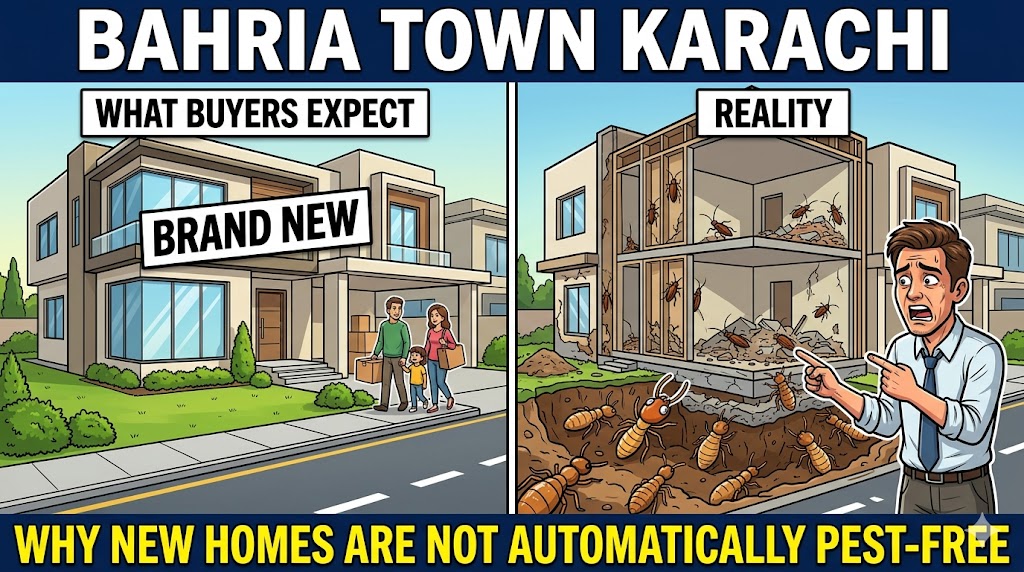
    But there is a persistent misconception among residents and prospective buyers: that Bahria Town’s planned development, modern construction, and professional management infrastructure somehow make pest problems less likely. That the fees, the gates, and the gleaming new facades translate into a pest-free living environment.

    They don’t. And this misconception — left unaddressed — leaves Bahria Town Karachi residents underprepared for pest problems that are both predictable and serious.

    This article explains the specific pest challenges facing Bahria Town Karachi’s residents, why new and planned developments carry their own vulnerabilities, and what homeowners need to do to actually protect their properties.

    The Planned Development Fallacy

    The appeal of a planned development like Bahria Town Karachi is real and justified in many ways. Roads are laid out in advance, utilities are designed systematically, and building standards are theoretically higher than in Karachi’s unplanned growth areas.

    But pest pressure doesn’t respect planning. Here’s the fundamental reality:

    Bahria Town Karachi is built on land that previously supported large populations of field rats, burrowing rodents, and the insect species that come with agricultural and semi-arid terrain. The act of construction — excavation, ground disturbance, vegetation removal — doesn’t eliminate these populations. It displaces and concentrates them.

    The development’s current construction boundary is enormous, and it is perpetually active. While one sector is fully completed and occupied, the adjacent sector is mid-construction and the one after that is being excavated. This means that at any given time, a significant portion of Bahria Town Karachi is a construction site — which is also prime rodent habitat — immediately adjacent to completed residential areas.

    And unlike in central Karachi, where pest populations have millennia of urban adaptation behind them, Bahria Town’s pests include field rodent species — notably the common bandicoot rat (Bandicota bengalensis) — that are larger, more aggressive, and more difficult to control than the house rat species common in older urban areas.

    Construction Phase Pest Legacy in Bahria Town

    Every completed sector in Bahria Town Karachi went through a construction phase that lasted months to years. During that phase:

    • Construction debris, timber, and stored materials provided nesting habitat for rodents
    • Temporary worker camps and canteen areas introduced cockroach species into the site
    • Ground disturbance concentrated displaced field rodent populations around the construction perimeter
    • Poor waste management during construction left food sources that sustained pest populations

    When construction ends and residents move in, these established pest populations don’t disappear. They adapt. The rats that were nesting in construction debris find their way into the completed buildings’ walls and ceiling voids. The cockroaches from the site facilities migrate into the newly occupied kitchens. Bahria Town Karachi’s gleaming new properties inherit a pest legacy before their first residents unpack their bags.

    This isn’t unique to Bahria Town — it is a universal characteristic of new development. But the scale of Bahria Town’s construction, and the type of terrain being developed, make this legacy particularly significant.

    The Bandicoot Rat Problem

    Bahria Town Karachi sits on land that, until relatively recently, supported extensive agricultural and semi-arid terrain. This terrain is home to the bandicoot rat — a species significantly larger and more behaviourally complex than the house rats common in established Karachi neighbourhoods.

    Bandicoots are burrowing rats. They create extensive underground tunnel systems, which means that physical exclusion — the standard technique for rodent control — is more difficult. They burrow under foundations, into garden areas, and beneath road surfaces. Their tunnels can destabilise garden walls and drainage channels over time.

    They are larger and more aggressive. Bandicoots regularly reach weights of 500 grams or more. They can cause structural damage that house rats typically cannot, and they are less deterred by standard rodent control measures.

    They enter buildings from below. While house rats typically enter through openings in walls and foundations, bandicoots often enter through floor drains, damaged floor slabs, and utility penetrations at ground level. Standard rodent-proofing at door and window level doesn’t address this entry route.

    Many Bahria Town Karachi homeowners who have dealt with what they thought was a standard rodent problem have been surprised to find evidence of bandicoot activity in their garden areas and ground floors. This is not a random occurrence — it is a predictable consequence of building on previously agricultural land.

    Karachi’s Climate Creates Year-Round Pest Pressure Even in Planned Areas

    Bahria Town Karachi’s location at the edge of the city does not remove it from Karachi’s climate. And Karachi’s climate is, as discussed in other contexts, among the most pest-hospitable in the world.

    The development’s location also introduces some specific climate-related challenges:

    Wind-blown dust and debris: Bahria Town’s exposed location means properties are subject to significant dust accumulation. Dust accumulation in HVAC systems, air gaps around windows and doors, and roof areas creates additional pest entry points and harbourage opportunities that well-sealed city-centre properties don’t face to the same degree.

    Green belt and landscape maintenance: Bahria Town’s landscaping — while attractive — provides significant pest habitat. Maintained lawns that are watered regularly create moist soil conditions ideal for subterranean insect activity. Dense planted borders harbour cockroaches and ants. Ornamental water features in some sectors attract mosquito breeding. The landscaping that adds to the development’s appeal is simultaneously adding to its pest pressure.

    Monsoon flooding and drainage: Parts of Bahria Town Karachi are in low-lying areas that experience significant water accumulation during the monsoon. Flooding events displace rodent populations from outdoor burrows into buildings, creating sharp seasonal spikes in rodent activity inside homes.

    Apartment Blocks vs. Villas: Different Challenges in the Same Development

    Bahria Town Karachi includes both high-rise apartment complexes and villa communities, and these housing types face different pest challenges that require different approaches.

    Apartment blocks: Share all the challenges of high-rise buildings discussed in other contexts — pests travelling between units through shared utilities, re-infestation from untreated neighbouring flats, moisture from shared water tanks. The same coordination problem that affects North Nazimabad’s high-rises applies in Bahria Town’s apartment towers. Professional, building-wide treatment is far more effective than individual unit treatment.

    Villa communities: Face different but equally serious challenges. Garden areas harbour bandicoots and provide rodent access routes to the home. Boundary walls with adjacent undeveloped plots are effectively bridges for rodent movement. Villas often have accessible roof areas that provide entry to ceiling voids — a route that apartment buildings typically don’t offer.

    Commercial areas within the development: Bahria Town’s internal commercial zones — the food courts, retail plazas, and market areas — are significant pest sources that affect surrounding residential properties. Commercial food waste, the constant movement of goods deliveries, and the density of food preparation create pest populations that spill into adjacent residential sectors.

    Why Bahria Town’s Management Cannot Solve Your Pest Problem

    Bahria Town Karachi does maintain common areas and infrastructure to a standard significantly above what most Karachi neighbourhoods receive. But residents sometimes assume that pest problems in their home are the responsibility of this management, or that the development’s general maintenance addresses individual property pest issues.

    It doesn’t, and it can’t. Bahria Town’s management can maintain common areas, but it has neither the mandate nor the ability to treat the interior of private properties. The pest management of your home — your kitchen, your bedrooms, your garden — is your responsibility.

    Furthermore, the management of common areas, while helpful, does not eliminate the pest pressure on individual homes. Well-maintained common areas reduce pest population density in shared spaces, but the constant arrival of new residents with their belongings, the ongoing construction at the development’s edges, and the pressure from surrounding terrain mean that pest pressure on individual properties is continuous and requires individual attention.

    The Construction Dust Problem and HVAC

    One pest entry route that is especially relevant in Bahria Town Karachi is the HVAC system. Many newer villas and apartments in the development have split air conditioning systems, ducted air handling units, or both. These systems have external components and ducting that, if not properly sealed, provide pest access routes that completely bypass the building’s external envelope.

    A rat or a cockroach that enters an HVAC conduit at the external unit can access ceiling voids, wall cavities, and in some configurations individual rooms via the supply air grilles. This is a surprisingly common but under-recognised entry route in Bahria Town’s newer builds.

    HVAC pest-proofing — fitting appropriate mesh screens at external unit penetrations, sealing conduit entries, and ensuring that supply and return air grilles have no gap between them and the wall — should be standard in any comprehensive pest control assessment for Bahria Town properties.

    What Effective Fumigation and Pest Control Looks Like in Bahria Town Karachi

    Given the specific challenges of Bahria Town Karachi — the bandicoot pressure from surrounding terrain, the construction legacy in recent phases, the HVAC vulnerability, and the ongoing development at the margins — effective pest control for the development’s residents needs to be comprehensive.

    External boundary assessment: Every property in Bahria Town needs an assessment of its external perimeter — looking for rodent burrows in garden areas, entry points through boundary walls, and evidence of bandicoot activity in areas adjacent to undeveloped land.

    Subterranean treatment where bandicoot activity is confirmed: Standard rodenticide bait stations are often insufficient for bandicoot control. Burrow treatment and physical exclusion of specific entry points are required.

    HVAC and utility penetration inspection: All external HVAC penetrations, conduit entries, and duct runs should be inspected and appropriately sealed or screened.

    Interior treatment matched to confirmed species: German cockroach gel baiting for kitchen and bathroom areas, targeted void treatments where rodent activity is confirmed in ceiling or wall cavities.

    Ongoing monitoring appropriate to the phase: Properties near Bahria Town’s active construction boundary need more frequent monitoring than those in established, fully developed sectors.

    A Word for Buyers and New Residents

    If you are considering purchasing a property in Bahria Town Karachi, or you have recently moved in, the single most important pest management step you can take is a professional inspection before or immediately after moving in.

    A pre-occupancy inspection identifies the specific vulnerabilities of your property — the unsealed penetrations, the bandicoot evidence in the garden, the HVAC gaps — before you have furniture in place and before any infestation has had time to establish. Treating a property before occupancy is faster, cheaper, and more effective than treating an established infestation.

    For existing residents experiencing recurring pest problems despite previous treatments, the answer is almost always that one or more significant entry points or harbourage zones have not been identified and addressed. A comprehensive reassessment rather than another round of the same treatment is the right approach.

    Professional fumigation services in Karachi for Bahria Town properties should understand the development’s specific challenges — the terrain, the construction timeline, the bandicoot pressure, and the HVAC vulnerabilities that generic pest control approaches miss.

    Book Your Free Inspection Today

    Bahria Town Karachi represents a significant investment for anyone who owns property there. Protecting that investment means protecting it from pest damage, contamination, and the structural problems that uncontrolled rodent activity can cause over time.

    Our team serves Bahria Town Karachi’s residential and commercial properties, and we understand the development’s specific pest challenges better than general pest control operators who apply the same approach regardless of location. Contact us today to book a free inspection. We will assess your property’s external perimeter, internal harbourage, entry points, and any specific vulnerabilities related to your sector’s position in the development. Don’t let the premium address give you a false sense of security — book your inspection today and protect your Bahria Town investment.

  • Korangi Industrial Area: Rodent and Cockroach Control for Factory and Warehouse Owners

    Korangi Industrial Area: Rodent and Cockroach Control for Factory and Warehouse Owners

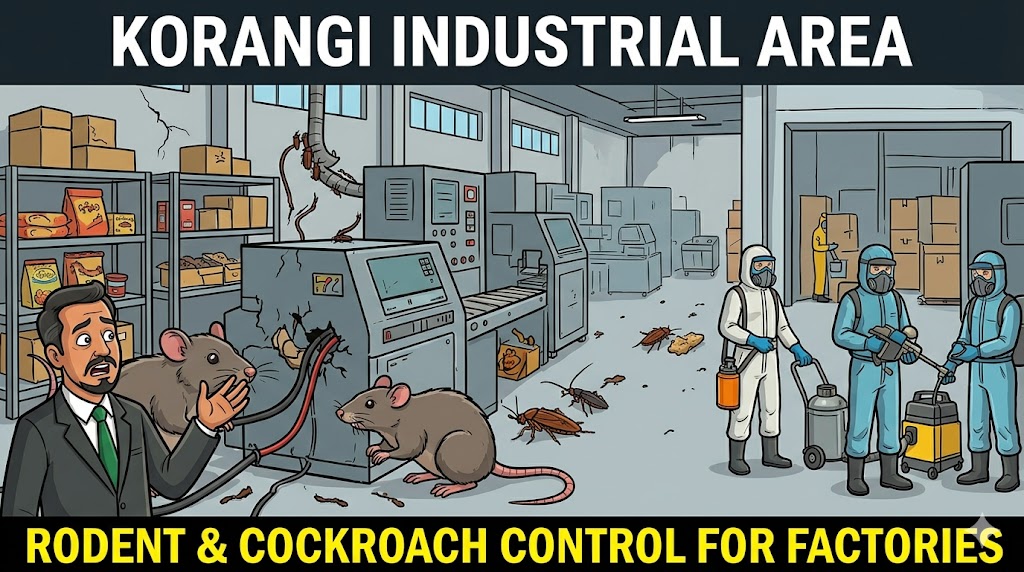
    Korangi Industrial Area is one of Karachi’s most significant economic zones — a sprawling expanse of factories, warehouses, food processing units, textile mills, pharmaceutical plants, and logistics facilities that has operated continuously since the 1960s. It is also, by the nature of what it is, one of the most challenging environments for pest management in the entire city.

    If you own or manage a factory or warehouse in Korangi, you are operating in conditions that create near-perfect habitat for two of the most damaging and disruptive pest species in Karachi: rats and cockroaches. Understanding why these pests are so prevalent in industrial environments — and what effective control actually looks like — is not just a matter of comfort. It is a matter of business survival.

    Why Korangi Factories and Warehouses Are Ideal Pest Habitat

    Industrial facilities share a set of characteristics that make pest management particularly challenging. Korangi’s facilities, many of which have operated for decades and feature aging infrastructure, amplify these challenges further.

    Food at scale: Many of Korangi’s industrial units process or store food products — flour mills, food packaging plants, spice processors, cold storage facilities. Even non-food facilities have canteens, waste streams from worker meals, and raw materials that attract rodents. A single spilled bag of flour in a warehouse can sustain a rat colony for months.

    Complex structures: Industrial facilities are typically complex buildings with extensive void spaces — raised floors, ceiling plenums, wall cavities, machinery bases, pallet racking systems, and dock areas. These provide almost unlimited harborage for both rats and cockroaches. A large facility may have thousands of potential nest sites that are practically impossible to inspect comprehensively.

    Constant access points: Factories and warehouses are, by definition, buildings that things move in and out of constantly. Loading docks are open for hours at a time. Goods arrive in packaging that may already be infested. Staff enter and exit through multiple points throughout the day. Every access point is a potential pest entry route that cannot simply be sealed.

    Aging infrastructure: Korangi’s older industrial facilities — many dating from the 1960s through 1980s — have aging concrete, deteriorating floor joints, cracked masonry, and pipeline infrastructure that was never designed with pest exclusion in mind. Gaps, cracks, and compromised surfaces are everywhere.

    Proximity to high-pressure pest zones: The drains, nullahs, and waste management systems surrounding Korangi Industrial Area sustain enormous rodent populations. Industrial facilities adjacent to or near drainage channels face constant pressure from rats looking for new territory, especially during and after the monsoon season when drainage is disturbed.

    The Real Cost of Rodent Infestations in Industrial Facilities

    Factory and warehouse owners sometimes treat rodent problems as a nuisance rather than a serious business risk. This is a mistake. The actual costs of an uncontrolled rodent infestation in an industrial facility in Korangi include:

    Product contamination and loss: A rat that enters a warehouse of bagged goods contaminates far more than it consumes. Gnawed packaging, droppings, urine trails, and fur contaminate surrounding products. A single contamination incident can result in the write-off of an entire batch or warehouse section.

    Equipment damage: Rats gnaw continuously to keep their teeth in check — they are not selective about what they gnaw on. Electrical wiring, hydraulic hoses, insulation, and plastic components in machinery are all at risk. Electrical fires caused by rodent damage to wiring are a documented cause of industrial fires in Karachi.

    Regulatory and certification risk: Any facility subject to food safety certification, pharmaceutical standards, or export compliance requirements risks losing certification if pest evidence is found during an inspection. The financial impact of losing an export certification far exceeds the cost of professional pest management.

    Structural damage: Burrowing rodents compromise foundations and floor integrity over time. A rat burrow under a warehouse floor slab that is not addressed can expand into a structural problem over months.

    Staff morale and retention: Workers who share their workplace with rats — encountering them on the factory floor, in canteen areas, in changing rooms — don’t stay. High turnover from poor working conditions carries its own cost.

    Cockroach Infestations in Industrial Settings: A Different Kind of Problem

    While rodents are often the most dramatic pest problem in Korangi’s industrial facilities, cockroach infestations are in many ways more persistent and more damaging from a contamination standpoint.

    The German cockroach and the American cockroach (which comes primarily from Korangi’s drain system) are both present in significant numbers in industrial facilities. Their specific risks include:

    Pathogen transmission: Cockroaches are documented carriers of Salmonella, E. coli, and a range of other pathogens. In food processing environments, cockroach presence in any food-contact area is a serious health and regulatory risk.

    Allergen production: Cockroach droppings, cast skins, and body parts are potent allergens. In facilities with air handling systems, cockroach-derived allergens can be distributed through the ventilation system, affecting worker health across large areas.

    Extreme reproductive speed: A female German cockroach produces an egg case every four to six weeks, each containing up to forty eggs. An infestation that is small in November can be massive by February if untreated. In the warm conditions of a Korangi factory — especially facilities with industrial ovens, boilers, or heated processes — cockroach reproduction accelerates even further.

    Product contamination: Cockroaches contaminate food products, packaging materials, and exposed machinery components. Any facility producing goods for human consumption that has a cockroach infestation in its processing areas is operating at serious regulatory risk.

    Why Standard Pest Control Approaches Fail in Industrial Facilities

    Many Korangi factory owners have tried pest control and been disappointed. Here’s why standard approaches often fail in industrial settings:

    Inadequate scope: A small team doing a spray treatment of a 5,000 square metre warehouse cannot cover the facility adequately. Industrial pest control requires more manpower, more time, and more targeted application than standard residential or commercial treatment.

    Wrong products for the environment: Many standard insecticide formulations are inappropriate for use in food processing environments due to contamination risk. And broad-spectrum surface sprays scatter cockroach populations without eliminating them — dispersed cockroaches simply recolonise treated areas from untouched harbourage zones.

    Failure to address entry points: Chemical treatment without physical exclusion — sealing entry points, installing door sweeps, fitting rodent guards on drains — provides only temporary relief. Pests that are eliminated will be replaced by new individuals entering through the same routes.

    No monitoring system: Effective industrial pest management requires an ongoing monitoring programme — a network of bait stations, sticky monitors, and regular inspection points that provide early warning of new activity before populations establish. Most one-off treatment services don’t include this.

    Inadequate documentation: Facilities subject to certification audits need documented pest control records — treatment logs, inspection reports, and corrective action records. Informal or undocumented services leave facility managers exposed during audits.

    What Effective Rodent and Cockroach Control Looks Like in Korangi

    Effective industrial pest management in Korangi is a programme, not an event. Here’s what it should include:

    Comprehensive site survey: Before any treatment, a thorough survey of the facility should identify entry points, harbourage zones, pest activity evidence, and high-risk areas. This should include roof areas, drainage, loading docks, and machinery bases — not just visible floor areas.

    Integrated Pest Management (IPM) approach: Effective industrial pest control combines physical exclusion (sealing entry points, installing barriers), environmental controls (improving sanitation, eliminating harbourage), biological monitoring (trap networks), and targeted chemical treatment. Chemical treatment alone is the weakest approach.

    Appropriate product selection: In food processing areas, only food-safe insecticide formulations should be used. Rodenticide placement must be in tamper-proof stations located in non-production areas. Gel baiting for cockroaches should be applied in void spaces and harbourage areas rather than on open surfaces.

    Staff training: Workers are the first line of defence in industrial pest management. Training staff to recognise pest evidence, report sightings immediately, and maintain sanitation in their areas dramatically improves the effectiveness of professional treatment programmes.

    Documented monthly monitoring: Monthly visits for inspection, bait station maintenance, and trap checking, with written reports, provide both ongoing control and the documentation required for certification audits.

    Seasonal Considerations for Korangi’s Industrial Facilities

    Korangi’s position in Karachi’s industrial east makes it subject to specific seasonal pest pressures that facility managers should plan for.

    Pre-monsoon (April to June): The weeks before monsoon are peak rodent migration season in Karachi. Rats move from exposed outdoor areas towards buildings in advance of the rains. Warehouse managers should increase monitoring and bait station checks during this period.

    Monsoon and post-monsoon (July to September): Flooding and drain disturbance during monsoon drives rodents upward from drain habitat into buildings. Post-monsoon humidity also accelerates cockroach reproduction. This is the period requiring the most intensive pest management attention.

    Winter (November to February): While cooler temperatures slow cockroach reproduction, rodents become more aggressive in seeking shelter. Warehouse facilities that have been managing rodent pressure should not reduce monitoring during the winter months.

    A Note on Documentation and Compliance

    An increasing number of Korangi’s industrial facilities export to international markets or supply domestic retailers who require suppliers to maintain food safety certifications. For these facilities, pest control is not just an operational issue — it is a compliance requirement.

    A professionally managed pest control programme with documented monthly reports, corrective action records, and a clear treatment history protects facility managers during certification audits. An undocumented or informal pest control arrangement, however effective in practice, provides no protection when an auditor asks for evidence.

    If your facility is subject to any food safety or export standard — whether HACCP, ISO, or a retailer-specific requirement — your pest management programme needs to meet those standards. Reliable pest control services in Karachi for industrial facilities provide the documentation, certification-appropriate products, and systematic approach that compliance demands.

    Immediate Steps for Korangi Facility Managers

    If you manage a factory or warehouse in Korangi and you are concerned about your current pest situation, here are the immediate priorities:

    • Walk your facility’s perimeter and loading dock areas and note any rodent burrows, droppings, or gnaw marks on structural elements
    • Check your drainage — blocked or poorly trapped drains are the primary cockroach entry route in most Korangi facilities
    • Assess your current pest control documentation — if you cannot produce treatment records for the last 12 months, you have a compliance gap
    • Check your bait station network — stations that haven’t been inspected and restocked in more than 30 days are providing false security
    • Review your loading dock protocols — propped-open dock doors during loading are your single largest rodent entry point

    Book Your Free Industrial Pest Inspection

    Pest problems in Korangi’s industrial facilities don’t get smaller over time. A rodent population that goes unaddressed through one monsoon season can quadruple by the next. A cockroach infestation in a food processing area that isn’t eliminated before a certification audit can cost you a contract.

    Our team works with factory and warehouse operators across Korangi Industrial Area. We understand industrial environments, we work with food-safe products, and we provide the documented, systematic service that compliance requires. Contact us today to book a free inspection of your facility — we’ll assess your specific pest vulnerabilities and design a management programme that protects your operations.

  • Gulistan-e-Johar Pest Control: What Newer Construction Still Gets Wrong

    Gulistan-e-Johar Pest Control: What Newer Construction Still Gets Wrong

    Gulistan-e-Johar has transformed dramatically over the past two decades. Once considered the outskirts of Karachi, it is now one of the city’s most densely populated and actively developing residential zones. New apartment blocks, gated communities, and commercial plazas continue to rise across its blocks, from Block 1 near the main Johar Chowk artery to the newer constructions in Blocks 18 and 19.

    And yet, despite this newness, residents of recently completed buildings in Gulistan-e-Johar are still calling pest control services. Often within months of moving in. Often with serious infestations.

    This surprises people. It shouldn’t. New construction, it turns out, is not a pest-free guarantee. In fact, in Karachi’s specific environment, newer buildings carry their own set of pest vulnerabilities — and the construction practices common in Gulistan-e-Johar’s rapid development cycle make things worse, not better.

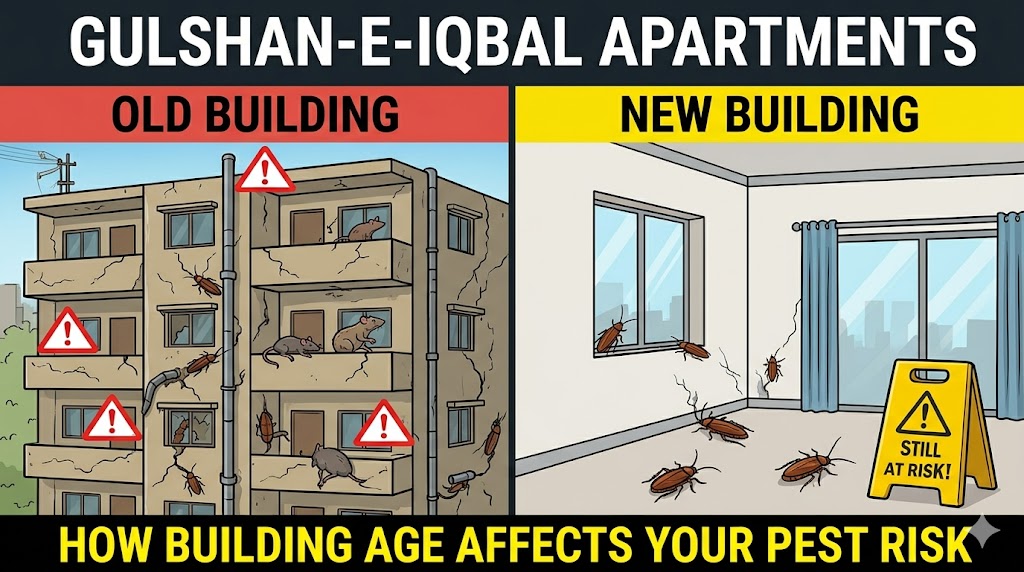
    This article explains what’s going wrong, why it matters, and what residents and building owners need to understand to actually protect their properties.

    The Myth of the ‘New Building’ Advantage

    When people move into a new apartment or house, the assumption is reasonable: fresh walls, new pipes, clean surfaces. Nothing has had time to establish itself. You’re starting with a blank slate.

    This assumption is wrong in several important ways.

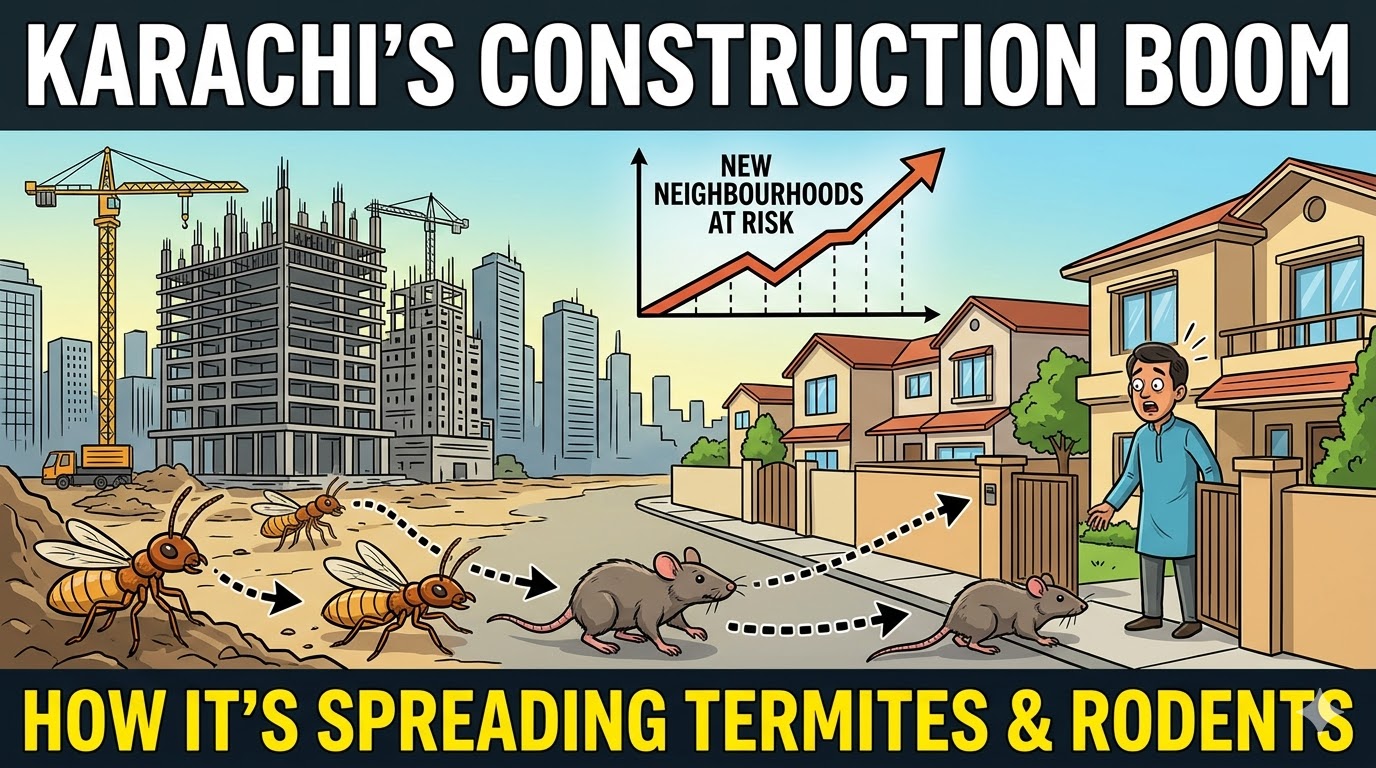
    First, construction sites are pest habitats. The months — sometimes years — of active construction on a site create ideal conditions for rodents and cockroaches. Building materials stored on site (timber, insulation, drywall) provide nesting material. Construction debris piles provide harborage. Food waste from construction workers accumulates. By the time a building is completed, a resident rodent and insect population may already exist within the structure’s walls and foundations.

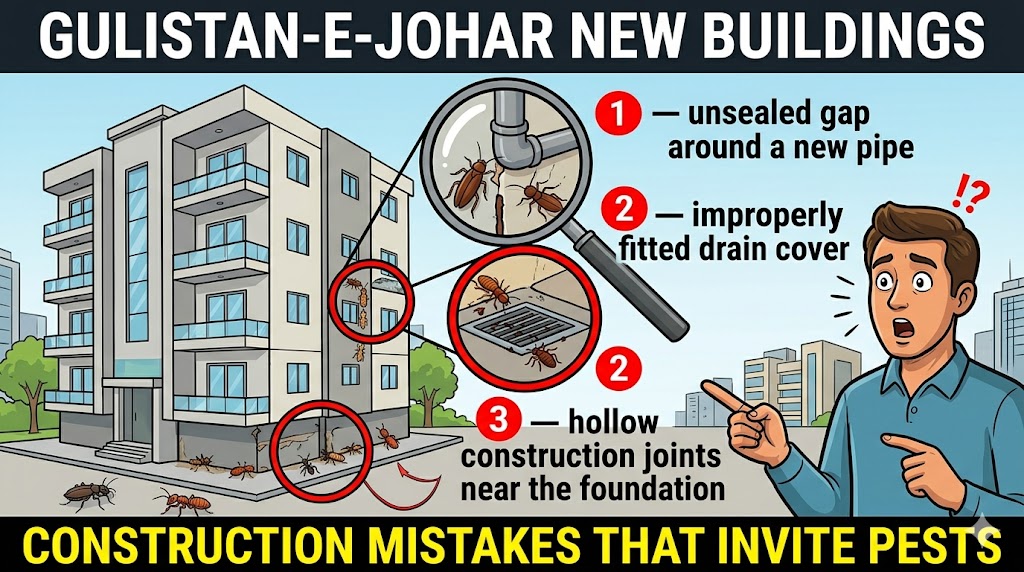
    Second, construction creates entry points that are never sealed. Every pipe that passes through a wall, every electrical conduit, every gap where different materials meet — all of these are potential pest entry points. In high-quality construction with careful finishing, these gaps are sealed. In the rapid, cost-conscious construction common in Gulistan-e-Johar’s development boom, they often aren’t.

    Third, new buildings in developed areas inherit the pest pressure of their surroundings. A new apartment block in Block 13 of Gulistan-e-Johar sits in a neighbourhood with established rodent populations in surrounding older buildings, in the drains running alongside the main roads, and in the food waste generated by the area’s dense commercial activity. The building is new. The pests surrounding it are not.

    What Gulistan-e-Johar’s Construction Boom Got Wrong

    Gulistan-e-Johar’s development has been characterised by speed. Plots are developed quickly, buildings are finished fast, units are sold or rented before the construction phase is fully complete in many cases. This speed has created specific, recurring pest vulnerabilities.

    Incomplete utility sealing: In the rush to finish and hand over units, the unsealed gaps around utility penetrations — the spaces where water pipes, gas lines, and electrical conduits pass through walls and floors — are frequently overlooked. These gaps, which can be several centimetres wide in poorly finished work, are motorways for cockroaches and rodents.

    Substandard concrete finishing: Many of Gulistan-e-Johar’s newer buildings show early cracking in plaster and masonry, particularly in areas exposed to Karachi’s coastal humidity. Cracked walls create harbourage and travel routes for insects within months of completion.

    Shared drain systems without traps: Building drainage is a major cockroach entry route in Karachi, and many newer buildings in the area install drainage without adequate P-traps in every outlet. Without these traps, drain runs provide direct access from the sewer system into bathroom and kitchen floors — and from there, into the rest of the unit.

    Insufficient damp-proofing: Karachi’s water table in low-lying parts of Gulistan-e-Johar can be surprisingly high, particularly during monsoon season. New buildings without proper damp-proofing in their foundations and basement areas develop moisture problems quickly, and moisture-laden walls are prime cockroach breeding habitat.

    Communal areas finished to a lower standard: Even in buildings where individual apartments are reasonably well finished, stairwells, utility rooms, and basement areas are frequently completed with gaps, cracks, and open pipe runs that provide perfect pest harbourage just metres from residents’ front doors.

    The Construction Site Legacy Problem

    Here is something that almost never gets discussed: the pest problems that develop during construction often survive into the occupied building.

    A construction site that runs for two years — as many larger Gulistan-e-Johar projects do — will develop an established rodent population in its foundations and ground floor areas. Rats that have been living under the construction site’s concrete slab for eighteen months do not leave when residents move in. They adapt. They move from the construction debris they were nesting in to the walls of the completed structure. They access food from residents’ kitchens. They become the building’s first tenants.

    Similarly, the German cockroaches that colonised the site’s temporary on-site facilities and storage areas during construction don’t vanish at handover. They migrate into the finished units, where warmth, moisture, and food are now available year-round.

    This is why buildings in Gulistan-e-Johar with infestations at six months old are not unusual. The infestation didn’t arrive after handover. It was already there.

    Karachi’s Specific Environmental Pressures on New Gulistan-e-Johar Builds

    Even a perfectly constructed building in Gulistan-e-Johar faces environmental pest pressures that building owners and managers need to understand.

    The Karachi drain system: Gulistan-e-Johar sits across a network of nullahs (storm drains) and sewage lines that are also habitat for enormous rodent populations. New buildings constructed adjacent to or over covered nullahs are subject to constant upward pressure from rodents looking for access. This is a structural challenge, not a hygiene one.

    Neighbouring plot development: In actively developing areas like Gulistan-e-Johar’s outer blocks, when an adjacent plot begins construction, the disturbance displaces established rodent and cockroach populations into neighbouring completed buildings. A new infestation in your building may have nothing to do with your building’s condition and everything to do with what’s being built next door.

    Open waste infrastructure: Solid waste management in many parts of Gulistan-e-Johar remains inconsistent, with collection points that overflow between pickups and waste accumulating in lanes and near building entrances. This constant, nearby food source sustains large pest populations at building perimeters, making interior infestation a recurring challenge regardless of interior treatment.

    The Specific Pests New Gulistan-e-Johar Residents Encounter

    Understanding which pests are most active in newer Gulistan-e-Johar construction helps target treatment effectively.

    German cockroaches (Blattella germanica): The dominant indoor cockroach species in Karachi’s apartments. They entered during construction and establish themselves in kitchen cabinets, behind appliances, and inside wall voids. They are resistant to many common insecticides and require professional gel bait treatment for effective elimination.

    House rats (Rattus rattus): Extremely common in Gulistan-e-Johar’s multi-storey new builds. They access buildings through unsealed utility penetrations, establish nests in ceiling voids and wall cavities, and are active from the ground floor up.

    American cockroaches (Periplaneta americana): Larger than the German variety, these come primarily from the drain system and are especially common in ground-floor and basement units where drainage traps are inadequate.

    Pharaoh ants: Increasingly common in newer Karachi apartments, these tiny ants travel through electrical conduits and wall voids, making them extremely difficult to control without professional treatment.

    What Effective Pest Control Looks Like for New Gulistan-e-Johar Buildings

    Treating a newly constructed building in Gulistan-e-Johar requires a different approach than treating an established older property.

    The first priority is a structural assessment. Before any chemical treatment, the building needs to be assessed for the specific entry points and harbourage areas that its construction has created. This is not a quick visual check — it means inspecting utility penetrations, drainage configurations, basement areas, and the condition of concrete finishing throughout.

    The second priority is sealing identified entry points. Chemical treatment without sealing is temporary. Pests that are killed will be replaced by new pests entering through the same gaps within weeks.

    The third priority is selecting the right treatment for the confirmed pest species. German cockroaches require gel baiting. Rodents require a combination of tamper-proof bait stations and physical exclusion. American cockroaches coming from drains require drain treatments and trap installation. One-size-fits-all spray treatments don’t address this variety.

    Finally, new buildings in active development areas like Gulistan-e-Johar need ongoing monitoring rather than one-time treatment. The environmental pressure — from surrounding construction, the drain network, and the area’s commercial density — is continuous. A treatment plan that includes scheduled follow-up visits is not an upsell. It is a practical necessity.

    What Residents Can Do Right Now

    If you have recently moved into a new build in Gulistan-e-Johar — or if you have been experiencing pest issues in a building that’s only a few years old — here are the immediate practical steps:

    • Check every pipe and conduit entry point in your unit and seal gaps with steel wool backed by silicone sealant
    • Ensure your kitchen and bathroom drains all have functioning P-traps — run water into rarely used drains to fill the trap
    • Report any cracks or damp patches in walls to your building management immediately
    • Don’t use over-the-counter cockroach spray as your primary treatment — it scatters populations without eliminating them
    • Request a professional inspection rather than waiting for a visible infestation to worsen

    The Bigger Picture

    Gulistan-e-Johar’s growth is impressive, and its newer buildings offer real advantages over the area’s older stock. But the pest challenges associated with rapid, high-density construction in Karachi’s climate are real, predictable, and manageable — if they are approached correctly.

    The mistake most residents and building owners make is assuming that newness equals safety, and that pest problems, when they appear, can be addressed with a single treatment. Neither assumption holds up in Karachi’s environment.

    If you are a Gulistan-e-Johar resident dealing with persistent pest problems in a relatively new building, or a building owner wanting to get ahead of the problem before tenants start complaining, professional fumigation services in Karachi that include structural assessment, targeted treatment, and follow-up monitoring are the only approach that reliably works.

    Book Your Free Inspection Today

    New building or not, pest problems in Gulistan-e-Johar need professional attention early. Our team understands the specific construction challenges and environmental pressures that affect this area’s newer developments. Contact us to book your free inspection — we will assess your building’s specific vulnerabilities, identify any active infestations, and design a treatment plan that protects your property long-term. Don’t let a new building give you a false sense of security. Book your inspection today.

  • Why North Nazimabad High-Rises Face a Different Pest Challenge Than Bungalow Areas

    Why North Nazimabad High-Rises Face a Different Pest Challenge Than Bungalow Areas

    If you live in one of North Nazimabad’s multi-storey buildings — whether it’s a four-floor walkup on Nagan Chowrangi Road or a ten-storey tower near Buffer Zone — you may have noticed something: pest problems in your apartment feel different. Not just worse. Different. And you’re right to think that.

    Homeowners in bungalow areas like Gulberg or parts of PECHS often assume pest control is a universal problem with universal solutions. Spray, fumigate, done. But vertical living in high-density residential zones like North Nazimabad introduces a set of structural, social, and environmental variables that make pest management significantly more complicated — and significantly more urgent.

    This article breaks down exactly why, and what you can do about it.

    The Vertical Living Trap: How Pests Travel Between Floors

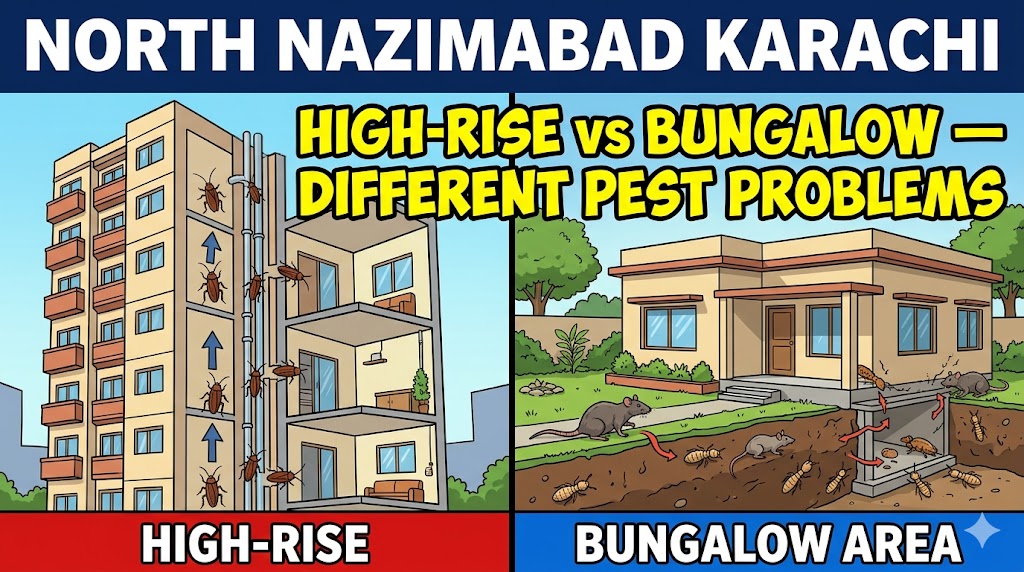
    In a standalone bungalow, your pest problem is largely contained to your property. Seal the entry points, treat the infestation, and you’ve addressed the source. In a multi-storey building, this logic breaks down entirely.

    Pests — particularly cockroaches, rats, and bedbugs — are expert climbers and squeeze artists. German cockroaches, the most common apartment species in Karachi, can travel through:

    • Electrical conduit gaps between floors
    • Shared plumbing chases that run vertically through the entire building
    • Wall cracks that connect units on adjacent floors
    • Shared garbage chutes common in older North Nazimabad towers
    • Elevator shafts and the mechanical rooms that serve them

    This means that even if you keep your unit spotlessly clean and chemically treat it thoroughly, pests can re-enter within days from an untreated flat two floors above or below you. This is not a hypothetical. It is the day-to-day reality that residents of high-rises in North Nazimabad deal with continuously.

    A building-wide infestation is almost never solved by treating one apartment. Yet that’s exactly what most residents — and even many pest control operators — attempt.

    North Nazimabad’s Specific Construction Profile

    Not all high-rises are built equal, and North Nazimabad’s residential stock has its own character. Much of the area developed rapidly during the 1980s and 1990s, with building quality varying considerably. This matters for pest control for several specific reasons.

    Aging infrastructure: Buildings from the 1980s and early 1990s often have deteriorating grout, cracked masonry, and poorly sealed pipe penetrations. These are exactly the gaps cockroaches and rodents exploit. A German cockroach needs only a 1.5mm gap to pass through — smaller than a credit card’s thickness.

    Shared utility systems: Many older buildings in this area have shared overhead water tanks that are cleaned infrequently. Moisture from these tanks seeps into walls and ceiling cavities, creating ideal conditions for cockroach breeding.

    Dense parking basements: Multi-storey buildings here almost universally have ground-floor or basement parking that sits directly below residential units. These dark, warm, vehicle-exhaust-rich zones are prime rodent territory. Rats nesting in basement parking do not stay in the parking.

    Market-adjacent locations: North Nazimabad is ringed by busy commercial activity — from the markets near Nazimabad No. 3 to the food vendors near the Nagan Chowrangi flyover. This commercial density is a constant source of pest pressure on surrounding residential buildings.

    The Social Coordination Problem

    Here’s a challenge that rarely gets discussed but is arguably the hardest to solve: in a building with 20 or 30 apartments, you cannot force your neighbours to participate in pest control.

    Even if you hire the best pest control company in Karachi and treat your unit comprehensively, if the family on the fourth floor has a cockroach-infested kitchen they haven’t treated in three years, your flat will be re-infested within weeks. This is not an exaggeration — it is the documented behaviour of German cockroaches in high-density housing.

    In bungalow areas, this coordination problem doesn’t exist. You control your property. In high-rises, pest control is inherently a collective action problem.

    The practical solution is building-wide treatment — ideally organised through the building committee or management. But where no such coordination exists, individual residents face a constant uphill battle.

    Karachi’s Climate Amplifies the Problem

    North Nazimabad sits in one of the most pest-hospitable climates on earth. Karachi’s combination of high humidity during the monsoon months of June through August, warm winters that rarely kill off pest populations, and year-round food availability creates what pest control professionals call a no-reset environment.

    In colder climates, winter temperatures kill or suppress pest populations annually, giving residents and pest controllers a natural reset point. In Karachi, there is no such break. Cockroach and rodent populations that establish themselves in a building’s infrastructure can grow continuously for years without seasonal interruption.

    For residents of North Nazimabad high-rises specifically, this means:

    • A German cockroach infestation discovered in October was likely establishing itself since at least May
    • Rat populations in basement parking areas can double every three months under Karachi’s conditions
    • Bedbug infestations spread faster because the warm, humid climate keeps them active year-round

    Seasonal treatment, which might be adequate in other parts of the world, is simply insufficient here. Effective pest control in Karachi’s high-rises requires ongoing monitoring and periodic re-treatment.

    The Water Tank and Plumbing Factor

    Perhaps the single most underappreciated pest factor in North Nazimabad’s multi-storey buildings is the water infrastructure. Most buildings rely on overhead tanks, and many of these tanks are cleaned only once or twice a year, are cracked or improperly sealed allowing moisture to seep into surrounding masonry, and are accessed via roof areas that are poorly sealed against birds, bats, and rodents.

    Moisture from poorly maintained tanks creates damp wall cavities that are perfect cockroach habitat. A single damp wall cavity in a building’s core — running from the third floor to the tenth — can harbour thousands of cockroaches that have access to every floor through pipe penetrations.

    Treatment without addressing the moisture source is temporary at best. Effective pest management in these buildings requires identifying and drying out these moisture pathways, not just applying chemicals.

    Why Standard Fumigation Often Fails in High-Rises

    Many residents book a standard fumigation treatment — the kind where a technician comes, sprays exposed surfaces, and leaves. This approach, while better than nothing, often produces disappointing results in multi-storey buildings.

    Surface-only treatment misses harbourage: Cockroaches spend most of their lives inside wall voids, behind electrical panels, and within pipe chases. Surface sprays don’t reach these areas.

    No structural assessment: Effective treatment in a high-rise requires identifying the building’s specific pest pathways — the cracks, gaps, and conduits through which pests are moving — not just treating visible pest activity.

    Single-unit treatment ignores re-infestation routes: Treating one unit without addressing neighbouring units provides only temporary relief.

    Incorrect product selection: German cockroaches, the dominant species in Karachi’s apartments, have developed resistance to many commonly used insecticides. Professional-grade gel baits and growth regulators are often necessary, but many cheaper services don’t use them.

    The right approach for a high-rise involves a combination of gel baiting — which cockroaches carry back to their harbourage, affecting entire colonies — targeted void treatments, rodent exclusion work at entry points, and ideally coordination across multiple units or floors.

    What North Nazimabad Residents Should Actually Do

    Stop treating this as a one-time problem. Pest management in your building is an ongoing process. Budget for at least two to three professional treatments per year, more if you have an active infestation.

    Identify and report moisture sources. If your walls feel damp or you see water stains, report it to building management. Moist wall cavities are cockroach incubators.

    Seal your unit’s connections to shared spaces. The gaps where pipes and conduits enter your flat from shared shafts should be sealed with steel wool and expanding foam. This is the most cost-effective prevention step a resident can take independently.

    Coordinate with neighbours and building management. Push for building-wide treatment if possible. Even getting two or three adjacent units treated simultaneously dramatically improves outcomes.

    Hire professionals who understand high-rise pest dynamics. Ask specifically about their experience with multi-storey residential buildings, their product range including gel baits versus surface spray, and whether they offer follow-up visits.

    The Bottom Line

    North Nazimabad’s high-rises are not simply taller bungalows. They are interconnected ecosystems where pests move freely between units, where moisture infrastructure creates persistent harbourage, and where Karachi’s climate removes the seasonal breaks that elsewhere help keep populations in check.

    Managing pests effectively in this environment requires a different mindset: one that treats the building as a system rather than individual units, that prioritises structural sealing alongside chemical treatment, and that commits to ongoing monitoring rather than one-off fixes.

    If you’re dealing with recurring pest problems in your North Nazimabad apartment — or you want to get ahead of the problem before it gets worse — you need professionals who understand these dynamics. Reliable pest control services in Karachi for high-rise buildings combine structural assessment, professional-grade treatments, and building-wide planning to deliver results that actually last.

    Book Your Free Inspection Today

    Don’t wait until a small problem becomes a building-wide infestation. Our team serves North Nazimabad and the surrounding areas, and we understand the specific challenges that high-rise residents face. Contact us today to book a free inspection of your unit. We will identify your specific pest pathways, recommend a treatment plan that fits your building’s reality, and help you coordinate with building management if needed. A pest-free apartment in North Nazimabad is achievable — it just requires the right strategy.

  • Ramazan Pest Alert: Why Karachi Kitchens Attract More Insects During Iftar Season

    Ramazan Pest Alert: Why Karachi Kitchens Attract More Insects During Iftar Season

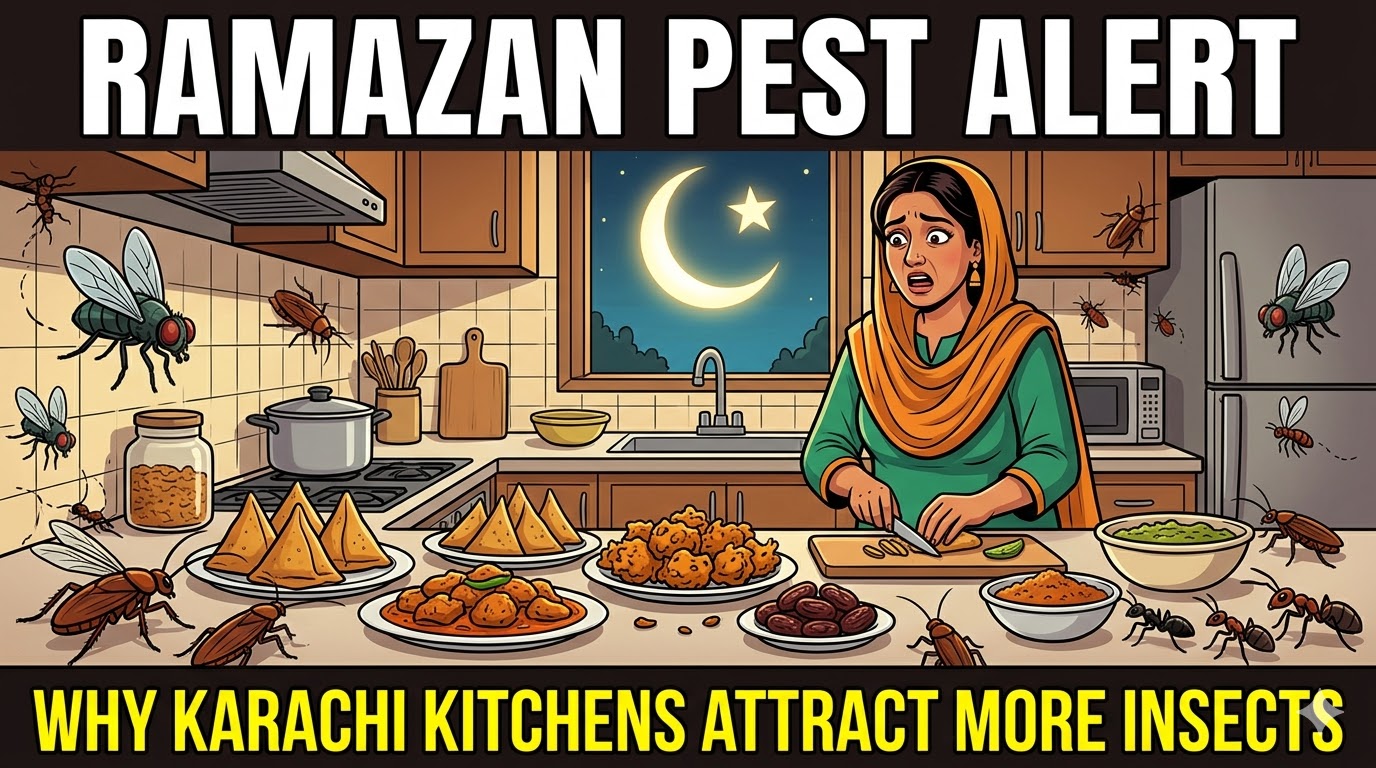
    Ramazan is a time of deep spiritual significance, family togetherness, and the abundant, aromatic food that Karachi’s kitchens are famous for. The sizzle of samosas, the fragrance of haleem, the sweet richness of khajoor and sheer khurma — Iftar in a Karachi home is a celebration. But amid all the preparation and hospitality, there is an uninvited and persistent problem that many households face every Ramazan: an explosion in kitchen pest activity.

    This is not imagined, and it is not simply the result of warmer weather. There are specific, identifiable reasons why Karachi kitchens experience heightened cockroach, ant, fly, and rodent activity during Ramazan — and understanding these reasons can help you protect your home, your food, and your family without compromising the spirit of the holy month.

    The Ramazan Kitchen: A Pest’s Ideal Environment

    To understand why Ramazan creates a pest surge, you need to think about what changes in a Karachi kitchen during the holy month. The differences from a normal month’s kitchen routine are significant — and from a pest’s perspective, they are almost uniformly positive.

    More Food, More Smells, Longer Hours

    During Ramazan, the quantity of food prepared in a typical Karachi home increases substantially. A family that usually cooks twice a day is now preparing elaborate Iftar spreads, full dinners, and Suhoor meals. The smells produced by cooking — oils, spices, cooked meat, fried items — are powerful pest attractants that permeate the kitchen and adjacent areas. Cockroaches and rodents can detect these smells from significant distances and navigate toward their source.

    The Critical 2am–4am Window

    Suhoor preparation happens in the early hours of the morning, often between 2am and 4am. This is precisely the period when cockroaches are most active — they are nocturnal creatures that do the majority of their feeding and movement in the hours between midnight and pre-dawn. A kitchen that would normally be quiet and dark during these hours is now warm, lit, filled with food smells, and producing fresh food waste. This is an exceptional opportunity for cockroaches and mice that they exploit aggressively.

    Dishes Left to Soak Overnight

    After Iftar, especially when family members are tired from a day of fasting and evening prayers, dishes often sit unwashed or soaking overnight. Standing water with food residue in it is a direct invitation to cockroaches, particularly German cockroaches that prefer the area around and under kitchen sinks. A dish soaking in the kitchen sink overnight is, from a cockroach’s perspective, a prepared meal with a water source — perfectly aligned with what they need to thrive.

    Increased Food Storage

    Ramazan involves bulk purchasing of ingredients — large bags of dates, dried fruits, nuts, lentils, rice, and other staples are bought in advance and stored in the kitchen or adjacent pantry. Many Karachi households use open containers, plastic bags that are loosely tied, or cloth storage bags that provide no real barrier to pests. Dates and dried fruits in particular are highly attractive to both cockroaches and rodents due to their high sugar content.

    Food on the Table Between Iftar and Taraweeh

    In many Karachi households, Iftar food is laid out on the table and the family eats, prays, and then leaves for Taraweeh prayers — often leaving partially eaten food and crumbs on the table for an hour or more before returning. This window of unattended, accessible food is exactly when cockroaches — which hide during periods of human activity — emerge to feed.

    Which Pests Specifically Surge During Ramazan?

    German Cockroach (Blattella germanica) — The Primary Culprit

    The German cockroach is the number one pest problem in Karachi kitchens during Ramazan. This small, light-brown cockroach lives exclusively indoors, preferring kitchens and bathrooms, and feeds on virtually any organic material — food crumbs, grease, spilled liquids, and even the glue on packaging. It is especially attracted to the sugar and starch in traditional Ramazan foods: dates, mithai, sewaiyan, sheer khurma, and fruit chaat.

    German cockroaches reproduce at an astonishing rate. A single female can produce an egg case (ootheca) containing 30-40 eggs every 20-30 days. In the warm conditions of a Karachi kitchen during Ramazan, hatching times are shortened and nymph development accelerated. A small cockroach problem that goes unaddressed at the start of Ramazan can become a significant infestation by Eid ul-Fitr.

    House Flies (Musca domestica)

    Flies are strongly attracted to the cooking smells, food waste, and organic matter that increase significantly during Ramazan. In Karachi’s warm climate, a fly can develop from egg to adult in as little as 7-10 days. The increased organic waste in kitchen bins during Ramazan — oily packaging, fruit peels, meat scraps — provides ideal breeding conditions. Flies landing on Iftar food are not just a nuisance — they transfer pathogens including Salmonella, E. coli, and cholera bacteria, which can cause serious food poisoning.

    Ants — Red Fire Ants and Sugar Ants

    The sugar-rich foods of Ramazan are irresistible to ants. Karachi homes commonly experience invasions of sugar ants (small black or brown ants) that appear seemingly from nowhere when sweet foods are present. Red fire ants, increasingly common in Karachi’s newer residential developments, form rapid foraging lines to food sources and can contaminate food within minutes. Ant infestations during Ramazan are particularly common in ground-floor and basement units, or in older buildings with cracks in kitchen walls and floors.

    House Mice (Mus musculus)

    The increase in bulk food storage during Ramazan makes pantries and kitchen cabinets more attractive to mice than at any other time of year. Mice can squeeze through gaps as small as 6mm, and large bags of rice, lentils, flour, and dried fruits provide both food and nesting material. A single mouse can contaminate far more food than it actually consumes through its droppings, urine, and hair. A mouse detected in the kitchen during Ramazan requires immediate action — waiting until after the month is a risk not worth taking when food safety is directly implicated.

    Pantry Moths (Indianmeal Moth)

    While less commonly discussed, pantry moths are a growing problem in Karachi kitchens during Ramazan. Their larvae feed on dry stored goods — flour, rice, oats, dried fruits, and especially nuts. They are frequently introduced into homes through contaminated bulk purchases from open-sack markets, which are common in Karachi’s older commercial areas. Once established, they spread quickly to other stored products, and their webbing and frass contaminate everything they touch.

    The Health Implications: Why This Matters More During Ramazan

    Food safety during Ramazan carries special significance. After a full day of fasting, the body is more vulnerable to the effects of contaminated food — digestive distress, food poisoning, and dehydration are more serious when they occur in a fasting person. Children, the elderly, and those with underlying health conditions are at particular risk.

    Cockroach and rodent contamination of Iftar food is not merely unpleasant — it is a genuine health risk. Consider what happens in a kitchen that has a cockroach presence:

    • Cockroaches travel from drain systems and garbage areas to kitchen surfaces, carrying bacteria on their legs and bodies
    • They defecate on food preparation surfaces and on food items left uncovered
    • Their shed skin and droppings become airborne, triggering asthma and allergy symptoms — particularly problematic in a fasting person whose respiratory system may be more sensitive
    • A single cockroach on an Iftar spread can contaminate food with Salmonella, E. coli, and other pathogens that cause acute food poisoning — with symptoms appearing just hours after consumption

    Rodent contamination is equally serious. Mouse and rat urine is virtually odourless and can contaminate loose food, pantry surfaces, and cooking equipment without any visible sign. The risk of leptospirosis, spread through rodent urine, is a real concern in Karachi particularly during and after the monsoon season, which in recent years has overlapped with Ramazan.

    Why Ramazan Pest Problems Are Often Invisible Until They’re Serious

    One of the most frustrating aspects of Ramazan pest infestations is that they often develop invisibly. Cockroaches are nocturnal and avoid light — the busy, well-lit Iftar kitchen is the safest time for them to hide. They emerge when the household is at Taraweeh, or in the silent hours before Suhoor. By the time a cockroach is spotted during daylight, the population is already large enough that individuals are being pushed out of their hiding places by overcrowding.

    The same is true of mice. These animals are naturally cautious and avoid exposure. A mouse that is seen crossing a kitchen floor during family Iftar time is a sign of a well-established infestation, not a lone intruder. They will have been active for weeks before being seen.

    This invisible build-up is why Ramazan pest prevention needs to happen before the month begins — not reactively once pests are spotted.

    A Room-by-Room Ramazan Pest Prevention Guide

    The Kitchen:

    • Store all Ramazan ingredients — dates, nuts, dried fruits, flours, and grains — in airtight glass or heavy-duty plastic containers, not original packaging
    • Wipe down all cooking surfaces after each meal, including after the Suhoor preparation session
    • Do not leave dishes soaking overnight — rinse and dry them before Taraweeh if possible
    • Empty the kitchen bin every day during Ramazan — the increased organic waste cannot be left to accumulate
    • Keep the area under the sink dry and free of organic buildup — this is the number one German cockroach habitat in Karachi kitchens
    • Check behind the refrigerator and under the stove monthly — these are major cockroach and mouse harborage sites

    The Dining Area:

    • Do not leave Iftar food uncovered on the table if you are leaving for prayers — use food covers or store food in covered containers
    • Sweep or vacuum under the dining table immediately after Iftar — crumbs on floors overnight are direct pest attractants
    • Wipe down chairs and table legs where food spills occur — cockroaches feed on grease and food residue on furniture surfaces

    The Pantry and Food Storage Areas:

    • Decant bulk purchases of rice, flour, and lentils immediately into sealed containers rather than keeping them in original paper or cloth bags
    • Inspect all bulk purchases of dates and dried fruits before storing — check for webbing or small larvae that indicate pantry moth contamination
    • Keep pantry shelves dry and clean — wipe down spills immediately
    • Do not store food items on the floor, even temporarily — floor storage is accessible to both mice and cockroaches

    What to Do If You Spot Pests During Ramazan

    If you spot cockroaches, mice, or significant ant activity in your kitchen during Ramazan, do not delay action. The temptation is to manage with DIY measures until after the month ends — a decision that allows populations to grow significantly. Here is what to do:

    • For cockroaches: Gel baits applied in kitchen cabinets, under sinks, and behind appliances are the most effective immediate treatment. They are odourless, safe to use around food preparation areas when correctly placed, and begin working within 24-48 hours. Professional application is recommended for best results
    • For mice: Snap traps placed under sinks, behind the refrigerator, and along walls are the most immediately effective control measure. Bait them with peanut butter or a small piece of date. Check and reset daily. If you catch more than one mouse in 48 hours, a professional rodent control service is essential
    • For ants: Do not spray individual ants with surface sprays — this breaks up foraging lines but does not address the colony. Use bait gels or granules that worker ants carry back to the colony to eliminate the source
    • For all pests: Contact a professional pest control service immediately. Treatments applied during Ramazan can be performed using products that are safe for food preparation environments, and a professional will treat the infestation at its source rather than the surface

    The Ideal Timing: Before Ramazan Begins

    The best pest control decision you can make for Ramazan is to schedule a professional kitchen treatment before the month begins. A pre-Ramazan inspection and treatment — ideally performed 1-2 weeks before the first fast — does the following:

    • Eliminates existing cockroach populations before food preparation intensity increases
    • Identifies and seals entry points that mice and cockroaches are using before bulk food storage begins
    • Applies residual treatments that continue protecting the kitchen throughout the entire month
    • Gives you complete peace of mind to focus on what Ramazan is actually about — without the distraction and distress of pest problems

    Keeping Your Ramazan Kitchen Safe and Pest-Free

    Ramazan transforms Karachi kitchens into extraordinarily active, food-rich environments — and that transformation, as we’ve seen, comes with a predictable pest response. But with the right preventive measures, proper food storage habits, and timely professional treatment, you can keep your kitchen safe, hygienic, and pest-free throughout the holy month.

    The specialists at Karachi Fumigation Services offer pre-Ramazan kitchen treatments specifically designed for Karachi homes. Using safe, food-area-approved treatments, they can eliminate existing infestations and prevent new ones — so your Iftar table remains exactly what it should be: a place of nourishment, gratitude, and family, not a feeding ground for uninvited guests.

    Conclusion

    The connection between Ramazan and kitchen pest activity in Karachi is real, well-documented, and entirely preventable. The combination of increased food preparation, late-night cooking, bulk food storage, and temporary lapses in kitchen hygiene creates conditions that cockroaches, mice, ants, and flies are biologically designed to exploit.

    Understanding this dynamic — and acting on it before Ramazan begins rather than during it — is the difference between a holy month focused on worship and family, and one disrupted by the anxiety and health risk of a kitchen infestation. Take action now, before the first fast begins.

    📞 Book Your Free Pre-Ramazan Inspection Today

    Don’t let pests compromise the purity of your Iftar table. Contact us today to schedule a free kitchen inspection before Ramazan begins. Our team will identify any existing pest activity, seal entry points, and apply safe, effective treatments so you can focus on what matters most. Book now — Ramazan preparation starts with a pest-free kitchen.

  • How Karachi’s Construction Boom Is Spreading Termites and Rodents into New Neighbourhoods

    How Karachi’s Construction Boom Is Spreading Termites and Rodents into New Neighbourhoods

    If you’ve moved into a new apartment in Bahria Town Karachi, a freshly built house in DHA City, or a recently completed building in Scheme 33 or Gulshan-e-Maymar, you might have expected to be starting fresh — a clean, new home free from the pest problems that plague older properties. What many residents of Karachi’s newest developments are discovering, to their shock and frustration, is the opposite: they are experiencing termite damage, rodent activity, and cockroach infestations within months of moving in.

    This is not a coincidence, and it is not bad luck. It is a direct consequence of Karachi’s ongoing and largely unregulated construction boom — one of the most intense phases of urban expansion the city has ever seen. Understanding exactly how construction spreads pests is the first step toward protecting your new home before the damage becomes irreversible.

    Karachi’s Construction Boom: The Scale of the Problem

    Karachi is one of the fastest-growing cities in the world. Over the past decade, massive residential projects have transformed what were once open fields, agricultural land, and mangrove fringes on the city’s outskirts. Bahria Town Karachi alone spans over 44,000 acres. DHA City Karachi, Gadap Town, and the various housing schemes in Surjani Town, Orangi, and Malir have collectively displaced tens of thousands of acres of undeveloped land in a remarkably short period.

    That undeveloped land was not empty. It was teeming with life — including a vast and complex ecosystem of underground termite colonies, burrowing rodents, and other pests that had lived undisturbed for decades. When construction begins, this ecosystem is violently disrupted. The question is never whether those pests will move — it’s where they will go. And the answer, almost invariably, is into the nearest available structure: your new home.

    How Termites Spread Through Construction Sites

    Termites are arguably the most serious pest threat created by Karachi’s construction boom. They are ancient, highly organised, and extraordinarily effective at finding and exploiting wood and cellulose-containing materials in structures. Here is how construction activities specifically facilitate their spread:

    Soil Disruption and Colony Displacement

    Subterranean termites — the dominant species in Karachi’s soil — build colonies that can extend several metres underground and span areas larger than a tennis court. When excavation work begins for foundations, roads, or underground utilities, these colonies are physically disrupted. Worker termites immediately begin searching for new territory, following moisture gradients and chemical trails. The freshly poured concrete and wood formwork of a construction site offers both moisture and cellulose — an irresistible combination.

    Infected Timber in Construction

    A major but under-discussed pathway for termite spread in Karachi is the use of infested timber in construction. Much of the formwork timber used in Karachi’s construction sites is reused multiple times and sourced from timber yards where storage conditions are poor. Termites in this timber are transported directly to new construction sites, often at considerable distances from their original colony. By the time the building is complete and residents move in, termites may already be active in wooden elements of the structure.

    Landscaping and Garden Mulch

    New housing societies in Karachi invest heavily in landscaping. The imported soil, mulch, and plants used in these projects frequently carry termite colonies. Bahria Town Karachi’s extensive green areas, for instance, have been created using soil brought from various locations — a practice that facilitates the widespread dispersal of termite populations across the development. Residents whose homes border these green zones are at particularly elevated risk.

    Construction Debris Left on Site

    In many Karachi construction projects, wood debris, cardboard, and cellulose waste is left on site for extended periods. This provides an ideal feeding and harbouring site for termites, allowing colonies to establish themselves close to the finished structures. Even after cleaning, the chemical trails (pheromones) left behind by termites in soil persist for months and continue to attract new termite activity.

    Poor Soil Treatment Compliance

    Pakistani building codes require anti-termite soil treatment (chemical barrier application) before foundation laying. In practice, this requirement is frequently skipped, inadequately applied, or performed with diluted chemicals by contractors seeking to cut costs. In a city undergoing the construction pace of Karachi, enforcement is virtually impossible. The result is that a significant proportion of new buildings in Karachi’s boom developments lack any chemical protection against subterranean termites.

    How Construction Spreads Rodents into New Areas

    Rodents — primarily Norway rats, roof rats, and house mice — are equally displaced by construction, though their mechanisms of spread differ from termites:

    Field Rat Displacement

    Karachi’s outer areas — including the Malir Valley, Hub River Road corridor, and the fringes of Gadap — have historically been home to large populations of field rats. These rodents live in burrows in agricultural and undeveloped land, feeding on seeds, grain, and vegetation. When that land is cleared for construction, the field rats are forced out almost immediately. Their natural behaviour is to move to the nearest available food and shelter — which is the construction site and, progressively, the residential areas taking shape within it.

    Construction Site Conditions That Attract and Breed Rodents

    Construction sites are almost ideal rodent environments. Labourers’ food waste, temporary shelter structures, stored materials, and poor sanitation all attract rats and mice. These rodents breed rapidly — a pair of Norway rats can produce 20-50 offspring in a year — and populations established on construction sites do not disappear when the site is completed. They move into the finished buildings.

    Infrastructure as Rodent Highways

    The laying of new sewage, drainage, and utility infrastructure across Karachi’s expanding areas creates underground tunnels and conduits that serve as protected rodent highways. Karachi’s rats are well-adapted to using drain systems for travel, and new infrastructure provides fresh routes into previously inaccessible residential areas. This is a particular problem in new housing developments where drainage infrastructure is completed before full occupancy, leaving rodents with unobstructed access to hundreds of homes.

    Demolition of Old Structures

    Karachi’s construction boom is not only about building in new areas — it also involves extensive demolition of older buildings in established neighbourhoods. In areas like PECHS, Gulshan-e-Iqbal, and Nazimabad, old bungalows and low-rise buildings are regularly demolished to make way for multi-storey apartment complexes. These demolitions displace established rodent colonies that have lived in the old structures for years, driving them into neighbouring buildings. Residents living next to demolition sites in Karachi frequently report sudden and severe rodent infestations with no prior history of the problem.

    The Specific Neighbourhoods Most Affected

    While the entire city is affected by construction-related pest spread, certain areas are experiencing particularly intense problems based on current development activity:

    • Bahria Town Karachi: The sheer scale of development across former agricultural land has created one of the most significant termite risk zones in the city. Residents in Phase 1 through Phase 7 have reported active termite infestations in brand-new properties. The extensive green landscaping, imported soil, and proximity to undeveloped buffer zones compounds the risk significantly.
    • DHA City Karachi and DHA Phase 8 Extension: Development adjacent to Hub River Road and the Lyari River corridor has displaced large rodent populations from previously undisturbed scrubland. New residents are encountering Norway rats and roof rats that are far more aggressive than the typical urban variety.
    • Scheme 33 and Gulshan-e-Maymar: Rapid, high-density construction in these areas has created conditions ideal for cockroach and rodent spread between units. Poor construction standards in some developments have left numerous entry points.
    • Orangi Town Expansion Areas: Construction at the edges of Orangi displaces pests from both the old neighbourhood infrastructure and the surrounding undeveloped land, creating a compounded pest pressure on new buildings.
    • PECHS and Bahadurabad Redevelopment Zones: Old bungalow demolitions throughout these established areas are consistently displacing rodent colonies into adjacent apartment buildings. Residents in these areas who have never had rodent problems are suddenly finding them after neighbouring demolitions.

    The Signs That Construction-Related Pests Have Entered Your Home

    Many residents of new properties do not immediately connect pest activity to the construction around them. Here are the specific signs to watch for:

    Signs of Termite Activity:

    • Mud tubes (thin, pencil-width tunnels of dried soil) on walls, foundations, or inside cupboards
    • Wood that sounds hollow when tapped
    • Paint that bubbles or peels without moisture explanation
    • Discarded termite wings on windowsills or floor — especially after evening hours when swarmers are active
    • Fine, sawdust-like frass (termite droppings) near wooden furniture or structural elements

    Signs of Rodent Activity:

    • Droppings — dark, capsule-shaped, most common near food sources or along walls
    • Gnaw marks on food packaging, wiring, or wooden surfaces
    • Grease trails — dark smear marks along walls at floor level, where rats travel repeatedly
    • Scratching sounds at night from ceilings, walls, or under floors
    • Nesting material — shredded paper, fabric, or insulation in hidden corners or roof spaces

    What New Karachi Homeowners Must Do Right Now

    If you have recently moved into a new property, or if construction is ongoing nearby, these actions are essential:

    For Termite Prevention:

    • Ask your developer or builder for documentation of anti-termite soil treatment. If they cannot provide it, assume it was not done adequately and schedule a professional soil treatment
    • Do not allow wood debris, cardboard boxes, or garden mulch to accumulate against your home’s exterior
    • Inspect new wooden furniture thoroughly before bringing it indoors — termite-infested furniture from timber markets is a common introduction route
    • Maintain adequate ventilation in all rooms — termites prefer damp, stale conditions
    • Have your property professionally inspected for termites before the end of the first monsoon season — this is when subterranean termite activity is most detectable

    For Rodent Prevention:

    • Seal all gaps around pipe penetrations through walls — these are the primary rodent entry points in new buildings
    • Install steel mesh over ventilation openings at foundation level
    • Check that all drain connections are properly sealed and covered
    • Do not allow construction waste, food packaging, or organic material to accumulate in or around your property
    • If you can hear rodent activity before the building is fully occupied, contact pest control before moving in — it is far easier to treat an unoccupied building

    The Responsibility Gap: Who Should Be Protecting New Residents?

    There is a genuine protection gap in Karachi’s construction industry. Developers are legally required to provide anti-termite treatment but frequently do not. Housing societies are obligated to maintain sanitary conditions but often lack enforcement mechanisms. Newly arrived residents assume their new homes have been properly treated — an assumption that is, in too many cases, incorrect.

    Until regulatory enforcement improves, the responsibility falls on homeowners and residents to be proactive. This means not assuming that a new building is pest-protected, understanding the risks of the construction environment you have moved into, and investing in professional pest management from the moment you take possession of a new property.

    Professional Pest Control: Essential, Not Optional, for New Developments

    For residents of Karachi’s new housing developments, professional pest control is not a reactive measure — it is a foundational step in making your new home liveable and protecting your investment. A professional inspection will identify whether anti-termite treatment was applied correctly, detect any existing rodent or insect activity, and recommend the appropriate preventive treatments to neutralise the risks inherent in your specific location.

    With experienced teams serving both new developments and established neighbourhoods across the city, the professionals offering fumigation services in Karachi understand the specific pest risks created by the city’s construction activity. They can provide new-construction termite treatment, rodent exclusion services, and ongoing preventive programmes tailored to the unique challenges of Karachi’s expanding urban landscape.

    Conclusion

    Karachi’s construction boom is transforming the city’s skyline, but it is also transforming its pest landscape. Every new development that displaces undeveloped land displaces the pests living in that land — and those pests go somewhere. Without proper preventive measures, that somewhere is your new home.

    If you live in or near a new development, if there has been recent demolition in your neighbourhood, or if you’ve moved into a new building in the last two years, the threat of construction-spread termites and rodents is real and present. Don’t wait for damage to appear before you act. In the case of termites especially, by the time the damage is visible, it has been ongoing for months — sometimes years.

    📞 Book Your Free Pest Inspection Today

    Whether you’ve just moved into a new development or you’ve been noticing warning signs for months, our team is ready to help. Book a free inspection with us today. We’ll assess your property for termite and rodent risk, check whether anti-termite soil treatment was properly applied, and recommend a clear, affordable protection plan. Your new home deserves a fresh start — let us make sure it gets one.

  • Best Month-by-Month Pest Control Schedule for Karachi Homes and Apartments

    Best Month-by-Month Pest Control Schedule for Karachi Homes and Apartments

    Ask any seasoned Karachi homeowner and they’ll tell you the same thing: pest problems in this city don’t follow a random pattern. There are predictable peaks and lulls through the year, driven by Karachi’s climate, humidity cycles, the monsoon season, and even cultural events like Ramazan and Eid. Yet most households respond to pests only when they see them — by which point an infestation is already well underway.

    The smarter approach is a proactive, month-by-month pest control schedule that anticipates what’s coming before it arrives. This guide gives you exactly that — a practical, Karachi-specific pest calendar that tells you what to expect each month, which pests to watch for, and what actions to take to keep your home protected throughout the year.

    Why Karachi Needs a Different Pest Calendar Than Other Cities

    Karachi’s climate is unlike most Pakistani cities. It has a relatively mild winter, an intensely humid summer, and a concentrated but powerful monsoon. It also has specific local factors — open drains, dense urban construction, industrial zones adjacent to residential areas, and a coastal position that keeps humidity elevated year-round. These factors mean that pest behaviour in Karachi differs significantly from cities like Lahore or Islamabad.

    A one-size-fits-all pest control approach simply doesn’t work here. This calendar is built specifically for Karachi’s conditions, with month-by-month guidance that reflects the city’s actual pest dynamics.

    The Month-by-Month Pest Control Schedule

    January — The Quiet Month That Isn’t

    Karachi’s winter is mild, but it is not pest-free. Temperatures drop at night, and rodents that have moved indoors during autumn and early winter are now well-established in wall cavities, roof spaces, and kitchen cabinets. Cockroaches slow down but do not disappear — they retreat into warm, humid areas around water heaters and behind refrigerators.

    Key threats this month: Norway rats and roof rats (now indoor), German cockroaches near appliances, stored product pests in pantry items.

    What to do in January:

    • Inspect all food storage areas for signs of rodent activity — droppings, gnaw marks, or chewed packaging
    • Check around water heaters, boilers, and refrigerator coils for cockroach activity
    • Seal any gaps in exterior walls that you may have missed before winter
    • This is an ideal month to schedule a professional inspection before pest activity begins to increase in spring

    February — Preparation Window

    February remains relatively cool but pest populations are building in anticipation of warmer months. This is one of the most valuable months for preventive pest control because treatments applied now can break pest breeding cycles before they accelerate in spring.

    Key threats this month: Rodents continue indoors, cockroach populations begin increasing, termite swarmers may appear in older properties.

    What to do in February:

    • Schedule a comprehensive professional treatment — this is ideal timing for pre-season rodent and cockroach control
    • Inspect wooden furniture, door frames, and skirting boards for early signs of termite activity, especially in DHA, Clifton, and PECHS where older trees and soil conditions favour termites
    • Repair any damaged door sweeps and window seals that may have degraded during winter
    • Clear roof gutters and check for standing water that could attract pests when temperatures rise

    March — Spring Awakening: Pest Activity Ramps Up

    As temperatures climb in March, Karachi enters one of its most active pest periods. Cockroach populations that have been dormant begin breeding aggressively. Ant colonies — including the red fire ants common in newer Karachi developments — become visibly active. Bed bugs, often transported via travel or second-hand furniture, become more mobile and easier to spread.

    Key threats this month: Cockroaches, ants, bed bugs, early mosquito activity in areas with standing water.

    What to do in March:

    • Deep clean the kitchen, with special attention to grease buildup behind the stove and under the refrigerator
    • Apply gel bait treatments in kitchen cabinets, under sinks, and behind appliances for cockroach control
    • Inspect beds, mattress seams, and headboards for bed bug signs if you’ve had any overnight guests or purchased second-hand furniture
    • Seal gaps around kitchen tiles and under sink cabinets

    April — Pre-Summer Peak

    April brings Karachi’s most intense heat, often exceeding 35-40°C. This drives pests to seek cooler refuge indoors. It also accelerates the breeding cycle of cockroaches dramatically — what takes months in winter takes weeks in April. Termite activity reaches its first annual peak, with swarmers (alates) appearing around windows and lights after sunset.

    Key threats this month: Peak cockroach breeding, termite swarmers, increased rodent indoor activity, mosquitoes in water storage tanks.

    What to do in April:

    • If you see termite swarmers around your windows or lights, contact a pest professional immediately — swarmers indicate an established colony nearby
    • Inspect your water storage tanks (which are common in Karachi homes due to water supply issues) for mosquito larvae and ensure they are tightly covered
    • Apply residual insecticide treatments around the perimeter of your home
    • This is a critical month for professional fumigation in heavily affected homes

    May — Ramazan Season Alert

    May often coincides with or falls near Ramazan in recent years. The preparation of large quantities of food for Iftar and Suhoor, late-night cooking, and the storage of excess food items creates an extremely attractive environment for cockroaches and rodents. The smell of cooked food, leftover crumbs, and delayed dishwashing all signal food availability to pests.

    Key threats this month: Kitchen cockroaches, pantry moths, house mice, ants — all attracted to Ramazan food activity.

    What to do in May:

    • Store all iftar ingredients in sealed containers, especially dates, nuts, and dried fruits
    • Wipe down kitchen surfaces after every cooking session, including after Suhoor preparation at 2-3am
    • Empty and clean garbage bins every day — do not allow overnight accumulation during Ramazan
    • Consider a targeted kitchen treatment at the start of Ramazan as a preventive measure

    June — Pre-Monsoon Surge Begins

    June marks the beginning of the pre-monsoon period in Karachi. Humidity begins to rise, outdoor pests become highly active, and the conditions that will drive the monsoon surge start to build. This is also when many Karachi residents see the first signs of what will become a significant monsoon pest problem.

    Key threats this month: Cockroaches, rodents beginning to relocate, mosquitoes, flies.

    What to do in June:

    • This is the last opportunity to seal entry points before the monsoon — prioritize any gaps around pipes and drains
    • Ensure drain covers are in place on all floor drains and outdoor drainage points
    • Schedule a professional pre-monsoon treatment to reduce existing populations before the surge
    • Trim back any vegetation touching your home’s exterior walls — branches and leaves create pest bridges

    July — Monsoon Month: Maximum Alert

    July is the single most critical month in Karachi’s pest calendar. The onset of monsoon rains floods Karachi’s drain systems, displacing thousands of cockroaches and rodents into residential areas. Pest complaints spike dramatically city-wide. This is not the time for DIY measures — this is the time for professional intervention.

    Key threats this month: Massive cockroach invasion from drains, rodent displacement, mosquito explosion, flies.

    What to do in July:

    • Do not open windows and doors unnecessarily during and immediately after rain events
    • Block under-door gaps with draft excluders temporarily during heavy rain
    • If you see cockroaches or rodents during this period, treat it as an emergency and contact a pest control service immediately — infestations established in July are the hardest to eliminate
    • Do not store any bags, boxes, or outdoor items against interior walls after rain — they provide harbourage for newly arrived pests

    August — Post-Monsoon Consolidation

    The worst of the rain may be over, but August is when pest populations that entered during monsoon begin to consolidate. Cockroaches that entered through drains start breeding in wall voids and kitchen cabinets. Rodents that came in during flooding begin establishing nesting sites. August treatments are critical to prevent these newly arrived pests from becoming permanent residents.

    Key threats this month: Cockroach breeding acceleration, rodent nesting, continued mosquito activity, fungus gnats.

    What to do in August:

    • Schedule a professional post-monsoon treatment — this is one of the two most important professional treatments of the year
    • Check under sinks, behind kitchen appliances, and in bathroom cabinets for cockroach egg cases (small brown capsules)
    • Look for rodent droppings or nesting material in roof spaces, false ceilings, and storage areas
    • Repair any water damage to walls or flooring that occurred during monsoon — damp walls accelerate cockroach infestations

    September — Second Termite Peak

    As humidity remains elevated and temperatures moderate slightly, September marks the second annual peak of termite activity in Karachi. Subterranean termites, which build their colonies in soil, use the moist post-monsoon ground conditions to expand their territory and create new mud tubes into buildings. This is particularly common in areas with soil-direct construction contacts like older bungalows and ground-floor apartments.

    Key threats this month: Termites (second peak), cockroaches, rodents, drain flies.

    What to do in September:

    • Inspect all wooden structures, door frames, window sills, and furniture for mud tubes or hollow-sounding wood
    • Check the perimeter of your home’s foundation for termite mud tubes on exterior walls
    • If termite activity is found, do not disturb it before professional treatment — disturbing termites can cause them to scatter and make treatment more difficult
    • Drain flies (tiny moth-like flies) in bathrooms indicate organic buildup in drains — treat with an enzyme drain cleaner or contact a professional

    October — Autumn Transition

    As Karachi begins its transition to cooler, drier weather, outdoor pests begin seeking indoor warmth. October is when roof rats, which are active climbers, begin exploring upper floors and roof spaces of buildings. It is also when German cockroaches, now in large numbers after a summer of breeding, become most visible as populations exceed the carrying capacity of their harbourage sites.

    Key threats this month: Roof rats entering from above, cockroach overcrowding becomes visible, stored grain pests.

    What to do in October:

    • Inspect roof spaces, water tanks on rooftops, and ceiling voids for rat activity
    • Check all stored food — especially grains and pulses — for evidence of rodent contamination or stored product insects
    • This is an ideal month for a comprehensive pest audit of the entire property before the year-end period

    November — Pre-Winter Rodent Rush

    November is the prime month for rodent entry into Karachi homes. As nights cool down, rats and mice actively seek warm nesting sites. They will exploit any entry point — gaps under doors, holes around pipes, spaces above suspended ceilings. A rodent that gets in during November can establish a colony that will be extremely difficult to remove by January.

    Key threats this month: Rodents (peak entry month), cockroaches retreating to warm areas, bed bugs remain active.

    What to do in November:

    • Walk the entire exterior of your home and seal every gap larger than 6mm with steel wool and sealant
    • Check that all exterior door sweeps are intact and creating a proper seal
    • Set preventive rodent bait stations in vulnerable areas like garages, utility rooms, and roof spaces
    • Check behind washing machines and dryers — these are favourite rodent entry points through external plumbing connections

    December — Year-End Audit

    December is quieter on the pest front but it is also the ideal time to conduct a year-end pest audit — to assess what worked, what didn’t, and plan your pest control schedule for the coming year. It’s also a month where holiday hosting increases food waste and can attract rodents and cockroaches if not carefully managed.

    Key threats this month: Indoor rodents settled from November, cockroaches around warm appliances, carpet beetles in stored winter textiles.

    What to do in December:

    • Conduct a comprehensive inspection before holiday gatherings — more guests and more food means more pest attraction
    • Check stored winter clothing and blankets for carpet beetles or silverfish
    • Schedule your January professional inspection to get ahead of the new year’s pest cycle

    Quick Reference: Karachi Pest Calendar at a Glance

    MonthPrimary ThreatsPriority Action
    JanuaryRodents, cockroaches near appliancesInspect food storage; schedule pre-season treatment
    FebruaryRodents, cockroaches, early termitesPre-season professional treatment window
    MarchCockroaches, ants, bed bugsDeep kitchen clean; gel bait application
    AprilCockroaches peak, termite swarmers, mosquitoesTermite inspection; perimeter treatment
    MayKitchen pests (Ramazan season)Seal food storage; daily kitchen hygiene
    JunePre-monsoon cockroaches, rodents, mosquitoesSeal entry points; pre-monsoon treatment
    JulyMonsoon surge: cockroaches, rats, mosquitoesEmergency response; professional treatment
    AugustPost-monsoon breeding surgePost-monsoon professional treatment (CRITICAL)
    SeptemberTermites (second peak), drain fliesTermite inspection; drain treatment
    OctoberRoof rats, cockroach overcrowdingRoof space inspection; audit entire property
    NovemberRodent entry peakSeal all exterior gaps; bait stations
    DecemberSettled rodents, carpet beetlesYear-end audit; pre-holiday inspection

    The Two Most Important Professional Treatments of the Year

    If you can only schedule two professional pest treatments per year, make them these:

    1. Pre-monsoon treatment (June): Applied before the rains arrive, this treatment reduces existing populations, treats harbourage sites, and creates a barrier that limits how many pests can establish themselves when monsoon displacement occurs.

    2. Post-monsoon treatment (August): This is the most critical treatment of the year. Applied within 2-4 weeks after the main rains, it targets the newly arrived cockroaches and rodents before they can breed and establish permanent infestations.

    For homes with active termite concerns, a dedicated annual termite treatment should be added, ideally in February or September.

    For Apartment Residents: Additional Considerations

    If you live in a multi-storey building in Karachi — common in areas like Gulshan-e-Iqbal, Gulistan-e-Jauhar, and PECHS — individual unit treatments are only partially effective. Cockroaches and rodents move freely between units through shared plumbing, electrical conduits, and wall voids. The most effective pest control for apartments involves building-wide coordination, and many Karachi apartment societies are now moving toward shared pest management agreements with professional providers.

    If your building does not have a shared pest control arrangement, advocate for one with your building management. In the meantime, focus on sealing internal as well as external gaps, and treat immediately if you suspect activity from neighbouring units.

    The Value of a Professional Partnership

    A month-by-month pest control schedule is most effective when supported by regular professional inspections and targeted treatments. Rather than calling for help only when you see pests, consider establishing an annual maintenance plan with a trusted provider. Expert teams offering comprehensive pest control services in Karachi can build a customised year-round schedule for your specific property, neighbourhood, and pest history — giving you consistent protection through every season.

    Conclusion

    Karachi’s pest calendar is predictable. With the right knowledge and a proactive approach, you can stay one step ahead of every seasonal surge — from the post-monsoon cockroach invasion to the November rodent rush. The key is consistency: regular inspections, timely treatments, and a year-round commitment to pest prevention rather than just reaction.

    Every month matters. Start your schedule today, and make this the year you break the cycle of seasonal infestations.

    📞 Book Your Free Pest Inspection Today

    Ready to get ahead of Karachi’s pest seasons? Book a free home inspection with our team today. We’ll assess your property, review your current vulnerabilities, and create a customised year-round pest control plan — so you’re never caught off guard again. Contact us now to schedule your appointment.

  • Post-Rain Cockroach and Rodent Surge in Karachi: Why It Happens Every Year

    Post-Rain Cockroach and Rodent Surge in Karachi: Why It Happens Every Year

    Every year, without fail, the rains arrive in Karachi — and so do the pests. Within days of the first monsoon downpour, residents across DHA, Gulshan-e-Iqbal, Nazimabad, Korangi, and virtually every corner of the city begin reporting an alarming uptick in cockroaches scuttling across kitchen floors, rats gnawing through pantry shelves, and mice darting behind furniture. This is not a coincidence. It is a predictable, science-backed phenomenon — and if you live in Karachi, understanding it could save your home, your food, and your family’s health.

    This article explains exactly why the post-rain pest surge happens every year in Karachi, which species are most affected, which areas are most at risk, and — most importantly — what you can do right now to stop it before it takes over your home.

    The Science Behind the Surge: Why Rain Drives Pests Indoors

    Karachi’s geography and infrastructure create a perfect storm for post-rain pest explosions. The city’s sprawling network of open drains, aging sewage lines, low-lying katchi abadis, and semi-paved streets means that when it rains, it doesn’t just create puddles — it creates highways for pests.

    Here is what happens on a biological and environmental level:

    • Flooding of underground burrows and drain systems: Rats and mice build their colonies in Karachi’s underground drain networks, open nullahs, and the spaces beneath older buildings. When monsoon rains flood these areas, rodents are physically forced out. They seek the nearest dry, elevated shelter — which is often your home.
    • Cockroach displacement from sewers: American cockroaches (Periplaneta americana), the large reddish-brown species commonly seen in Karachi, live primarily in sewage systems and outdoor drains. Heavy rain overwhelms these drains, pushing cockroaches upward through pipes into bathrooms, kitchens, and utility areas.
    • Waterlogging creates new breeding grounds: Standing water in Karachi’s low-lying areas — common in areas like Orangi Town, Lyari, and parts of Malir — provides mosquitoes and other insects with ideal breeding conditions, compounding the pest pressure on homes nearby.
    • Humidity accelerates reproduction: Post-rain humidity in Karachi often exceeds 80-90%. Cockroaches, in particular, thrive in high humidity — their egg cases (oothecae) hatch faster, and populations can double within weeks under these conditions.
    • Food scarcity outdoors drives rodents inside: Flooded outdoor environments destroy the food sources that rats and mice rely on. Garbage dumps get washed away, seeds and grain are destroyed, and foraging becomes difficult. Your kitchen, with its accessible food, becomes the most attractive alternative.

    The Main Culprits: Know Your Post-Rain Pests

    Not all pests surge equally after rain. In Karachi, the following species are responsible for the majority of post-monsoon infestations:

    American Cockroach (Periplaneta americana)

    These are the large, fast-moving cockroaches that emerge from drains. They are particularly common in older residential buildings in areas like Saddar, Liaquatabad, and Clifton. They carry bacteria including Salmonella and E. coli, and are known to trigger asthma and allergies, especially in children.

    German Cockroach (Blattella germanica)

    Smaller, lighter-coloured, and far more difficult to eliminate, German cockroaches prefer kitchens and bathrooms. They reproduce rapidly — a single female can produce up to 300 offspring in her lifetime. Post-rain humidity accelerates their breeding cycle significantly.

    Norway Rat (Rattus norvegicus)

    Commonly known as the sewer rat, the Norway rat is the primary rodent species displaced by flooding in Karachi. These rats are aggressive, destructive, and capable of gnawing through electrical wiring, PVC pipes, and even thin concrete. They are carriers of leptospirosis, a serious bacterial disease spread through their urine — a particular risk in flood-affected areas of Karachi.

    Roof Rat (Rattus rattus)

    These are the smaller, more agile rats commonly seen climbing walls and electrical cables in Karachi. They prefer to nest in roof spaces, false ceilings, and upper floors. During and after monsoon, they become extremely active as they seek dry shelter in elevated spaces.

    House Mouse (Mus musculus)

    House mice are a year-round problem in Karachi, but the post-rain period sees a sharp spike in indoor sightings. They are small enough to enter through gaps the size of a pencil, and a single pair can produce up to 60 offspring per year.

    Why Karachi Is Particularly Vulnerable

    Other cities in Pakistan experience rain, but few face the same level of post-rain pest pressure as Karachi. Several factors specific to the city make it uniquely susceptible:

    • Aging drainage infrastructure: Much of Karachi’s drainage system was designed during the British colonial era for a fraction of today’s population. When the city’s drainage capacity is overwhelmed — as it regularly is during monsoon — sewage and stormwater mix, creating ideal displacement conditions for cockroaches and rodents.
    • High-density housing: In areas like Nazimabad, North Karachi, and Korangi, residential buildings are packed tightly together with shared walls and drainage systems. A pest problem in one unit can spread rapidly across an entire building.
    • Widespread open food storage: Many Karachi households, particularly in older areas, store grains, pulses, and dry goods in open or loosely sealed containers. During post-rain surges, this makes kitchens extremely attractive to rodents and cockroaches.
    • Construction and waste mismanagement: Karachi’s rapid and often unregulated expansion means construction sites, open lots, and waste dumps are common. These serve as pest reservoirs year-round, and during monsoon, their resident populations are forcefully displaced into surrounding residential areas.
    • Flat rooftops and water pooling: A distinctive architectural feature of Karachi homes is the flat rooftop, which commonly accumulates standing water after rain. This creates mosquito breeding grounds and a damp entry point for roof rats.

    The Health Risks Are Real — and Serious

    The post-rain pest surge in Karachi is not merely a matter of inconvenience or disgust. It poses genuine, documented health risks to families:

    • Leptospirosis: Spread through rat urine contaminating floodwater or food, leptospirosis cases increase sharply in Karachi every monsoon season. Symptoms include fever, jaundice, and muscle pain, and it can be fatal if untreated.
    • Salmonella and food poisoning: Cockroaches that travel through sewage systems carry pathogens on their bodies. When they walk across kitchen surfaces, cutting boards, or food, they contaminate everything they touch.
    • Dengue and malaria: While mosquitoes are technically a separate issue from cockroaches and rodents, the same post-rain waterlogging that displaces rodents also creates mosquito breeding grounds, multiplying the health burden on Karachi households.
    • Hantavirus: Though less commonly discussed in Pakistan, rodent-borne hantavirus is a real risk in areas with significant rat populations. It is transmitted through exposure to rat droppings, urine, or saliva.
    • Allergies and asthma: Cockroach droppings and shed skin are among the most potent indoor allergens. In a city like Karachi where air quality is already a concern, cockroach infestations significantly worsen respiratory conditions, especially in children.

    Which Karachi Neighbourhoods Are Most at Risk?

    While no area of Karachi is entirely immune, some neighbourhoods consistently experience higher post-rain pest pressures than others:

    • Lyari and Orangi Town: Historically prone to flooding, these densely populated areas see massive rodent displacement every monsoon.
    • Saddar and surrounding old city areas: Older buildings with aging plumbing and shared drainage systems make cockroach entry points numerous and difficult to seal.
    • Korangi Industrial Area and surroundings: Industrial waste and food processing proximity create high rodent populations that move into residential areas during rain.
    • New housing developments in Bahria Town, DHA City Karachi, and Scheme 33: Counter-intuitively, newer areas built near former agricultural or undeveloped land see significant rodent influxes during monsoon as field rats are displaced.
    • Apartment buildings in Gulshan-e-Iqbal and North Nazimabad: Multi-storey apartments with shared drainage experience rapid cockroach spread across floors, particularly when ground-floor units are affected first.

    What You Can Do Right Now

    Whether the monsoon has already arrived or you’re preparing in advance, these steps will significantly reduce your risk:

    Before the rains:

    • Seal all gaps around pipes, cables, and drain openings with waterproof sealant or steel wool
    • Install drain covers with fine mesh on all floor drains and sink drain pipes
    • Store all dry food in airtight glass or metal containers
    • Clear any debris, standing water, or clutter from around the exterior of your home
    • Book a preventive pest inspection — ideally before the first rains arrive

    During the rain season:

    • Check for and seal any new gaps that develop as walls absorb moisture and expand
    • Do not leave food out overnight — even a few hours is enough time for cockroaches to contaminate it
    • Keep drainage channels around your home clear of leaves and debris
    • Dispose of garbage daily and use sealed bins

    After rain events:

    • Inspect under sinks, behind refrigerators, and in utility cupboards for signs of cockroach or rodent activity
    • Look for droppings, gnaw marks, or grease trails along walls — these are early warning signs
    • Act immediately if you spot any signs — early treatment is far more effective than waiting for a full infestation

    Why DIY Solutions Are Not Enough

    Many Karachi homeowners reach for supermarket sprays or sticky traps when they first notice pests. While these can provide temporary relief, they almost never address the root cause of a post-rain infestation. A few cockroaches visible in the kitchen likely means hundreds are hiding in wall voids, drain pipes, and under appliances. A single rat sighting often means an established colony is already in place.

    Professional pest control uses targeted treatments — including gel baits, residual insecticides, rodent bait stations, and physical exclusion methods — that address the infestation at its source. More importantly, a professional inspection will identify the specific entry points and conditions that are enabling pests to enter your home, allowing for a long-term solution rather than a temporary fix.

    Professional Help: Don’t Wait Until It’s Out of Control

    If you’ve been noticing increased pest activity in your Karachi home — especially in the weeks before, during, or after monsoon — this is the time to act. The longer an infestation is allowed to establish itself, the more difficult and expensive it becomes to eliminate.

    The team at Karachi Fumigation Services specialises in post-rain pest control for residential homes and apartment buildings across Karachi. Using safe, effective, government-approved treatments, they offer comprehensive inspections and treatment plans tailored to Karachi’s unique pest challenges — including the seasonal surges that occur every monsoon.

    Conclusion

    The post-rain cockroach and rodent surge in Karachi is as predictable as the monsoon itself. Understanding why it happens — flooded drains, displaced sewer pests, humidity-accelerated breeding, and Karachi’s specific infrastructure vulnerabilities — puts you in a position to take proactive action rather than reactive panic.

    The rains will come every year. Whether they bring a pest infestation into your home is, to a large extent, within your control.

    📞 Book Your Free Pest Inspection Today

    Don’t wait for a full infestation to take action. Contact us today to book a free inspection for your Karachi home or apartment. Our trained technicians will assess your property, identify risk areas, and recommend a targeted treatment plan — before the next rains arrive. Your family’s health and peace of mind are worth it.

    Call or WhatsApp us now, or visit our website to schedule your appointment. Early action is the best protection.