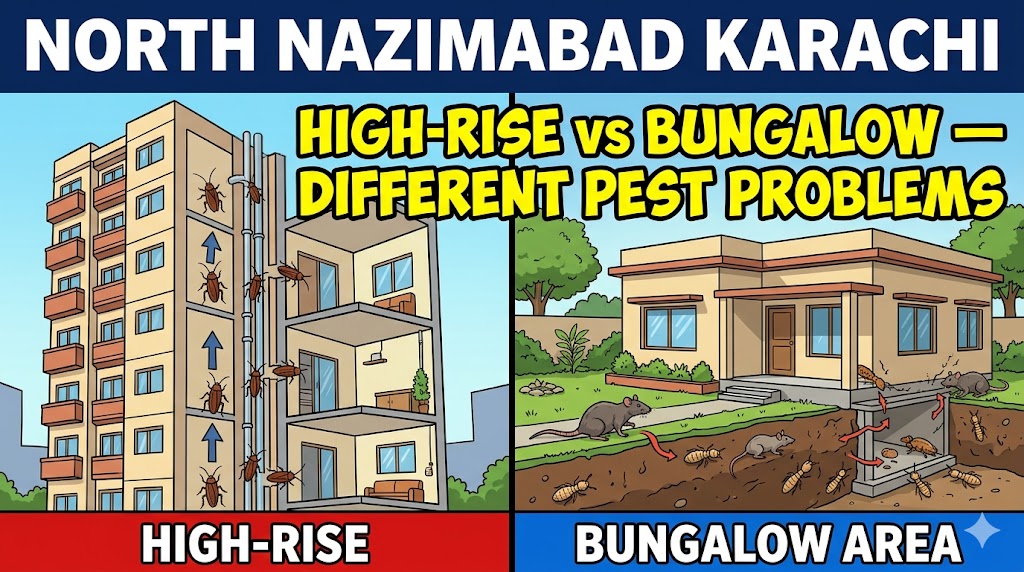
If you live in one of North Nazimabad’s multi-storey buildings — whether it’s a four-floor walkup on Nagan Chowrangi Road or a ten-storey tower near Buffer Zone — you may have noticed something: pest problems in your apartment feel different. Not just worse. Different. And you’re right to think that.
Homeowners in bungalow areas like Gulberg or parts of PECHS often assume pest control is a universal problem with universal solutions. Spray, fumigate, done. But vertical living in high-density residential zones like North Nazimabad introduces a set of structural, social, and environmental variables that make pest management significantly more complicated — and significantly more urgent.
This article breaks down exactly why, and what you can do about it.
The Vertical Living Trap: How Pests Travel Between Floors
In a standalone bungalow, your pest problem is largely contained to your property. Seal the entry points, treat the infestation, and you’ve addressed the source. In a multi-storey building, this logic breaks down entirely.
Pests — particularly cockroaches, rats, and bedbugs — are expert climbers and squeeze artists. German cockroaches, the most common apartment species in Karachi, can travel through:
- Electrical conduit gaps between floors
- Shared plumbing chases that run vertically through the entire building
- Wall cracks that connect units on adjacent floors
- Shared garbage chutes common in older North Nazimabad towers
- Elevator shafts and the mechanical rooms that serve them
This means that even if you keep your unit spotlessly clean and chemically treat it thoroughly, pests can re-enter within days from an untreated flat two floors above or below you. This is not a hypothetical. It is the day-to-day reality that residents of high-rises in North Nazimabad deal with continuously.
A building-wide infestation is almost never solved by treating one apartment. Yet that’s exactly what most residents — and even many pest control operators — attempt.
North Nazimabad’s Specific Construction Profile
Not all high-rises are built equal, and North Nazimabad’s residential stock has its own character. Much of the area developed rapidly during the 1980s and 1990s, with building quality varying considerably. This matters for pest control for several specific reasons.
Aging infrastructure: Buildings from the 1980s and early 1990s often have deteriorating grout, cracked masonry, and poorly sealed pipe penetrations. These are exactly the gaps cockroaches and rodents exploit. A German cockroach needs only a 1.5mm gap to pass through — smaller than a credit card’s thickness.
Shared utility systems: Many older buildings in this area have shared overhead water tanks that are cleaned infrequently. Moisture from these tanks seeps into walls and ceiling cavities, creating ideal conditions for cockroach breeding.
Dense parking basements: Multi-storey buildings here almost universally have ground-floor or basement parking that sits directly below residential units. These dark, warm, vehicle-exhaust-rich zones are prime rodent territory. Rats nesting in basement parking do not stay in the parking.
Market-adjacent locations: North Nazimabad is ringed by busy commercial activity — from the markets near Nazimabad No. 3 to the food vendors near the Nagan Chowrangi flyover. This commercial density is a constant source of pest pressure on surrounding residential buildings.
The Social Coordination Problem
Here’s a challenge that rarely gets discussed but is arguably the hardest to solve: in a building with 20 or 30 apartments, you cannot force your neighbours to participate in pest control.
Even if you hire the best pest control company in Karachi and treat your unit comprehensively, if the family on the fourth floor has a cockroach-infested kitchen they haven’t treated in three years, your flat will be re-infested within weeks. This is not an exaggeration — it is the documented behaviour of German cockroaches in high-density housing.
In bungalow areas, this coordination problem doesn’t exist. You control your property. In high-rises, pest control is inherently a collective action problem.
The practical solution is building-wide treatment — ideally organised through the building committee or management. But where no such coordination exists, individual residents face a constant uphill battle.
Karachi’s Climate Amplifies the Problem
North Nazimabad sits in one of the most pest-hospitable climates on earth. Karachi’s combination of high humidity during the monsoon months of June through August, warm winters that rarely kill off pest populations, and year-round food availability creates what pest control professionals call a no-reset environment.
In colder climates, winter temperatures kill or suppress pest populations annually, giving residents and pest controllers a natural reset point. In Karachi, there is no such break. Cockroach and rodent populations that establish themselves in a building’s infrastructure can grow continuously for years without seasonal interruption.
For residents of North Nazimabad high-rises specifically, this means:
- A German cockroach infestation discovered in October was likely establishing itself since at least May
- Rat populations in basement parking areas can double every three months under Karachi’s conditions
- Bedbug infestations spread faster because the warm, humid climate keeps them active year-round
Seasonal treatment, which might be adequate in other parts of the world, is simply insufficient here. Effective pest control in Karachi’s high-rises requires ongoing monitoring and periodic re-treatment.
The Water Tank and Plumbing Factor
Perhaps the single most underappreciated pest factor in North Nazimabad’s multi-storey buildings is the water infrastructure. Most buildings rely on overhead tanks, and many of these tanks are cleaned only once or twice a year, are cracked or improperly sealed allowing moisture to seep into surrounding masonry, and are accessed via roof areas that are poorly sealed against birds, bats, and rodents.
Moisture from poorly maintained tanks creates damp wall cavities that are perfect cockroach habitat. A single damp wall cavity in a building’s core — running from the third floor to the tenth — can harbour thousands of cockroaches that have access to every floor through pipe penetrations.
Treatment without addressing the moisture source is temporary at best. Effective pest management in these buildings requires identifying and drying out these moisture pathways, not just applying chemicals.
Why Standard Fumigation Often Fails in High-Rises
Many residents book a standard fumigation treatment — the kind where a technician comes, sprays exposed surfaces, and leaves. This approach, while better than nothing, often produces disappointing results in multi-storey buildings.
Surface-only treatment misses harbourage: Cockroaches spend most of their lives inside wall voids, behind electrical panels, and within pipe chases. Surface sprays don’t reach these areas.
No structural assessment: Effective treatment in a high-rise requires identifying the building’s specific pest pathways — the cracks, gaps, and conduits through which pests are moving — not just treating visible pest activity.
Single-unit treatment ignores re-infestation routes: Treating one unit without addressing neighbouring units provides only temporary relief.
Incorrect product selection: German cockroaches, the dominant species in Karachi’s apartments, have developed resistance to many commonly used insecticides. Professional-grade gel baits and growth regulators are often necessary, but many cheaper services don’t use them.
The right approach for a high-rise involves a combination of gel baiting — which cockroaches carry back to their harbourage, affecting entire colonies — targeted void treatments, rodent exclusion work at entry points, and ideally coordination across multiple units or floors.
What North Nazimabad Residents Should Actually Do
Stop treating this as a one-time problem. Pest management in your building is an ongoing process. Budget for at least two to three professional treatments per year, more if you have an active infestation.
Identify and report moisture sources. If your walls feel damp or you see water stains, report it to building management. Moist wall cavities are cockroach incubators.
Seal your unit’s connections to shared spaces. The gaps where pipes and conduits enter your flat from shared shafts should be sealed with steel wool and expanding foam. This is the most cost-effective prevention step a resident can take independently.
Coordinate with neighbours and building management. Push for building-wide treatment if possible. Even getting two or three adjacent units treated simultaneously dramatically improves outcomes.
Hire professionals who understand high-rise pest dynamics. Ask specifically about their experience with multi-storey residential buildings, their product range including gel baits versus surface spray, and whether they offer follow-up visits.
The Bottom Line
North Nazimabad’s high-rises are not simply taller bungalows. They are interconnected ecosystems where pests move freely between units, where moisture infrastructure creates persistent harbourage, and where Karachi’s climate removes the seasonal breaks that elsewhere help keep populations in check.
Managing pests effectively in this environment requires a different mindset: one that treats the building as a system rather than individual units, that prioritises structural sealing alongside chemical treatment, and that commits to ongoing monitoring rather than one-off fixes.
If you’re dealing with recurring pest problems in your North Nazimabad apartment — or you want to get ahead of the problem before it gets worse — you need professionals who understand these dynamics. Reliable pest control services in Karachi for high-rise buildings combine structural assessment, professional-grade treatments, and building-wide planning to deliver results that actually last.
Book Your Free Inspection Today
Don’t wait until a small problem becomes a building-wide infestation. Our team serves North Nazimabad and the surrounding areas, and we understand the specific challenges that high-rise residents face. Contact us today to book a free inspection of your unit. We will identify your specific pest pathways, recommend a treatment plan that fits your building’s reality, and help you coordinate with building management if needed. A pest-free apartment in North Nazimabad is achievable — it just requires the right strategy.

Ahmad Karimi is a PPMA-registered pest management specialist and the lead technical consultant at Karachi Fumigation Services, where he has overseen field operations and treatment protocols since 2005. With over 20 years of hands-on experience treating residential, commercial, and industrial properties across Karachi — from DHA bungalows with structural termite infestations to Korangi factories requiring large-scale rodent exclusion — he brings direct field knowledge to every article published on this blog.
Ahmad has managed pest control programs for clients including Descon Engineering, Pakistan Tobacco Company, Saylani Welfare, and J. (Junaid Jamshed), and has issued hundreds of fumigation certificates for health authority compliance, import/export, and commercial licensing purposes. He holds active PPMA membership and works exclusively with WHO-approved chemicals in all field operations.
The content on this blog draws directly from two decades of Karachi-specific infestation data — seasonal pest patterns, neighbourhood-level risk factors, building-age vulnerabilities, and the regulatory requirements that Karachi businesses actually face. No recycled content from foreign pest control sites. Every article reflects conditions specific to Karachi’s climate, infrastructure, and compliance environment.
For treatment enquiries or technical questions, Ahmad’s team can be reached at 03463303875 or via the office at Trade Tower, Civil Lines, Karachi.