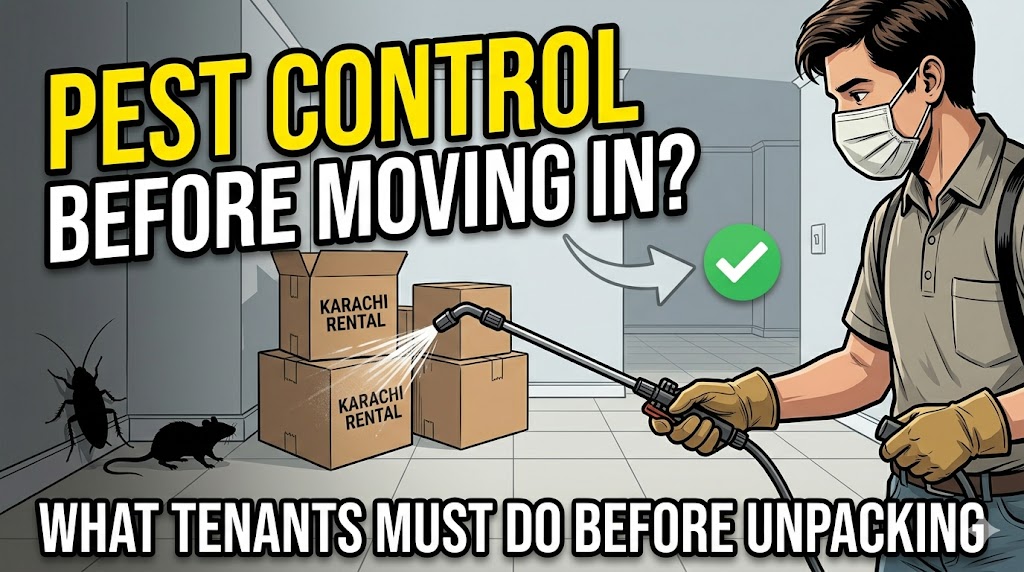
You’ve signed the lease, handed over the deposit, and finally got the keys to your new place. The last thing on your mind is pest control. You’re thinking about the move, the furniture, the curtains, which wall the sofa goes against. Understandable. But here’s what’s also in that apartment, most likely: cockroach eggs in the kitchen cabinets, rodent droppings behind the fridge cavity, bed bug traces in the bedroom corners, and possibly termite damage hidden inside the walls or under the floor. The previous tenant didn’t tell the landlord. The landlord didn’t tell you. And once you unpack and move your furniture in, these problems become ten times harder — and more expensive — to treat.
Karachi’s rental market is fast-moving. Apartments in Gulshan-e-Iqbal, North Karachi, Landhi, Korangi, Clifton, and Defence change hands constantly. Pest infestations don’t reset when a tenant leaves — they wait. New tenants arrive with fresh food, warm bodies, and a home full of new hiding spots for pests that have been quietly surviving in walls, under floors, and behind kitchen units for months or years.
This guide is for any tenant in Karachi — whether you’re moving into a flat in a high-rise or a house in a residential neighbourhood — who wants to do this right before they’re living in the middle of someone else’s pest problem.
Why Rental Properties in Karachi Are High-Risk
The combination of factors in Karachi’s rental market creates unusually high pest risk for incoming tenants:
- High tenant turnover. Apartments in densely populated areas like Nazimabad, Liaquatabad, and Federal B Area see tenants cycle through regularly. Pest problems from one tenancy carry directly into the next.
- Landlord underreporting. Most landlords in Karachi do not disclose pest history, and there is no legal obligation to do so. Many genuinely don’t know — they live elsewhere and the property sat empty for weeks or months between tenants.
- Structural age and condition. A significant portion of Karachi’s rental stock is aging construction with cracked walls, failing plumbing, gaps around pipe entries, and poor drainage — all of which are pest superhighways.
- Shared buildings. If you’re in a multi-storey building, you are sharing pest populations with your neighbours. A cockroach infestation on the floor below becomes your problem when they migrate upward seeking food.
- Empty-property accumulation. When a property sits empty, pests don’t leave — they become established in undisturbed areas. An empty flat that’s been vacant for two months has given cockroaches time to lay eggs, rats time to build nests, and termites time to advance unchallenged.
The window of opportunity you have — between getting the keys and moving your belongings in — is the best possible time to treat a rental property. You have open access to every corner, nothing to move, and no furniture or personal items to protect from treatment chemicals. Use it.
Step One: Inspect Before You Assume Anything
Before you call anyone or do anything, walk through the empty property systematically. You’re looking for evidence, not the pests themselves. Bring a torch.
Kitchen:
- Open all cabinets and drawers — look for cockroach droppings (small, dark, like ground pepper) or egg casings (brown, oval-shaped, about 8–10mm long)
- Check behind and under the stove cavity if the previous tenant left it
- Inspect under the sink — this is a prime cockroach and rodent zone due to pipe penetrations and moisture
- Look for gnaw marks on skirting boards or cabinet bases, which indicate rodent activity
- Check where water pipes enter the wall for gaps — these are entry points
Bathroom:
- Silverfish and cockroaches both thrive here — check under the toilet base, around the drain, and behind the cistern
- Look for moisture damage on walls and floors — this sustains multiple pest types
- Check grout lines for cracks where insects can harbour
Bedroom and living room:
- Inspect all skirting boards for gaps or cracks
- Check corners near the floor in every room — bed bugs leave rust-coloured staining and small dark spots on walls and skirting boards near sleeping areas
- If previous furniture marks are visible, check those areas carefully — bed bugs harbour in wall cracks near where beds were positioned
- Look along the ceiling-wall join in any room that shows damp patches — this is where cockroaches often travel
Storage areas and outside spaces:
- Check any built-in wardrobes, store cupboards, or utility spaces for rodent nesting material (shredded paper, fabric scraps, droppings)
- If the property has a garden, terrace, or outdoor drain, inspect for rodent burrows or standing water
- Inspect walls for small, pencil-width mud tubes — these are termite activity trails, and finding them should be treated as urgent
Document everything with photos. This matters both for the pest control assessment and for your protection with the landlord if disputes arise later about damage.
Step Two: Negotiate With Your Landlord — Before You Sign or Before You Move In
If you’ve already signed the lease, this section still applies. Many tenants don’t realise they have standing to request a professional pest treatment before moving in, particularly if inspection reveals evidence of infestation. This is a negotiation, and your leverage is the signed lease plus documented evidence of existing pest activity.
If you haven’t signed yet and inspection reveals a significant pest problem, request that the landlord arrange professional fumigation as a condition of the agreement. Get it in writing — a WhatsApp message counts. If the landlord refuses and the evidence is clear, factor the cost of treatment into your decision to rent or not.
In reality, many Karachi landlords will agree to arrange or share the cost of pre-tenancy treatment if approached professionally and with documented evidence. Those who flatly refuse — especially in the face of clear proof — are telling you something about how they’ll handle future maintenance issues too.
Step Three: Treat the Property Before Any Furniture Goes In
This is the single most important advice in this post. Treat before you move anything in. Here’s why:
Professional pest treatment requires access to every surface — skirting boards, under-sink areas, wall-floor junctions, inside cupboards, behind appliances. Once your furniture, boxes, and belongings are in, many of these areas become inaccessible. Treatment becomes a compromise, and a compromised treatment is a treatment that will need to be repeated sooner, at additional cost.
Additionally, when you bring your furniture in from your previous home, you risk introducing your own pest load. Mattresses and bed frames can harbour bed bugs. Cardboard boxes are cockroach habitat. Wooden furniture from an infested home may carry termites. Treating the property first gives you a clean baseline — and you should inspect and treat your incoming furniture separately before it enters.
What a proper pre-tenancy treatment should include:
- General fumigation — residual spray treatment of all surfaces, cracks, skirting boards, and entry points to address cockroaches, silverfish, and crawling insects
- Targeted cockroach control — gel bait placement in kitchen and bathroom zones where cockroaches harbour and breed
- Bed bug inspection and treatment of bedroom areas, particularly around walls and skirting boards near previous bed positions
- Rodent assessment — checking for active infestation and, if found, deploying appropriate rodent control measures before your food enters the property
- Termite inspection — if any wood-based structural elements show damage or mud trails are present, a dedicated termite treatment is required before you move in
If you’re moving into a commercial space rather than a residential rental, a commercial fumigation package is what you need — the scope and approach differ from residential treatment.
Step Four: Address the Structural Entry Points
Treatment kills the pests that are there. Sealing entry points stops new ones from coming in. Both are required. Treatment without sealing is a revolving door.
After the pest control professional has done their work and you’ve received their report, address these physical entry points before or immediately after moving in:
- Pipe penetrations: Every point where a water pipe, gas pipe, or electrical conduit enters a wall should be sealed with expanding foam or steel wool packed into the gap. In Karachi kitchens and bathrooms, these are rarely properly sealed and serve as cockroach and rodent highways.
- Door gaps: Gaps under exterior doors — even gaps of a few millimetres — are sufficient for cockroaches and rats. Door sweeps cost a few hundred rupees and eliminate this entry point.
- Window frames: Cracked or poorly sealed window frames let in both insects and moisture. A tube of silicone sealant is cheap and does the job.
- Drain covers: Karachi’s open drain culture is a rodent motorway. If your kitchen or bathroom drains don’t have secure covers, fit them. Cockroaches also regularly enter through drains.
- Wall cracks: Any visible crack in plaster — particularly at wall-floor junctions and around window and door frames — should be filled before you move in.
Ask your landlord to be responsible for sealing structural issues. If they won’t, do it yourself and keep receipts — in some cases this can be deducted from rent with proper documentation.
Step Five: Set Up Your Kitchen and Storage Correctly From Day One
The way you set up your kitchen and storage areas on day one determines your pest risk for the entire tenancy. Most tenants make avoidable mistakes here:
- Never leave food in open bags or cardboard boxes. Every flour bag, rice sack, sugar packet, and cereal box should be decanted into sealed containers within days of arrival. Karachi’s conditions — heat, humidity, and universal cockroach presence — make open food storage a guarantee of infestation.
- Don’t stack cardboard in storage areas. Cardboard is cockroach habitat. Break it down and dispose of it immediately after unpacking.
- Wipe down cabinets before use. Even if the unit looks clean, wipe all surfaces with a disinfectant before placing food or utensils.
- Don’t store items under the kitchen sink. This is the highest-risk zone in any Karachi kitchen. Keep it clear and regularly inspected.
- Dispose of rubbish daily. Don’t leave food waste in the kitchen overnight. This is the single biggest attractant for cockroaches in urban Karachi homes.
Ongoing Pest Management During Your Tenancy
A pre-move-in treatment is not a once-and-done solution in Karachi. Given the city’s climate, urban density, and building conditions, ongoing vigilance is required throughout your tenancy.
Practically, that means:
- A follow-up treatment every 3 to 6 months depending on your building’s general pest pressure
- Immediate response if you see cockroaches, rodents, or bed bugs — don’t wait to see if it’s “just one”
- Regular inspection of water storage areas — water tanks that aren’t properly sealed attract mosquitoes and create conditions that support multiple pest types. Water tank cleaning is part of responsible home management in Karachi, not a luxury
- Seasonal mosquito management — particularly before and during monsoon season when standing water accumulates. Consider professional mosquito control treatment for the property
If you have pets in the property, flea and tick treatment should be part of your routine — particularly if the previous tenants had animals or if the property has a garden.
Book Your Pre-Tenancy Pest Control in Karachi
Don’t move your belongings into someone else’s pest problem. The cost of a professional pre-tenancy treatment is a fraction of what you’ll spend dealing with an established infestation — or replacing what pests destroy.
Get a free quote from Karachi Fumigation Services before your move-in date. Confirm whether your area is covered by checking the areas served page, and book your inspection while the property is still empty. It’s the single best pest control decision you’ll make as a tenant.

Ahmad Karimi is a PPMA-registered pest management specialist and the lead technical consultant at Karachi Fumigation Services, where he has overseen field operations and treatment protocols since 2005. With over 20 years of hands-on experience treating residential, commercial, and industrial properties across Karachi — from DHA bungalows with structural termite infestations to Korangi factories requiring large-scale rodent exclusion — he brings direct field knowledge to every article published on this blog.
Ahmad has managed pest control programs for clients including Descon Engineering, Pakistan Tobacco Company, Saylani Welfare, and J. (Junaid Jamshed), and has issued hundreds of fumigation certificates for health authority compliance, import/export, and commercial licensing purposes. He holds active PPMA membership and works exclusively with WHO-approved chemicals in all field operations.
The content on this blog draws directly from two decades of Karachi-specific infestation data — seasonal pest patterns, neighbourhood-level risk factors, building-age vulnerabilities, and the regulatory requirements that Karachi businesses actually face. No recycled content from foreign pest control sites. Every article reflects conditions specific to Karachi’s climate, infrastructure, and compliance environment.
For treatment enquiries or technical questions, Ahmad’s team can be reached at 03463303875 or via the office at Trade Tower, Civil Lines, Karachi.