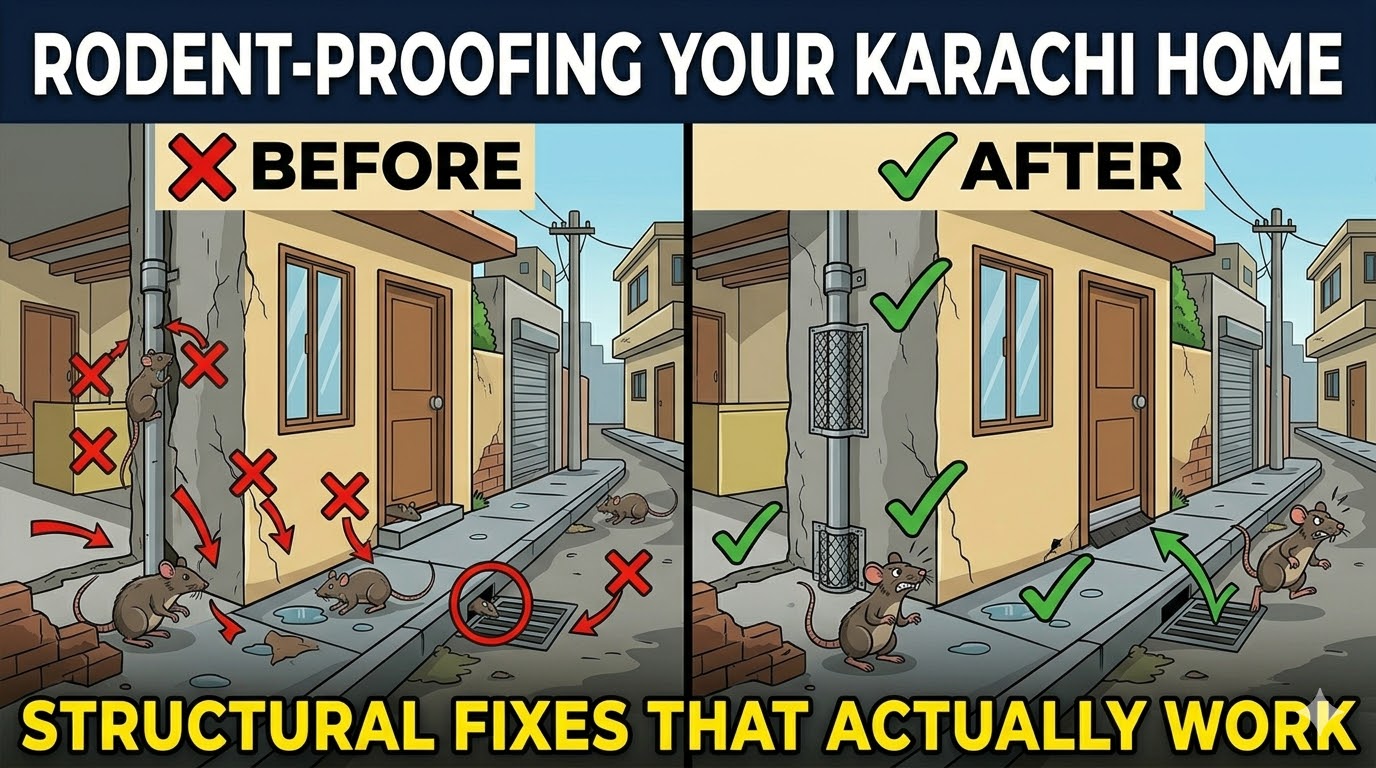
Getting rid of rats is one problem. Keeping them out permanently is an entirely different challenge — and the one that most homeowners in Karachi fail to solve. Pest control treatments eliminate the rodents currently inside your property, but without addressing the structural vulnerabilities that let them in, you are simply resetting the clock. In a city with Karachi’s population density, open drainage infrastructure, and year-round warm climate, the rodent pressure on any given property is constant.
Rodent-proofing — also called exclusion — is the practice of physically modifying your home so that rats and mice cannot enter, regardless of how many are present outside. Done properly, it is the most durable and cost-effective form of rodent control available. This guide covers the structural fixes that actually work in Karachi conditions, using locally available materials and methods suited to our building types.
Understanding What You Are Up Against
Before fixing anything, it helps to understand rodent biology. Norway rats (the large, ground-dwelling species common in Karachi’s markets, drains, and residential areas) can compress their bodies to fit through a gap of 12 to 20 millimetres — roughly the diameter of a 1-rupee coin. Roof rats (the sleeker, climbing species found in attics, ceilings, and upper floors in areas like Gulshan-e-Iqbal and Clifton) can fit through a 12mm gap and can jump over 60 centimetres from a standing position. Mice require even less — 6 millimetres is enough.
Rats can gnaw through soft mortar, plaster, wood, rubber, and standard caulk. Exclusion materials must therefore be physically impenetrable to gnawing — steel, concrete, and rated expandable mesh — not just gap-fillers that create an illusion of sealing.
Step 1: The External Perimeter Audit
Start outside. Walk the full perimeter of your property at ground level. You are looking for:
- Cracks in the foundation or plinth area wider than 5mm
- Gaps where pipes exit or enter through external walls
- Spaces beneath main doors, back doors, utility room doors, and garage doors
- Open weep holes in boundary walls (small gaps left for drainage in hollow brick walls)
- Gaps where downpipes meet the wall or ground
- Missing or broken drain covers at ground level
Mark every gap you find. In Karachi’s older residential neighbourhoods, a single external inspection typically reveals between 8 and 20 separate entry points, many of which the homeowner had no awareness of.
Step 2: Sealing Foundation and Plinth Cracks
For cracks in concrete or brick at ground level, the appropriate fix is a cement-based repair rather than sealant. Remove loose material from the crack, clean the area, and fill with a stiff cement mortar mix. Pack it firmly and allow it to cure properly before considering the repair complete. For larger gaps — anything wider than 20mm — embed steel mesh (hardware cloth with openings no larger than 6mm) into the repair to prevent rats from gnawing through the mortar once it sets.
In Karachi’s humid coastal climate, mortar repairs in outdoor or semi-outdoor areas benefit from a waterproofing additive to resist the deterioration caused by monsoon moisture and ground-level dampness. This is particularly important in properties in Clifton, DHA, and other areas with high water table levels.
Step 3: Pipe Penetration Sealing
Every pipe that enters your home through an external wall needs a properly sealed escutcheon — the cover plate around the pipe. In most Karachi homes, these are absent, decorative rather than functional, or have corroded and pulled away from the wall. The correct approach is:
- Remove any existing escutcheon or sealant that is no longer functioning
- Pack the gap around the pipe with coarse steel wool — rats cannot gnaw through it
- Apply hydraulic cement or a quality mortar mix over the steel wool
- Once cured, apply a bead of silicone sealant at the pipe-wall interface to close any remaining hairline gaps
For large conduit openings (such as electrical cable bundles or drainage pipe clusters), use purpose-made pipe escutcheon plates with a backing foam rated for rodent exclusion, and secure them mechanically rather than relying solely on adhesive.
Step 4: Door and Window Fixes
Doors are among the most commonly overlooked entry points. In Karachi’s climate, wooden door frames swell and warp, creating bottom gaps that change with the season. Metal frames fare better but still develop gaps over time. For every external door, fit a door sweep — a metal or heavy-duty rubber strip that closes the gap when the door is shut. The sweep should compress against the threshold, not just rest against it.
Windows in older Karachi homes often have deteriorated rubber or foam seals around the frame. Replacing these with fresh silicone bead and ensuring the window closes flush eliminates another entry route. Window fly screens with fine mesh (1.2mm or smaller) add an additional layer of protection for windows left open during evenings.
Step 5: Drains and Sewage Points
Drain covers are non-negotiable. Every open drain in your property — floor drains in bathrooms, kitchens, terraces, and utility areas — must have a functioning metal drain cover. The cover should be heavy enough that a rat cannot lift it from below, and the mesh should be fine enough that juvenile rats cannot pass through.
For properties connected to the main Karachi sewage network, consider fitting rat blocker valves on the main drain outlet. These one-way devices allow wastewater to flow out but prevent anything entering from the sewer side. They are particularly valuable in areas with older, cracked sewer laterals where rodents move freely through the underground system.
Step 6: Roof Level and Upper Floor Access
Roof rats exploit any opening at height. Inspect:
- Gaps around water tank pipes and inspection hatches
- The junction between the roof slab and parapet walls
- Any broken or missing roof tiles in older properties
- Vents, exhaust outlets, and AC penetrations at upper floor level
All vent openings at the roofline should be covered with 6mm galvanised steel mesh, secured with screws rather than adhesive. Check these annually — the mesh rusts in Karachi’s coastal air and can develop holes that allow entry.
Step 7: Vegetation and External Structures
Tree branches overhanging the roof provide a highway for roof rats to enter from above. Trim any branch that comes within 1.5 metres of the roofline. Creeper plants growing along external walls — a popular aesthetic choice in Karachi gardens — provide ideal climbing structure for both rat species. If you are serious about rodent-proofing, creepers on external walls must go.
Stacked materials against external walls — firewood, old tyres, building materials, potted plants — create shelter and nesting sites directly adjacent to your home. Keeping a clear 50cm band around the exterior perimeter removes this harborage.
Materials That Work and Materials That Don’t
Many Karachi homeowners attempt DIY sealing with materials that rats simply gnaw through. For clarity:
- Steel wool: Effective when packed firmly into gaps — rats cannot gnaw it
- Hardware cloth (6mm galvanised mesh): Ideal for covering larger openings
- Hydraulic cement / mortar: Durable for structural gaps, especially at plinth level
- Silicone sealant: Good for finishing around sealed gaps — not a primary filler
- Standard expanding foam: Ineffective alone — rats gnaw through it within days
- Rubber or foam door seals: Only effective if the backing is secure and regularly maintained
Why Professional Exclusion Work Delivers Better Results
A professional rodent exclusion service does not just seal the gaps you can see. Trained technicians identify rodent travel paths using UV inspection, look for gnaw marks and grease trails that indicate active routes, and seal entry points in the correct sequence — ensuring that rodents being displaced by treatment have no alternative but to leave the property rather than relocate within it. Our rodent control service in Karachi combines treatment with a structural exclusion assessment, so you are not paying for pest control twice.
As part of our work, we connect clients with trusted local contractors for structural repairs that go beyond what a pest control visit alone can address. This integrated approach is the only way to achieve lasting results in Karachi’s high-pressure rodent environment. Homeowners who have tried pest control services in Karachi without the exclusion component consistently report re-infestation within weeks.
Maintenance Is Not Optional
Rodent-proofing is not a one-time job. In Karachi’s climate, sealants degrade, steel mesh rusts, monsoon seasons create new cracks, and construction in neighbouring properties can disturb rodent populations that then seek new shelter in yours. A semi-annual inspection — before the pre-monsoon season and after the rains — is the minimum maintenance schedule to keep your exclusion work effective.
Book a Free Inspection Today
If you are ready to stop the cycle of repeated infestations, start with a professional assessment of your property’s structural vulnerabilities. Our team will conduct a free inspection, identify every entry point, and provide a detailed exclusion plan with practical, Karachi-specific solutions. Contact us today to book your free inspection and take the first real step toward a rodent-free home.

Ahmad Karimi is a PPMA-registered pest management specialist and the lead technical consultant at Karachi Fumigation Services, where he has overseen field operations and treatment protocols since 2005. With over 20 years of hands-on experience treating residential, commercial, and industrial properties across Karachi — from DHA bungalows with structural termite infestations to Korangi factories requiring large-scale rodent exclusion — he brings direct field knowledge to every article published on this blog.
Ahmad has managed pest control programs for clients including Descon Engineering, Pakistan Tobacco Company, Saylani Welfare, and J. (Junaid Jamshed), and has issued hundreds of fumigation certificates for health authority compliance, import/export, and commercial licensing purposes. He holds active PPMA membership and works exclusively with WHO-approved chemicals in all field operations.
The content on this blog draws directly from two decades of Karachi-specific infestation data — seasonal pest patterns, neighbourhood-level risk factors, building-age vulnerabilities, and the regulatory requirements that Karachi businesses actually face. No recycled content from foreign pest control sites. Every article reflects conditions specific to Karachi’s climate, infrastructure, and compliance environment.
For treatment enquiries or technical questions, Ahmad’s team can be reached at 03463303875 or via the office at Trade Tower, Civil Lines, Karachi.
Leave a Reply