
Pregnancy brings a heightened awareness of everything in your environment: the food you eat, the air you breathe, the cleaning products you use. So when pest season hits in Karachi, or a cockroach infestation forces the issue, the question becomes urgent: can I have my home fumigated while pregnant?
The honest answer is that it depends on four things: the type of treatment, the trimester, how the work is carried out, and what happens before and after. Handled properly, a pest treatment does not need to put a pregnancy at risk. Handled carelessly, with the mother at home and a strong spray in every room, it is an exposure nobody needs. This guide covers how to get it right.
Why Pregnancy Changes the Rules on Chemical Exposure
During pregnancy the body changes in ways that make both mother and baby more sensitive to chemicals than at any other time:
- The developing baby has no working detoxification system of its own; its liver and kidneys cannot clear chemicals efficiently until much later in development.
- Many insecticides are fat-soluble and can cross the placenta.
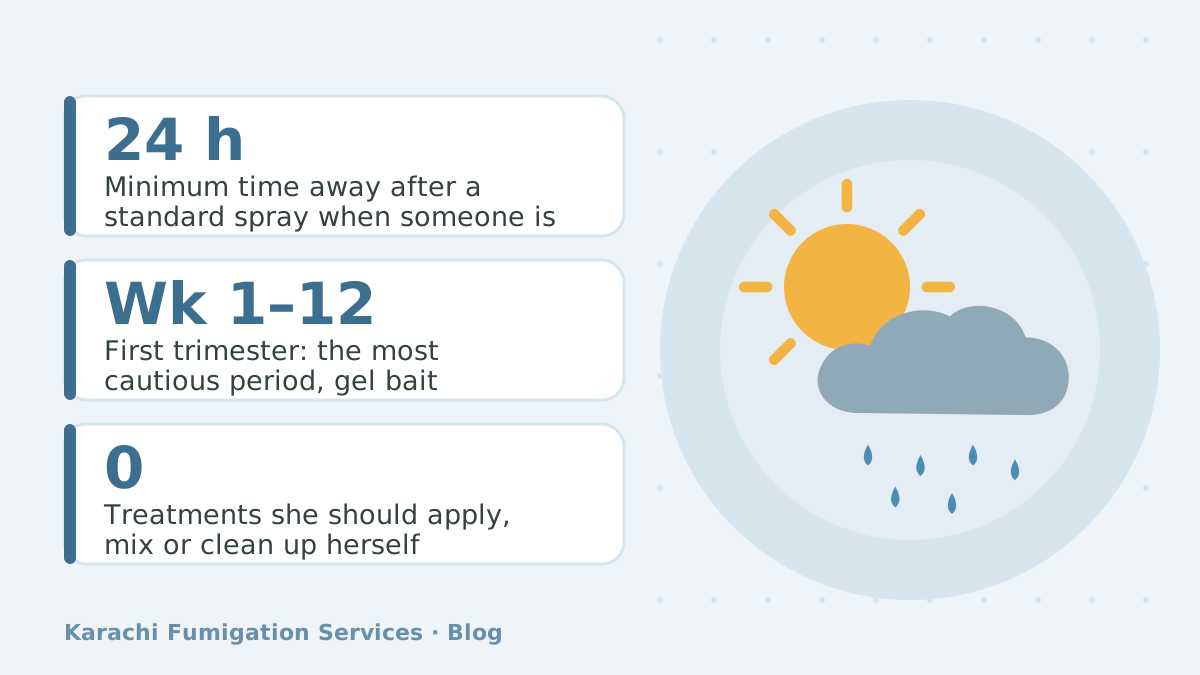
- The first trimester (weeks 1 to 12) is when all the major organ systems form, so it is the most cautious period.
- Pregnancy hormones make nausea, dizziness and sensitivity to fumes much worse, so even a mild odour can make an expectant mother feel unwell.
None of this means a home with a pregnant woman can never be treated. It means the treatment has to be planned around her: the right product, the right method, and the mother out of the house.
Keep the risk in proportion. MotherToBaby, the information service run by teratology specialists, notes that having a home treated by a professional exterminator is unlikely to raise exposure enough to increase risks to a pregnancy. The precautions below are about keeping exposure as close to zero as you reasonably can.
The Pest Problem Reality in Karachi
Karachi is one of South Asia's most densely populated cities, and pests are a year-round reality here. Monsoon brings surges of mosquitoes and cockroaches, and termites damage wooden furniture and fittings in DHA, Gulshan and Malir every year. Pest control is not a luxury in this city.
Families in older neighbourhoods such as Lyari, old Clifton and parts of Saddar often live in buildings whose shafts, drains and wall voids hold established pest colonies. Putting off treatment is not risk-free either: mosquitoes carry dengue, cockroaches contaminate food, and the stress of a severe infestation is real.
The goal is to manage treatment safely, not to avoid it for nine months.
Which Pest Control Chemicals Need the Most Caution in Pregnancy?
| Treatment type | Typical use in Karachi | Puts product in the air? | Guidance during pregnancy |
|---|---|---|---|
| Gel bait, boric acid bait | Cockroaches, ants | No | First choice, especially in the first trimester |
| Pyrethroid spray (cypermethrin, deltamethrin, permethrin) | General crawling insects, bed bugs, mosquitoes | Yes, while wet | Acceptable with the mother out of the house and the rooms aired |
| Organophosphates (chlorpyrifos, malathion) | Older cockroach and mosquito products | Yes | Avoid; ask for an alternative |
| Fogging / thermal fog | Mosquitoes, outdoor areas | Yes, heavily | Mother away until the next day |
| Gas fumigation (sulfuryl fluoride, methyl bromide, phosphine) | Structural or commodity fumigation | Yes, toxic gas | Only by licensed operators; full evacuation and air testing before anyone returns |
Organophosphates
Chlorpyrifos and malathion are organophosphates, still found in some cockroach and mosquito products. Research has linked prenatal organophosphate exposure with lower birth weight and effects on the developing brain, which is why regulators have tightened their use. In the United States, for example, most household uses of chlorpyrifos were withdrawn as far back as 2000 (US EPA). Ask your provider directly whether they use organophosphates, and ask for an alternative if they do.
Pyrethroids
Synthetic pyrethroids such as cypermethrin, deltamethrin and permethrin are the most widely used insecticides in Karachi. They are considered lower risk than organophosphates and break down relatively quickly, but caution is still sensible, particularly in the first trimester. The risk is low when the expectant mother is away during the treatment and the rooms are properly aired before she returns.
Gas fumigants: methyl bromide, sulfuryl fluoride and phosphine
These gases are used for tent or structural fumigation and for treating stored goods. They are highly toxic to everyone, not only in pregnancy. A home treated this way must be fully evacuated and should not be re-entered by anyone until a licensed operator has aired it and tested the air. For a pregnant woman, plan on staying elsewhere for the whole process and the following day or two.
Boric acid and gel baits
These are among the safest options. Boric acid baits and gel baits for cockroaches have a much lower toxicity profile and do not put insecticide into the air the way sprays and fogs do. Where the infestation allows, a good pest control company will recommend these first in a home with a pregnant woman.
Trimester-by-Trimester Risk Guide
- 1First trimester (weeks 1 to 12): most caution. Organs, brain and nervous system are forming. Prefer gel bait or targeted crack-and-crevice work. If a spray or fog is unavoidable, stay out of the home during the treatment and for at least 24 to 48 hours afterwards, and do not be present even while gel bait is being placed.
- 2Second trimester (weeks 13 to 26): moderate caution. The main organ-forming window has passed, but the nervous system keeps developing. A pyrethroid spray with the mother away and the rooms aired is generally manageable. Discuss the specific product with your gynaecologist.
- 3Third trimester (weeks 27 to 40): caution still needed. The baby's brain is still growing rapidly, and late pregnancy makes fumes and breathlessness harder to tolerate. The same rules apply: be out of the house, air it thoroughly and return only when surfaces are dry and there is no smell.
Safety Rules for Fumigation When Someone Is Pregnant
If treatment is needed in a home with a pregnant family member, these rules are non-negotiable:
Treatment day when someone is pregnant
- BeforeShe leavesOut of the home before work starts, not in another room
- DuringLow-air methods firstGel bait and crack-and-crevice work where possible
- 24 h+She stays awayLonger after fogging or a heavy spray
- ReturnSomeone else airs and wipesWindows open, floors mopped, surfaces wiped first
- She leaves the home before treatment begins, not just goes to another room or another floor.
- She stays away at least 24 hours after a standard spray, longer after fogging or gas fumigation.
- Food, water, utensils and baby items are removed or sealed before the technician starts.
- The company is told about the pregnancy when you book, so it can choose the product and method accordingly.
- You ask for the product name or safety data sheet (MSDS) for everything that will be used, to show your doctor.
- Someone else airs the home and wipes surfaces before she returns; windows stay open for the rest of the day.
- Your doctor knows before and after the treatment, with the product names.
- Do not mix, spray or apply pesticides yourself while pregnant. This is the exposure that matters most, and it is the one specialist services advise against.
- Do not do the post-treatment cleaning, handle sprayers or empty containers.
- Do not use shop-bought foggers ("bug bombs") indoors while pregnant.
How We Handle a Visit When Someone at Home Is Pregnant
Tell us when you book and the visit is planned around it. Where the pest allows, we use gel bait and targeted crack-and-crevice placement instead of broad spraying, and a low-odour (be-bu) product is available on request. Food-contact surfaces are not sprayed. The expectant mother should be out of the home during the treatment and for the longer re-entry time, and someone else should do the airing and wiping before she returns.
Every active ingredient we use is listed on our chemicals we use page, so you can show the list to your doctor before the visit. Our safety guidance covers pregnancy, babies and pets, and general waiting times are explained in how long after fumigation you can enter your home.
What to Ask Your Pest Control Provider in Karachi
Not every pest control company in Karachi is open about what it uses. When you call to book, mention the pregnancy and ask:
- Which exact products or active ingredients will be used?
- Are any organophosphates included? If so, can they be replaced?
- What re-entry time do you recommend for a pregnant woman?
- Can the job be done with gel bait or targeted treatment instead of a full spray?
- Will you give the product names in writing?
A professional pest control service in Karachi will answer all of these clearly. If a company brushes the questions aside or cannot name its products, do not hire it.
Lower-Risk Alternatives to Consider
In the first trimester, or when an infestation is still small, these options can manage the problem with little or no chemical exposure:
Lower-risk options during pregnancy
- Gel and boric acid baitsCockroaches, with almost no airborne exposure
- Diatomaceous earthMineral powder in cracks and behind appliances
- Snap traps and glue boardsRodents, no chemicals at all
- Nets, screens, fans and repellentThe safest indoor protection from mosquitoes
- Sealing and cleaningFewer gaps, leaks and food sources
- Gel and boric acid baits: effective for cockroaches, with almost no airborne exposure.
- Diatomaceous earth: a mineral powder that damages insects physically, used in cracks and behind appliances.
- Snap traps and glue boards for rodents: no chemicals at all.
- Nets, screens and fans for mosquitoes: the safest indoor protection, alongside a skin repellent.
- Sealing and cleaning: closing gaps around pipes, fixing leaks and removing food sources shrinks any infestation.
Ultrasonic repellers and essential-oil sprays are often sold for this purpose, but there is little evidence that they control pests, so do not rely on them. These alternatives will not clear a severe infestation, but they can keep a problem in check until a safer time for full treatment.
A Word on Karachi's Dengue Season
Many articles on fumigation and pregnancy leave this out: in Karachi, refusing all mosquito control during pregnancy carries its own risk. Dengue rises during and after the monsoon, roughly July to October, and the CDC notes that dengue in pregnancy can cause premature birth, low birth weight and fetal death, and can pass to the baby around the time of birth.
When dengue risk peaks in Karachi
LowerRisingHighPeak
In neighbourhoods near nullahs, water bodies or poor drainage, including parts of Orangi, Baldia and Keamari, mosquito control is not optional. There, a properly managed treatment with the mother away from home is usually a smaller risk than dengue itself.
Use repellent. The CDC states that EPA-registered repellents containing DEET, picaridin, IR3535 or oil of lemon eucalyptus are safe and effective for pregnant and breastfeeding women when used as the label directs. Make the timing decision on any outdoor fogging with your gynaecologist, who knows your pregnancy.
After Fumigation: Steps for Pregnant Women
When it is time to go home:
- 1
Let someone else open up and clean
A family member or helper opens every window and door, mops the floors and wipes kitchen counters, tables and baby items before you walk in.
- 2
Keep the air moving on day one
Keep windows open and fans on for several hours, and avoid sitting in closed rooms with poor ventilation on the first day back.
- 3
Stay away from equipment and containers
Do not wash or handle sprayers, empty bottles or bait packaging.
- 4
Watch for symptoms
If you notice headache, nausea, dizziness or shortness of breath, go outside into fresh air and call your doctor.
- 5
Tell your doctor what was used
Share the product names with your gynaecologist or midwife at your next visit.
The Bottom Line
Fumigation during pregnancy is manageable when it is planned around the expectant mother: she is out of the house, the product is chosen with the pregnancy in mind, someone else airs and cleans, and her doctor knows what was used. In a city where pest pressure and dengue are both real, the goal is careful, informed pest management, not avoidance at all costs. If you are pregnant and dealing with a pest problem, book a free inspection and tell us about the pregnancy so the visit is planned around it.