
There's a particular kind of frustration that Karachi homeowners know all too well: you hired a fumigation company, paid the fee, vacated your home for a day, came back hopeful, and within three weeks, the cockroaches were back. Or the termites hadn't really gone anywhere. Or the bedbug bites on your children continued every night.
And you realise, too late, that the "great deal" you found wasn't a deal at all.
Cheap fumigation in Karachi is everywhere. Budget operators advertise on OLX, post in neighbourhood WhatsApp groups, and hand out flyers in apartment buildings across DHA, Gulshan, North Nazimabad, and Korangi. Their prices can seem appealing, sometimes far below established companies. But in almost every case, that initial saving dissolves quickly and often multiplies into much larger costs.
This post explains exactly why, and helps you understand what you're actually paying for when you choose on price alone.
The Real Cost of a Pest Problem in Karachi
Before we break down the shortcuts cheap operators take, it's worth understanding what's at stake in a city like Karachi.
Karachi's combination of heat, humidity, aging infrastructure, and dense housing makes it one of the most pest-prone urban environments in South Asia. Pests here aren't merely a nuisance; they cause real, measurable damage:
- Termites can compromise the structural integrity of wooden beams, door and window frames and fitted furniture. A serious infestation in an older property can leave a large repair bill.
- Cockroaches carry pathogens including Salmonella and E. coli. In homes with young children or elderly residents, this is a genuine health concern.
- Bedbugs spread rapidly between rooms, units, and floors in apartment buildings. A missed or partial treatment can lead to a full building infestation within weeks.
- Rodents chew through wiring (creating fire risk), contaminate food, and carry diseases. They are also notoriously difficult to fully eliminate without professional-grade baiting strategies.
The cost of letting any of these infestations go unresolved, or being treated ineffectively, far exceeds the cost of proper professional treatment the first time.
What Cheap Fumigation Companies in Karachi Actually Cut
When a fumigation company charges substantially less than the market rate, they are cutting costs somewhere. Here is where those cuts almost always happen:
Where a cheap job saves its money
Cheap operator
- Diluted, unlabelled or fake chemicals
- No inspection, just a quick surface spray
- Untrained helpers
- No follow-up and no written warranty
- Safety steps skipped
Professional service
- Registered products at the label strength
- Inspection to find nests and entry points
- Trained technicians
- Follow-up plan and a written warranty
- Re-entry times and safety advice given
1. They Use Substandard or Diluted Chemicals
Professional-grade pesticides (particularly those used for termite treatment, bedbug eradication, and cockroach gel baiting) are not cheap. They are imported or locally formulated to specific concentrations that have been tested for efficacy and safety.
Budget operators frequently use:
- Diluted solutions that fall below the effective concentration threshold
- Counterfeit or unregistered chemicals purchased from unverified suppliers
- General-purpose agricultural pesticides repurposed for domestic use, often incorrectly
- Older chemical formulations that pests in Karachi have developed resistance to
The result: pests are not fully eliminated. Some die, creating a false sense of success. But survivors, and their eggs, repopulate within weeks. You're left calling the company again (if they're still reachable) or paying for a second full treatment from a different provider.
2. They Skip the Inspection
A proper fumigation job begins before a single chemical is applied. It begins with a thorough inspection of the property: identifying the pest type, severity, spread, entry points, harbourage zones, and moisture sources.
Budget operators almost universally skip this step. They apply a standard treatment regardless of what the property actually needs. This means:
- The wrong chemicals may be used for the specific pest
- Nesting zones and entry points are not addressed
- High-risk areas that require targeted treatment are missed
- The treatment is superficial rather than systemic
It's the equivalent of a doctor prescribing medication without examining the patient. The prescription might help temporarily, or it might do nothing at all.
3. Technicians Are Untrained or Minimally Trained
Proper pest control is a skilled trade. It requires knowledge of pest biology, chemical handling, application techniques, safety protocols, and regulatory requirements. Training takes time and investment, and budget operators typically invest neither.
Untrained technicians:
- Apply chemicals incorrectly: the wrong concentration, the wrong surface, the wrong method
- May not identify secondary infestation zones during the treatment
- Handle chemicals without proper protective equipment, which is also a liability for your household
- Cannot diagnose why a previous treatment failed or what adjustment is needed
The treatment may look thorough from the outside: the technicians showed up, sprayed things, and left. But the actual efficacy depends entirely on expertise that was never there.
4. No Follow-Up, No Warranty
Effective pest control (particularly for termites, bedbugs, and rodents) often requires multiple visits. A single application rarely eliminates an established infestation completely. Eggs hatch. Stragglers emerge. Neighbouring units reintroduce pests.
Professional companies build follow-up visits into their service packages and offer warranties that cover re-treatment if the infestation recurs within a defined period. Budget operators offer neither.
When you call them back two weeks later to report re-infestation, one of three things happens:
- They charge you again for a second treatment
- They blame you: "You must have left a window open" or "The infestation must have spread from a neighbour"
- They don't answer at all
This is the most common hidden cost of cheap fumigation: paying twice, or three times, for results that a single proper treatment would have achieved.
5. Health and Safety Corners Are Cut
This is the most serious risk, and the least discussed.
Pesticides used in fumigation can be hazardous. Some chemical compounds used in termite treatments, rodent control, or general fumigation require specific ventilation periods, protective measures for food and utensils, and safe re-entry times. Applied improperly, they pose genuine health risks, particularly for children, pregnant women, and anyone with respiratory conditions.
A budget operator with no formal training may:
- Fail to advise you on proper food protection before treatment
- Apply chemical concentrations that require longer ventilation than they tell you
- Use compounds in indoor spaces where they are not designed to be used
- Leave chemical residue on food preparation surfaces
The cost of a health incident (medical treatment, anxiety, and the broader disruption to your household) is incalculable. This is a risk that no price saving justifies.
The True Cost of Cheap Fumigation: A Realistic Scenario
Let's put this in concrete terms. Consider a typical apartment in Gulshan-e-Iqbal or Nazimabad with a cockroach and bedbug infestation.
How a 'cheap' cockroach and bed bug job adds up
- Week 0Budget sprayLow fee, no inspection, no warranty
- Weeks 2–3Pests backEggs hatch and survivors breed
- Month 1Same fee againA second spray with the same result
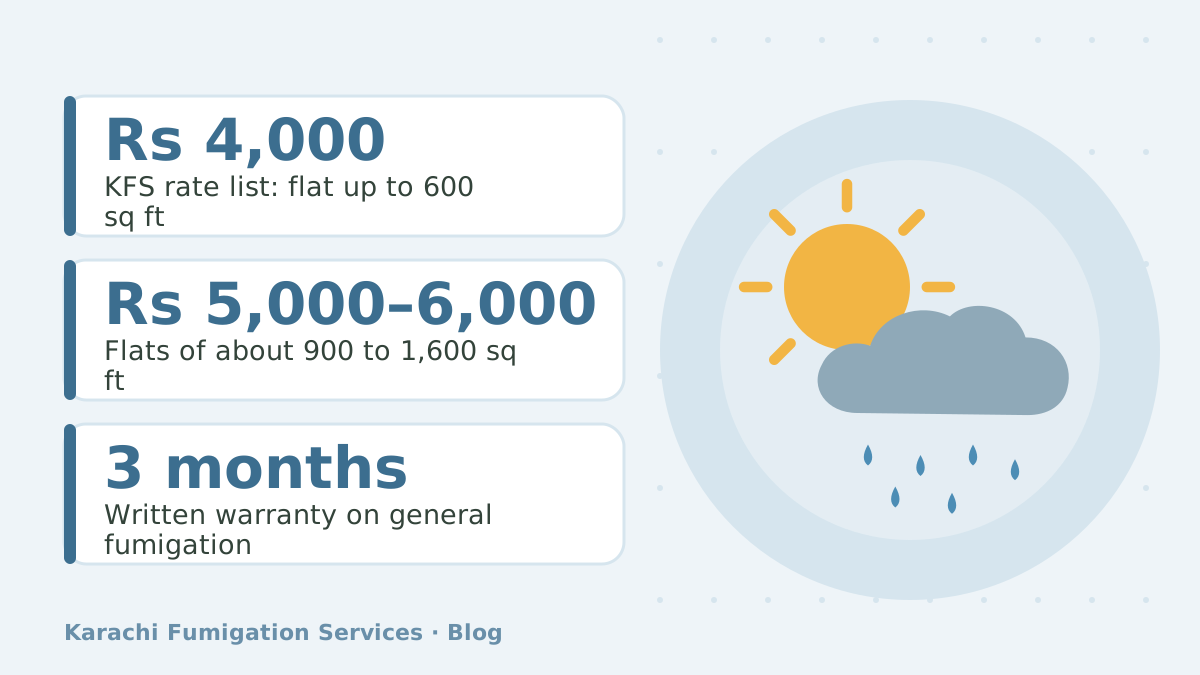
- Month 2Professional treatment anywayRs 5,000–6,000 for a 900–1,600 sq ft flat, with warranty
- LaterFurniture lossesBed bugs that spread may cost a mattress or sofa
- Budget operator: A low flat fee for a one-time spray. No inspection. No warranty. Pests partially controlled for 2 to 3 weeks.
- Month 1 repeat treatment: The same fee again (because the first one failed).
- Professional company (second attempt): The published rate for the flat's size, Rs 5,000 to 6,000 for a flat of roughly 900 to 1,600 sq ft on our rate list, with a written warranty. But because the previous cheap treatments disrupted (without eliminating) the infestation, treatment is now more complex.
- Replacement of an infested mattress or sofa: often the biggest bill of all, because bed bugs that weren't eliminated in time spread into furniture.
- Total: Several times what a single professional treatment would have cost from the start.
This scenario plays out in Karachi homes more often than most homeowners would like to admit. The maths is unambiguous.
What You Are Actually Paying For With a Professional Service
When you choose a properly priced, professional fumigation service, here is what that price actually represents:
- Registered, tested chemicals at appropriate concentrations, sourced from legitimate suppliers
- Trained and certified technicians who understand pest biology and application methodology
- A proper pre-treatment inspection to accurately assess the infestation and determine the right approach
- Safety protocols to protect your family and property during and after treatment
- A written warranty that covers re-treatment if the infestation returns within the warranty period
- Follow-up visits to verify efficacy and address any remaining problem areas
- Accountability: a registered business with a physical address and reachable contact details
When evaluating pest control services in Karachi, ask providers to break down what their fee includes. A legitimate company will answer every question clearly and in writing.
Fair pricing does not have to mean guesswork. Our rates are published by flat size and plot size on the fumigation prices page, with no call-out fee, no survey fee and nothing added on the day. Termite, rodent and tank work is quoted after a free survey. The chemicals we use are listed pest by pest, and the warranty terms are written down before you book.
How to Avoid Being Misled by Low Prices
Here are practical steps to protect yourself from the cheap fumigation trap:
Before you book on price
- Know how the price is setRate list by size for standard jobs; survey for termites, rodents and commercial
- Get a written breakdownProducts, number of visits, warranty terms
- Ask what the warranty coversPests, period, exclusions and how to claim
- Check registrationNTN and SRB, names matching the invoice
- Know how the price is set. A published rate list by flat or plot size is fair for standard treatments. For termites, rodents or large and commercial properties, a phone price without a survey means the company is guessing or cutting corners.
- Ask for a written breakdown. What chemicals are being used? How many visits are included? What does the warranty cover? A professional company will provide this without hesitation.
- Compare warranties, not just prices. A higher upfront price with a written warranty often costs less in total than a lower price with no follow-up.
- Check the company's track record. How long have they been operating in Karachi? Do they have a physical office? Are there genuine customer reviews?
- Trust your instincts. If a company is evasive about chemicals, vague about guarantees, or uses high-pressure tactics, walk away.
The Bottom Line
Fumigation is not a commodity. The difference between the cheapest quote and a properly priced one is not just the price; it is the chemicals, the expertise, the safety protocols, the follow-up service, and ultimately, whether your home is actually pest-free at the end of it.
In Karachi's climate and urban environment, pests do not give up easily. They require treatment that is comprehensive, targeted, and backed by professional knowledge. Cutting corners on pest control is one of those decisions that always reveals itself, usually faster than you'd expect.
Invest in proper fumigation once. It is almost always far cheaper than paying for inadequate treatment repeatedly.