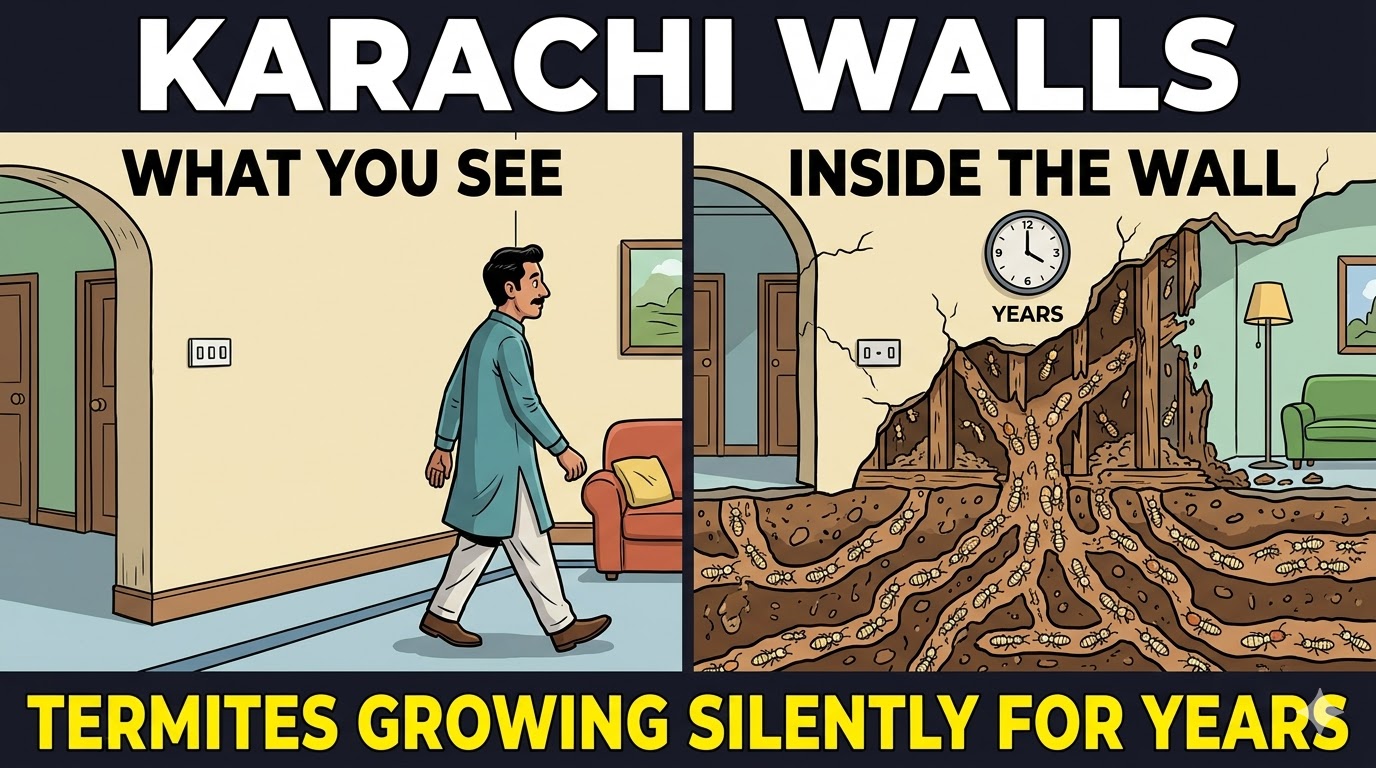
Most Karachi homeowners discover termites the hard way — a hand pressed against a wall suddenly sinks in, a wooden door frame crumbles at the touch, or a lick of paint peels back to reveal a hollow, honeycomb-like ruin beneath. By that point, termites have already been living in your home for years.
This is the terrifying truth about termite infestations: the damage happens long before any visible sign appears. In Karachi’s climate — humid coastal air, clay-heavy soil, and temperatures that rarely dip below 20°C — subterranean termites find an almost perfect environment to build massive underground colonies and quietly consume everything in their path.
In this article, we explain exactly how termite colonies establish, grow, and spread inside Karachi homes without triggering any alarm — and what you can do about it before the damage becomes irreversible.
Understanding Termite Biology: Why They Are So Hard to Detect
To understand why termites go unnoticed for so long, you need to understand how they live. The most destructive species in Karachi is the subterranean termite (Coptotermes gestroi and related species), and their entire biology is designed around staying hidden.
A Colony Is a Living, Growing Organism
A single termite colony can contain anywhere from 100,000 to over one million individual termites. However, a colony does not start that way. It begins with a single pair — one reproductive queen and one king — that settle into the soil, usually beneath or near a building’s foundation.
In the first year, the queen lays only a handful of eggs per day. The colony at this stage is microscopic — a few dozen workers foraging cautiously within inches of the nest. No structural damage occurs. No signs appear. This is why even a professional cannot always detect a brand-new infestation.
By Year 3 to 5, the queen’s egg production can reach thousands per day. The colony now has a fully organized caste system: workers (who eat your walls), soldiers (who defend the colony), and reproductives (who will eventually spread to new locations). The foraging range expands dramatically — up to 100 metres in every direction.
They Never Surface — Unless Forced To
Subterranean termites are photophobic — they actively avoid light and open air. Every tunnel they build is sealed with a mixture of soil, saliva, and faecal matter (called “carton”). When they penetrate walls, they hollow out the inside of wood and drywall while leaving the outer surface completely intact. This is why you can tap a wall for years and hear nothing wrong until the structure has been almost entirely consumed.
Karachi’s Unique Conditions: A Termite’s Ideal Home
Not every city in Pakistan faces the same level of termite risk. Karachi has several specific environmental and construction factors that make it one of the highest-risk cities in the country for termite infestation.
Coastal Humidity and Clay Soil
Karachi’s coastal location keeps humidity levels elevated for most of the year, particularly in areas like Clifton, DHA, Lyari, and Korangi. Termites need moisture to survive, and damp soil near foundations provides the perfect environment for underground colonies to thrive. Clay-heavy soil, common across much of Karachi’s older residential zones, retains moisture exceptionally well — acting almost like a natural termite nursery.
Older Construction and RCC Slab Buildings
Much of Karachi’s residential housing stock — particularly in areas like PECHS, North Nazimabad, Gulshan-e-Iqbal, and Nazimabad — was built between the 1960s and 1990s using construction methods that offer little termite resistance. Exposed wooden joinery, inadequate chemical pre-treatment of foundations, and the use of low-density timber in doors, windows, and ceiling frames have left an entire generation of homes vulnerable.
Even newer constructions in DHA Phases 7 and 8, Bahria Town, and Scheme 33 are at risk if pre-construction anti-termite soil treatment was skipped or applied inadequately — which, according to professionals, happens more often than homeowners realise.
Plumbing Leaks and Ground-Floor Vulnerability
Dripping pipes, slow drainage, and bathroom seepage create moisture hotspots inside walls. Termites detect these wet zones and use them as entry points. Ground-floor apartments and bungalows are especially at risk, but termites in Karachi are regularly found on upper floors as well — travelling through pipe ducts, electrical conduit paths, and party walls shared between units.
The Silent Timeline: How a Colony Grows Inside Your Walls Year by Year
Here is a realistic breakdown of what happens inside a Karachi home during a typical termite infestation:
Year 1: Establishment Below Ground
A queen and king termite — called “alates” — land near your home after a monsoon swarm, shed their wings, and burrow into soil near the foundation. The nest is established 30 to 60 cm below ground. No signs are visible. The colony has fewer than 1,000 members.
Year 2: Probing the Foundation
Workers begin extending foraging tunnels, reaching foundation walls. If there are any cracks, gaps around plumbing pipes, or poorly sealed expansion joints, workers enter the structure. They begin feeding on concealed timber elements — skirting boards, door frames, and sub-floor timbers if present. Still no external evidence. Colony size: 5,000 to 30,000.
Year 3 to 4: Active Wall Infestation
Termites build mud tubes along the inner surface of walls and begin hollowing out wooden elements systematically. In homes with false ceilings, they travel upward to wooden battens and POP framing. In older homes, they consume door architraves, window frames, and kitchen cabinetry. The outer paint or plaster remains intact. Colony size: 100,000 to 500,000.
Year 5 and Beyond: Reproductive Expansion
The colony produces winged reproductives (swarmers) that emerge — usually after the first monsoon rains — to establish new colonies nearby. Homeowners often see small, winged insects near light sources and mistake them for flying ants. This is the first visible sign most people notice, and by this point, the primary colony is enormous and the structural damage is already severe.
The Warning Signs You Should Know — and Why Most Homeowners Miss Them
Termites do leave signs, but these signs are subtle and easy to misinterpret without training. Here is what to look for:
- Mud tubes on walls or near the base of walls: These pencil-thin brown tubes are how termites travel above ground. Check exterior and interior walls at ground level, especially in storage rooms, utility areas, and behind furniture.
- Hollow sound when tapping wood: Use your knuckle to tap along door frames, skirting boards, and kitchen cabinets. A hollow, papery sound suggests the interior has been eaten away.
- Bubbling or uneven paint: Paint that bubbles, blisters, or appears to have moisture beneath it on an interior wall can indicate termites building carton material just under the surface.
- Discarded wings near window sills or light fixtures: Swarmers shed their wings immediately after landing. Small piles of translucent wings — often mistaken for insect litter — are a major warning sign.
- Tight-fitting doors and windows: Termite activity generates heat and moisture that warps timber. If doors or windows that previously opened smoothly have become stiff or warped, this may be an early structural indicator.
- Frass (termite droppings): Dry-wood termites push their droppings out of small holes. These look like tiny, hexagonal pellets or sawdust and appear near infested wood.
The challenge is that in a busy Karachi household, these signs are often overlooked, attributed to moisture, or simply cleaned up without investigation. By the time homeowners grow concerned enough to call a professional, the infestation has typically been active for three to five years.
What Areas of Your Home Are at Greatest Risk?
Termites do not attack randomly — they follow moisture, wood, and structural gaps. The highest-risk areas in a typical Karachi home include:
- Ground-floor walls adjacent to soil: Any wall that sits directly on or near the ground, especially in older homes without a damp-proof course (DPC), is highly vulnerable.
- Bathroom and kitchen walls: Pipe leaks and condensation create sustained moisture that attracts termites into wall cavities.
- Wooden door and window frames: These are often the first structural elements attacked, particularly in homes with solid wood frames.
- False ceilings and POP work: Widely installed across DHA and Gulshan properties, false ceilings with wooden battens provide an ideal concealed environment for termites to spread horizontally across an entire floor.
- Under stairs and inside storage cupboards: Dark, rarely disturbed spaces with contact to walls are prime infestation zones.
- Behind fitted kitchen cabinets: Particularly in older kitchens where cabinets sit against external or ground-adjacent walls.
Why Professional Detection Matters More Than DIY Inspection
Many homeowners attempt self-inspection, but termite detection requires more than looking for obvious damage. A professional inspection involves:
- Thermal imaging to detect heat anomalies behind walls that indicate termite activity
- Moisture mapping to identify entry points and feeding zones
- Probing and tapping across all suspect surfaces systematically
- Inspection of subterranean entry points including expansion joints, plumbing ducts, and foundation cracks
- Colony activity assessment to determine whether an infestation is new, established, or in an advanced stage
If you suspect termite activity — or simply want peace of mind — professional termite treatment in Karachi begins with a thorough site inspection that identifies not just active infestations but structural vulnerabilities that could be exploited in the future.
Prevention: Reducing the Risk Before Termites Establish
While professional treatment is the only reliable solution for an active infestation, there are practical steps Karachi homeowners can take to reduce the risk of initial colony establishment:
- Fix all plumbing leaks promptly — dripping pipes inside walls are among the most common termite attractants in urban Karachi homes.
- Seal all cracks and gaps at the wall-floor junction, particularly on ground floors.
- Avoid storing firewood, construction timber, or cardboard against exterior walls or inside enclosed spaces adjacent to walls.
- Ensure proper drainage away from your home’s foundation — pooling water near walls creates the moisture conditions termites need.
- If renovating or building new, insist on certified anti-termite pre-construction soil treatment before the slab is poured.
For existing homes, annual inspections by a licensed pest control company are the single most effective preventive measure. A qualified team offering pest control services in Karachi will identify early-stage activity before it becomes a structural crisis.
Frequently Asked Questions
Can termites damage a concrete structure?
Termites do not eat concrete, but they exploit any crack, gap, or joint in concrete to reach wooden elements inside walls and floors. Concrete structures in Karachi are not immune — the wood embedded within them (door frames, window frames, ceiling battens) is still fully at risk.
How quickly can termites spread from one floor to another?
In a multi-storey building, termites can travel from ground floor to upper floors within 12 to 18 months of establishing a large colony. They travel through pipe ducts, shared walls, and structural joints. In Karachi’s apartment buildings, termite infestations regularly spread across multiple units.
Is it possible to have termites without seeing mud tubes?
Yes. Termites living entirely within wall cavities, false ceilings, or subfloor structures may not construct visible mud tubes on accessible surfaces. This is why an inspection is the only reliable detection method.
Do termites only affect old homes?
No. New homes in Karachi are equally at risk if pre-construction treatment was not applied correctly. We have inspected homes less than three years old with active infestations. Soil conditions and construction quality are more important risk factors than age alone.
Conclusion: The Damage Is Happening Right Now
The most dangerous thing about termites in Karachi is not that they are destructive — it is that they are patient. By the time you see the damage, years of silent destruction have already occurred. Walls that look solid are hollow. Frames that appear intact are structurally compromised. Repairs that could have cost a few thousand rupees have grown into projects costing lakhs.
The only protection is early detection. A professional inspection costs a fraction of what termite repair work costs — and it gives you something no wall inspection can: certainty.
Book Your Free Termite Inspection Today
Do not wait for the damage to become visible. Our licensed inspectors serve all major Karachi neighbourhoods — DHA, Clifton, Gulshan-e-Iqbal, PECHS, North Nazimabad, Bahria Town, Scheme 33, and more. We identify termite activity at every stage, provide a detailed inspection report, and recommend a customised treatment plan for your specific home.
Contact Karachi Fumigation Services now to schedule your free inspection. The earlier we find them, the less they cost you.

Ahmad Karimi is a PPMA-registered pest management specialist and the lead technical consultant at Karachi Fumigation Services, where he has overseen field operations and treatment protocols since 2005. With over 20 years of hands-on experience treating residential, commercial, and industrial properties across Karachi — from DHA bungalows with structural termite infestations to Korangi factories requiring large-scale rodent exclusion — he brings direct field knowledge to every article published on this blog.
Ahmad has managed pest control programs for clients including Descon Engineering, Pakistan Tobacco Company, Saylani Welfare, and J. (Junaid Jamshed), and has issued hundreds of fumigation certificates for health authority compliance, import/export, and commercial licensing purposes. He holds active PPMA membership and works exclusively with WHO-approved chemicals in all field operations.
The content on this blog draws directly from two decades of Karachi-specific infestation data — seasonal pest patterns, neighbourhood-level risk factors, building-age vulnerabilities, and the regulatory requirements that Karachi businesses actually face. No recycled content from foreign pest control sites. Every article reflects conditions specific to Karachi’s climate, infrastructure, and compliance environment.
For treatment enquiries or technical questions, Ahmad’s team can be reached at 03463303875 or via the office at Trade Tower, Civil Lines, Karachi.
Leave a Reply