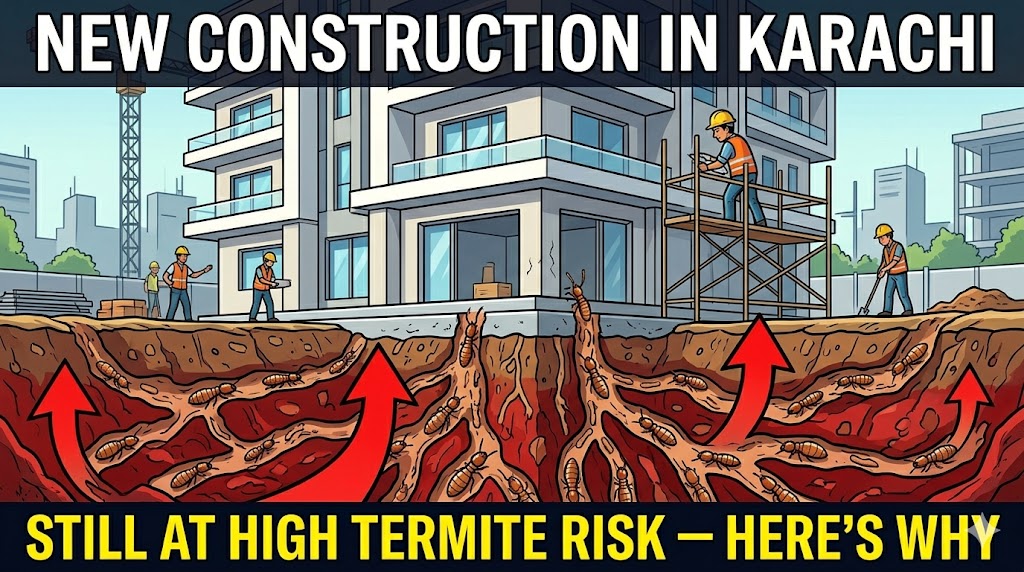
A common assumption among new property buyers in Karachi is that a newly built home or apartment is automatically safe from termites. After all, the structure is fresh — new concrete, new timber, new fittings. What could termites possibly have found their way into?
This assumption is dangerously wrong, and it is costing homeowners across the city significant money in structural repairs within just a few years of moving in. New construction in Karachi is not inherently protected from termites. In fact, several factors specific to Karachi’s building industry, geography, and regulatory environment make new builds particularly vulnerable — and the damage often begins long before the first occupant moves in.
If you have recently purchased a new property in Karachi, are in the process of building, or are considering buying off-plan, this article explains the risks you need to understand and what you can do about them.
Reason 1: Pre-Construction Termite Treatment Is Often Skipped or Done Poorly
In a properly managed construction project, anti-termite soil treatment is applied before the concrete foundation slab is poured. This creates a chemical barrier in the soil immediately beneath and around the building, preventing subterranean termites from entering through the floor.
The problem is that in Karachi, this step is frequently skipped, performed incorrectly, or done with substandard materials to cut costs. The construction industry in Pakistan operates in an environment where oversight is inconsistent, and small contractors — who build the majority of residential properties in Karachi — face commercial pressure to finish quickly and cheaply.
Common failures in pre-construction treatment include:
- Using diluted or low-quality termiticide that does not meet required concentration levels
- Treating only part of the foundation area rather than the full floor plan
- Applying treatment in dry conditions without adequate soil moisture, reducing chemical absorption
- Failing to treat around plumbing penetrations, utility entries, and expansion joints — the very gaps termites exploit
- Using uncertified or counterfeit pesticide products that have no verified efficacy
When pre-construction treatment is inadequate, the building is essentially constructed on top of an untreated termite habitat. The soil may harbour active colonies — and those colonies will find their way into the structure within months to a few years of completion.
Reason 2: Karachi’s Soil Harbours Termite Colonies Year-Round
Subterranean termites — the species most responsible for structural damage in Karachi — live in the soil. They build extensive underground colonies that can number in the hundreds of thousands of workers, and they forage widely through the soil searching for cellulose food sources.
Karachi’s soil conditions are highly favourable for termite colony survival. The city’s underlying geology includes sandy, porous soil layers in many areas — particularly across Malir, Korangi, Bin Qasim Town, and the newer development zones toward Super Highway and Karachi-Hyderabad Motorway. These soil types retain enough moisture during and after monsoon season to support large underground termite populations, while draining well enough that colonies do not flood.
Crucially, construction activity itself creates ideal conditions for termites. Excavation exposes deep soil layers. Construction waste — offcuts of timber, cardboard, wooden pallets, scaffolding timber left in contact with the ground — provides a rich food source that attracts and establishes termite populations right at the building site. By the time construction is complete, a thriving termite colony may already be established in the soil immediately adjacent to the new foundation.
This is why new development areas on the outskirts of Karachi — including parts of Bahria Town Karachi, DHA City, and schemes along the Northern Bypass — report significant termite problems in properties that are only one to three years old.
Reason 3: Untreated or Poorly Treated Timber
Modern construction in Karachi uses timber in a number of applications: door frames, window frames and shutters, ceiling joists in some construction styles, built-in furniture, and roof structures. The quality and treatment of this timber varies enormously.
Pressure-treated or borate-treated timber is termite-resistant. Untreated timber — even newly cut, fresh wood — is not. Termites will find and attack untreated wood regardless of how new it is.
In Karachi’s construction supply chain, much of the timber used in residential projects comes from local markets where treatment standards are not verified or enforced. Timber merchants sell both treated and untreated wood, often without clear labelling. Contractors purchase based on price, and untreated timber is cheaper.
The result is that many new buildings in Karachi contain door frames, window surrounds, and fitted furniture made from wood that offers zero termite resistance. These elements are the first to be attacked once termites establish access to the building, and in warm, humid conditions — particularly in ground-floor units and basements — attack can begin within the first year of construction.
Reason 4: Coastal Humidity Accelerates Termite Activity
Karachi’s position on the Arabian Sea coast has a direct impact on termite activity. Termites thrive in warm, humid conditions, and coastal Karachi provides both in abundance for much of the year.
The monsoon season, typically running from July to September, saturates soil and creates ideal nesting conditions for subterranean termites. But even in the drier months, sea breezes carry ambient humidity that keeps building materials and soil at moisture levels favourable for termite activity. Unlike cities in Pakistan’s drier interior, Karachi rarely provides the extended dry periods that naturally suppress termite populations.
For new construction, this means that any gap in termite protection — inadequate soil treatment, untreated timber, unsealed entry points — will be exploited relatively quickly. There is no seasonal dormancy to provide a grace period. Termites can be active and foraging throughout most of Karachi’s calendar year.
Areas closest to the coast — DHA Phases 1 through 8, Clifton, Defence Housing, Kemari, and parts of Lyari — experience the highest ambient humidity and consequently some of the highest rates of termite activity in the city.
Reason 5: Post-Construction Entry Points
Even when pre-construction soil treatment is done correctly, new buildings develop vulnerabilities over time. Every new building in Karachi goes through a period of settlement — minor shifting and cracking of the foundation slab, walls, and floor joins — that creates new entry points for termites.
These include:
- Cracks in the expansion joints between the floor slab and walls
- Gaps around plumbing pipes where they pass through the floor or foundation
- Settling cracks in external walls at or near ground level
- Gaps between concrete foundation blocks where mortar has shrunk slightly
- Drainage channels and utility conduits that run from outside to inside the building
Subterranean termites can exploit a gap as narrow as 1.5 mm. In a building that is two to three years old — settling naturally and experiencing its first few monsoon cycles — such gaps are virtually guaranteed to exist, regardless of how well the construction was executed.
This is why post-construction treatment and a professional inspection in the first few years of a new building’s life is not just for older properties — it is essential maintenance for any new build.
Reason 6: Inadequate Regulation and Quality Control
Pakistan does not currently have a robust national standard or enforcement mechanism for anti-termite treatment in residential construction. Building plans may require anti-termite treatment certification as a condition of approval, but on-site verification of whether treatment was actually carried out — and carried out correctly — is inconsistent.
Karachi’s building control environment adds further complexity. With millions of units across both formally approved and informally developed areas, systematic inspection of anti-termite measures is not realistic with available resources. Developers and contractors know this, and it reduces the incentive to invest properly in termite protection.
For new property buyers, this regulatory gap means you cannot rely on the existence of a building approval certificate as evidence that proper anti-termite treatment was completed. You need to ask for specific documentation from the developer — the name of the pest control company, the product used, the area treated, and any warranty provided.
Reason 7: Landscaping and External Features Introduce New Risk
Once a new property is occupied, homeowners typically invest in landscaping — gardens, flower beds, boundary trees, and decorative timber elements. Each of these can introduce termite risk if not managed carefully.
Soil brought in for garden beds may contain termite eggs or juvenile colonies. Mulch used in planting areas is an attractive food source for termites. Wooden garden furniture, timber pergolas, boundary trellises, and decorative driftwood placed near the building create bridges between soil-level termite activity and the structure itself.
New construction in gated communities such as those in DHA City, Bahria Town Karachi, and Saadi Town often includes communal green spaces and landscaping managed by the development authority. If this landscaping is not properly treated and monitored for termite activity, it creates a shared risk for all adjacent properties.
What New Property Owners in Karachi Should Do Right Now
If you have recently moved into a new property in Karachi — or are about to — here are the practical steps to take:
1. Request documentation from your developer. Ask specifically for the anti-termite treatment certificate, including the company name, product used, and treatment date. If the developer cannot provide this, assume the treatment was either not done or not done correctly.
2. Get a professional inspection in the first year. Even if documentation exists, a professional inspection by a qualified technician gives you an independent assessment of the current condition. This is especially important if you notice any of the early warning signs — mud tubes, hollow-sounding woodwork, frass deposits, or paint bubbling near the floor.
3. Arrange post-construction treatment if documentation is absent.
4. Use treated timber in all future additions. If you are adding a pergola, fitted wardrobe, kitchen extension, or any new wooden element, ensure the timber has been pressure-treated or borate-treated before installation.
5. Manage external landscape risk. Keep soil, mulch, and garden beds at least 30 cm away from the building’s foundation walls. Inspect wooden outdoor furniture and fixtures annually. Remove dead wood, tree stumps, and construction waste from the garden.
6. Seal foundation cracks promptly. As your building settles and small cracks develop, have them sealed with appropriate materials. Do not leave them open — even a small gap is sufficient for termite entry.
The Hidden Cost of Waiting
Termite damage in new Karachi properties rarely announces itself dramatically. It develops quietly over months and years. By the time homeowners notice bubbling paint, a door that no longer closes properly, or a skirting board that crumbles when touched, the damage behind the visible surface is often far more extensive than it appears.
The cost of treating a new property proactively is a fraction of the cost of repairing structural termite damage even a few years into ownership. And with Karachi’s property market representing major financial commitments for most families, protection of that investment is not optional — it is essential.
Book Your Free Inspection — Before Termites Make the Decision for You
If your property is newly built or under construction and you are not 100% certain that professional-grade anti-termite treatment has been applied, now is the time to act. Our team provides free inspections across Karachi, a detailed written assessment, and honest advice on the right protection for your specific property.
Do not wait for visible damage to appear. By the time you can see it, termites have already been at work for much longer than you realise. Contact us today to book your free inspection and protect your new home from day one.

Ahmad Karimi is a PPMA-registered pest management specialist and the lead technical consultant at Karachi Fumigation Services, where he has overseen field operations and treatment protocols since 2005. With over 20 years of hands-on experience treating residential, commercial, and industrial properties across Karachi — from DHA bungalows with structural termite infestations to Korangi factories requiring large-scale rodent exclusion — he brings direct field knowledge to every article published on this blog.
Ahmad has managed pest control programs for clients including Descon Engineering, Pakistan Tobacco Company, Saylani Welfare, and J. (Junaid Jamshed), and has issued hundreds of fumigation certificates for health authority compliance, import/export, and commercial licensing purposes. He holds active PPMA membership and works exclusively with WHO-approved chemicals in all field operations.
The content on this blog draws directly from two decades of Karachi-specific infestation data — seasonal pest patterns, neighbourhood-level risk factors, building-age vulnerabilities, and the regulatory requirements that Karachi businesses actually face. No recycled content from foreign pest control sites. Every article reflects conditions specific to Karachi’s climate, infrastructure, and compliance environment.
For treatment enquiries or technical questions, Ahmad’s team can be reached at 03463303875 or via the office at Trade Tower, Civil Lines, Karachi.
Leave a Reply