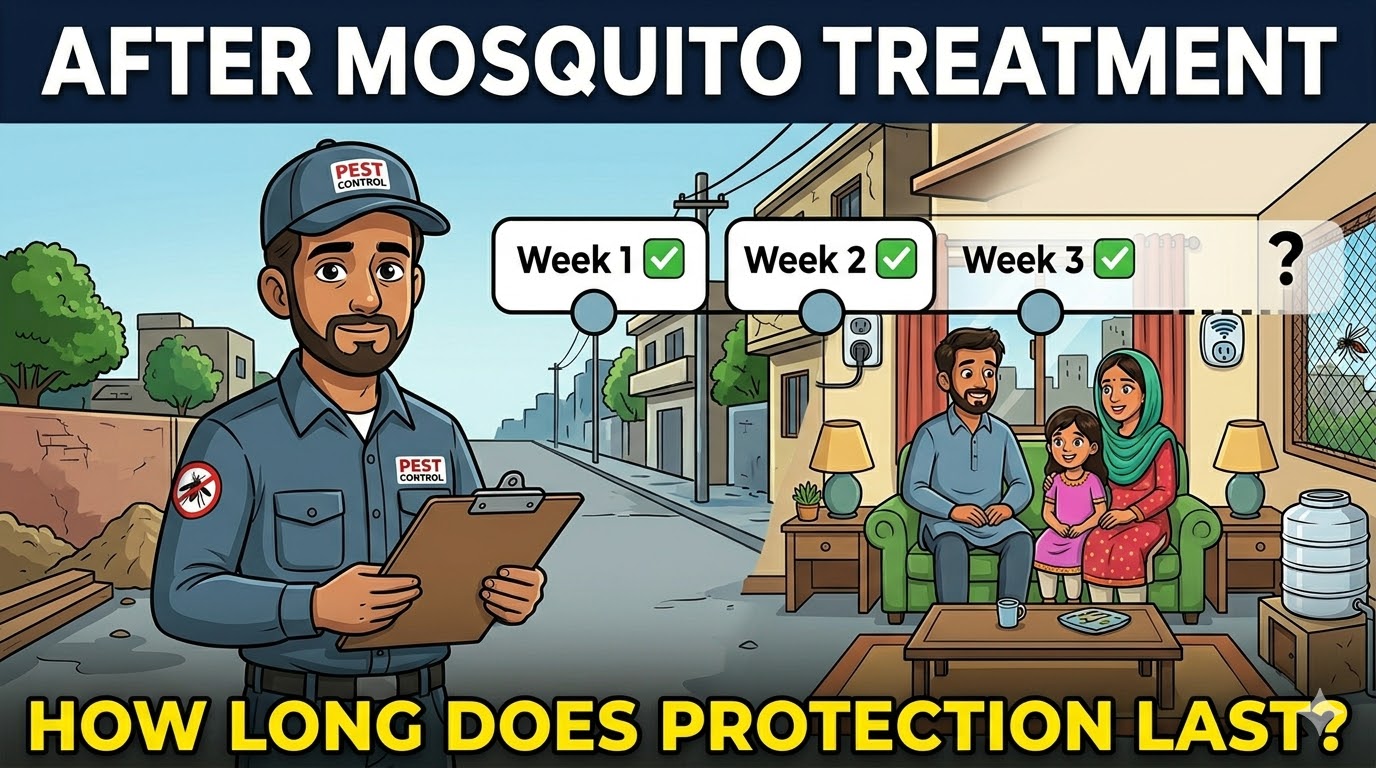
The Question Every Treated Homeowner Asks: The technicians have completed their work. The equipment is packed away. Your home smells faintly of treatment product. You are wondering: how long will this last? Do we need to do anything differently? When should we call again?
These are the right questions to ask — and the answers matter, because misunderstanding post-treatment expectations leads to either complacency (assuming you are permanently protected) or unnecessary anxiety (calling for retreatment before it is needed). This guide gives you a complete picture of what to expect after professional mosquito treatment in a Karachi home.
Understanding What Was Treated: The Three Layers of Protection
Professional mosquito control in Karachi typically addresses three interconnected problems. The duration of protection differs for each.
Layer 1: Adult Mosquito Knockdown (ULV Fogging / Space Spray)
The most immediately noticeable result of professional treatment is the rapid reduction of adult mosquitoes. ULV (ultra-low-volume) fogging or thermal fogging generates fine insecticide droplets that remain airborne for 20 to 30 minutes, reaching into crevices, under furniture, behind curtains, and inside wardrobes where mosquitoes rest.
Expected result: A very significant reduction — 80 to 95 percent — in adult mosquito activity within 2 to 4 hours of treatment.
Duration: The knockdown effect lasts 24 to 72 hours. This is not a residual treatment — it rapidly kills the mosquitoes present at the time of treatment but does not prevent new mosquitoes from entering or emerging from untreated breeding sites.
What you will notice: Reduced mosquito activity almost immediately. Some dead mosquitoes may be visible on floors and surfaces for the first day — this is normal and expected.
Layer 2: Residual Surface Treatment
Residual insecticide application to wall surfaces, skirtings, behind appliances, under furniture, and inside drainage covers creates a treated zone that remains effective for a sustained period. When mosquitoes land on treated surfaces — even those that were not present during the initial treatment — they absorb a lethal dose.
Expected result: Continued mosquito mortality for weeks after treatment, even as new adult mosquitoes emerge from breeding sites.
Duration: Typically 4 to 8 weeks under Karachi conditions, depending on:
- Temperature and humidity — Karachi’s summer heat accelerates breakdown of surface insecticides
- Surface type — porous surfaces (bare concrete, untreated wood) absorb insecticide faster than painted or tiled surfaces
- Cleaning activity — mopping floors or wiping walls with detergent removes residual deposits and should be avoided in treated areas
What you will notice: Gradual reduction in residual effectiveness over 4 to 8 weeks. Your pest control provider should advise when retreatment is recommended.
Layer 3: Larvicide Treatment
If your water tanks, drains, or other water bodies were treated with larvicide (typically BTI or temephos), the duration of protection depends on the specific product used.
- BTI-based granules or tablets: Effective for 30 days in most water temperatures
- Temephos (Abate) sand granules: Effective for 6 to 12 weeks in cooler water, less in Karachi’s warm conditions
Regular reapplication of larvicide — especially to water tanks during monsoon season — is one of the most cost-effective ongoing dengue prevention measures available.
The First 24 Hours After Treatment: What to Do
The period immediately following treatment requires some specific actions to maximize effectiveness and ensure household safety.
During and Immediately After Treatment
- Leave all treated areas for 1 to 2 hours after indoor treatment is completed
- Keep windows and doors closed for the first 30 to 60 minutes after space spray treatment to allow the insecticide to remain airborne and penetrate resting sites
- Keep children and pets out of treated areas until dry — typically 1 to 2 hours for surface treatments
- Remove or cover food and cooking utensils before treatment begins — if not already done by the technician
- Ensure fish tanks are covered and air pumps turned off during fogging — some insecticides are toxic to aquatic organisms
First 48 Hours
- Avoid mopping floors with detergent in treated areas for at least 48 hours — this removes residual deposits
- Do not wipe down treated wall surfaces
- Continue normal household ventilation after the initial 2-hour period
- Some dead mosquitoes appearing on floors and surfaces in the first 24 hours is evidence the treatment is working
What Is Normal After Treatment — And What Is Not
Normal
- Dead mosquitoes on floors in the first 24 to 48 hours
- Slightly reduced mosquito activity within hours
- Faint chemical smell in treated areas for 24 to 48 hours
- Occasional mosquito sighting after 48 hours — not all mosquitoes are killed simultaneously, and new ones may enter from external sources
Not Normal — Call Your Provider
- No reduction in mosquito activity at all after 48 hours
- Strong, persistent chemical smell beyond 72 hours that is causing discomfort
- Skin irritation or respiratory symptoms following treatment that were not pre-existing
- Visible insecticide residue on food preparation surfaces (this should not occur with proper treatment)
Why Mosquitoes Return After Treatment
One of the most common concerns Karachi homeowners express after treatment is: ‘We still see some mosquitoes. Did the treatment fail?’ Almost always, the answer is no — and understanding why helps set appropriate expectations.
Mosquitoes return after treatment for several entirely normal reasons:
- Eggs and pupae in water sources at the time of treatment are not affected by adult mosquito insecticides — they hatch and emerge as adults days later. This is why larvicide treatment of water bodies is essential alongside adult treatment.
- Mosquitoes from untreated external sources — neighbors’ gardens, nearby open drains, construction sites — continuously re-enter your home. This is a containment challenge, not a treatment failure.
- Residual treatment wears off progressively over 4 to 8 weeks. Mosquitoes that enter late in the treatment cycle may survive longer.
The appropriate response to ongoing mosquito presence is not immediate retreatment — it is an assessment of remaining breeding sites and a scheduled retreatment based on the post-treatment timeline.
Recommended Post-Treatment Schedule for Karachi
Based on Karachi’s dengue season and climate conditions, an optimal mosquito control schedule for high-risk periods looks like this:
Pre-Monsoon (May to June)
First treatment of the year. Focus: comprehensive adult knockdown, surface residual application, and larvicide for all water bodies. This sets baseline protection before mosquito populations begin their seasonal surge.
Peak Monsoon (July to August)
Second treatment at the 6 to 8 week mark from initial treatment, coinciding with the highest-risk period. Reinforce residual surface treatment and reapply larvicide. If neighboring areas have reported dengue cases, consider an earlier retreatment.
Late Monsoon / Post-Monsoon (September to October)
Final seasonal treatment. This addresses the residual breeding surge that follows monsoon as water from rain events slowly evaporates or drains. This is the treatment most frequently skipped — and the one that leaves households exposed during the September-October second peak.
Outside of dengue season — November through April — treatment frequency can reduce to quarterly unless persistent mosquito problems are identified.
How to Maintain Protection Between Treatments
Professional treatment provides a strong protective foundation. Household maintenance practices between treatments determine how effectively that foundation holds:
- Continue weekly source reduction — emptying and scrubbing water containers regardless of treatment status
- Check and clean AC drip trays monthly
- Monitor water tank lid condition after rains that may shift or damage covers
- Avoid creating new water accumulation on balconies, in plant trays, or through leaking fixtures
- Report and address any new drainage issues in or around your compound promptly
Homes that maintain strong source reduction practices between professional treatments consistently report longer-lasting effectiveness from each service — because fewer breeding sites mean fewer new adult mosquitoes, regardless of residual protection levels.
Questions to Ask Your Pest Control Provider After Treatment
A professional provider should be able to answer the following clearly and specifically:
- What specific products were used and what are their active ingredients?
- Which areas were treated with residual insecticide and which with space spray?
- Were any water bodies treated with larvicide, and if so, which product and at what concentration?
- When is the next recommended treatment based on today’s application?
- Are there any specific post-treatment instructions for this property?
If a provider cannot answer these questions clearly, that is a concern. Reputable mosquito control services in Karachi document their treatments and provide clear guidance on expectations and follow-up scheduling.
Professional mosquito control services in Karachi should come with full transparency on products used, coverage areas, and protection timelines — not just a spray-and-leave service.
Conclusion
Post-treatment protection in a Karachi home is most effective when you understand what each treatment component does, how long each lasts, and what your role is in maintaining effectiveness between services. The initial adult knockdown gives immediate relief. The residual surface treatment provides ongoing protection for weeks. The larvicide breaks the breeding cycle at its source.
Together, these create a meaningful window of protection — but only if supported by proper household practices and timely retreatment. Think of professional mosquito control not as a one-time solution but as a regular part of your home’s health maintenance cycle during Karachi’s dengue season.
📞 Book a Free Inspection Today: Whether you have had treatment before or are considering it for the first time, our team at Karachi Fumigation Services will assess your current situation, explain exactly what treatment your home needs, and set up a seasonal protection schedule that keeps your family safe from dengue all year long. Book your free inspection now — it costs nothing and could protect everything.

Ahmad Karimi is a PPMA-registered pest management specialist and the lead technical consultant at Karachi Fumigation Services, where he has overseen field operations and treatment protocols since 2005. With over 20 years of hands-on experience treating residential, commercial, and industrial properties across Karachi — from DHA bungalows with structural termite infestations to Korangi factories requiring large-scale rodent exclusion — he brings direct field knowledge to every article published on this blog.
Ahmad has managed pest control programs for clients including Descon Engineering, Pakistan Tobacco Company, Saylani Welfare, and J. (Junaid Jamshed), and has issued hundreds of fumigation certificates for health authority compliance, import/export, and commercial licensing purposes. He holds active PPMA membership and works exclusively with WHO-approved chemicals in all field operations.
The content on this blog draws directly from two decades of Karachi-specific infestation data — seasonal pest patterns, neighbourhood-level risk factors, building-age vulnerabilities, and the regulatory requirements that Karachi businesses actually face. No recycled content from foreign pest control sites. Every article reflects conditions specific to Karachi’s climate, infrastructure, and compliance environment.
For treatment enquiries or technical questions, Ahmad’s team can be reached at 03463303875 or via the office at Trade Tower, Civil Lines, Karachi.
Leave a Reply