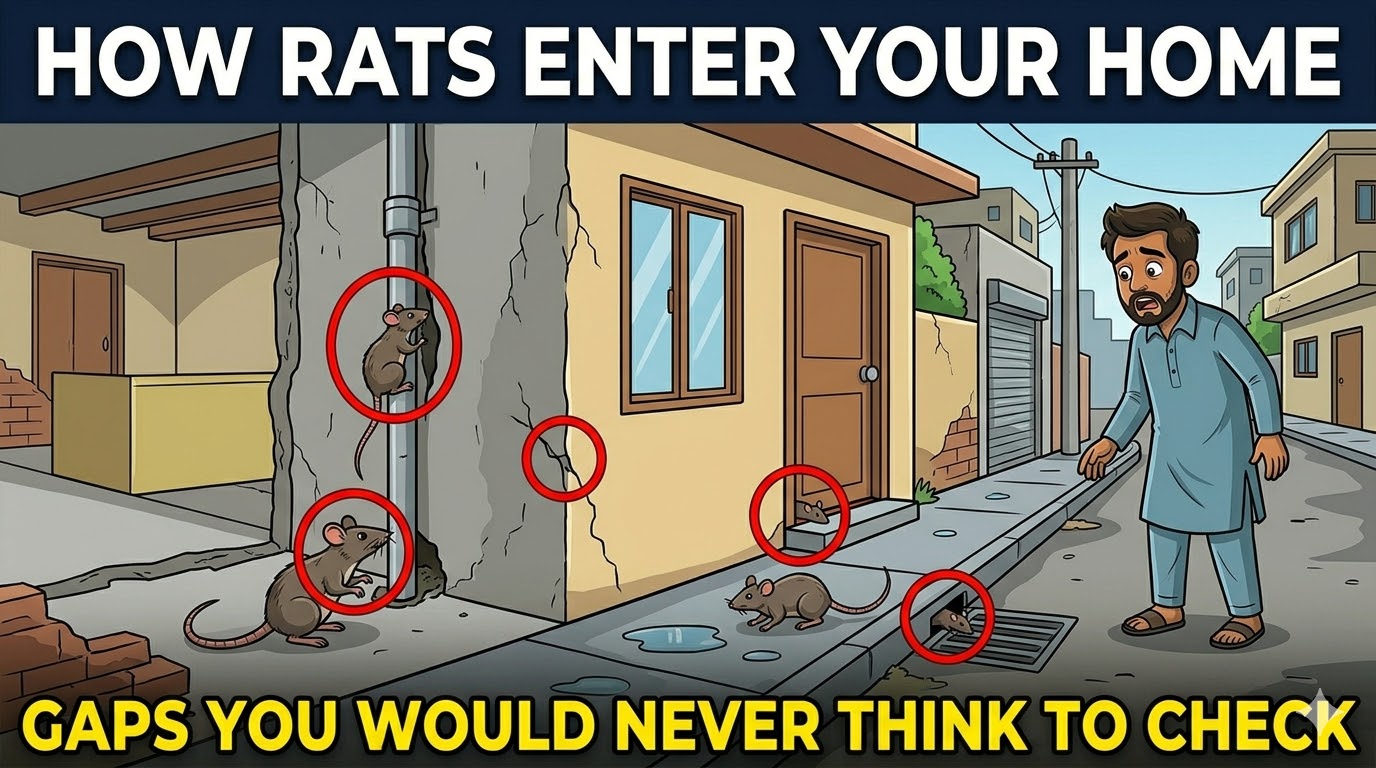
Most Karachi homeowners only notice a rodent problem after the damage is done — chewed wires, contaminated food, or the unmistakable sound of scratching inside the walls at night. But by the time you hear or see rats, they have almost certainly been living inside your home for weeks, possibly months. The question that rarely gets asked is: how did they get in?
Rats and mice do not need large openings. A rat can squeeze through a gap as small as a 50-paisa coin, and a mouse requires even less space. In a city like Karachi — with its aging infrastructure, rapid construction, and monsoon-battered walls — there is no shortage of entry points. The troubling part is that most of them are in places homeowners never think to inspect.
Why Karachi Homes Are Especially Vulnerable
Karachi’s built environment is a near-perfect storm for rodent entry. Older bungalows in areas like PECHS, Nazimabad, and Clifton have decades of wear, with cracks along foundations, deteriorating sealant around pipes, and gaps that have quietly widened over years of ground movement and monsoon flooding. Newer apartment blocks in Defence, Bahria Town, and Gulshan face a different problem: rapid construction where utility conduits, drainage pipes, and service shafts are rarely sealed properly before handover.
Add to this the density of Karachi’s street-level environment — open drains, garbage accumulation, roadside food stalls — and the city essentially has a continuous rodent population seeking the nearest available shelter and food. Your home is that shelter.
The Hidden Entry Points Homeowners Consistently Miss
1. The Space Around Utility Pipes
Every home has pipes entering through walls — water lines, gas pipes, drainage, and electrical conduits. The gap between the pipe and the wall is almost never perfectly sealed. In Karachi’s older neighbourhoods, these gaps are often large enough for an adult rat to pass through without any difficulty. Even in newer construction, the sealant used is often a cheap mortar that cracks within a year. Check every pipe entry point in your kitchen, bathroom, utility area, and outside walls.
2. Drain Pipes and Floor Drains
This is the entry point that surprises most homeowners. Rats are excellent swimmers and can travel through sewer systems with ease. A floor drain in a bathroom, kitchen, or terrace without a functioning drain cover is a direct invitation. In areas connected to older municipal drainage infrastructure — which describes most of Karachi — the rat population in sewers is significant. Drain covers that are broken, missing, or simply light enough to be pushed aside are exploited regularly.
3. The Gap Under External Doors
A gap of just 6 to 10 millimetres under an external door is sufficient for a mouse and a young rat. Metal and wooden door frames in Karachi homes warp over time, especially with humidity and temperature variation. Main entrance doors, back doors, servant quarter doors, and garage doors are all potential entry points. Door sweeps — the rubber or metal strip at the base of the door — are rarely installed in Karachi homes, and when they are, they degrade and are not replaced.
4. Air Conditioning and Exhaust Vents
The wall penetration for split AC units creates a circular gap that, even when the AC pipe passes through, almost always has space on the sides. Exhaust fan openings that are not covered with mesh on the outside are another overlooked entry point. In Karachi’s summer months, when virtually every room has an AC unit, the number of unprotected penetrations in a typical home can be surprisingly high.
5. Roof and Ceiling Access Points
Rats are agile climbers. They can scale rough walls, run along electrical cables, and enter through openings near the roofline that homeowners never see because they never look up. Gaps where the ceiling meets the wall in storage areas, broken roof tiles in older bungalows, and open attic or water tank access hatches are all common points of entry. Black rats — the species often found in upper floors and ceilings — are particularly adept at accessing homes from above.
6. Construction Joints and Expansion Gaps
Modern construction uses expansion joints between slabs and walls to accommodate movement. These gaps run the entire length of a wall and can be several millimetres wide. Without proper sealing and maintenance, they become rat highways, especially at ground-floor level where they are most accessible from outside. In Karachi’s multi-storey buildings, these joints can run vertically as well, allowing rats to move between floors.
7. Cable and Internet Entry Points
The proliferation of cable TV and internet connections has created dozens of small wall penetrations in typical Karachi homes. Installers drill holes and feed cables through without sealing the surrounding space, leaving gaps that are invisible behind furniture but fully accessible from outside. Every cable entering from an external wall is worth inspecting.
8. Gaps in the Plinth and Foundation Area
The area at ground level where the wall meets the ground — the plinth — is vulnerable to rodent burrowing. In Karachi’s older localities, particularly in Lyari, Saddar, and Orangi, properties sit on foundations that have partially settled or cracked. Rats burrow along the plinth to access subfloor areas and from there into the home’s interior. Properties with gardens or that share a boundary wall with vacant plots are especially at risk.
Seasonal Patterns in Karachi That Increase Risk
Entry attempts spike at two specific times of year in Karachi. The pre-monsoon season (May to June) drives rats to seek higher ground as ground-level burrows begin to flood. Post-monsoon (September to October), when food sources in open areas diminish, rats move aggressively into homes and commercial properties. If you have not inspected your entry points before these seasons, this is the time to do it.
What an Effective Inspection Looks Like
A proper entry-point inspection requires getting low. Examine the base of all exterior walls, both inside and outside the property. Look at every pipe entry with a torch. Test the seal around AC units. Pull furniture away from walls periodically to check for cable holes. Inspect your drains. Climb to the roof level and examine the parapet and any openings around water tanks and service pipes.
If you find gaps, seal them with materials rats cannot gnaw through — steel wool packed into the gap, followed by cement or expanding foam rated for rodent exclusion. Standard foam alone is insufficient; rats will chew through it within days.
When DIY Inspection Is Not Enough
Identifying all possible entry points in a Karachi home requires a trained eye. Professionals know not just where to look but what to look for — signs of active gnawing around gaps, grease marks on surfaces that indicate regular rodent travel, and droppings that confirm which areas are being used as entry corridors. Our team at Karachi Fumigation Services conducts thorough property inspections that cover every area described in this article and more.
Taking the Next Step
Finding and sealing entry points is the foundation of any effective rodent control plan. Without it, even the most thorough extermination effort will fail — new rats will simply move in through the same gaps. Combining structural exclusion with professional rodent control in Karachi gives you a lasting solution rather than a temporary fix.
Book a Free Inspection Today
Do not wait until you find evidence of a full infestation. Book a free property inspection with our team today. We will identify every entry point in your home, recommend the appropriate sealing strategy, and provide a complete rodent control plan tailored to your property’s specific vulnerabilities. Contact us now to schedule your visit.

Ahmad Karimi is a PPMA-registered pest management specialist and the lead technical consultant at Karachi Fumigation Services, where he has overseen field operations and treatment protocols since 2005. With over 20 years of hands-on experience treating residential, commercial, and industrial properties across Karachi — from DHA bungalows with structural termite infestations to Korangi factories requiring large-scale rodent exclusion — he brings direct field knowledge to every article published on this blog.
Ahmad has managed pest control programs for clients including Descon Engineering, Pakistan Tobacco Company, Saylani Welfare, and J. (Junaid Jamshed), and has issued hundreds of fumigation certificates for health authority compliance, import/export, and commercial licensing purposes. He holds active PPMA membership and works exclusively with WHO-approved chemicals in all field operations.
The content on this blog draws directly from two decades of Karachi-specific infestation data — seasonal pest patterns, neighbourhood-level risk factors, building-age vulnerabilities, and the regulatory requirements that Karachi businesses actually face. No recycled content from foreign pest control sites. Every article reflects conditions specific to Karachi’s climate, infrastructure, and compliance environment.
For treatment enquiries or technical questions, Ahmad’s team can be reached at 03463303875 or via the office at Trade Tower, Civil Lines, Karachi.
Leave a Reply