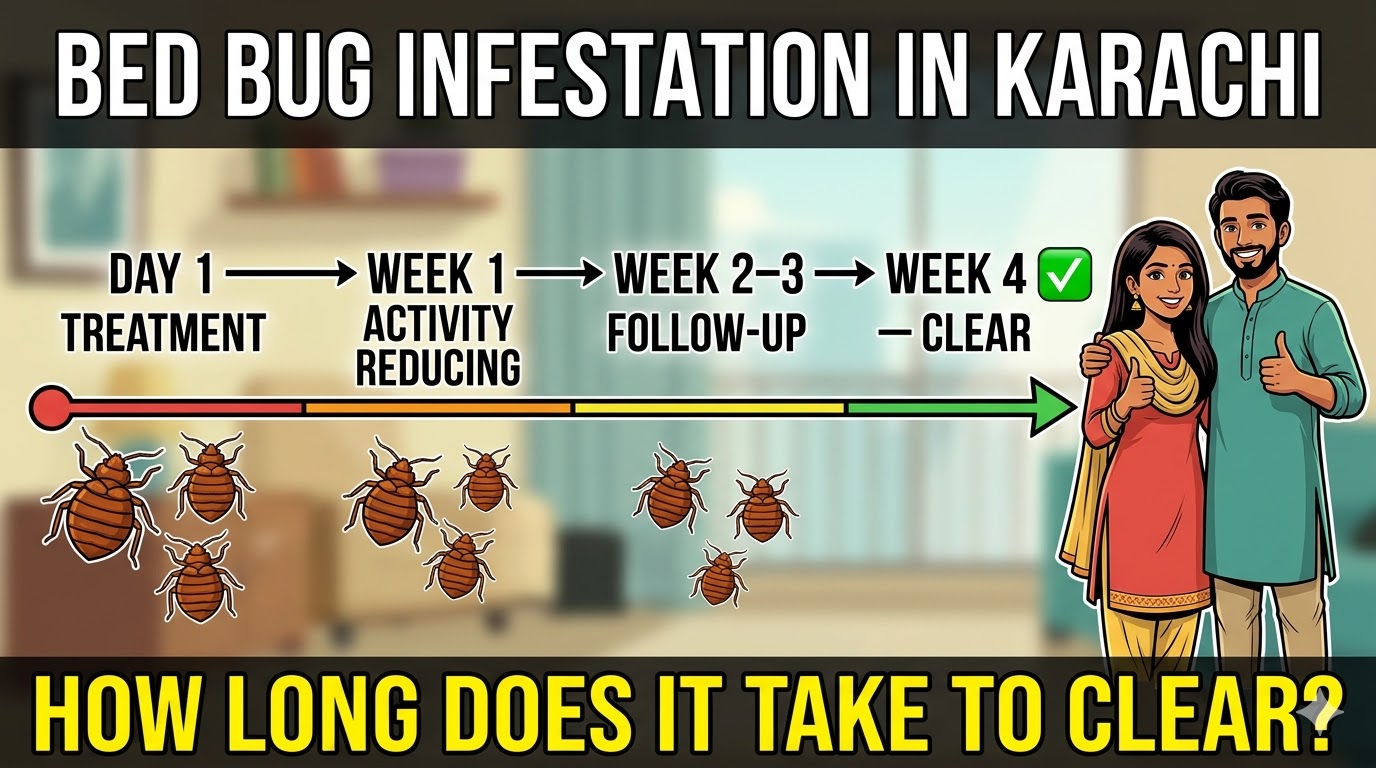
This is one of the first questions Karachi homeowners ask after they’ve identified a bed bug problem and started treatment: How long is this going to take? When will I know it’s actually over?
There is no universal answer, because the timeline depends on several factors specific to your situation. But there are clear benchmarks and expected timeframes you can plan around, and understanding them will help you stay patient, stay vigilant, and know when to be concerned that treatment isn’t working.
This guide gives you a realistic, honest picture of what to expect during and after bed bug treatment in Karachi’s conditions.
The Short Answer
For a moderate infestation in a standard Karachi flat — treated professionally with a multi-visit protocol — most homeowners see a significant reduction in activity within 2 weeks of the first treatment, and complete elimination within 4–8 weeks including follow-up visits. Severe infestations or those that have spread to multiple rooms or multiple units in a building can take longer.
If you are still seeing active bugs or getting new bites after 8 weeks of proper professional treatment, something in the treatment protocol needs to be reviewed.
Why It’s Never Instant: The Life Cycle Factor
Understanding why bed bug elimination takes weeks rather than days requires understanding the life cycle — specifically, the egg stage.
A female bed bug lays 1–5 eggs per day, cementing them into cracks and seams. Most professional insecticides are highly effective against adult bugs and nymphs but significantly less effective against eggs. Even a thorough first treatment will leave surviving eggs that will hatch within 6–10 days at Karachi room temperatures.
This is not a treatment failure — it is a biological reality that professional pest controllers account for. It is why the follow-up visit, scheduled at 10–14 days after the first treatment, is essential. The follow-up targets newly hatched nymphs before they reach reproductive maturity (which takes 5–6 weeks), breaking the cycle.
This is why single-visit treatments almost always fail: they kill the adults but leave the eggs, and the cycle restarts.
Week-by-Week: What to Expect After Professional Treatment in Karachi
Days 1–3: Increased Activity (Normal and Expected)
Immediately after chemical treatment, it’s common to see more bed bugs than before — sometimes significantly more. This is not a sign that treatment failed. The disturbance and chemical residual causes bugs to emerge from their harborage sites, become more visible, and in many cases die on treated surfaces.
Do not call the pest control company in a panic on day two. This is a normal part of the treatment process.
Days 4–10: Declining Activity
The number of bugs you see (and the frequency of bites) should begin declining noticeably within a week. The residual chemical continues killing bugs as they come into contact with treated surfaces. You may still see occasional bugs during this period — this is normal.
Days 10–14: The Critical Follow-Up Window
This is when the follow-up treatment should happen. Eggs laid before the first treatment are now hatching. If you have engaged a professional bed bug treatment service in Karachi that follows a proper protocol, your technician will return at this point for the second application, targeting newly hatched nymphs.
Skipping this visit because things seem “much better” is a common mistake. The infestation is not over yet — it’s in a vulnerable window.
Weeks 3–4: Major Reduction
After the second treatment, activity should drop to near zero. You should not be experiencing regular bites. If you do see occasional bugs, they are likely stragglers from harborage areas that were partially missed — not a sign of reinfestation.
Weeks 5–8: Confirmation Period
Continue monitoring using active interceptor traps placed under bed legs. Check these every few days. If the traps remain empty for 4–6 consecutive weeks after the last treatment, combined with no new bites and no visible evidence, the infestation can be considered cleared.
Week 8+: Third Treatment (If Needed)
For severe infestations, or those that had spread to multiple rooms, a third treatment may be warranted. Your pest control provider should assess at the week 4–6 mark whether a third visit is necessary.
Factors That Extend the Timeline in Karachi
Several factors specific to Karachi conditions can extend the clearance timeline:
Karachi’s Year-Round Warmth Accelerates Egg Hatching
In cooler climates, eggs may take up to 21 days to hatch. In Karachi’s warm conditions (24–32°C year-round in most flats), hatching can occur in as little as 6 days. This compresses the window between first and second treatment — if your follow-up visit is delayed beyond 14 days, a new generation may already be developing.
Re-infestation From Neighbouring Units
In dense apartment buildings in areas like Nazimabad, Liaquatabad, Federal B Area, and Orangi Town, treatment of a single flat may be undermined by continuous re-entry of bugs from neighbouring units through wall voids and shared infrastructure. If you’re experiencing recurring infestations despite proper treatment, the building as a whole may need to be addressed.
Missed Harborage Sites
If treatment didn’t reach all harborage sites — particularly wall voids, inside electrical fittings, or deeply embedded in heavy furniture — surviving populations can restart the infestation. This is why professional inspection quality matters as much as the quality of the products used.
Inadequate Preparation
Homes that were not properly prepared before treatment (cluttered floors, furniture against walls, unsealed clothing) will have more surviving populations post-treatment, extending the timeline.
How to Monitor Progress During Treatment
Don’t rely solely on bites to monitor progress. Use these methods:
- Bed leg interceptor traps: Place these under all four legs of the bed. Check weekly. Declining trap counts are a reliable indicator of progress.
- Visual inspection of mattress seams: Check every 3–5 days. Declining evidence (fewer fresh dark spots) indicates the population is reducing.
- White cloth test: Once a week, run a damp white cloth along the mattress seams and bed frame — any bugs, eggs, or dark material will transfer to the cloth.
- Keep a log: Note dates, number of bugs seen, trap catches, and whether you experienced bites. This log helps your treatment provider make informed decisions about follow-up strategy.
When Should You Be Concerned?
Contact your pest control provider if:
- You are still experiencing frequent bites more than 3 weeks after the first treatment
- You are seeing live bugs in large numbers more than 2 weeks after treatment
- Activity appears to be increasing rather than declining
- New harborage sites have been discovered that weren’t treated initially
A good pest control company will want to know this information and will respond with a plan — not dismiss your concerns.
When Is It Truly Over?
Bed bug elimination is confirmed when:
- No live bugs or eggs are found during a thorough inspection
- Interceptor traps have been empty for 4–6 consecutive weeks
- No new bites have occurred for at least 3–4 weeks
- A professional re-inspection (recommended) confirms no activity
Do not remove interceptor traps or fully relax vigilance after just 2 weeks of no activity. The 4–6 week monitoring window exists specifically because the life cycle allows for slow-developing eggs to hatch late.
A Realistic Summary
For most Karachi homeowners with a moderate infestation caught reasonably early:
- Significant relief after first treatment: 1–2 weeks
- Follow-up treatment: 10–14 days after first treatment
- Near-complete elimination: 4–6 weeks after treatment begins
- Confirmed clearance: 6–8 weeks after treatment begins
For severe infestations or building-wide problems, plan for 8–12 weeks of monitoring.
Start the Clock — Book Your Treatment Today
The sooner treatment begins, the shorter the total timeline to a bug-free home. Every week of delay is more eggs, more bugs, and a longer road to resolution. Contact our team for a free inspection and let us begin the process of clearing your Karachi flat of bed bugs with a protocol that’s built for your specific situation. Reach us through Karachi Fumigation Services — professional pest control delivered with honesty and accountability.

Ahmad Karimi is a PPMA-registered pest management specialist and the lead technical consultant at Karachi Fumigation Services, where he has overseen field operations and treatment protocols since 2005. With over 20 years of hands-on experience treating residential, commercial, and industrial properties across Karachi — from DHA bungalows with structural termite infestations to Korangi factories requiring large-scale rodent exclusion — he brings direct field knowledge to every article published on this blog.
Ahmad has managed pest control programs for clients including Descon Engineering, Pakistan Tobacco Company, Saylani Welfare, and J. (Junaid Jamshed), and has issued hundreds of fumigation certificates for health authority compliance, import/export, and commercial licensing purposes. He holds active PPMA membership and works exclusively with WHO-approved chemicals in all field operations.
The content on this blog draws directly from two decades of Karachi-specific infestation data — seasonal pest patterns, neighbourhood-level risk factors, building-age vulnerabilities, and the regulatory requirements that Karachi businesses actually face. No recycled content from foreign pest control sites. Every article reflects conditions specific to Karachi’s climate, infrastructure, and compliance environment.
For treatment enquiries or technical questions, Ahmad’s team can be reached at 03463303875 or via the office at Trade Tower, Civil Lines, Karachi.
Leave a Reply