Author: admin

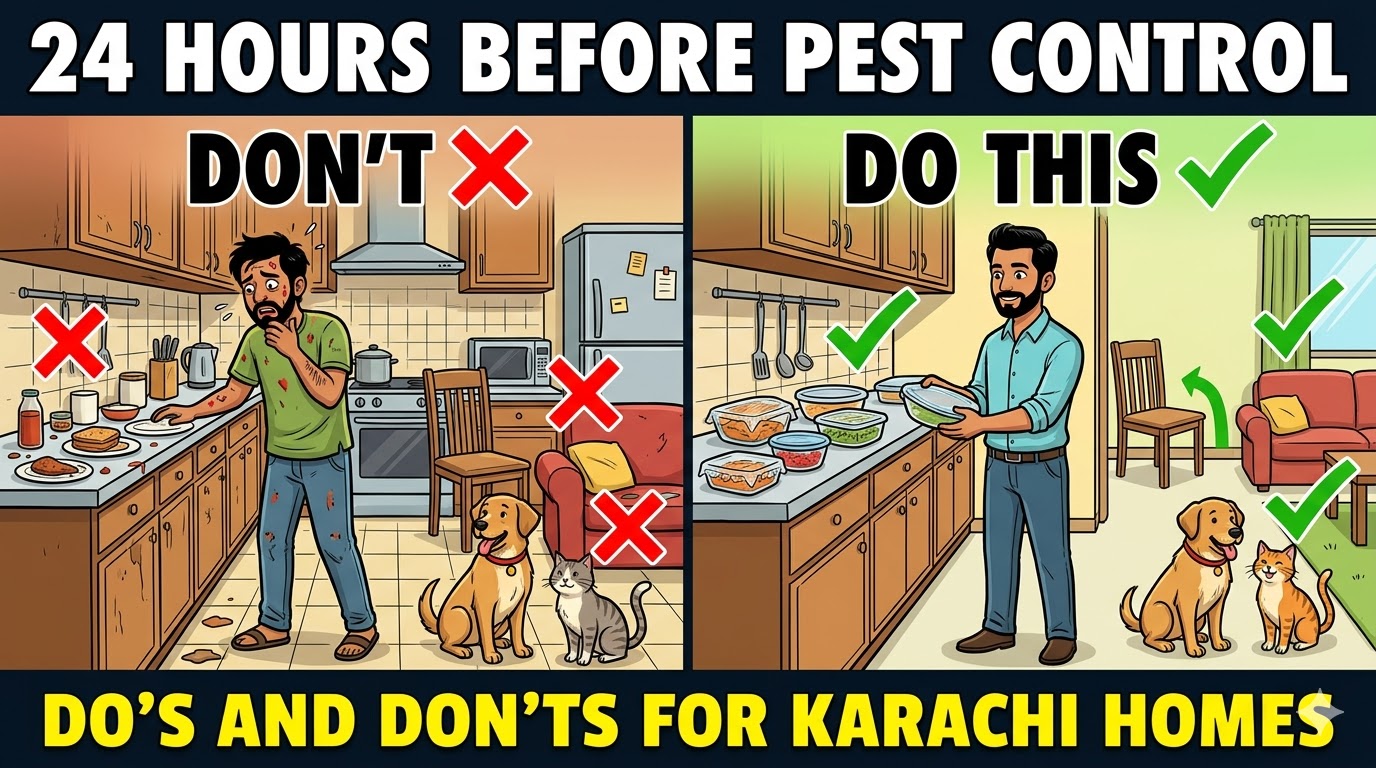
  • What to Do — and Not Do — in the 24 Hours Before Pest Control Visits Your Karachi Home

    What to Do — and Not Do — in the 24 Hours Before Pest Control Visits Your Karachi Home

    You have booked a pest control visit. The team is coming tomorrow. Now what?

    Most Karachi homeowners assume their job ends at booking the appointment. But the preparation you do — or fail to do — in the 24 hours before a pest control visit directly determines how effective the treatment will be. It also determines how safe your family and your home will be during and after the process.

    This guide walks you through everything you must do, everything you must avoid, and the specific Karachi-context factors that make preparation here different from what you might read in a generic online checklist.

    Why Pre-Treatment Preparation Matters More Than Most People Realise

    Here is the reality that many pest control companies do not emphasise enough: if your home is not properly prepared before fumigation or pest control spraying, the treatment will underperform. Clutter blocks chemical access to pest hiding spots. Uncovered food becomes a contamination hazard. Sealed entry points prevent proper aeration. And a poorly prepared home often means the infestation returns faster, costing you more money and more stress.

    Preparation is your investment in making the treatment work. Think of it as doing your part so the professionals can do theirs.

    The 24-Hour Do List: What You Must Do Before the Visit

    1. Clear and Clean All Kitchen Surfaces

    The kitchen is ground zero for most pest infestations in Karachi homes — cockroaches in particular thrive in kitchen cabinets, behind appliances, and under sinks. For the treatment to reach these areas effectively:

    • Remove everything from kitchen countertops and lower cabinets
    • Clear out underneath the sink completely — this is one of the most common cockroach harbourage zones
    • Pull appliances away from walls where possible — refrigerators, washing machines, and stoves should have at least a few inches of clearance
    • Remove everything stored on the floor of kitchen cabinets
    • Wipe down cabinet interiors to remove food debris that could compete with chemical baits

    2. Store All Food Safely

    This step is non-negotiable for both effectiveness and safety. All food must be out of harm’s way before any chemical treatment takes place.

    • Place all open food items — including flour, rice, spices, and snacks — in sealed containers or plastic bags
    • Move sealed containers to an area that will not be treated, or store them in a sealed box
    • Baby food, formula, and any items used by infants must be completely removed from the premises
    • Do not forget pet food and animal water bowls — remove or seal these as well
    • In Karachi’s heat, food left out in improperly sealed containers can also attract pests, so proper food storage is good practice year-round

    3. Cover or Relocate Water Storage

    This is one of the most Karachi-specific preparations on this list. Many households have rooftop tanks, ground-level storage tanks, or large containers for drinking water storage — particularly in areas with irregular KWSB supply such as parts of Orangi, North Karachi, and Korangi.

    • Ensure all water storage containers have tight-fitting lids or are sealed with plastic wrap
    • Cover overhead tanks if any roof access points are near treatment areas
    • Empty and flip water vessels that are not in use, preventing both contamination and post-treatment mosquito breeding
    • If you have water purification equipment (RO filters), cover inlet points

    4. Remove or Cover Aquariums and Relocate Pets and Birds

    • Fish tanks must be covered with plastic sheeting and the air pump must be switched off before any fogging or spraying occurs — chemicals can enter through the air supply
    • Birds must be physically moved to a location away from the treatment area — a neighbour’s home, a car with windows up, or another part of the building that will not be treated
    • Cats and dogs should be moved outside or to a separate location for the duration of the treatment plus the recommended re-entry period
    • Small caged animals (rabbits, hamsters, guinea pigs) are extremely sensitive and must be relocated

    5. Clear Clutter from Floors and Baseboards

    Pest control technicians need clear access to baseboards, wall corners, and the spaces beneath furniture — these are the highways and harbourage zones for most urban pests in Karachi homes.

    • Pick up clothes, bags, shoes, and boxes from floor level
    • Move children’s toys away from walls and off the floor
    • Shift furniture slightly away from walls to expose the baseboard and corner areas
    • In bedrooms: clear under the bed and ensure the technician has access to all four walls

    6. Empty and Clear Bathroom and Drainage Areas

    Cockroaches and other pests often use drainage pipes and damp bathroom areas as entry points — especially in Karachi’s older buildings where pipe sealing is poor.

    • Remove bath items, soap dishes, and toiletries from the floor
    • Clear under the bathroom sink
    • If requested by your pest control team, pour water down all floor drains to create a water seal (prevents chemical back-draft)

    7. Arrange Alternative Accommodation for Your Family

    For most standard spray treatments, you will need to vacate for 2–6 hours. For more intensive treatments (fogging or structural fumigation), you may need to stay away for up to 24 hours or longer. Plan this in advance:

    • Arrange to stay with a family member, friend, or neighbour
    • In a pinch, a local cafe or mall in DHA, Clifton, or Gulshan-e-Iqbal can serve as a waiting area for shorter treatments
    • Have a bag packed with essentials: medications, children’s items, phone chargers
    • Make arrangements for school-aged children — do not plan the treatment on a day when kids will be returning from school mid-treatment

    8. Inform Household Staff

    Many Karachi households have domestic staff — bais, drivers, or security guards. Ensure:

    • All domestic workers are informed of the treatment and are not present in the home during the process
    • If the guard or driver will remain on the property, they should stay in the outdoor compound or vehicle — not inside the home
    • The building chowkidar or security should be informed if fumigation will affect common areas

    9. Identify and Mark Problem Areas for the Technician

    The more specific information you can give your pest control team, the better targeted the treatment will be. Walk through your home mentally and note:

    • Where you have seen the most cockroach activity (inside cabinets, behind stove, etc.)
    • Any confirmed or suspected termite damage (wooden window frames, skirting boards, furniture legs)
    • Areas of damp or water seepage — particularly relevant in Karachi homes during and after monsoon
    • Previous pest activity zones that may have been treated before

    Share this information with the technician when they arrive. It helps them prioritise and ensures no area is missed.

    10. Remove Plants from Treatment Areas

    Many pest control chemicals are harmful to plants. Indoor plants and potted plants on balconies or near windows that will be treated should be moved out of the spray zone. If you have a rooftop garden, inform the technician in advance.

    The 24-Hour Don’t List: What You Must Avoid Before the Visit

    Do Not Spray Your Own Insecticides the Night Before

    This is a very common mistake in Karachi homes. Homeowners use local mosquito sprays or hit-type aerosols the night before a professional visit, thinking it will give the treatment a head start. It does the opposite.

    When pests are exposed to one chemical before a professional treatment, they can become temporarily sensitised or alert — causing them to avoid treated areas. Some DIY sprays also interact poorly with professional chemicals. Let the professionals do their work on a clean slate.

    Do Not Mop with Strongly Scented Floor Cleaners

    Bleach, pine oil, and strongly scented floor cleaners used just before treatment can mask chemical trails and disrupt the attractant properties of gel baits. If you want to clean the floors, use plain water. Avoid scented or chemical-heavy floor cleaners for at least 24 hours before the visit.

    Do Not Seal or Caulk Potential Entry Points the Day Before

    It sounds counterintuitive, but sealing entry points — gaps in skirting, cracks in walls, pipe penetrations — immediately before a treatment can trap pests inside, making the infestation harder to resolve. Entry point sealing is best done after treatment, as part of a longer-term prevention strategy.

    Do Not Leave Standing Water

    Especially during Karachi’s monsoon season (July–September), standing water in coolers, buckets, and plant trays around the home creates mosquito breeding zones that can re-infest a freshly treated property within days. Drain or cover all standing water before the visit.

    Do Not Cook or Leave Food Out

    Cooking smells and uncovered food attract pests actively. If pest control is scheduled for the morning, avoid cooking the night before and leaving any food residue out. A clean, food-odour-free kitchen makes the bait treatments more effective.

    Do Not Forget the Store Room, Garage, or Back Passage

    Karachi homes with a store room (qila), utility passage, or attached garage often treat these as afterthoughts. These spaces are frequently the primary harbourage zones — especially for rats, termites, and cockroaches. Do not clean them up minimally. Give them the same level of clearance as your main living areas.

    Room-by-Room Preparation Checklist

    Use this as a final walk-through checklist the evening before your scheduled visit:

    Kitchen

    • All food removed from countertops and lower cabinets
    • Under-sink area cleared completely
    • Appliances pulled away from walls
    • All pet food and bowls removed

    Bedrooms

    • Floors cleared of clutter, clothing, and shoes
    • Furniture pulled slightly away from walls
    • Bed linens that will not be washed can be covered temporarily

    Bathrooms

    • Floor cleared of personal items
    • Under-sink cleared
    • Drains have water in P-trap

    Living Areas

    • Sofas and chairs moved slightly from walls
    • Books and items removed from low shelves
    • Children’s toys collected and stored in a sealed bag or box

    Rooftop / Utility Areas

    • Water tanks sealed or covered
    • Standing water drained or covered
    • Any loose items near treated areas stored away

    Preparing Your Building Neighbours (If Applicable)

    If you live in a multi-floor apartment building in an area like Defence, Clifton, or Gulshan-e-Iqbal, pest control in your unit alone may have limited long-term effectiveness. Cockroaches and rodents move between units through shared walls, drainage, and service passages.

    Consider informing your neighbours and building management that you are having your home treated. A coordinated building-wide approach produces far better results than isolated treatments. Some of Karachi’s better-managed apartment complexes now arrange annual pest control for the entire building — worth raising with your building management committee if you are on one.

    Communicating with Your Pest Control Team

    Good preparation also means good communication. When you book with a professional pest control company in Karachi, confirm the following details in advance:

    • Exactly which areas of your home will be treated
    • The specific chemicals to be used (ask for names or active ingredients)
    • The recommended re-entry time for your specific household (with children, pets, elderly, etc.)
    • Whether food and water should be removed or if sealed storage is sufficient
    • What post-treatment cleaning is necessary

    A professional company will walk you through all of this without hesitation. If they cannot or will not, find a different provider.

    Why Preparation Is the Difference Between One Treatment and Many

    In Karachi’s residential pest environment — dense housing, persistent heat, seasonal moisture, and older building stock in many neighbourhoods — pest infestations are tenacious. A poorly prepared home leads to an ineffective treatment, which leads to a recurring infestation, which leads to more treatments and more expense.

    Doing your preparation properly the first time is the most cost-effective and safest approach. It means the treatment reaches every hiding spot, the chemicals are not competing with food odours or cleaning products, and your family returns to a home that has been genuinely cleared rather than superficially sprayed.

    Book Your Professional Pest Control Visit Today

    Ready to finally deal with that cockroach problem in your kitchen, the termite damage in your wooden doors, or the mosquitoes that have taken over your drawing room? Our team will come to your home, carry out a thorough inspection, and walk you through exactly what preparation is needed for your specific situation.

    We do not give vague instructions and leave you guessing. We tell you precisely what to do, exactly when to do it, and we make sure the treatment is as effective as possible — for the long term, not just for a week.

    Book your free inspection today and take the first step toward a pest-free Karachi home.
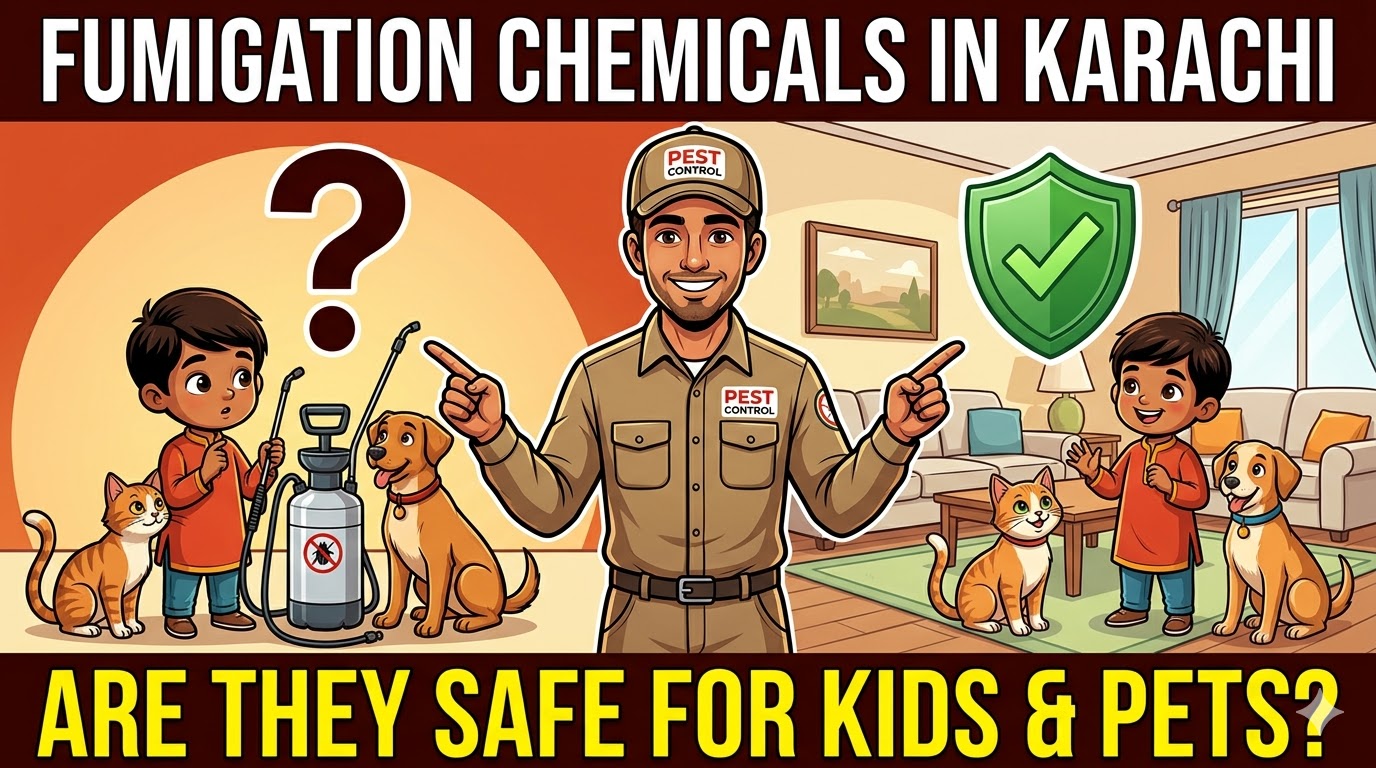
  • Are Fumigation Chemicals in Karachi Safe for Children and Pets? The Honest Answer

    Are Fumigation Chemicals in Karachi Safe for Children and Pets? The Honest Answer

    If you have children running barefoot across the floors or a cat lounging on the sofa, the thought of filling your home with pest control chemicals is unsettling. You want the cockroaches and mosquitoes gone — but not at the cost of your child’s health or your pet’s safety. So what is the honest answer: are fumigation chemicals safe for kids and pets in Karachi?

    The answer requires nuance. Some chemicals are genuinely risky. Others are safe if used correctly. And the outcome depends heavily on which company you hire, what precautions are taken, and how you manage the post-treatment period. This article gives you the complete picture — no sugarcoating, no unnecessary alarm.

    Why Children and Pets Are More Vulnerable Than Adults

    Children and pets are not just smaller versions of adults. Their physiology makes them genuinely more susceptible to chemical exposure, and the reasons are specific:

    Children

    • Children breathe faster than adults, meaning they inhale more air — and more airborne chemicals — per unit of body weight
    • They spend more time on the floor, where chemical residues settle and concentrate
    • Their hands frequently go in their mouths, creating a direct ingestion pathway for surface residues
    • Their developing organ systems — particularly the liver, kidneys, and nervous system — are less capable of metabolising and eliminating toxins
    • Neurological development continues well into adolescence, making young children particularly vulnerable to chemicals that affect the brain and nervous system

    Pets

    • Dogs and cats groom themselves by licking their fur and paws, which brings any surface residue directly into their digestive systems
    • Birds and small animals (hamsters, rabbits, guinea pigs) are extremely sensitive to airborne chemicals and can suffer respiratory distress or death even from low concentrations
    • Reptiles and fish absorb chemicals through skin and water respectively — aquarium water can become contaminated from spray drift
    • Pets cannot communicate symptoms of chemical poisoning early, meaning reactions can escalate before you notice

    The Most Common Fumigation Chemicals Used in Karachi Homes — and Their Risk Profiles

    Pyrethroids (Cypermethrin, Permethrin, Deltamethrin)

    These are the most widely used chemicals in Karachi residential pest control. They are synthetic versions of natural pyrethrin and are effective against cockroaches, ants, mosquitoes, and bed bugs.

    For children: Pyrethroids are considered relatively low toxicity when used correctly and when the home is properly ventilated before re-entry. However, they can cause skin irritation, eye irritation, and respiratory sensitivity in young children if re-entry occurs too early.

    For pets: Permethrin is highly toxic to cats. This is critical — many pet owners do not know this. A cat that walks across a freshly treated floor and then grooms itself can experience tremors, seizures, and in severe cases, death. Dogs are less sensitive but should still be kept away for the recommended period.

    Organophosphates (Chlorpyrifos, Malathion, Dichlorvos)

    These are older-generation chemicals that are still in use by some pest control companies in Karachi. They work by disrupting the nervous system of insects — and they can do the same to children and pets in high enough doses.

    For children: Chronic exposure to organophosphates has been linked to impaired cognitive development, reduced IQ scores, and increased risk of ADHD in children. The WHO has classified chlorpyrifos as a developmental neurotoxin. Ask your pest control provider directly whether they use any organophosphate-based products.

    For pets: Organophosphates are toxic to dogs and cats. Symptoms of poisoning include excessive salivation, vomiting, tremors, and difficulty breathing. Immediate veterinary attention is required if exposure is suspected.

    Boric Acid

    Boric acid is one of the safer options used in gel baits for cockroaches. It works as a stomach poison for insects.

    For children: Boric acid has low inhalation risk since it is not sprayed. However, it is still a toxin if ingested in quantity, so gel bait placements should be out of children’s reach — inside cabinets, behind appliances.

    For pets: Similarly low risk when placed in inaccessible areas. A pet chewing on a gel bait station is unlikely to consume enough to cause serious harm, but placement matters.

    Rodenticides (Bromadiolone, Brodifacoum)

    These are anticoagulant poisons used in rat control. They are among the highest-risk chemicals for both children and pets.

    For children: Rodenticide ingestion is a medical emergency. These should only be placed in locked bait stations that children cannot access.

    For pets: Secondary poisoning is a serious risk. A dog or cat that eats a poisoned rodent can itself be poisoned. This is a well-documented veterinary emergency. If you have pets and need rodent control, inform your pest control provider — there are safer, enclosed bait station options.

    Specific Risks in Karachi Homes

    Floor Contamination

    Karachi homes with marble, tile, or cemented floors are common, and many children spend significant time sitting and playing on these surfaces. When sprays are applied to floors and lower surfaces, residues can persist — particularly in the grout lines of tiles and porous concrete. Even after visual drying, residue can remain active for days. Mopping with water after the recommended re-entry period is essential before allowing young children onto treated floors.

    Rooftop Water Tanks

    Many Karachi households store drinking water in overhead tanks or ground-level reservoirs. During fumigation, if tanks are not sealed, spray aerosols and fumes can contaminate the water supply. This is not hypothetical — it is a documented risk in densely housed neighbourhoods. Every responsible fumigation company should verify water storage is sealed before treatment.

    Kitchen and Food Storage Areas

    Cockroach infestations in Karachi kitchens are extremely common, and kitchen fumigation is one of the most frequent requests. However, the kitchen is also where chemical exposure through food is most likely. All open food, spices, and utensils must be removed or sealed before treatment. Babies’ milk storage, formula, and weaning foods must receive special attention.

    Bird Cages and Aquariums

    If you have birds, even covering a cage in the same room may not be enough — the respiratory system of birds is extremely sensitive. Birds must be moved to a completely separate, unaffected area during and for at least 24 hours after treatment. Fish tanks must be covered with plastic and the air pump disconnected before fogging or spraying.

    A Practical Safety Checklist for Karachi Families with Children and Pets

    Before fumigation:

    • Move all children and pets out of the home before treatment begins
    • Remove or tightly seal all food, water, and baby items
    • Cover fish tanks and disconnect air pumps; relocate birds and small animals
    • Inform the pest control team you have children and pets — ask for low-toxicity alternatives
    • Request the names and MSDS sheets for all chemicals to be used

    After fumigation:

    • Do not bring children or pets back before the recommended re-entry time
    • Mop all hard floors with water before children return
    • Wipe all reachable surfaces, furniture, and children’s play areas
    • Wash pet bedding and remove any items the pet might lick or chew
    • Keep windows open for continued ventilation for several hours
    • Do not let cats back in until all treated surfaces are fully dry and the home is aired

    How to Choose a Fumigation Company That Takes Child and Pet Safety Seriously

    Not all pest control operators in Karachi follow the same standards. Here is how to identify one that will genuinely protect your family:

    • They ask about children and pets before recommending a treatment plan
    • They provide clear, written re-entry timelines specific to your household composition
    • They offer low-toxicity or child/pet-safe treatment options when relevant
    • They do not use organophosphate compounds without clear justification and disclosure
    • They provide product documentation upon request

    When selecting a provider, look for established home fumigation services in Karachi that employ trained technicians, use registered chemicals, and demonstrate transparency in their process. A company that brushes off questions about child and pet safety is not one you want in your home.

    What Are the Symptoms of Chemical Exposure in Children?

    If you suspect a child has been exposed to pest control chemicals, watch for:

    • Skin redness, itching, or rash
    • Red or watery eyes
    • Persistent coughing or sneezing
    • Nausea or vomiting
    • Dizziness or unusual fatigue
    • Headache
    • In severe cases: tremors, difficulty breathing, or loss of consciousness

    If any of these symptoms appear after returning to a recently fumigated home, seek medical attention immediately and inform the doctor about the chemicals used. Save any product documentation from your pest control provider.

    What Are the Symptoms of Chemical Exposure in Pets?

    Watch for these signs in your animals after fumigation:

    • Excessive pawing at the face or mouth
    • Drooling or foaming at the mouth
    • Vomiting or diarrhoea
    • Trembling or muscle weakness
    • Dilated pupils
    • Difficulty walking or loss of coordination
    • Breathing difficulty

    If you observe any of these signs, contact a veterinarian immediately and provide information about the chemicals used. Time matters in chemical poisoning cases.

    Safer Alternatives That Work in Karachi’s Context

    For families with young children, infants, or sensitive pets, these lower-risk approaches can reduce or eliminate the need for high-toxicity treatments:

    • Gel baits for cockroaches: Applied in enclosed spaces away from children and pets, gel baits are highly effective and carry minimal inhalation or dermal risk
    • Diatomaceous earth: A physical rather than chemical pest control agent, effective against crawling insects without systemic toxicity
    • Integrated Pest Management (IPM): A professional IPM approach combines monitoring, exclusion techniques, targeted low-toxicity treatments, and prevention to minimise chemical use over time
    • Boric acid powder: When placed correctly (deep inside wall cavities, under appliances), it offers effective cockroach control without direct exposure risk

    A good pest control company will discuss these options with you rather than defaulting immediately to heavy chemical spraying.

    The Bottom Line: Safe, Yes — But Only When Done Right

    Fumigation in a Karachi home with children and pets is not inherently dangerous. It becomes dangerous when done by unqualified operators, when the wrong chemicals are used, when safety protocols are not followed, or when families return too early.

    Properly conducted, professionally supervised pest control — using appropriate chemicals, with full evacuation of children and pets, and with correct post-treatment ventilation and cleaning — can be carried out safely. The responsibility lies jointly with you as the homeowner to ask the right questions, and with the pest control company to answer them honestly.

    Book Your Free Home Inspection — Child and Pet Safety Is Our Priority

    Dealing with cockroaches, termites, mosquitoes, or rodents and worried about the impact on your children or pets? Our team will come to your home, assess the infestation, and design a treatment plan that is both effective and as safe as possible for every member of your household.

    We are transparent about every chemical we use, we explain the re-entry timeline clearly, and we offer lower-toxicity options where they are appropriate. We know your family’s safety is not negotiable.

    Book your free inspection today — and get a pest control solution designed around your family, not just the pests.

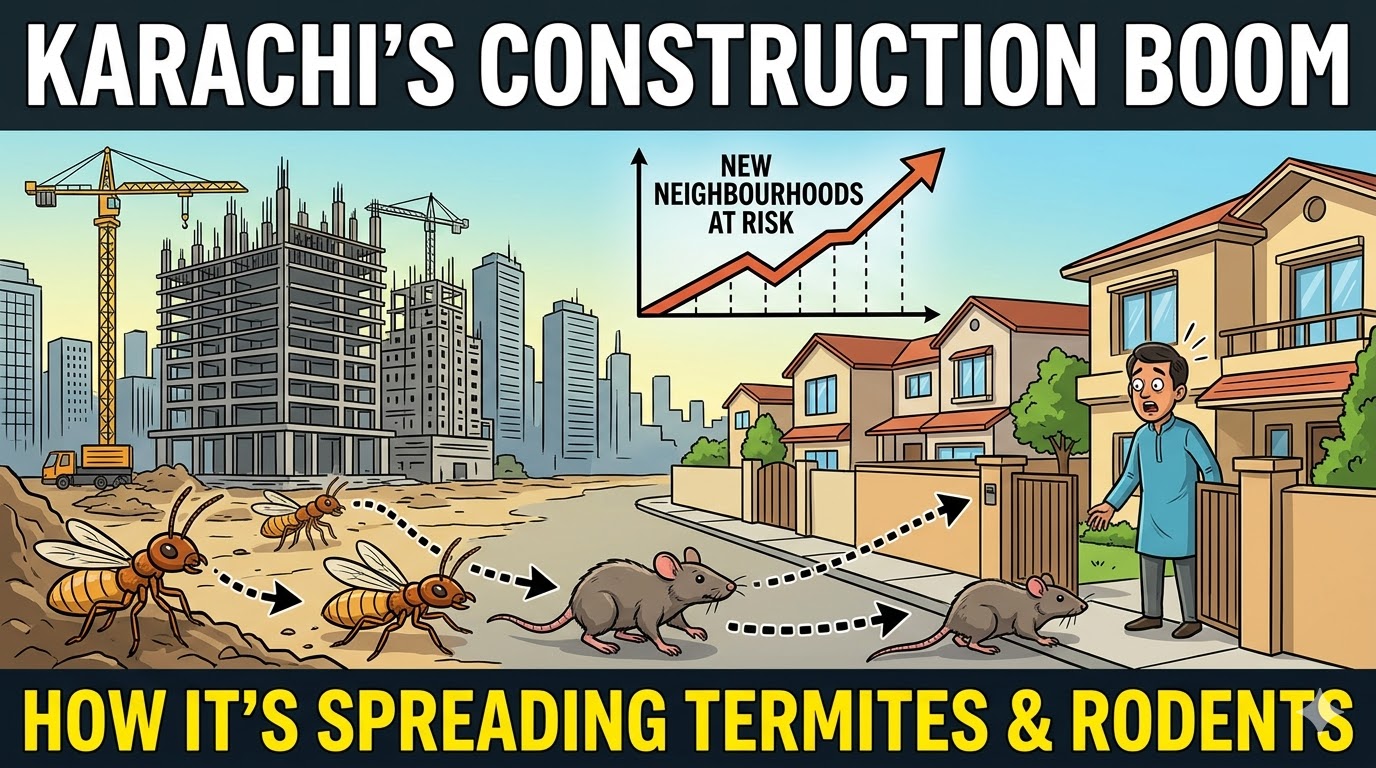
  • How Karachi’s Construction Boom Is Spreading Termites and Rodents into New Neighbourhoods

    How Karachi’s Construction Boom Is Spreading Termites and Rodents into New Neighbourhoods

    If you’ve moved into a new apartment in Bahria Town Karachi, a freshly built house in DHA City, or a recently completed building in Scheme 33 or Gulshan-e-Maymar, you might have expected to be starting fresh — a clean, new home free from the pest problems that plague older properties. What many residents of Karachi’s newest developments are discovering, to their shock and frustration, is the opposite: they are experiencing termite damage, rodent activity, and cockroach infestations within months of moving in.

    This is not a coincidence, and it is not bad luck. It is a direct consequence of Karachi’s ongoing and largely unregulated construction boom — one of the most intense phases of urban expansion the city has ever seen. Understanding exactly how construction spreads pests is the first step toward protecting your new home before the damage becomes irreversible.

    Karachi’s Construction Boom: The Scale of the Problem

    Karachi is one of the fastest-growing cities in the world. Over the past decade, massive residential projects have transformed what were once open fields, agricultural land, and mangrove fringes on the city’s outskirts. Bahria Town Karachi alone spans over 44,000 acres. DHA City Karachi, Gadap Town, and the various housing schemes in Surjani Town, Orangi, and Malir have collectively displaced tens of thousands of acres of undeveloped land in a remarkably short period.

    That undeveloped land was not empty. It was teeming with life — including a vast and complex ecosystem of underground termite colonies, burrowing rodents, and other pests that had lived undisturbed for decades. When construction begins, this ecosystem is violently disrupted. The question is never whether those pests will move — it’s where they will go. And the answer, almost invariably, is into the nearest available structure: your new home.

    How Termites Spread Through Construction Sites

    Termites are arguably the most serious pest threat created by Karachi’s construction boom. They are ancient, highly organised, and extraordinarily effective at finding and exploiting wood and cellulose-containing materials in structures. Here is how construction activities specifically facilitate their spread:

    Soil Disruption and Colony Displacement

    Subterranean termites — the dominant species in Karachi’s soil — build colonies that can extend several metres underground and span areas larger than a tennis court. When excavation work begins for foundations, roads, or underground utilities, these colonies are physically disrupted. Worker termites immediately begin searching for new territory, following moisture gradients and chemical trails. The freshly poured concrete and wood formwork of a construction site offers both moisture and cellulose — an irresistible combination.

    Infected Timber in Construction

    A major but under-discussed pathway for termite spread in Karachi is the use of infested timber in construction. Much of the formwork timber used in Karachi’s construction sites is reused multiple times and sourced from timber yards where storage conditions are poor. Termites in this timber are transported directly to new construction sites, often at considerable distances from their original colony. By the time the building is complete and residents move in, termites may already be active in wooden elements of the structure.

    Landscaping and Garden Mulch

    New housing societies in Karachi invest heavily in landscaping. The imported soil, mulch, and plants used in these projects frequently carry termite colonies. Bahria Town Karachi’s extensive green areas, for instance, have been created using soil brought from various locations — a practice that facilitates the widespread dispersal of termite populations across the development. Residents whose homes border these green zones are at particularly elevated risk.

    Construction Debris Left on Site

    In many Karachi construction projects, wood debris, cardboard, and cellulose waste is left on site for extended periods. This provides an ideal feeding and harbouring site for termites, allowing colonies to establish themselves close to the finished structures. Even after cleaning, the chemical trails (pheromones) left behind by termites in soil persist for months and continue to attract new termite activity.

    Poor Soil Treatment Compliance

    Pakistani building codes require anti-termite soil treatment (chemical barrier application) before foundation laying. In practice, this requirement is frequently skipped, inadequately applied, or performed with diluted chemicals by contractors seeking to cut costs. In a city undergoing the construction pace of Karachi, enforcement is virtually impossible. The result is that a significant proportion of new buildings in Karachi’s boom developments lack any chemical protection against subterranean termites.

    How Construction Spreads Rodents into New Areas

    Rodents — primarily Norway rats, roof rats, and house mice — are equally displaced by construction, though their mechanisms of spread differ from termites:

    Field Rat Displacement

    Karachi’s outer areas — including the Malir Valley, Hub River Road corridor, and the fringes of Gadap — have historically been home to large populations of field rats. These rodents live in burrows in agricultural and undeveloped land, feeding on seeds, grain, and vegetation. When that land is cleared for construction, the field rats are forced out almost immediately. Their natural behaviour is to move to the nearest available food and shelter — which is the construction site and, progressively, the residential areas taking shape within it.

    Construction Site Conditions That Attract and Breed Rodents

    Construction sites are almost ideal rodent environments. Labourers’ food waste, temporary shelter structures, stored materials, and poor sanitation all attract rats and mice. These rodents breed rapidly — a pair of Norway rats can produce 20-50 offspring in a year — and populations established on construction sites do not disappear when the site is completed. They move into the finished buildings.

    Infrastructure as Rodent Highways

    The laying of new sewage, drainage, and utility infrastructure across Karachi’s expanding areas creates underground tunnels and conduits that serve as protected rodent highways. Karachi’s rats are well-adapted to using drain systems for travel, and new infrastructure provides fresh routes into previously inaccessible residential areas. This is a particular problem in new housing developments where drainage infrastructure is completed before full occupancy, leaving rodents with unobstructed access to hundreds of homes.

    Demolition of Old Structures

    Karachi’s construction boom is not only about building in new areas — it also involves extensive demolition of older buildings in established neighbourhoods. In areas like PECHS, Gulshan-e-Iqbal, and Nazimabad, old bungalows and low-rise buildings are regularly demolished to make way for multi-storey apartment complexes. These demolitions displace established rodent colonies that have lived in the old structures for years, driving them into neighbouring buildings. Residents living next to demolition sites in Karachi frequently report sudden and severe rodent infestations with no prior history of the problem.

    The Specific Neighbourhoods Most Affected

    While the entire city is affected by construction-related pest spread, certain areas are experiencing particularly intense problems based on current development activity:

    • Bahria Town Karachi: The sheer scale of development across former agricultural land has created one of the most significant termite risk zones in the city. Residents in Phase 1 through Phase 7 have reported active termite infestations in brand-new properties. The extensive green landscaping, imported soil, and proximity to undeveloped buffer zones compounds the risk significantly.
    • DHA City Karachi and DHA Phase 8 Extension: Development adjacent to Hub River Road and the Lyari River corridor has displaced large rodent populations from previously undisturbed scrubland. New residents are encountering Norway rats and roof rats that are far more aggressive than the typical urban variety.
    • Scheme 33 and Gulshan-e-Maymar: Rapid, high-density construction in these areas has created conditions ideal for cockroach and rodent spread between units. Poor construction standards in some developments have left numerous entry points.
    • Orangi Town Expansion Areas: Construction at the edges of Orangi displaces pests from both the old neighbourhood infrastructure and the surrounding undeveloped land, creating a compounded pest pressure on new buildings.
    • PECHS and Bahadurabad Redevelopment Zones: Old bungalow demolitions throughout these established areas are consistently displacing rodent colonies into adjacent apartment buildings. Residents in these areas who have never had rodent problems are suddenly finding them after neighbouring demolitions.

    The Signs That Construction-Related Pests Have Entered Your Home

    Many residents of new properties do not immediately connect pest activity to the construction around them. Here are the specific signs to watch for:

    Signs of Termite Activity:

    • Mud tubes (thin, pencil-width tunnels of dried soil) on walls, foundations, or inside cupboards
    • Wood that sounds hollow when tapped
    • Paint that bubbles or peels without moisture explanation
    • Discarded termite wings on windowsills or floor — especially after evening hours when swarmers are active
    • Fine, sawdust-like frass (termite droppings) near wooden furniture or structural elements

    Signs of Rodent Activity:

    • Droppings — dark, capsule-shaped, most common near food sources or along walls
    • Gnaw marks on food packaging, wiring, or wooden surfaces
    • Grease trails — dark smear marks along walls at floor level, where rats travel repeatedly
    • Scratching sounds at night from ceilings, walls, or under floors
    • Nesting material — shredded paper, fabric, or insulation in hidden corners or roof spaces

    What New Karachi Homeowners Must Do Right Now

    If you have recently moved into a new property, or if construction is ongoing nearby, these actions are essential:

    For Termite Prevention:

    • Ask your developer or builder for documentation of anti-termite soil treatment. If they cannot provide it, assume it was not done adequately and schedule a professional soil treatment
    • Do not allow wood debris, cardboard boxes, or garden mulch to accumulate against your home’s exterior
    • Inspect new wooden furniture thoroughly before bringing it indoors — termite-infested furniture from timber markets is a common introduction route
    • Maintain adequate ventilation in all rooms — termites prefer damp, stale conditions
    • Have your property professionally inspected for termites before the end of the first monsoon season — this is when subterranean termite activity is most detectable

    For Rodent Prevention:

    • Seal all gaps around pipe penetrations through walls — these are the primary rodent entry points in new buildings
    • Install steel mesh over ventilation openings at foundation level
    • Check that all drain connections are properly sealed and covered
    • Do not allow construction waste, food packaging, or organic material to accumulate in or around your property
    • If you can hear rodent activity before the building is fully occupied, contact pest control before moving in — it is far easier to treat an unoccupied building

    The Responsibility Gap: Who Should Be Protecting New Residents?

    There is a genuine protection gap in Karachi’s construction industry. Developers are legally required to provide anti-termite treatment but frequently do not. Housing societies are obligated to maintain sanitary conditions but often lack enforcement mechanisms. Newly arrived residents assume their new homes have been properly treated — an assumption that is, in too many cases, incorrect.

    Until regulatory enforcement improves, the responsibility falls on homeowners and residents to be proactive. This means not assuming that a new building is pest-protected, understanding the risks of the construction environment you have moved into, and investing in professional pest management from the moment you take possession of a new property.

    Professional Pest Control: Essential, Not Optional, for New Developments

    For residents of Karachi’s new housing developments, professional pest control is not a reactive measure — it is a foundational step in making your new home liveable and protecting your investment. A professional inspection will identify whether anti-termite treatment was applied correctly, detect any existing rodent or insect activity, and recommend the appropriate preventive treatments to neutralise the risks inherent in your specific location.

    With experienced teams serving both new developments and established neighbourhoods across the city, the professionals offering fumigation services in Karachi understand the specific pest risks created by the city’s construction activity. They can provide new-construction termite treatment, rodent exclusion services, and ongoing preventive programmes tailored to the unique challenges of Karachi’s expanding urban landscape.

    Conclusion

    Karachi’s construction boom is transforming the city’s skyline, but it is also transforming its pest landscape. Every new development that displaces undeveloped land displaces the pests living in that land — and those pests go somewhere. Without proper preventive measures, that somewhere is your new home.

    If you live in or near a new development, if there has been recent demolition in your neighbourhood, or if you’ve moved into a new building in the last two years, the threat of construction-spread termites and rodents is real and present. Don’t wait for damage to appear before you act. In the case of termites especially, by the time the damage is visible, it has been ongoing for months — sometimes years.

    📞 Book Your Free Pest Inspection Today

    Whether you’ve just moved into a new development or you’ve been noticing warning signs for months, our team is ready to help. Book a free inspection with us today. We’ll assess your property for termite and rodent risk, check whether anti-termite soil treatment was properly applied, and recommend a clear, affordable protection plan. Your new home deserves a fresh start — let us make sure it gets one.

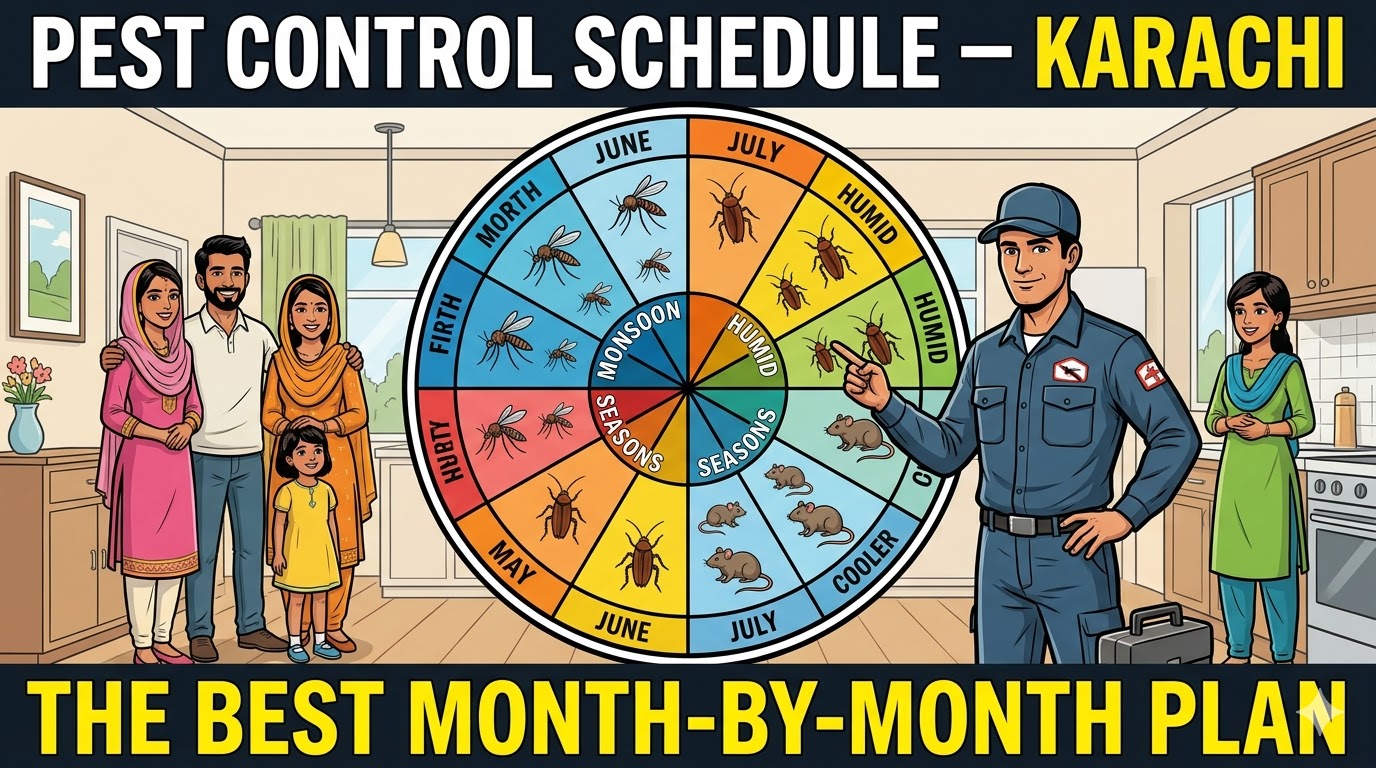
  • Pre-Monsoon Pest Control Checklist for Karachi Homeowners

    Pre-Monsoon Pest Control Checklist for Karachi Homeowners

    Karachi’s climate is relentless. With temperatures regularly climbing above 40°C in May and June, and then monsoon humidity setting in from late June through September, the city creates one of the most pest-hospitable environments in South Asia. By the time July arrives, the combination of standing water, soaring humidity, and warm nights creates ideal breeding conditions for mosquitoes, cockroaches, rodents, and termites alike.

    The problem? Most homeowners wait until they see the infestation before acting. By then, the damage — to their health, their home, and their peace of mind — has already begun.

    This guide gives you a step-by-step pre-monsoon pest control checklist specifically designed for Karachi homes. Whether you live in a DHA bungalow, a flat in Clifton, a house in Gulshan-e-Iqbal, or a property in North Nazimabad, these steps apply directly to you. Follow this checklist before the rains arrive, and you’ll enter monsoon season dramatically better protected.

    Understanding the Karachi Pest Calendar

    Before diving into the checklist, it helps to understand why the pre-monsoon window (roughly April to mid-June) is the single most important time for pest control in Karachi.

    During this period:

    • Termite colonies are actively expanding as heat increases soil activity
    • Cockroach populations are at peak breeding cycles due to dry warmth
    • Mosquito larvae are already present in stagnant water around homes
    • Rodents are seeking cooler interior spaces — your kitchen and attic
    • Flies and drain pests thrive in the pre-rain humidity build-up

    Once the monsoon arrives, pest populations explode because breeding accelerates dramatically. A pre-monsoon treatment does two things: it eliminates existing colonies before they can capitalise on the rain, and it creates a chemical barrier that persists into the wet season.

    The Complete Pre-Monsoon Pest Control Checklist

    1. Inspect and Seal All Entry Points

    Pests don’t appear from nowhere — they enter your home through cracks, gaps, and structural weaknesses. Your first job before monsoon is a thorough inspection.

    What to check:

    • Window frames and door frames for gaps or rot
    • Pipe entry points into walls (kitchen sink pipes, bathroom plumbing)
    • AC duct openings where wall penetrations exist
    • Roof edges and soffit areas in older homes
    • Basement ventilation grilles (common in older Karachi bungalows)
    • Foundation cracks — especially in homes in low-lying areas of Korangi or Landhi

    Action: Use a silicone sealant or steel wool for smaller gaps. Larger structural cracks need masonry repair before the monsoon — water ingress alongside pest entry is a double problem.

    2. Clear and Treat All Drains

    Karachi’s drainage system is notoriously overloaded during monsoon. Even within your own home, drains are ground zero for cockroach activity and mosquito breeding.

    Action steps:

    1. Pour boiling water followed by a baking soda and vinegar solution down all kitchen and bathroom drains
    2. Apply a drain-safe insecticide gel into floor drains at least two weeks before monsoon
    3. Install drain covers or strainers if they are missing
    4. Check the outside drainage channels around your home and clear blockages
    5. If you have a rooftop drain or water tank overflow pipe, treat these as well — they are prime mosquito breeding zones

    3. Address All Water Storage and Collection Points

    In many Karachi neighbourhoods, water is stored in overhead tanks, underground sumps, water drums, and even rooftop buckets due to irregular supply schedules. Every single one of these is a potential dengue and malaria mosquito nursery.

    Pre-monsoon action:

    • Inspect all water tank lids and replace cracked or missing covers
    • Flush and clean underground water tanks — ideally hire a professional tank cleaning service
    • Discard any unused containers, tyres, or flowerpots that collect rainwater
    • Apply BTI (Bacillus thuringiensis israelensis) tablets to water tanks — these are safe biological larvicides
    • Ensure rooftop rainwater drainage is free-flowing so water doesn’t pool

    4. Schedule a Professional Termite Inspection

    Termites are Karachi’s most structurally damaging pest, and they are uniquely active in the pre-monsoon heat. Subterranean termites — the most common species in Sindh — build mud tubes and travel from soil into wooden structures. You will rarely see them until significant damage has already been done.

    Warning signs to look for now:

    • Hollow sounds when you tap wooden floors, skirting boards, or door frames
    • Fine sawdust-like frass near wooden fixtures
    • Mud tunnels along walls near the floor or around window frames
    • Discarded wings near windowsills after a windy day

    If you spot any of these, do not wait. A professional termite treatment before monsoon — typically a soil barrier or baiting system — is far cheaper than structural repairs after damage has occurred. This is arguably the most important item on the entire checklist.

    5. Treat the Kitchen Thoroughly

    The kitchen is the heart of every Pakistani home and, unfortunately, the heart of every cockroach and rodent infestation too. Karachi kitchens face particular challenges due to warm temperatures year-round and the tendency for moisture to accumulate around cooking areas.

    Pre-monsoon kitchen checklist:

    • Empty all cabinets and drawers completely — check for egg cases behind and underneath
    • Clean behind and beneath the refrigerator (a favourite cockroach hiding spot)
    • Seal any gaps where pipes enter the kitchen wall
    • Apply cockroach gel bait along the inside of cabinet hinges and behind the refrigerator
    • Store all food in airtight containers — open packets of rice, lentils, or flour are invitations
    • Fix any leaking taps or pipes — moisture is the number one cockroach attractant

    6. Treat the Bathroom and Wet Areas

    Bathrooms in Karachi homes — particularly older properties in areas like Saddar, Garden, or PECHS — frequently have structural damp issues that attract a range of pests including silverfish, cockroaches, and drain flies.

    Action steps:

    • Inspect and re-grout any cracked tile areas that accumulate moisture
    • Treat all floor drains with an appropriate gel or insecticide
    • Ensure exhaust fans are working — ventilation dramatically reduces moisture
    • Check under bathroom vanity units for cockroach activity
    • Replace any decaying or damp wooden fixtures

    7. Inspect Roof, Loft, and Storage Areas

    Rodents — both rats and mice — seek shelter in rooftop areas and unused loft spaces in the weeks before monsoon, when outdoor temperatures spike dramatically. In Karachi, the period from May to June sees a measurable rise in rodent activity inside homes as temperatures outdoors become extreme.

    What to do:

    • Physically inspect your loft or roof space if accessible
    • Look for droppings, gnaw marks, or nesting material
    • Place rodent bait stations in corners and along walls
    • Seal any entry points on the external roof or parapet walls
    • Ensure water tanks are not providing an inadvertent entry route via exposed pipes

    8. Treat the Garden, Boundary Walls, and External Perimeter

    Your garden, if you have one, is the first line of contact between outdoor pest populations and your home. Dense vegetation, compost heaps, stacked firewood, and accumulated leaf litter all serve as harbourage sites.

    Pre-monsoon garden treatment:

    • Trim all bushes and shrubs so they do not touch the house walls
    • Remove stacked debris, old plant pots, and unused furniture from garden areas
    • Treat the external perimeter of your home with a residual insecticide spray
    • Apply ant and cockroach treatments along boundary walls
    • If you have fruit trees, clear fallen fruit regularly as it attracts wasps and flies

    9. Schedule a Full Fumigation Treatment

    A thorough interior fumigation — ideally covering all rooms, including the kitchen, bathrooms, and storage areas — creates a residual chemical barrier that will protect your home through the early months of monsoon. This is not a DIY job. Effective fumigation requires professional-grade products, correct dilutions, and knowledge of target pests specific to Karachi’s urban environment.

    This is the step many homeowners skip to save money. It is also the step they regret most when cockroaches overrun their kitchen in July or dengue hits their neighbourhood in August.

    The Karachi Factor: Why Generic Advice Falls Short

    Many online pest control guides are written for Western or generic tropical climates. Karachi has unique conditions that change the calculus:

    • The urban heat island effect makes central Karachi areas like Saddar and Lyari hotter than outlying neighbourhoods, accelerating insect metabolism and breeding cycles
    • The dual water supply problem (tanker water plus municipal supply) means most homes have multiple water storage points — each a potential breeding site
    • High-density housing in areas like Orangi Town and Korangi means infestations spread rapidly between neighbouring properties
    • Older housing stock in areas like Soldier Bazaar, Federal B Area, and Nazimabad has more structural entry points due to age and construction style

    A genuinely effective pre-monsoon strategy acknowledges these realities. It doesn’t treat your Gulshan apartment the same as a suburban home in Islamabad.

    How Far in Advance Should You Act?

    Ideally, pre-monsoon pest control in Karachi should begin in April and be completed by the end of May. This gives:

    • Enough time for termite treatments to establish a full soil barrier
    • Time to identify structural issues and get them repaired
    • A window to observe whether treatments are working before monsoon amplifies any remaining pest pressure

    If you are reading this in June, you have not missed the window entirely — but act now. Every week of delay means another week of pest population growth before the rains arrive.

    DIY vs. Professional Treatment: Being Honest

    Let’s be direct. Some of this checklist you can do yourself: sealing gaps, clearing drains, covering water tanks, tidying the garden. These are homeowner responsibilities and cost little beyond time and effort.

    But the chemical treatment components — particularly termite treatments, interior fumigation, and rodent control programmes — require professional expertise to be effective. Over-the-counter products available in Karachi’s hardware shops are often lower concentration, incorrectly applied, and provide inadequate residual protection. In some cases, improper DIY treatments cause pests to scatter deeper into walls rather than eliminating them.

    If you are serious about protecting your home, engaging a professional pest control service in Karachi before monsoon is not an extravagance — it is a cost-effective investment in your family’s health and your property’s structural integrity.

    Frequently Asked Questions

    How long does a pre-monsoon fumigation last?

    A professionally applied interior fumigation typically provides residual protection for 2 to 3 months under Karachi’s conditions. Applying it in May means coverage through the peak months of July and August.

    Is fumigation safe for children and pets?

    Yes, when carried out by professionals using approved products and correct application protocols. You will typically be asked to vacate the property for 3 to 4 hours post-treatment and ventilate before re-entry. Always inform your pest control provider about children, infants, or pets so they can advise on appropriate products.

    Do I need termite treatment if I live in a flat?

    Potentially, yes. Termites in multi-storey buildings travel through shared walls and structural elements. If lower floors or neighbouring units have activity, upper floors are not automatically protected. A professional inspection will determine your actual risk level.

    Can I do pest control in stages — kitchen first, then other rooms?

    You can, but it is significantly less effective. Pests move between rooms when threatened, and partial treatments can drive them into untreated areas temporarily. A whole-home treatment in a single visit is always more effective than a piecemeal approach.

    Summary Checklist at a Glance

    Before the monsoon arrives, make sure you have:

    • Inspected and sealed all entry points to the home
    • Cleared, cleaned, and treated all drains
    • Covered and protected all water storage points
    • Scheduled a professional termite inspection
    • Deep-cleaned and treated the kitchen
    • Treated bathrooms and wet areas
    • Inspected the roof, loft, and storage areas
    • Treated the external garden perimeter
    • Booked a full professional fumigation

    Book Your Free Pre-Monsoon Inspection Today

    Karachi’s monsoon season does not forgive the unprepared. The pests are coming — the only variable is whether your home is ready to stop them.

    Our team of licensed pest control specialists operates across Karachi, from DHA and Clifton to Gulshan, North Nazimabad, PECHS, Korangi, and beyond. We offer a free, no-obligation home inspection that identifies your specific vulnerabilities and recommends a targeted treatment plan.

    Do not wait until you see cockroaches in your kitchen or mosquitoes swarming your bedroom. Book your free pre-monsoon inspection with us today — and enter monsoon season with confidence.

    Contact us now to schedule your appointment. Spaces fill quickly in the pre-monsoon period.

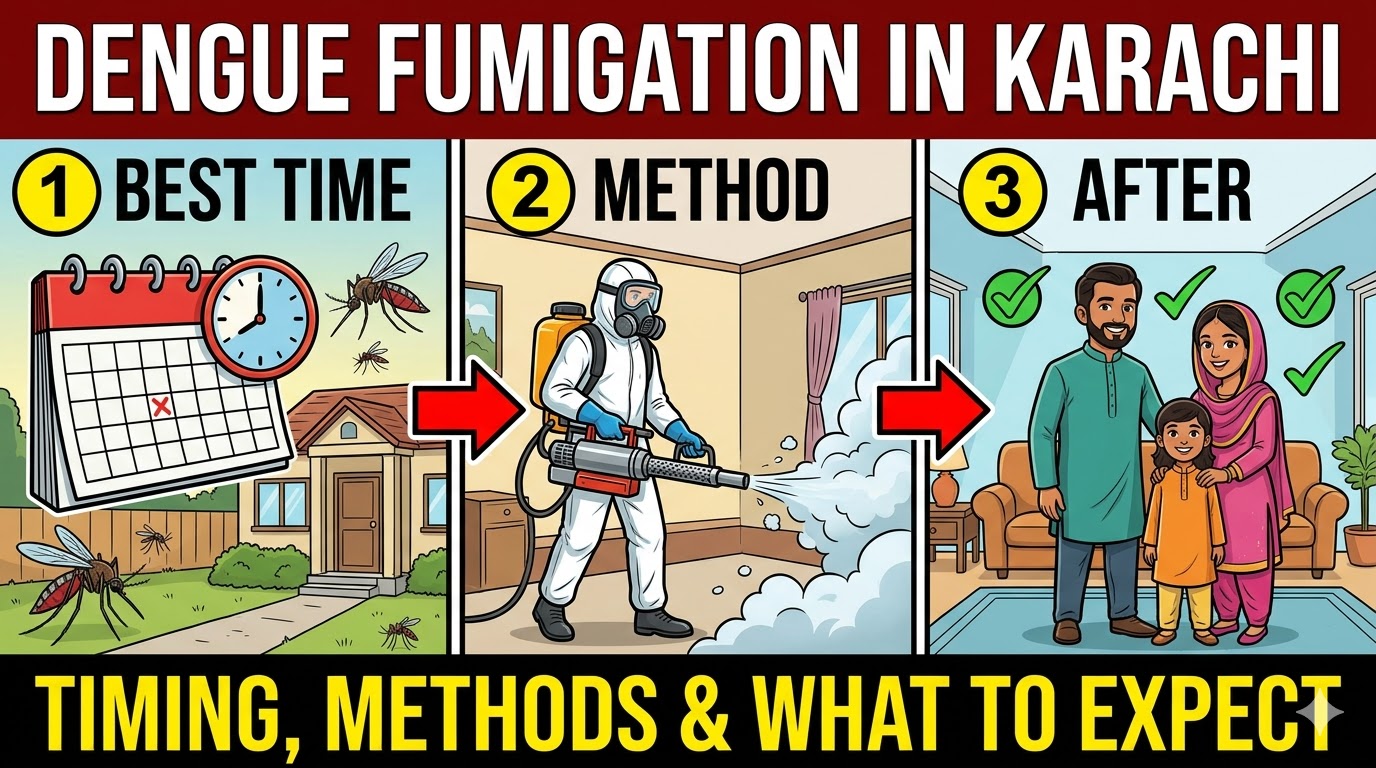
  • Dengue Mosquito Fumigation in Karachi: Best Timing, Methods, and What to Expect

    Dengue Mosquito Fumigation in Karachi: Best Timing, Methods, and What to Expect

    Every year, as Karachi’s monsoon season peaks in July and August, dengue fever cases surge in hospitals across the city. Neighbourhoods in DHA, Clifton, Gulshan-e-Iqbal, North Nazimabad, and PECHS are not immune — dengue has repeatedly demonstrated that it does not discriminate by postcode or income level.

    The Aedes aegypti mosquito, Karachi’s primary dengue vector, breeds in clean standing water, bites during daylight hours, and thrives in residential environments. Your water tank, your garden, your rooftop, and even a discarded bottle cap filled with rainwater can harbour enough larvae to produce biting adults within a week.

    This article covers everything you need to know about dengue mosquito fumigation in Karachi: the best time to act, the specific methods professionals use, how to prepare your home, and what to realistically expect from treatment. This is practical, Karachi-specific information — not generic advice that could apply to any city in the world.

    Understanding the Dengue Threat in Karachi

    The Mosquito Behind the Disease

    Aedes aegypti is a relatively small, dark mosquito with white markings on its legs and body. Unlike the Culex mosquito that bites at night, Aedes aegypti is a daytime biter — most active in the two hours after sunrise and the two hours before sunset. This makes bedroom mosquito nets largely ineffective against dengue transmission, which is why fumigation of the entire home environment is so important.

    The female Aedes aegypti requires a blood meal to develop her eggs. She can lay up to 300 eggs in a single clutch, depositing them at the waterline of containers rather than on the water surface. These eggs can remain viable for up to twelve months — meaning a dried-out container that held water during last monsoon can produce mosquitoes the moment water returns.

    Why Karachi Is Particularly Vulnerable

    Several features of Karachi’s urban environment make it one of Pakistan’s highest-risk cities for dengue transmission:

    • The water storage culture: millions of open or partially covered containers distributed across residential properties provide an unparalleled density of breeding sites
    • Dense housing in areas like Orangi, Korangi, Landhi, and Liaquatabad means mosquito populations spread rapidly between homes
    • Intermittent municipal water supply means tanks are refilled frequently, creating water-level fluctuation that is ideal for egg-laying
    • Year-round warmth means Aedes aegypti does not face the winter die-off that limits populations in cooler Pakistani cities
    • Limited coordinated public health vector control means household-level action is critical

    Best Timing for Dengue Fumigation in Karachi

    Timing is perhaps the most important variable in dengue mosquito control. Getting this right significantly affects how much protection you actually receive.

    The Pre-Monsoon Window: April to Early June

    This is the single most important and most underutilised treatment window. During this period, Aedes aegypti populations are building but have not yet exploded. A professional fumigation treatment applied before the monsoon rains arrive achieves two things simultaneously: it eliminates adult mosquitoes present in and around your home, and the residual chemical treatment creates a barrier that persists into the early monsoon weeks.

    Pre-monsoon treatment is proactive rather than reactive. It is considerably more effective — and more cost-efficient — than waiting until an outbreak is confirmed in your neighbourhood.

    Early Monsoon: Late June to Mid-July

    If pre-monsoon treatment was not completed, the early monsoon window is the next best opportunity. Mosquito populations are rising but the peak surge of July and August has not yet arrived. Treatment at this stage can still significantly reduce peak population levels.

    This window also coincides with the emergence of the first dengue case reports from Karachi hospitals, which tends to motivate homeowners who were previously undecided. Do not wait for cases in your specific street — act when your district shows activity.

    Peak Monsoon: July and August

    Treatment during peak monsoon is still worthwhile and can reduce immediate risk, but expectations need to be calibrated. Adult mosquito populations are at their highest, breeding sites have multiplied enormously, and the humid conditions mean residual treatments degrade more quickly than in dry conditions.

    During peak months, a single treatment is rarely sufficient. A programme of two to three interventions, spaced two to three weeks apart, is typically recommended for meaningful protection during this period.

    Post-Monsoon: September to November

    A post-monsoon treatment is often overlooked but important for several reasons. It eliminates the adult populations that survived the wet season and prevents carryover activity into winter. In Karachi, where temperatures remain warm year-round, Aedes aegypti populations do not fully die off in winter — they merely reduce. A post-monsoon treatment prevents this reduced population from serving as the founding population for next year’s breeding season.

    Dengue Fumigation Methods: What Actually Works

    Not all fumigation methods are equally effective against dengue mosquitoes. Understanding the available approaches helps homeowners ask the right questions and make informed decisions.

    Method 1: ULV (Ultra Low Volume) Fogging

    ULV fogging is the most commonly recognised form of mosquito fumigation. It involves producing an ultra-fine mist of insecticide droplets that remain suspended in the air for a period of time, contacting and killing adult mosquitoes that are flying or resting in the treated area.

    ULV fogging can be conducted indoors or outdoors. Outdoor ULV treatment covers the garden, boundary areas, and external walls. Indoor ULV treatment penetrates curtains, under furniture, and into the micro-environments where resting mosquitoes shelter.

    Important limitation: ULV fogging kills adult mosquitoes but has no effect on eggs or larvae. It must therefore always be combined with larvicidal treatment for comprehensive dengue control.

    Method 2: Residual Surface Spraying

    Residual surface spraying applies a liquid insecticide to surfaces where mosquitoes rest — walls, ceilings, behind furniture, under beds, inside wardrobes. Unlike fogging, the insecticide does not evaporate but leaves a chemical film that kills mosquitoes that land on treated surfaces for weeks or months after application.

    This is one of the most effective tools against Aedes aegypti specifically, because this species has a strong tendency to rest on indoor surfaces after feeding. A well-applied residual spray treatment creates a lethal environment for any mosquito that enters the home and rests before its next blood meal.

    Effective residual surface spraying requires complete access to all resting surfaces, which means furniture must be moved and the treatment cannot be rushed. A thorough treatment of a typical Karachi home should take 45 minutes to 1.5 hours depending on size.

    Method 3: Larvicidal Treatment

    Larvicidal treatment targets mosquito larvae in standing water before they develop into biting adults. This is the most cost-effective form of mosquito control — eliminating mosquitoes before they can bite or breed further.

    Larvicides used in residential settings include:

    • Biological larvicides (BTI — Bacillus thuringiensis israelensis): safe for use in drinking water tanks, kills larvae without affecting humans or animals
    • Chemical larvicides (temephos and others): used in non-potable water bodies such as drains, garden water features, and outdoor containers
    • Larvicidal oils: thin surface films that prevent larvae from breathing at the water surface

    In Karachi, larvicidal treatment is particularly critical given the number of water storage containers in most residential properties. A fumigation without larvicidal treatment leaves the breeding cycle intact and produces new adult mosquitoes within days.

    Method 4: Thermal Fogging

    Thermal fogging uses heat to vaporise insecticide, producing a dense, visible white fog that penetrates deep into vegetation and outdoor spaces. It is highly effective for garden and boundary treatments and is commonly used in outdoor community-level mosquito control campaigns.

    For residential use, thermal fogging is most appropriate for larger properties with significant outdoor areas — large gardens, farmhouses, or villa-style homes in areas like DHA, Bahria Town, or Defence View. For apartments and smaller urban homes, ULV fogging is typically more practical.

    The Integrated Approach: Why You Need More Than One Method

    Professional dengue mosquito control in Karachi should always be an integrated programme rather than a single-method application. A comprehensive treatment combines:

    1. Source reduction consultation: identifying and eliminating all breeding sites
    2. Larvicidal treatment of any remaining water bodies
    3. Indoor residual spray of resting surfaces
    4. ULV fogging of indoor spaces
    5. Outdoor ULV or thermal fogging of garden and boundary areas

    Each component targets a different stage of the mosquito lifecycle. Omitting any one of them leaves a gap in protection that allows the population to recover.

    How to Prepare Your Home for Dengue Fumigation

    Preparation is not optional. The effectiveness of any fumigation treatment is directly related to how thoroughly the home has been prepared. Here is what you need to do before the treatment team arrives:

    24 to 48 Hours Before Treatment

    • Identify and note all water storage containers for the technician to treat or advise on
    • Clear clutter from under beds, behind sofas, and in storage rooms — these are prime resting sites and need to be accessible
    • Remove or cover all food items in the kitchen — containers should be sealed, open packets placed in sealed bags
    • Inform all family members and domestic staff of the treatment date and timing
    • Arrange accommodation for children under two years, pregnant women, and anyone with respiratory conditions for the duration of the treatment plus re-entry period

    On the Day of Treatment

    • Open all internal doors, drawers, and cabinet doors so technicians can access all surfaces
    • Move furniture slightly away from walls to allow spraying of wall bases
    • Ensure fish tanks are covered and their air pumps are switched off
    • Cover birdcages or remove them from the treatment area
    • Vacate all humans and pets at least 30 minutes before treatment begins
    • Leave windows closed during indoor fogging treatment — this keeps the fogged droplets suspended longer

    After Treatment: Re-entry and Ventilation

    Your pest control team will advise on the specific re-entry period for the products used. Typically:

    • ULV fogging: re-entry after 2 to 3 hours once adequately ventilated
    • Residual surface spray: re-entry after 3 to 4 hours; do not wipe treated surfaces
    • Larvicidal treatment of water tanks: follow technician advice on when water is safe to use (BTI-treated water is immediately safe; chemical larvicides require a waiting period)

    After re-entry, ventilate rooms well by opening windows for at least 1 hour before settling back in. Wipe food preparation surfaces with a clean damp cloth before use.

    What to Expect: Realistic Outcomes

    Understanding what professional dengue fumigation can and cannot achieve helps homeowners use it most effectively.

    What It Will Do

    • Kill the large majority of adult mosquitoes present in and around your home at the time of treatment
    • Create a residual barrier that kills newly arriving mosquitoes for 4 to 8 weeks, depending on conditions and products used
    • Eliminate larvae in treated water bodies
    • Significantly reduce biting activity in the treated area within 24 to 48 hours

    What It Will Not Do

    • Provide permanent protection — residual treatments degrade, especially in Karachi’s monsoon humidity, and adult mosquitoes continue to be produced from untreated breeding sites in the wider neighbourhood
    • Protect against mosquitoes breeding on neighbouring properties — community-level protection requires coordinated treatment
    • Eliminate eggs already laid in treated containers — these may still hatch
    • Substitute for source reduction — untreated breeding sites will continue producing adults

    The Realistic Expectation

    A professionally conducted, integrated dengue mosquito treatment will significantly reduce the mosquito population in and around your home and provide meaningful protection for several weeks. In combination with personal protection measures (long clothing during peak biting hours, window screens, eliminating standing water), it can dramatically reduce your family’s dengue exposure risk.

    It is not a one-time permanent solution. In a high-transmission season like July and August in Karachi, repeat treatments every four to six weeks are appropriate for high-risk properties or households with vulnerable individuals.

    Choosing the Right Dengue Fumigation Service in Karachi

    The quality of dengue fumigation services in Karachi varies considerably. Here is what to look for when selecting a provider:

    • Licensed operators with documented use of approved insecticide products — ask for the product name and registration number
    • Integrated approach: any provider offering only fogging without larvicidal treatment is offering a partial solution
    • Evidence of proper equipment — professional ULV machines, not hand-pump sprayers
    • Willingness to conduct a pre-treatment inspection and source reduction consultation
    • Clear communication on re-entry times and post-treatment instructions
    • References or demonstrated track record in your area of Karachi

    Choosing quality fumigation services in Karachi for dengue mosquito control means choosing a team that treats your home as a system, not a single-room job.

    Dengue Risk Reduction Beyond Fumigation: Completing the Picture

    Fumigation is a critical component of dengue prevention, but it works best as part of a broader strategy. Actions that complement professional treatment:

    • Cover all water storage tanks completely with tight-fitting lids — inspect weekly for damage
    • Empty and scrub any container that holds water at least once per week — this removes eggs laid at the waterline
    • Dispose of unused tyres, old plant pots, and containers that accumulate rainwater
    • Install window screens on all opening windows — fine mesh screens reduce adult mosquito entry significantly
    • Use mosquito repellent on exposed skin during morning and late afternoon hours
    • Wear long-sleeved, light-coloured clothing during peak biting periods
    • Ensure your neighbourhood WhatsApp group is aware of dengue cases so residents can coordinate

    Specific Neighbourhoods and Dengue Risk in Karachi

    While dengue can occur anywhere in Karachi, certain factors make some areas higher risk during monsoon:

    High-density areas with poor drainage (parts of Orangi Town, Baldia, Liaquatabad, and Korangi) face higher mosquito pressure due to persistent flooding and the density of unregistered water containers.

    Newer residential areas and housing schemes (certain parts of Gulshan-e-Maymar, Scheme 33, and Malir Cantonment) have reported dengue activity due to construction-related water accumulation and incomplete drainage infrastructure.

    Established upscale areas (DHA, Clifton, PECHS, and Gulshan-e-Iqbal) are not protected by their postcode. Garden areas, swimming pools, and rooftop water tanks are common breeding sites in these neighbourhoods. In some years, these areas have recorded above-average dengue case rates.

    The lesson: dengue risk in Karachi is distributed citywide. Location does not protect you. Behaviour and treatment do.

    Frequently Asked Questions About Dengue Fumigation in Karachi

    How many treatments do I need per monsoon season?

    For baseline protection in a residential home, one well-executed integrated treatment before or at the start of monsoon, followed by one treatment at peak monsoon (July-August), provides meaningful coverage. High-risk households — those with infants, elderly residents, immunocompromised individuals, or large gardens — should consider three treatments across the monsoon season.

    Is fumigation safe when I have a newborn at home?

    Professional fumigation using approved products is safe when applied correctly and re-entry guidelines are followed. We recommend vacating with a newborn for a longer period — typically 4 to 6 hours — and fully ventilating the home before re-entry. Inform your pest control team about the newborn so they can advise on the safest product selection.

    My water tank cannot be emptied — can larvae still be treated?

    Yes. Biological larvicides such as BTI are safe for use in drinking water tanks and do not require the tank to be emptied. They specifically target mosquito larvae without affecting the safety of the water for human use. Your pest control provider should offer this as standard.

    Will one treatment protect my entire neighbourhood?

    No. Fumigation treats your property and creates a buffer zone around it, but adult mosquitoes from neighbouring properties will continue to enter your area. For community-level protection, coordinated treatment of multiple homes on the same block is significantly more effective. Consider organising this through your building management or neighbourhood committee.

    What is the difference between government spray campaigns and professional home treatment?

    Government outdoor spray campaigns cover public areas, roads, and parks. They do not enter private homes and typically do not address indoor resting sites or private water containers. Professional home treatment is specifically targeted to your property, including indoor residual spraying and private breeding sites. The two are complementary, not alternatives.

    Conclusion: Dengue Fumigation Is Not an Expense — It Is Protection

    Dengue fever is not just uncomfortable. It can be severe, occasionally life-threatening, and always disruptive. In Karachi, where every monsoon brings a new wave of cases, protecting your family requires deliberate action — not hope that your neighbourhood will be spared.

    Professionally conducted dengue mosquito fumigation, timed correctly and delivered with an integrated approach, is one of the most effective tools available to Karachi homeowners. It is not a luxury for large villas or special circumstances. It is appropriate for every home — apartments, houses, floors in multi-storey buildings — anywhere that mosquitoes can breed or enter.

    The window for pre-monsoon treatment is the best opportunity. But even if that window has passed, acting now is always better than waiting.

    Book Your Free Dengue Fumigation Inspection Today

    Our licensed pest control team specialises in dengue mosquito control across Karachi. We serve homeowners in DHA, Clifton, Gulshan, North Nazimabad, PECHS, Korangi, Malir, Orangi, and all major residential areas.

    Our free home inspection includes a complete assessment of mosquito breeding sites on your property, a risk evaluation based on your home type and location, and a clear recommended treatment plan — all at no cost and no obligation.

    Dengue cases are being reported in Karachi right now. Do not wait for one to happen in your family. Book your free inspection with us today and let us help you protect what matters most.

    Call us now or fill in our contact form — our team responds promptly and can typically schedule an inspection within 24 to 48 hours.

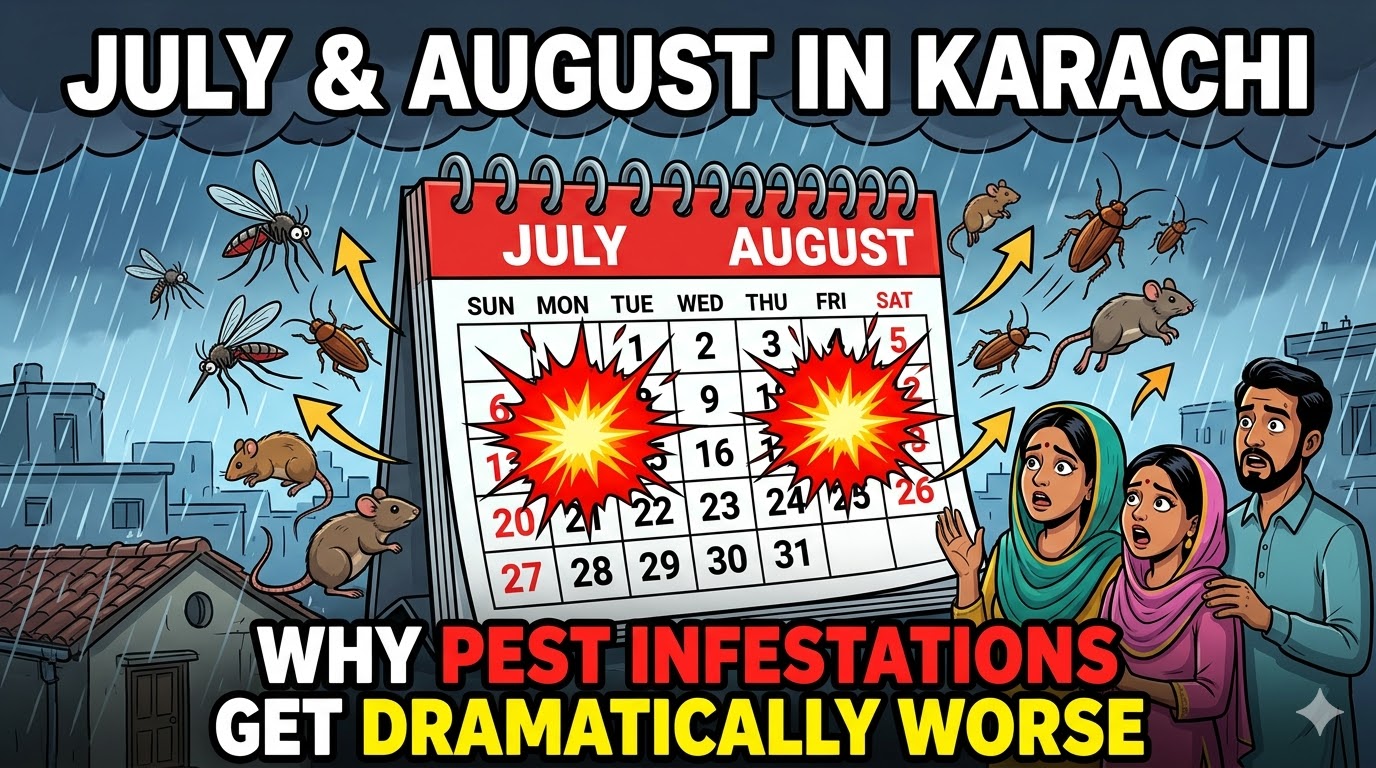
  • Why Pest Infestations in Karachi Get Dramatically Worse in July and August

    Why Pest Infestations in Karachi Get Dramatically Worse in July and August

    Every year, Karachi homeowners notice the same thing. The cockroaches they occasionally saw in May become a daily occurrence by July. The mosquitoes go from a nuisance to a genuine health threat by August. Rats that were outside are suddenly inside. What feels like an overnight explosion in pest activity is actually the result of weeks of accelerating conditions — and understanding why it happens is the first step toward stopping it.

    This article explains, in clear terms, the biological, environmental, and structural reasons why pest infestations in Karachi intensify so dramatically during July and August. It also tells you what that means for your home — and what you can still do about it.

    The Perfect Storm: What Makes July and August Different

    Karachi’s monsoon season typically begins in late June and reaches its peak in July and August. During these two months, the city experiences a convergence of conditions that pest biologists would describe as near-perfect for population explosions across multiple species simultaneously.

    These conditions include:

    • Ambient temperatures between 32 and 38 degrees Celsius — warm enough to accelerate insect breeding cycles
    • Relative humidity levels frequently above 80% — ideal for cockroach survival and mosquito larvae development
    • Standing water accumulation everywhere, from blocked drains to open containers to waterlogged gardens
    • Organic matter saturation — wet food waste, damp wood, and flooded compost all provide abundant nutrition for pest populations
    • Structural entry: monsoon rain forces pests that prefer outdoor environments to seek shelter inside homes

    No single one of these factors is decisive on its own. Together, they create a compounding effect where pest populations can double in size every week under favourable conditions.

    The Biology Behind the Surge: How Temperature and Humidity Accelerate Breeding

    Cockroaches: Temperature-Driven Reproduction

    The German cockroach — the most common species found in Karachi kitchens — has a development cycle from egg to adult that varies dramatically with temperature. At 25 degrees Celsius, the cycle takes approximately 60 days. At 35 degrees Celsius, that drops to around 35 days. In practical terms, this means the Karachi summer is producing cockroach generations at nearly twice the speed of cooler months.

    What makes July and August particularly bad is not just the heat — it is the combination of heat and humidity. Cockroaches are susceptible to desiccation (drying out) in hot and dry conditions. High monsoon humidity removes this limiting factor entirely. Cockroaches that survive in cracks and drains during dry months now have ideal survival conditions everywhere in your home.

    The result: a population that has been building since May reaches an inflection point in July where the numbers become impossible to ignore.

    Mosquitoes: Standing Water Is All They Need

    Aedes aegypti, the primary dengue vector in Karachi, requires only about a tablespoon of standing water to complete its larval development. In a city where monsoon rainfall regularly floods gardens, rooftops, and roads, and where water storage practices leave multiple containers open, the availability of breeding sites multiplies by an order of magnitude in July.

    The development cycle from egg to adult mosquito — at monsoon temperatures — takes as few as seven days. This means a single breeding event can produce biting adults within one week. Multiple overlapping breeding cycles, all triggered simultaneously by the same rainfall events, explain why mosquito populations seem to appear all at once.

    Culex quinquefasciatus, the common night-biting mosquito associated with nuisance bites and some disease transmission, breeds preferentially in polluted water — Karachi’s waterlogged drains and sewage-contaminated floodwater are ideal. This species peaks slightly later in the monsoon season, meaning August can actually be worse than July for this particular pest.

    Rodents: Displacement and Shelter-Seeking

    Rats and mice in Karachi occupy outdoor environments for most of the year: drains, garbage areas, construction sites, and open land. When monsoon rains flood these habitats, rodents are displaced en masse and seek dry, elevated shelter. For urban rodents, that means the insides of nearby buildings.

    The black rat — the dominant species in Karachi — is an excellent climber and can enter homes through gaps as small as 1.5 centimetres. During July and August, as outdoor environments become saturated, the pressure of rodents attempting to enter homes increases significantly. Homes that had no rodent problem in May may suddenly experience activity in the kitchen, loft, or walls as displaced populations seek new territory.

    Termites: Monsoon Triggers Swarming

    One of the most alarming sights for Karachi homeowners in the early monsoon weeks is a swarm of winged termites — known as alates — emerging from walls, floors, or gardens. This is a natural event in the termite colony lifecycle, triggered by the first heavy rains of the season, and it signals that a mature colony is nearby.

    The swarm itself is not directly destructive — the alates are reproductive individuals seeking to establish new colonies. But their presence tells you something critical: there is an established, active colony in or near your home, and it has been feeding on your structure throughout the dry season. The monsoon swarming event is nature’s announcement that the colony has been there all along.

    Karachi-Specific Factors That Make It Even Worse

    Karachi’s pest surge in July and August is worse than comparable coastal cities for several reasons unique to the city’s geography, infrastructure, and urban density.

    The Drainage Infrastructure Problem

    Karachi’s stormwater drainage network was designed for a smaller city and has not kept pace with urban expansion. During peak monsoon, large areas of the city flood regularly — from Sea View and Clifton in the south to Surjani Town and Orangi in the north-west. This flooding does two things for pest populations: it creates massive new breeding sites and it disrupts the natural separation between outdoor pest habitats and indoor living spaces.

    Neighbourhoods with particularly poor drainage — including parts of Landhi, Korangi, Baldia Town, and Liaquatabad — tend to experience the worst pest surges because floodwater persists for days or weeks rather than draining away.

    The Open Water Storage Problem

    Karachi’s intermittent water supply has created a city-wide culture of water hoarding that unintentionally creates ideal mosquito breeding conditions at scale. The millions of water tanks, barrels, buckets, and containers distributed across the city’s rooftops and yards represent, in aggregate, an enormous network of standing water bodies. During July and August, even containers that are regularly used and refilled can develop mosquito larvae if covers are absent or damaged.

    High Urban Density

    In densely populated areas of Karachi — from the old city areas of Saddar and Lyari to newer high-density zones like Gulshan-e-Maymar — pest populations spread rapidly between adjacent properties. A treated apartment surrounded by untreated neighbours will see reinfestation more quickly than a standalone home. This is particularly relevant for cockroach control: populations from adjacent units move freely through shared wall cavities, drain pipes, and cable routes.

    Construction Activity

    Karachi is in a near-constant state of construction. Open excavations, exposed foundations, construction waste, and improperly stored building materials create ideal rodent and termite habitats throughout the year. During monsoon, when excavation sites flood, displaced rodent populations accelerate the pressure on nearby residential areas.

    Health Consequences: Why the Surge Matters Beyond Inconvenience

    The July-August pest surge in Karachi is not merely an inconvenience — it is a direct and measurable public health threat.

    Dengue Fever

    Karachi has experienced recurring dengue outbreaks, with hospitalisation numbers spiking every year during the monsoon months. The Aedes aegypti mosquito that transmits dengue is a daytime biter, meaning indoor protection during sleeping hours does not prevent transmission. High-density residential areas in Karachi have recorded dengue cases across all socioeconomic levels, from low-income katchi abadis to upscale DHA and Clifton housing.

    Gastroenteritis and Food Contamination

    Cockroaches and rodents contaminate food preparation surfaces, utensils, and stored food with bacteria including Salmonella, E. coli, and Listeria. The July-August cockroach surge coincides directly with an increase in food-borne illness presentations in Karachi hospitals. The connection is well-established in public health literature.

    Rodent-Borne Disease

    Leptospirosis — spread through rodent urine in floodwater — becomes a genuine risk during severe monsoon flooding. Karachi’s 2020 and 2022 monsoon flooding events were associated with documented leptospirosis cases. Rodents sheltering inside homes dramatically increase the contamination risk to residents.

    What Homeowners Typically Do Wrong

    Having treated thousands of homes across Karachi, professional pest controllers consistently identify the same mistakes homeowners make during the monsoon season:

    • Waiting until the infestation is visible before acting — at which point populations have already compounded significantly
    • Relying on a single intervention (one spray) rather than a systematic programme
    • Ignoring roof and drain areas while only treating interior living spaces
    • Using over-the-counter products at incorrect concentrations, which kill a fraction of the population and drive the rest deeper into walls
    • Assuming that a pre-monsoon treatment will last indefinitely — heavy rain and humidity actively degrade residual treatments, and reapplication may be needed by late July
    • Treating their own property while not coordinating with neighbours in high-density housing situations

    What You Should Do Right Now

    If you are reading this in July or August, the surge is either already happening or about to. Here is what to prioritise immediately:

    • Eliminate all standing water on your property today — check containers, plant pot saucers, blocked gutters, and unused tyres
    • Ensure all water tank covers are intact and fitted
    • Inspect your kitchen tonight and identify where cockroach activity is occurring — under the fridge, behind the stove, inside cabinet hinges
    • Check your roof and ceiling for signs of rodent activity, particularly scratching sounds at night
    • Look for mud tubes along walls near floor level — a sure sign of active termites

    Then, contact professional fumigation services in Karachi without delay. During peak monsoon season, pest populations double quickly — the difference between acting this week and next week is measurable.

    What Professional Pest Control Does That You Cannot Do Yourself

    During July and August, professional pest control is qualitatively different from what is achievable with retail products. Here is why it matters:

    • Professional-grade products have higher active ingredient concentrations and residual durations than retail alternatives
    • Experienced technicians know the harbourage sites specific to Karachi housing types — they treat where pests actually live, not just where they are visible
    • Integrated pest management approaches combine chemical treatment with source reduction advice, producing longer-lasting results
    • Licensed companies use products approved by Pakistan’s relevant regulatory bodies — ensuring safety alongside efficacy
    • Follow-up inspections identify whether reinfestation is occurring before it becomes a full-blown crisis again

    The Connection Between July-August and the Rest of the Year

    It is worth understanding that the pest population surge of July and August does not fully recede when monsoon ends. Populations that established large colonies during the wet months carry those numbers into October and beyond. Cockroach colonies that colonised your kitchen in August will still be there in November — reduced but present.

    The most effective pest management strategy in Karachi is therefore cyclical: pre-monsoon treatment to limit breeding season starting populations, mid-monsoon intervention when needed, and post-monsoon consolidation to prevent carry-over populations entering the dry season at elevated levels.

    Conclusion: The Window Is Narrow

    July and August are not the time to learn about why Karachi’s pest problem is so severe. They are the time to act. The conditions that drive the surge — temperature, humidity, standing water, displaced outdoor populations — are at their peak for a defined window. Effective action taken now creates demonstrably better outcomes than action taken in September.

    The biology is not negotiable. But your response to it is.

    Book Your Free Inspection Today

    Do not let this monsoon season become a repeat of last year. Our experienced pest control team serves Karachi homeowners across all major neighbourhoods — from DHA and Clifton to Gulshan, PECHS, North Nazimabad, Orangi, and Korangi.

    We offer a free, no-obligation home inspection to assess your current infestation level and identify the highest-risk areas in your specific property. We will explain exactly what we find and what we recommend — with no pressure and no obligation.

    Book your free inspection with us today. Because in Karachi in July and August, every week you wait makes the problem harder and more expensive to solve.

  • Best Month-by-Month Pest Control Schedule for Karachi Homes and Apartments

    Best Month-by-Month Pest Control Schedule for Karachi Homes and Apartments

    Ask any seasoned Karachi homeowner and they’ll tell you the same thing: pest problems in this city don’t follow a random pattern. There are predictable peaks and lulls through the year, driven by Karachi’s climate, humidity cycles, the monsoon season, and even cultural events like Ramazan and Eid. Yet most households respond to pests only when they see them — by which point an infestation is already well underway.

    The smarter approach is a proactive, month-by-month pest control schedule that anticipates what’s coming before it arrives. This guide gives you exactly that — a practical, Karachi-specific pest calendar that tells you what to expect each month, which pests to watch for, and what actions to take to keep your home protected throughout the year.

    Why Karachi Needs a Different Pest Calendar Than Other Cities

    Karachi’s climate is unlike most Pakistani cities. It has a relatively mild winter, an intensely humid summer, and a concentrated but powerful monsoon. It also has specific local factors — open drains, dense urban construction, industrial zones adjacent to residential areas, and a coastal position that keeps humidity elevated year-round. These factors mean that pest behaviour in Karachi differs significantly from cities like Lahore or Islamabad.

    A one-size-fits-all pest control approach simply doesn’t work here. This calendar is built specifically for Karachi’s conditions, with month-by-month guidance that reflects the city’s actual pest dynamics.

    The Month-by-Month Pest Control Schedule

    January — The Quiet Month That Isn’t

    Karachi’s winter is mild, but it is not pest-free. Temperatures drop at night, and rodents that have moved indoors during autumn and early winter are now well-established in wall cavities, roof spaces, and kitchen cabinets. Cockroaches slow down but do not disappear — they retreat into warm, humid areas around water heaters and behind refrigerators.

    Key threats this month: Norway rats and roof rats (now indoor), German cockroaches near appliances, stored product pests in pantry items.

    What to do in January:

    • Inspect all food storage areas for signs of rodent activity — droppings, gnaw marks, or chewed packaging
    • Check around water heaters, boilers, and refrigerator coils for cockroach activity
    • Seal any gaps in exterior walls that you may have missed before winter
    • This is an ideal month to schedule a professional inspection before pest activity begins to increase in spring

    February — Preparation Window

    February remains relatively cool but pest populations are building in anticipation of warmer months. This is one of the most valuable months for preventive pest control because treatments applied now can break pest breeding cycles before they accelerate in spring.

    Key threats this month: Rodents continue indoors, cockroach populations begin increasing, termite swarmers may appear in older properties.

    What to do in February:

    • Schedule a comprehensive professional treatment — this is ideal timing for pre-season rodent and cockroach control
    • Inspect wooden furniture, door frames, and skirting boards for early signs of termite activity, especially in DHA, Clifton, and PECHS where older trees and soil conditions favour termites
    • Repair any damaged door sweeps and window seals that may have degraded during winter
    • Clear roof gutters and check for standing water that could attract pests when temperatures rise

    March — Spring Awakening: Pest Activity Ramps Up

    As temperatures climb in March, Karachi enters one of its most active pest periods. Cockroach populations that have been dormant begin breeding aggressively. Ant colonies — including the red fire ants common in newer Karachi developments — become visibly active. Bed bugs, often transported via travel or second-hand furniture, become more mobile and easier to spread.

    Key threats this month: Cockroaches, ants, bed bugs, early mosquito activity in areas with standing water.

    What to do in March:

    • Deep clean the kitchen, with special attention to grease buildup behind the stove and under the refrigerator
    • Apply gel bait treatments in kitchen cabinets, under sinks, and behind appliances for cockroach control
    • Inspect beds, mattress seams, and headboards for bed bug signs if you’ve had any overnight guests or purchased second-hand furniture
    • Seal gaps around kitchen tiles and under sink cabinets

    April — Pre-Summer Peak

    April brings Karachi’s most intense heat, often exceeding 35-40°C. This drives pests to seek cooler refuge indoors. It also accelerates the breeding cycle of cockroaches dramatically — what takes months in winter takes weeks in April. Termite activity reaches its first annual peak, with swarmers (alates) appearing around windows and lights after sunset.

    Key threats this month: Peak cockroach breeding, termite swarmers, increased rodent indoor activity, mosquitoes in water storage tanks.

    What to do in April:

    • If you see termite swarmers around your windows or lights, contact a pest professional immediately — swarmers indicate an established colony nearby
    • Inspect your water storage tanks (which are common in Karachi homes due to water supply issues) for mosquito larvae and ensure they are tightly covered
    • Apply residual insecticide treatments around the perimeter of your home
    • This is a critical month for professional fumigation in heavily affected homes

    May — Ramazan Season Alert

    May often coincides with or falls near Ramazan in recent years. The preparation of large quantities of food for Iftar and Suhoor, late-night cooking, and the storage of excess food items creates an extremely attractive environment for cockroaches and rodents. The smell of cooked food, leftover crumbs, and delayed dishwashing all signal food availability to pests.

    Key threats this month: Kitchen cockroaches, pantry moths, house mice, ants — all attracted to Ramazan food activity.

    What to do in May:

    • Store all iftar ingredients in sealed containers, especially dates, nuts, and dried fruits
    • Wipe down kitchen surfaces after every cooking session, including after Suhoor preparation at 2-3am
    • Empty and clean garbage bins every day — do not allow overnight accumulation during Ramazan
    • Consider a targeted kitchen treatment at the start of Ramazan as a preventive measure

    June — Pre-Monsoon Surge Begins

    June marks the beginning of the pre-monsoon period in Karachi. Humidity begins to rise, outdoor pests become highly active, and the conditions that will drive the monsoon surge start to build. This is also when many Karachi residents see the first signs of what will become a significant monsoon pest problem.

    Key threats this month: Cockroaches, rodents beginning to relocate, mosquitoes, flies.

    What to do in June:

    • This is the last opportunity to seal entry points before the monsoon — prioritize any gaps around pipes and drains
    • Ensure drain covers are in place on all floor drains and outdoor drainage points
    • Schedule a professional pre-monsoon treatment to reduce existing populations before the surge
    • Trim back any vegetation touching your home’s exterior walls — branches and leaves create pest bridges

    July — Monsoon Month: Maximum Alert

    July is the single most critical month in Karachi’s pest calendar. The onset of monsoon rains floods Karachi’s drain systems, displacing thousands of cockroaches and rodents into residential areas. Pest complaints spike dramatically city-wide. This is not the time for DIY measures — this is the time for professional intervention.

    Key threats this month: Massive cockroach invasion from drains, rodent displacement, mosquito explosion, flies.

    What to do in July:

    • Do not open windows and doors unnecessarily during and immediately after rain events
    • Block under-door gaps with draft excluders temporarily during heavy rain
    • If you see cockroaches or rodents during this period, treat it as an emergency and contact a pest control service immediately — infestations established in July are the hardest to eliminate
    • Do not store any bags, boxes, or outdoor items against interior walls after rain — they provide harbourage for newly arrived pests

    August — Post-Monsoon Consolidation

    The worst of the rain may be over, but August is when pest populations that entered during monsoon begin to consolidate. Cockroaches that entered through drains start breeding in wall voids and kitchen cabinets. Rodents that came in during flooding begin establishing nesting sites. August treatments are critical to prevent these newly arrived pests from becoming permanent residents.

    Key threats this month: Cockroach breeding acceleration, rodent nesting, continued mosquito activity, fungus gnats.

    What to do in August:

    • Schedule a professional post-monsoon treatment — this is one of the two most important professional treatments of the year
    • Check under sinks, behind kitchen appliances, and in bathroom cabinets for cockroach egg cases (small brown capsules)
    • Look for rodent droppings or nesting material in roof spaces, false ceilings, and storage areas
    • Repair any water damage to walls or flooring that occurred during monsoon — damp walls accelerate cockroach infestations

    September — Second Termite Peak

    As humidity remains elevated and temperatures moderate slightly, September marks the second annual peak of termite activity in Karachi. Subterranean termites, which build their colonies in soil, use the moist post-monsoon ground conditions to expand their territory and create new mud tubes into buildings. This is particularly common in areas with soil-direct construction contacts like older bungalows and ground-floor apartments.

    Key threats this month: Termites (second peak), cockroaches, rodents, drain flies.

    What to do in September:

    • Inspect all wooden structures, door frames, window sills, and furniture for mud tubes or hollow-sounding wood
    • Check the perimeter of your home’s foundation for termite mud tubes on exterior walls
    • If termite activity is found, do not disturb it before professional treatment — disturbing termites can cause them to scatter and make treatment more difficult
    • Drain flies (tiny moth-like flies) in bathrooms indicate organic buildup in drains — treat with an enzyme drain cleaner or contact a professional

    October — Autumn Transition

    As Karachi begins its transition to cooler, drier weather, outdoor pests begin seeking indoor warmth. October is when roof rats, which are active climbers, begin exploring upper floors and roof spaces of buildings. It is also when German cockroaches, now in large numbers after a summer of breeding, become most visible as populations exceed the carrying capacity of their harbourage sites.

    Key threats this month: Roof rats entering from above, cockroach overcrowding becomes visible, stored grain pests.

    What to do in October:

    • Inspect roof spaces, water tanks on rooftops, and ceiling voids for rat activity
    • Check all stored food — especially grains and pulses — for evidence of rodent contamination or stored product insects
    • This is an ideal month for a comprehensive pest audit of the entire property before the year-end period

    November — Pre-Winter Rodent Rush

    November is the prime month for rodent entry into Karachi homes. As nights cool down, rats and mice actively seek warm nesting sites. They will exploit any entry point — gaps under doors, holes around pipes, spaces above suspended ceilings. A rodent that gets in during November can establish a colony that will be extremely difficult to remove by January.

    Key threats this month: Rodents (peak entry month), cockroaches retreating to warm areas, bed bugs remain active.

    What to do in November:

    • Walk the entire exterior of your home and seal every gap larger than 6mm with steel wool and sealant
    • Check that all exterior door sweeps are intact and creating a proper seal
    • Set preventive rodent bait stations in vulnerable areas like garages, utility rooms, and roof spaces
    • Check behind washing machines and dryers — these are favourite rodent entry points through external plumbing connections

    December — Year-End Audit

    December is quieter on the pest front but it is also the ideal time to conduct a year-end pest audit — to assess what worked, what didn’t, and plan your pest control schedule for the coming year. It’s also a month where holiday hosting increases food waste and can attract rodents and cockroaches if not carefully managed.

    Key threats this month: Indoor rodents settled from November, cockroaches around warm appliances, carpet beetles in stored winter textiles.

    What to do in December:

    • Conduct a comprehensive inspection before holiday gatherings — more guests and more food means more pest attraction
    • Check stored winter clothing and blankets for carpet beetles or silverfish
    • Schedule your January professional inspection to get ahead of the new year’s pest cycle

    Quick Reference: Karachi Pest Calendar at a Glance

    MonthPrimary ThreatsPriority Action
    JanuaryRodents, cockroaches near appliancesInspect food storage; schedule pre-season treatment
    FebruaryRodents, cockroaches, early termitesPre-season professional treatment window
    MarchCockroaches, ants, bed bugsDeep kitchen clean; gel bait application
    AprilCockroaches peak, termite swarmers, mosquitoesTermite inspection; perimeter treatment
    MayKitchen pests (Ramazan season)Seal food storage; daily kitchen hygiene
    JunePre-monsoon cockroaches, rodents, mosquitoesSeal entry points; pre-monsoon treatment
    JulyMonsoon surge: cockroaches, rats, mosquitoesEmergency response; professional treatment
    AugustPost-monsoon breeding surgePost-monsoon professional treatment (CRITICAL)
    SeptemberTermites (second peak), drain fliesTermite inspection; drain treatment
    OctoberRoof rats, cockroach overcrowdingRoof space inspection; audit entire property
    NovemberRodent entry peakSeal all exterior gaps; bait stations
    DecemberSettled rodents, carpet beetlesYear-end audit; pre-holiday inspection

    The Two Most Important Professional Treatments of the Year

    If you can only schedule two professional pest treatments per year, make them these:

    1. Pre-monsoon treatment (June): Applied before the rains arrive, this treatment reduces existing populations, treats harbourage sites, and creates a barrier that limits how many pests can establish themselves when monsoon displacement occurs.

    2. Post-monsoon treatment (August): This is the most critical treatment of the year. Applied within 2-4 weeks after the main rains, it targets the newly arrived cockroaches and rodents before they can breed and establish permanent infestations.

    For homes with active termite concerns, a dedicated annual termite treatment should be added, ideally in February or September.

    For Apartment Residents: Additional Considerations

    If you live in a multi-storey building in Karachi — common in areas like Gulshan-e-Iqbal, Gulistan-e-Jauhar, and PECHS — individual unit treatments are only partially effective. Cockroaches and rodents move freely between units through shared plumbing, electrical conduits, and wall voids. The most effective pest control for apartments involves building-wide coordination, and many Karachi apartment societies are now moving toward shared pest management agreements with professional providers.

    If your building does not have a shared pest control arrangement, advocate for one with your building management. In the meantime, focus on sealing internal as well as external gaps, and treat immediately if you suspect activity from neighbouring units.

    The Value of a Professional Partnership

    A month-by-month pest control schedule is most effective when supported by regular professional inspections and targeted treatments. Rather than calling for help only when you see pests, consider establishing an annual maintenance plan with a trusted provider. Expert teams offering comprehensive pest control services in Karachi can build a customised year-round schedule for your specific property, neighbourhood, and pest history — giving you consistent protection through every season.

    Conclusion

    Karachi’s pest calendar is predictable. With the right knowledge and a proactive approach, you can stay one step ahead of every seasonal surge — from the post-monsoon cockroach invasion to the November rodent rush. The key is consistency: regular inspections, timely treatments, and a year-round commitment to pest prevention rather than just reaction.

    Every month matters. Start your schedule today, and make this the year you break the cycle of seasonal infestations.

    📞 Book Your Free Pest Inspection Today

    Ready to get ahead of Karachi’s pest seasons? Book a free home inspection with our team today. We’ll assess your property, review your current vulnerabilities, and create a customised year-round pest control plan — so you’re never caught off guard again. Contact us now to schedule your appointment.

  • Post-Rain Cockroach and Rodent Surge in Karachi: Why It Happens Every Year

    Post-Rain Cockroach and Rodent Surge in Karachi: Why It Happens Every Year

    Every year, without fail, the rains arrive in Karachi — and so do the pests. Within days of the first monsoon downpour, residents across DHA, Gulshan-e-Iqbal, Nazimabad, Korangi, and virtually every corner of the city begin reporting an alarming uptick in cockroaches scuttling across kitchen floors, rats gnawing through pantry shelves, and mice darting behind furniture. This is not a coincidence. It is a predictable, science-backed phenomenon — and if you live in Karachi, understanding it could save your home, your food, and your family’s health.

    This article explains exactly why the post-rain pest surge happens every year in Karachi, which species are most affected, which areas are most at risk, and — most importantly — what you can do right now to stop it before it takes over your home.

    The Science Behind the Surge: Why Rain Drives Pests Indoors

    Karachi’s geography and infrastructure create a perfect storm for post-rain pest explosions. The city’s sprawling network of open drains, aging sewage lines, low-lying katchi abadis, and semi-paved streets means that when it rains, it doesn’t just create puddles — it creates highways for pests.

    Here is what happens on a biological and environmental level:

    • Flooding of underground burrows and drain systems: Rats and mice build their colonies in Karachi’s underground drain networks, open nullahs, and the spaces beneath older buildings. When monsoon rains flood these areas, rodents are physically forced out. They seek the nearest dry, elevated shelter — which is often your home.
    • Cockroach displacement from sewers: American cockroaches (Periplaneta americana), the large reddish-brown species commonly seen in Karachi, live primarily in sewage systems and outdoor drains. Heavy rain overwhelms these drains, pushing cockroaches upward through pipes into bathrooms, kitchens, and utility areas.
    • Waterlogging creates new breeding grounds: Standing water in Karachi’s low-lying areas — common in areas like Orangi Town, Lyari, and parts of Malir — provides mosquitoes and other insects with ideal breeding conditions, compounding the pest pressure on homes nearby.
    • Humidity accelerates reproduction: Post-rain humidity in Karachi often exceeds 80-90%. Cockroaches, in particular, thrive in high humidity — their egg cases (oothecae) hatch faster, and populations can double within weeks under these conditions.
    • Food scarcity outdoors drives rodents inside: Flooded outdoor environments destroy the food sources that rats and mice rely on. Garbage dumps get washed away, seeds and grain are destroyed, and foraging becomes difficult. Your kitchen, with its accessible food, becomes the most attractive alternative.

    The Main Culprits: Know Your Post-Rain Pests

    Not all pests surge equally after rain. In Karachi, the following species are responsible for the majority of post-monsoon infestations:

    American Cockroach (Periplaneta americana)

    These are the large, fast-moving cockroaches that emerge from drains. They are particularly common in older residential buildings in areas like Saddar, Liaquatabad, and Clifton. They carry bacteria including Salmonella and E. coli, and are known to trigger asthma and allergies, especially in children.

    German Cockroach (Blattella germanica)

    Smaller, lighter-coloured, and far more difficult to eliminate, German cockroaches prefer kitchens and bathrooms. They reproduce rapidly — a single female can produce up to 300 offspring in her lifetime. Post-rain humidity accelerates their breeding cycle significantly.

    Norway Rat (Rattus norvegicus)

    Commonly known as the sewer rat, the Norway rat is the primary rodent species displaced by flooding in Karachi. These rats are aggressive, destructive, and capable of gnawing through electrical wiring, PVC pipes, and even thin concrete. They are carriers of leptospirosis, a serious bacterial disease spread through their urine — a particular risk in flood-affected areas of Karachi.

    Roof Rat (Rattus rattus)

    These are the smaller, more agile rats commonly seen climbing walls and electrical cables in Karachi. They prefer to nest in roof spaces, false ceilings, and upper floors. During and after monsoon, they become extremely active as they seek dry shelter in elevated spaces.

    House Mouse (Mus musculus)

    House mice are a year-round problem in Karachi, but the post-rain period sees a sharp spike in indoor sightings. They are small enough to enter through gaps the size of a pencil, and a single pair can produce up to 60 offspring per year.

    Why Karachi Is Particularly Vulnerable

    Other cities in Pakistan experience rain, but few face the same level of post-rain pest pressure as Karachi. Several factors specific to the city make it uniquely susceptible:

    • Aging drainage infrastructure: Much of Karachi’s drainage system was designed during the British colonial era for a fraction of today’s population. When the city’s drainage capacity is overwhelmed — as it regularly is during monsoon — sewage and stormwater mix, creating ideal displacement conditions for cockroaches and rodents.
    • High-density housing: In areas like Nazimabad, North Karachi, and Korangi, residential buildings are packed tightly together with shared walls and drainage systems. A pest problem in one unit can spread rapidly across an entire building.
    • Widespread open food storage: Many Karachi households, particularly in older areas, store grains, pulses, and dry goods in open or loosely sealed containers. During post-rain surges, this makes kitchens extremely attractive to rodents and cockroaches.
    • Construction and waste mismanagement: Karachi’s rapid and often unregulated expansion means construction sites, open lots, and waste dumps are common. These serve as pest reservoirs year-round, and during monsoon, their resident populations are forcefully displaced into surrounding residential areas.
    • Flat rooftops and water pooling: A distinctive architectural feature of Karachi homes is the flat rooftop, which commonly accumulates standing water after rain. This creates mosquito breeding grounds and a damp entry point for roof rats.

    The Health Risks Are Real — and Serious

    The post-rain pest surge in Karachi is not merely a matter of inconvenience or disgust. It poses genuine, documented health risks to families:

    • Leptospirosis: Spread through rat urine contaminating floodwater or food, leptospirosis cases increase sharply in Karachi every monsoon season. Symptoms include fever, jaundice, and muscle pain, and it can be fatal if untreated.
    • Salmonella and food poisoning: Cockroaches that travel through sewage systems carry pathogens on their bodies. When they walk across kitchen surfaces, cutting boards, or food, they contaminate everything they touch.
    • Dengue and malaria: While mosquitoes are technically a separate issue from cockroaches and rodents, the same post-rain waterlogging that displaces rodents also creates mosquito breeding grounds, multiplying the health burden on Karachi households.
    • Hantavirus: Though less commonly discussed in Pakistan, rodent-borne hantavirus is a real risk in areas with significant rat populations. It is transmitted through exposure to rat droppings, urine, or saliva.
    • Allergies and asthma: Cockroach droppings and shed skin are among the most potent indoor allergens. In a city like Karachi where air quality is already a concern, cockroach infestations significantly worsen respiratory conditions, especially in children.

    Which Karachi Neighbourhoods Are Most at Risk?

    While no area of Karachi is entirely immune, some neighbourhoods consistently experience higher post-rain pest pressures than others:

    • Lyari and Orangi Town: Historically prone to flooding, these densely populated areas see massive rodent displacement every monsoon.
    • Saddar and surrounding old city areas: Older buildings with aging plumbing and shared drainage systems make cockroach entry points numerous and difficult to seal.
    • Korangi Industrial Area and surroundings: Industrial waste and food processing proximity create high rodent populations that move into residential areas during rain.
    • New housing developments in Bahria Town, DHA City Karachi, and Scheme 33: Counter-intuitively, newer areas built near former agricultural or undeveloped land see significant rodent influxes during monsoon as field rats are displaced.
    • Apartment buildings in Gulshan-e-Iqbal and North Nazimabad: Multi-storey apartments with shared drainage experience rapid cockroach spread across floors, particularly when ground-floor units are affected first.

    What You Can Do Right Now

    Whether the monsoon has already arrived or you’re preparing in advance, these steps will significantly reduce your risk:

    Before the rains:

    • Seal all gaps around pipes, cables, and drain openings with waterproof sealant or steel wool
    • Install drain covers with fine mesh on all floor drains and sink drain pipes
    • Store all dry food in airtight glass or metal containers
    • Clear any debris, standing water, or clutter from around the exterior of your home
    • Book a preventive pest inspection — ideally before the first rains arrive

    During the rain season:

    • Check for and seal any new gaps that develop as walls absorb moisture and expand
    • Do not leave food out overnight — even a few hours is enough time for cockroaches to contaminate it
    • Keep drainage channels around your home clear of leaves and debris
    • Dispose of garbage daily and use sealed bins

    After rain events:

    • Inspect under sinks, behind refrigerators, and in utility cupboards for signs of cockroach or rodent activity
    • Look for droppings, gnaw marks, or grease trails along walls — these are early warning signs
    • Act immediately if you spot any signs — early treatment is far more effective than waiting for a full infestation

    Why DIY Solutions Are Not Enough

    Many Karachi homeowners reach for supermarket sprays or sticky traps when they first notice pests. While these can provide temporary relief, they almost never address the root cause of a post-rain infestation. A few cockroaches visible in the kitchen likely means hundreds are hiding in wall voids, drain pipes, and under appliances. A single rat sighting often means an established colony is already in place.

    Professional pest control uses targeted treatments — including gel baits, residual insecticides, rodent bait stations, and physical exclusion methods — that address the infestation at its source. More importantly, a professional inspection will identify the specific entry points and conditions that are enabling pests to enter your home, allowing for a long-term solution rather than a temporary fix.

    Professional Help: Don’t Wait Until It’s Out of Control

    If you’ve been noticing increased pest activity in your Karachi home — especially in the weeks before, during, or after monsoon — this is the time to act. The longer an infestation is allowed to establish itself, the more difficult and expensive it becomes to eliminate.

    The team at Karachi Fumigation Services specialises in post-rain pest control for residential homes and apartment buildings across Karachi. Using safe, effective, government-approved treatments, they offer comprehensive inspections and treatment plans tailored to Karachi’s unique pest challenges — including the seasonal surges that occur every monsoon.

    Conclusion

    The post-rain cockroach and rodent surge in Karachi is as predictable as the monsoon itself. Understanding why it happens — flooded drains, displaced sewer pests, humidity-accelerated breeding, and Karachi’s specific infrastructure vulnerabilities — puts you in a position to take proactive action rather than reactive panic.

    The rains will come every year. Whether they bring a pest infestation into your home is, to a large extent, within your control.

    📞 Book Your Free Pest Inspection Today

    Don’t wait for a full infestation to take action. Contact us today to book a free inspection for your Karachi home or apartment. Our trained technicians will assess your property, identify risk areas, and recommend a targeted treatment plan — before the next rains arrive. Your family’s health and peace of mind are worth it.

    Call or WhatsApp us now, or visit our website to schedule your appointment. Early action is the best protection.

  • Ramazan Pest Alert: Why Karachi Kitchens Attract More Insects During Iftar Season

    Ramazan Pest Alert: Why Karachi Kitchens Attract More Insects During Iftar Season

    Ramazan is a time of deep spiritual significance, family togetherness, and the abundant, aromatic food that Karachi’s kitchens are famous for. The sizzle of samosas, the fragrance of haleem, the sweet richness of khajoor and sheer khurma — Iftar in a Karachi home is a celebration. But amid all the preparation and hospitality, there is an uninvited and persistent problem that many households face every Ramazan: an explosion in kitchen pest activity.

    This is not imagined, and it is not simply the result of warmer weather. There are specific, identifiable reasons why Karachi kitchens experience heightened cockroach, ant, fly, and rodent activity during Ramazan — and understanding these reasons can help you protect your home, your food, and your family without compromising the spirit of the holy month.

    The Ramazan Kitchen: A Pest’s Ideal Environment

    To understand why Ramazan creates a pest surge, you need to think about what changes in a Karachi kitchen during the holy month. The differences from a normal month’s kitchen routine are significant — and from a pest’s perspective, they are almost uniformly positive.

    More Food, More Smells, Longer Hours

    During Ramazan, the quantity of food prepared in a typical Karachi home increases substantially. A family that usually cooks twice a day is now preparing elaborate Iftar spreads, full dinners, and Suhoor meals. The smells produced by cooking — oils, spices, cooked meat, fried items — are powerful pest attractants that permeate the kitchen and adjacent areas. Cockroaches and rodents can detect these smells from significant distances and navigate toward their source.

    The Critical 2am–4am Window

    Suhoor preparation happens in the early hours of the morning, often between 2am and 4am. This is precisely the period when cockroaches are most active — they are nocturnal creatures that do the majority of their feeding and movement in the hours between midnight and pre-dawn. A kitchen that would normally be quiet and dark during these hours is now warm, lit, filled with food smells, and producing fresh food waste. This is an exceptional opportunity for cockroaches and mice that they exploit aggressively.

    Dishes Left to Soak Overnight

    After Iftar, especially when family members are tired from a day of fasting and evening prayers, dishes often sit unwashed or soaking overnight. Standing water with food residue in it is a direct invitation to cockroaches, particularly German cockroaches that prefer the area around and under kitchen sinks. A dish soaking in the kitchen sink overnight is, from a cockroach’s perspective, a prepared meal with a water source — perfectly aligned with what they need to thrive.

    Increased Food Storage

    Ramazan involves bulk purchasing of ingredients — large bags of dates, dried fruits, nuts, lentils, rice, and other staples are bought in advance and stored in the kitchen or adjacent pantry. Many Karachi households use open containers, plastic bags that are loosely tied, or cloth storage bags that provide no real barrier to pests. Dates and dried fruits in particular are highly attractive to both cockroaches and rodents due to their high sugar content.

    Food on the Table Between Iftar and Taraweeh

    In many Karachi households, Iftar food is laid out on the table and the family eats, prays, and then leaves for Taraweeh prayers — often leaving partially eaten food and crumbs on the table for an hour or more before returning. This window of unattended, accessible food is exactly when cockroaches — which hide during periods of human activity — emerge to feed.

    Which Pests Specifically Surge During Ramazan?

    German Cockroach (Blattella germanica) — The Primary Culprit

    The German cockroach is the number one pest problem in Karachi kitchens during Ramazan. This small, light-brown cockroach lives exclusively indoors, preferring kitchens and bathrooms, and feeds on virtually any organic material — food crumbs, grease, spilled liquids, and even the glue on packaging. It is especially attracted to the sugar and starch in traditional Ramazan foods: dates, mithai, sewaiyan, sheer khurma, and fruit chaat.

    German cockroaches reproduce at an astonishing rate. A single female can produce an egg case (ootheca) containing 30-40 eggs every 20-30 days. In the warm conditions of a Karachi kitchen during Ramazan, hatching times are shortened and nymph development accelerated. A small cockroach problem that goes unaddressed at the start of Ramazan can become a significant infestation by Eid ul-Fitr.

    House Flies (Musca domestica)

    Flies are strongly attracted to the cooking smells, food waste, and organic matter that increase significantly during Ramazan. In Karachi’s warm climate, a fly can develop from egg to adult in as little as 7-10 days. The increased organic waste in kitchen bins during Ramazan — oily packaging, fruit peels, meat scraps — provides ideal breeding conditions. Flies landing on Iftar food are not just a nuisance — they transfer pathogens including Salmonella, E. coli, and cholera bacteria, which can cause serious food poisoning.

    Ants — Red Fire Ants and Sugar Ants

    The sugar-rich foods of Ramazan are irresistible to ants. Karachi homes commonly experience invasions of sugar ants (small black or brown ants) that appear seemingly from nowhere when sweet foods are present. Red fire ants, increasingly common in Karachi’s newer residential developments, form rapid foraging lines to food sources and can contaminate food within minutes. Ant infestations during Ramazan are particularly common in ground-floor and basement units, or in older buildings with cracks in kitchen walls and floors.

    House Mice (Mus musculus)

    The increase in bulk food storage during Ramazan makes pantries and kitchen cabinets more attractive to mice than at any other time of year. Mice can squeeze through gaps as small as 6mm, and large bags of rice, lentils, flour, and dried fruits provide both food and nesting material. A single mouse can contaminate far more food than it actually consumes through its droppings, urine, and hair. A mouse detected in the kitchen during Ramazan requires immediate action — waiting until after the month is a risk not worth taking when food safety is directly implicated.

    Pantry Moths (Indianmeal Moth)

    While less commonly discussed, pantry moths are a growing problem in Karachi kitchens during Ramazan. Their larvae feed on dry stored goods — flour, rice, oats, dried fruits, and especially nuts. They are frequently introduced into homes through contaminated bulk purchases from open-sack markets, which are common in Karachi’s older commercial areas. Once established, they spread quickly to other stored products, and their webbing and frass contaminate everything they touch.

    The Health Implications: Why This Matters More During Ramazan

    Food safety during Ramazan carries special significance. After a full day of fasting, the body is more vulnerable to the effects of contaminated food — digestive distress, food poisoning, and dehydration are more serious when they occur in a fasting person. Children, the elderly, and those with underlying health conditions are at particular risk.

    Cockroach and rodent contamination of Iftar food is not merely unpleasant — it is a genuine health risk. Consider what happens in a kitchen that has a cockroach presence:

    • Cockroaches travel from drain systems and garbage areas to kitchen surfaces, carrying bacteria on their legs and bodies
    • They defecate on food preparation surfaces and on food items left uncovered
    • Their shed skin and droppings become airborne, triggering asthma and allergy symptoms — particularly problematic in a fasting person whose respiratory system may be more sensitive
    • A single cockroach on an Iftar spread can contaminate food with Salmonella, E. coli, and other pathogens that cause acute food poisoning — with symptoms appearing just hours after consumption

    Rodent contamination is equally serious. Mouse and rat urine is virtually odourless and can contaminate loose food, pantry surfaces, and cooking equipment without any visible sign. The risk of leptospirosis, spread through rodent urine, is a real concern in Karachi particularly during and after the monsoon season, which in recent years has overlapped with Ramazan.

    Why Ramazan Pest Problems Are Often Invisible Until They’re Serious

    One of the most frustrating aspects of Ramazan pest infestations is that they often develop invisibly. Cockroaches are nocturnal and avoid light — the busy, well-lit Iftar kitchen is the safest time for them to hide. They emerge when the household is at Taraweeh, or in the silent hours before Suhoor. By the time a cockroach is spotted during daylight, the population is already large enough that individuals are being pushed out of their hiding places by overcrowding.

    The same is true of mice. These animals are naturally cautious and avoid exposure. A mouse that is seen crossing a kitchen floor during family Iftar time is a sign of a well-established infestation, not a lone intruder. They will have been active for weeks before being seen.

    This invisible build-up is why Ramazan pest prevention needs to happen before the month begins — not reactively once pests are spotted.

    A Room-by-Room Ramazan Pest Prevention Guide

    The Kitchen:

    • Store all Ramazan ingredients — dates, nuts, dried fruits, flours, and grains — in airtight glass or heavy-duty plastic containers, not original packaging
    • Wipe down all cooking surfaces after each meal, including after the Suhoor preparation session
    • Do not leave dishes soaking overnight — rinse and dry them before Taraweeh if possible
    • Empty the kitchen bin every day during Ramazan — the increased organic waste cannot be left to accumulate
    • Keep the area under the sink dry and free of organic buildup — this is the number one German cockroach habitat in Karachi kitchens
    • Check behind the refrigerator and under the stove monthly — these are major cockroach and mouse harborage sites

    The Dining Area:

    • Do not leave Iftar food uncovered on the table if you are leaving for prayers — use food covers or store food in covered containers
    • Sweep or vacuum under the dining table immediately after Iftar — crumbs on floors overnight are direct pest attractants
    • Wipe down chairs and table legs where food spills occur — cockroaches feed on grease and food residue on furniture surfaces

    The Pantry and Food Storage Areas:

    • Decant bulk purchases of rice, flour, and lentils immediately into sealed containers rather than keeping them in original paper or cloth bags
    • Inspect all bulk purchases of dates and dried fruits before storing — check for webbing or small larvae that indicate pantry moth contamination
    • Keep pantry shelves dry and clean — wipe down spills immediately
    • Do not store food items on the floor, even temporarily — floor storage is accessible to both mice and cockroaches

    What to Do If You Spot Pests During Ramazan

    If you spot cockroaches, mice, or significant ant activity in your kitchen during Ramazan, do not delay action. The temptation is to manage with DIY measures until after the month ends — a decision that allows populations to grow significantly. Here is what to do:

    • For cockroaches: Gel baits applied in kitchen cabinets, under sinks, and behind appliances are the most effective immediate treatment. They are odourless, safe to use around food preparation areas when correctly placed, and begin working within 24-48 hours. Professional application is recommended for best results
    • For mice: Snap traps placed under sinks, behind the refrigerator, and along walls are the most immediately effective control measure. Bait them with peanut butter or a small piece of date. Check and reset daily. If you catch more than one mouse in 48 hours, a professional rodent control service is essential
    • For ants: Do not spray individual ants with surface sprays — this breaks up foraging lines but does not address the colony. Use bait gels or granules that worker ants carry back to the colony to eliminate the source
    • For all pests: Contact a professional pest control service immediately. Treatments applied during Ramazan can be performed using products that are safe for food preparation environments, and a professional will treat the infestation at its source rather than the surface

    The Ideal Timing: Before Ramazan Begins

    The best pest control decision you can make for Ramazan is to schedule a professional kitchen treatment before the month begins. A pre-Ramazan inspection and treatment — ideally performed 1-2 weeks before the first fast — does the following:

    • Eliminates existing cockroach populations before food preparation intensity increases
    • Identifies and seals entry points that mice and cockroaches are using before bulk food storage begins
    • Applies residual treatments that continue protecting the kitchen throughout the entire month
    • Gives you complete peace of mind to focus on what Ramazan is actually about — without the distraction and distress of pest problems

    Keeping Your Ramazan Kitchen Safe and Pest-Free

    Ramazan transforms Karachi kitchens into extraordinarily active, food-rich environments — and that transformation, as we’ve seen, comes with a predictable pest response. But with the right preventive measures, proper food storage habits, and timely professional treatment, you can keep your kitchen safe, hygienic, and pest-free throughout the holy month.

    The specialists at Karachi Fumigation Services offer pre-Ramazan kitchen treatments specifically designed for Karachi homes. Using safe, food-area-approved treatments, they can eliminate existing infestations and prevent new ones — so your Iftar table remains exactly what it should be: a place of nourishment, gratitude, and family, not a feeding ground for uninvited guests.

    Conclusion

    The connection between Ramazan and kitchen pest activity in Karachi is real, well-documented, and entirely preventable. The combination of increased food preparation, late-night cooking, bulk food storage, and temporary lapses in kitchen hygiene creates conditions that cockroaches, mice, ants, and flies are biologically designed to exploit.

    Understanding this dynamic — and acting on it before Ramazan begins rather than during it — is the difference between a holy month focused on worship and family, and one disrupted by the anxiety and health risk of a kitchen infestation. Take action now, before the first fast begins.

    📞 Book Your Free Pre-Ramazan Inspection Today

    Don’t let pests compromise the purity of your Iftar table. Contact us today to schedule a free kitchen inspection before Ramazan begins. Our team will identify any existing pest activity, seal entry points, and apply safe, effective treatments so you can focus on what matters most. Book now — Ramazan preparation starts with a pest-free kitchen.

  • The Importance of Fumigation & Pest Control Services in Karachi

    The Importance of Fumigation & Pest Control Services in Karachi

    Karachi — Pakistan’s largest city and economic hub — is home to over 16 million people living in dense residential communities, thriving commercial districts, and sprawling industrial zones. But the same heat, humidity, and urban density that defines this vibrant city also makes it one of the most pest-prone environments in South Asia.

    From cockroaches in restaurant kitchens to termites silently hollowing out wooden furniture, from rodents infesting warehouses to mosquitoes spreading life-threatening diseases — pests are a constant, year-round challenge in Karachi. The consequences of ignoring them extend far beyond minor inconvenience: they impact public health, structural safety, food security, and economic productivity.

    This is why professional fumigation and pest control services in Karachi have become an indispensable part of responsible home and business management.


    Why Karachi Is Especially Vulnerable to Pest Infestations

    Understanding the root causes of Karachi’s pest problem helps explain why regular, professional pest control is so critical here — far more so than in cities with drier or cooler climates.

    1. The Climate Factor

    Karachi sits on the Arabian Sea coastline and experiences a hot, semi-arid climate with high humidity levels, particularly during the monsoon season from June to September. Temperatures often exceed 35–40°C in summer, and humidity routinely climbs above 70–80%. This combination is exactly what cockroaches, mosquitoes, termites, and rodents thrive in. Unlike cold climates where winters naturally suppress pest populations, Karachi offers pests a warm, hospitable environment every single month of the year.

    2. Rapid Urbanization & Dense Housing

    Karachi’s explosive urban growth has created densely packed neighbourhoods — from the high-rise apartments of Clifton and Defence to the bustling lanes of Orangi Town and Lyari. Dense housing means shared walls, communal drainage systems, and interconnected infrastructure, all of which make it extremely easy for pests to migrate from one unit to another. A single infested apartment can spread cockroaches or bed bugs to an entire building within weeks.

    3. Drainage & Sanitation Challenges

    Many parts of Karachi still face challenges with open drainage channels, irregular garbage collection, and standing water after rainfall. These conditions are prime breeding grounds for mosquitoes, flies, and rodents. Areas near nullahs (drainage canals) are particularly high-risk zones for serious pest infestations.

    4. Year-Round Food Industry Activity

    Karachi is home to thousands of restaurants, food processing units, warehouses, and markets — all operating continuously. Food facilities are magnets for cockroaches, rodents, flies, and stored-product insects. Without rigorous, professional pest management, food contamination becomes an ever-present risk.


    Common Pests Found in Karachi Homes & Businesses

    Karachi is home to a wide variety of pest species, each with its own behaviour, hiding spots, and damage profile:

    • Cockroaches — German & American species thrive in kitchens, bathrooms, and drainage pipes. A major food contamination risk year-round.
    • Mosquitoes — Aedes & Anopheles species breed in standing water and are vectors for dengue, malaria, and chikungunya.
    • Rodents (Rats & Mice) — Gnaw through electrical wiring, contaminate food, and carry leptospirosis and other dangerous diseases.
    • Termites — Silent destroyers that cause devastating structural damage to wood and foundations, often undetected for years.
    • Bed Bugs — Hitchhike through luggage and second-hand furniture. Extremely difficult to eliminate without professional treatment.
    • Wasps & Bees — Build nests in wall cavities and rooftops, posing a serious risk to children and allergic individuals.
    • Flies — Houseflies and drain flies spread bacteria rapidly across food preparation areas.
    • Lizards — Their droppings contaminate food surfaces and their presence often signals a larger underlying insect infestation.

    The Serious Health Risks of Uncontrolled Pest Infestations

    The most urgent reason to take pest control seriously in Karachi is public health. Pests are not merely a nuisance — they are active vectors and carriers of dangerous diseases that affect thousands of families in the city every year.

    Mosquito-Borne Diseases: A Deadly Annual Threat

    Karachi faces dengue fever outbreaks virtually every monsoon season. The Aedes aegypti mosquito breeds in clean, stagnant water found in flower pots, water containers, and clogged drains. Dengue can be fatal in its severe hemorrhagic form. Malaria, transmitted by Anopheles mosquitoes, also remains a public health concern in peri-urban areas of Karachi.

    Professional mosquito fumigation programs dramatically reduce breeding populations and are critical during and after the monsoon period.

    Cockroaches and Gastrointestinal Illness

    Cockroaches carry Salmonella, E. coli, Staphylococcus, and numerous other pathogens on their bodies and legs. They contaminate food surfaces, utensils, and stored food with their droppings and shed skin. For Karachi’s food service industry, a cockroach infestation is not just a health code violation — it is a direct pathway to foodborne illness outbreaks affecting customers and staff.

    Rodents and Leptospirosis

    Rats and mice are prolific in Karachi’s urban environments, particularly near markets, restaurants, and older residential buildings. Rodent urine is the primary vehicle for leptospirosis — a bacterial infection that can cause liver and kidney failure if untreated. Rodents also gnaw through electrical wiring, creating serious fire hazards in homes and commercial premises.

    Bed Bugs and Mental Health Impact

    While bed bugs do not transmit diseases, their impact on quality of life is profound. Itching bites, sleep deprivation, anxiety, and the psychological distress of a persistent infestation take a measurable toll on the mental health of affected households. Children are particularly vulnerable in severe infestations.

    “In Karachi, pest control is not a luxury service — it is a public health necessity for every household, school, hospital, restaurant, and office in the city. The cost of inaction is always greater than the cost of prevention.”


    Protecting Your Property from Pest-Related Damage

    Beyond health risks, pests cause enormous financial damage to properties across Karachi every year.

    Termites: The Silent Structural Threat

    Termites are arguably the most financially devastating pest in Karachi. Subterranean termite colonies can silently consume wooden beams, floorboards, furniture, books, and even structural components of a building for years before any visible damage becomes apparent. By the time homeowners notice signs — bubbling paint, hollow-sounding wood, mud tubes along walls — the damage is often already extensive and expensive to repair.

    A single mature termite colony can number in the millions. Professional termite control with soil treatment and baiting systems is the only reliable solution.

    Rodent Damage to Infrastructure

    Rodents must constantly gnaw to keep their teeth from overgrowing. In buildings, this means chewing through electrical cables, water pipes, insulation, and structural materials. Chewed electrical wiring is a leading cause of unexplained fires in residential and commercial properties.

    Cockroaches and Business Reputation

    For restaurants, hotels, and food processing businesses in Karachi, a cockroach infestation can be catastrophic. A single failed health inspection or viral social media complaint can cost a business years of hard-earned goodwill. Regular professional pest control is not just a compliance requirement — it is fundamental brand protection.


    Why Professional Fumigation Is Far Superior to DIY Methods

    Many Karachi residents and businesses attempt to manage pest problems with over-the-counter sprays and traps. While these may offer temporary relief, they consistently fail to address the root cause of infestations. Here is why professional fumigation is in a different league entirely:

    1. Accurate Identification & Assessment — Trained technicians identify the exact species, assess the severity of the infestation, and locate nesting sites and entry points that untrained eyes routinely miss.
    2. Commercial-Grade Treatments — Licensed fumigation companies use approved, commercial-strength pesticides that are not available to the general public. These are significantly more effective at eliminating entire colonies, not just visible individuals.
    3. Safety & Proper Application — Many fumigation chemicals require precise dosages and application methods. Professional technicians are trained in safe handling, proper ventilation procedures, and post-treatment protocols to protect residents and pets.
    4. Integrated Pest Management (IPM) — Reputable pest control companies combine chemical treatments with physical barriers, exclusion methods, sanitation recommendations, and follow-up monitoring for long-term, sustainable protection.
    5. Guaranteed Results & Follow-Up — Professional services include warranties and follow-up treatments if a problem persists. DIY products offer no such guarantee.

    Key Fumigation & Pest Control Services Available in Karachi

    A full-service provider offers a comprehensive range of specialized treatments:

    General Fumigation

    Application of liquid insecticides to interior surfaces — walls, floors, crevices, and drains — to eliminate cockroaches, ants, silverfish, and other crawling insects. The foundational service most homes and offices require on a quarterly or bi-annual basis.

    Termite Proofing & Control

    Includes soil treatment (applying termiticide around and beneath foundations), wood treatment, and bait station systems that allow termites to carry slow-acting poison back to the colony. Requires expert assessment before treatment.

    Mosquito Control & Fogging

    Thermal or cold fogging machines disperse insecticidal mist across gardens, drains, and outdoor spaces. Particularly valuable before the monsoon season, during dengue alerts, and for housing societies and commercial campuses.

    Rodent Control

    Combines bait stations with rodenticide, glue traps, and — most critically — exclusion work: identifying and sealing entry points through which rodents are accessing the building.

    Bed Bug Treatment

    Typically requires heat treatment or a combination of liquid insecticide and dust applications to all harbourage areas including mattresses, bed frames, skirting boards, and electrical sockets. Multiple treatment sessions are usually required.

    Warehouse & Commercial Fumigation

    For large warehouses, food storage facilities, and industrial premises, whole-building fumigation is used to eliminate stored-product insects and rodents from bulk commodities and large spaces.


    Who Needs Professional Pest Control in Karachi?

    The short answer: everyone. But certain properties have particularly heightened needs:

    • Residential homes & apartments — especially ground-floor units, older buildings, and properties near drainage channels
    • Restaurants, cafes & food courts — regulatory compliance, food safety, and reputation management all depend on zero-tolerance pest control
    • Hospitals & clinics — where pest activity poses direct infection control risks to vulnerable patients
    • Schools & educational institutions — protecting children from cockroach allergens, mosquito bites, and rodent-spread illness
    • Hotels & guesthouses — where a single bed bug complaint can damage years of business reputation
    • Warehouses & storage facilities — preventing losses from pest-damaged goods and stock
    • Offices & commercial premises — employee health, hygiene standards, and professional image
    • Newly constructed buildings — pre-construction termite proofing is far more effective and economical than post-infestation treatment

    How Often Should You Schedule Pest Control in Karachi?

    The ideal frequency depends on your property type, location, and past infestation history:

    Property TypeRecommended Frequency
    Residential homesEvery 3–4 months; annual termite inspection
    Restaurants & food businessesMonthly at minimum; quarterly deep treatment
    Hotels & hospitalsMonthly for high-risk areas; quarterly comprehensive
    OfficesQuarterly; annual termite inspection
    WarehousesQuarterly; pre-shipment fumigation as required

    Karachi’s year-round warm climate means there is no “off-season” for pests. Consistent scheduled treatment is always more effective — and more economical — than reactive emergency treatments after a major infestation takes hold.


    The Economic Case for Investing in Pest Control

    Some property owners hesitate due to perceived cost. This is a false economy.

    A professional quarterly fumigation program for a standard home in Karachi costs a fraction of what a single termite remediation project costs after structural damage has occurred. Termite repairs to wooden furniture, flooring, and structural beams can run into hundreds of thousands of rupees.

    A restaurant facing closure due to a failed pest inspection loses far more in a single day than a full year of monthly professional fumigation would cost.

    Pest control is, at its core, an investment in asset protection — whether that asset is your family’s health, your property’s structural integrity, or your business’s operational continuity and reputation.


    Preventive Measures Between Professional Treatments

    Professional fumigation creates a protective window — but your habits between treatments significantly influence how long that protection lasts:

    • Seal all cracks, gaps, and crevices in walls, around pipes, and under doors
    • Store food in airtight containers — open packaging is an open invitation for cockroaches and rodents
    • Eliminate standing water immediately after rain — even a small container is sufficient for mosquito breeding
    • Clear clutter regularly, especially cardboard boxes, which are ideal nesting sites
    • Keep drainage pipes and sink drains clean and fitted with mesh covers
    • Inspect second-hand furniture carefully before bringing it into your home
    • Maintain clean garbage disposal practices and use sealed dustbins
    • Trim vegetation near building foundations to reduce termite and rodent harborage

    Conclusion: Pest Control Is Non-Negotiable in Karachi

    Karachi’s unique combination of tropical climate, dense urbanization, and year-round warmth makes it one of the most challenging cities in South Asia for pest management. Cockroaches, mosquitoes, termites, rodents, and bed bugs are not seasonal visitors here — they are permanent residents that will proliferate unchecked without active, professional intervention.

    The importance of fumigation and pest control services in Karachi cannot be overstated. It is a matter of public health — protecting families from dengue, salmonella, and leptospirosis. It is a matter of property protection — defending homes and businesses from the devastating structural damage caused by termites and rodents. And it is a matter of economic responsibility — preventing far greater costs from reactive repairs, business closures, and medical treatment.

    Whether you own a flat in Gulshan-e-Iqbal, manage a restaurant in Saddar, run a warehouse in SITE, or operate a hotel in Clifton — professional fumigation and pest control is not a luxury. It is a fundamental responsibility to the people who live, work, and eat in your space.

    To learn more or to schedule a free inspection, visit Karachi Fumigation Services — your trusted partner in creating pest-free environments across the city.