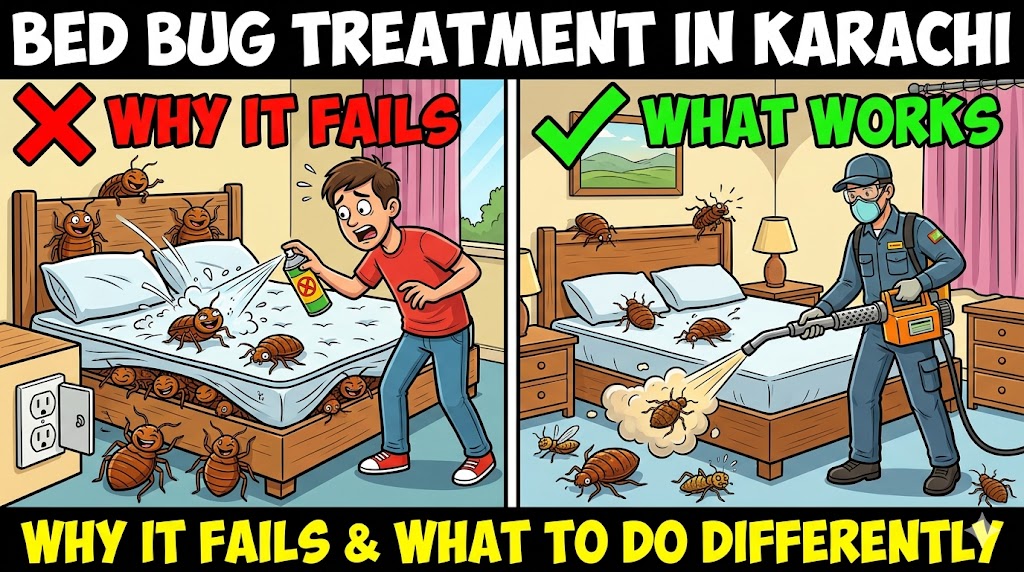
You called a pest control team. They sprayed. You thought the problem was over. Then, two weeks later, the bites started again.
If this sounds familiar, you are not alone. Failed bed bug treatments are one of the most common complaints among Karachi homeowners — and the frustration is completely understandable. You spent money, you prepared your home, and the problem came back. What went wrong?
The answer is almost never “bed bugs are impossible to kill.” The answer is almost always that the treatment was insufficient — either in method, in scope, or in follow-up. Understanding why treatments fail is the first step to making sure your next one succeeds.
Reason 1: Only the Surface Was Treated
The most common failure in Karachi flat treatments is surface-only application. A technician sprays the mattress, maybe the skirting boards, and leaves. This approach misses the vast majority of the infestation.
Bed bugs do not live in the open. They hide in:
- Cracks in bed frames and headboards
- Inside the joints of sofas, chairs, and wooden furniture
- Behind electrical sockets and light switch plates
- Inside wall voids and behind skirting boards
- Under carpets and beneath flooring edges
- Inside wardrobes, between clothes, and in cardboard boxes
- In ceiling-to-wall junctions in heavy infestations
If treatment doesn’t reach these locations — with the right product, at the right concentration — the bugs simply retreat deeper, wait for the chemical residual to break down, and repopulate. In Karachi’s humid climate, insecticide residuals degrade faster than they would in cooler, drier environments, making thorough coverage even more critical.
Reason 2: Eggs Were Not Addressed
This is the single most technically important reason treatments fail, and the one most homeowners don’t know about.
Bed bug eggs are covered in a protective coating that makes them significantly more resistant to insecticides than adult bugs. A treatment that kills every adult and nymph in your flat today will leave a population of eggs completely untouched. Those eggs hatch within 6–10 days at Karachi room temperatures, and the cycle restarts.
Effective bed bug treatment protocols account for this. They:
- Use products with ovicidal (egg-killing) properties or physical action (heat, desiccants)
- Schedule mandatory follow-up treatments 10–14 days after the initial treatment to kill newly hatched nymphs before they reach reproductive maturity
- Combine treatment methods to cover the full life cycle
A single-visit treatment that only uses one type of chemical insecticide will almost certainly fail. If a pest control company doesn’t mention a follow-up visit as part of their protocol, that is a major warning sign.
Reason 3: The Infestation Had Spread Beyond the Bedroom
Many Karachi households discover bed bugs in the master bedroom and treat only that room. This is another common failure point.
By the time a bed bug infestation is large enough to be noticed, it has typically already spread. Bugs follow the carbon dioxide exhaled by sleeping humans — but they also spread through:
- Shared walls between flats in the same building
- Children carrying bugs from the bedroom to other sleeping areas
- Guests or family members bringing bugs in from treated rooms on clothing
- Furniture moved between rooms before treatment
In Karachi’s dense apartment buildings — particularly in areas like Gulshan-e-Iqbal, North Karachi, Liaquatabad, and Orangi Town where families live in close quarters — it is not uncommon for an infestation to span multiple units in the same building. Treating one flat while the adjacent unit remains infested almost guarantees re-infestation.
Reason 4: The Wrong Products Were Used
The pest control market in Karachi is not uniformly regulated, and product quality varies widely. Some operators use:
- Generic agricultural pesticides not formulated for indoor bed bug use
- Heavily diluted concentrations that are insufficient to achieve efficacy
- Products to which local bed bug populations have developed resistance
- Single-mode-of-action chemicals that kill on contact but leave no residual effect
Professional-grade bed bug treatments use a combination of contact insecticides, residual sprays, and in some cases insect growth regulators (IGRs) that prevent nymphs from reaching reproductive maturity. This multi-pronged approach is far more effective than a single chemical class.
Reason 5: Inadequate Preparation by the Homeowner
Even the best treatment will underperform if the home wasn’t properly prepared. Common preparation failures that compromise treatment:
- Leaving clutter on floors and under beds — this gives bugs places to hide that treatment can’t penetrate
- Not removing items from wardrobes so they can be treated
- Failing to wash and dry bedding before (or immediately after) treatment
- Re-entering treated rooms too quickly and disturbing chemical residuals
- Not vacuuming thoroughly before treatment to remove shed skins and debris
A good pest control company will provide you with a detailed preparation checklist before treatment day. If they don’t, ask for one — it’s a sign of professionalism.
Reason 6: The Technician Wasn’t Specifically Trained for Bed Bugs
General pest control and bed bug treatment are not the same skill set. A technician experienced with cockroaches or rodents may not have the specific training to identify bed bug harborage sites, understand the life cycle implications for treatment timing, or know which chemical combinations are effective for this particular pest.
When choosing a service provider, ask specifically: Do your technicians have dedicated training and experience in bed bug treatment? How many bed bug cases have you handled in Karachi? What is your protocol for follow-up visits?
What a Proper Bed Bug Treatment in Karachi Looks Like
A treatment that is genuinely effective against bed bugs in a Karachi flat will typically include:
- Thorough inspection first: Identifying the extent and location of the infestation before any product is applied.
- Preparation guidance: Written instructions for the homeowner to prepare the property properly.
- Multi-product application: Combining contact killers, residual insecticides, and potentially desiccant dusts in cracks and voids.
- Full-room treatment: Not just the mattress — every room, every piece of furniture, every crack.
- Scheduled follow-up: A second visit at 10–14 days to address newly hatched nymphs.
- Post-treatment advice: Guidance on what to monitor for and when to call back if activity continues.
This is the standard our team follows with every bed bug fumigation service in Karachi. It’s why our clients don’t call us a second time for the same infestation.
What to Do If a Previous Treatment Failed
If you’ve already had a treatment that didn’t work, here’s how to move forward:
- Don’t assume the problem is worse than it is — assess the current situation with a fresh inspection
- Be honest with the new service provider about what was treated before and what products were used
- Ask specifically about their follow-up protocol and what guarantees they offer
- Prepare your home more thoroughly this time — use the full checklist
- Consider treating the whole flat, not just the affected room, to eliminate satellite populations
Book a Free Inspection — Get It Right This Time
If a previous treatment hasn’t solved your bed bug problem, it’s time to work with a team that understands what effective treatment actually requires in Karachi’s specific conditions. Contact Karachi Fumigation Services today to book a free inspection. We’ll assess your situation honestly, explain exactly what needs to be done, and give you a clear treatment plan — no shortcuts, no repeat failures.

Ahmad Karimi is a PPMA-registered pest management specialist and the lead technical consultant at Karachi Fumigation Services, where he has overseen field operations and treatment protocols since 2005. With over 20 years of hands-on experience treating residential, commercial, and industrial properties across Karachi — from DHA bungalows with structural termite infestations to Korangi factories requiring large-scale rodent exclusion — he brings direct field knowledge to every article published on this blog.
Ahmad has managed pest control programs for clients including Descon Engineering, Pakistan Tobacco Company, Saylani Welfare, and J. (Junaid Jamshed), and has issued hundreds of fumigation certificates for health authority compliance, import/export, and commercial licensing purposes. He holds active PPMA membership and works exclusively with WHO-approved chemicals in all field operations.
The content on this blog draws directly from two decades of Karachi-specific infestation data — seasonal pest patterns, neighbourhood-level risk factors, building-age vulnerabilities, and the regulatory requirements that Karachi businesses actually face. No recycled content from foreign pest control sites. Every article reflects conditions specific to Karachi’s climate, infrastructure, and compliance environment.
For treatment enquiries or technical questions, Ahmad’s team can be reached at 03463303875 or via the office at Trade Tower, Civil Lines, Karachi.
Leave a Reply