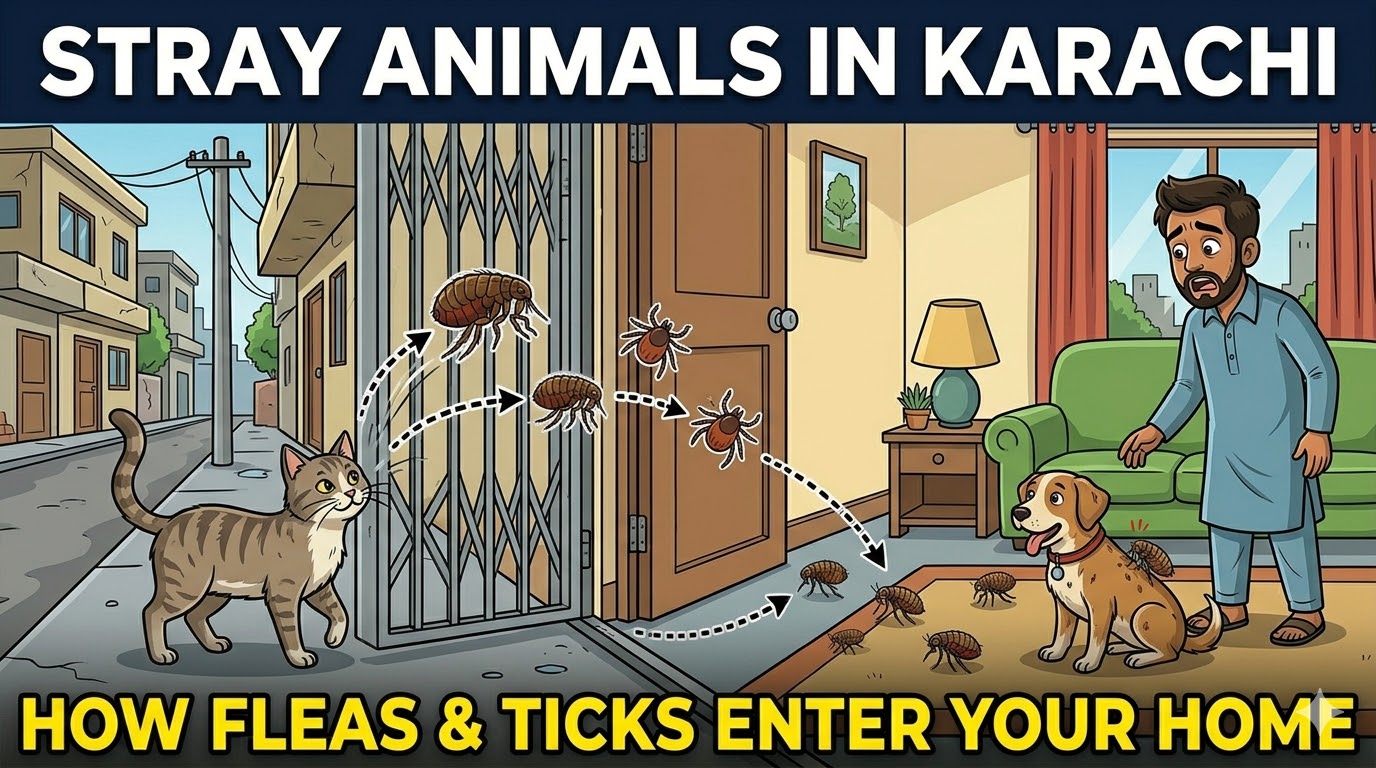
You may not own a pet. You may not let strays into your home. But if you live in Karachi, the city’s vast population of stray animals may already be affecting the pest load inside your house — in ways most homeowners have not considered.
Karachi’s Stray Animal Problem Is Everyone’s Problem
Karachi has one of the largest urban stray dog populations in South Asia, and the number of feral and community cats is similarly high. Estimates vary, but stray dogs alone in the city likely number in the hundreds of thousands. They live in virtually every neighbourhood — from Defence and Clifton to Orangi, Korangi, Landhi, and beyond. Stray cats occupy apartment building courtyards, rooftops, alleys, and car parks across the city.
This is relevant to every homeowner — not just those with pets — because stray animals are among the most significant vectors for introducing fleas and ticks into residential environments. Unlike owned pets that receive occasional flea treatment, strays carry persistent, high-density flea and tick infestations year-round with no intervention. They are, in epidemiological terms, a constantly replenishing reservoir.
The Transmission Pathways You May Not Have Considered
Pathway 1: Shared Outdoor Spaces
Strays rest, sleep, and spend extended time in outdoor areas directly adjacent to or connected with your home: car parks, building lobbies, shared gardens, rooftops, stairwells, and back lanes. During this time, flea eggs, larvae, and adult fleas drop from their bodies onto the ground, grass, soil, and crevices in paving. Ticks drop from their hosts after feeding and wait in vegetation or gaps for a new host.
When you, your children, or your domestic staff walk through these same areas, fleas jump onto clothing and shoes, and ticks attach to exposed skin or fabric. They are then carried into your home.
Pathway 2: Shared Walls, Drains, and Gaps
In Karachi’s older housing stock — bungalows, older apartments, houses in areas like Saddar, Lyari, PECHS, or North Nazimabad — gaps under doors, open drains, and cracks in exterior walls are common. Fleas can enter through these gaps. More critically, flea larvae and eggs introduced into these entry zones by passing strays can develop indoors once inside.
Ground-floor apartments and homes with courtyards are particularly vulnerable. If stray cats regularly sleep in your courtyard or porch area, they are effectively conducting ongoing flea seeding of your immediate environment.
Pathway 3: Your Children
Children interact with stray animals. Despite parental warnings, this is a consistent reality in urban Pakistan. A brief petting of a neighbourhood stray — something that occurs daily in most Karachi residential areas — can transfer dozens of flea eggs and potentially ticks onto a child’s clothing. Those pests are then brought inside, deposited onto carpets and furniture, and begin their life cycle in your home.
Pathway 4: Shared Building Areas in Apartments
In Karachi’s many multi-unit residential buildings, if one ground-floor unit or a building’s shared basement or car park has an established flea infestation — potentially seeded and maintained by strays entering those spaces — the infestation can spread via shared corridors, elevators, and ventilation pathways to upper floors. This is a pattern that pest control professionals in the city encounter regularly.
Pathway 5: Domestic Workers
Domestic staff who travel on public transport, pass through stray-animal-dense areas on their commute, or live in neighbourhoods with significant stray populations may unknowingly carry flea larvae or adults into your home on their clothing or bags. This pathway is almost never considered but represents a real vector, particularly for households that employ daily domestic help.
Why Strays Carry More Fleas Than Owned Pets
The disparity between the flea and tick burden carried by strays versus owned pets is substantial. A typical untreated stray dog in Karachi may host hundreds to thousands of fleas in various life stages across its body. An owned pet on a regular flea prevention programme may carry very few to none.
The reasons are straightforward: strays receive no veterinary care, no flea treatment, no grooming, and no dietary support that would strengthen their immune system. They also interact constantly with other strays, making reinfestation a daily occurrence. This means that any stray regularly accessing the area around your home is a continuous, near-inexhaustible source of flea and tick introduction.
Signs That Stray Animals Are the Source of Your Infestation
If you do not own a pet but have an active flea or tick infestation, a nearby stray is the most probable source. Specific indicators include:
- Bites concentrated on lower legs and ankles, consistent with ground-level flea exposure near entry points
- Flea activity noticed near exterior doors, hallways, or ground-floor rooms more than other areas
- Visible stray activity in your building’s immediate surroundings — strays resting near your gate, in the parking area, or in a shared garden
- A flea infestation that returns repeatedly despite treatment, suggesting ongoing external introduction
What You Can Do to Block These Pathways
Secure Entry Points
Seal gaps under exterior doors with door sweeps or weather stripping. Fill cracks in exterior walls, around pipes entering the home, and in floor junctions near exterior boundaries. Pay particular attention to gaps in grilles, ventilation openings, and gaps around utility pipes.
Discourage Strays from Accessing Your Immediate Property
While compassionate care for stray animals is admirable, allowing strays to sleep regularly in your courtyard, porch, or driveway creates a persistent flea-seeding zone directly adjacent to your home’s entry points. If you are concerned about the welfare of local strays, coordinate with a local animal welfare organisation for humane management — but address the immediate pest risk to your home simultaneously.
Treat the Perimeter, Not Just the Interior
Standard indoor flea and tick treatments address the interior of your home but do not break the external introduction cycle. If strays are regularly accessing areas adjacent to your home, the exterior perimeter — driveway edges, garden borders, courtyards, car park areas — should be included in any professional treatment.
A comprehensive flea and tick treatment for your Karachi home should include assessment of exterior harbourage zones where stray animal activity has been observed, not just interior rooms.
Personal Hygiene After Outdoor Exposure
After passing through areas with known stray activity, change clothing at the door before entering main living areas. Have children change clothes and wash hands after any outdoor play or animal contact. This sounds excessive but is a genuinely effective practice in high-exposure environments.
A Note on Karachi’s Specific Neighbourhoods
Flea and tick transmission risk from strays is not uniform across the city. Areas with higher stray densities — particularly older residential areas, areas near open waste grounds, and neighbourhoods adjacent to industrial zones or markets — carry higher risk. However, even in well-maintained localities like DHA, Bahria Town Karachi, and Gulshan-e-Iqbal, stray animal presence is consistent enough to create real transmission pathways. No area of the city is entirely insulated.
The Broader Picture
Stray animals are a permanent feature of Karachi’s urban landscape and are unlikely to be eliminated in the near future. This means that managing flea and tick risk in your home requires an ongoing, layered approach rather than a one-time fix. Environmental sealing, regular professional treatment, and awareness of transmission pathways are all necessary components. If you are dealing with a flea or tick problem and suspect strays are involved, speak with a specialist in fumigation and pest control in Karachi who can assess both your interior and your exterior environment.
Suspect Strays Are Behind Your Infestation? Book a Free Inspection Our team can assess both your home interior and the surrounding access points to identify exactly how pests are entering and recommend a treatment plan that addresses the full picture. Contact Karachi Fumigation Services today — free inspection, honest advice.

Ahmad Karimi is a PPMA-registered pest management specialist and the lead technical consultant at Karachi Fumigation Services, where he has overseen field operations and treatment protocols since 2005. With over 20 years of hands-on experience treating residential, commercial, and industrial properties across Karachi — from DHA bungalows with structural termite infestations to Korangi factories requiring large-scale rodent exclusion — he brings direct field knowledge to every article published on this blog.
Ahmad has managed pest control programs for clients including Descon Engineering, Pakistan Tobacco Company, Saylani Welfare, and J. (Junaid Jamshed), and has issued hundreds of fumigation certificates for health authority compliance, import/export, and commercial licensing purposes. He holds active PPMA membership and works exclusively with WHO-approved chemicals in all field operations.
The content on this blog draws directly from two decades of Karachi-specific infestation data — seasonal pest patterns, neighbourhood-level risk factors, building-age vulnerabilities, and the regulatory requirements that Karachi businesses actually face. No recycled content from foreign pest control sites. Every article reflects conditions specific to Karachi’s climate, infrastructure, and compliance environment.
For treatment enquiries or technical questions, Ahmad’s team can be reached at 03463303875 or via the office at Trade Tower, Civil Lines, Karachi.
Leave a Reply