Author: admin

  • How Bed Bugs Survive Karachi’s Heat — And Why Summer Doesn’t Kill Them

    How Bed Bugs Survive Karachi’s Heat — And Why Summer Doesn’t Kill Them

    If you live in Karachi, you’ve probably heard the common belief: “The summer heat will take care of the bed bugs.” It sounds logical. Karachi summers are brutal — temperatures regularly climb above 40°C, humidity is high, and the city bakes for months. Surely no pest could survive that. Unfortunately, this is one of the most dangerous myths about bed bugs, and believing it costs Karachi homeowners weeks of suffering, sleepless nights, and a worsening infestation.

    The truth is that bed bugs are not just surviving Karachi’s heat — they are thriving in it. Understanding why is the first step toward actually getting rid of them.

    The Biology Behind Bed Bug Heat Resistance

    Bed bugs (Cimex lectularius) are among the most resilient insects on the planet. They have survived for thousands of years alongside humans across climates ranging from Siberia to the tropics. Their biology gives them specific tools to handle heat that most people don’t know about.

    Core body temperature vs. ambient temperature: Bed bugs are small, flat, and they hide. When temperatures rise in a room, bed bugs don’t simply sit in the open air and absorb that heat. They burrow deep into mattress seams, wall cracks, behind skirting boards, inside electrical sockets, and inside furniture joints. The temperature a few centimetres inside a crack can be 10–15°C lower than the surface temperature of the same wall.

    Thermal death point requirements: Scientific research shows that bed bugs die when their body temperature reaches approximately 45–48°C for a sustained period — typically 90 minutes or more. Karachi ambient air may hit 42°C outdoors, but inside a shaded room, inside a mattress, inside a wardrobe crack, the bug’s actual body temperature may never come close to the lethal threshold.

    Metabolic slowing: In high temperatures, bed bugs can slow their metabolism and enter a semi-dormant state. They reduce activity, conserve moisture, and wait. They are not dead — they are simply waiting for conditions to normalise, which in Karachi’s coastal climate, they always do.

    Why Karachi’s Climate Actually Helps Bed Bugs

    This may be uncomfortable to read, but Karachi’s climate is close to ideal for bed bug survival. Here’s why:

    1. Warmth Accelerates Their Life Cycle

    Bed bugs reproduce faster in warm temperatures. Between 21°C and 32°C — a range Karachi experiences nearly year-round — a bed bug can go from egg to adult in as little as 21 days. A female lays 1 to 5 eggs per day. Do the arithmetic: within three months of an undetected infestation, you can go from a handful of bugs to thousands.

    In colder climates, winters slow the life cycle dramatically, giving residents a natural “reset.” In Karachi, there is no such reset. The cycle runs continuously, which is why infestations here grow so quickly once established.

    2. High Humidity Helps Them Retain Moisture

    Bed bugs lose moisture through their exoskeleton. In extremely dry environments, they desiccate and die. But Karachi’s coastal humidity — often 60–90% during the monsoon months — creates exactly the kind of environment where bed bugs can maintain their body moisture with ease.

    3. Dense Housing and Constant Human Traffic

    Karachi is one of the most densely populated cities in the world. Areas like Saddar, Landhi, Korangi, North Nazimabad, and SITE Town have apartment buildings where dozens of families share walls. Bed bugs travel through wall voids, electrical conduit pipes, and shared spaces. Even if you fumigate your flat perfectly, re-infestation from a neighbouring unit can happen within weeks if the building isn’t treated comprehensively.

    Common Myths That Get Karachi Residents in Trouble

    Beyond the heat myth, several other beliefs delay treatment and allow infestations to worsen:

    • “Bed bugs only live in dirty homes.” False. Bed bugs are attracted to human blood, not filth. A spotless Defence or Clifton apartment is just as susceptible as any other home if someone brings in infested luggage or secondhand furniture.
    • “I’ll just wash everything in hot water.” Washing and drying on high heat kills bed bugs on fabrics — but it does nothing for bugs hiding in your bed frame, inside your walls, or behind skirting boards.
    • “We sprayed — the problem is gone.” A single spray treatment from an unqualified team rarely eliminates a full infestation. Eggs are resistant to many common insecticides, and hatching nymphs will restart the cycle within 10–14 days.
    • “It’s mosquito bites, not bed bugs.” This confusion is extremely common and costs weeks of action. Bed bug bites typically appear in lines or clusters on exposed skin, and the bugs themselves leave rust-coloured stains on bedding.

    What Temperature Is Actually Needed to Kill Bed Bugs?

    Professional heat treatments work by raising the temperature of an entire room or flat to above 50°C for several hours, ensuring heat penetrates every hiding spot. This is very different from Karachi’s ambient summer heat.

    Similarly, chemical treatments must be applied by trained professionals who understand:

    • Which products are effective against eggs as well as adults
    • How to treat cracks, voids, and furniture joints — not just surfaces
    • The need for follow-up treatments to catch newly hatched nymphs

    This is why professional bed bug fumigation in Karachi follows a structured, multi-visit protocol — not a single spray-and-leave approach.

    Signs That Heat Has Not Solved Your Problem

    If you’re hoping Karachi’s summer will handle the infestation, watch for these signs that it hasn’t:

    • Continuing to wake up with new bites after hot weather
    • Rust-coloured or dark brown spots on mattress seams, bed frames, or walls
    • A sweet, musty smell in the bedroom (a sign of a large infestation)
    • Tiny white eggs or pale yellow shed skins in mattress folds or furniture joints
    • Live bugs — small, flat, reddish-brown ovals — visible at night

    If you see any of these, do not wait for the weather to solve it. Every week of delay means exponentially more bugs.

    What You Should Do Instead

    The moment you suspect bed bugs, act in a structured way:

    1. Confirm the infestation with a proper inspection — check mattress seams, bed frame joints, and skirting boards with a torch.
    2. Contact a professional pest control team immediately — the faster you act, the smaller and more manageable the infestation.
    3. Avoid moving furniture between rooms — this spreads bugs throughout your home.
    4. Wash and dry all bedding on maximum heat and seal them in plastic bags until treatment is complete.
    5. Prepare your home for a professional treatment — move items away from walls, declutter storage areas.

    Final Word: Karachi’s Heat Is Not Your Ally

    It is a deeply frustrating truth, but Karachi’s climate — warm, humid, and consistent — is one of the reasons bed bug infestations here can grow so rapidly and persist for so long. The heat doesn’t kill them. It feeds them.

    Taking action quickly, understanding the real biology of the pest, and working with qualified professionals is the only reliable path to eliminating a bed bug infestation in Karachi.

    Book a Free Bed Bug Inspection Today

    Don’t let a myth cost you months of disturbed sleep and a worsening infestation. Our team provides professional bed bug treatment services across Karachi — from Defence and Clifton to Gulshan-e-Iqbal, PECHS, and beyond. Contact us today to book your free inspection, get an honest assessment of your situation, and start sleeping soundly again.
  • What Happens If You Ignore a Termite Infestation in Your Karachi Home for 6 Months?

    What Happens If You Ignore a Termite Infestation in Your Karachi Home for 6 Months?

    You noticed a few discarded wings near the window last month. There might be a small mud tube behind the cupboard — or it could just be dirt. The walls look fine. Nothing is broken. Surely it can wait.

    This is the reasoning that costs Karachi homeowners hundreds of thousands of rupees every year.

    A six-month delay in treating an active termite infestation is not a minor risk — it is a major one. In Karachi’s warm, humid climate, termite colonies grow aggressively. What looks manageable today can become structurally catastrophic within half a year. This article walks you through exactly what happens — month by month — when a termite infestation is left untreated, and what the real-world consequences look like for homeowners in this city.

    First, Understand What You Are Dealing With

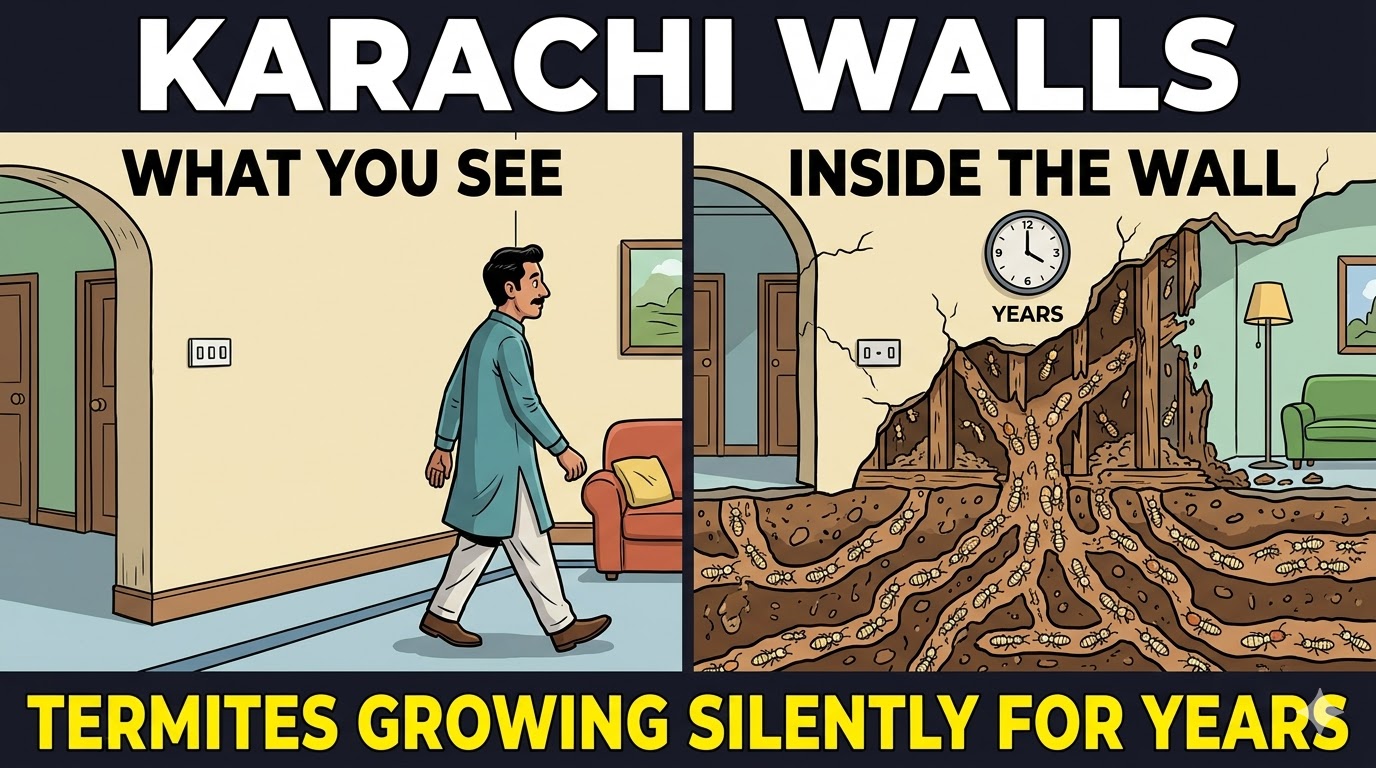
    When a Karachi homeowner first notices signs of termite activity — mud tubes, wing litter, hollow-sounding walls — the infestation is almost never new. As explained in detail in our guide on how termite colonies grow silently inside Karachi walls, by the time any visible sign appears, the colony has typically been established for two to four years and contains hundreds of thousands of individuals.

    What you are seeing is not the beginning of the problem — it is the problem announcing itself after years of quiet growth. And once it announces itself, the pace of visible damage accelerates significantly.

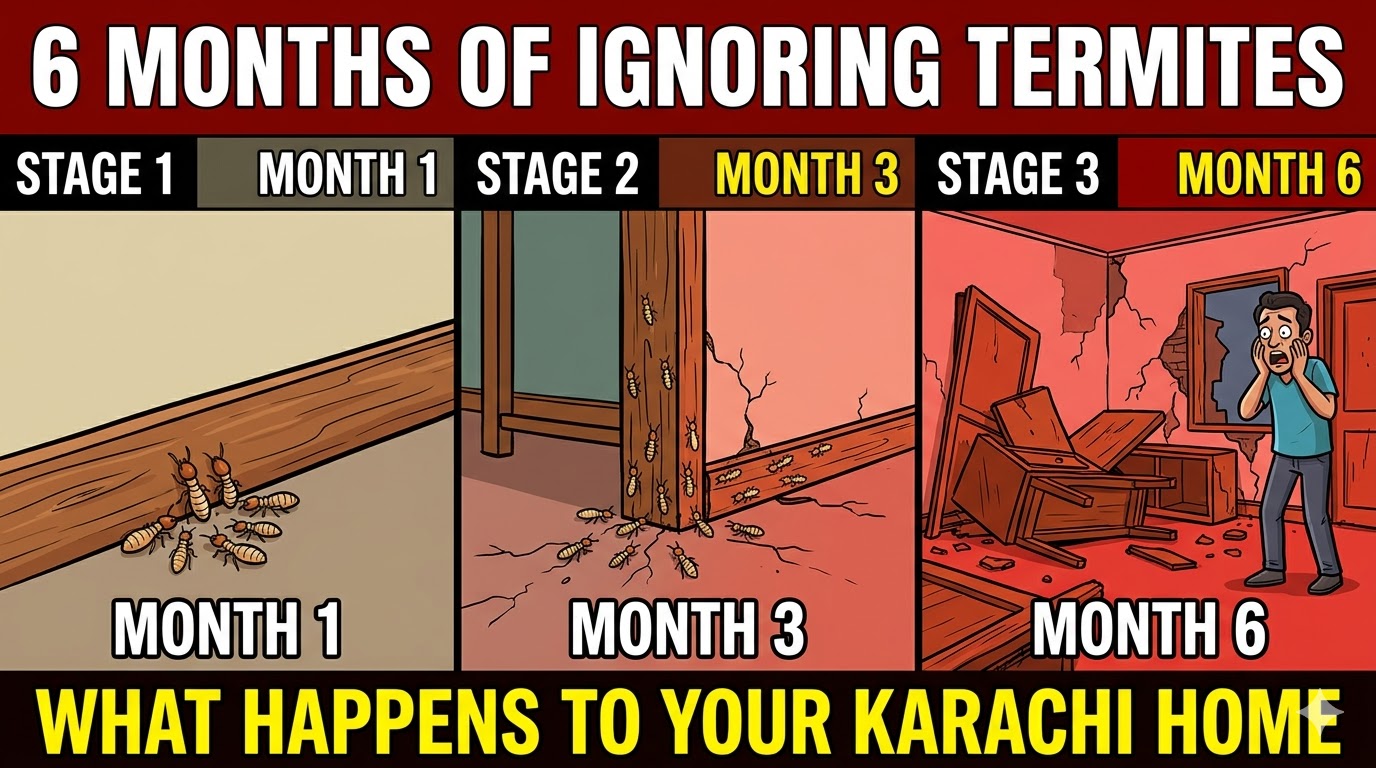
    Month-by-Month: What a 6-Month Delay Actually Looks Like

    Month 1 — Signs Are Present, Damage Is Contained

    You notice the first signs — perhaps mud tubes or a slightly soft spot on a door frame. The structural damage at this point is localised. Treatment would be relatively straightforward: injection of termiticide into affected areas, barrier treatment around the foundation, and monitoring stations. Repair cost estimate: minor — perhaps Rs. 5,000 to Rs. 20,000 for carpentry.

    Month 2 — The Colony Doubles Its Foraging Activity

    With no treatment interrupting their foraging, workers continue to expand their tunnel network. In Karachi’s warm temperatures, termite metabolic activity stays high year-round. By month two, what began as a single door frame infestation has typically spread to the adjacent wall cavity and, in many cases, to the skirting boards of the connected room.

    Month 3 — False Ceiling and Vertical Spread

    By the third month, a well-established colony will have extended its tunnels upward through wall cavities. In homes with POP false ceilings — extremely common in DHA, Clifton, and Gulshan — termites reach the wooden battens and metal framework that support the ceiling. The hollowing of ceiling elements begins. You may start to notice small cracks in plaster or slightly discoloured patches on the ceiling surface.

    Month 4 — Kitchen Cabinets, Built-In Wardrobes, and Furniture

    Fitted furniture that backs against affected walls is now under direct attack. In Karachi homes, this typically means kitchen cabinets, built-in wardrobes in bedrooms, and shelving units. The internal chipboard and MDF used in most fitted furniture is especially vulnerable — termites consume it far faster than solid timber. By month four, entire cabinet sections may be structurally compromised even while the outer surface appears intact.

    Month 5 — Structural Door and Window Frames Fail

    Door frames and window frames that were partially affected in month one are now severely compromised. In older Karachi homes where frames were set directly into the wall without a protective cavity, the wood behind the plaster may be almost entirely consumed. Doors begin to sag. Windows become difficult to open or close. In some cases, frames crack or collapse under normal use.

    Month 6 — Electrical Hazards, Ceiling Risk, and Structural Damage

    At the six-month mark, the infestation has typically spread to multiple rooms and multiple structural elements. However, the greatest risks at this stage are less visible:

    • Electrical conduits inside walls are often built with plastic casing. Termites, in their tunnelling, can breach PVC conduit and chew through cable insulation. This creates a genuine fire and electrocution risk.
    • False ceilings supported by compromised wooden battens can partially collapse under their own weight or during minor movement.
    • Load-bearing wooden elements in older properties — lintels, roof joists, and stair stringers — may have lost significant structural integrity.

    The Cost of Delay: A Real-World Comparison

    The following comparison illustrates the typical cost difference between treating an infestation promptly versus delaying by six months, based on professional assessments in Karachi residential properties:

    Damage CategoryTreated Promptly (Month 1)Treated After 6 Months
    Termite treatment costRs. 8,000 – 25,000Rs. 25,000 – 60,000+
    Door/window frame replacement1–2 frames4–8+ frames
    Cabinet/furniture repairMinor or noneFull replacement likely
    False ceiling repairNonePartial or full replacement
    Electrical inspection needed?NoOften yes
    Structural engineer assessment?NoPossibly yes
    Estimated total repair costRs. 20,000 – 50,000Rs. 150,000 – 500,000+

    The Hidden Costs Beyond Repair Bills

    Property Value Reduction

    In Karachi’s property market, a disclosed termite infestation or visible termite damage can reduce the resale or rental value of a property by 10% to 30%. In high-demand areas like DHA and Clifton, where buyers conduct pre-purchase inspections, untreated or poorly treated termite damage is a significant red flag. Many property transactions in Karachi have collapsed at the final stage because of termite issues discovered during inspection.

    Disruption and Displacement

    Extensive termite damage often requires significant renovation work — replastering walls, replacing ceilings, reinstalling cabinets, and repainting entire rooms. In severe cases, families are displaced for days or weeks during repair work. The inconvenience, stress, and associated costs of temporary accommodation add significantly to the total impact.

    Health and Safety Risks

    Beyond structural concerns, severely infested homes carry secondary health and safety risks. Damaged electrical wiring increases fire risk. Collapsing false ceiling elements can cause injury. Moisture damage associated with extensive termite activity creates conditions favourable to mould growth, which carries its own respiratory health implications — particularly relevant for children and the elderly.

    Why Karachi Homeowners Delay — and Why Those Reasons Are Costly

    Having worked with hundreds of Karachi homeowners, we consistently hear the same reasons for delayed action:

    “It does not look that bad.”Termites are designed to look invisible. By the time it looks bad, it is already serious.

    “I will get it treated after Eid / after the summer / after the rains.”Termites are not waiting for a convenient time. In Karachi’s warm climate, colony growth is year-round.

    “I will try a spray from the hardware store first.”Over-the-counter sprays kill surface termites but do not penetrate walls or reach the colony. They often cause the colony to split and spread more widely — a phenomenon called “budding”.

    “The cost seems high.”Professional treatment costs a fraction of the repair bills that follow six months of inaction. The table above illustrates this clearly.

    What Effective Treatment Actually Involves

    Many homeowners imagine termite treatment as a simple spray-down. Professional treatment is considerably more comprehensive — and that comprehensiveness is what makes it effective.

    A qualified termite control service in Karachi typically includes:

    • Full site inspection to map infestation extent and identify all active tunnels, entry points, and affected structural elements
    • Soil treatment around the external perimeter using professional-grade termiticide to create a chemical barrier that kills foraging termites and disrupts the colony
    • Targeted injection of termiticide into internal wall cavities and affected structural timbers
    • Bait station installation to monitor for new activity and deliver slow-acting termiticide back to the colony
    • Post-treatment report and a scheduled follow-up inspection

    Treatment duration and complexity increase significantly with infestation size. A treatment that takes one day for a contained early-stage infestation may require two to three days for a property with six months of unchecked damage.

    A Note on Karachi’s Monsoon Season

    The period between June and September — Karachi’s monsoon season — is when termite swarming activity peaks. Alates emerge from established colonies and attempt to found new ones. Homeowners across Karachi report seeing winged insects around light sources in large numbers during and after monsoon rains.

    If you see this happening in your home this monsoon and choose to delay action until “after the rains settle down”, you are giving an already large colony several additional months of optimal growth conditions. Post-monsoon is also the season when we receive the largest volume of calls from homeowners who wish they had called six months earlier.

    Frequently Asked Questions

    Can I treat a severe infestation myself?

    No. DIY products available in Karachi’s hardware markets are not formulated for structural termite treatment. They do not penetrate wall cavities, do not carry the active ingredient back to the colony, and do not provide any lasting barrier. In some cases, improper DIY treatment causes colony splitting, which spreads the infestation to new areas.

    How long does professional treatment take for a severe infestation?

    Depending on property size and infestation extent, treatment for a severe infestation typically takes one to three days. Structural repairs — replacing frames, cabinets, and ceiling elements — take considerably longer and are separate from the treatment process.

    Can a severely infested home be fully treated?

    Yes. Professional termite treatment eliminates active colonies and prevents reinfestation through ongoing barrier and monitoring systems. The termites can always be treated — the question is how much structural damage needs to be repaired afterwards.

    Conclusion: Six Months Is a Very Long Time

    In Karachi’s climate, a six-month delay in treating an active termite infestation transforms a manageable problem into a major crisis. Contained damage becomes widespread structural compromise. Affordable treatment becomes expensive multi-room renovation. A simple inspection becomes an urgent structural assessment.

    The termites in your walls are not going to stop. They are not going to move on. They are going to eat — quietly, relentlessly, and invisibly — until they are stopped.

    The good news is that treatment is effective, available, and significantly cheaper than the alternative. But it requires action today — not next month.

    Do Not Give Termites Another Six Months
    If you have noticed any signs of termite activity — or if you simply have not had an inspection in over a year — now is the time to act. Our licensed team covers all of Karachi, including DHA, Clifton, Gulshan-e-Iqbal, PECHS, North Nazimabad, Bahria Town, and beyond.
    Book your free termite inspection with Karachi Fumigation Services today. We will assess your property, identify any active infestation, and give you a clear, honest report — with no obligation. The earlier we treat it, the less it costs you.

  • How to Confirm You Have Bed Bugs in Your Karachi Home Before Calling a Company

    How to Confirm You Have Bed Bugs in Your Karachi Home Before Calling a Company

    Waking up with itchy red welts is alarming. Your first instinct might be to call a pest control company immediately — but before you do, it’s worth taking 30 minutes to do a proper inspection yourself. Not because professional help isn’t necessary (it almost certainly will be), but because confirming what you’re dealing with helps you communicate clearly with the treatment team, ensures the right treatment is planned, and prevents you from paying for treatment of the wrong pest.

    This guide walks you through exactly how to inspect your Karachi home for bed bugs — what tools you need, where to look, and how to interpret what you find.

    Why Confirming the Pest Matters

    Not every bite is a bed bug bite. In Karachi, mosquitoes, fleas (especially in homes with pets), mites, and even allergic reactions can produce skin reactions that look similar. Calling a pest control company for bed bugs when you actually have a flea problem leads to the wrong treatment being applied.

    Conversely, many Karachi residents who do have bed bugs don’t realise it for weeks because they attribute bites to mosquitoes. During those weeks, the infestation grows significantly.

    A proper inspection resolves the uncertainty in either direction, and the evidence you gather helps a professional team understand the scope of the problem before they arrive.

    What You’ll Need for the Inspection

    You don’t need any specialist equipment. Gather:

    • A bright LED torch or phone flashlight
    • A credit card, old loyalty card, or thin plastic card (to probe seams and cracks)
    • A white sheet of paper or a white cloth to catch fallen bugs or debris
    • Disposable gloves
    • A magnifying glass if available (helpful but not essential)
    • A phone for taking photos of any evidence you find

    Where to Look: Room by Room

    The Bed — Your Primary Search Area

    Bed bugs are named for their habitat. The bed is always the first and most thorough inspection area.

    Mattress: Strip all bedding completely. Inspect every seam of the mattress — run your card along the seam as you look, because bugs and eggs hide in the folded edge. Look at both sides and all four sides. Check any tufts or stitching details. Look for:

    • Dark spots (1–2mm) — bed bug excrement, which appears as dark ink dots
    • Rust-coloured smears — dried blood, often from a bug crushed during sleep
    • Tiny white oval eggs — usually cemented along seam folds
    • Translucent yellow shed skins (exuviae)
    • Live bugs — flat, oval, reddish-brown, roughly 5mm long when unfed

    Bed frame and headboard: This is often the heaviest concentration area. Unscrew the headboard from the wall if it’s wall-mounted, or pull the bed slightly away from the wall. Inspect every joint, groove, and crack. Run your card into the gaps. Bugs cluster in these areas in large numbers in established infestations.

    Box spring: If your bed has a box spring, inspect along every seam and edge. The fabric backing is often a major harborage area. Lift the mattress completely to inspect the top of the box spring.

    Bedside Furniture

    Nightstands, bedside tables, and any furniture within 1–2 metres of the bed are common satellite harborage areas. Open every drawer and inspect the inside edges. Check the joints where legs meet the frame. Pull furniture away from the wall and inspect the back surfaces.

    Sofas and Upholstered Furniture

    In heavier infestations, or in homes where people frequently sleep on the sofa, upholstered furniture becomes infested. Inspect all seams, under cushions, and along the bottom edge of the frame. Lift the cushions and check underneath.

    Walls and Electrical Points

    Bed bugs travel along walls and hide behind electrical socket plates, light switches, and wall frames near sleeping areas. Gently pull these plates away (after turning off the power at the breaker) and shine your torch inside. This is a spot many homeowners miss entirely.

    Check also: any picture frames or mirrors hanging close to the bed, any cracks in plaster or paint, and the junction between wall and skirting board.

    Wardrobe and Clothing Storage

    In heavier infestations, bugs migrate to wardrobes. Check along the inside edges and joints of the wardrobe, especially if it is close to the sleeping area.

    Interpreting What You Find

    Here’s a quick guide to what different signs tell you about the infestation:

    • Only dark spots, no live bugs: Early or moderate infestation. Bugs are present but may be hidden deeply. Professional treatment is needed.
    • Dark spots plus shed skins: Active infestation with ongoing reproduction. Urgency is high.
    • Live bugs visible in daylight: Significant infestation. When bugs are visible outside their normal nocturnal hiding period, the population is large enough that hiding spots are crowded.
    • Eggs found: Treatment must include follow-up visits to catch newly hatching nymphs. Flag this to your treatment provider.
    • Infestation in multiple areas of the home: The spread is already established. Multiple rooms need to be treated simultaneously.

    How Bite Patterns Help Confirm the Pest

    While bites alone can’t definitively confirm bed bugs (they look similar to other bites), the pattern can help:

    • Bed bugs: Bites typically appear in a line or small cluster (3 or more bites close together). They appear on exposed skin — arms, neck, face, legs. They itch intensely the next day.
    • Mosquitoes: Random placement, no pattern, typically larger welt with a central puncture mark.
    • Fleas: Concentrated around the ankles and lower legs, associated with pet presence.

    Bed bug bites may not appear until 24–72 hours after the bite. Some people react strongly; others show almost no visible reaction at all, which is why physical evidence from the inspection matters more than bites alone.

    Document Your Findings Before Calling

    Before you call a professional, photograph everything you’ve found. Good documentation:

    • Helps the pest control team understand the scope before they arrive
    • Enables a more accurate quote
    • Ensures the right treatment protocol is planned
    • Provides a baseline for post-treatment comparison

    Once you’ve confirmed the infestation, contact a professional for a thorough bed bug inspection and treatment in Karachi. Share your photos and inspection findings with them.

    Book Your Free Professional Inspection

    Your own inspection is a valuable first step — but a professional inspection will check areas you may not have access to, use detection tools you don’t have at home, and give you an accurate picture of the full extent of the infestation. Contact Fumigation Services in Karachi today to book your free inspection. Our team will confirm exactly what you’re dealing with and recommend the right treatment plan for your specific situation.

  • How Termite Colonies Silently Grow Inside Karachi Walls for Years Before You Notice

    How Termite Colonies Silently Grow Inside Karachi Walls for Years Before You Notice

    Most Karachi homeowners discover termites the hard way — a hand pressed against a wall suddenly sinks in, a wooden door frame crumbles at the touch, or a lick of paint peels back to reveal a hollow, honeycomb-like ruin beneath. By that point, termites have already been living in your home for years.

    This is the terrifying truth about termite infestations: the damage happens long before any visible sign appears. In Karachi’s climate — humid coastal air, clay-heavy soil, and temperatures that rarely dip below 20°C — subterranean termites find an almost perfect environment to build massive underground colonies and quietly consume everything in their path.

    In this article, we explain exactly how termite colonies establish, grow, and spread inside Karachi homes without triggering any alarm — and what you can do about it before the damage becomes irreversible.

    Understanding Termite Biology: Why They Are So Hard to Detect

    To understand why termites go unnoticed for so long, you need to understand how they live. The most destructive species in Karachi is the subterranean termite (Coptotermes gestroi and related species), and their entire biology is designed around staying hidden.

    A Colony Is a Living, Growing Organism

    A single termite colony can contain anywhere from 100,000 to over one million individual termites. However, a colony does not start that way. It begins with a single pair — one reproductive queen and one king — that settle into the soil, usually beneath or near a building’s foundation.

    In the first year, the queen lays only a handful of eggs per day. The colony at this stage is microscopic — a few dozen workers foraging cautiously within inches of the nest. No structural damage occurs. No signs appear. This is why even a professional cannot always detect a brand-new infestation.

    By Year 3 to 5, the queen’s egg production can reach thousands per day. The colony now has a fully organized caste system: workers (who eat your walls), soldiers (who defend the colony), and reproductives (who will eventually spread to new locations). The foraging range expands dramatically — up to 100 metres in every direction.

    They Never Surface — Unless Forced To

    Subterranean termites are photophobic — they actively avoid light and open air. Every tunnel they build is sealed with a mixture of soil, saliva, and faecal matter (called “carton”). When they penetrate walls, they hollow out the inside of wood and drywall while leaving the outer surface completely intact. This is why you can tap a wall for years and hear nothing wrong until the structure has been almost entirely consumed.

    Karachi’s Unique Conditions: A Termite’s Ideal Home

    Not every city in Pakistan faces the same level of termite risk. Karachi has several specific environmental and construction factors that make it one of the highest-risk cities in the country for termite infestation.

    Coastal Humidity and Clay Soil

    Karachi’s coastal location keeps humidity levels elevated for most of the year, particularly in areas like Clifton, DHA, Lyari, and Korangi. Termites need moisture to survive, and damp soil near foundations provides the perfect environment for underground colonies to thrive. Clay-heavy soil, common across much of Karachi’s older residential zones, retains moisture exceptionally well — acting almost like a natural termite nursery.

    Older Construction and RCC Slab Buildings

    Much of Karachi’s residential housing stock — particularly in areas like PECHS, North Nazimabad, Gulshan-e-Iqbal, and Nazimabad — was built between the 1960s and 1990s using construction methods that offer little termite resistance. Exposed wooden joinery, inadequate chemical pre-treatment of foundations, and the use of low-density timber in doors, windows, and ceiling frames have left an entire generation of homes vulnerable.

    Even newer constructions in DHA Phases 7 and 8, Bahria Town, and Scheme 33 are at risk if pre-construction anti-termite soil treatment was skipped or applied inadequately — which, according to professionals, happens more often than homeowners realise.

    Plumbing Leaks and Ground-Floor Vulnerability

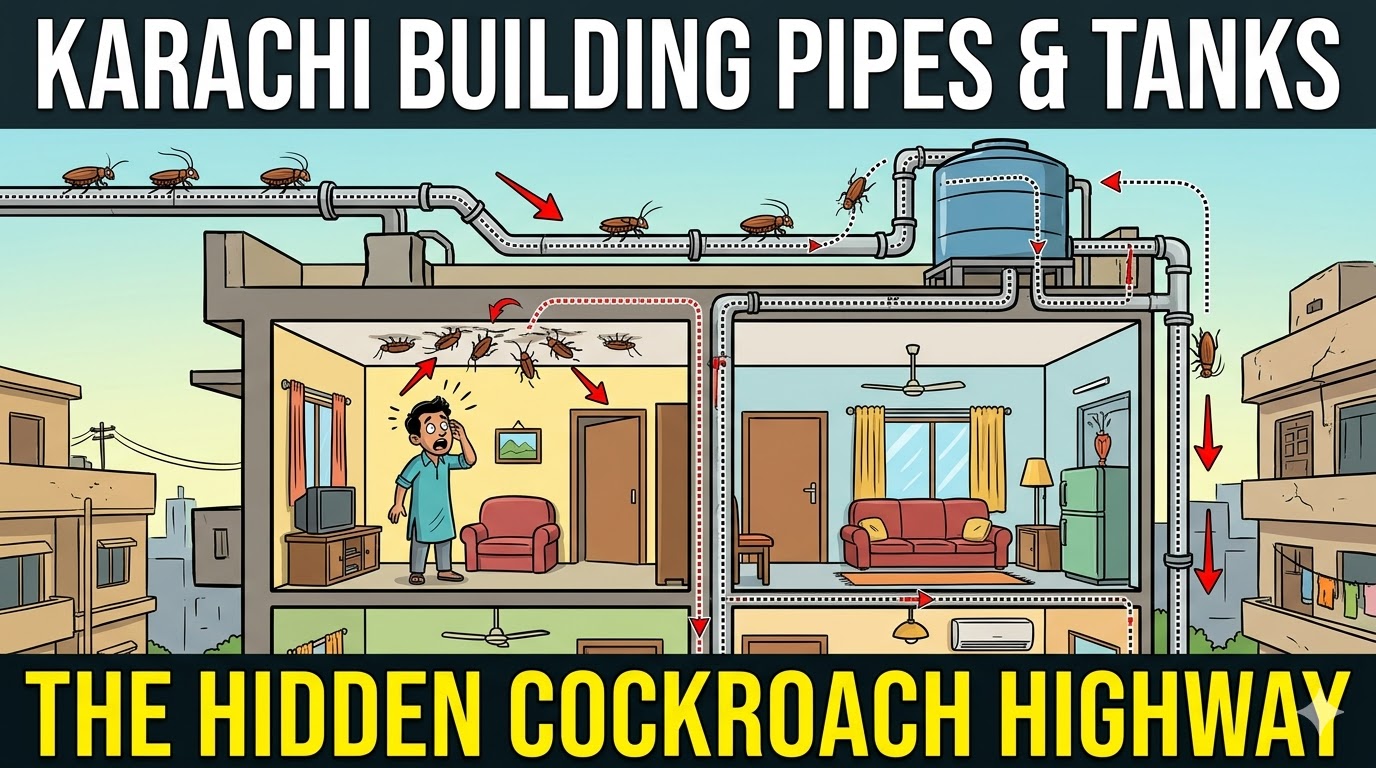
    Dripping pipes, slow drainage, and bathroom seepage create moisture hotspots inside walls. Termites detect these wet zones and use them as entry points. Ground-floor apartments and bungalows are especially at risk, but termites in Karachi are regularly found on upper floors as well — travelling through pipe ducts, electrical conduit paths, and party walls shared between units.

    The Silent Timeline: How a Colony Grows Inside Your Walls Year by Year

    Here is a realistic breakdown of what happens inside a Karachi home during a typical termite infestation:

    Year 1: Establishment Below Ground

    A queen and king termite — called “alates” — land near your home after a monsoon swarm, shed their wings, and burrow into soil near the foundation. The nest is established 30 to 60 cm below ground. No signs are visible. The colony has fewer than 1,000 members.

    Year 2: Probing the Foundation

    Workers begin extending foraging tunnels, reaching foundation walls. If there are any cracks, gaps around plumbing pipes, or poorly sealed expansion joints, workers enter the structure. They begin feeding on concealed timber elements — skirting boards, door frames, and sub-floor timbers if present. Still no external evidence. Colony size: 5,000 to 30,000.

    Year 3 to 4: Active Wall Infestation

    Termites build mud tubes along the inner surface of walls and begin hollowing out wooden elements systematically. In homes with false ceilings, they travel upward to wooden battens and POP framing. In older homes, they consume door architraves, window frames, and kitchen cabinetry. The outer paint or plaster remains intact. Colony size: 100,000 to 500,000.

    Year 5 and Beyond: Reproductive Expansion

    The colony produces winged reproductives (swarmers) that emerge — usually after the first monsoon rains — to establish new colonies nearby. Homeowners often see small, winged insects near light sources and mistake them for flying ants. This is the first visible sign most people notice, and by this point, the primary colony is enormous and the structural damage is already severe.

    The Warning Signs You Should Know — and Why Most Homeowners Miss Them

    Termites do leave signs, but these signs are subtle and easy to misinterpret without training. Here is what to look for:

    • Mud tubes on walls or near the base of walls: These pencil-thin brown tubes are how termites travel above ground. Check exterior and interior walls at ground level, especially in storage rooms, utility areas, and behind furniture.
    • Hollow sound when tapping wood: Use your knuckle to tap along door frames, skirting boards, and kitchen cabinets. A hollow, papery sound suggests the interior has been eaten away.
    • Bubbling or uneven paint: Paint that bubbles, blisters, or appears to have moisture beneath it on an interior wall can indicate termites building carton material just under the surface.
    • Discarded wings near window sills or light fixtures: Swarmers shed their wings immediately after landing. Small piles of translucent wings — often mistaken for insect litter — are a major warning sign.
    • Tight-fitting doors and windows: Termite activity generates heat and moisture that warps timber. If doors or windows that previously opened smoothly have become stiff or warped, this may be an early structural indicator.
    • Frass (termite droppings): Dry-wood termites push their droppings out of small holes. These look like tiny, hexagonal pellets or sawdust and appear near infested wood.

    The challenge is that in a busy Karachi household, these signs are often overlooked, attributed to moisture, or simply cleaned up without investigation. By the time homeowners grow concerned enough to call a professional, the infestation has typically been active for three to five years.

    What Areas of Your Home Are at Greatest Risk?

    Termites do not attack randomly — they follow moisture, wood, and structural gaps. The highest-risk areas in a typical Karachi home include:

    • Ground-floor walls adjacent to soil: Any wall that sits directly on or near the ground, especially in older homes without a damp-proof course (DPC), is highly vulnerable.
    • Bathroom and kitchen walls: Pipe leaks and condensation create sustained moisture that attracts termites into wall cavities.
    • Wooden door and window frames: These are often the first structural elements attacked, particularly in homes with solid wood frames.
    • False ceilings and POP work: Widely installed across DHA and Gulshan properties, false ceilings with wooden battens provide an ideal concealed environment for termites to spread horizontally across an entire floor.
    • Under stairs and inside storage cupboards: Dark, rarely disturbed spaces with contact to walls are prime infestation zones.
    • Behind fitted kitchen cabinets: Particularly in older kitchens where cabinets sit against external or ground-adjacent walls.

    Why Professional Detection Matters More Than DIY Inspection

    Many homeowners attempt self-inspection, but termite detection requires more than looking for obvious damage. A professional inspection involves:

    • Thermal imaging to detect heat anomalies behind walls that indicate termite activity
    • Moisture mapping to identify entry points and feeding zones
    • Probing and tapping across all suspect surfaces systematically
    • Inspection of subterranean entry points including expansion joints, plumbing ducts, and foundation cracks
    • Colony activity assessment to determine whether an infestation is new, established, or in an advanced stage

    If you suspect termite activity — or simply want peace of mind — professional termite treatment in Karachi begins with a thorough site inspection that identifies not just active infestations but structural vulnerabilities that could be exploited in the future.

    Prevention: Reducing the Risk Before Termites Establish

    While professional treatment is the only reliable solution for an active infestation, there are practical steps Karachi homeowners can take to reduce the risk of initial colony establishment:

    • Fix all plumbing leaks promptly — dripping pipes inside walls are among the most common termite attractants in urban Karachi homes.
    • Seal all cracks and gaps at the wall-floor junction, particularly on ground floors.
    • Avoid storing firewood, construction timber, or cardboard against exterior walls or inside enclosed spaces adjacent to walls.
    • Ensure proper drainage away from your home’s foundation — pooling water near walls creates the moisture conditions termites need.
    • If renovating or building new, insist on certified anti-termite pre-construction soil treatment before the slab is poured.

    For existing homes, annual inspections by a licensed pest control company are the single most effective preventive measure. A qualified team offering pest control services in Karachi will identify early-stage activity before it becomes a structural crisis.

    Frequently Asked Questions

    Can termites damage a concrete structure?

    Termites do not eat concrete, but they exploit any crack, gap, or joint in concrete to reach wooden elements inside walls and floors. Concrete structures in Karachi are not immune — the wood embedded within them (door frames, window frames, ceiling battens) is still fully at risk.

    How quickly can termites spread from one floor to another?

    In a multi-storey building, termites can travel from ground floor to upper floors within 12 to 18 months of establishing a large colony. They travel through pipe ducts, shared walls, and structural joints. In Karachi’s apartment buildings, termite infestations regularly spread across multiple units.

    Is it possible to have termites without seeing mud tubes?

    Yes. Termites living entirely within wall cavities, false ceilings, or subfloor structures may not construct visible mud tubes on accessible surfaces. This is why an inspection is the only reliable detection method.

    Do termites only affect old homes?

    No. New homes in Karachi are equally at risk if pre-construction treatment was not applied correctly. We have inspected homes less than three years old with active infestations. Soil conditions and construction quality are more important risk factors than age alone.

    Conclusion: The Damage Is Happening Right Now

    The most dangerous thing about termites in Karachi is not that they are destructive — it is that they are patient. By the time you see the damage, years of silent destruction have already occurred. Walls that look solid are hollow. Frames that appear intact are structurally compromised. Repairs that could have cost a few thousand rupees have grown into projects costing lakhs.

    The only protection is early detection. A professional inspection costs a fraction of what termite repair work costs — and it gives you something no wall inspection can: certainty.

    Book Your Free Termite Inspection Today
    Do not wait for the damage to become visible. Our licensed inspectors serve all major Karachi neighbourhoods — DHA, Clifton, Gulshan-e-Iqbal, PECHS, North Nazimabad, Bahria Town, Scheme 33, and more. We identify termite activity at every stage, provide a detailed inspection report, and recommend a customised treatment plan for your specific home.
    Contact Karachi Fumigation Services now to schedule your free inspection. The earlier we find them, the less they cost you.

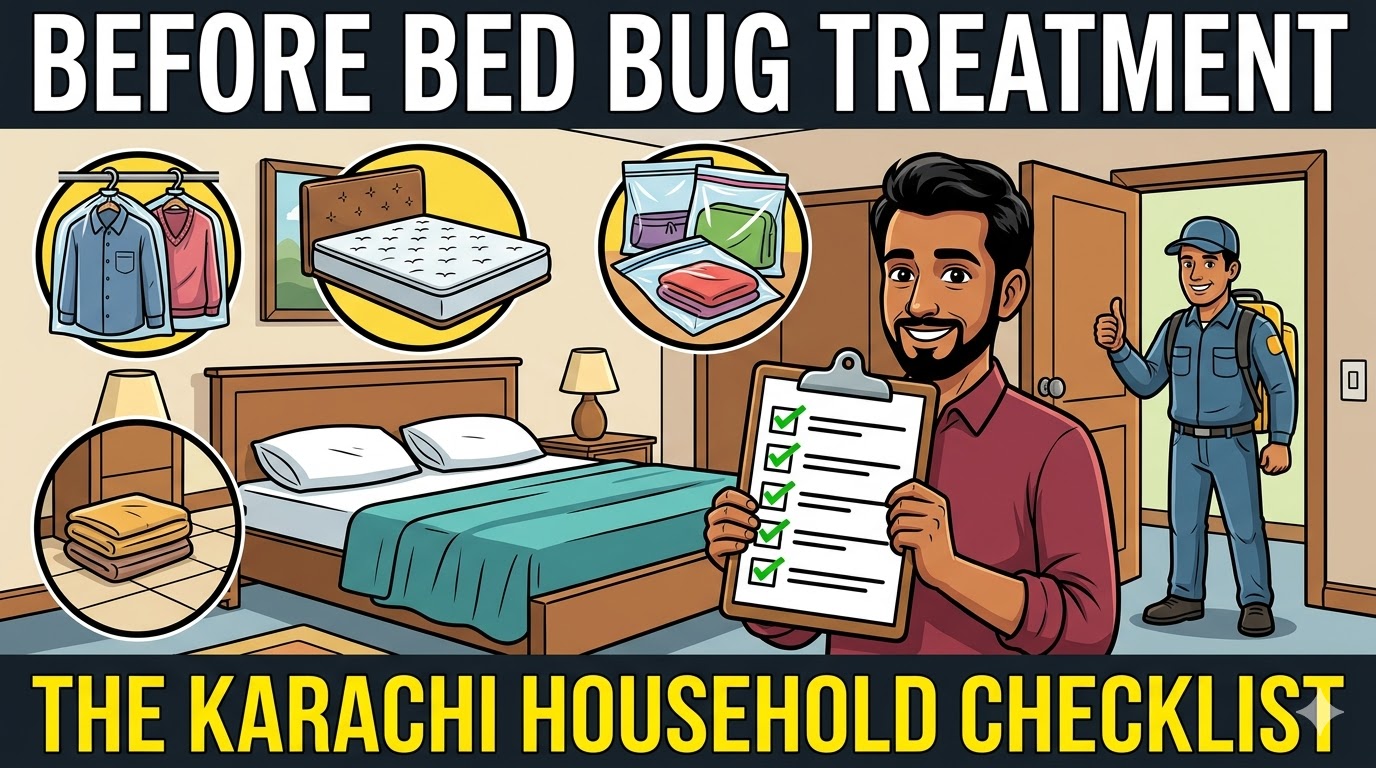
  • Bed Bug Treatment Preparation Checklist for Karachi Households

    Bed Bug Treatment Preparation Checklist for Karachi Households

    You’ve booked a professional bed bug treatment. You’ve taken the first and most important step. But how well your home is prepared on treatment day has a direct, significant impact on how effective the treatment will be.

    Many treatment failures in Karachi can be traced back to inadequate preparation — not inadequate products or untrained technicians, but a home that wasn’t ready for treatment. Clutter blocks chemical access. Undisturbed piles of clothing give bugs safe refuges. Furniture pushed against walls prevents treatment of critical areas.

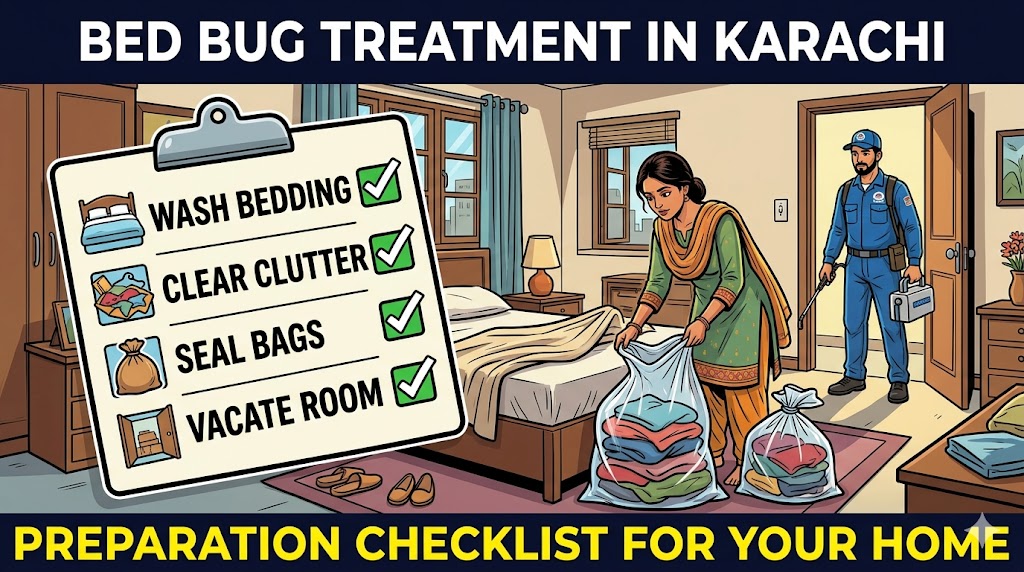
    This comprehensive checklist is designed for Karachi households. Use it to prepare every room that will be treated, completing each section the day before your treatment appointment.

    Why Preparation Matters So Much

    Professional-grade bed bug insecticides need direct contact or proximity to harborage sites to be effective. If a crack is blocked by a pile of books, or a wardrobe base is covered by shoes, treatment cannot reach the bugs hiding there.

    Proper preparation:

    • Ensures treatment reaches every harborage site
    • Reduces the number of bugs that escape treatment and seed a new population
    • Makes follow-up treatments more effective
    • Protects your belongings during and after treatment

    Think of it this way: a professional treatment is only as good as the access you give the technician.

    Bedroom Preparation Checklist

    Bedding and Linens

    • Strip all sheets, pillowcases, duvet covers, and blankets from the bed
    • Place them in sealed plastic bags immediately — do not carry them loosely
    • Wash on the hottest setting tolerable (60°C+) and dry on maximum heat
    • Store clean, dried bedding in sealed bags away from the treatment area — do not return to the bed until after treatment is complete and the room has been aired
    • Remove and bag all decorative cushions and pillow covers from the room

    Mattress and Bed Frame

    • Move the mattress away from the wall — your technician will need access to all sides and the base
    • If possible, stand the mattress upright against a clear wall so all surfaces are accessible
    • Move the bed frame away from the wall — there should be at least 30cm of clear access on all sides
    • Remove any items stored under the bed and wash, inspect, or seal them in bags

    Furniture and Storage

    • Empty all wardrobe and drawer contents — clothes and soft items should be washed and sealed in bags
    • Remove all items from shelving near the bed
    • Move furniture at least 30cm away from walls so skirting boards are fully accessible
    • Disassemble any bed frames that can be taken apart — this gives technicians access to internal joints
    • Remove all items from under sofas and chairs in the room

    Electrical and Wall Areas

    • Remove and bag any items hung on walls in the treatment area
    • Remove picture frames and mirrors near the bed and lean them against a cleared wall
    • Ensure electrical socket plates near the bed are accessible — technicians will need to treat behind these

    Living Room and Common Areas Preparation

    • Remove cushion covers from all sofas and chairs — wash and bag them
    • Move sofa cushions to allow access to the frame underneath
    • Clear the floor of rugs, mats, toys, and loose items
    • Move sofas and chairs away from walls
    • Remove items from shelving units near sleeping or resting areas
    • Clear coffee tables and side tables completely

    Kitchen and Non-Sleeping Areas

    Bed bugs don’t typically inhabit kitchens (there’s no host nearby), but if the infestation is heavy or the kitchen doubles as a sleeping area, the same principles apply. For standard treatments:

    • Cover and seal any exposed food and utensils — some products require this
    • Remove pet food and water bowls from the treatment area
    • Ensure pets are out of the treatment area and kept away for the duration specified by your treatment provider

    Clothing and Soft Items

    This is one of the most important and most overlooked preparation tasks. Clothing left in the treatment area during spraying may absorb chemical residuals — wash them before putting them back on. More importantly, unwashed clothing that has been in contact with infested areas can re-introduce bugs after treatment.

    • All clothing in the infested room should be washed on 60°C+ and dried on maximum heat
    • Sealed bags of laundered clothing should be stored outside the treatment area
    • Don’t return clothing to wardrobes until after treatment is complete and the room has been confirmed clear
    • Shoes from the infested area should be inspected — bugs can hide in shoes

    Children and Pets

    Safety during and after professional treatment:

    • Children and pets must vacate the treated area for the duration specified by your treatment provider — typically 2–4 hours for spray treatments
    • Children’s toys in the treatment area should be bagged and sealed
    • Ensure children’s room is prepared with the same thoroughness as the master bedroom if it is being treated
    • Aquariums should be covered and air pumps turned off during chemical treatment

    Day-of Checklist

    On the morning of your treatment:

    1. Confirm all preparation tasks are complete
    2. Ensure all family members and pets know when they need to leave the property
    3. Have a bag ready with essentials you’ll need while the treatment is drying (phones, medications, documents)
    4. Leave keys accessible for the technician if you won’t be home
    5. Note down any areas you weren’t able to prepare and inform the technician on arrival

    After Treatment: Important Instructions

    Your bed bug treatment provider in Karachi will give you specific post-treatment instructions. General guidelines include:

    • Stay out of treated areas for the time period specified by your technician
    • Do not vacuum treated surfaces for at least 2 weeks — this removes the chemical residual that continues killing newly hatched bugs
    • Do not wipe or mop treated surfaces
    • Keep windows closed for the first few hours after treatment to allow products to work
    • Report any continued activity to your treatment provider — this is what the follow-up visit is for

    A Note on Karachi-Specific Conditions

    In Karachi’s hot and humid climate, preparation is even more important than in cooler environments. The heat accelerates the bed bug life cycle, meaning freshly hatched nymphs emerge faster. Ensuring treatment reaches every possible harborage site reduces the chance of any surviving population restarting the cycle before the follow-up visit.

    Additionally, in Karachi apartment buildings, the shared wall cavities can harbour bugs from neighbouring units. If your building has a history of infestation across multiple flats, mention this to your treatment provider — it affects the treatment strategy.

    Download and Use This Checklist

    Print or save this checklist and work through it systematically the day before your treatment. Assign tasks to different family members if needed — preparation is a household effort, but it’s worth every hour it takes.

    Book Your Treatment — We Handle the Rest

    Our team provides complete guidance to Karachi homeowners before, during, and after professional bed bug fumigation. When you book with us, we send you a full preparation guide specific to your home’s layout and infestation scope. Book your free inspection today and we’ll walk you through exactly what needs to happen before treatment day.

  • What to Do the Night You Discover Bed Bugs in Your Karachi Home: A Step-by-Step Response

    What to Do the Night You Discover Bed Bugs in Your Karachi Home: A Step-by-Step Response

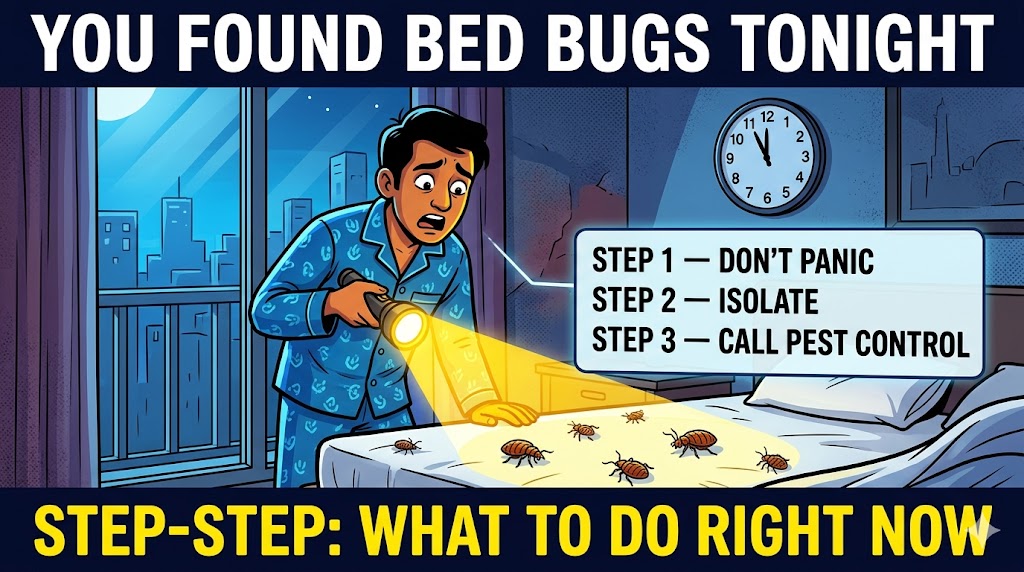
    It’s late at night. You’ve pulled back your mattress and found what you were hoping you wouldn’t find: the telltale dark spots, maybe a live bug, maybe both. Your stomach drops. What do you do right now, tonight?

    The decisions you make in the first few hours after discovering a bed bug infestation can significantly affect how quickly and completely it gets resolved. The wrong moves — panic reactions that seem logical but aren’t — can spread the infestation further and make professional treatment harder. The right moves contain the problem and set you up for successful elimination.

    This is your step-by-step guide for tonight.

    Step 1: Stay Calm and Don’t Panic Spray

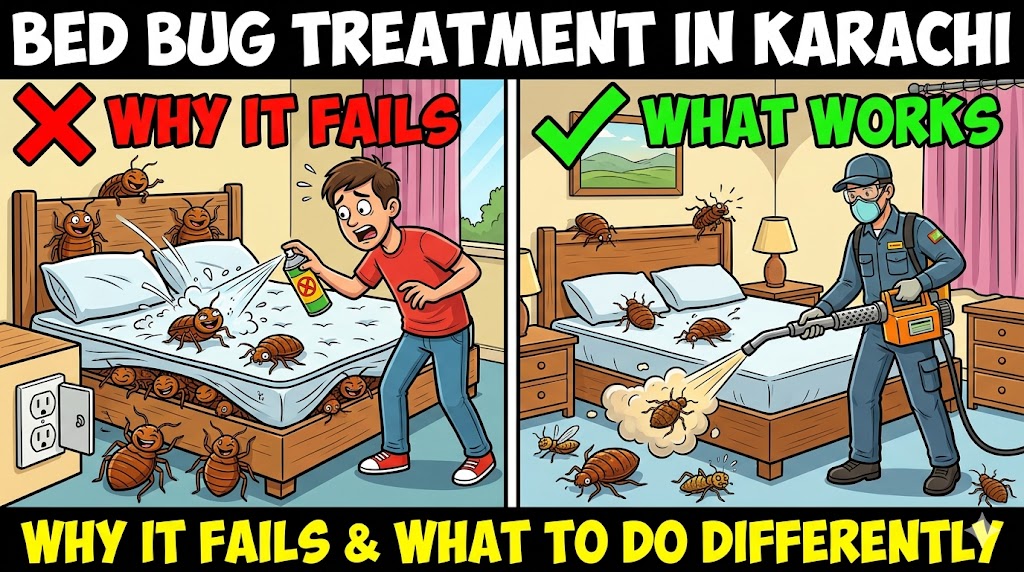
    The first instinct for many people is to grab a can of Mortein, Raid, or whatever insecticide is available and spray the mattress and surrounding area immediately. Resist this urge.

    Why? Because over-the-counter sprays used without a proper plan can cause bugs to scatter from their primary harborage area into the walls, other rooms, and other furniture. You might temporarily drive the infestation out of sight — but you’ll make professional treatment significantly more difficult and spread bugs that were previously concentrated in one area.

    Taking a breath and making smart decisions tonight is far more valuable than reactive spraying.

    Step 2: Do a Focused Inspection to Understand What You’re Dealing With

    Before you do anything else, take 20–30 minutes to properly inspect the area around the discovery. Use a bright torch and check:

    • All seams and folds of the mattress
    • The bed frame, headboard joints, and any screw holes
    • Behind the headboard if it’s wall-mounted
    • The nightstand drawers and joints
    • Electrical sockets on the wall near the bed

    The goal is to understand the rough extent of the infestation tonight — is it limited to one area, or have you found evidence in multiple locations? This information will be important when you call a professional tomorrow morning.

    Photograph everything you find. Dark spots on seams, shed skins, eggs, live bugs — photograph it all. This documentation helps the pest control team plan an effective treatment.

    Step 3: Contain — Do Not Spread

    This is the most important principle for tonight: do not move infested items to other rooms. This is the number one mistake Karachi homeowners make on discovery night.

    Do NOT do the following tonight:

    • Move the mattress to another room or to the balcony — bugs will travel off it and into new areas
    • Carry pillows, sheets, or clothing through the house in your arms — put them directly into sealed plastic bags first
    • Move furniture to a different room — satellite populations will spread
    • Go sleep in another room without first checking that room — you may be carrying bugs with you

    Step 4: Bag and Isolate Bedding

    What you should do with bedding tonight:

    1. Take all sheets, pillowcases, duvet covers, and pillows directly off the bed.
    2. Place them immediately into a sealed plastic bag — don’t carry them through the house loosely.
    3. If your washing machine is accessible tonight, run the bedding on the hottest setting the fabric allows (60°C or higher), followed by the highest heat dryer cycle.
    4. If washing isn’t possible tonight, keep the bags sealed until morning.
    5. Store the clean, dried bedding in a clean sealed bag until treatment is complete — don’t put it back on the mattress.

    Step 5: Vacuum the Immediate Area

    A thorough vacuum of the mattress, bed frame, and surrounding floor will remove many surface bugs, eggs, and shed skins. Important points:

    • Use a vacuum with a bag (not bagless) if possible — dispose of the bag immediately after in a sealed plastic bag placed outside your home
    • If using a bagless vacuum, empty the canister outside into a sealed bag immediately and clean the canister
    • Do not vacuum treated areas before your pest control team arrives — wait for guidance
    • Vacuum seams, folds, and cracks of the mattress thoroughly, as well as the floor around the bed, the bed frame, and the skirting boards

    Vacuuming doesn’t eliminate a bed bug infestation — but it reduces the immediate surface population and makes the environment cleaner for professional treatment.

    Step 6: Create a Barrier Around the Bed

    If you need to sleep tonight (and most people do), you can reduce exposure while you wait for professional treatment. Consider:

    • Moving the bed away from the wall on all sides so bugs can’t climb up via the wall
    • Placing each bed leg in a bed bug interceptor trap (a plastic cup with talcum powder, or commercially available interceptors) — bugs can’t climb the slippery surface
    • Ensuring no bedding is hanging to the floor — this creates a bridge for bugs to climb up

    These are temporary measures. They do not eliminate the infestation — they reduce your exposure while professional treatment is arranged.

    Step 7: Call a Professional First Thing Tomorrow Morning

    Tonight, you’ve stabilised the situation. Tomorrow morning, your first task is to contact a professional pest control service. When you call:

    • Describe where you found the evidence and how extensive it appeared
    • Mention whether you’ve seen live bugs, eggs, and dark spots
    • Share your photographs if the company has a WhatsApp or email
    • Ask about their inspection and treatment process, and specifically about follow-up visits
    • Ask how quickly they can come — for active infestations, within 24–48 hours is ideal

    Our team offers professional bed bug treatment across Karachi and can usually arrange an inspection within 24 hours of your call.

    What NOT to Do Tonight (Summary)

    To make this as clear as possible, here’s a quick list of things that will make your situation worse:

    • Spraying random insecticides — scatters bugs, may increase spread
    • Moving infested items to other rooms — spreads the infestation
    • Throwing away all furniture tonight — unnecessary (bugs can be treated) and you may carry bugs to the skip and then back inside on your clothes)
    • Sleeping in another room without precautions — you may carry bugs there
    • Waiting to see if it “gets better” — it won’t. Every day of delay is more eggs and more bugs.

    You’re Not Alone — This Happens More Than You Think

    Bed bug infestations are genuinely common in Karachi — across Defence, PECHS, Clifton, Gulshan, and every other neighbourhood. Dense housing, high humidity, and year-round warmth create ideal conditions for their spread. Finding them in your home is not a reflection of your cleanliness or how well you maintain your home.

    What matters now is the response: calm, systematic, and professional.

    Book Your Free Inspection Now

    Don’t wait through another sleepless night. Contact our fumigation services team in Karachi first thing tomorrow — or even right now if you prefer to WhatsApp us — and book your free bed bug inspection. Our team will assess your situation quickly, explain the treatment plan clearly, and get you on the road to a bug-free home as fast as possible.

  • Bed Bugs in Karachi Student Housing and Hostels: What Residents Need to Know

    Bed Bugs in Karachi Student Housing and Hostels: What Residents Need to Know

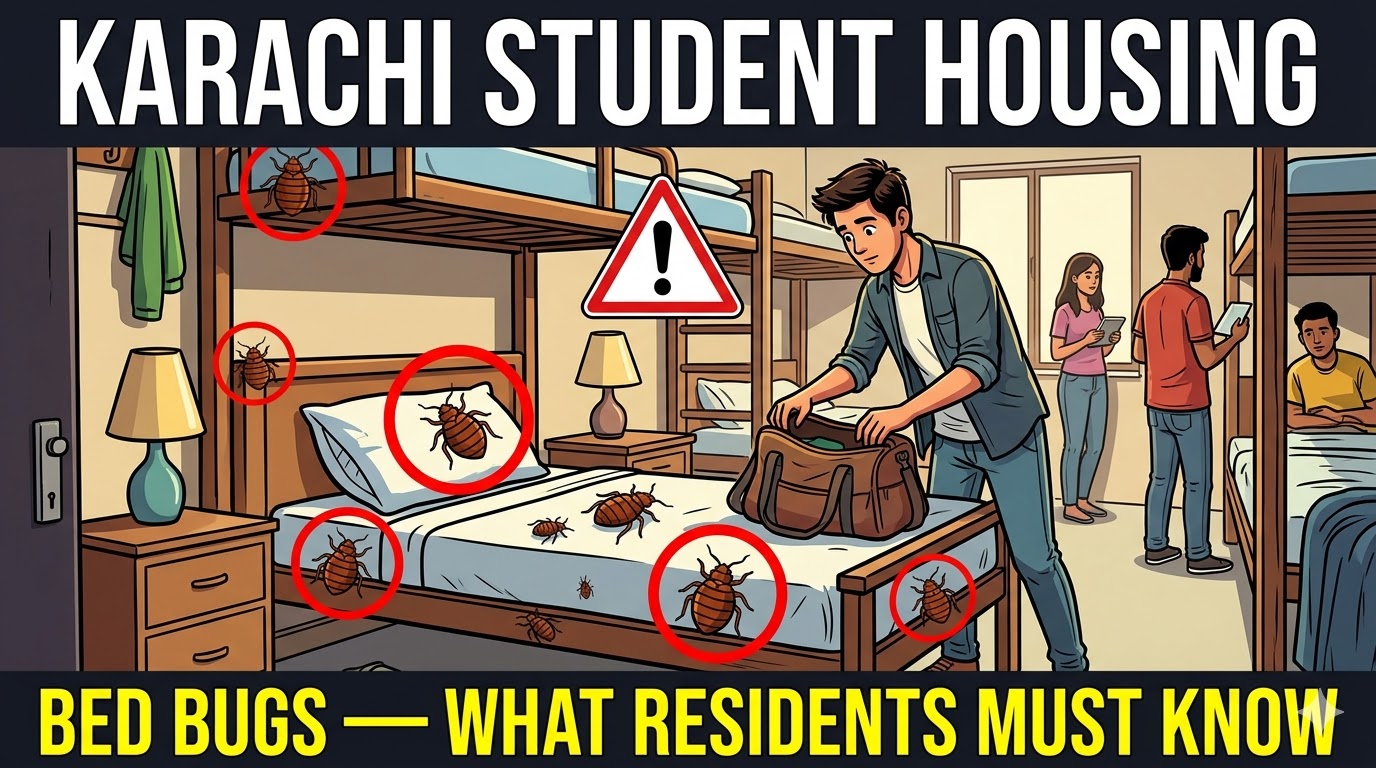
    If you’re living in a hostel or student accommodation in Karachi — near Karachi University, NED, IBA, SZABIST, LUMHS, or any of the city’s dozens of campuses — bed bugs are a risk you need to take seriously. Not because student housing is dirty or poorly managed, but because of the specific conditions that make shared accommodation the single highest-risk environment for bed bug infestations.

    Students move in and out constantly. Luggage travels from home to hostel and back. Secondhand furniture gets shared. Bunk beds are close together. Room inspections are infrequent. These factors combine to create near-perfect conditions for bed bugs to establish and spread rapidly.

    This guide is for students, hostel wardens, parents of students, and anyone managing shared accommodation in Karachi. Understanding the risk is the first step to protecting yourself.

    Why Hostels and Student Housing Are High-Risk

    Constant Turnover of Residents

    Bed bugs spread by travelling on luggage, clothing, and personal items. When students return from semester breaks, weekends at home, or trips to other cities, they can unknowingly bring bed bugs back with them. In a hostel where 10, 20, or 50 people are moving in and out of the same space throughout the academic year, the chances of introduction are extremely high.

    Shared and Secondhand Furniture

    Many hostels in Karachi use mattresses and furniture that have been in service for years, shared across many students. Even a single prior infested mattress that wasn’t treated correctly can harbour eggs in the seams that will hatch months later. Students buying or borrowing secondhand furniture from markets in Saddar, Empress Market, or from departing seniors are at particular risk.

    Close Sleeping Quarters

    Bed bugs find hosts by following warmth and carbon dioxide. In a room with multiple bunk beds, all sleeping areas are within easy reach of a bug population. A single infested bed can seed the entire room within weeks.

    Delayed Reporting

    Students often delay reporting bites or visible bugs out of embarrassment, uncertainty about what they’re dealing with, or not wanting to cause disruption. By the time a hostel management team is informed, the infestation has typically had weeks or months to spread through multiple rooms.

    How to Identify Bed Bugs in Your Hostel Room

    You don’t need to see a live bug to confirm an infestation — though you might. Here’s what to look for:

    • Rust-coloured stains on bedding: These are dried blood spots left when a fed bug is crushed or when it defecates. Check the mattress, sheets, and pillow cases.
    • Dark spots on mattress seams: Bed bug droppings look like small dark ink dots, usually along mattress folds, seams, and in the bed frame joints.
    • Shed skins: Nymphs shed their outer skin (exoskeleton) five times as they grow. These translucent, yellowish husks collect in hiding spots.
    • Eggs: Tiny (1mm), white, and oval-shaped, usually stuck to surfaces in batches along seams.
    • Live bugs: About the size and shape of an apple seed when unfed — flat, oval, reddish-brown. After feeding they become darker and more rounded.
    • Bites: Typically appear in lines or clusters on exposed skin — arms, legs, neck, face. They itch intensely but are not always felt at the time of the bite.

    Check especially: mattress seams and tufts, the underside of the box spring or platform, behind the headboard, along the bed frame, behind electrical sockets near the bed, and in the folds of any stuffed furniture.

    What to Do Immediately If You Find Bed Bugs

    Finding bed bugs in your room does not mean you have failed at hygiene. It means a pest that is extremely good at hitchhiking found its way to your space. Act quickly and systematically:

    1. Report to hostel management immediately — don’t delay out of embarrassment. The sooner management knows, the sooner the entire affected area can be treated.
    2. Do not move your belongings to another room — this will spread the infestation. Stay put until treatment is arranged.
    3. Bag all bedding, clothing, and soft items in sealed plastic bags — wash them on the highest heat setting your fabrics can tolerate, then dry on high heat.
    4. Vacuum the mattress, bed frame, and floor carefully — dispose of the vacuum bag in a sealed plastic bag outside the building.
    5. Do not self-treat with sprays from a general store — these are almost never effective against a true infestation and may cause bugs to scatter further.

    For Hostel Management: What a Proper Response Looks Like

    If you manage student accommodation in Karachi, a confirmed bed bug sighting should trigger the following response:

    1. Inspect the Entire Floor, Not Just the Reported Room

    Bed bugs spread through wall voids, under door gaps, and via shared items. Assume the infestation extends beyond the room where it was first found. Inspect all adjacent rooms immediately.

    2. Engage a Professional Service Immediately

    Do not attempt to resolve a hostel-level infestation with generic sprays purchased from a shop. The scope, the life cycle management, and the need for follow-up treatments require a professional approach. Delays allow the population to grow.

    3. Communicate Clearly with Residents

    Students who know there is a treatment happening are more likely to prepare their belongings properly, which directly improves treatment efficacy. Secrecy is counterproductive.

    4. Schedule Mattress Inspection and Replacement Where Necessary

    Some mattresses in long-term use are too heavily infested to treat economically. Professional advice on which mattresses to replace versus treat is valuable.

    5. Establish a Re-inspection Schedule

    After treatment, a follow-up inspection 2 weeks later, and again at 4–6 weeks, is essential. One treatment is rarely sufficient.

    Prevention: How Students Can Protect Themselves

    You can’t fully control what happens in a shared building, but you can reduce your personal risk significantly:

    • When moving into a new room, inspect the mattress and bed frame before sleeping in it
    • Store luggage off the floor — use luggage racks or hang bags when possible
    • When returning from travel or a visit home, inspect your bag before bringing it into your room
    • Avoid secondhand mattresses, upholstered furniture, and bedding
    • If buying used furniture from Saddar or other markets, inspect thoroughly and consider steam-cleaning before use
    • Use a mattress encasement cover — this traps any bugs inside the mattress and makes it easier to detect activity

    What Parents Should Know

    If your child is living in student accommodation in Karachi, bed bugs are a real and common risk. If they report bites or mention bugs, take it seriously and support them in escalating to hostel management. Delayed action results in a larger infestation that is harder to treat.

    Professional bed bug removal services in Karachi can be arranged for both hostels and individual rooms. If hostel management is unresponsive, parents can arrange an inspection directly.

    Book a Free Inspection for Your Hostel or Student Room

    Whether you’re a student dealing with an active infestation, a parent concerned about your child’s accommodation, or a hostel manager who needs a reliable professional response — we’re here to help. Pest control services in Karachi from our team cover all types of shared accommodation, with discreet, thorough treatment that protects every resident. Book your free inspection today and let us handle the problem the right way.

  • How Long Does a Bed Bug Infestation Take to Clear Completely in a Karachi Flat?

    How Long Does a Bed Bug Infestation Take to Clear Completely in a Karachi Flat?

    This is one of the first questions Karachi homeowners ask after they’ve identified a bed bug problem and started treatment: How long is this going to take? When will I know it’s actually over?

    There is no universal answer, because the timeline depends on several factors specific to your situation. But there are clear benchmarks and expected timeframes you can plan around, and understanding them will help you stay patient, stay vigilant, and know when to be concerned that treatment isn’t working.

    This guide gives you a realistic, honest picture of what to expect during and after bed bug treatment in Karachi’s conditions.

    The Short Answer

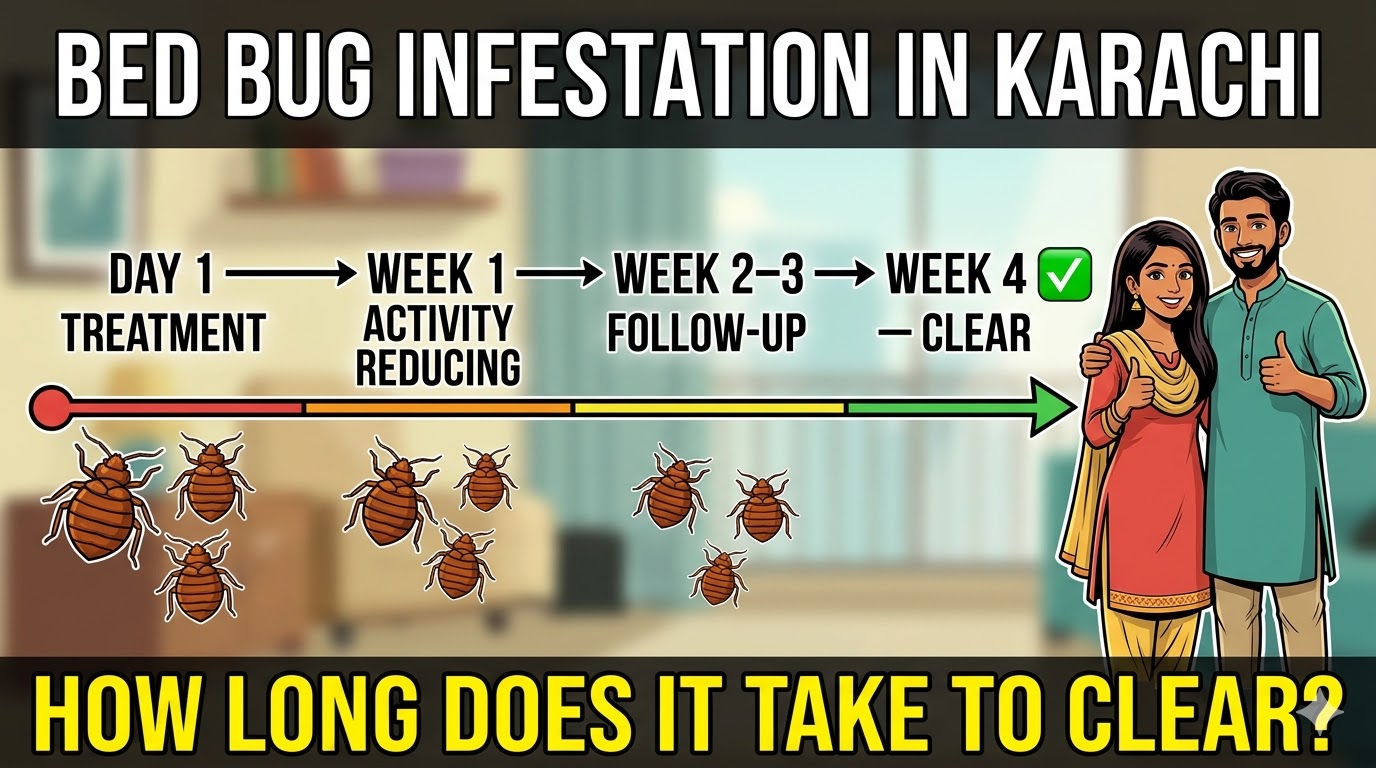
    For a moderate infestation in a standard Karachi flat — treated professionally with a multi-visit protocol — most homeowners see a significant reduction in activity within 2 weeks of the first treatment, and complete elimination within 4–8 weeks including follow-up visits. Severe infestations or those that have spread to multiple rooms or multiple units in a building can take longer.

    If you are still seeing active bugs or getting new bites after 8 weeks of proper professional treatment, something in the treatment protocol needs to be reviewed.

    Why It’s Never Instant: The Life Cycle Factor

    Understanding why bed bug elimination takes weeks rather than days requires understanding the life cycle — specifically, the egg stage.

    A female bed bug lays 1–5 eggs per day, cementing them into cracks and seams. Most professional insecticides are highly effective against adult bugs and nymphs but significantly less effective against eggs. Even a thorough first treatment will leave surviving eggs that will hatch within 6–10 days at Karachi room temperatures.

    This is not a treatment failure — it is a biological reality that professional pest controllers account for. It is why the follow-up visit, scheduled at 10–14 days after the first treatment, is essential. The follow-up targets newly hatched nymphs before they reach reproductive maturity (which takes 5–6 weeks), breaking the cycle.

    This is why single-visit treatments almost always fail: they kill the adults but leave the eggs, and the cycle restarts.

    Week-by-Week: What to Expect After Professional Treatment in Karachi

    Days 1–3: Increased Activity (Normal and Expected)

    Immediately after chemical treatment, it’s common to see more bed bugs than before — sometimes significantly more. This is not a sign that treatment failed. The disturbance and chemical residual causes bugs to emerge from their harborage sites, become more visible, and in many cases die on treated surfaces.

    Do not call the pest control company in a panic on day two. This is a normal part of the treatment process.

    Days 4–10: Declining Activity

    The number of bugs you see (and the frequency of bites) should begin declining noticeably within a week. The residual chemical continues killing bugs as they come into contact with treated surfaces. You may still see occasional bugs during this period — this is normal.

    Days 10–14: The Critical Follow-Up Window

    This is when the follow-up treatment should happen. Eggs laid before the first treatment are now hatching. If you have engaged a professional bed bug treatment service in Karachi that follows a proper protocol, your technician will return at this point for the second application, targeting newly hatched nymphs.

    Skipping this visit because things seem “much better” is a common mistake. The infestation is not over yet — it’s in a vulnerable window.

    Weeks 3–4: Major Reduction

    After the second treatment, activity should drop to near zero. You should not be experiencing regular bites. If you do see occasional bugs, they are likely stragglers from harborage areas that were partially missed — not a sign of reinfestation.

    Weeks 5–8: Confirmation Period

    Continue monitoring using active interceptor traps placed under bed legs. Check these every few days. If the traps remain empty for 4–6 consecutive weeks after the last treatment, combined with no new bites and no visible evidence, the infestation can be considered cleared.

    Week 8+: Third Treatment (If Needed)

    For severe infestations, or those that had spread to multiple rooms, a third treatment may be warranted. Your pest control provider should assess at the week 4–6 mark whether a third visit is necessary.

    Factors That Extend the Timeline in Karachi

    Several factors specific to Karachi conditions can extend the clearance timeline:

    Karachi’s Year-Round Warmth Accelerates Egg Hatching

    In cooler climates, eggs may take up to 21 days to hatch. In Karachi’s warm conditions (24–32°C year-round in most flats), hatching can occur in as little as 6 days. This compresses the window between first and second treatment — if your follow-up visit is delayed beyond 14 days, a new generation may already be developing.

    Re-infestation From Neighbouring Units

    In dense apartment buildings in areas like Nazimabad, Liaquatabad, Federal B Area, and Orangi Town, treatment of a single flat may be undermined by continuous re-entry of bugs from neighbouring units through wall voids and shared infrastructure. If you’re experiencing recurring infestations despite proper treatment, the building as a whole may need to be addressed.

    Missed Harborage Sites

    If treatment didn’t reach all harborage sites — particularly wall voids, inside electrical fittings, or deeply embedded in heavy furniture — surviving populations can restart the infestation. This is why professional inspection quality matters as much as the quality of the products used.

    Inadequate Preparation

    Homes that were not properly prepared before treatment (cluttered floors, furniture against walls, unsealed clothing) will have more surviving populations post-treatment, extending the timeline.

    How to Monitor Progress During Treatment

    Don’t rely solely on bites to monitor progress. Use these methods:

    • Bed leg interceptor traps: Place these under all four legs of the bed. Check weekly. Declining trap counts are a reliable indicator of progress.
    • Visual inspection of mattress seams: Check every 3–5 days. Declining evidence (fewer fresh dark spots) indicates the population is reducing.
    • White cloth test: Once a week, run a damp white cloth along the mattress seams and bed frame — any bugs, eggs, or dark material will transfer to the cloth.
    • Keep a log: Note dates, number of bugs seen, trap catches, and whether you experienced bites. This log helps your treatment provider make informed decisions about follow-up strategy.

    When Should You Be Concerned?

    Contact your pest control provider if:

    • You are still experiencing frequent bites more than 3 weeks after the first treatment
    • You are seeing live bugs in large numbers more than 2 weeks after treatment
    • Activity appears to be increasing rather than declining
    • New harborage sites have been discovered that weren’t treated initially

    A good pest control company will want to know this information and will respond with a plan — not dismiss your concerns.

    When Is It Truly Over?

    Bed bug elimination is confirmed when:

    • No live bugs or eggs are found during a thorough inspection
    • Interceptor traps have been empty for 4–6 consecutive weeks
    • No new bites have occurred for at least 3–4 weeks
    • A professional re-inspection (recommended) confirms no activity

    Do not remove interceptor traps or fully relax vigilance after just 2 weeks of no activity. The 4–6 week monitoring window exists specifically because the life cycle allows for slow-developing eggs to hatch late.

    A Realistic Summary

    For most Karachi homeowners with a moderate infestation caught reasonably early:

    • Significant relief after first treatment: 1–2 weeks
    • Follow-up treatment: 10–14 days after first treatment
    • Near-complete elimination: 4–6 weeks after treatment begins
    • Confirmed clearance: 6–8 weeks after treatment begins

    For severe infestations or building-wide problems, plan for 8–12 weeks of monitoring.

    Start the Clock — Book Your Treatment Today

    The sooner treatment begins, the shorter the total timeline to a bug-free home. Every week of delay is more eggs, more bugs, and a longer road to resolution. Contact our team for a free inspection and let us begin the process of clearing your Karachi flat of bed bugs with a protocol that’s built for your specific situation. Reach us through Karachi Fumigation Services — professional pest control delivered with honesty and accountability.

  • The Real Reason Bed Bug Treatments Fail in Karachi Flats — And What to Do Differently

    The Real Reason Bed Bug Treatments Fail in Karachi Flats — And What to Do Differently

    You called a pest control team. They sprayed. You thought the problem was over. Then, two weeks later, the bites started again.

    If this sounds familiar, you are not alone. Failed bed bug treatments are one of the most common complaints among Karachi homeowners — and the frustration is completely understandable. You spent money, you prepared your home, and the problem came back. What went wrong?

    The answer is almost never “bed bugs are impossible to kill.” The answer is almost always that the treatment was insufficient — either in method, in scope, or in follow-up. Understanding why treatments fail is the first step to making sure your next one succeeds.

    Reason 1: Only the Surface Was Treated

    The most common failure in Karachi flat treatments is surface-only application. A technician sprays the mattress, maybe the skirting boards, and leaves. This approach misses the vast majority of the infestation.

    Bed bugs do not live in the open. They hide in:

    • Cracks in bed frames and headboards
    • Inside the joints of sofas, chairs, and wooden furniture
    • Behind electrical sockets and light switch plates
    • Inside wall voids and behind skirting boards
    • Under carpets and beneath flooring edges
    • Inside wardrobes, between clothes, and in cardboard boxes
    • In ceiling-to-wall junctions in heavy infestations

    If treatment doesn’t reach these locations — with the right product, at the right concentration — the bugs simply retreat deeper, wait for the chemical residual to break down, and repopulate. In Karachi’s humid climate, insecticide residuals degrade faster than they would in cooler, drier environments, making thorough coverage even more critical.

    Reason 2: Eggs Were Not Addressed

    This is the single most technically important reason treatments fail, and the one most homeowners don’t know about.

    Bed bug eggs are covered in a protective coating that makes them significantly more resistant to insecticides than adult bugs. A treatment that kills every adult and nymph in your flat today will leave a population of eggs completely untouched. Those eggs hatch within 6–10 days at Karachi room temperatures, and the cycle restarts.

    Effective bed bug treatment protocols account for this. They:

    • Use products with ovicidal (egg-killing) properties or physical action (heat, desiccants)
    • Schedule mandatory follow-up treatments 10–14 days after the initial treatment to kill newly hatched nymphs before they reach reproductive maturity
    • Combine treatment methods to cover the full life cycle

    A single-visit treatment that only uses one type of chemical insecticide will almost certainly fail. If a pest control company doesn’t mention a follow-up visit as part of their protocol, that is a major warning sign.

    Reason 3: The Infestation Had Spread Beyond the Bedroom

    Many Karachi households discover bed bugs in the master bedroom and treat only that room. This is another common failure point.

    By the time a bed bug infestation is large enough to be noticed, it has typically already spread. Bugs follow the carbon dioxide exhaled by sleeping humans — but they also spread through:

    • Shared walls between flats in the same building
    • Children carrying bugs from the bedroom to other sleeping areas
    • Guests or family members bringing bugs in from treated rooms on clothing
    • Furniture moved between rooms before treatment

    In Karachi’s dense apartment buildings — particularly in areas like Gulshan-e-Iqbal, North Karachi, Liaquatabad, and Orangi Town where families live in close quarters — it is not uncommon for an infestation to span multiple units in the same building. Treating one flat while the adjacent unit remains infested almost guarantees re-infestation.

    Reason 4: The Wrong Products Were Used

    The pest control market in Karachi is not uniformly regulated, and product quality varies widely. Some operators use:

    • Generic agricultural pesticides not formulated for indoor bed bug use
    • Heavily diluted concentrations that are insufficient to achieve efficacy
    • Products to which local bed bug populations have developed resistance
    • Single-mode-of-action chemicals that kill on contact but leave no residual effect

    Professional-grade bed bug treatments use a combination of contact insecticides, residual sprays, and in some cases insect growth regulators (IGRs) that prevent nymphs from reaching reproductive maturity. This multi-pronged approach is far more effective than a single chemical class.

    Reason 5: Inadequate Preparation by the Homeowner

    Even the best treatment will underperform if the home wasn’t properly prepared. Common preparation failures that compromise treatment:

    • Leaving clutter on floors and under beds — this gives bugs places to hide that treatment can’t penetrate
    • Not removing items from wardrobes so they can be treated
    • Failing to wash and dry bedding before (or immediately after) treatment
    • Re-entering treated rooms too quickly and disturbing chemical residuals
    • Not vacuuming thoroughly before treatment to remove shed skins and debris

    A good pest control company will provide you with a detailed preparation checklist before treatment day. If they don’t, ask for one — it’s a sign of professionalism.

    Reason 6: The Technician Wasn’t Specifically Trained for Bed Bugs

    General pest control and bed bug treatment are not the same skill set. A technician experienced with cockroaches or rodents may not have the specific training to identify bed bug harborage sites, understand the life cycle implications for treatment timing, or know which chemical combinations are effective for this particular pest.

    When choosing a service provider, ask specifically: Do your technicians have dedicated training and experience in bed bug treatment? How many bed bug cases have you handled in Karachi? What is your protocol for follow-up visits?

    What a Proper Bed Bug Treatment in Karachi Looks Like

    A treatment that is genuinely effective against bed bugs in a Karachi flat will typically include:

    1. Thorough inspection first: Identifying the extent and location of the infestation before any product is applied.
    2. Preparation guidance: Written instructions for the homeowner to prepare the property properly.
    3. Multi-product application: Combining contact killers, residual insecticides, and potentially desiccant dusts in cracks and voids.
    4. Full-room treatment: Not just the mattress — every room, every piece of furniture, every crack.
    5. Scheduled follow-up: A second visit at 10–14 days to address newly hatched nymphs.
    6. Post-treatment advice: Guidance on what to monitor for and when to call back if activity continues.

    This is the standard our team follows with every bed bug fumigation service in Karachi. It’s why our clients don’t call us a second time for the same infestation.

    What to Do If a Previous Treatment Failed

    If you’ve already had a treatment that didn’t work, here’s how to move forward:

    • Don’t assume the problem is worse than it is — assess the current situation with a fresh inspection
    • Be honest with the new service provider about what was treated before and what products were used
    • Ask specifically about their follow-up protocol and what guarantees they offer
    • Prepare your home more thoroughly this time — use the full checklist
    • Consider treating the whole flat, not just the affected room, to eliminate satellite populations

    Book a Free Inspection — Get It Right This Time

    If a previous treatment hasn’t solved your bed bug problem, it’s time to work with a team that understands what effective treatment actually requires in Karachi’s specific conditions. Contact Karachi Fumigation Services today to book a free inspection. We’ll assess your situation honestly, explain exactly what needs to be done, and give you a clear treatment plan — no shortcuts, no repeat failures.

  • Why Karachi’s Building Water Tanks and Overhead Pipes Are a Hidden Cockroach Highway

    Why Karachi’s Building Water Tanks and Overhead Pipes Are a Hidden Cockroach Highway

    When most Karachi homeowners think about cockroach entry points, they picture open drains, kitchen gaps, or bathroom cracks. Very few look up. Yet one of the most significant — and most consistently overlooked — pathways for cockroach movement in Karachi’s residential and commercial buildings runs directly overhead: through the network of water storage tanks, overhead supply pipes, and rooftop plumbing infrastructure that almost every building in the city relies on.

    Understanding how cockroaches exploit this vertical infrastructure is essential for any homeowner serious about controlling infestations — because as long as these pathways remain open, even the most thorough ground-level treatment will only produce temporary results.

    Karachi’s Water Storage Reality

    Unlike cities with high-pressure municipal supply, the majority of Karachi’s residential buildings depend on overhead water tanks — typically installed on rooftops or elevated platforms — to store and distribute water throughout the day. Water is pumped from underground reservoirs or tankers into these tanks, which then gravity-feed the building below through a network of pipes running inside walls, under floors, and through ceiling voids.

    This infrastructure is practical. But from a pest control perspective, it creates an interconnected warm, moist, sheltered network that extends from the rooftop to every floor of the building — and cockroaches are extremely well-adapted to exploit exactly these kinds of environments.

    Why Cockroaches Are Attracted to Water Infrastructure

    Cockroaches have three core survival requirements: warmth, moisture, and food. Water pipes and storage tanks consistently provide the first two — and in most Karachi buildings, the third is never far away.

    Specifically, cockroaches are drawn to water infrastructure because:

    • Condensation on pipes provides a reliable water source in otherwise dry areas
    • Pipe lagging (insulating foam wrap) offers warm, undisturbed hiding and nesting space
    • Gaps where pipes enter walls or floors create direct access to concealed internal spaces
    • Water tanks collect organic debris — algae, sediment, dead insects — that serves as a food source
    • The dark, enclosed environment around overhead tanks is rarely inspected or disturbed

    In older Karachi buildings — particularly in areas like Saddar, Liaquatabad, New Karachi, and parts of Gulshan-e-Iqbal — where pipe fittings have degraded and tank seals have deteriorated over decades, these access points are even more pronounced.

    How Cockroaches Travel Vertically Through a Building

    Most people think of cockroaches as floor-level creatures. They are not. German cockroaches and American cockroaches — both extremely common in Karachi — are capable climbers and will readily move vertically through a building using:

    • Pipe chases (the vertical shafts in which plumbing runs between floors)
    • The exterior surface of supply pipes that pass through ceiling and floor penetrations
    • Gaps around where pipe brackets are fastened to walls
    • Ventilation gaps in water tank housing structures
    • Open access hatches on rooftop tank enclosures

    A cockroach that enters a ground-floor drain can, within a single night, travel through the building’s internal pipe infrastructure and emerge on the third or fourth floor — directly behind a kitchen cabinet or underneath a bathroom sink. This is why infestations in Karachi apartments so frequently appear to materialise from nowhere, even in units where the occupants maintain clean habits.

    The Rooftop Tank: A Nesting Site Above Your Head

    Rooftop water tanks in Karachi are among the most problematic cockroach hotspots in the city, yet they receive almost no pest control attention. Consider the typical conditions:

    • The tank enclosure is dark and undisturbed for months or years at a time
    • Moisture from condensation and minor overflows creates ideal humidity
    • Organic material accumulates in corners and on surfaces
    • Pipe entry points are rarely sealed
    • The structural warmth of a rooftop absorbs and retains heat throughout the night

    An established cockroach colony in a rooftop tank enclosure can number in the hundreds. From this central hub, individuals disperse down through the building’s pipe infrastructure each night, reaching multiple floors and multiple units. No amount of ground-floor treatment will resolve an infestation that is being replenished from above.

    Overhead Pipes Inside Walls: The Invisible Highway

    Beyond the rooftop tank, the internal pipe runs within the walls themselves represent a continuous hidden tunnel system. In most Karachi residential construction, pipes are chased directly into masonry walls with gaps that are plastered over rather than properly sealed. Over time, as plaster cracks and fittings loosen, these gaps reopen and provide access.

    The interior of a wall cavity adjacent to a water pipe is often 5 to 10 degrees warmer than the surrounding wall, slightly humid from pipe condensation, and completely dark. This is essentially a customised cockroach habitat running the full height of your building. A population established in these cavities is inaccessible to surface sprays, aerosol treatments, and standard bait placement — making professional intervention with appropriate formulations a necessity, not an option.

    What This Means for Multi-Storey Buildings in Karachi

    If you live in a multi-storey apartment building — as a large proportion of Karachi residents do — the pipe and tank infrastructure problem is compounded significantly. Shared plumbing means that cockroach movement is not just vertical within your unit; it is lateral across the building, connecting your apartment to every other unit that shares the same pipe infrastructure.

    This is why professional cockroach control in Karachi for apartment buildings must address common areas, pipe shafts, rooftop infrastructure, and individual units as a coordinated system — not as isolated treatments applied unit by unit.

    Signs That Your Pipes and Tank Are Part of the Problem

    Look for these indicators that overhead and pipe infrastructure is contributing to your cockroach infestation:

    • Cockroaches appearing on upper floors even after ground-level treatment
    • Cockroaches found near ceiling-height areas, behind high cabinets, or inside overhead storage
    • Sightings near pipe exits behind sinks, toilets, or appliances
    • Cockroach activity reappearing 2 to 4 weeks after a spray treatment — suggesting reinfestation from above
    • Faecal spotting near pipe penetration points in walls or floors

    Any of these patterns points to a vertical infestation pathway that standard surface treatments will not resolve.

    Practical Steps Homeowners Can Take

    While professional treatment is necessary to fully address this problem, homeowners can take some immediate steps to reduce access:

    • Seal visible gaps around pipe entry and exit points using appropriate filler or expanding foam
    • Ensure rooftop tank enclosures are kept closed and properly latched
    • Request that building management inspect and seal pipe chases in common areas
    • Avoid storing food directly beneath overhead pipes where drip contamination could occur
    • Have water tanks cleaned and inspected annually for pest activity

    These measures reduce but do not eliminate the problem. An existing colony in the pipe infrastructure requires targeted professional treatment to eradicate.

    Book a Free Inspection — Including Overhead Infrastructure

    Our team specialises in identifying and treating the complete cockroach pathway in Karachi buildings — not just the surfaces you can see. We assess rooftop tanks, pipe shafts, internal wall cavities, and every other access point that cockroaches exploit.

    As one of the leading pest control services in Karachi, we bring the expertise and equipment to treat your building’s full vertical infrastructure. Contact us today to book your free inspection and find out exactly where your cockroach problem is coming from.